
I am a Historian of the History of Natural History, or a Stáir ar Stáir an Nádúir in Irish. This means that I study how animals and plants were understood by naturalists in the past, in my case during the mid-1500s, or what I like to call the Late Renaissance. Central to all of this is the fact that the animals I study are all from the Americas, so they were brand new to the French and Swiss naturalists whom I study. In a sense then, natural history seeks to provide a history on human terms for nature. It seeks to bring something so vast as nature down to our level and make it familiar.
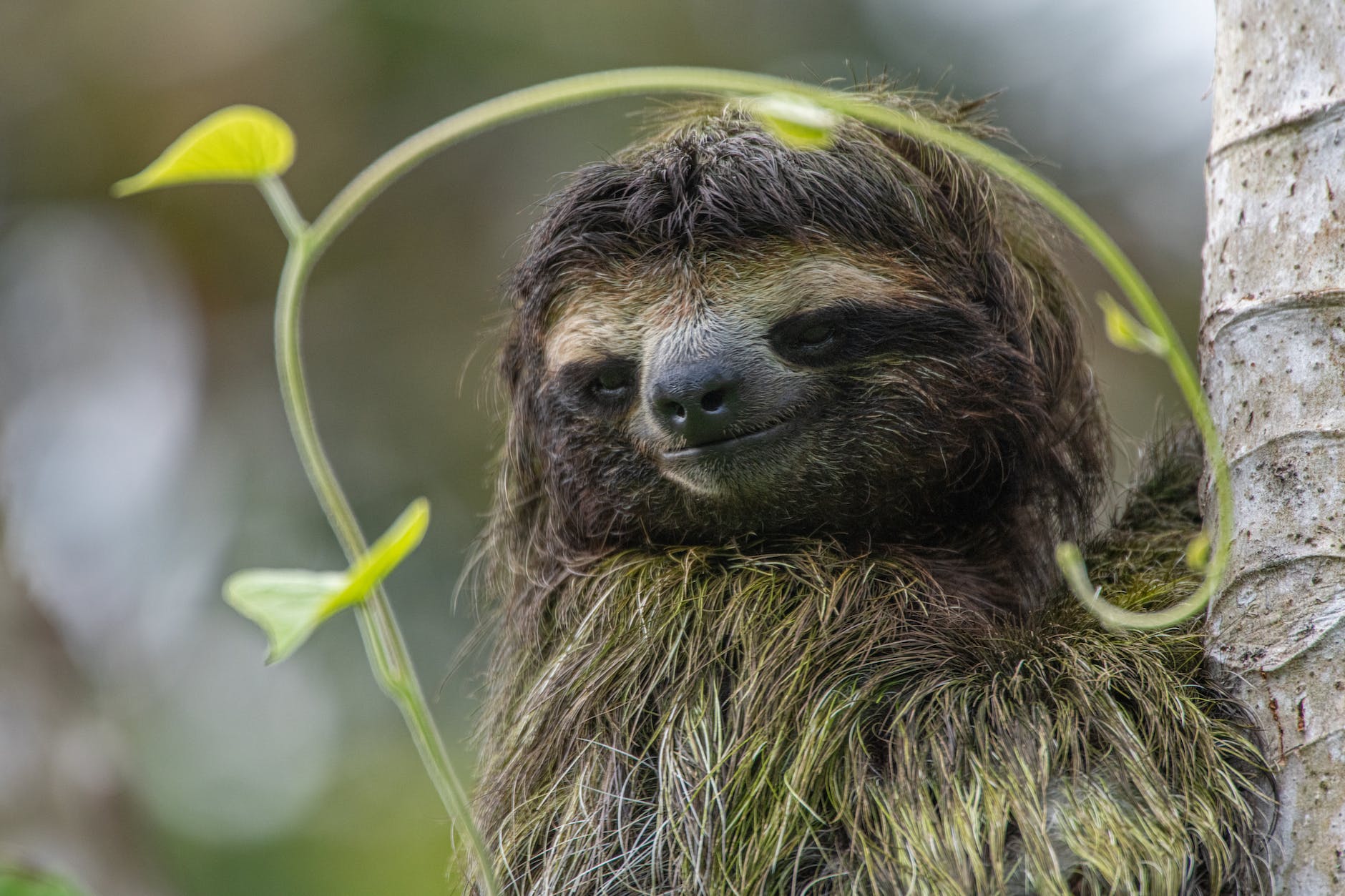
In my research this story focuses on the maned sloth (Bradypus torquatus), a species of three-toed sloth that’s native to the Brazilian Atlantic Forest. It was first recorded in a work of natural history by the Frenchman André Thevet in his 1557 book The Singularities of France Antarctique. Thevet has become famous in the history of natural history for using local names for local animals, rather than calling it a “sloth” he called it a “haüt“, his rendering of the local Tupinambá name. To me this is critical to understanding the History of Natural History, for while you could look at an animal and call it a “sloth” because it moves very slowly another option is to turn to the people who’ve lived alongside it for generations and ask them what they call it. This is what Thevet did.
Last week I got the chance to spend a couple days down in New York City, during which time I wanted to pay a visit to the American Museum of Natural History, arguably one of the preeminent institutions dedicated to the study of nature in this country. It’s a nice enough place, though I’ll admit the exhibits tend to be a bit dated now in 2022. Still, the American Museum offers a good foundation for the layout of such museums around the country. Like its Chicago counterpart, the Field Museum, my favorite such museum, the American Museum has sections focusing on Zoology, Paleontology, Botany, Astronomy, and Anthropology. It seeks to be an encyclopedia of nature in one big building on the edge of Central Park, something it does quite well.
What has struck me the most over the last few years of choosing to visit natural history and science museums in every city that I visit is how all of them try to tell the same story, a history of nature from the Big Bang down to the present. The Field Museum does a wonderful job of capturing this in their Deep Time exhibit, the place where you can find the dinosaurs, in that it begins with that first primordial burst of energy that got everything started and it ends with a wall showing all the species that have gone extinct already in our current age alongside a ticker counting the number of species currently going extinct. We model our natural history on our own history, and frankly our own history is one bookended by a lack of life, whether it be before we exist or after we’ve died.
It’s important that we understand the fact that our perspective is born entirely out of our own experiences. So, we understand the course of time as a linear and finite thing. Past generations have thought of trees and plants as animated creatures like us, while today we recognize they are living if perhaps not as sentient as we animals are. Many among us have understood nature through faith, prescribing that energy which drives all creation to a Creator, a Divine Essence as I like to call the most paradoxical and incomprehensible. (One of these days maybe I’ll release an episode all about the idea and promise of God.)
Thevet understood the sloth to be “most deformed” because of its strange shape and notable slowness. To his perspective it wasn’t a normal creature, natural to its own world yes, but not normal as he understood normal. We still today describe things that are “normal” or “ordinary” as things that we find familiar and comforting. I do it just as much as the next person (see the episode two weeks ago about cultural homogenization). In moderation this is a good thing, it allows us to formulate a baseline, a control, against which we can better understand the unusual and extraordinary around us. The beautiful thing about Nature is as much as our science has made great progress in seeking to describe and understand it, there’s always more out there for us to learn about.
I’m going to leave it there this week. If you haven’t noticed, my voice is failing me today. Let me finish with the thing that I myself will eventually want written as my epitaph (however many decades away that is): stay curious.
 Wednesday Blog by Seán Thomas Kane