Tag Archives: Chicago

On Technology

Last week, I returned to Chicago, this time on a business trip to attend a conference, and on the way took time to slow things down and enjoy the lived experience. — Click here to support the Wednesday Blog: https://www.patreon.com/sthosdkane


Last week, I returned to Chicago, this time on a business trip to attend a conference, and on the way took time to slow things down and enjoy the lived experience.


On Wednesday last week I boarded Amtrak’s Southwest Chief at Kansas City Union Station bound for Chicago. This visit to the metropolis of my birth was less for family affairs and instead for business. I spoke on Friday at the Renaissance Society of America’s conference at the Palmer House Hotel about how toucans were seen by sixteenth-century French merchants as economic commodities first and foremost. It was an unusual topic, but one that fluttered enough feathers in the organizers to earn me a travel grant from the RSA and a matching grant from my own History Department back in Binghamton to cover about half of my overall expenses for the trip.

In recent months, as I’ve had this trip and all the other ones planned in 2024 in mind, I’ve found myself growing evermore tired of being in constant contact with people near and far. Our technology allows us to make wonders, and to inspire ourselves to newer and greater heights with those wonders, yet I’ve found myself asking more lately how much we really ought to rely entirely on our technology? Every so often throughout the year I will find myself with a physical book, whether a paperback or a hardcover, that seems appealing, and I’ll stop and read. I used to read constantly. 

When I was in elementary school my grandparents gave me their 1979 World Book Encyclopedia set that had gone through several moves with them over the years. That year, feeling the effects of insomnia for the first time that I can remember in my life, I often stayed up late in my room reading these encyclopedia volumes. My parents eventually gave that set away, admittedly now the knowledge contained in them is 45 years out of date, it still showed Jimmy Carter as the sitting President, yet I remain forever grateful for that gift in all its thousands of pages. I can still remember the smell of those books in particular, and the charming and sometimes funny black-and-white pictures they contained.

Later, when I was in middle school I read several large and complex books in a row, including Thomas Kinsella’s translation of the Táin Bó Cúailnge, an Irish epic set 2,000 years ago, and Frank Delaney’s book Ireland: A Novel, which my Dad bought for me at a Hudson’s in O’Hare on the way back from another trip up to Chicago to see family during my eighth grade year. Perhaps the last of these memories of endless hours reading for fun was in preparation for the release of the last Harry Potter book, the Deathly Hallows, when I read the other 6 books in 3 days.

All of this changed when I started high school. I chose St. James Academy for two main reasons: they offered Latin as a foreign language, and they offered MacBooks for all of their students. With easier internet access than ever before and the creation of YouTube around that time, I found myself hooked reading more things online and watching videos. Today, I’m often more likely to open YouTube on my computer during some downtime than I am to pull up a book on my phone. I’ve gone through waves of enjoying reading books on my phone here and there, yet these are again just waves.

I spoke to my friend, Carmelita Bahamonde, who I’ve known now for over a decade since we met as undergraduates at Rockhurst University. She gives up her social media accounts every year for Lent, and now during Holy Week is nearing the end of that technological fast for its 2024 occurrence. 

Seán: “I worry that because it’s how I connect with so many people professionally, and cousins in Europe and across the United States, that it’ll minimize how much I’m in touch with them.”

Carmelita: “Yeah, I do, and I do take time off during Lent, yet I take it further, so the longest I’ve gone was to the end of June and start of July. It’s hard to keep that up.”

Seán: “June or July! That’s a long time to keep that up.”

Carmelita: “Yeah, the first time I did it I think I made it through May, and I came back for my Masters, and I decided this was something to come back for.”
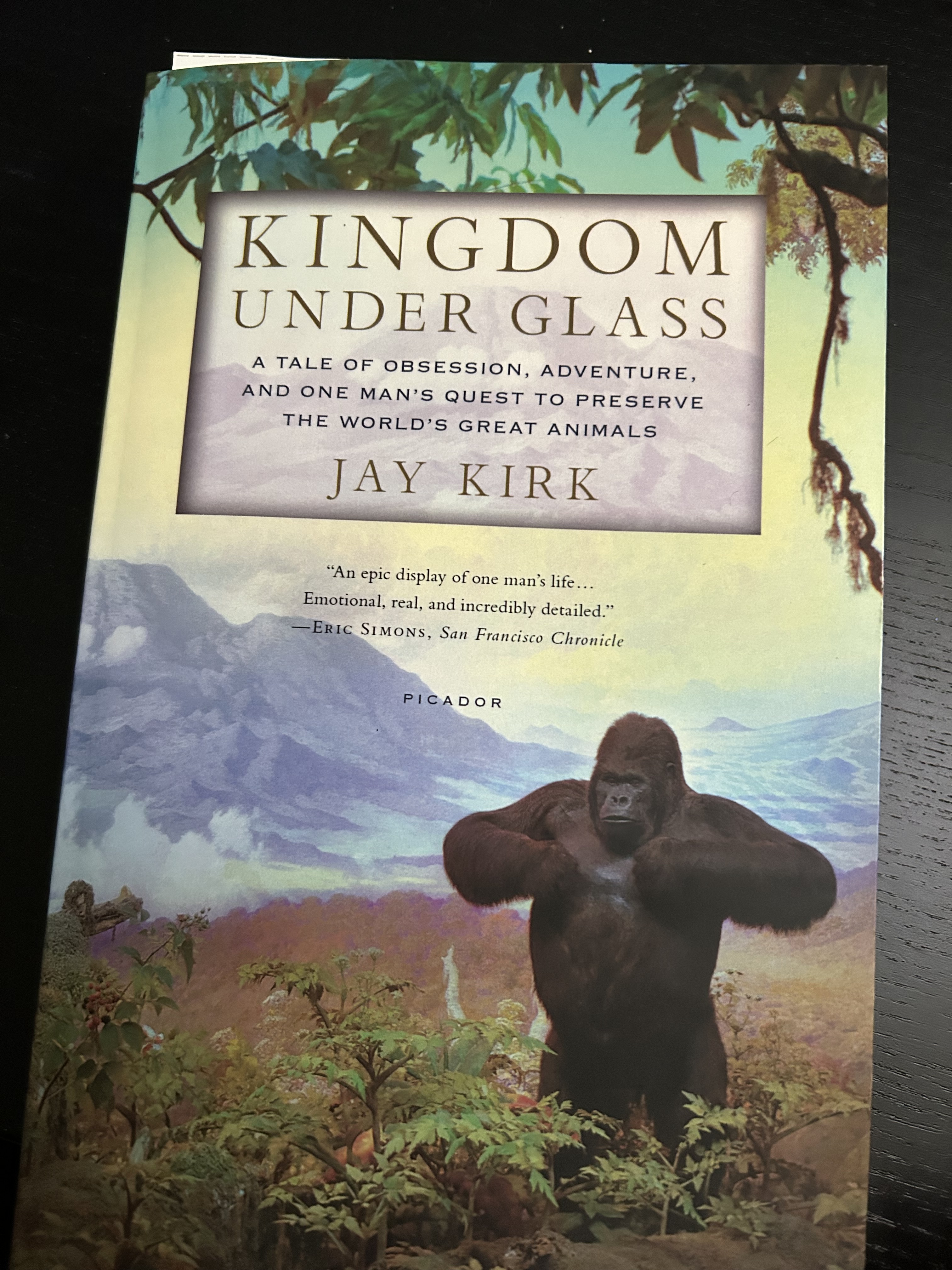
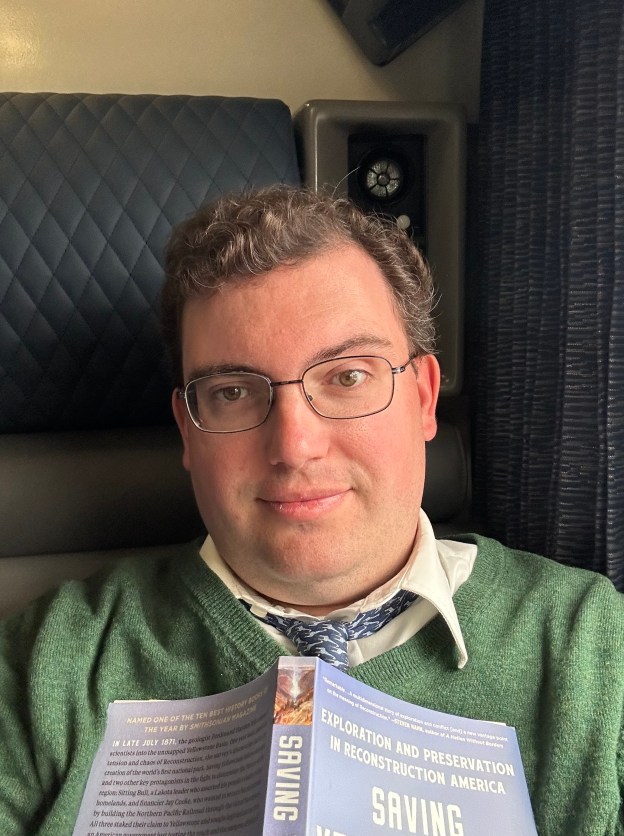
So, when I saw that I could afford to purchase roundtrip sleeper tickets on the Southwest Chief for this trip, I jumped at the opportunity to not only enjoy the best that Amtrak’s western services have to offer, but to also enjoy 7 hours of disconnection from my technology. I spent those 7 hours reading Megan Kate Nelson’s book Saving Yellowstone about the first federal expeditions to the Yellowstone Basin, the building of the Northern Pacific Railroad, the decline of the Lakota’s autonomy, and the foundation of Yellowstone National Park. I brought two other books, three magazines, and all the books downloaded on my phone with me on this trip, figuring I’d have a fair bit of time to read. (On the return trip, rather than reading the materials I brought with me I ended up reading a book I bought in Chicago at the Field Museum’s bookstore by Jay Kirk called Kingdom Under Glass: A Tale of Obsession, Adventure, and One Man’s Quest to Preserve the World’s Great Animalsabout Carl Akelely, the first Taxidermist-in-Chief at the Field Museum. I’m going off script here to say how wonderful it is.)

Seán: “And, I know people who have very full and happy and lovely lives and they’re not on social media, so it’s not necessary to be on it. Yet, it seems that’s how people connect nowadays, right?”

Carmelita: “Yeah, though I only post happy, lovely things, even when I’m at my lowest. So, I always see that so and so is travelling, and man I’m falling behind this year. Yet I wonder how much over time they’ve been doing this year that they can do that?”

Beyond even disconnecting to read, I feel a pull towards stepping back a bit from my complete adoption of all of this technology. I see myself looking more at the screens before me than at the world around me. A friend recently pointed me toward a book which considers that the decline in recreational bowling leagues in this country can be tied to an overall decline in a communal spirit and a deconstruction of our bonds of trust, which have contributed to the current sense of mass isolation, fear, and mistrust which have contributed in turn toward our present political paradigm. I haven’t read this book yet, to be clear, yet I see how the premise works. I love coming to conferences like the RSA to experience the community that these events foster. There are people here who I met last Fall at the Sixteenth Century Society Conference in Baltimore or last March at the 2023 RSA in Puerto Rico. I’ve had the opportunity to tell people here how much I appreciate their work, and to talk a bit about my own, to hear the affirmations that I so often miss in my daily life about the actual research I do.

Carmelita: “Yeah, you have both positives and negatives, you get to connect with family and peers who are far away, yet you also can lose yourself in our technology.”

We could certainly meet remotely using our technology to foster connections, yet those bonds would be far less strong than they are now that we’ve met and know some more about each other. Our technology allows us to instantaneously talk with people whole continents and oceans away, even to the astronauts orbiting our planet on the International Space Station. It has allowed us to even communicate with our furthest satellites that have reached far beyond where any human has gone before. Yet those connections are proxies for the real, physical connections we inherently desire by our basic evolutionary biology. I have trouble sometimes overcoming my own shyness in public settings, I certainly felt that at certain points on this trip, at times I’ve found conferences unbearable because I don’t feel up to talking to people I don’t already know, even when I’ve read and enjoyed their work. I do feel I would be more comfortable in these situations if I were less technologically connected and more connected to the human.

Seán: “What are some alternatives to social media that you’ve found useful?”

Carmelita: “I still have [Facebook] Messenger on my phone, so I use that to stay in touch with people. I sent a message this year to my friend in the Netherlands to say ‘Hey, just to let you know I’m taking my yearly break from social media,’ and she said ‘hey, no problem,’ and she’ll continuously text me and send me things, and my parents will show me things on social media if they’re really necessary. The people who, like you, really want to stay in touch will do so, and I really appreciate that.”

Seán: “It speaks to Robin Dunbar, who’s a primatologist and sociologist, who wrote about this idea called Dunbar’s number where there’s this maximum number that a human can have in their social circles, and I think it really speaks to that culling of that number. I’ve probably got 1700 friends on Facebook, and excluding family which is 30-40 people, there might be 10 people who I stay in touch with, and you’re one of them.”

Carmelita: “Yeah, and you are too. And I’ve actually had people reach out to me in the past and say ‘Hey, I haven’t seen anything from you, are you actually alive?’ and I’ll reply, ‘Hey, yeah I’m actually kind of better!'” (laughs)
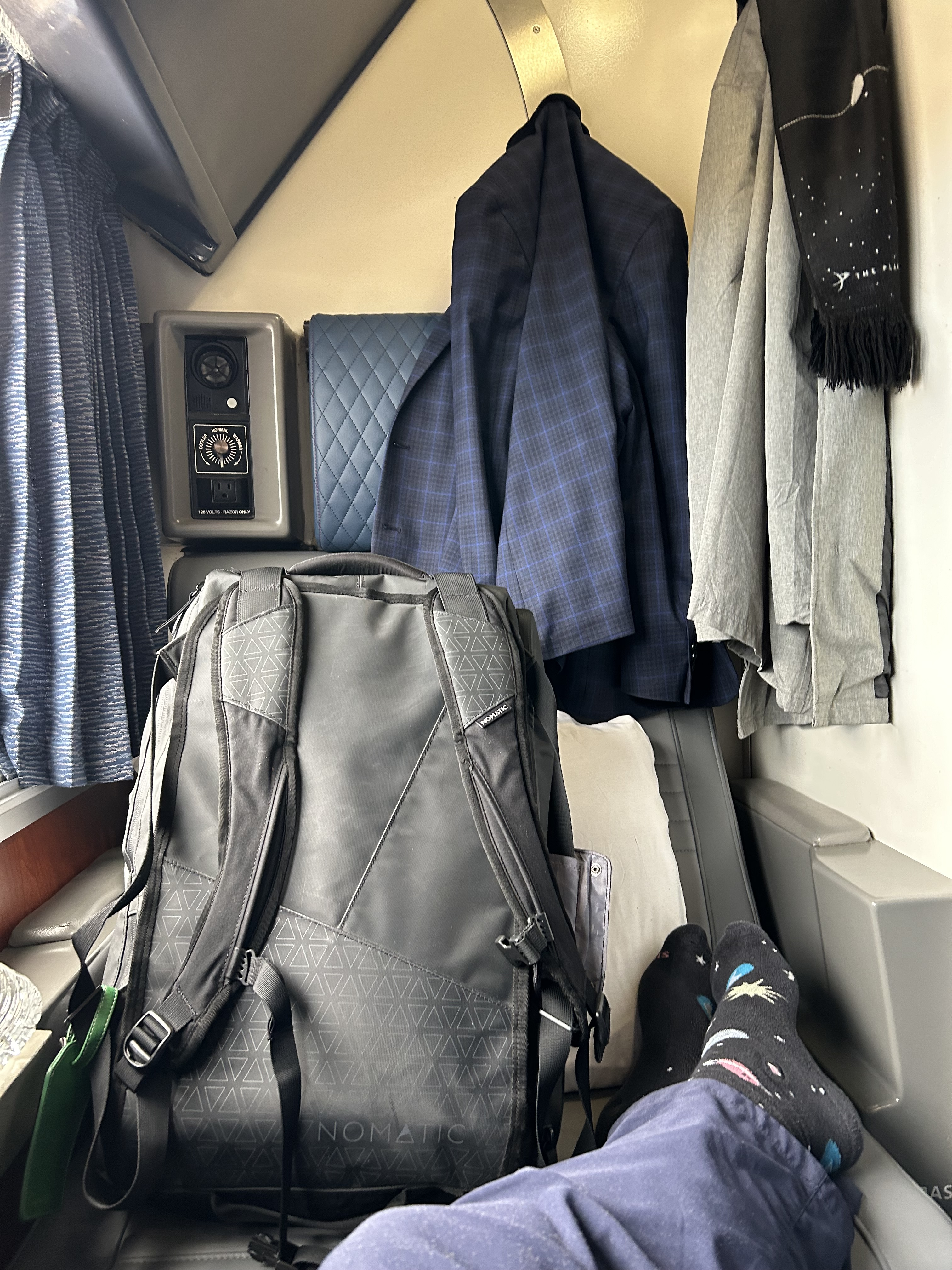
My roomette on the Southwest Chief on the way up to Chicago.

I admire my friends and family who can give up some of this technology for extended periods of time. There are things to appreciate about the connectedness our technology provides to be sure, I appreciate seeing the social media posts of those who I care most deeply about, yet within that outer circle there are the few who I see on a daily basis, and I wonder how much I really pay attention to them, or them to me, with these screens in front of us all the time?

It strikes me that more often than not, when I’m mindlessly scrolling through YouTube on a given evening at home, I’m often finding the same music as I had the evening before, listening to the same songs or variations of those songs over and over again. Those songs evoke certain emotions for me, emotions tied to dreams and memories both. Yet I ought to really be focused on the people around me, for as much as our creations may have achieved a sense of immortality with their technological life spans far outpacing our own, those whom I love will only be with me for so long.

Carmelita: “It feels like if you didn’t post it, it didn’t happen; and so last year I went on a family trip, and at the end of the year I didn’t have any pictures and it feels like it didn’t happen, so that’s why I appreciate my social media. Yet like you said earlier today, you don’t have to post everything.”

There ought to be a balance between connection and relief, between all our noise and the silence, which is an acquired taste to be sure, yet is beautiful in its own way. I appreciate the assistance that my technology can provide in my work; it is far easier to do my research using PDF copies of these sixteenth-century books than having to rely on quickly written notes made during a rare research trip to a distant library. When I did my first research trip as an undergrad in 2013 to the Library of Congress, I actually took handwritten notes of the books I read. I quickly realized it was far more efficient to take notes by computer, to type things out at 70 words per minute than to write them by hand in my elegant if at times slow cursive script. This has meant that in the 11 years since I’ve found myself writing by hand less and less, even perhaps risking the loss of the art of penmanship, and calligraphy (if I may be bold to call it that).

Seán: “What’s the underlying purpose of posting? Is it self-gratification, is it to say ‘look what I did!’ is it say ‘look at how cool I am,’ or something like that? I always try to think of the underlying reasons for what I do.”

Carmelita: “I once had a friend who asked me why I post everything, and I said ‘well, I wanted to post pictures of this trip,’ and I think it’s a good way to show what I’m doing to more distant family who I haven’t seen in twenty years. I do sometimes wonder, ‘is this for showing off?’ I don’t like to post things that are show-offy. Several years ago, I got a promotion at work and I wanted to post about it but I sat on it for a while and ended up deleting it because I can’t brag, and so it is a double-edged sword, because you don’t want to brag but you should at the same time. It comes down to perspective: who do you want to know about your successes? Graduating from my Masters, I wanted everyone to know, ‘hey, look I worked my butt off!’ but a trip to Disney isn’t something for everyone to see.”

Let me close with this: I could have all the efficiency in the world with my computer and smart watch and smart phone and voice-activation software in my car and my headphones that connect wirelessly to my other devices so I can talk and take notes on my phone at the same time. I can learn so much from watching all the videos anyone has ever made on a subject and imagine wonders I might never otherwise consider with the invention of film, television, and the videos we upload to the internet. Yet none of it is as rewarding or as joyous as seeing a friend smile, and feeling the warmth of our interaction in that one specific moment in which we are living. Perhaps we need a little more of our human nature in our lives after all.

Seán: “Let me ask you one final question and then we’ll get back to lunch here, this meatball sandwich is giving me a look: do you think technology makes us more or less human? If you think about how we originally evolved in our nature as humans, as Homo sapiens, as wise people, as learned people, and yet do our creations diminish our base humanity if we’re too focused on them?”

Carmelita: “I think it depends on what you post on social media and if you’re fake about them. We talk about influencers who post amazing photos but are broke because of it, then it’s not worth it. Social media allows us to stay connected, and that’s a wonderful thing. So, as long as you’re being true to yourself then that’s the key.”

Seán: “Excellent, I like the connection between philosophy and real life there.”


Finally, for your viewing pleasure my view facing north crossing the Mississippi at Ft. Madison, Iowa.

Correction

Corrected on 28 March 2024 to reflect the correct spelling of Carl Akeley’s name. I’ve misread it now for 31 years as Akerely.
Context is Key

This week on the Wednesday Blog, I want to air a pet peeve of mine about stories taken out of context. — Click here to support the Wednesday Blog: https://www.patreon.com/sthosdkane

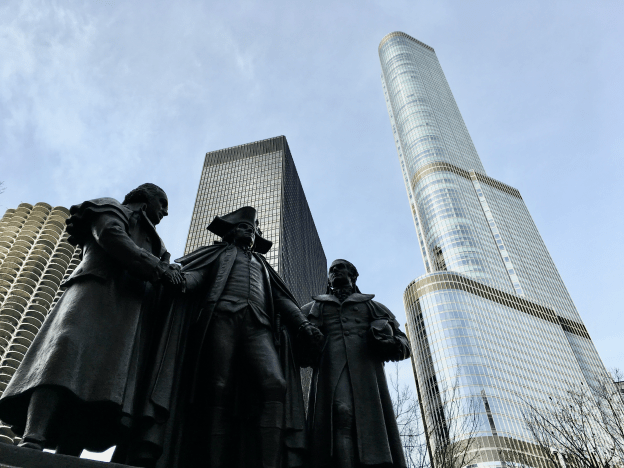
In late December 2017, during one of my family’s regular Christmas trips back to Chicago, my Dad and I were walking along Wacker Drive (upper, not lower) past the Herald Square Monument on the northwest corner of Wabash and Wacker. The monument depicts George Washington with two of the principal financial backers of the Continental Army during the Revolutionary War, Robert Morris and Haym Salomon. I took a picture of the monument with the Trump Tower looming in the background, a pairing of two presidents who in many ways could not be more different in character from one another. My Dad suggested I should learn more about the monument before posting my picture and get the full context of why it’s there in the first place.

As it turns out, the inscription on the monument’s base “The Government of the United States which gives to bigotry no sanction, to persecution no assistance, requires only that they who live under its protection should demean themselves as good citizens in giving it on all occasions their effectual support,” was what made my picture seem so poignant in the first place, and likely had the same effect on many pocket photographers who had walked by in the years since 2016 with their smart phones at the ready to capture the world as they saw it.

That inscription, I learned later that day when we returned to our hotel, was from a letter President Washington sent to the Jewish congregation of the Turo Synagogue in Newport, Rhode Island affirming their religious liberty and emancipation from any separate law code contrary to the custom in most western countries at the time. The context fit the story I was hoping to tell with my picture, yet I was appreciative of the advice to learn more about that monument before making a statement of my own with its picture.

I have many pet peeves, most of which I don’t talk about out of respect for everyone else. I’d rather be known as someone who has positive things to say rather than a complainer, and in those moments when I find myself overly melancholic or acting in a “woe is me” manner, I tend to annoy myself a fair bit. So, it takes a lot for me to want to say anything terribly negative, yet this matter of context is key to something that does bother me. I am annoyed when stories are taken out of the context in which they were created. 

This usually doesn’t happen with novels or movies or TV shows, except now with the deluge of memes using images and moments from these stories to express emotions. I do see this trend played out more in music where the original story of a song might not be as familiar to the people listening to it, yet they sing the words all the same. Context provides so much more color and energy to a story that turns it from a linear narrative with a beginning, middle, and end into a vibrant world crafted by a storyteller that began as a mere idea in their mind.

Pulling a story out of its original context robs the listener of a chance to appreciate the whole depth of the yarn being spun, to see every last fiber of that tapestry being brought together in a great work of art that is inspired by the ideas of its creator. When we break ourselves off from the context of life, we lose a great deal of the beauty of the Cosmos around us. This is why we can sit back and do too little to help our planet as the climate crisis grows ever dire day by day. Last week, several researchers from the University of Copenhagen’s Niels Bohr Institute reported their findings that the Atlantic’s currents could stop moving this century, as soon as 2025, due to rising sea temperatures; earlier in the week the National Weather Service also reported that water temperatures over 100ºF (38ºC) were recorded for the first time off the Florida coast. The currents feed the very life we have evolved to depend on and to be an integral part of. By focusing just on our own story, we have lost the context of the greater world of stories that ours inhabits.

Here in the Midwestern United States the weather tends to move in cycles with some wet years followed by some dry years. In my adult life we’ve seen three wet cycles so far, with heavy flooding on the Missouri River around the years 2011, 2015, and 2019. Since 2019 we’ve been in a drier spell, with some seasonal thunderstorms but not the great floods of years past; yet these last two summers the Midwest has been inundated with flood after flood, striking different regions at different times. Over the 4th of July weekend, there were rainfalls in Chicago that dropped as much as 8.96 inches (22.76 cm) of rain on the western Chicago suburbs of Berwyn and Cicero. A few weeks later on 14 July, Kansas City experienced a storm line that produced minimal tornadoes, what we’re more used to here, but instead a line of storms over 40 miles (64 km) long from north to south which produced winds reaching at least 75 if not 80 mph (120.7–128.7 km/h) winds that brought down trees throughout Kansas City, knocking out power lines and leaving much of the metro in the dark. 

I for one am used to thunderstorms, they’re quite exciting to be frank, yet this one scared me more than any other I’ve watched from the safety of a well-built house. What scared me most was that the windswept rains reminded me of video I’d seen of the Category 1 hurricanes that hit the East Coast every Fall. To me, this proved that the story I’d been hearing my whole life about the weather here in the Midwest was truly changing, that it was not a couple of bad years followed by a return to milder weather. The baking summer heat that followed that Friday afternoon storm, which last week left portions of Kansas City reading heat indices of over 120ºF (49ºC), was the flip side of the same story we heard in December when the extreme Arctic cold winds that swept down from Canada and locked much of the continent in an ice box settled on Kansas City. That weekend we were treating our garage like an air lock, closing the interior house door and making sure everyone who was going outside had all their skin covered before opening the garage door to the -30ºF (–34ºC) blistering wind to go shovel out our driveway of snow and lay down kitty litter (our preferred road salt) to try and break up some of the ice that had formed.

Without the full context, we cannot see the future we are creating for all life on Earth. Visitors to my favorite place on Earth, Chicago’s Field Museum, will likely go see their fossil halls, an exhibit now called Evolving Planet, in order to see the famed dinosaurs––and especially SUE the Tyrannosaurus Rex––who live in those galleries. I love going in there for many reasons, which if I haven’t written about before on the Wednesday Blog, I’ll be sure to write about the next time I visit. Yet, the Evolving Planet exhibit ends with a counter showing the number of species that have on average gone extinct over the course of any given day. The later in the day you leave that exhibit, the higher the number is. In all our other problems, and especially in all our distractions, we forget that we need all the other life that evolved on this planet with us. We forget that their stories are important to understanding our own.I know a great deal more about the history of the Turo Synagogue after stumbling into Sam Aronow’s Jewish History series on YouTube just before Christmas in 2021. Learning other peoples’ histories allows us to have a better appreciation for the entire tapestry of humanity. For me, it presented a greater sense of respect in President Washington’s words engraved in the base of the Herald Square Monument at the corner of Wacker and Wabash. That context only strengthens the story of our national experiment at citizen-led representative government, now nearing its 250th anniversary.

Living Memory

This week, a consideration of how memories survive as stories. — Click here to support the Wednesday Blog: https://www.patreon.com/sthosdkane

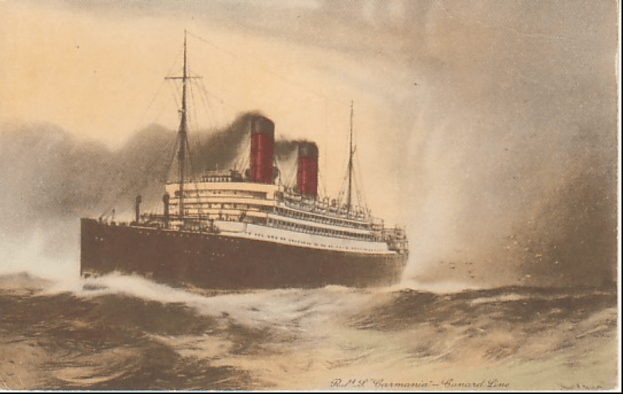
The Header Image on this Week’s Post is of the RMS Carmania, which carried my great-grandfather to America in April 1914.

A few weeks ago, when I visited Mount Carmel Bluffs and the Motherhouse of the Sisters of Charity of the Blessed Virgin Mary (known more commonly as the BVMs) in Dubuque, Iowa I was struck at how even though it had been 8 years since my last visit and 14 years since the last time I was there for a family funeral, the memory of those relatives, my great-aunt Sr. Therese Kane in particular, still lived on in the sisters who came up to us throughout the day telling stories of times now long past and all the people they knew who lived in those moments. It had been so long since I’d seen Sr. Therese that it felt strange to still call her “Sister” as we all did in the Kane family when she lived.

That visit to Dubuque was in honor of Sister and my grandfather’s cousin, Sr. Mary Jo Keane, who died in April only a few weeks after having moved into her community’s retirement facility called Mount Carmel Bluffs. At her wake I noted to the attending sisters, relatives, and friends that she was one of the very last in my family who knew her parents’ generation who came to Chicago from County Mayo in the first half of the last century. Moreover, she was the very last person living who attended my great-grandfather Kane’s funeral in 1941, the last one who could tell some of the stories she heard as a child of life in Mayo at the end of centuries of colonial rule.

At Sister’s funeral lunch in 2009 I remember hearing Sr. Mary Jo, my grandfather, and their cousin Fr. Bill McNulty telling these stories about their parents, some of which I had never heard before then, of how hard it was for them to come to America, and of the trouble they faced in Ireland that led to their immigration. Some of these stories were still in the air at Sr. Mary Jo’s funeral lunch, told by my cousin Rosemary, yet as that first generation born in America leaves us so too their stories begin to fade away.

In the last week I slowly began to acknowledge the news of the lost submersible Titan which left St. John’s in Newfoundland for the wreck of the RMS Titanic and upon its descent beneath the surface was never seen again. At first, I acknowledged it was happening yet didn’t pay the story much heed, yet as my parents began to give it more attention and talk about it over dinner, I slowly started paying attention more. The Titan‘s mission to take tourists down to the remains of the Titanic 2.5 miles (3.8 km) beneath the surface of the North Atlantic is as much an act of nostalgia as any pilgrimage or historical tour can be. For $250,000 passengers were brought to the ocean floor to see the great ship as it rests slowly decaying away with the passage of time. I’ll admit the idea of seeing it for myself is intriguing, though even before the Titan was reported lost at sea, I doubt I’d ever take that opportunity to visit the Titanic.

One disaster resulted from fascination in another disaster. The sinking of the Titanic is a curious event for me because it is just on the horizon of what I consider recent events to my own life. Many of the last survivors––who themselves were old enough to remember the event––died around the time I was born, 80 years after the ship sank into the cold North Atlantic. What’s more, the generation of young immigrants in their 20s and 30s who left Ireland for America at the time of its sinking included my Kane great-grandparents who arrived in this country in 1914 and 1920 respectively. The Titanic followed the same course that my great-grandfather’s ship the RMS Carmania sailed between Cobh (then called Queenstown) and New York two years later in April 1914, and there is a point in my mind where it’s clear that had circumstances been different, had he sailed at age 20 instead of age 22, he very well could’ve been on the Titanic.

It’s always been strange to me to talk with people for whom recent memory is far shorter. When I started teaching at Binghamton University I expected my students, all New Yorkers, would have more vivid memories of 9/11 or perhaps had families who were directly involved, yet these students could tell me little about it, saying they were either too young or had not been born yet when the attacks took place 22 years ago. I think to my own early childhood, to my understanding of world events as the happened right before my birth in December 1992, and I at least have known a fair deal about events like the 1992 Presidential Election or the Fall of the Soviet Union in August 1991 for most of my life. I thank an insatiable curiosity and old Saturday Night Live re-runs for much of what I know about those events. Still, for most of my childhood memories of people who lived in the nineteenth century persisted, and so for me my great-grandfather Thomas Kane, who died 51 years before I was born, feels today closer than might be expected of someone who was born 100 years before me.

On Monday night this week I found myself diving deep down rabbit holes reading about Titanic survivors. It’s rather morbid to say that someone’s sole distinction is that they’re the last Titanic survivor of a certain demographic, that’s certainly something I’d have trouble being proud of. My reading led me to the story of an Englishwoman named Millvina Dean, who was a 9-week old infant at the time of the sinking, who was on her way to Kansas City with her parents to start a new life here on the prairies. 

The Washington Post reported in 1997 on the completion of her long voyage when “85 years after setting out for Kansas City” she finally arrived here to meet cousins long separated by the waters of the Atlantic. The article in question mentioned where her uncle who the Dean family was planning on staying with lived, on Harrison Street, leading me to old city directories to see where on Harrison. The most likely address is at the corner of Harrison St. and Armour Blvd. on the eastern side of Midtown near where many of my maternal Donnelly relatives lived in the 1910s. Ms. Dean herself died in May 2009, I remember reading about her death when it happened; and on the centenary of the sinking of the Titanic, I noticed the date come and go. There was a story that weekend on CBS This Morning, yet for me the main emotion was a strange feeling of an event which had always been there in the edge of memory of the people I knew fading ever further into the distance, less a lived event that my relatives read about in the papers when it happened and more a historical event.

In time all our lives will reach that threshold, our memories recorded will survive as relics of people, places, and moments long past, and those that were only spoken or thought yet never written down will fade away. There is so much I wish I knew about the immigrant generation in my family, I’ve seen pictures, heard stories, been told I look like my great-grandfather Kane in a striking way, yet beyond those things I’ve never really known them. We are fortunate in our time to have so many audio and video recordings of our world, to an extent that our memories will hopefully survive long after we are all gone. The democratization of these technologies is a gift, it means that when future generations want to yearn for the early 21st century they will have the cornucopia of our recorded memories to relive. For older generations, we are left with visions of the past defined by movies, talking and silent alike, which the New York Times columnist Maureen Dowd wrote about this week, her own father almost boarded the Titanic on his Atlantic Crossing from Ireland. Like the French anthropologist Claude Lévi-Strauss seeking the most remote of peoples in Brazil, to get an idea of what first contact was like in 1500, we are left with less recognition of the spirit behind these historical events the further they move away from us, until in a tragic ending to our story they are ancient history to us.

Dalí and the Surreal

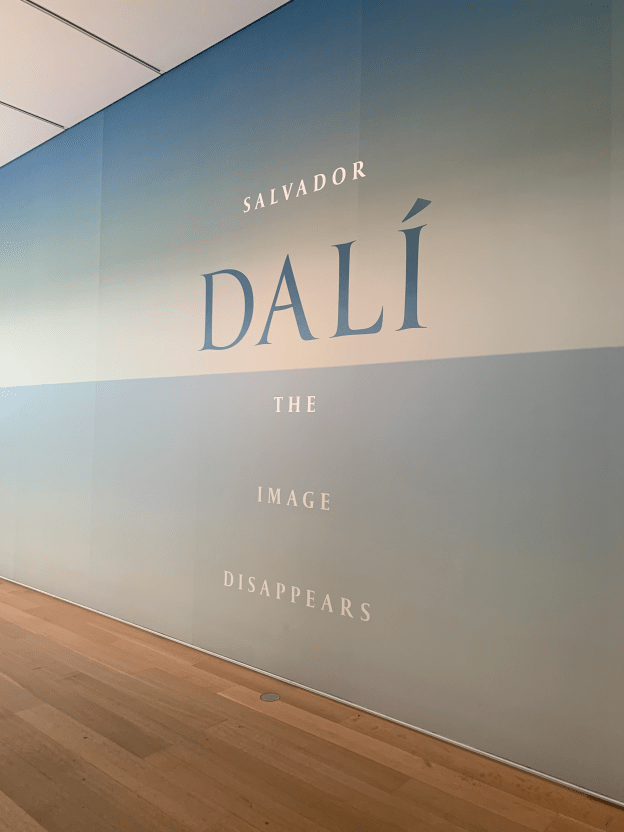
Over the weekend I was in Chicago to see a special exhibit at the Art Institute called Salvador Dalí: The Image Disappears. It got me thinking about the appeal of the surreal. Click here to support the Wednesday Blog: https://www.patreon.com/sthosdkane

Over the weekend I was in Chicago to see a special exhibit at the Art Institute called Salvador Dalí: The Image Disappears. It got me thinking about the appeal of the surreal.

I for one really like Dalí’s art, it captures something of the subconscious possibility in the way it bends and transforms nature. Surrealism creates a mirror universe governed by its own laws, inhabited by a cast of characters that are just familiar enough to us to warrant closer inspection and intense curiosity. When developed to its fullest extent with sound and movement, the color and light of the surreal comes to life in a truly radiant and radical fashion. I’m talking of course of Dalí’s collaboration with Walt Disney, which became the short film Destino, a gorgeous film that is available today on Disney+. The Spanish guitar and drums, and singer’s voice pair well with Dalí’s images that find themselves unlocked from the monumental stone edifices they were built into upon their creation, the permanence of place and pose in painting.

The Dalí paintings at the Art Institute reflected the opposite of the great monuments of Destino, and more the impermanence and fragility of life itself. Crafted and devised throughout Dalí’s life, in particular during the troubled years of the Spanish Civil War, these images tell their own stories of paranoia and chaos. They show how Dalí expressed his emotions and innermost thoughts in his art. When world events on his doorstep forced him to contemplate horrors that pulled him from his passions, those horrors showed themselves in his work.

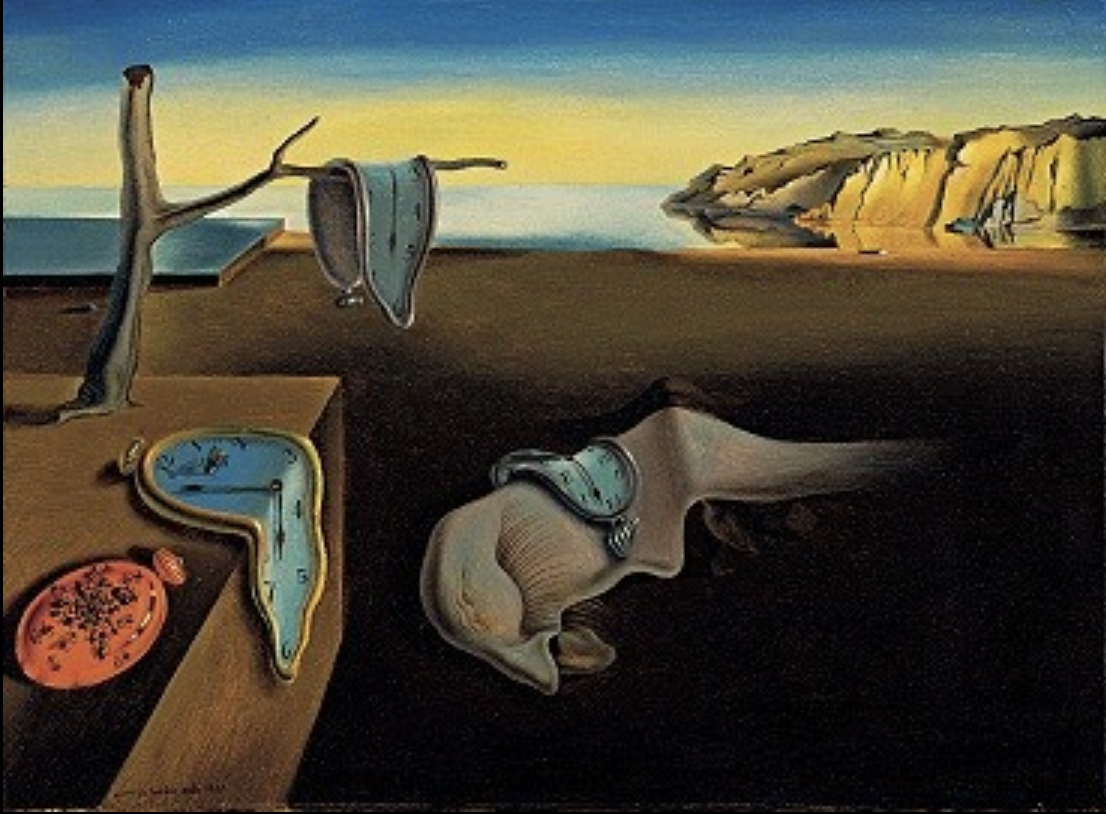
The Persistence of Memory

I’m drawn to Dalí’s most classic examples of surrealism, The Persistence of Memory being the type painting of these. They remind me with their distant hazy horizons of a book of labyrinths that I was given for Christmas one year in the early 2000s that had the same eternal yet present horizon line which stretched out from the central object echoing the idea of infinity yet not quite reaching that point itself. About a decade ago I was lucky enough to get to see another Dalí exhibit, this one in the Hallmark Headquarters at Crown Center here in Kansas City, where several Dalí images commissioned by Hallmark in the 1950s for a new line of greeting cards were on display for employees and their families. I remember Dalí’s interpretation of Santa for a Christmas card was fascinating, though not what Hallmark, the Norman Rockwell of American companies, necessarily wanted.

On Monday, I decided to compliment the Dalí exhibit with a visit to the Nelson-Atkins Museum of Art here in Kansas City to see Alberto Giacometti: Toward the Ultimate Figure, a collection of sketches, paintings, and sculptures by the Swiss master artist whose work spanned the first six decades of the twentieth century, and was in many ways Dalí’s contemporary. Yet where Dalí sought to interpret the human form through distortion imbued with a great sunny sense of Catalan romance, Giacometti’s works narrowed down their focus to the purest and ultimate human figure, which he crafted throughout his life’s work into sculptures notable for their roughness, slenderness, and height. I for one prefer Dalí’s vision over Giacometti’s, though I respect both artists for what they were trying to create.

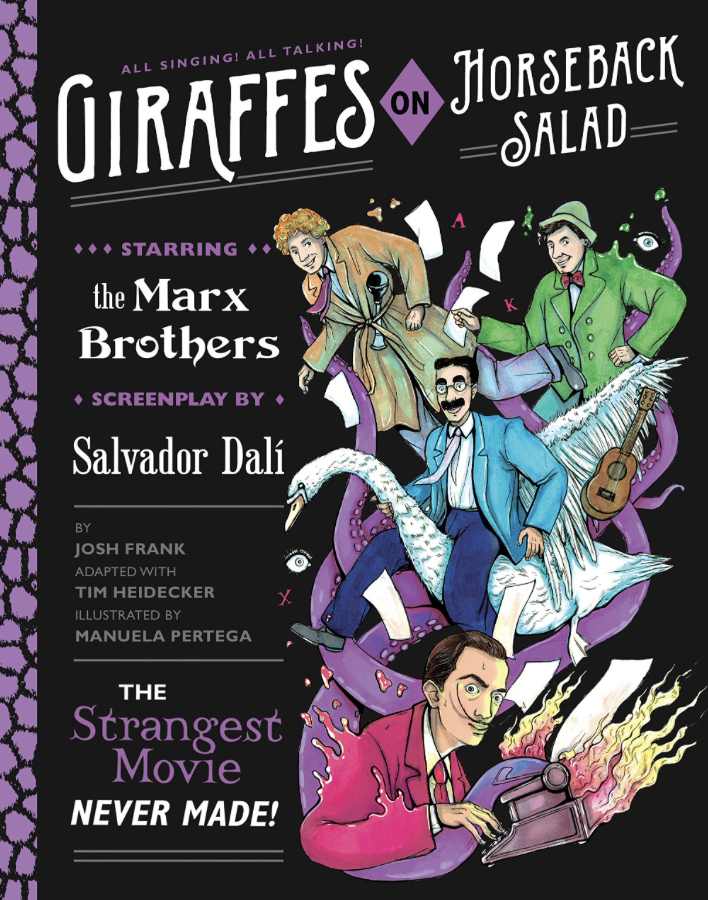
The surreal appeals to me because it echoes the disorderly world of my own dreams, the images that dance through my mind when I sleep are best described as surreal. Dalí collaborated with one of my favorite comics of his day, Harpo Marx, to create a film which ultimately was dropped by MGM for being too strange and finally in the last decade adapted into a graphic novel called Giraffes on Horseback Salad. Neither man spoke each other’s language, yet they both knew how to approach the language of the surreal, and so crafted a story that is the definition of weird and silly, that proved to be too strange even for Harpo’s brother Groucho. It’s good for us to have this alternate to our own world to turn to, this dreamlike fantasy realm where things don’t quite add up to how we expect. We humans are too imaginative to really fully be the normal people we make ourselves out to be. We have dreams, all of us, and rarely do they turn out to meet our expectations of what is normal.

Cosmos

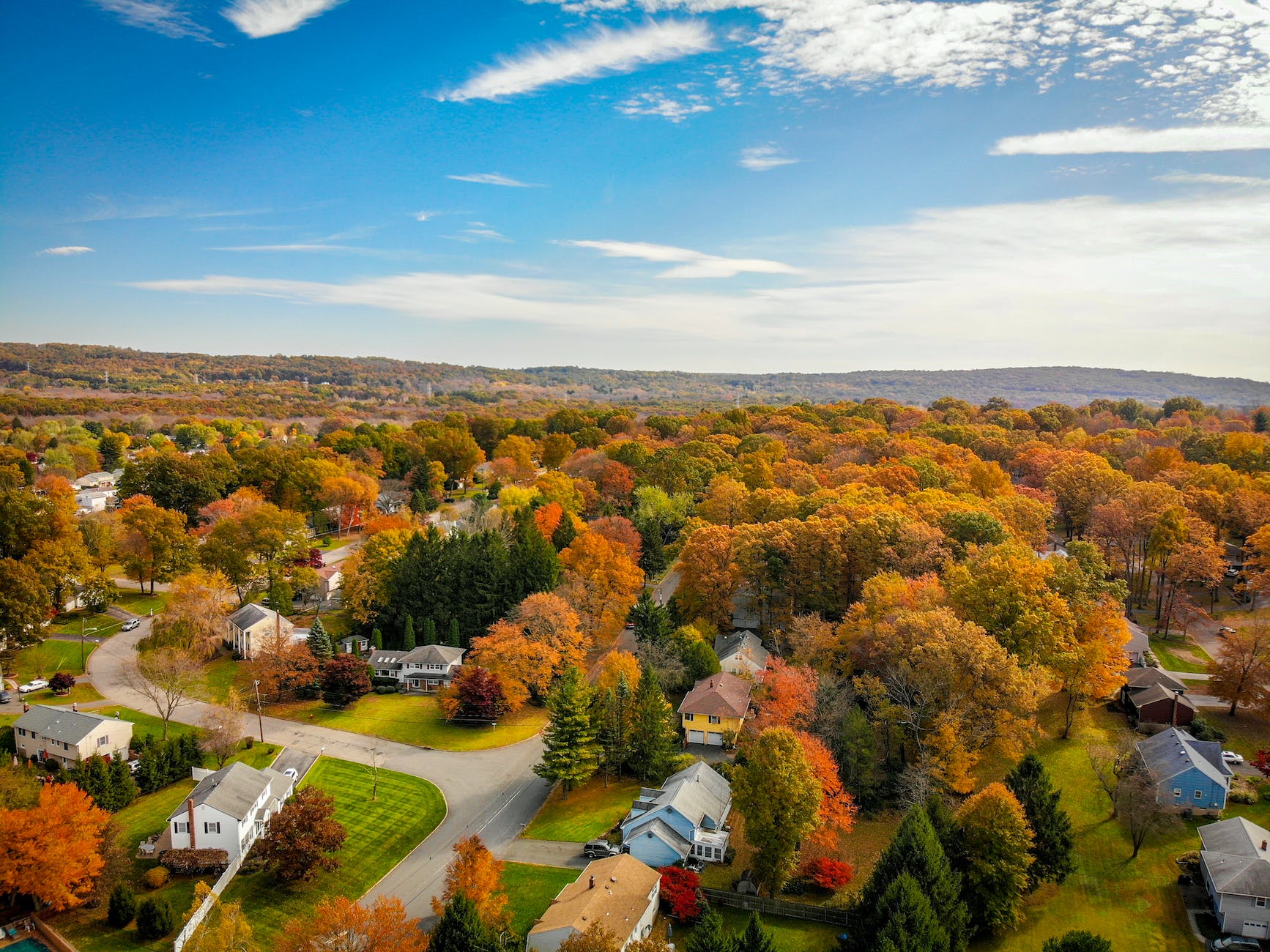
Photo by Pixabay on Pexels.com

Cosmos comes to English from Ancient Greek, where it referred to a sort of order in nature, the opposite of Chaos. This meaning stuck into the medieval period in works like the twelfth-century philosopher Bernardus Silvestris’s Cosmographia. In the Renaissance, the period I study, a science called cosmography developed in Europe as a way of making sense of all the worlds the explorers setting out from Portugal, Spain, France, and England were encountering. Still later, in the early nineteenth century the German scientific polymath Alexander von Humboldt named his greatest work, the five volume book Kosmos, which sought to describe the totality of nature as he and his colleagues had observed throughout his long lifetime. Today, Cosmos speaks to something far exceeding the Earth in scale, it’s the observable Universe with a potential for even more that we presently don’t know to be included under that cosmic umbrella.

A term like Cosmos is important because it helps us understand how we make sense of everything around us. I feel like I can imagine the entirety of the Universe but I’m sure if I saw an artistic rendering of the visible Universe, I’d feel like I was seeing a new face. This weekend as I was on my way west back to Kansas City through Chicago, the two cities I’ve called home over these past thirty years, I found my perspective shifting away from that of the stranger in the Northeast to one of familiarity and comfort back in my own native Midwest again. Arriving in Chicago I was delighted to realize I didn’t need the GPS in my car anymore, I knew exactly where I was in a place so vividly familiar to me. The same can be said for the rest of my drive west of Chicago, everything was familiar and wonderful to see.

My own Cosmos then, the order that keeps my life together, is built with Midwestern sentiments and expectations. Something that made life in New York difficult for me was how the customs there are at least somewhat different from what I’m used to. Even in these last few weeks there I still had to remind myself it wasn’t intentional rudeness when people I knew wouldn’t acknowledge me, let alone smile and say “hi” when we’d walk past one another, it’s just the impersonality of life in a place that has never really become familiar to me.

In these last three years I’ve now stretched my world out further, filling in many of the gaps of my own experience here in North America with trips to nearly all of the major cities on the East Coast and to Montréal and Toronto. I now know so many of the highways that link the Midwest & Great Lakes with the east. I found myself thinking about how as a child living in the Chicago suburbs that my family never took road trips east out of Chicago to Michigan, Indiana, or Ohio, nor north to Wisconsin. Instead, whenever we traveled it was west to St. Louis, Kansas City, and Denver further afield. Thus, the ways heading east were new to me as I drove along them this weekend, the easy drive on I-94 from Detroit to Chicago being one such example.

I’ve known many people who define themselves by where they’re from, for good or ill. There have been plenty who are loud and proud supporters of their hometown baseball team, and others who use their origins as an excuse to be unkind to the people around them. Over these last three years I had moved into a state of mind where my own origins were somewhat more dormant, sure I had all sorts of art up on the walls in my apartment celebrating both Chicago and Kansas City, and I’ve interchangeably worn my Cubs and Royals hats, but I’d begun to think of myself more as a person who can shift between places and communities, a skill that I needed to develop in Binghamton. Yet upon my return first on Saturday to Chicago and then on Monday to Kansas City I found all those old emotions and memories flooding back. 

One of the parts of the Christmas story that I always remember is that St. Joseph had to go to Bethlehem from Nazareth to participate in the census because that’s where he was born. I am who I am just as much because of the places I’ve grown up in and the people I’ve lived among as the experiences I’ve had as an individual trying to make things work over these last three years alone in a lonely valley far from home. Home is a word of tremendous significance for me, it’s the place where I feel the most comfortable, the safest, and the most appreciated. For much of my life I’ve seen both Chicago and Kansas City as my home. It’s a sentiment I’ve reinforced this weekend on my first visit to the city of my birth since the pandemic began. Were I to say I have a “homeland,” Lake Michigan would remain its eastern boundary, the Great Plains beyond Kansas City its western. That is the heart of my Cosmos.

Cultural Homogenization

Photo by Dave Frisch on Pexels.com

One of my favorite YouTubers is J.J. McCullough, a Vancouver-based political columnist for The Washington Post who creates videos discussing topics of culture, politics, and society here in North America. In the summer he made a video discussing the topic of cultural homogenization, of how all cities here in the US and Canada tend to have a fair number of similar things going on. It’s a thesis that I agree with, though with some hesitancy.

I for one am happy with this idea that you can go to any major city in these two countries today and generally feel rather familiar with your surroundings. It’s why I’ll often prefer to stay in chain hotels over smaller super-local B&Bs or even use Air BnB or VRBO when I’m traveling. I like the fact that I know what to expect in a hotel room from the generic furniture to having the same soaps and shampoos to having the same set up with the TVs. When I travel, I’m not traveling to spend my time in a hotel, rather I want that consistency as somewhere I can return to and feel familiar in after a day of going around a city that I may not know quite as well.

Likewise, on the long drives I’ve done four times a year for the past 3 years between Kansas City and Upstate New York, I’ve often mentioned along the way that I feel at home in the suburbs of the various cities I tend to stop in. In particular, my usual overnight hotel in Columbus felt quite familiar, in part thanks to its modern décor and highly suburban surroundings, far more so than Binghamton, NY where I’ve been working on my PhD. This has led me to often remark that leaving Columbus is like leaving the familiarity I’ve come to know and appreciate in the urban Midwest as I head into the Appalachians of New York.

The biggest difference here that I’ve noticed between Binghamton and the other American cities I’ve lived and worked in––Chicago & Kansas City––is that Bing has had a rougher recent economic history than either of the two. While Chicago was able to survive the decline of older industries in the Great Lakes Region, aka the Rust Belt, through its sheer size and the diversity of its economy, and while Kansas City has had a renaissance of its own in the last twenty years to the point that it is today a thriving, growing metropolis with ever increasing opportunities, Binghamton has never really had the size or the economic diversity to stay as strong throughout the bad last few decades of outsourcing jobs and closing down old factories in some of these older towns and cities in the Northeast. There are some hints of this continental North American culture here in Binghamton and in Broome County more broadly, just look at the national chains that line Vestal Parkway, but in its current state I argue that this city has far more in common with the other old industrial centers of the Northeast, particularly in New York and Pennsylvania that have seen their main industries move away within the last 40 years than it does with the broader North American culture.

Still, there are moments when I’ll be driving around suburban Broome County where I’ll find myself remarking how similar the houses are to some of the older Cook County suburbs of Chicago, albeit built in a valley surrounded by what the US Geological Survey calls “small mountains.” I myself am a child of the western DuPage County suburbs of Chicago, and after moving grew up on the far western edge of Kansas City, Kansas, whose older neighborhoods to the east are equally similar in their character and in the age of the buildings to some places here in Binghamton, Johnson City, and Endicott.

In seeing those similarities I’m seeing the broad cultural trends of a century ago. Just as today there are particular architectural styles that are in fashion across this continent, from the renovation of old urban industrial buildings into lofts to the big glass buildings that mark the styles of the later 2000s and into the 2010s, a time when after the worst of the Great Recession had passed, I do think in retrospect we’ll say was a time of optimism, however short it ended up being.

In the media I consume, I’ve often found it interesting that I’ll prefer to watch the national evening news broadcasts over the local news. In my own case I’m a PBS Newshour guy, and there’s something about watching that broadcast that I know millions of other people around the U.S. are also watching, and that it’s coming from a studio in in the Virginia suburbs of D.C. (a place I know very well), that makes me feel like I’m a part of a wider community. The same goes for watching Jeopardy! every weeknight. It’s a show that I know a big number of people watch from all living generations, and it’s 30 minutes a day when I can feel like I’ve got something in common with all of them. I don’t otherwise watch much popular TV, and when I do watch shows that’ll catch the headlines like the recently released Lord of the Rings: The Rings of Power, I often have to ignore those same headlines and subreddits for how negative they often become. In those moments, that hour a week, I want to enjoy the story and not be caught up in what other people might think about it.

Our world is built on mass-production in every sense of the word. We wouldn’t be able to sustain the lifestyles we lead, nor our current population, without industrialization. So, while I will go on a limb and try out the local cuisine when I’m traveling, whether that’s crab cakes in Maryland or the breakfast burritos in Austin, I still like to see what my usual staples are like in a given place. I’ll freely admit to preferring to get a burger or pizza or chicken when I’m doing overnight stops in cities in part because after a day of traveling, I don’t want to be as adventurous, yet also because I can use that baseline, that control, to see how they do the same sorts of meals in a given restaurant in one city and compare it to all the others I’ve tried that in. In some cases, like at Mr. Bartley’s Burger Cottage in Cambridge, Massachusetts it was a wonderful choice, in others like at many of the places I’ve ordered burgers at higher altitude in the Rockies, it’s been a poor choice seeing as I’m less of a fan of well-done beef.

Yet with all this mass-production it strikes me as funny that we often have our very particular ways of distinguishing ourselves, from monograms to those new Facebook avatars, that are themselves mass-produced. I first started seeing this style of monogram, one large letter surrounded by two smaller letters, when I was in college. They often became near logos for the people who used them, yet those very personal symbols were themselves created from templates and used by millions of other people. I did the same thing with the logo for this podcast, which I chose out of a set of templates as a matter of convenience when I was creating it, my own meager attempts at making a logo had all been rejected by Anchor’s formatting.

When it comes to some of the very local sayings that J.J. mentioned, like the often-heard Kansas Citian remark, “if you don’t like the weather just wait five minutes,” it’s something I’ve also heard in many other cities. When I moved to London, I found that our North American customs surrounding weather & seasons made a lot more sense there. The dates when we demarcate our seasons, Winter & Summer starting at the solstices, Spring & Fall at the Equinoxes, makes sense in Europe. It doesn’t make sense here in North America where the weather fluctuates dramatically within a given day. Even now, I’m wearing short sleeves on a 66ºF (19ºC) day in Upstate New York and watching the leaves now past their Fall peak begin to be blown off the trees by the impending winter air. Last week, by comparison, I was wearing thick wool sweaters, wool socks, with a coat, hat, and gloves when outside. Our weather makes a lot more sense when you think of it continentally, after all no one place is entirely separated from everywhere else in North America when it comes to the weather. The snow that strikes the Dakotas one day could well fall in the Mid-Atlantic States a day or two later.

I love Kansas City, and Chicago, the two cities I consider to be my hometowns. I love the things they do that are different from other cities, like Chicago’s hot dogs, Italian beef, and deep dish, or Kansas City’s barbecue. They are the two cities where my own experiences, and my family’s American experience has played out, both in their old urban neighborhoods and in the postwar suburban sprawl where I grew up. I appreciate all the things they have in common, things which they share with much the rest of the metropolitan cities of North America. That’s what’s made places like St. Louis, Denver, Columbus, Indianapolis, suburban Maryland & Virginia, and even Toronto feels like a place where I could settle down. I’ve heard Toronto referred to as a cleaner version of Chicago. It’s what’s made the big merging metros of the Northeast––Philly, New York, and Boston––feel less foreign to me than the cities that lie between them and the Midwest.

I’m happy that we have so much in common in this time when we seem so set on dividing ourselves into parties and camps constantly at odds with each other. Our commonalities demonstrate how much we depend on one another.

Anniversaries

The Chicago skyline as seen from the Museum Campus in January 2013
This week, I feel a bit sentimental about the biggest anniversary in my life to date.

23 years ago this week, my parents and I packed up our house in the Chicago suburbs and moved about 500 miles southwest to a farm on the western edge of Kansas City, Kansas. There were so many different aspects to that move from an opportunity for a different sort of life to the chance that I could grow up with my maternal cousins. In the years since we’ve had all that and more. Still, for the first 20 years I approached this anniversary with a bit of a sour attitude. 

I was excited at first at the prospect of moving to a farm, to a place where we’d have horses and all sorts of pets (back then I was really into cowboys as well as dinosaurs like your typical 6-year-old). But as time passed and I began to realize what it meant to be living on a farm on the outskirts of a metropolitan city away from so many of the things I’d come to know and love back in Chicago, I developed a sense of gloom about the whole story.

It took until my mid-twenties for me to fully appreciate how wonderful a city Kansas City is, and how much it had really become my home. As the twentieth anniversary of the big move approached in 2019, I was back in Chicago for a week for probably the first time as an adult returning to my original hometown for business rather than on a family trip. At that point I seemed to be on the verge of securing a position back in that city and felt like all my hopes of the previous two decades were finally coming true. That job didn’t end up panning out, and besides a quick overnight stop in the suburbs on a long drive west to Kansas City from Upstate New York in October 2020, I haven’t been back to the city of my birth yet this decade.

When I was there in January 2019 attending the American Historical Association’s annual conference, I paused here and there between things to reflect on the life I might have had if we’d stayed. Now as an adult having gone through academia I wonder if I might be in a more advantageous position today professionally if I’d gone to high school and college up there rather than down here. Don’t misunderstand me, my education at St. James and Rockhurst was wonderful and something I’ll always treasure. Still, the opportunities of things to study, especially in the sciences, are far greater there than here. In fact, I wonder if I would be in a different field today if we had stayed there than here: planetary science, paleontology, geology, who knows, maybe even anthropology.

It’s curious to me that my interest in history didn’t really begin until after the move to Kansas City. In Chicago we were members of the Field Museum, a cultural icon that we visited easily once or twice every month. My fascination with the past was born in those hallowed halls, first for dinosaurs and in more recent years for the ancient megafauna of the Pleistocene and for anthropology. Without that steady anchor in the natural sciences to keep my interest I began to turn to other things like Roman and later medieval history as well as linguistics.

The Field Museum in its Winter splendor

In many ways, that move impacted me far greater than any other event in my life so far. I became the guy I am today because of it. The guy in the classroom with more complicated loyalties and interests, the one with two favorite baseball teams (the Cubs and the Royals). Yet I’ve realized in recent years that I accentuated the fact that I’m not a native Kansas Citian for a good long while because it was something I could use to stand out from the crowd. Though rather than it being just a bunch of grandstanding, that fact of my life is one of the deepest and most personal parts of my story. Loyalty is something I treasure above all, and my own loyalty to my original hometown, even after 23 years, remains strong. To me, for example, abandoning the Cubs would be like turning my back on a core part of my identity.

That passion is helped by the fact that those first six years contain many of my best memories, like the April Fool’s Day when my Mom woke me up to a clear sky and said, “I took the day off work, and I’m keeping you out of school today. Let’s go to the Brookfield Zoo.” Or the time when some relatives were visiting, and I rode with my Aunt Kay in the back of my parents’ Ford Explorer down the Eisenhower Expressway so all of us could go see the then brand-new Michael Jordan statue outside the United Center. There are the times when I got to go visit my grandparents with my Dad up in Mt. Prospect, or the times when he took me on the Metra downtown to go to the Field Museum (again, that old museum). There are all the summer days we spent on our sailboat, the Arctic Tern, out on Lake Michigan up and down the Chicago lakefront and out to where the skyline fell below the western horizon.

You can understand why then for 20 years I felt like I was missing something from my life. After we moved to Kansas City we went from the big towers and expansive museums and endless suburban streets to big open skies, beautiful sunsets, and days spent remembering what we had before we left the place that to me still felt most like home. I think the farm wasn’t ever really going to feel like home to me, it was too quiet, and as an only child out there I was pretty lonely. Only after we moved into Brookside, the neighborhood where my Mom grew up, did Kansas City really feel like a place where I belonged.

Still, as much as I may grumble about the move it has also brought so many wonderful and dear people into my life. I got to know most of my family after moving to Kansas City, all my aunts, uncles, and cousins on my Mom’s side. I also made many dear friends in school and in daily life, including some who have been a part of this podcast so far and my brothers in the Donnelly Division of the Ancient Order of Hibernians in Kansas. I would not have gotten to know my dogs and cats and other pets if it weren’t for the move. I learned to love my best friend Noel, departed a year ago this month, and became a far better, kinder, and gentler person because of her presence in my life. Kansas City has given me so much, and made me who I am today.

Now as an adult I can see many different paths ahead of me, some of which lead back to that great lakefront metropolis, the beating heart of the Midwest. Others lead me back here to the Fountain City that I’ve adopted as home after a long and sometimes begrudging trial period. Some see me keep working out in the East in one of those great cities, and still more see me move out West to California or stay closer to home in Colorado. Nevertheless, today I could conceivably decide to fly up to Chicago for the day and go walk around those museums and streets that I remember so fondly from my youth. For me the Field Museum today is as much a place of scientific wonder as it is a place of wonderful memories. I’m still a member there, even though I haven’t actually visited in three years. (Thanks, COVID!)The Ancient Greeks had an understanding of time that we are always facing backwards to the past with the future still over our shoulders. I like that idea both as a historian and as a passionate person with a still young life filled with memories. What can I say, I’m always in a sentimental mood.


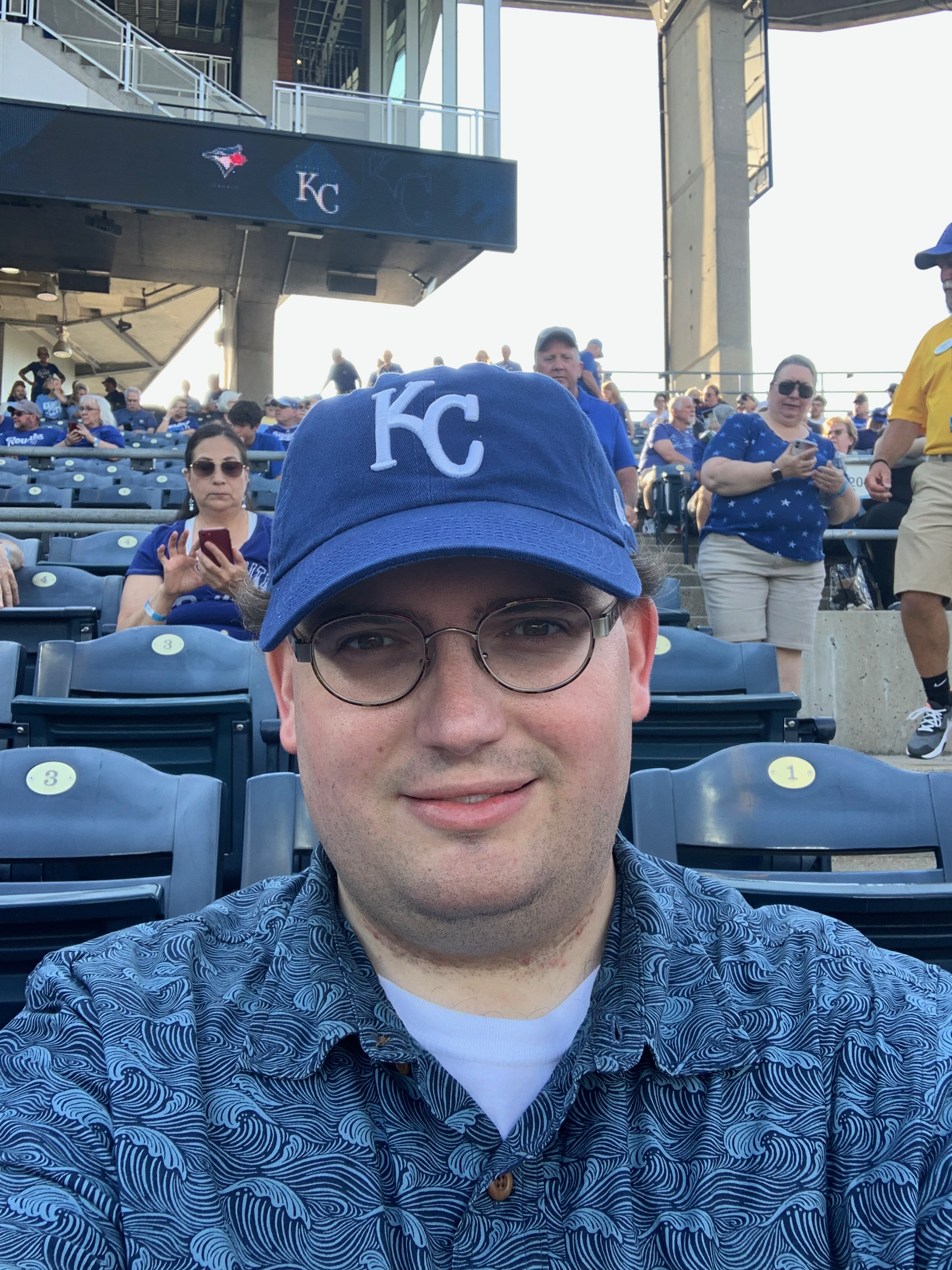
23 Years Later and I finally bought my first Royals hat.

Rivalries

The idea of a rivalry and all the extra stuff that goes with it seems to be baked into American culture. Rivalries often make for the most exciting games in a league’s calendar not only for the history traditionally associated with that matchup but also for the antics and occasional brawls that break out in the process of playing the game. As a young Cub fan I always expected there’d be a fight during a Cubs vs Cardinals game or a Cubs vs White Sox game, just as any meeting between the Red Sox and the Yankees seemed sure to produce the sort of atmosphere normally reserved in North American professional sports for the hockey rink.

Interestingly, going off of what I wrote about last week in terms of regionalism, I think it’s important to recognize that rivalries often define a region’s local identity more than anything else. The two great cities of Missouri, Kansas City and St. Louis, are defined just as much by the shuttlecocks at the Nelson-Atkins and the Gateway Arch as they are by the rivalry between the Royals and Cardinals, particularly during the 1985 World Series, which ended in Game 7 with a Royals victory over the red birds. I only hope that with the introduction of MLS’s new St. Louisian team, St. Louis City SC, that we’ll see a strong rivalry between “City” as likely they’re going to call themselves, and our own Sporting.

If anything unites most American cities and their surrounding metropolitan suburbs it’s a general dislike for other cities and their metros. Often the greatest of these rivalries seem to be founded in sports: the Chicago/St. Louis rivalry for example, which certainly began as a disagreement among two of the Midwest’s greatest metropolises in the nineteenth century and developed in the last decades of that century and into the early decades of the twentieth through the birth of the Cubs in 1871 and the ancestors of the Cardinals, the original St. Louis Browns, in 1882. In the decades and generations since that rivalry has grown not only with the introduction of the Blackhawks vs. Blues rivalry in hockey but also a general sentiment that I experienced as a Cub fan going to college at a place dominated by St. Louisians; it didn’t help that my freshman year was also a year when the redbirds won their last World Series.

On a larger scale it seems like we could carry this idea of the rivalry to a geopolitical level. Sure, the US has rivals, traditionally they’d be our counterparts in Europe, in particular in the nineteenth century Britain and in the first half of the twentieth century Germany. More recently though, in the last few generations the US’s biggest global rivals have tended to be the likes of Russia and more recently China. I will fully admit to playing off of the eternal bogeyman in the American psyche by playing the sublimely stereotypically Russian theme tune to the fantastic 1990 film The Hunt for Red October every time I find myself in St. Louis when the Cardinals are doing well. In my own silly way it’s playing off of fears of the bogeyman projected on the wall in this country in communism, comparing my own Cubs’ greatest rival to that red scourge.

It’s interesting though that we have come to develop such profound senses of national pride out of how different we are from other countries, or at least how different we see ourselves from other countries. People in positions of authority, both in government and in the media, have taken advantage of this idea of rivalry to profoundly change the political discussion: we hear more banter about the creeping influences of socialism or Islam today than we do from the same people about problems that face our country internally like racism, vast inequality, and the constant threat of violence due to our overly lenient gun laws.

I’ve often thought that if anything is true it’s that a people who define themselves by what they aren’t rather than what they are will surely fall apart in the long run. Equally, a people who cry wolf at the shadow of the wolf on the wall, labelling it something foreign, when its fangs are being used by the same crier to cause chaos in the cave itself is a people doomed to falter. We’ve found ways to use the excitement of sports to infiltrate our politics and our daily lives, forcing us to adopt a mindset that it’s always us vs. them. Eventually, if we’re not careful we’re going to bring about our own defeat on the field of play, and not by anything our opponents do. It’ll be an own goal, a safety, our knives in our own back that will bring the land of rivals to its knees.

Languages

Of any one of my talents, the one that I tend to pride myself in the most is my ability to pick up languages fairly easily. I listen for the patterns, for words that may sound familiar, and gradually piece together what the speaker or author is trying to say. I have a number of stories involving me fumbling through having to speak languages foreign to me, whether it be the time I accidentally said “no” in Finnish when I mean to say “eh?” as in asking the flight attendant to repeat her question, or the time when I tried to tell a pair of Flemish men I didn’t need to see a doctor after falling down a flight of stairs at the train station in Welkenraedt in eastern Belgium. My solution there, by the way, was to merge the German “Ich bin gut” with what little I knew of Dutch, coming up with “Ik bin gut.” Regardless of how accurate it was to the situation, the fumbled line in my attempted Flemish worked, and kept the medical attention at bay.

The first language I learned to speak was English, American English, centered on the Midwestern cities that I’ve called home, Chicago and Kansas City. I’ve often yearned for small signs here or there of linguistic peculiarities in my own speech, and in the ways my family and friends speak. While many of the most evident signs I’d hope would appear haven’t shown, we aren’t terribly distinctive in how we speak, pretty standard American to be honest, the potential that we could have some regionality in our speech certainly makes the foundations for a good story.

I wouldn’t really begin to learn other languages until I was 14, when I began taking classes in Irish, the language of the majority of my ancestors. I’ve always wanted to be fluent in Irish, to speak the language which I feel is the closest to the beating heart and origins of my community. Based on Census data, my great-grandparents’ generation among my Kane ancestors, the ones who came over from Mayo a century ago, were the last ones who likely had some Irish. That multigenerational gap in our ability to read, write, speak, and think in our ancestral language reflects the degree to which we’ve become American with each generation, to which we’ve given up the cóta of the coasts of Clew Bay and embraced our new urban Midwestern American nature to its fullest.

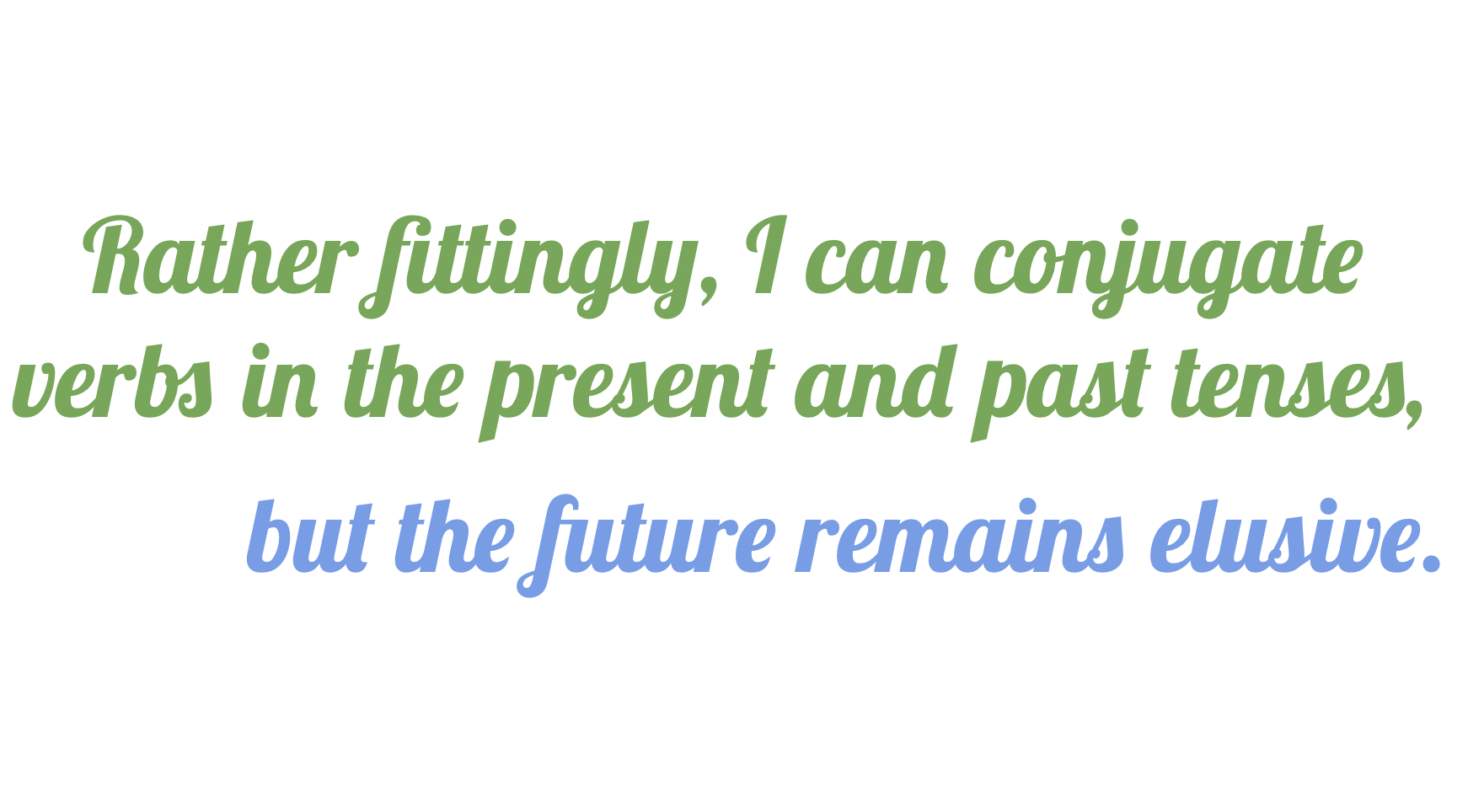
Today, I can do somethings in Irish; rather fittingly I can conjugate verbs in the present and past tense, but the future remains elusive. I use my limited Irish in some contexts, when she was still alive I’d talk to Noel in Irish, saving that language so dear to my heart for my dearest of friends. In the meantime, I’ve focused on other languages: I’m now on my third attempt to properly learn Latin, thankfully as I hope my previous post made clear, third time’s a charm. I’ve also spent a great deal of effort and time learning French, with enough comfort to the extent that I built my PhD dissertation’s source material around the availability of French sources that I could. I’ve spent time studying German and Italian, Ancient Greek, and Egyptian Hieroglyphs. I’ve studied my other ancestral languages, Welsh, Finnish, and Swedish, as well as a little more Flemish after my railway station tumble.

I once wrote a sentence in Irish that I thought expressed how I think about the language, how many of us the descendants of European immigrants spread across this continent may well equally think of their ancestral languages. Is ár dteanga an glór ár n-anama í. “Our language is the voice of our soul.” As best I can tell, it’s grammatically correct, and to me it has deep meaning. As long as we understand and remember our ancestral languages, the deep and intricate contexts of so many aspects of our familial manners and ways of life will stay alive. Even in the whisper of an ethnic memory that comes in preserving our names, the many Irish Americans named Patrick, Molly, Colleen, Brendan, Aidan, or Seán, we can see a hint of the Irish language alive today.

If I am able to truly become fluent in Irish, and I hope I’ll be able to dedicate the time and energy to do so in the long run, I hope my contribution to the language will reflect our times, that as truly it will recognize the efforts of generations past, my Irish will be the language as it is spoken in the twenty-first century, with recognition of the international nature of the language deeply rooted in the native soil from whence all Irish Americans’ ancestors came. I hope deeply, as an American cousin, that my efforts to continue my studies will reflect the respect and admiration I feel for the modern, progressive people my Irish cousins have become.

September – Thank God it’s over

Kansas City – After all the fun and adventure of this past summer, you’d think I’d take this semester a bit slower, a bit quieter, to recuperate and ready myself for the coming year. But then again, I’m not that sort of person. I started the semester with a bit of a bang – one month with event after event.

First there was Irish Fest on Labour Day weekend. Then there was a day of volunteering at the Irish Centre (Cúltúrlann Éireannach). This was followed by a 60+ hour week of academics, work, business, and other fun events. Then there was the wedding of two good friends in Lenoir, North Carolina. I returned to Rockhurst from the wedding exhausted, and ready for the quiet weekend to come. That came after another 60+ hour week, and at first it looked promising. But then something rather unfortunate happened. Saturday 21 September 2013 will always be one of those days that just didn’t have to happen – and yet in a big way it did. I woke that morning to an early alarm as I was going to be filming the Classroom scene for my film Sisyphus that day. However, none of the extras showed up to film – so I ended up having to postpone the shoot until this past Sunday 6 October. I left Rockhurst for my parents’ house, where my Mom was home alone getting ready for the Lyric Opera of Kansas City’s opening night premiere of Bellini’s I Capuleti e i Montecchi. The day before I drove my Dad up to the airport to fly to Chicago to see my Granddad, with plans of sorting out the plans to move him into hospice care by Sunday.

That, unfortunately didn’t happen. I was at 59th and Rockhill, heading back to my parents’ house after getting a shirt for the opera when my phone rang. My Dad was on the other end, at my Uncle Bill’s house in Suburban Chicagoland – my Granddad had died at about 16.30 CDT. From then on out, the entire world seemed to flip on its head. My Mom and I did go the opera that night, but the next morning I found myself driving her up to the Airport so she could fly up to Chicago to meet my Dad and work with the rest of their generation in the Kane family on the funeral arrangements. I stayed behind in Kansas City for a while longer, so that I wouldn’t miss too much class. That, as it turned out, didn’t really work so well. I missed my first class on Monday morning, Western Civilisation II, because I was taking the dogs to the vet for boarding for the time that I’d also be in Chicago. Then I skipped out on my Modern Political Philosophy class because I just didn’t feel like I could take it just then. Finally, I threw in the towel on school for the week when the power of what had happened to my family hit me like a bag of rocks in choir, when we were rehearsing the Jesuit hymn These Alone are Enough for the Family Weekend Mass.

I flew up to Chicago on the evening of the 23rd – weary, and ready to be with my parents, aunt, uncle, and cousins. It was a short flight, and considering that I had no bags to bring with, as my Mom had already packed everything I’d need – I flew up in the first row on Southwest! The time in Chicagoland was very emotional for me. Between facing the fact that now both of my Kane grandparents are dead, and experiencing all of these places again that I remembered from my early childhood, a time which I cherish quite dearly, I found it hard sometimes to face the facts. Thus, when we were driving from place to place, especially in the traffic on the Tristate Tollway and with that awful construction traffic on Dempster at the Tollway, I slept. The wake and funeral were nice. It was especially great to get to see all of the more distant cousins on my Dad’s side, many of my grandparents’ friends, and some college friends of my parents (including my Godparents). But in the end, I was just ready to go back to Kansas City and sleep for a long time.

After that second exhausting trip, I was in no mood for work. I ended up being a fair bit behind in my work, especially when it came to French. I’ve only just caught up. My classes on Thursday and Friday were a blur, and to be honest I probably wouldn’t have even had any will to go to them if it weren’t for the fact that I had nothing else to do at that point. By Friday 27 September, I had gone for at least 20 days with sleep worth only about 15 normal nights, and was in no mood for any more misadventures.

Thankfully, that weekend was anything but a misadventure. My cousin Ashley, who I’ve known for my entire life, got married! It was a very nice wedding, and a fantastic reception. That wedding was a good way to balance out the stress and grief of the month in which it occurred, as it showed me that even though all sorts of dour things happen in our lives, there’s still room for happiness and jolliness. Which on that note: Middlesex County Cricket finished 3rd in the County Championship! O, and the USA Men’s Team (the Waldoes as I call them) qualified for the ’14 World Cup in Brazil!

So, as I write this, safe and sound, now 7 days removed from that dreadful month, I have to say “Buíchos le Dia!” that it’s over. Less than 24 hours ago, I was able to shoot that scene that originally was intended to be shot on the 21st – and this time no one that I know died on the same day! September was about as poor at its’ game as Chivas USA is at soccer, which is saying something really sad about that month. But, on the plus side – I got paid at the end of it all, thanks to that week and a half of French tutoring that I did in August!

Hopefully I’ll be able to update a bit more in the future, as things may be settling down. We’ll have to see.