Tag Archives: Christianity

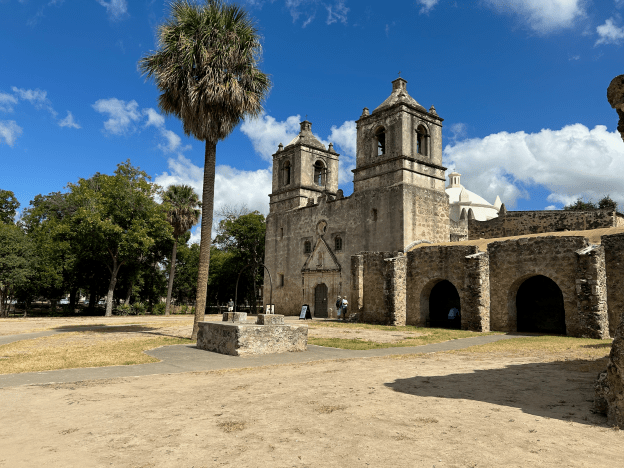
Mission Concepción, San Antonio, TX, USA

New Worlds

This week, I reflect on the flexibility of the word world.—Click here to support the Wednesday Blog: https://www.patreon.com/sthosdkane


This week, I reflect on the flexibility of the word world.


In my field the focus is often on nomenclature as much as it is on the history itself. We, early modern historians of the Atlantic are left dealing with the original intent of our historical subjects while also reckoning with the legacies of their choices in the living world today. That word world is one such central question, after all what does it really mean? In a twenty-first century context the world is synonymous with the Earth itself. I see in the sixteenth century the creation of the current state when the world can be a planetary designation. For past generations the world was something smaller, at most hemispheric yet more often regional in character. André Thevet’s use of the French word sauvage to define the alterity of those beyond his own world in turn set boundaries about his own world, what he wrote about was a Christian world centered on the Mediterranean that was a natural outgrowth of the classical civilizations of Greece and Rome.

I am hesitant then to use the term New World in my dissertation. Sure, it was a term in use in the sixteenth century, popularized by Peter Martyr d’Anghiera (1457–1526), yet in our time it’s gained enough shackles from the dark legacies of the conquest and colonization of these continents that I want to be conscious of my twenty-first century readers even as I seek to place my historical narrative in the sixteenth century. Thus, I argue instead that this new world was created by the conquest and colonization, that it is a new global world born from the encounter between the many old worlds that came before. This follows the arguments made by Marcy Norton concerning a Mesoamerican classical past to which the Spanish in particular looked when placing their new administration upon the remains of the old over the indigenous societies in present day Mexico.[1] I see in how Thevet described the one part of the Americas that was fully colonized in 1556, namely the island of Hispaniola, a new world in all its novelty and experimentation.

I grew up knowing of the Americas as the New World, it’s one term I remember hearing very early on in my youth. Even then, I felt a sense of reluctance at it, after all new things aren’t necessarily all good, so does that mean our New World is in fact worse off than the Old? Most of my family only arrived in the United States in the last four to five generations, at the time within the last century, and so for us America was still in some ways new. I treasure the stories my dad told me as a young boy about Chicago, where we lived; those stories were likely my introduction to history that led slowly toward the career I’ve now chosen. Even now, if I’m looking for something fun to read it will often be something about my hometown as it was a century ago. In 2024 I spent many happy hours engrossed in Jay Kirk’s biography of Carl Akeley (1864–1926), and a few months later once it was released I read eagerly Paul Brinkman’s Now is the Time to Collect about the Field Museum’s 1896 expedition to Africa. Granted, both deal with the same subject, the museum where my own curiosity was first sparked as a young kid, yet they are mementos of that same nostalgia that draws me back into what I thought of when first I considered this term New World. It speaks to Churchill’s famous final rousing word of hope in his “We shall fight on the beaches” speech that Britain need hold out “until in God’s good time, the New World, with all its power and might, steps forth to the rescue and liberation of the Old.”[2] This dichotomy between the youthful New World and our older cousins across the water is echoed in Bernard-Henri Lévy’s 2018 book The Empire and the Five Kings about the decline of American geopolitical power in the present century. Lévy wrote of America, the Empire, as the sons of Aeneas who several generations ago returned east to the Old World to liberate it as Churchill hoped. Yet now, the imperial sons of Aeneas are themselves fattened by their spoils of victory and incapable of meeting the struggles of the current moment as the threats are multiple and not focused on one rival superpower as they were for much of the last century.

Perhaps this is the key facet of this whole conundrum now: not only is the world so diffuse as to merit multiple definitions, but it reflects the uneasy global world in which we all live. For me the disquiet in all this comes just as much from the fact that the benefits which our interconnectedness ought to have brought––peace, economic, political, and social prosperity, greater human solidarity––are still mired in the same old problems of greed, small mindedness, and war as ever. We live in the shadow of Cain as much as in the warm glow of that optimism which keeps the home fires burning. We are at a place in our development as a species where disease, hunger, poverty, and war could all be avoided or cured on the sociopolitical level. We merely lack the will to do any of that. The optimistic promise of this New World which I perceived as a kid in Chicago remains but one vision of our shared reality. The New World into which I was born is built on the remnants of those old worlds that were often assimilated with violent force.I like to find the positive, if possible. When I was considering what I wanted to pursue in my doctoral studies I looked at what my friends were doing and first decided that I didn’t want to do something that would be depressing or sad. I wanted instead to focus on something that would fuel my curiosity and that connected back to those things which I’ve been most interested in throughout my life. I chose to study André Thevet’s sloth because the idea of being a sloth historian made me laugh. Now, with my first peer-reviewed article on the subject published with the journal Terrae Incognitae I feel that the work of these last six years is finally paying off.[3] That work considers the creation of a New World, while balancing contemporary sentiments around that term with historical perceptions of the same. I am after all someone who studies the past for the benefit of illuminating something as of yet uncovered about my subject. That said, I’m writing for readers living now and, in the future, and need to bear their perspectives in mind. That’s at the core of any communication: we learn foreign languages in order to communicate with people from other cultures, countries, and even worlds. I know that my writing is tinged with my own idiolect, yet I hope it remains universal enough to be understood by anyone who is curious enough to read it.


[1] Marcy Norton, The Tame and the Wild: People and Animals After 1492, (Harvard University Press, 2024), 305-313.

[2] Hansard HC Deb 04 June 1940 vol 361 cc787-98.

[3] Seán Thomas Kane, “A Sloth in the First French Colony in the Americas,” Terrae Incognitae 57, no. 3 (2025): 1–15.

On Conversion

This week, I spoke with a friend who converted to Catholicism as an adult about her conversion and how she relates to the Catholic Church as a whole.—Click here to support the Wednesday Blog: https://www.patreon.com/sthosdkane


This week, I spoke with a friend who converted to Catholicism as an adult about her conversion and how she relates to the Catholic Church as a whole.


The Catholic Church in 2025 stands at a crossroads in the shadow of our late Pope Francis when the world at large has fallen into so many new wars, conflicts, and when fearmongers are the loudest voices in so many countries and governments. It was striking then when Pope Leo XIV began his Urbi et Orbi address, his first public address as pontiff, last Thursday with the words “peace be with you.” To achieve that peace, one needs to allow one’s heart and soul to open to the possibility of peace and of dialogue with both our innermost selves and the world around us. Faith gives an avenue for this dialogue which has provided a moral foundation for generations. Biblical scholar Richard Elliott Friedman made the case in his book The Exodus: How It Happened and Why It Matters that the faith of Moses and the Hebrews evoked in Exodus was the first faith recorded which preached love for neighbor and love for oneself. It was the first time in human history that a religion sought to elevate humanity and dignify us as children of God made in the Image of God.

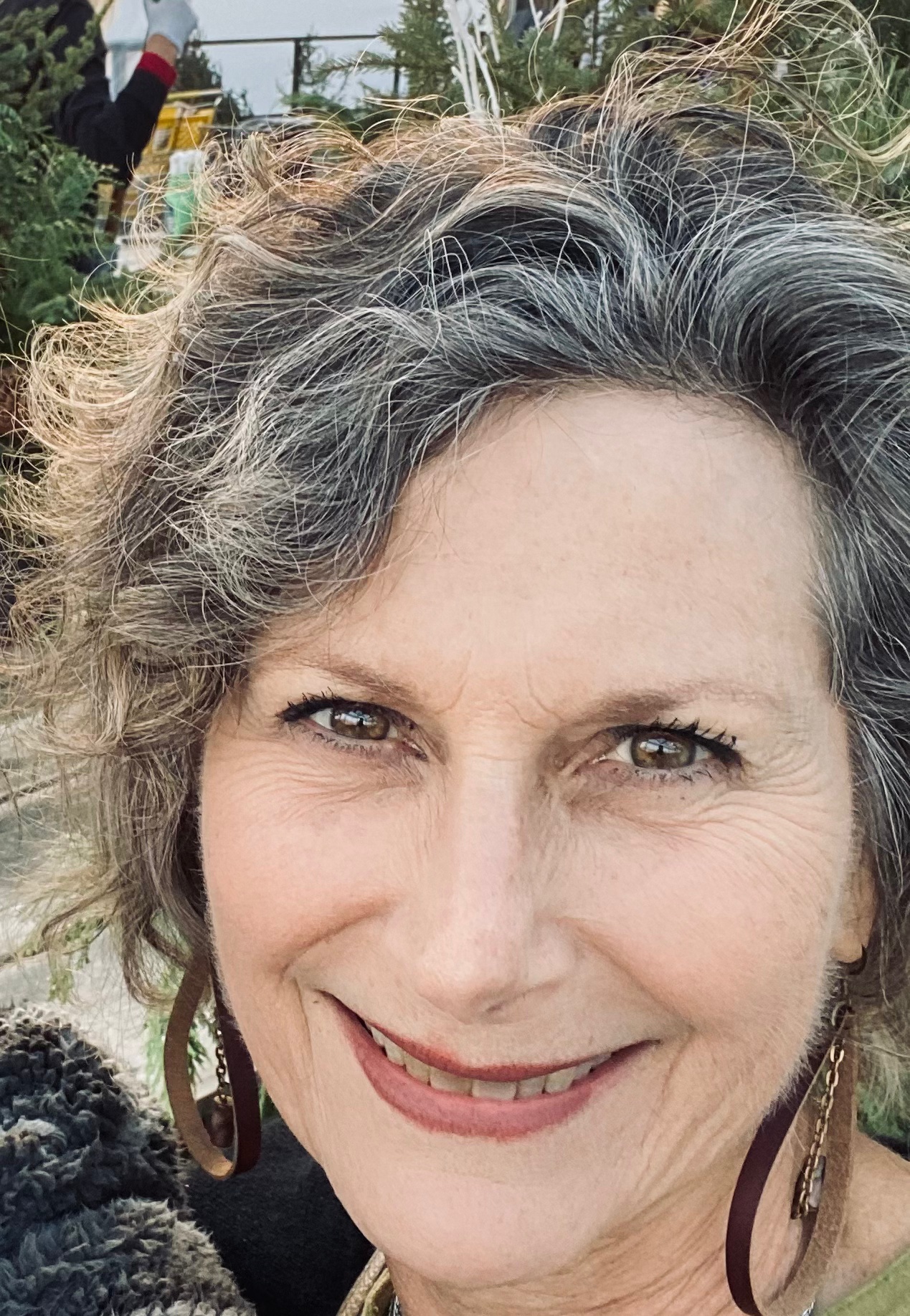
Kim Meyer

I’ve long considered this topic of conversion; in fact, I’ve often noticed how different the perceptions of our shared religion are between cradle Catholics like myself and converts to the Church. My own Catholicism is built on fifteen centuries of believers in my family going back to my distant early medieval Irish ancestors who in the fifth century surely noticed when St. Patrick made his pilgrimages up the holy mountain on the southern shore of Clew Bay, a mountain that towers over the townlands where my ancestors lived for thousands of years that now bears the saint’s name as Croagh Patrick. I asked my friend, Dr. Kim Meyer, if she could tell me more about her perceptions of her faith and our shared religion. A convert to Catholicism who grew up in a secular suburban Kansas City family with Lutheran and Methodist roots, Kim told me about how she found her faith through the most horrific experience of her life as a journalism student at Kansas State University reporting on the activities of a cult in Abeline, Kansas in 1977. Kim described it as “a really dark, dark time and my editors had people in the room with me when I was editing it because I was terrified. It was several months of terror.” After one particularly intense night of terror during her investigations in Abeline when she felt she “was terrified for my soul and I started praying to God, and my Mom had given me a penny of the 23rd Psalm on it, but I was so scared that I couldn’t remember the Lord’s Prayer so I kept rubbing this penny saying, ‘God, if you exist, save me until morning.’ It was really a horrible, horrible, terrifying experience. The next morning, I was still praying and the sun came up, and I realized that the sense of evil was no longer present.” Kim described how she went to several local religious leaders to tell them her story, including the cult leaders, but the only one who listened was the local Catholic priest at St. Andrew’s Parish in Abeline, Monsignor Alfred Wasinger.

This speaks to something that I’ve known, and that has led to little conversions of my own often from one plan or ambition to another. We are drawn to people who appreciate our humanity and who listen to us as this priest listened to Kim at the darkest moment in her life. That’s something that Pope Leo was famous for before his papacy; in all the reports of his life he’s often referred to as a good listener. This draw to a faith that listens to its people is what drew Kim to the Jesuits. More than just thinking of herself as a convert, Kim said she doesn’t “think of myself as a Catholic first. There’s still so much tradition and so much politicking around Catholicism that I find deeply offensive, but the Jesuits’ critical thinking, open spirit, missionary focus, all of that, and it’s the same theology for both, and it’s all about how we practice, and I’m not into the way how some sects of Catholicism practice.” For her, the Jesuits are “really trying to walk the Way of Jesus. It’s literally the Way of Jesus. Some people want to walk the way of Paul or the way of the most recent Pope, but they forget it’s really all about Jesus.” 

Converts like Kim have more of an opportunity to find “the beauty of questioning and the opportunity to discover their faith.” This questioning has marked my faith for most of my life, yet even more so in my adult years as I moved on from my Jesuit undergraduate university and onto graduate and doctoral programs outside of the Church. Whereas my faith is so deeply rooted in millennia old traditions and inheritances embodied in the last century by the various neighborhood parishes that my family called home in Chicago and Kansas City, Kim’s faith seems to fly above that tradition, seeking a closer connection with God through the mysteries of Catholicism and our belief that God opens us to a wider world of possibilities. In Kim’s words, “once I came to believe that God loves me and God is in every person, and I really believed in it that the world wasn’t really the same.” It is notable that of those old neighborhood parish churches, Kim and my parish, St. Francis Xavier in Kansas City is the only one left open. Unlike the others it has adapted with the changing demographics of its home neighborhood, which a few generations ago was largely Irish American, and now caters to Kansas City Catholics seeking Ignatian spirituality. St. Francis was one of the fastest growing parishes in Kansas City during the pandemic, in large part because of its Jesuit affiliation. However, due to a variety of factors the Jesuits left the parish at the end of July 2024 and transferred its leadership to the Diocese of Kansas City-St. Joseph, leading to an uncertain moment for a parish that stands out in this city for its openness and Ignatian spirituality. Kim noted that “Last year we didn’t know what the transition away from being Jesuit would look like, and our community is just as Ignatian as it has ever been.”

Because of this, Kim said she feels more closely connected to the Jesuits than to the Church as a whole. I’ve been struck in the two years since I met Kim how much her outward approach to others reflects this deep well of her faith. I felt in our conversation that we could relate in that depth, though I do not outwardly project my own beliefs in the same way she does, preferring to take a rational approach to life. Yet that rationality has its limits, as I’ve written here in the Wednesday Blog before. Faith and a conversion to accepting the possibility of the improbable is necessary to be open to new and unknown things both in the furthest fringes of our knowledge and at home in our understandings of ourselves. Like anything, there is a blind spot closest to home and that self-reflection and introspection is necessary to live a full and enriching life.

With the election of Pope Leo, the Cardinals embraced this period of self-reflection for the Church in full. They chose a pope who embraced synodality in his Urbi et Orbi address and who said he would continue the efforts of Pope Francis all while seeking to build bridges between the increasingly disparate factions and camps in the Church. The Pope’s humanity shows in his imperfections, in his poor history of dealing with the sex abuse scandals, something familiar to many of us in our own bishops and local leadership. Kim’s approach to life, her mentality born from her Catholic faith has led her to think “’what would Jesus do?’ and that means looking at each person and trying to see God inside of them, and that’s each person.” This stands in contrast to “‘what is the right thing,’ which has less clarity and less consistency in the secular world. Because if you think right vs. not right, where you draw that line is a lot more subjective in the secular world.” The greatest way toward conversion, she said, is prayer. “Pray with others, go find somebody you trust as a spiritual mentor. Stretch yourself and pray. Find ways that you praise that you never imagined.” Both of us pray the Ignatian Examen in our own ways, as Kim said “Prayer changes over time. What I do in my prayer time changes from one season to the next.”Just as May brought us a new Pope and each passing day new things to worry about in politics, the economy, and in ordinary life, so too this conversation told me that the place where one’s spirit is resting will change with time. It may float along in the river of our life, following the currents where they take it, yet it will be there for an opportunity to pray to announce itself. In the wider world we hear messages of people seeking connection with something greater than themselves; it’s a part of our social nature. We do these things to find connection with other people and to grow in those connections as we were born to do. These are all conversions, all transformations of ourselves which can reawaken something dormant that will lead to us living fuller and richer lives. A conversion can reawaken the self to their spirit and spiritual need for connection to something greater than themselves through God as love.


On Servant Leadership

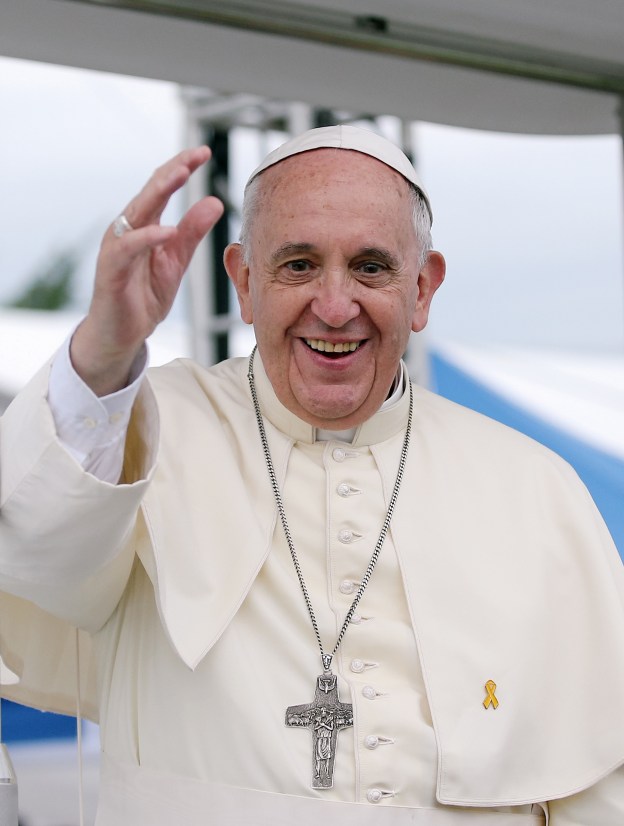
This week, in memory of His Holiness Pope Francis and of the revolutionary anniversaries in America and Ireland this week, some words on the humility necessary for the best sorts of leaders.—Click here to support the Wednesday Blog: https://www.patreon.com/sthosdkanePhoto: By Korea.net / Korean Culture and Information Service (Photographer name), CC BY-SA 2.0, https://commons.wikimedia.org/w/index.php?curid=34828249

Photo Credit: By Korea.net / Korean Culture and Information Service (Photographer name), CC BY-SA 2.0, https://commons.wikimedia.org/w/index.php?curid=34828249


This week, in memory of His Holiness Pope Francis and of the revolutionary anniversaries in America and Ireland this week, some words on the humility necessary for the best sorts of leaders.


Over the past weekend as we marked the 250th anniversary of Paul Revere’s Ride, the Battles of Lexington and Concord, the Siege of Boston, and the beginning of the American Revolution, I started to think about writing this week about that anniversary. I partook in the Veterans’ Rally on the Plaza here in Kansas City, which was part of the National Day of Action against Kings. During the hour walk to and from the event in Mill Creek Park I thought long and hard about what I would say, of my fascination with Paul Revere as a child, or about my first visit to Boston in 2002 when my parents & I walked the Freedom Trail with a family friend who I reconnected with on this most recent trip. Normally, at this point in April I’m more focused on the more recent revolutionary anniversary of the Easter Rising which began with the reading of the Proclamation of the Irish Republic in front of the General Post Office in Dublin. Perhaps I could blend the two revolutionary touchstones into something profound for our own moment; of the unrealized dreams and aspirations of both sets of revolutionaries.

Yet events of the following days have changed all that. I’m writing this now close to two hours after I heard the sad news of the death of Pope Francis. After a half an hour replying to messages from my parents and various friends who texted me the news over the night, I wrote my own brief message which appeared on my social media accounts:

This one feels different to me. Papa Frank was our pope: from the Americas, a Jesuit, and more open minded to the world. His Universal Synod will remain a testament to the man and his twelve years of service to our Church.

Francis’s pontificate marked my early adult years. He was elected at the height of my time as a student at Rockhurst University, when I was surrounded by Jesuit philosophy and spirituality, at a moment when his election seemed to match the optimism I felt in our world. Pope Francis remained a rock amid the tempestuousness of the years that have followed. His humility and humanity shone beyond either of the other two popes of my lifetime. Last summer, my European tour originally included nearly a month in Italy on the way to a dear friend’s wedding party. I’d planned to be in Rome for one Wednesday in the hopes of going into the Paul VI Audience Hall to see Pope Francis in person, even if I was way in the back of the room and wouldn’t be able to meet him. The Swiss & Italian portions of that trip didn’t end up happening, and I regret not getting to see the man in person.

Despite this, I felt that I knew Pope Francis on a personal level. He always struck me as another guy trying to make the best out of life. I’ve heard many people refer to him as the grandfather of the Church away in the Vatican keeping us in mind and in good humor. I like this image; it matches what I saw when he was interviewed by the American television networks. Like Voltaire, my mental image of Pope Francis is him with a smile on his face, an earnest and caring smile and perhaps with a joke in mind. Pope Francis was a leader I was willing to follow because he did so with intense humility. I was standing in the lobby of the Campus Ministry, Counseling, and Career Counseling offices at Rockhurst that afternoon of 13 March 2013 when Cardinal Tauran delivered the Habemus papam announcement from the balcony of St. Peter’s Basilica and announced that Cardinal Jorge Mario Bergoglio of Buenos Aires was our new Pope, Francis, a name chosen to commemorate the humblest of saints. That he asked us to pray for him, to help him in his pontificate was for me the first sign that this man was different.

The Catholic Church exists in a very different world today than it did a century ago. Then when only 150 years had passed since the eruption of the American Revolution and even less since the anticlerical outbursts of the French Revolution the relationship of the Church to democracy was more fraught. A century ago, fascists in Italy claimed they were acting in defense of tradition and of the Church to attacks from communism. We saw where that road led in the Second World War. A century ago, the Church emerged from the ashes of the Irish Civil War in a dominant position in the new Free State, a position it would hold through the founding of the Republic in 1949 and into my own lifetime. Here in America, Catholic voices led the chorus of the most extreme and anti-democratic factions in this country railing against anyone who opposed them, even their fellow Catholics.

I worried twelve years ago as we neared the end of the first decade of Pope Benedict XVI’s reign that the disconnect between the Church and our world would only continue, and that locally the voices of we liberals and progressives in the Church would remain a hushed minority. We received two new bishops in Greater Kansas City that were appointed by St. John Paul II in 2004; in January Archbishop Fred Naumann was appointed to lead the Archdiocese of Kansas City in Kansas where I grew up, and in May Bishop Robert Finn was appointed to lead the Diocese of Kansas City-St. Joseph, which covers the Missouri half of this metropolis. Both were far more conservative than their predecessors, and far more dogmatic. Bishop Finn closed a great many of the social justice ministries of the Diocese and alienated at least a quarter of the local Catholics. My own parish, St. Francis Xavier, often stood in sharp opposition to his leadership as the Jesuit parish remained welcoming and open to all. By the time Pope Francis was elected Finn’s leadership was crumbling under the weight of his inaction and obstruction with the abuse scandals, though Archbishop Naumann was only replaced in the last two weeks with the far more synodal and open Bishop W. Shawn McKnight, who previously led the Diocese of Jefferson City in central Missouri. I for one am hopeful that Archbishop elect McKnight will prove to be a better listener to the Catholics of his new archdiocese.

I remember the sun shining on the day when Pope Francis was elected. It was actually very similar to today, Monday, 21 April 2025, and my sense of a new dawn for our Church. The Sun was shining overhead, and the Spring birdsong was resounding around campus. I experienced many of the same things today. It’s profound to me how similar those two days are.

It did feel revolutionary in many ways when he was elected. He was the first Pope from the Americas, an Argentinian by birth. He was the first Jesuit pontiff, the first pope in a long time to be the child of immigrants. Pope Francis felt like he was one of us. Over the weekend I thought a great deal about what it takes to enact change and restore optimism and hope to a society such as ours which is so bereft of it. Pope Francis brought hope because he was one of us. The minutemen who stood up for their communities and their rights as citizens of a democracy 250 years ago at Concord were like us. The Irish Volunteers like so many of my great-grandparents’ siblings who stood up to British colonial rule a century ago and for better or worse kept fighting even after some liberty had been attained were like us. The people I saw on Saturday were mere ordinary people standing up not just for themselves but for all of us.

The true merits of a servant leader lie in their willingness to help everyone, not only their friends or fellows. Pope Francis was the Papa for all Catholics, especially those who disagreed with him and so loudly denounced his efforts at reform. He was the Pope who listened to us even when the bishops receiving his messages didn’t always heed them. I participated in the Synod on Synodality in the initial parochial stage when I was still in Binghamton; I spent an evening writing my own lengthy and heartfelt answers to the questionnaire, and when my parish’s report was published, I was excited to see some of my comments appear amid the harmonious chorus of like-minded people at my parish. Yet when the diocesan report was published, I was saddened to see how little of that chorus was heard, and at the one listening session I was able to attend several years into the Synod process I felt that as much as we in the laity heard each other that our local clerical leadership kept their ears closed.A servant leader listens to the people. They are approachable, open, and honest about their decisions. I’ve known many leaders who fit this bill: from the late Pope to many of my pastors down the years, to our Mayor Quinton Lucas, a man who I consider to be a friend. Servant leaders do great things as ordinary people. During my walk home from the rally, I remembered a scene from the second episode of the 2008 HBO miniseries John Adams, one of the touchstones of all millennial history buffs in this country. That scene showed a team of men and oxen pulling the cannons from Fort Ticonderoga past the Adams farm to the Dorchester Heights to the south of Boston. I rewatched this episode that afternoon and felt a upswelling of emotion at seeing something akin to what I saw on the Plaza that afternoon: ordinary people working together for a common cause to make life better for all of us. These are the extraordinary acts of ordinary people. That, dear reader, is servant leadership.


The Divine Essence

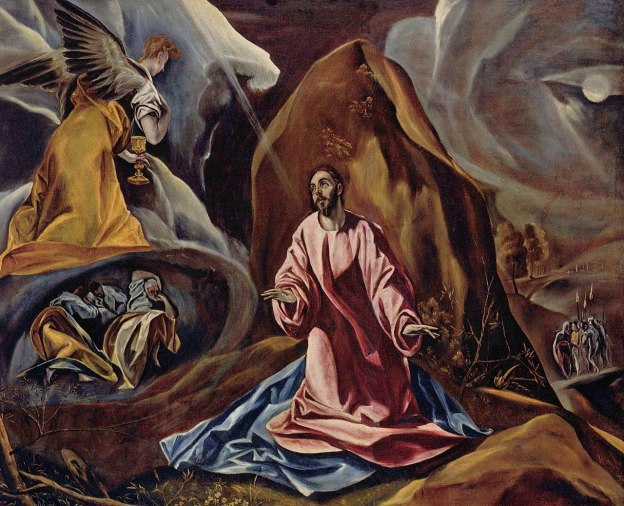
Art: Studio of El Greco, “Agony in the Garden,” (1590) oil on canvas, 102 x 131 cm, Toledo Art Museum, Toledo, Ohio, USA, ⁠National Gallery, London⁠.

This week, a meditation on the Name of God.—Art: Studio of El Greco, "Agony in the Garden," (1590) oil on canvas, 102 x 131 cm, Toledo Art Museum, Toledo, Ohio, USA, National Gallery, London.Click here to support the Wednesday Blog: https://www.patreon.com/sthosdkane


This week, a meditation on the Name of God.


At the start of Advent last November, I picked up a little blue book after Mass as an Advent lectio divina guide for the coming weeks. I’d done this several times before in Advent and Lent, the two holy seasons of preparation in Christianity, yet this time I actually read that little blue book and kept up with it each day through Christmas. By the end of it I was looking forward to being done with this one part of my nightly routine before bed, the time when I was able to sit and read the daily reflection. I wasn’t sure then if I would pick up the little black book when it appeared at my parish the weekend before Ash Wednesday, and yet when it was there, I took a copy home.

This year’s little black book offers reflections on St. John’s Gospel, the most spiritual in focus of the evangelists. Several aspects of the readings have caught my attention, usually out of a curiosity concerning the grammar or translation of the biblical text. On one early day, the reflection was on John’s recounting of the arrest of Jesus in the Garden of Gethsemane. This recounting contradicts the three other Gospels in that Jesus asks the soldiers to let his disciples go, rather than the disciples taking flight in fear of the soldiers. It is more self-sacrificial, following the prophetic undertones of the Gospel overall. Not only does this vital moment of arrest in the Passion narrative take place in a Garden, akin to the Garden of Eden where humanity’s fall into sin occurred, but it is also here where Jesus revealed Himself as God the Son. Quoting here from the New American Bible:

[4] Jesus, knowing everything that was going to happen to him, went out and said to them, “Whom are you looking for?”[5] They said to him, “Jesus the Nazorean.” He said to them, “I AM.” Judas his betrayer was also there with them. [6] When he said to them, “I AM,” they turned away and fell to the ground. [7] So he again asked them, “Whom are you looking for?” They said, “Jesus the Nazorean.” [8] Jesus answered, “I told you that I AM. So if you are looking for me, let these men go.”

(John 18: 4–8)

In this passage the omniscience of God is first revealed, followed by the humility of God the Son as merely one among them, “the Nazorean.” Here though the omnipotence of God as the Divine Essence, existence in its purest form as “I AM,”[1] before showing such mercy toward the soldiers at making it clear he was in their power and would surrender to them yet asking for mercy from them for his friends, his disciples who not being omniscient were very much afraid as any of us would be. It is the third part of this passage, the identification of God that I wish to focus on here.

The Name of God is known as the Tetragrammaton after the four Hebrew letters which comprise that Name. These are the four holiest letter combinations out there. The Name of God is too sacred to write in Judaism, and considering Hebrew is an abjad lacking written vowels it’s not entirely certain how this Name was originally pronounced before that prohibition.[2] This prohibition extends in some traditions to not even writing the word God, as it is capitalized as the common Name of God in regular parlance. I grew up capitalizing this word in reference to the Abrahamic God, who I do believe is the Creator and One True God, I don’t just recite the Nicene Creed every week at Mass to do it; and yes, this capitalization is in line with the tradition of capitalizing proper nouns in all of the languages I speak and write. Yet I’ve never really thought of God as a name, rather it’s a title in the same way that Christ is a title and Jesus the name. I’ve had some students over the years who won’t write God out, instead writing “G-d” out of respect for this title, which I think is fair. For the sake of my readers, I won’t include the Hebrew Tetragrammaton here, you can look it up on your own.

What I’m more interested in is how the Tetragrammaton was translated from Biblical Hebrew into the other languages in which I’ve read the Bible. There are really four such languages: English, Latin, Koine Greek, and Irish. 

I was first introduced to the Bible and to my Catholic faith through English, I was born in the second generation after the vernacular Mass was allowed largely replacing the older Tridentine Mass said in Latin. The New American Bible (NAB) which I read from a few paragraphs back is the translation that I grew up with, and the one which I use in all aspects of my life. It was also developed during Vatican II as the approved English biblical translation for the United States. In Ireland, Australia, and New Zealand the Jerusalem Bible (JB) is the translation used, while in Great Britain the English Standard Version – Catholic Edition (ESV-CE) is used. 

I was introduced to the Latin Vulgate and Greek New Testament and Septuagint in high school and college and today I own a copy of the Greek New Testament published by the German Bible Society (Deutsche Bibelgesellschaft). Both are key sources for the English translations that I grew up with, alongside the Hebrew Tanakh itself. I chose St. James Academy for my high school years largely because they offered Latin, and while the fact that Latin remains the official language of the Roman Catholic Church, I was more interested in reading classical Roman literature. Likewise, the first of the two Ancient Greek classes I’ve taken was at St. James under the direction of our Latin teacher Bob Weinstein. That class was focused on Classical Attic Greek from democratic Athens of the 5th century BCE. In college at Rockhurst I made the 5 century leap forward to the Koine Greek of the 1st century CE when I studied Biblical Greek under Professor Daniel Stramara. I wasn’t the best student, yet I was fascinated by that class and would love someday to study Latin and Greek more fully. It would certainly be a benefit to my research.

Finally, while I’ve known of the Bíobla Naofa, the approved Irish translation of the Bible, for a long while, I only bought one in the last year. Irish is an odd language for me that feels untouched by the embrace of vernacular piety for me as by the time the Vatican II Council occurred between 1962 and 1965 my family largely spoke English, though the last generation of native Irish speakers were still around. For me then the Bíobla Naofa is as much a study tool as it is an aspiration of piety. I keep mine on my desk the easier to reference when I’m curious how a particular word or phrase is translated into Irish. The Bible is a good source if you want to see how common biblical names are translated from one language to another. It’s how I know that the Irish biblical tradition predates the Anglo-Norman invasion of 1169 because St. John is called Naomh Eoin, not Naomh Seán. My name is an Irish rendering of the French name Jean, while Eoin is an older rendering of the Latin and Greek name Ioannes, which is also the parent of the French Jean. The Evangelist is thus known by the same name today as the Celtic monks knew him in the early medieval period when the Irish cultural influence on Europe was at its peak.

Returning then to the Tetragrammaton, when I read this passage from St. John’s Gospel that evening, I was curious to see how it was translated from the original Koine Greek into Latin and Irish. Translation is a funny business, it’s not ever as simple as going word-by-word and replacing the original language’s text with the target language’s equivalent. There’s far more nuance to each language and its dialects to allow for this. I’ve learned this in my efforts to translate André Thevet’s 1557 book Les Singularitez de la France Antarctique from Middle French into Modern English. The last English translation was written in 1568 and is thus in Early Modern English from the generation just before William Shakespeare. Thanks to the bard Early Modern English is still fairly familiar to many of us, myself included, yet it is still different from how this language sounds and is written today. To make the first draft of my translation I brought together a composite of the 1558 Antwerp French edition, the 1568 London translation, the 1878 Paris French edition, and the 1944 and 1978 Brazilian Portuguese translations to create an accurate and modern English translation fitting for the 21stcentury.[3] All this is to say that translation is far more complicated than just taking the original text and interpreting each word on its own. The words work together within the ecosystem of the phrase.

I was curious then to see if the English “I AM THAT AM” was perhaps clunkier than the Greek. This full phrase is familiar to me especially from the Burning Bush story in the Book of Exodus (Ch. 3), in which Moses meets God in a burning bush. This scene is beautifully retold in the 1998 animated film The Prince of Egypt which is a classic from my childhood. The four words we have mirror the four letters of the Tetragrammaton in the original Hebrew, yet these four words are reduced to two in Greek. In John’s telling Jesus’s response “I AM,” is written in the original Koine Greek as “ἐγώ εἰμι,” (John 18:5) with the full phrase in the Septuagint’s retelling of the burning bush story written as “ἐγώ εἰμι ὁ ὤν,” (Exodus 3:14) or I am the Being. I feel this final word ὤν is essential here. It is the present active participle of the Greek copular verb εἰμι. In a sense, it is saying that God is existence itself, the essence behind the Cosmos and all Reality itself. One translation of ὤν in the Liddell, Scott, Jones Ancient Greek Lexicon (LSJ) is the English word fact.

This is adopted into Latin somewhat, as the Vulgate is drawn so much from the Greek Bible, where the Name of God is rendered as “Ego sum qui sum,” whence we received the English “I AM THAT AM.” Yet because Latin doesn’t have a similar present active participle for the copular verb sum, the reuse of the indicative present active form sum is necessary. The English present participle of be is being, yet replacing the second am in the name with being doesn’t work grammatically in this language.

I was pleasantly surprised to see the Irish translation of this phrase for how simple it is. The Greek ἐγώ εἰμιwas translated as “Is mise é,” a phrase which I’d usually translate back into English as “I am he.” On an immediate level this is profound in its everyday character. This is something I’d say when someone asks “An bhfuil tú Seán?” Yet on a deeper level it speaks to Irish’s ability to express emphasis in a manner unfamiliar to English. The first person pronoun in Irish is , this is the translation of both the English I and me. Yet the -seending tacked onto it expresses extra emphasis on the pronoun. The closest we can get in English, or at least in my American English, to this is saying “me too,” or perhaps capitalizing ME and adding an exclamation mark behind it (or several if you’re one of those people who are overly fond of exclamatory sentences). So, God’s existence is expressed in Irish in the emphatic, as something to be shouted from the rooftops in wonder all while reflecting the priority Irish gives to all of us to be worthy of emphasizing no matter how mighty or small we may be. The Irish translation of the full Name from Exodus is “Is mé an te atá ann,” which is closer in meaning to the Greek ἐγώ εἰμι ὁ ὤν, translating into English as “I am the one who is.” Again, this speaks to the ability of Irish to interpret the existence of God as the essence of reality.

In my undergraduate years when I started to think deeply about the Tetragrammaton & the Name of God, I settled on the idea that the best way to describe God without limiting God in human terms was to focus on God as the essence of life. In this way, I began to refer to God in my theological studies as the Divine Essence, in an attempt to better reflect this truth that God is omniscient, omnipotent, and omnipresent. The Divine Essence rises above any limitations of human terminology or senses of gender that weigh down even the word God, which is traditionally masculine in English and its fellow Indo-European languages. I’d rather see God in God’s fullness existing beyond gender, the better “to see the Face of God,” to quote Jean Valjean’s last words in the musical adaptation of Victor Hugo’s Les Misérables.I’ve had trouble with this thinking in the last few years, because how should I begin to approach God in these terms in prayer? How can I seek any sort of personal connection to God when I’ve devoted such effort to seek to understand God in such abstract terms by stretching language as far as it will go without breaking? This Lent that is where I stand, and where I am uncertain. Looking at the story of the Garden of Gethsemane told in John’s Gospel in this year’s little black book, I noticed that while Jesus revealed His true Nature, he also identified himself as mere “Jesus the Nazorean,” a human and God all the same. That human nature is approachable, personable. I remember how in the Ignatian Examen one is called to think of one sitting with Jesus while one reflects on their day. This is a starting point, and a good point of departure for reflection this Lent.


[1] In my Catholic tradition we capitalize this phrase as the name of God.

[2] See Richard Elliott Friedman, The Exodus: How it Happened and Why it Matters, (New York: HarperOne, 2017) for more on this. I really enjoyed reading this book a year ago.

[3] NB: I used a 2018 reprint of the 1944 Brazilian Portuguese translation.


Three Ologies

This week, talking through three terms I’ve historically had trouble understanding: epistemology, ontology, and teleology.—Click here to support the Wednesday Blog: https://www.patreon.com/sthosdkane


This week, talking through three terms I’ve historically had trouble understanding.


A major turning point in my life came at the end of 2014 when I decided to drop my philosophy major to a minor and not take the final class that I needed to complete that major. The class in question was Continental Philosophy, and it remains one of those decisions that I regret because it closed some doors for me in the long run even while it seemed like a reasonable decision in the short term. A year later, now working on my master’s degree in International Relations and Democratic Politics at the University of Westminster, I was reminded daily that I really should’ve just taken that last class because so much of what we were studying was based in continental philosophy.

I initially pursued a triple major in History, Philosophy, and Theology and a double minor in French and Music at Rockhurst University. I was quite proud of the fact that up to that point in my seven completed semesters at Rockhurst that I’d been able to juggle those three majors and the two minors while still having an active and fulfilling social life on campus. I went into Rockhurst with several vague ideas of what I might want to do with these degrees when I was finished; notably I remember both considering doing a Ph.D., likely in History, and possibly going from Rockhurst either into the Jesuit novitiate or into a diocesan Catholic seminary to become a priest. The first four years of Catholic seminary is comprised of that philosophy bachelor’s degree, so it felt like a good idea to undertake that at Rockhurst and keep the door open.

Now ten years after I would’ve finished my undergraduate with that philosophy degree, I realize that even as I continued to consider holy orders that I may well have properly begun to close that door in my early twenties, not feeling that the priesthood was the right fit for me in spite of what many people have said. Even then, most of the other professions that I’ve considered have been shrinking in one way or another in my lifetime. It feels here as in so many other aspects of my life that I was born at a high point in our society’s capacity to consider the arts, humanities, and even the sciences and that as I’ve gotten older that capacity has diminished time and again. Even while I continue to be frustrated to remain in these wilderness years, I nevertheless continue to learn and to grow in my understanding of what is possible for me to do in my career.

In the last seven years I’ve reasserted myself as a historian first and foremost, settling into the Renaissance as my period of study in late 2017 and gradually shifting from considering the history of Englishwomen’s education to the history of translation to now the history of natural history. Yet all of these disciplines lie under the common umbrella of intellectual history. My manner of writing the history I craft tends to speak toward French notions of mentality and perception, while the economics I still occasionally encounter in my work speak to Max Weber’s notions of capitalism as a broader Cross-Channel enterprise including Brittany and Normandy alongside England, Picardy, Flanders, and the Dutch Republic. I’m beginning to try out a new method of writing history that draws on the natural sciences to better understand the animals and other natural things described by my Renaissance cosmographers and natural historians.

Amid all of this, three words continue to appear, three words which I have often had trouble remembering their meaning. These three are epistemology, ontology, and teleology. In spite of my training in Ancient Greek, I still have trouble keeping these three apart. They represent three central tenants of philosophy which help make sense of how we understand things. It may not sound like the strongest topic for a riveting podcast episode, but for those of you listening bear with me.

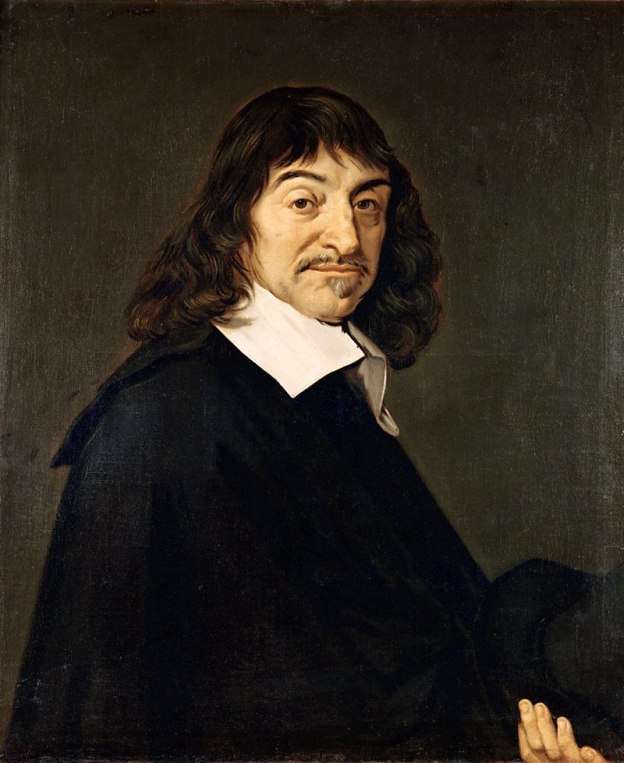
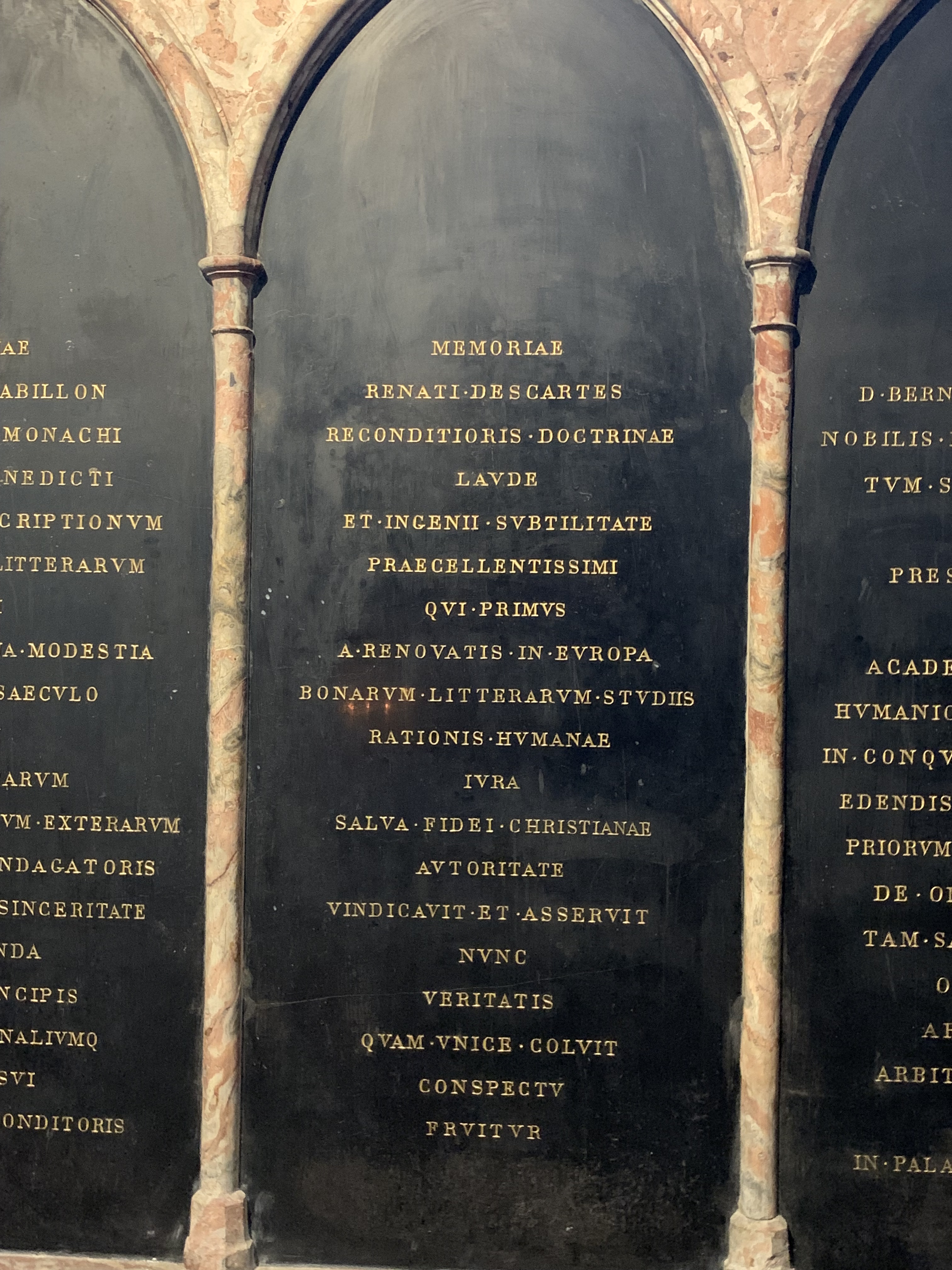
Descartes’s tomb, photo by the author.

Epistemology is the theory of knowledge. It distinguishes things which are justified from mere opinions. This theory of knowledge considers propositions about facts, practices which form knowledge, and familiarity with an object thus allowing the subject to know it. This word episteme in Greek (ἐπιστήμη) translates into English as both knowledge and science. Science itself is a word which at its core refers to knowledge, for the root Latin verb sciō means “to know.” We know for instance that we exist because we can recognize our existence, in Descartes’s famous words “I think, therefore I am.” I made a point of visiting Descartes’s tomb in the Abbey Church of St. Germain-des-Prés when I was in Paris in October 2023 because so much of my own philosophy is Cartesian in its origins. I reject the principle that we could be living in a simulation on the grounds that based on what we can know and perceive we are not inclined to accept such a suggestion.

The second of these words is ontology, a branch of metaphysics dealing with the nature of being. This word derives from the present participle of the Greek to-be verb εἰμί. I stand by my assertion that the life we are living is real because we can recognize it in large part because the best explanation that I’ve found for the course our history has taken is reliant on us having the freedom to decide the courses of our own lives. This free will explains how a society can seem to take steps backward even while the chaos those retreats cause is to the society’s detriment. The method which I am developing in my research to understand the nature of historical animals using modern scientific research is ontological in character. I can test if this method will work by applying it to particular individual animals who appear in the historical record and determining their true character by a process of eliminating candidate species until the animal’s own species is determined. In this search for the nature of these animals I hope to prove that the historical past, before the development of the scientific method in the seventeenth century, is valuable to the natural sciences as a means of understanding the longer-term nature of other animals during the period in which human influence upon nature was growing toward the Anthropocene which we find ourselves in today.

I like to think of ontology in the linguistic context of how the copular to be verb appears in our literature. Think, for instance, of how God is identified in the Bible. In the story of the burning bush, the Divine is referred to as “I Am that I Am,” or rather the purest expression of existence. For this reason, when I was an undergraduate in my theology major, I began to refer to God as the Divine Essence owing to the root of essence in the Latin copular verb. English recognizes a far wider set of states of being than does Irish. Where in English I might say “I am sad,” in Irish I would say “sadness is upon me,” or “Tá brón orm.”

The third of these words is teleology. This is the explanation of phenomena in terms of their purpose rather than the manner of their invention. Τέλος (telos) is the Greek word for an end, an aim, or a goal. The purpose of something’s existence then is at focus here. I do question this idea that we have a specific purpose in life, perhaps because mine has not gone quite how I expected. In my Catholicism, the most teleological concept we retain is the idea of a vocation either to holy orders, marriage, or to the single life. The teleology at play here speaks to some sense of destiny which I feel stands in opposition to our free will. Perhaps there is some purpose to life, at its initial conception in the first moments that matter began to form in the void that became our Universe, yet I do not believe that I can perceive any intended influence beyond the flick of the first domino at the Big Bang. We may not even be sure that the Big Bang was the beginning of everything, after all there had to be energy to build up to cause such a tremendous explosion in the first place. In a theological view I would point to the Incarnation of Jesus as an example of telos in our history, I am a Catholic after all. My lingering question is where should that theological teleology interact with the other ways of knowing?

I’ve written here before about my view that belief and knowledge are two distinct yet interrelated things. One must believe in one’s senses to know, yet there are things in which one can believe without knowing which one cannot know without believing. The prime example of this is God; “I believe in One God,” it’s something I say every week at Mass in the Creed, “Credo in unum Deum,” in the Latin original of our Roman Missal. Yet God alone is a tremendous challenge to know because God is both paradoxical and far greater than the extent of my knowledge. For this reason, we had the Incarnation, as we recite in the Creed:

“I believe in one Lord Jesus Christ,

The Only Begotten Son of God,

Born of the Father before all ages.”

For God to be knowable God needed to come down to our human level in the person of Jesus, God the Son. This was Jesus’s telos, to be known, to be heard, and as we believe restore faith in God and cleanse humanity of original sin. Here there is a collision of belief and knowledge, where something clearly happened about 2,000 years ago because a new profusion of faith occurred, beginning in Judaea and spreading around the Mediterranean World in the Roman Empire and beyond to become Christianity. That new religion adapted to fit the cultures it encountered, so as to be more acceptable to its new converts. Today that collision continues in the Eucharist, the most sacred of all seven sacraments, in which we Catholics alongside our Orthodox brothers and sisters believe that God becomes flesh again in the sacramental bread and wine. Can we know that it happens? Not by any scientific measure, yet something does happen. That something is perceptible through belief, and it is the Great Mystery of the Faith that has kept me in the Catholic Church in spite of the ecclesiastical politics and divisions of our time.

My Irish Gaelic ancestors understood Christianity in their own way, aspects of which survive into the present day. That collision of belief and knowledge looks to some lingering folk belief, or superstition if you will, that I’ve inherited of particular days in the calendar when the worlds of the living and the dead could collide. We see this most pronounced in the old Gaelic calendar on Samhain, which developed through Catholicism into Halloween, the Day of the Dead, and All Souls’ Day around the beginning of November. I see All Saints’ Day fitting into this as well, after all the Saints are our honored dead all the same. Likewise, Bealtaine, the celebration of the coming of Summer at the beginning of May is also the Catholic celebration of the Crowning of Mary, something I attended at Rockhurst on several occasions.

What in all of this can I actually know? I know the stories that have survived from before St. Patrick and the coming of Christianity to my ancestors 15 centuries ago, even if those stories are Christianized in some way or another. I know this just as much as I know that Jesus existed in the first century CE because there are effects of these stories in the lives and histories that are remembered down the generations. If these stories have any teleology, it’s to teach us lessons about life that our ancestors learned so that we might not have to face the same trouble all over again. The folly of humanity is that we are resistant to having a clear purpose or end to our aims. Through our free will we know that there are always many options to choose between.I don’t know if I made the right choice in dropping that philosophy major at the last moment. In many respects, it was a poor decision. I learned from that experience and many others in my early life to stick with things until their conclusion. This learning is something that has been tested to grow beyond mere opinion through belief into something that is verifiable. When I look at my prospects in my doctoral program, I always decide to stick with it because I don’t yet know what my prospects will be like once I’ve earned it, something that I do know having 2 master’s degrees and a bachelor’s degree to my name. I have gained a great deal of epistemic experience through all these memories that have informed the nature of my character. Yet where they lead I cannot say, for the purpose of my life is something I continue to decide day by day.


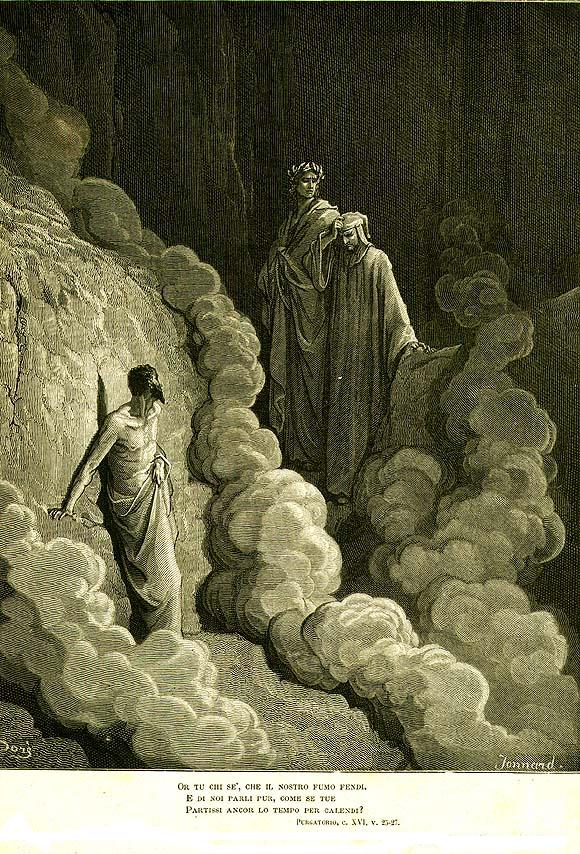
Dante and Virgil meet Marco Lombardo, envisioned by Gustave Doré.

Purgatorio

Last week, I wrote my thoughts on the first cantica of Dante’s Divine Comedy. This week then, the second part, the Purgatorio. All quotations from the Divine Comedy come from Robin Kirkpatrick’s English translation published in the 2012 Penguin edition. — Click here to support the Wednesday Blog: https://www.patreon.com/sthosdkane


Last week, I wrote my thoughts on the first cantica of Dante’s Divine Comedy. This week then, the second part, the Purgatorio.


The sentiment of purgatory isn’t a good one, it’s a place where you don’t want to end up yet often find yourself stuck for longer periods of time. I often have dreams about needing to get somewhere or to do something or find something and getting stuck in an eternal loop of steps along the way and never actually reaching that goal. There are many different ways I could interpret those dreams of mine, yet in this instance I think they may be my subconscious imagination of purgatory. 

Dante’s Purgatorio is an early depiction of this concept, though Jacques Le Goff (1924–2014), the French annaliste medieval historian wrote in the second appendix to his book The Birth of Purgatory that “the noun purgatorium was added to the vocabulary alongside the adjective purgatories.” In the next paragraph, Le Goff dated this addition to the decade between 1170 and 1180.[1] The concept itself is affirmed by the Catholic Church as doctrine today based on an interpretation of three verses from Chapter 12 of the Second Book of Maccabees, in which the author described how Judas Maccabaeus (d. 160 BCE) “exhorted the people to keep themselves free from sin, for they had seen with their own eyes what had happened because of the sin of those who had fallen.”[2] The footnote there in the New American Bible acknowledges that this passage “is the earliest statement of the doctrine that prayers and sacrifices for the dead are efficacious” and that “this belief is similar to, but not quite the same as, the Catholic doctrine of purgatory.” Dante’s depiction of purgatory fits well into this model, though he does write often of souls asking him to pray for them, as prayers for those in purgatory will speed their cleansing that they may enter Paradise again.

In this light, Dante’s purgatory is optimistic and hopeful. Sure, he encounters people who continue to suffer as they did in life from their own actions. In Canto 12, an angel proclaims to the poet and Virgil his guide, using Robin Kirkpatrick’s translation, “O human nature! You are born to fly! / Why fail and fall at, merely, puffs of wind?”[3] The cleansing path that the souls in this realm take requires tremendous effort and faith both in one’s abilities to surmount that path, and the reward for those efforts. Dante remarks later in Canto 12, “How different from the thoroughfares of Hell / are those through which we passed. For here with songs / we enter, there with fierce lamentations.”[4] The dead who walk the paths of purgatory then are working toward something, they know that they will learn in their paths the way into Paradise, it just may take a while.

The Purgatorio is remarkable for how it contrasts with the far more popular Inferno. Again, Dante stops and talks to everyone, and again nearly everyone he encounters is an Italian like him, someone with whom he can relate. He finds his fellow Tuscans among the crowds and makes his own birth well known by speaking Tuscan along his way. In several instances the souls he meets remark on the fact that he must be a Tuscan by his way of speaking, even if they themselves are Lombards, Latins, or from elsewhere. 

I found it fascinating to see him encounter the ruling elite of Europe, the kings and popes who work off their sins. In one instance he sees Henry III of England (r. 1216–1272), one of my favorite medieval English kings, who had a pretty unfortunate and quite long reign. Dante places him among several other failed rulers, including Rudolf I of Germany (r. 1273–1291), Ottokar II of Bohemia (r. 1253–1278), Philip III of France (r. 1270–1285), Henry the Fat of Navarre (r. 1270–1274), Charles I of Naples (r. 1266–1285), and Peter III of Aragon (r. 1276–1285).[5] In Canto 20, Dante meets Hugh Capet (r. 987–996) who succeeded the last of the Carolingians as King of the Franks and founded the great medieval French royal dynasty which still exists as the Royal Family of Spain today. Capet sees his old life as something distant from himself: 

“I was, down there, called Hugh Capet once.

From me were born those Louis and Philippes

by whom in these new days our France is ruled.

I was from Paris, and a butcher’s son.

And when the line of ancient kings died out ––

All gone, save only one who wears a monk’ dark cowl ––

I found my hands were tight around the reins

That govern in that realm, and so empowered

In making that new gain, with friends so full,

that, to the widowed crown my son’s own head

received advancement. And from him began

our lineage of consecrated bones.”[6]

In this world which he devised, Dante created tangible settings where the soul is cleansed after its life and before its final entry into Paradise. Dante himself climbed high until by the time he reached Canto 15, the suffering and toil of purgatory cleansed his own soul, so that in place of any other emotion “caritas burns brighter.”[7] The distinction in Latin between caritas and amor is something that I remember being discussed at length in my undergraduate theology classes at Rockhurst. These Latin terms are in turn translations of the Greek originals ἀγάπη and ερως, which I’ve come to understand as a distinction between charity and romance. The higher Dante and the penitents climbed up Mount Purgatory, the purer their souls became so that the affection they felt for their fellows and for all things was less a love that desired something of each other rather than a love that wished only to exist in communion with each other. In my fraternal order, the Ancient Order of Hibernians (AOH), our motto of “Friendship, Unity, and Christian Charity” speaks to this vision of love as charitable, unifying, and amicable. Purgatory was intended to replace fear and “penitential tears” with charitable love:

            “If love, though, seeking for the utmost sphere,

            should ever wrench your longings to the skies,

            such fears would have no place within your breast.

            For, there, the more we can speak of ‘ours’,

            the more each one possesses of the good.

            and, in that cloister, caritas burns brighter.”[8]

In purgatory, the penitents seek to cleanse themselves, and to cleanse the world in time as well. In Canto 16, the medieval Italian courtier Marco Lombardo remarked to Dante that societal corruption stems from the government:

            “So — as you may well see — bad government

            is why the world is so malignant now.

            It’s not that nature is corrupt in you.”[9]

The hopes then of the penitent are that not only will they enter the Gates of Paradise but that all those who they left behind on the Earth will also join them and God among the heavenly spheres in their own time. Marco Lombardo remarked to Dante that “of better nature and of greater power / you are free subjects. And you have a mind / that planets cannot rule and stars concern.” In this, Marco reminds Dante that the key to Paradise is accepting one’s responsibility for one’s actions and life and being honest and free about one’s mistakes. Dante experiences this at the end of the Purgatorio, when he at last arrived in the Garden of Eden, located at the top of Mount Purgatory. There, he encounters his beloved Beatrice, the love of his life who sent the poet Virgil from the first circle of Hell (Limbo) to guide Dante to this point where he will at last be reunited with her.

Yet when Beatrice sees Dante standing there in the garden, she admonishes him for his sins and faults when she was alive and afterwards. She challenges him to be better, and to give up the last of his fear and worry, he had not come to her in the usual way after his own death. Beatrice challenged Dante, silencing him with sharp words that he did not expect of her:

            “Respond to me. Your wretched memories

            Have not been struck through yet by Lethe’s stream.”[10]

To advance further, and to be with his beloved again, Dante needed to forgo his feelings of fear and worry, remorse and sorrow, and instead embrace the moment in which he was living, standing there in her sight and hearing her voice.

            “And yet –– so you may bear the proper shame

            your error brings and, hearing, once again,

            the siren call you may show greater strength ––

            put to one side the seed that nurtures tears.”[11]

Beatrice is the first one in the entire Purgatorio who calls Dante by his name, the first to properly recognize him for who he is, more than just the wandering Tuscan poet or the Italian. I’ve often thought about how I would reveal characters’ names in my stories. I like to slowly peel away the layers of fog surrounding a narrative and let the audience discover the characters’ names in a more natural fashion. In a story I’ve begun to write, a sort of cleansing purgatory for the main character, his name is not uttered until after he has passed through these great circles of repentance in his own wandering way home.The Purgatorio concludes in a very mystical fashion, heralding the beginning of the Paradiso that follows. The symbols of the heavens abound, as Dante leaves fatherly Virgil behind to return to his own circle and follows instead his muse Beatrice toward the highest heights anyone in this cosmos can hope to achieve. That then, is where we will continue next week.


[1] Jacques Le Goff, The Birth of Purgatory, (Chicago: University of Chicago Press, 1984), 362.

[2] 2 Macabees 12:42–45 (NAB).

[3] Dante, Purgatorio 12.95–96.

[4] Dante, Purgatorio 12.112–114.

[5] Dante, Purgatorio 7.

[6] Dante, Purgatorio 20.49–60.

[7] Dante, Purgatorio 15.57.

[8] Dante, Purgatorio 15.52–57.

[9] Dante, Purgatorio 16.103-105.

[10] Dante, Purgatorio 31.11–12.

[11] Dante, Purgatorio 31.43–46.


All quotations from the Divine Comedy come from Robin Kirkpatrick’s English translation published in the 2012 Penguin edition.