
Tag Archives: Citizenship

Politics and the Citizen

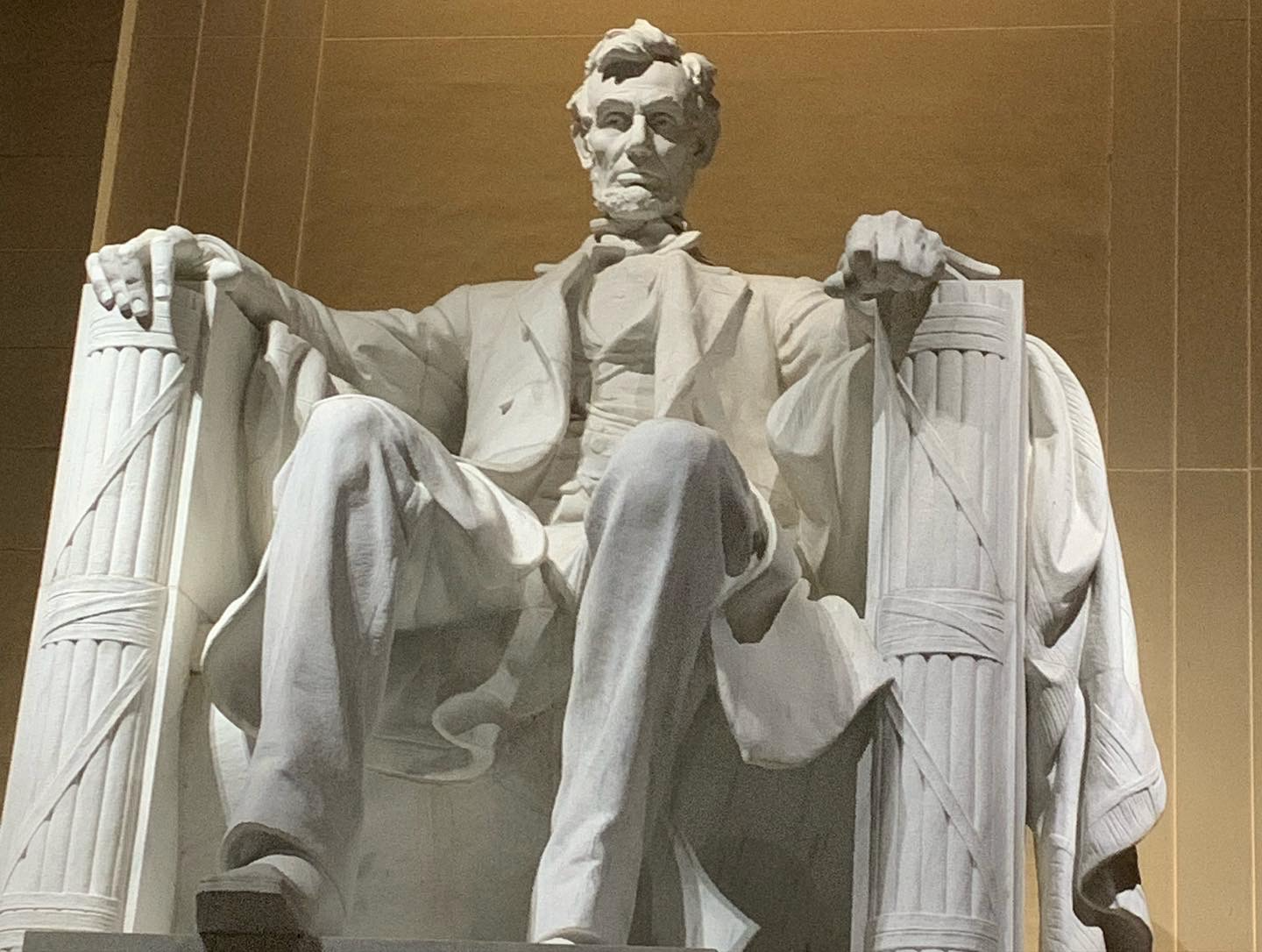
Mr. Lincoln

Politics and the Citizen Wednesday Blog by Seán Thomas Kane

This week, I want to speak to you about the meaning of the word "political."

Words are at the center of all our political debates. They are at the center of our lives, the core of our existence. We would not exist as we do without words. Words have tremendous power to do good, to inspire people to achieve wonderous things, to rise above what they thought possible and make a better future. Yet words are also dangerous when poorly used. They can have the effect of destroying trust between people; they are capable of breaking up families and communities. Without common words we cannot have a common society.

I was struck last week reading in the New York Times how the protests following the recent Supreme Court ruling of Dobbs v. Jackson Women’s Health Organization were rephrased by the far right as an “Insurrection.” That is a word that has been far more justly levied at their own faction, whose actions on January 6th last year proved their lack of faith in a democratic society. Other words and ideas have been poisoned by the same fearmongers from Critical Race Theory to the Green New Deal. These are ideas and proposals that if considered in their true meaning have merit, yet any mention of them in the political square anymore will be met with the screaming banshees in the wings whose greatest weapon and sole power is the volume of their voices.

One such word which they have demonized by their own behavior, perhaps the most critical word to our democracy, is politics. It is taboo now to be political in a crowd when you don’t know everyone else’s own political views. A professional soccer team wearing practice shirts recognizing racial inequality is dangerously “politicizing” an otherwise family event. It’s curious to me because their own use of the word “political” has no bearing on the actual meaning of the word, nor on its origins.

The word political simply refers to the idea of the city, the polis in Greek. To be political is to be a citizen, an active member of society. To be political is to participate in government through voting, running for public office, and serving the people in the public sector. To be called political is one of the greatest honors anyone can bestow, for it means you care about something greater than yourself, you care about your community and want to contribute to its future.

In the ancient and medieval context, a citizen was far more particular of a person than today. The idea of universal suffrage is a modern thing, something that has been fought for down the generations and even still is being fought over today. Today though I believe the best way to describe a citizen is simply a person who wants to contribute to their own community. They need not have the papers conferring official legal citizenship in their country of residence, for even without those individual people can make a difference to their communities.

This is intolerable to those who demonize the word political. Why else would they make such an effort to poison an entire population against such an idea that at its core is meant to better their lives? It is intolerable to them because they know their views, as extreme as they are, are in the minority among their fellow citizens. There are generations of Americans who have come to recognize the benefits of democracy, and who have pushed us to improve upon those benefits already existing, that they might be extended to more and more people until eventually some day we may have true political equity. 

Yet now, as has happened in every generation since the founding of the first English colonies on the East Coast 415 years ago the powerful voice of a small few who see democracy as a threat to their own interests has influenced the course of affairs in this country to the great detriment not only of we the American people but of humanity at large. I’m speaking of course of the West Virginia v. Environmental Protection Agency ruling made on the last day of the recent session of the Supreme Court. In that ruling the conservative majority declared that regulation should only be conducted through legislation. This means the President and any federal agency acting under the authority of the Presidency, even if acting in the best interests of the people they are sworn under oath to serve, have less ability to create broad regulations that are not expressly allowed under Acts of Congress.

The voices of a few who feel greater concern for their profits than they do for the future health of humanity and our home planet spoke up and were heard over the cries of the rest of us. I could say let’s trust in Congress to do their part now and legislate new regulations that will replace what was stripped from those executive orders revoked by the Court but those in Congress with the power to save us are also listening to that swansong of the soloists rather than the Dies Irae being belted by we, the chorus.

Our politics are in many ways broken by our extreme partisanship. It is this word, partisan that ought to be used when the far right uses the word political as a curse. We retreat into our slogans but don’t actually talk to one another. One side hears “Defund the Police” and the other “Law and Order” and neither leaves the table any better off. Rather, both parties find themselves far less willing to talk to the other, to find things in common with the other, to learn from each other. Once again, those fissures that threatened to make two countries out of one in that messy divorce of 160 years ago that left 6% of the population dead are beginning to show. 

Do we really want to go down that path again? Do we really want to fall into such political disfunction that we cease to see each other as fellow citizens and instead as enemies? We have let the battle cry change from “E Pluribus Unum, Out of Many One” to “No Compromise”, leading us to rally ’round our own partisan flags to the detriment of our common threads. I want to cry out in pain every time I see the American flag used as a symbol by those who want to be exclusionary, by those who would see all it has stood for over these past centuries be replaced by the worst of our nature: by our greed.

2016 Super Tuesday Democrats Abroad Primary

As citizens of a democracy, we have a right to know, to understand, and to discuss these questions of who we were, who we are, and who we want to be. And, as citizens of a democracy, we do have the right to dissolve our democracy, to end the experiment that’s been running for so long. I recognize that our current federal system isn’t going to last forever, nothing does, yet I remain hopeful that when it does eventually take its leave that that system will be succeeded by something better, crafted by the wisdom and love of another set of founders inspired by the precedents set by the first, who will craft a new system with all the best traits of our own yet reimagined in such a way as to overcome the faults in our own today. Until then, we citizens are caretakers of this democracy. It’s a fragile gift passed down to us from our ancestors, which we get to treasure and improve as best we can so that when we pass it on to our descendants it will be in better shape than how we found it. Let’s do our duty.

The Problem with our Politics

Embed from Getty Images

Political parties and politics do serve a purpose in the betterment and stability of society, no matter how unstable they may seem. A political party is a tool by which people of a common perspective can organise and promote their principles and philosophy with one voice. These parties in turn have the ability to take that philosophy to the pinnacle of government and power and propose it as policy, should said party be elected into office. Yet when party comes before public the political process shows signs of putridity and decay.

Today there are a variety of party systems in use around the globe; often they are organised based upon the number of parties they allow for. Here in the United States, the political process operates on a two-party system, yet throughout Europe most polities operate on a multi-party system. Likewise, in some states one will find a dominant party system, which is essentially a one-party state yet with the trappings of a two-party or multi-party state. Each system does justice to its respective society, as only that party system which adheres to the framework of its respective society can properly do justice to its public. Yet in some cases the frameworks set up in some cases generations ago to keep the wheels of government well oiled and turning have proven themselves to be susceptible to rust and degradation.

If anything is going to halt the Republican Party’s march towards dominance in all branches of the Federal Government, it will be this principle that politics unbounded from the public need will always be overwhelmed by the public will. If the Republicans want to maintain their overwhelming majority in the House of Representatives in the 2018 General Election, they need to cast astray the bull that they let into the china shop at 1600 Pennsylvania Avenue N.W. They must disassociate themselves from Trumpism and all its baggage. If the Republicans want to stay in power they should move swiftly with the transference of power from the current President towards the next guilt-free individual on the Order of Succession.

And yet, in a somewhat comical way, the House Republicans will most likely stand by their man to the bitter end. Like a pompous captain remaining aboard his sinking ship they will be submerged into the muck and mire that spreads from the current President like a virus. It certainly seems to me that that infection is too wide spread in the halls of power in Washington for any executive change to be made prior to November 2018. Perhaps then it is up to the Democrats to take the advantage and not only expel one of the greatest embarrassments to ever befall this country from that house across from Lafayette Square, but to also regain a more sizeable position in the House from which their own philosophy can shine.

The politics of the present are all too embittered by a bad case of food poisoning. Those in power more often than not seem poisoned by the power they wield, and the personal prosperity it proposes to offer. They have proven themselves to be far too unworthy of the position of public servant through their venomous guile, their lack of transparency, and their blatant disregard for the public will. If we are not careful, this poison could sink not only the current political parties, but the entire ship of state as well. The act of preserving the body politick is a duty not just of those in positions of power, but of all citizens, all persons with a vested interest in the continued goodwill and wellbeing of the body politick. It is just as much our responsibility to reform our political processes, as it is the responsibility of those in power.

If this reform is to be successful, it must be done without violence, but through discussion, debate, and dialogue. This reform must be on all levels and must include all individuals with a desire to take part. We must craft our political society in the image of the public that it serves; otherwise that political society will only grow to serve itself. Should that happen, we will be right back were we are now, and I doubt that would be anyone’s preferred outcome.

What is citizenship?

16179019_10210642139022398_8265398912556879037_o

Photo: Cole Gibson

In our present time of political upheaval around the globe, the central questions of any political society are once more in the foreground. Central to these is the question of what it truly means to be part of a political society, to play one’s part in this comedy we call politics. In most constitutional countries today, the citizen, the most basic piece in the larger puzzle that is the body politick, fulfils this role. What does it mean to be a citizen, and furthermore, what is citizenship, the state of being a citizen? Citizenship is an old concept, one that can be traced back to the earliest polities, from the Ancient Greek πόλις to the varying degrees of Roman citizen, through concepts of medieval subjecthood, to the Renaissance and modern understandings of citizenship within the Westphalian empires and nation-states that have been the norm in the West since the mid-seventeenth century.

Today our definitions of citizenship are primarily two-fold, founded upon both ius sanguinis and ius soli. Jus sanguinis is the understanding that one’s legal status as a citizen is based solely upon one’s ancestry, one’s blood. As an American citizen who has at times, and will certainly again, prefer to live overseas in the U.K., should any of my future children be born beyond the borders of the United States, they will automatically be United States citizens, having inherited that citizenship from me, their father. However, should they be born in the United Kingdom, the children of a permanent resident of that country, they will have also inherited British citizenship through ius soli, having been born on British soil.

These two sub-classifications of citizenship are straightforward enough, and reasonable means to define what makes a person a citizen. Yet a citizen is not just an individual who happens to have either been born in one country, born to a parent from a country, or who has resided in a particular country for an extended period of time. A citizen is also an active participant in their government. The chief way a citizen can partake in politics, can wield the power that comes with their citizenship, is through voting. Without the right to vote, citizenship is but a muted title, a lame duck of a word.

Here in the United States, the most fundamental definition of who can vote simply considers age and time spent in a particular state. In most cases, an American citizen can vote in their state if they are 18 years of age and have resided in that state for at least 90 days. Yet politicians who see their only hope of maintaining power resides in further limiting who amongst the citizenry can vote have begun to pass legislation restricting voting rights from a wide swath of citizens. In Missouri, a citizen must present a state issued ID card when arriving at their voting precinct, yet that state issued ID card can only be granted to the citizen by the state if that citizen can a.) prove their citizenship, and b.) prove their residency. In order to prove one’s citizenship, one either must present a valid birth or naturalisation certificate, or a valid U.S. Passport to the D.M.V. Furthermore; one must prove that one does live at one’s legal voting address. The latter can be arranged, through the presentation of a utility or car bill, or even a bank statement, yet the former is far more complicated to find, particularly if the citizen in question was born in another state.

These laws have been written to “combat voter fraud”, yet there has been hardly any such voter fraud anywhere in the United States in the past twenty years. What these entirely unnecessary laws do accomplish is to restrict voting rights to a select few, to a smaller portion of the population. This is one of many symptoms of our ailing democracy, of our democracy that is sickened and addicted to the power of the almighty dollar. The same politicians that have instituted these voter suppression laws are also the ones who stand to gain the most from having a smaller electorate. Their political power rests squarely on the broad shoulders of their own special interests, cemented through bribery and intimidation alike. This is why sensible gun control legislation has not passed in Congress, despite the string of mass shootings and domestic terror attacks that have plagued this country. This is why the United States does not lead the nations of the world in combatting climate change, in keeping to the standards set in the Paris Climate Agreement. This is why an entire generation of Americans are left in severe debt and often unable to find work upon earning their Bachelor’s degrees. This is why the House Republicans voted to take federal health insurance from 20 million Americans. The voice of the citizen has been overwhelmed by the voice of the special interest.

Our democracy is under threat of becoming a plutocratic oligarchy, a nation governed by a class solely defined by their wealth. Sure, any American can make it to the top, but so long as that American is of European descent, and is willing to do anything it takes to earn more money. The dignity of the citizen is being replaced by the pessimistic wolfish piracy of an unscrupulous few that never outgrew their days of playground bullying. We the citizens should continue to make ourselves heard, we must continue to protest, to march, to call our elected officials, to tweet them, to write to them, to visit their offices and make ourselves heard. But most importantly, come Election Day, we must go out and vote! Without our voting rights were are not citizens but merely voiceless sheep being led about at the whims of a small few.

If our democracies are going to make it through this present time of political upheaval, we the citizens of those democracies must ensure that our voices are not silenced, not muffled by the wealthy and powerful. A person who has nothing to their name, not even a penny, should still have the right to vote; after all that person is a citizen of the country they were born in. Whether we like it or not, we are all subject to the ebbs and flows of the political process. It is up to us to ensure we control that tide, lest it sweep over us and leave us for dead.