Tag Archives: Claude Lévi-Strauss

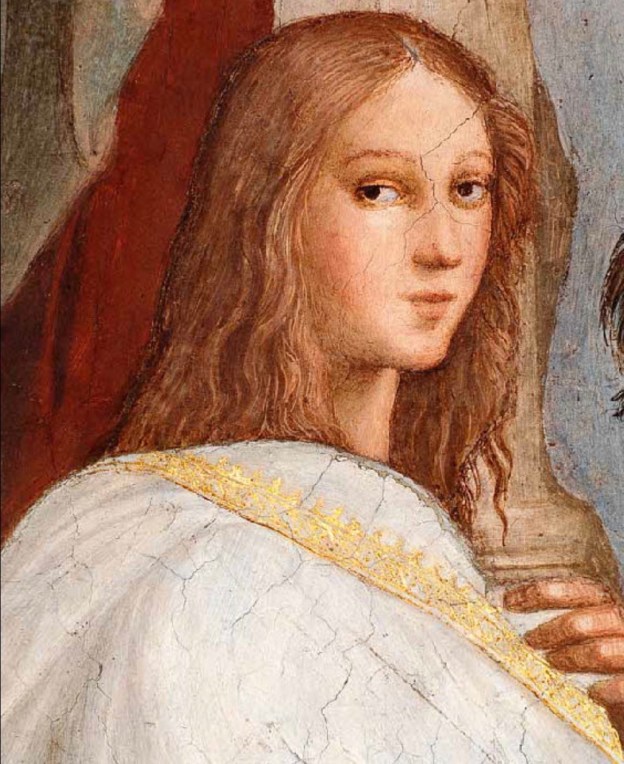
A figure from Raphael's "The School of Athens" variously identified as Francesco Maria della Rovere, Pico della Mirandola, or Hypatia of Alexandria.

On Knowledge

This week, I want to address how we recognize knowledge in comparison to the various fields of inquiry through which we refine our understanding of things.—Click here to support the Wednesday Blog: https://www.patreon.com/sthosdkaneArtRaphael, The School of Athens (1509–1511), Apostolic Palace, Vatican Museums, Vatican City. Public Domain.Sources“On Writing,” Wednesday Blog 6.27.Surekha Davies, Humans: A Monstrous History, (University of California Press, 2025).Marcy Norton, The Tame and the Wild: People and Animals After 1492, (Harvard University Press, 2024), 307.Dead Poets Society, (1989) "What will your verse be?" Video on YouTube.


This week, I want to address how we recognize knowledge in comparison to the various fields of inquiry through which we refine our understanding of things.


Lately my work has been dedicated to a thorough review of the historiography within which I’m grounding my dissertation. I wrote about this two weeks ago in an essay titled “On Writing.”[1] My research is historical, yet it touches on secondary literature which operates within various fields within the discipline of history. These include Renaissance history, and its larger sibling early modern history, the history of cartography, the history of animals, the history of botany, and more broadly the history of early modern science. Methodologically, I owe a great deal to two great twentieth-century Francophone anthropologists, Alfred Métraux (1902–1963) and Claude Lévi-Strauss (1908–2009). While Métraux and Lévi-Strauss aren’t considered directly in the historiographic section of the new introduction that I’m writing for my dissertation, which is limited to sources published since the millennium, they nevertheless stand tall in the background of my history.

Today we often talk within academia about a desire for interdisciplinarity in our work and our research. We’ve found ourselves too narrowed by our ever shrinking fields and seek greener common pastures for grazing as our intellectual and pastoral ancestors alike once knew. In my case, this interdisciplinarity lies more in my efforts to incorporate historical zoology into my work, a methodology which seeks to use zoological methodology and theory to explain historical animals. I have friends who study many things. Among them is one whose passion for history, classics, and mathematics has come together to craft a dissertation which seeks to demonstrate the intersections between those three to better understand the great transitions in human inquiry. Another seeks to follow the medical connections across oceans between disparate regions in the Americas and Europe that nevertheless existed even if they seem remarkable today. Still more, I have a friend who applies basic economic need to explain a complex diplomatic situation that once existed between the Venetian Republic and the Ottoman Empire in the Adriatic Sea. All of these historians of whom I write are applying a degree of interdisciplinarity to their work that reflects their own disparate interests and curiosities. In early modern history we talk about curiosities as objects which were collected from disparate and exotic lands into cabinets to display the erudite collector’s prestige and wealth. I say our curiosity is something to be collected by those worthy archives, libraries, museums, or universities that will employ us in the near future and for us to feed with new ideas and avenues of investigation that we will never be bored with life.

In all of these things, there is an underlying genre of knowledge which I am addressing. I’ve written thus far about history alone, yet it is the same for the anthropologists, astronomers, planetary scientists, and physicists who I know. Likewise for the literature scholars and the linguists. Our fields of inquiry all grow on the same planet that comprises of our collected knowledge. In English, this word knowledge is somewhat nebulous. To me, it says that we know things broad or specific. In London, for instance, the Knowledge is the series of tests which new cabbies must complete in order to learn every street within a certain radius of Charing Cross. The Latin translation of this word, scientia, makes things even more complicated as that is the root of the English word science. Thus, when we refer to Renaissance science, there is always a caveat in the following sentence explaining that “this is not science as we know it but a sort of protoscience.” I was advised, similarly, after a particularly poorly received presentation at a workshop at the Museum of Natural Sciences in Brussels in October 2023 that I shouldn’t refer to “sixteenth-century conservation” because no such concept existed at the time; instead, it would be better to discuss a “genealogy of conservation.” This sense that modern terms, in use since the Enlightenment of the eighteenth century, ought not to be pulled further back into the past I think loses some of the provenance of those terms and how the Enlightenment philosophes first came across them. 

I find it telling that the Ancient Greek translation of knowledge, γνῶσις (gnôsis), is a word with which I’m more familiar from theology and the concept of Gnosticism whereas scientia reminds me of philosophy and the other fields of inquiry which grew from that particular branch of the tree of human curiosity. One might even say that philosophy and theology are a pair, siblings perhaps? They seek to understand similar things: on the one hand an inquiry into thought, and ideally wisdom, and on the other a search for the nature of the Divine, which at least in my Catholicism we can know because we are made in the Image of God. The division here between the Ancient Greek term being affiliated with faith and the Latin one with reason I think speaks to the Latin roots of my own education in Catholic schools and at a Jesuit university, where I learned about Plato and Aristotle, yet I recognized Aristotle’s Historia animalium (History of Animals) by its Latin name by which it was generally known in Western Europe for centuries before the rise of vernacular scholarship rather than by its Greek original Τῶν περὶ τὰ ζα ἰστοριῶν (Ton peri ta zoia historion). Note that the English translation of this title, History of Animals reflects better the Latin cognate of ἰστοριῶν rather than the better English translation of that Greek word, Inquiry.

Added onto these classical etymologies, in my first semester Historiography class at Binghamton University I was introduced to the German translation of scientiaγνῶσις, and knowledge. Wissenschaft struck me immediately because I saw the German cognate for the English word wizard in its prefix, and because I knew that the -schaft suffix tends to translate into English as -ship. Thus, my rough Anglicization of Wissenschaft renders Wizardship, which is rather nifty. Yet this word Wissenschaft instead was seen in the nineteenth century as a general word which could be translated into English as science. This is important for us historians trained in the United States because our own historiographic tradition, that is our national school of historians traces our roots back to German universities in the early and middle decades of the nineteenth century. I remember long sessions of my historiography class at UMKC discussing the works of Leopold von Ranke (1795–1886), the father of research-based history. I felt a sense that this concept of Wissenschaft seemed relatable, and as it turned out that was because Irish has a similar concept. 

Whereas in English we tack on the suffix -ology onto any word to make it the study of that word, in Irish you add the suffix -ocht. So, geology is geolaíocht and biology is bitheolaíocht. Yet note with the second example that the suffix is not just -ocht but an entire word, eolaíocht. This is the Irish word for science, added onto the end of bitheolaíocht to demonstrate that this word refers to the study of bith- a prefix combining form of the word beatha, meaning life. So, biology then is the science of life itself. Powerful stuff. I appreciate that Irish linguists and scholars have sought overall to preserve our language’s own consistency with its scientific terminology. It means that these fields of study, these areas of knowledge, can exist purely within the purview of the Irish language without any extra need to recognize that their prefixes or suffixes come from Latin, Greek, or English. There are some exceptions of course: take zó-eolaíocht, the Irish word for zoology, which effectively adopts the Greek word ζῷον perhaps through the English zoo into Irish. Would it not have been just as easy for whoever devised this hyphenated word to instead write ainmhíeolaíocht, translated into English as the science of animals? Here though I see more influence from English because this language adopts as much as it can from other languages out of prestige and a desire for translingual communicability. As an English speaker, I find scholarly works often easier to read because we share common etymologies for our words relating to knowledge. English’s sciencegeology, biology, and zoology are French’s sciencegéologie,biologie, and zoologie. In English, we drop any pretense of Englishness to clothe ourselves in a common mantle familiar to colleagues from related cultures around the globe. In academia this is to our mutual benefit, after all so much of our work is international. I’m regularly on webinars and Zoom calls with colleagues in Europe for instance. I believe this is the lingering spirit of the old scholarly preference for Latin as a lingua franca which at least to me seems close enough in the past that it’s tangible yet realistically it’s surely been a very long time since any serious scholarly work beyond classics was published in Latin for the benefit of a broad translingual readership?

I for one admire the Irish word eolaíocht and its root eolas, which translates into English as knowledge, that is an awareness of things because eolaíocht represents a universal concept while retaining its own native nature. So often in my research I am discussing the early assimilation of indigenous cosmovisions, to borrow a Spanish word put to good use by Surekha Davies in her latest book, into the nascent global world centered on Europe.[2] I see how these cosmic conceptions faded until they were rendered in Gothic or Latin letters on the voluminous pages of encyclopedic Renaissance general and natural histories which remain among the most often cited primary sources for these indigenous cultures who Marcy Norton argued in her 2024 book The Tame and the Wild: People and Animals After 1492 had their own classical past made remote from their colonial present by European contact, conquest, and colonization.[3] Seeing these indigenous perspectives fade into their categorized and classified statuses within the cosmos defined by Europe’s natural philosophers I feel fortunate that my own diaspora (which was also colonized) has retained this element of our individual perspective. I first came across the -ocht suffix in the word poblacht, the Irish word for republic. A famous story from the birth of the Irish Free State during the Anglo-Irish Treaty negotiations in 1921 tells of British Prime Minister David Lloyd-George, a Welsh speaker, remarking to Michael Collins, an Irish speaker, that their choice of a republic was unusual because none of the Celtic languages naturally have a word for republic. That word evokes its Roman roots in the ancient Res publica Romana, the Roman Republic, whose northward expansion across the Alps led to the gradual death of the Continental Celtic languages, whose speakers’ descendants today are largely the Western Romance speakers of French, Romansh, Occitan, Catalan, Spanish, Galician, and Portuguese, among others. Romance languages are noted for their common descent from Latin, whence they all derive variations on the Latin word scientia; English gets science through Old French. “How are you going to name your new government in the Irish language?” Lloyd-George asked. Collins replied something along the lines of “a kingdom is called a ríocht, so this government of the people (pobal) will be called a poblacht. Thus, the Republic of Ireland is named in Irish Poblacht na hÉireann. Naturally, this word pobal derives from the Latin populus, so the shadow of Rome hovers even over unconquered Hibernia. Yet that is another topic for a different essay.

Let me conclude with a comment on the difference between knowledge and wisdom, as I see it. The former is far more tangible. We can know things through learning embodied best in living and in reading. I know for instance to look both ways before crossing a street because plenty of people in the last 140 years have been hit by cars, buses, and trucks, and you can never be too careful. Likewise, I know everything I do about the things I study through reading what others have written about these topics. It’s my job then to say what I will. In Whitman’s words made immortal by our recitation, the answer to the eternal question, “that the powerful play goes on, and you may contribute a verse.” That’s history, people! Reading the powerful play of what others have written and summoning up the courage to take the podium and have your say. I first heard this particular poem, as did many in my generation, recited by Robin Williams in the 1989 film Dead Poets Society. Knowledge is the recitation of these facts we’ve learned. Wisdom is understanding how these facts fit together and speak to our common humanity. What makes us human? I believe it’s as much what we know as what we remain ignorant of. Our ignorance isn’t always a curse, rather it’s another foggy field we’ve yet to inquire about, a place where someone’s curiosity will surely thrive someday. It is another evocation of eolas still to come in our long human story. How wonderous is that?


[1] “On Writing,” Wednesday Blog 6.27.

[2] Surekha Davies, Humans: A Monstrous History(University of California Press, 2025).

[3] Marcy Norton, The Tame and the Wild: People and Animals After 1492, (Harvard University Press, 2024), 307.

A frame from Abraham Ortellius's map of the Americas, 1587.

On Toponymy

This week, the first in several scribblings about my research: how I connect historic places in my sources with their modern names.—Click here to support the Wednesday Blog: https://www.patreon.com/sthosdkane


This week, the first in several scribblings about my research: how I connect historic places in my sources with their modern names.


When I started working on my dissertation and began downloading copies of André Thevet’s 1557 book Les Singularitez de la France Antarctique, I was struck by a curious question regarding the identity of some of the places which Thevet described along the disparate shores of the Atlantic Ocean in the middle of the sixteenth century. Some of these were readily accessible, the Portuguese fortress of Elmina for one remained an infamous outpost of the slave trade for centuries after Thevet’s 1555-1556 voyage. Likewise, Thevet made early references to regions like Florida, Mexico, Peru, and Brazil which are still known by those names today. I especially admire how he demonstrated the assimilative power of colonialization in the renaming of the Taíno island of Haiti into a newly christened European island literally called Little Spain, that is Hispaniola. Today, we know Haiti as the name of the western republic on the island of Hispaniola, and the Haitians as a people predominately of African descent, yet that term on its own originated with the indigenous inhabitants of that island and its neighbors.

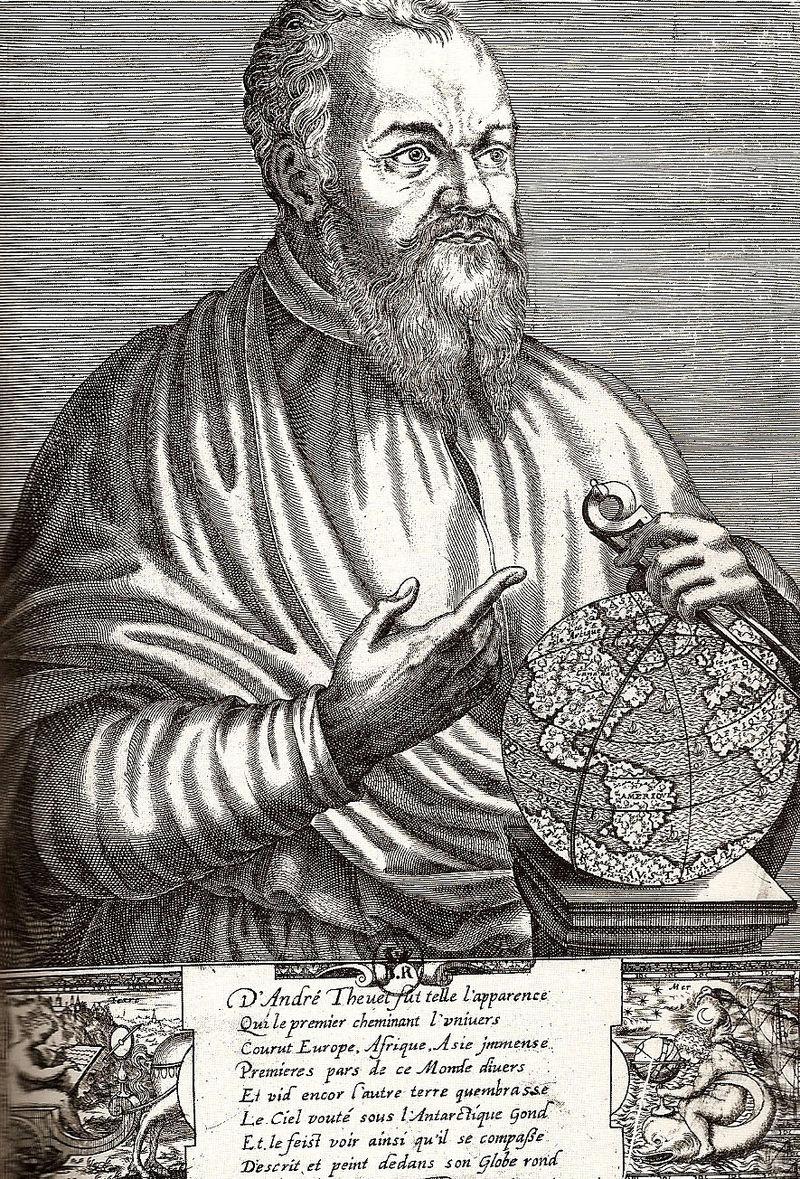
André Thevet (1516-1590) from his Grande Insulaire.

This new world of names which Thevet hoisted upon the places he sought to describe in his Singularitez place that book in its historical context at the dawn of the European colonization of the broader Atlantic World and also in some cases provides a perspective on precolonial and early contact societies that have otherwise been diminished by the deluge of colonial toponyms which in many places replaced them. Thevet, like his fellow Frenchman Jacques Cartier, tended to use indigenous names for places, flora, and fauna. I’ve written in great detail about this concerning Thevet’s use of a French rendering of the Tupi name for the sloth, Haüt, and my dissertation includes similar analyses of the preservation of indigenous names for toucans, parrots, and macaws from Tupi for Thevet’s own French audience in his work. While his preference for indigenous names certainly added a lure of the exotic to his work, it is clear that he saw the utility of keeping these names and promulgating them to his readers.

When I am approaching a location in Thevet’s work I begin by seeing what the other editors and translators of Thevet down the last 468 years have done to familiarize what Thevet wrote for their audience. Thomas Hacket’s 1568 translation is beneficial to see how an Elizabethan reader might interpret distant Brazil and is useful for connecting Thevet’s Atlantic to Ralegh’s. Likewise, Giuseppe Horologgi’s 1562 translation is beneficial for understanding how Thevet was read by Italian humanists curious about the wider world; these readers were most likely thinking about Thevet’s stories in the context of the wider genre of travel literature typified in Italy by Giovanni Battista Ramusio’s (1485–1557) I Navigationi et Viaggi and for his natural history the collected works of Ulisse Aldrovandi (1522–1605). Moving from Thevet’s contemporaries, I then turn to a nineteenth century French reprint of the Singularites (as they were rendered in Modern French) edited by Paul Gaffarel. This edition was published in 1878 at a time when interest in Thevet and sixteenth-century French Brazil had a resurgence during the Third Republic which lasted into the early career of Claude Lévi-Strauss and Alfred Métraux, the two most prominent French anthropologists to consider the value of Thevet and his rival Jean de Léry as primary sources on early contact Tupinambá culture. Finally, I will turn to the two modern Brazilian translations of Thevet, Estêvão Pinto’s from 1944 and Eugenio Amado’s from 1978. Together these two sources are often my first choice when tracking down taxa of Brazilian flora and fauna and confirming Brazilian demonyms and toponyms. I figure these translators tended to have better access to Brazilian archives and scientific studies concerning their own country than their European counterparts considering the great distance between these continents. Lastly, several partial modern English translations of Thevet exist which provide their own regional analyses, most notable of these is Roger Schlesinger and Arthur Stabler’s 1986 translation of Thevet’s North American chapters which does particular justice to Thevet’s account of Canada. 

The best sort of contributions any of us can make to collective human knowledge is built upon the conclusions and efforts of our colleagues past and present. The academy is a collaborative effort that only survives as long as we believe in the value of our work and of each other. I was reminded of this when I was in Boston during the Renaissance Society of America’s annual conference in March and felt such a potent sense of jubilation at that experience of camaraderie, I felt spending those four days among friends and colleagues. I especially see this among my fellow grad students and early career scholars who are the future of higher education and who are engaged in their work to a degree that in the span of a doctorate we readily become experts in our own disparate fields yet find solace and support in that common experience.

Returning to the task at hand, once I have consulted each of these various editions and translations of Thevet’s Singularitez, I then turn to his Cosmographie Universelle, a two volume magnum opus which was published in 1575. Volume 1 contains his accounts of Asia and Africa, and Volume 2 collected knowledge about Europe and the Americas. Thankfully, the Cosmographie Universelle has a good set of indices crafted by Thevet himself, which make navigating this gargantuan work easier. At this point, six years into my study of the man my PDF files of this book have enough of my own highlights & notes that I’ve added my own layer of internal navigation atop the cosmographer’s original efforts. Often, the Cosmographie Universelle supplements the Singularitez and adds greater depth and detail to it. For one, I first recognized Thevet’s claim that the sloth was an animal which could “live only on air” in the Cosmographie Universelle, only later noting the same claim in Chapter 52 of his Singularitez. In the Cosmographie Universelle it’s actually pulled out as a section heading in the margins of the book.

If again, Thevet either uses the same name for the geographical feature in question without any further context or the feature all together isn’t mentioned I will then turn to his 1586 Grande Insulaire, an unpublished manuscript of his which was edited by the preeminent French Thevet scholar Frank Lestringant and released in book form in 2016 by the Genevan publisher Droz. Lestringant has a long career studying Thevet, and his footnotes on the cosmographer remain among the best around. Often, he’ll be able to identify the places I’m looking for, but again his specialty is the history of French Protestantism in the sixteenth century, so toponymy isn’t necessarily his focus in reading Thevet.

This then leaves the last resort: a quick internet search to see what comes up when I type in Thevet’s sixteenth-century name for a given location. Often, I have better luck searching French or Portuguese Google than English Google (google.fr or google.pt) or even the French or Portuguese editions of Wikipedia, though all results from both the search engine and online encyclopedia need to be taken with a grain of salt and tremendous care. Anything I find online needs to be double-checked with other sixteenth-century sources, often Spanish in origin, to determine where Thevet got his name for the place from.

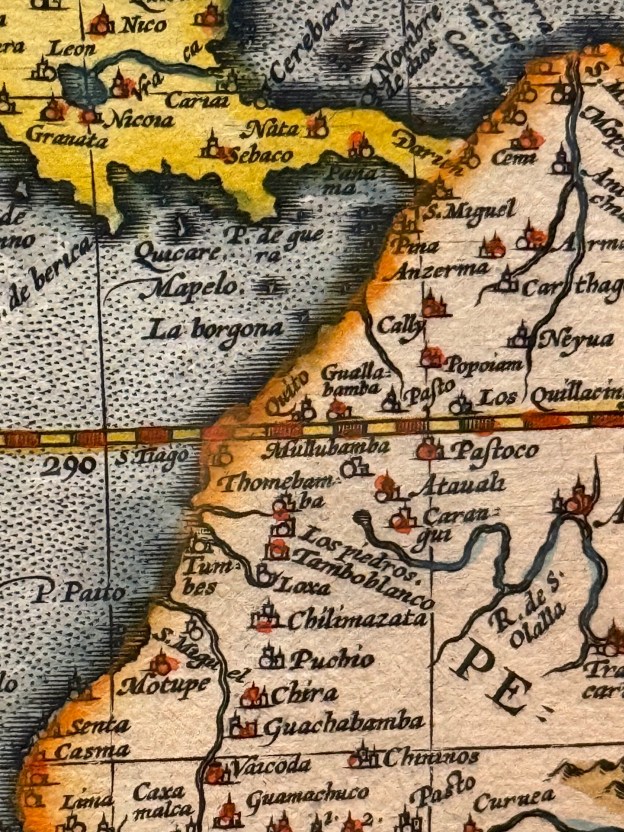
With my method in place, I want to put it to use explaining how I identified one particularly confusing toponym which Thevet used to describe a city on the coast of Peru. First, let me say that Thevet had a very broad understanding of Peru which included the entire side of South America west of the Andes, Panama, most of Central America, and the Caribbean archipelago beyond. Knowing this, I began by ignoring the word Peru and focusing instead on the coordinates Thevet ascribed to this city. He wrote in Volume 2, Book 22, Chapter 8 of his Cosmographie Universelle that this city was located “22 degrees from the Equator.”[1] Thevet used a Ptolemaic system for determining degrees of latitude, writing in the Singularitez that the Earth was divided into “360 degrees, and each degree is divided into 70 miles, which equals 16.5 leagues (96.48 km).”[2] By this calculation, the Earth’s circumference should be 34,732.8 km, which is 5,342.217 km short of the actual circumference at the Equator. This is a fitting comparison to make because the region where this city of “Saint Iacques” was located because it was certainly Equatorial in latitude considering he placed it among the cities of Quito & Ingapirca, which are located in modern Ecuador and Cusco & Cajamarca, which are located in modern Peru. 

A frame from Abraham Ortellius's map of the Americas, 1587.
A frame from Abraham Ortellius’s map of the Americas, 1587, showing Thevet’s Sainct Iacques as S. Tiago.

Generally, I found that Thevet’s degrees of latitude tend to be about double their modern equivalents, though this is a rough and often incorrect assessment. In this instance, that theory led me to search maps of the Peruvian coast around 11ºS looking for towns called Santiago, the Spanish translation of the Middle French Sainct Jacques. After spending a day searching, I gave up on this particular effort for the first time. Weeks later though, I returned to it after a conversation with frequent Wednesday Blog reader and one of my best friends Carmelita Bahamonde, who pointed out to me that her Ecuadorean hometown’s official, long name is Santiago de Guayaquil. I looked into it, and found several pages later hidden amid the text that Thevet had clarified further about this particular city of Sainct Jacques, writing that it was “the old port formerly named Guayaquil.”[3] I put this oversight at not finding this information where it was in that same source to my own poor eyesight, yet I remain grateful to my friend for confirming her hometown’s presence in Thevet’s Atlantic cosmography. He went into further detail about Guayaquil’s Spanish founder, the conquistador Francisco de Orellana (1511–1546) who led the first successful European expedition down the Amazon from the Andes to the Atlantic, losing almost all of his men along the way to desertion, disease, and attacks by the locals who knew to not welcome the Spaniards. In fact, when I began hearing about the lost Amazonian civilization first on PBS’s NOVA and later in one of my magazines, I believe it was in Smithsonian, I nearly leapt from my chair shouting “Thevet wrote about them!”

An engraving from a 16th century book of indigenous Brazilians cutting down trees for their timber.
The Franco-Tupinambá trade partnership in action from Thevet’s Cosmographie Universelle, vol. 2, 21.16, f. 950v. BNF, Public Domain.

The value of André Thevet’s books lie in their character as sources for understanding the Americas just at the moment of these continents’ invention as the fourth part of a larger global world. The Singularitez and Cosmographie Universelle offer stories and perspectives of peoples and places that had not yet been subsumed into the colonial deluge that would submerge so much of the indigenous cultures of these continents in the coming centuries. This week, my colleague (and newly minted Ph.D.) Mary Katherine Newman at Oxford published a blog post with the History Workshop on restoring indigenous historical practices to equal prominence with the written European archive that we historians are trained to use. In many respects, Thevet did this, albeit through the perspective of a sense of civilizational hierarchy which was the accepted norm of his day. Métraux wrote that Thevet was the better of the sixteenth-century travelers to visit Brazil when it came to finding the precolonial and early contact Tupinambá in that same written archive. In my work, I’ve made a strong effort at acknowledging Tupinambá agency in their colonial encounters with the French, who were interested in trading with the locals rather than conquering, colonizing, or converting them. This allowed for a vibrant trading partnership  to develop between the French and the Tupinambá which lasted through the mid 1560s. French colonial efforts might have taken off in Brazil had the colony, named France Antarctique, survived its first decade. Through a mix of sectarian infighting and increasing Portuguese dominance along the Brazilian coast, the French were expelled from France Antarctique by 1567. Still, one French toponym survives; the island where the French built their fort, which they named Fort Coligny, is today still known in Portuguese as Ilha da Villegagnon, after France Antarctique’s governor, Admiral Nicolas Durand de Villegaignon (1510–1571), the man who brought Thevet to Brazil to serve as the colony’s chaplain.


[1] Thevet, Cosmographie Universelle, vol. 2, 22.8, f. 970a.

[2] Thevet, Singularitez, f. 132v.

[3] Thevet, Cosmographie Universelle, vol. 2, 22.8, f. 972a.


On Democracy

This week, for my birthday I want to write to you about my belief in all of us and how democracy remains our best hope. — Click here to support the Wednesday Blog: https://www.patreon.com/sthosdkane


This week, for my birthday I want to write to you about my belief in all of us and how democracy remains our best hope.


One of those great efforts with which human history is concerned is the question of what our original nature was at our beginning and if and how we have changed that nature. The French anthropologist Claude Lévi-Strauss’s notion of the primitive as “closer to humanity’s origins” and living in a state without the societal and technological innovations “that obscure their nature” evokes this original nature, what in Christianity is called our original sin, or biologically our evolved state as a particular form of bipedal mammals among other lifeforms.[1] The seeming natural state of human societies until very recently has been toward forms of monarchy and aristocracy, the Tory Party in Britain today still refers to itself as the natural party of government because they descend through many generations from the old Cavaliers who supported Charles I and the aristocrats in the Parliaments of the Stuart and Georgian centuries who opposed the liberal reforms of the Whigs. Here in the United States, our own whiggish political tradition sees its modern manifestation in the old establishment wing of the Republican Party, also known as the Grand Old Party or G.O.P., whose founders in the 1850s included former Northern members of the Whig Party once led by our own aristocrats, men like Henry Clay and John Quincy Adams in the early republic.

Yet those same men stood for something beyond just preserving their own aristocratic power within their own society. These American Whigs and their Republican and Democratic successors aspired to a high ideal of human nature that entrusted power in the hands of the many rather than in those of a few or the one. Dr. Heather Cox Richardson recently wrote in her Letters from an American about how the Secessionists who dragged this country into our Civil War in 1860 and 1861 were trying to assert their own aristocratic vision of the republic that would benefit the few at the disregard of most and the expense of the many. As James J. Sheehan reminded us in his essay in the December 2024 issue of Commonweal, Tocqueville wrote that the chief difference between the source of power in an aristocracy or a monarchy, or their corrupted forms oligarchy and a tyranny, and the source of power in a democracy is that “despotism may govern without faith, but liberty cannot.”[2] The despots rely less on our trust in their rule, and in many of the cases we see today they sew discontent in government, the economy, and for all of us with each other in order to assert their authority and keep hold of power. 

Democracy is a far harder thing to keep, as Dr. Franklin knew well. The inclusion of more and more people complicates any organization, yet it also allows that organization to better reflect all involved. Democracy requires the efforts of all of us to survive; if left unwatered and unnourished by each generation it will wither and die like any other flower or fruit on the vine. Throughout my life, I’ve looked to heroes in our history from Lincoln, Mandela, Óscar Romero, Popes Francis and St. John XXIII, to people closer to my own life. What all of them have in common is a desire to improve the lot of humanity, and in the case of Lincoln and Mandela to promote democracy in their homelands. When I look ahead and worry about what might be coming in these next four years, I often wonder if I would be safer, happier, healthier, and living a more fulfilled life elsewhere in another country where I can leave the troubles of my own behind. Yet I remember these heroes, MacDonagh and MacBride, and Connolly and Pearse, my great-grandfathers who fought in the two World Wars, the dreamers and optimists who organized and marched non-violently for civil rights here in America and in Ireland too, and looking again at our own day I pause. This is our time to make life better for our successors while we live to overcome the long winter of fear before us. If I left now, could I look those heroes of mine in the eye when my time ends?

I believe in democracy because it is the best form of government we’ve yet imagined. I believe in representative government because I would rather have a say in my neighborhood, my city, my county, my state, and my country than not. I believe in democracy because I believe in humanity and that all of us can make something better if only we believed in ourselves and in each other. I believe that before that original sin there was original grace, original goodness; that before the first frown there was the first smile; that before the first thoughts of lust there were thoughts of love. I believe in democracy because I need to believe that I will have a future, that all the things which I’ve done in these last 31 years are building up to something which will, in Bill Nye’s words, “change the world,” no matter how small that change may be. To do any of this, to see any of this goodness in our hearts, to believe in ourselves again we need to be willing first to acknowledge our faults and second to forgive ourselves and put in the effort to make our lives better. For all our technology and our ever increasingly complicated ways of life, we are still the same humans as our ancestors living in Lévi-Strauss’s primitive manner. We retain the same bodies and souls. Because of this, we can build a future for our posterity in a spirit of grace, compassion, and optimism that would make the heroes of old proud.


[1] Claude Lévi-Strauss, From Montaigne to Montaigne, trans. Robert Bononno, (Minneapolis: University of Minnesota Press, 2019), 25.

[2] James J. Sheehan, “Democracy and Its Discontents,” Commonweal, December 2024, 13.