Tag Archives: Communication

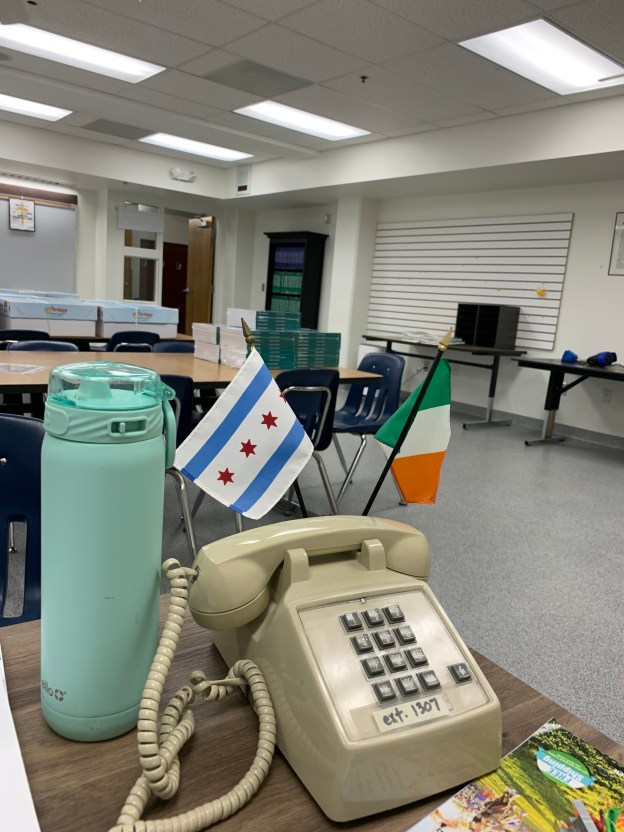
A landline telephone in a classroom.

Electronic Signals

This week, the coalescence of my thoughts over the last few months about how the way we communicate today in 2025 is so rooted in our technology.—Click here to support the Wednesday Blog: https://www.patreon.com/sthosdkane


This week, the coalescence of my thoughts over the last few months about how the way we communicate today in 2025 is so rooted in our technology.


For most of my life I tended to write a lot of ordinary quotidian things out by hand on paper either in notebooks, on notepads, or on the backs of receipts, envelopes, or whatever paper I had around. I kept up a good cursive hand and used it on a regular basis. Yet in the last decade technology has caught up to the humble notepad; a decade ago when I was living in London and trying to write out ideas for my first round of graduate essays on my phone’s Notes app while I was on the train or walking about, I often found that app in particular drained my phone’s battery at a considerable and worrisome rate. Then again, that particular smartphone tended to die if the battery dropped below 40 percent, so it had a bad battery. Still, that led to me continuing with the practice of keeping notes and scribblings in little notebooks or on notepads that I carried with me in a pocket. 

It’s funny then that it’s only now in 2025 that I notice how little I write these same notes anymore by hand; in 2021 when my Mom came to visit me in Binghamton, she brought me a couple of notebooks emblazoned with pictures of various national parks on their covers, a new trend in notebooks that began around then. I was a little taken aback by this gift because by that point I’d largely done away with handwritten notes all together. In fact, my Binghamton years launched me head-first into doing as much as possible on the computer so that I’d have less paper and books to carry back and forth between Upstate New York and Kansas City. Like printed books over digital ones, when I returned to Kansas City I began to write handwritten notes again. This is largely thanks to my employers at the Kauffman Center for the Performing Arts; in our department we still carry around paper performance notes on our shifts. When I started, I was surprised to realize that at some point in the last 5 years I’d stopped carrying a pen with me on a daily basis. Since then, in April 2023, I’ve always had a pen in my pocket.

The pandemic reinforced our digital communications in ways which pushed us firmly forward toward more frequent videocalls and texting to the detriment of the telephone in particular. Most of my friends and family tend to prefer text messages over phone calls, especially among my fellow millennials, to the point that I often second-guess myself as to whether I should try calling someone in the first place. Is a phone call intrusive, whereas a text message is like a telegram or a letter? It can be replied to in the recipient’s own time, though with a text the response time is usually expected to be faster than with a letter that’ll take days to arrive, or even an email, which I see as slightly more formal. Since the invention of Samuel Morse’s electrical telegraph in 1838, our communications have moved into a realm of electricity which was foreign to our conversations and our lives beyond lightning strikes and the daily shocks one gets in a dry climate.

This Spring then, when I was regularly on videocalls–usually over Zoom–with friends, colleagues, and family alike a thought occurred to me that all of our communications are being translated down to electrical signals being sent over wires from one person’s device to another. Those messages, no matter the content, all buzz and fizzle through our wireless data signals and across our telephone wires, through our data centers and bouncing off our satellites all to better communicate to anyone whether on the planet or high above us in orbit or beyond. It’s made us all so much closer to one another. Today, I’m regularly in contact with people in North America, Europe, and Asia and that contact is often almost as instantaneous as if we were together in the same room. It’s what makes my solitary life feel lived in community with the people I like. And yet it’s also spoiled us for the slower communication of the written letter or even the face-to-face conversation that started all these “words, words, words” as Hamlet says that we “might unpack my heart with words.” We communicate to do just that: to speak our thoughts and to live in the strange and beautiful worlds we build around ourselves. So often now, those conversations are not only occurring with the aid of the electrical signals pulsing about our minds telling us how to react and what to say and do, but also through their extracorporeal currents which connect us through our technology across vast distances to one another.

You are listening to my voice filtered by the microphone and my audio editing software being transmitted to anyone with an internet connection. While naturally we aren’t supposed to hear it, as my hearing isn’t quite as good as it should be, I can now hear the differences between sound frequencies in a finer detail yet to the point that if two voices are speaking with the same frequency, I only hear ringing at that frequency and no words or other noise. This was demonstrated to me with dramatic and terrifying effect several years ago when I was nearly t-boned by a Kansas City fire engine roaring along at full speed because I didn’t hear its siren, which wails at the same frequency as the particular section of the 1st movement of Tchaikovsky’s Violin Concerto that I was listening to in my car at the time. So, when you hear my voice what you’re hearing is an electronic recording of my voice being transmitted to you. Often, I sound higher pitched on the recording even by just a half-step, than I do to my ears when I’m doing the recording. I’m a tenor, so I’m okay with that. Still, it’s noticeable especially if I record later in the day or at night, or if I’m nervous.

After I began my graduate studies in History back in August 2017, I started making a practice of recording any conference presentation or invited lecture I gave. I’d usually only make a sound recording, not wanting to deal with a camera. This way too, if someone missed a talk and wanted to see it, I could lay the slides over the recording in iMovie and turn it into a video to send around. This has turned into a wonderful tool for listening to changes in my voice over the years. Yet it’s also interesting now because I not only use this tool for recording the actual performance but also the rehearsals as well, and sometimes when I’m editing papers. I gave a lightning talk last week that was part of a webinar hosted by the Graduate Student Advisory Committee of the Renaissance Society of America about animal intelligence titled “Animals Adapting to Changes in Nature: Perceptions of Animal Intelligence in the Renaissance?” The paper itself was pretty quick and easy to write; it maybe took me an hour to make the first draft several months ago. Yet I began recording rehearsals and making edits after each one up to the minutes before I went live on Thursday morning. I was a bit nervous when I presented, so in the end the cool and practiced pace I’d planned with a mid-range voice ended up being a minute faster than expected and closer to my upper register. When I’ve thought about what to do if anyone asked to hear this talk after the fact, I’ve considered possibly sending out my last rehearsal recording from an hour before the performance, after all many speakers would in decades past make a separate recording of their lectures & speeches from the actual live reading. Yet to keep it authentic to the talk as it went ahead, I also feel inclined to send out the one that I gave on Thursday morning to the 16 other panelists and organizers on the call and the 35 attendees listening in from around the globe. This question gets to the heart of my talk because I made the case that André Thevet’s sloth showed signs of intelligence by refusing food it didn’t want to eat and not falling to the same bad practices as the Frenchmen who captured it or the native Tupinambá who were more familiar with it. Those practices, human faults one might say, include indecision.

Rather than flip a coin or pick another method of choosing, I’m instead going to play for you now the last rehearsal recording for one very simple reason. The main benefit of my recording of the actual talk is that it ought to have captured the organizer’s introduction and the questions that followed my presentation. Yet, my phone’s microphone couldn’t pick any of that up because my computer’s sound output was going into my headphones. So, without any more gilding the lily here are my thoughts on Renaissance sloths adapting to changes in nature, brought to you through a most electronic form of communication.

~

Animals Adapting to Changes in Nature:

Perceptions of Animal Intelligence in the Renaissance?

I want to begin by thanking the members of the RSA Graduate Student Advisory Committee for holding these lightning talks and accepting my proposal among the speakers today. When considering this question of animal intelligence, I’m drawn back to the Aristotelian notions of the animal sensitive soul in contrast to the human rational soul; Erica Fudge put it well, writing that animals can feel, perceive, and move, yet humans are the only natural beings to express intellect.[1] Animals were used as stand-ins for humans in allegory and vivisection, and an over-exertion of passion could drive a human into a state of animality, yet the human was understood to be fundamentally different because of our facilities of reason developed through experience over one’s lifetime.[2]

Newly encountered American animals played a disruptive role in this dynamic. Anatomically, many such animals defied European expectations for their size, or their chimerical character appearing as a composite of unrelated creatures known to exist in the wider Mediterranean World. Chief among these in my research is the three-toed sloth which was described by the French cosmographer André Thevet (1516–1590) in his 1557 book Les Singularitez de la France Antarctique. There are many different aspects of Thevet’s sloth which allowed it to stand out as a singularity among singularities from its appearance as a bear-like ape to its vocalizations “sighing like a little child afflicted with sorrow” to its general disregard by the indigenous Tupinambá people who explained aspects of its manner to Thevet.[3] I’ve written and spoken extensively about this, I know several of you have heard me talk about Thevet’s sloth at a number of conferences in the last several years. Today though, I want to discuss something I haven’t addressed yet in all these presentations; namely the signs in Thevet’s text which point toward some sense of the sloth’s intelligence.

The sloth’s intelligence is seen in its abstention from eating the food Thevet provided it. Thevet wrote “I kept it well for a space of 26 days, where I knew that it never ate or drank, but was always in a similar state.”[4] This reaffirmed Thevet’s assertion that “this beast has never been seen to eat by a living human,” either by the Tupinambá or the French.[5] This abstention from eating could well be understood as a sign of the sloth’s lack of a rational soul which would know to eat; yet I think it is better to perceive the sloth’s abstinence as an active choice made by an animal who didn’t favor the food it was offered. Thevet wrote that “some believe that this beast lives solely on leaves of a tree named in [the Tupi language] Amahut,” which is one of the Cercopia species known to live along the Brazilian coast.[6] Yet a 2021 sloth behavioral study published in the journal Austral Ecology has proven that this claim is less grounded in the genus’s actual experience.[7]

Perhaps the sloth can be best contrasted with the dogs which killed it at the end of that 26-day captivity, or even with the accused descent from humanity by first the Tupinambá and later the French in accusations of cannibalism. Unlike the humans who occupy these stories from France Antarctique who so often fall so far from their rationality to eat each other, the sloth simply refused to eat at all. This small creature, taken from its forest home and left in the care of an unfamiliar human who didn’t know what to feed it, chose to preserve its nature and not eat what was foreign to it. The sloth adapted to changes in the nature around it and expressed an intelligence perhaps more elevated than the humans who captured it. I’m drawn to one of the most poignant lines in Montaigne’s essay “Des cannibales” in which the erstwhile political animal himself wrote “I think there is more barbarity in eating a man alive than in eating him dead; and in tearing by tortures and the rack a body still full of feeling.”[8] In all of the variations on his sloth account, Thevet published this same story twice first in the Singularitez of 1557 and later in the Cosmographie Universelle of 1575, the dominant sense I get from Thevet’s text is one of befuddlement at an animal that defied his expectations in so many ways. In the tradition of animal allegories from Aesop to Renyard the Fox the sloth fills the role of an exotic oddity, a stranger in the canon of European natural history which didn’t quite fit any mold available. Even after Thevet’s sloth was christened by Conrad Gessner an Arctopithecus in 1560 and by Carolus Clusius as an Ignavus in 1605, this fact that it refused to eat or drink what Thevet offered it for 26 days remained a constant in its story. I see in the sloth a sign of intelligence beyond expected human norms and rules which rendered it exceptional. Any assimilation of the sloth was an artifice laid over its character, a colonial imposition. Still, its abstinence fit the framework of the sensitive soul, reflecting a delicate sensitivity toward things it found unfamiliar.

~

How does a 450 year old sloth’s intelligence have any bearing on the electronic signals which carry our communications in this new century? I wouldn’t have been able to study Thevet’s sloth in the way I have without the internet and all our technology. So much of my work is with digitized primary sources, mostly printed books, that I do almost all of my research on the computer. It’s a rare occurrence that I get to go into an archive to look at a source in the flesh. Yet I think there’s another interpretation we can take here: like the sloth we choose how much we are in touch with each other, how much of our lives are spent with our phones in our hands. My weekly screen-time report tends to fall in the 3 hour range per day. Yet I’m not only checking my social media accounts or texting with people on my phone, but I’m also reading books and writing notes and ideas down on my phone or using the camera to try and capture an artful reflection of the lived world around me. Recently on Instagram I saw another person’s screen-time report say they spend 14 hours on their phone per day, which is essentially the entirety of my waking hours. To me that is unhealthy to an extreme. Yet that’s how that individual has chosen to live their life.

I know that no matter where I end up, I will remain connected to others through our technology. Somedays I do miss the slower pace of sending letters or calling family and friends on the phone as things were when I was a child. I’d rather talk with someone face-to-face or voice-to-voice than text. As I wrote in January, I feel that we’ve allowed texting to take the place that videocalls were supposed to hold in the 21st century. We’re not constantly talking to people over monitors beyond Zoom calls that are scheduled and with that pre-arrangement more formal than the quotidian string of text messages. Today, I do have a notepad on my desk, one that was given to me among the materials of a workshop I attended at the École des Hautes-Études en Sciences Sociales in Paris last summer. It’s gotten some use, yet one year later I’m still only halfway through the gridded pages. As with so much of life in general, I feel that I’m trying to find a balance between the digital and the manual, between life online and life in this place where I find myself in a given moment. All I know for certain is that over all else, I long for connection.


[1] Erica Fudge, Brutal Reasoning: Animals, Rationality, and Humanity in Early Modern England(Cornell University Press, 2019), 13.

[2] Fudge, 17.

[3] Thevet, Singularitez (Antwerp, 1558), 99r.

[4] Thevet, Singularitez (Antwerp, 1558), 99v–98r.

[5] Thevet, Singularitez (Antwerp, 1558), 99v.

[6] Thevet, Singularitez (Antwerp, 1558), 98r.

[7] Gastón Andrés Fernandez Giné, Gastón Andrés, Laila Santim Mureb, and Camila Righetto Cassano, “Feeding ecology of the maned sloth (Bradypus torquatus): Understanding diet composition and preferences, and prospects for future studies,” Austral Ecology 47 (2022): pp. 1124–1135, at p. 1132.

[8] Michel de Montaigne, “Of Cannibals,” in The Complete Essays of Montaigne, trans. Donald M. Frame, (Stanford University Press, 1965), 155.


On Pauses

This week, some words about silence in communication. — Click here to support the Wednesday Blog: https://www.patreon.com/sthosdkane Photo: the poster for the new film "Lee" which is discussed in this episode.


This week, some words about silence in communication.


In my current job, one thing that is often challenging for new hires is learning how to operate our radios. In general, personal radios are the same no matter where you go, albeit with different features added to higher-end models like screens telling you which channel it’s tuned to. I found our radios to be one of the easier parts of the job to adapt to, I have experience working with radios from my time in the Boy Scouts for one. Yet I wish when teaching people how to use radios for the first time we would talk about how we communicate on a most basic level. We use all of our senses to communicate but especially our sight and hearing. 

Sound is the purest medium of communication for us humans: we talk with one another by emitting sounds from our mouths and receiving them with our ears. There’s a whole genre of performance these days called “spoken word” which annoys me because that’s the purest and most fundamental form of communication, let alone art, that we have. Rather, it should be called speakingtalking, or if you want to be fancier oratory. It’s only since we began to read silently that this distinction between speech and writing has grown. From what I remember hearing, the first significant reader to read silently was St. Augustine of Hippo, though that could be apocryphal.

Beyond sound there’s visual communication. In my job when we’ve talked about backup plans should our radios no longer be functional or useful I’ve suggested, perhaps a tad jocularly, that we should resort to semaphore flags, or some sort of similar if more rudimentary system. I have the semaphore Wuthering Heightssketch from Monty Python’s Flying Circus in mind when making this suggestion, but still, it’s always worth considering. In writing we are stuck having to express the full range of emotions and meanings in a manner that is limited by letters, words, and symbols on a physical surface. Emojis now help in more popular parlance to express the emotion behind our texts and social media posts, yet there again I often get annoyed when I see the bubbly and bucolic emojis used in places where they seem unfit, as though a contemporary expectation is that we all are using a string of emojis at the ends of our sentences because everyone else is doing it. I removed the emojis placed by default on a happy birthday message that Facebook suggested I send to a friend because they aren’t a necessary part of my communication. I use the period, or full stop for my non-American readers, at the ends of my texts because that’s how I end a sentence unless it’s interrogatory or exclamatory in nature.

As you can see, I have more to say about visual communication, especially the written word, because that is my own medium. I also dabble in photography, and have embraced Instagram for this reason, yet again I feel less need to take selfies everywhere I go because I can far more honestly demonstrate my presence in a place through writing. On my Instagram stories, I decided about a decade ago when I first opened my account that I would always format my captions with a highlighted blue background and white text as a way of saying, however subtly, to my readers that these are my words. I’ve kept to that, though this is the first time I’ve acknowledged that practice.

In either of these senses, hearing or sight, should we lack one we have to rely even more on the other to understand our surroundings and what others are trying to express. I’ve learned a hard lesson that my nonfiction writing benefits greatly from firm clarity over the opacity that I prefer as I unravel the story in my fiction. The same occurs when using radios: these are devices which allow an individual to communicate with others from a distance sight-unseen. The words we speak into our radios then need to be crystal clear for the people listening to understand what we are trying to say. I like to think of the mission controllers in Houston or Star City who have relayed intricate strings of numbers up to astronauts and cosmonauts beyond our planet to help them complete their missions and return home safely. It gives me a thrill to try to be that clear on my radio, and to be comfortable with that level of clarity when speaking into it.

Yet beyond these two senses, we have minds which are experiencing all of the things that our senses relay to it. We see more than just the messages other people display or transmit, and we hear more than just talk. Our minds are capable of parsing through all of this and making meaning out of it to orientate us in our lived worlds. This summer when I was back in London, I knew I was in a very public setting in close proximity to about 10 other people when I took the new Elizabeth line from the Docklands to the West End one Sunday afternoon, yet I also knew from experience and from seeing the people around me that no one would think anything if I pulled out the book I’d just bought, Michael Palin’s Erebus, and start reading it. Sure, everyone around me could see what I was reading if they wanted, but in that moment it was perfectly alright to do that because it was an unspoken part of life on the trains of the British capital that people pass the time by reading, so long as those readers don’t then share what they’ve just read with the strangers seated or standing about them.

On Friday afternoon last week, I went to one of the local cinemas to see the new film Lee staring Kate Winslet as Lee Miller, one of the great photographers and war correspondents of the last World War. I bought my ticket knowing it was going to be a stellar performance from Winslet, yet I was struck just as much by the dialogue as I was by the pauses written into the script. In one scene, one such pause propelled the story forward far more than any other moment in the whole film, connecting the postwar framing narrative together with the main story being told. That’s the beauty of theatre and film: it’s a medium where the written script is interpreted by actors who we see and hear, and so these two senses are unified to bring these characters and stories to life. This film, like its contemporary Freud’s Last Session which I saw earlier this year, had the feel of a play, and could probably work as such though the realism of Lee is that it takes the audience along with the photographer as she witnesses the destruction of Europe and the horrors committed by the Nazis in the wake of their fall from power in 1944 and 1945.

These silent moments are something that I find can be expressed more in my narrative writing, a style I usually use writing fiction, where I’m writing dialogue as well as the connecting tissue giving those words spoken by the characters their place in the world of the story. In real life we can express nearly as much with a look as we can with a word. This setting of Britain, Occupied France, and Germany in World War II is a potent one for telling stories, after all so many movies continue to be made about that war even as we move ever further from those years. I wonder if in the twenty-first century when we are so connected by our technology, how are our innate communicative abilities adapting to our newfound world? When I was little it was a big deal to see a copy of a foreign newspaper available for sale here in Kansas City; you could maybe buy a copy of the Sunday Times at Barnes & Noble in the magazine section, but they wouldn’t always have it available. Today though, we have people from all around the globe talking at once.

What is it we aren’t saying amid all the cacophonic chaos of our modern social media?


An Election Year Independence Day

An Election Year Independence Day Wednesday Blog by Seán Thomas Kane

This week, I’m writing to you with this week’s holiday in mind, with some of my aspirations and hopes for America. — Click here to support the Wednesday Blog: https://www.patreon.com/sthosdkane

This week, I’m writing to you with this week’s holiday in mind, with some of my aspirations and hopes for America.


While I have colonial ancestors who settled New Haven, Connecticut and Newark, New Jersey, and who at the time of the American Revolution were living in Pennsylvania, Maryland, and North Carolina, I more closely associate with my recent immigrant ancestors. I’m one of those hyphenated-Americans who holds onto elements of a culture and identity that transcends the Atlantic and provides connections not only to this country but to the places where my ancestors came from. One aspect of the political philosophy of American nationalism that I don’t agree with says that you have to conform to a particular American identity when you come here. My ancestors did that, to varying degrees, and I’m more American than anything else, yet it’s all those other elements that give our Americanness its richness of character.

So, when I think of the music that embodies the soul of America, it’s music written by a fellow hyphenated-American, Aaron Copland, the dean of American classical music. When I tried my hand at musical composition in college, I wrote a four-movement trio sonata that told the story of a voyage from Ireland to America by St. Brendan and his monks in the sixth century. My addition to the fable was to have the tone of the music switch from being very Irish in the first and second movements to taking after Copland’s sound in the third and especially the fourth movement as they reached this side of the water. I’ve long wanted to write a blog post all about my admiration for Copland’s music, but thanks to the copyrights on his recordings I’m waiting for a few more decades. For now, go listen to Appalachian Spring and Rodeo after you’re done listening to, or reading, this.

Copland’s music speaks to me now in 2024 especially as we approach an election year. This is the most sacred task that we American citizens fulfill in our obligations to our republic: we do our duty by voting for whom we want to represent us on all levels of government, and on the host of ballot measures found further down-ballot. This election feels far more pivotal than any we’ve seen in my lifetime. For context, I was born exactly one month before the elder President Bush stood aside for President Clinton. While I may have disagreed with the policies of both Presidents Bush, they still seemed to be decent men. It’s hard to say that this year about one of the two candidates who flooded Thursday night’s debate on CNN with so many half-truths and outright lies that the network did nothing to check live on air. I was baffled watching it to think that the network’s executives and news directors didn’t choose to lay out better safeguards considering this is the same man whose rhetoric and refusal to admit his loss in 2020 led to the storming of the Capitol on January 6th, 2021.

When I think of a President who I want leading our country, I think of Copland’s Fanfare for the Common Man.I want someone who best represents the best ideals of America, someone who can speak with all of us and for all of us. I hope for someone who can work with Congress and the states to execute legislation that will lead to an overall improvement in our national well-being. I was disappointed to see the President perform so poorly during the debate on Thursday, yet of our choices this year he is the closest to embodying that ideal of the common man.

This year’s election is not politics as usual, there are deep intrinsic questions at stake over the future of our country and what sort of government we want to have. I was deeply unsettled to read the transcript of David Brooks’s recent interview with Steve Bannon, who Brooks called a Trotsky-figure for the MAGA movement. From the interview, and from the way Bannon positioned himself as a leader of that movement, he made it clear that there is no room for communication with their political opponents, who Bannon termed in a far more affrontive manner as their enemies. That is the most essential element of good government, something that all the great political philosophers recognized: we need to be able to communicate with each other and grow together as one body politick made up of a great many parts. I’ve seen the same problem on the left as on the right, a disinterest in listening and in compromising to achieve a higher ideal or a common good that will benefit everyone. Yet the greater threat is coming from the faction who’ve gained enough sway that they now control their party and their leader is again a candidate for the Presidency.

This Independence Day, Americans around the globe will celebrate the invention of our republic from an ideal written on paper during a hot and humid Philadelphia summer 248 years ago. I’ve heard it said that that was the first time that anyone thought to write down the idea that “all men are created equal.” Think about that for a moment: that was the first time that the notion of universal equality, or better universal equity, had ever been considered. The President is the President, and I respect him for serving in that office as I feel respect for the office itself. It is a monument to self-sacrifice when done well, and a trap of self-aggrandizement when the oath is taken for the wrong reasons. Yet when a sitting President leaves the office on Inauguration Day, they may still be Former President, but they are now again just another citizen who’s offered to carry that mantle in the relay until the next candidate will take it up.

The burdens of preserving, protecting, and defending the Constitution of the United States are greater than one person can carry on their own. The office holder ought to have us, we the people who come first in the Constitution, supporting them as long as they keep their oath, and do their duty for as long as their term lasts. It is a humbling thing to serve in such an august role. It is something that truly should not be taken lightly, or brought on by a candidate for any other reason than for service.


Understanding Others and Communicating Well

This may not necessarily be a post that will be on a topic that’s familiar to most of you, the 30 or so people who occasionally read these posts, but it’s something that’s important to me. The ability to communicate well, and efficiently, is paramount. It’s ultimately going to be key to solving all of our problems, to making life better for everyone. I truly believe if we could, or rather would, actually sit down and talk with someone we have a disagreement with, chances are we’d find enough common ground to begin sorting our problems out.

But this post isn’t about solving humanity’s big problems, and I’m going to try to refrain from my usual upbeat optimistic conclusions that I’ve noticed I tend to write. Because this evening I want to write about a topic I’ve been interested in for nearly 20 years, one that I’ve struggled with and studied, and am only now really feeling like I’ve confidently mastered: Latin.

Latin is a language that I’ve been fascinated by for a very long time. In part, I’ll admit it’s an attraction to the prestige it embodies: the language of the Romans, and of my Church. It’s been a constant piece of the intellectual and cultural fabric of European and now Atlantic civilization (that’s another idea I’m working on) for millennia. It’s also a highly logical language, a systematic language governed by a set of rules that, once explained, make pretty good sense. Moreover, it’s the ancestor of a number of humanity’s most widely spoken languages, and has directly influenced many, many others, including English. It’s taken three tries now, but I’ve made sense of the language well enough now to feel confident not just repeating the declensions and conjugations that I’ve memorized, but understanding the intricacies of their meaning, and in so doing, to have a better idea at understanding how Latin works.

Latin has also come to reflect the people who have written in it and spoken it over the generations, particularly in their preferences in word order and writing. I’ve often thought, considering that word order isn’t as important in Latin, after all the word endings provide the meaning, couldn’t a native Irish speaker go ahead and speak Latin using a verb, subject, object order and be decently-well understood just as much as a speaker using the classical Ciceronian order of subject, object, verb? Yet there’s one thing that does survive from the ancient world in faint traces that was revived later than other customs in written Latin, something that is still not universally adopted: the macron.

Macrons: the flat line over a vowel sometimes seen in Latin writing, as well as the first family of France, is something that I believe to be fundamental in properly understanding Latin. Sure, my medievalist friends will say, it wasn’t used in Medieval Latin, so we (Medieval and Renaissance historians & scholars, myself included) don’t need to memorize the macrons. But for me, it’s the macrons that have been one of the best tools to help me make sense of Latin. It’s answered the question for me of how a Latin speaker might differentiate between līber, “a child” (pronounced like Lee) and liber, “a book” (li pronounced like literature). It helps me make sense of the difference between a 1st declension nominative singular noun (the subject form) and a 1st declension ablative singular noun (a slightly more complicated form).1 The macron makes everything clear.

This is a good explanation from a far better Latin scholar than me about the use of macrons (the apex).

Without the macron, the meaning of a sentence can be understood, but with much more difficulty. This particular idea makes perfect sense to me because of my work with my primary ancestral language, Irish. In Irish, there are two types of vowels, long and short. The long vowels are represented by a fada over the vowel, essentially an acute accent (accent aigu en français). This is how an Irish speaker knows when reading my name that they’re in fact reading about a guy named Seán and not something that’s old (sean). The presence of the fada isn’t just to make the language look cool (which it also does), but it has a very real impact on the pronunciation and meaning of the word as a whole.

I think it’s best not to think of Irish vowels with fada or Latin vowels with macrons as just variant forms of those vowels but instead as entirely different vowels all together. The á in Seán is an entirely different sound, and thus ought to be seen as an entirely different letter to the a in sean. In the same way, that ī in līber is a different character, and a different sound from the i in liber.

We don’t have these same written variations of our vowels in English. We just have the 5 vowels, occasionally 6, which are supposed to represent all of the vowel sounds that English uses, in all national and regional Englishes around the globe, and in all of their local varieties. In my own accent, I can count at least 3 different sounds that each of the vowels represent. Granted, English wasn’t always like this, macrons were also used in Old English, and through generations of linguistic change, immigration, and English’s constant adoption of foreign words the language has become the exceedingly complicated, often irregular form of communication it is today. Not only is my English influenced by the most basic form of the language studied and spoken here in North America, but there’s also hints of Irish in there as well as the strong British, German, and Nordic influences in my English from all those immigrants who settled in my home region, the American Midwest, in the 19th and 20th centuries, including some of my other ancestors from England, Finland, Flanders, Sweden, and Wales.2

In English, we’ve chosen complexity in spelling as it relates to the spoken language over a 1-to-1 matching of the written language with the spoken language. Why? My best guess is it’s to preserve the unity of English. This keeps it so that all English speakers are generally spelling their words in the same way, between the two main written forms of English (UK & Commonwealth, and US English). For the most part, it’s worked for English, and I wouldn’t recommend moving away from the current model for the exact reasons why it exists; more on that at a later date.

But returning to Latin, if students trying to learn this language, famous for its now generally unspoken nature, really want to give themselves a good chance of succeeding in learning it, then those of us familiar with Latin, whether as students or as teachers, should embrace the macron even more than it already is, and use it throughout all our written Latin. Up until recently, it was challenging especially on computers with English keyboards to type any sort of accented vowels or consonants, but the technology has advanced enough that it’s readily possible today for most keyboards to make things work. On my Mac, I can hold down any of the vowel keys until a box pops up on the screen indicating each accent that can be put on that vowel. I then just have to choose them by number. So, for līber, when it comes to the ī, all I have to do is hold down the i key and press 4, et voilà, I’ve got myself an ī. We should do ourselves, and Latin itself, a favor, after all the easier we make learning this language, the more likely people are going to want to keep learning it.

I like Latin, it’s orderly, and when it’s explained well it can make a lot of sense. All of my Latin teachers to date have done a wonderful job explaining it, sometimes though it takes a bit more maturity to make sense of things. In general, I think we tend to have trouble in the English-speaking world understanding grammar. Let’s face it, our own language has so many contradictions that often English speakers don’t even really understand the rules of English grammar all that well. One of these days, I want to write a little book, a libellus in Latin, that can provide at least what I see as some of the more important rules in English, that’ll allow English to make more sense for the average speaker.

Today though, in my Latin studies (Wheelock, Ch. 20), I learned to my delight that the word frūctus means both fruit and profit. Frankly, those two make sense together, after all what are profits but the fruits of our labors. For the rare admirer of Star Trek out there who might be reading this, it came to mind that if I ever get the chance to write for them on a future Trek TV show involving the Ferengi of DS9 fame, I’d want to have a particularly smart-ass human academic offer a Ferengi a bowl of fruit (frūctus), after all the sole goal in the life of a Ferengi is the acquisition of profit (frūctus). A Latin pun set in an imagined version of the 24th or 25th century CE somewhere out in Space. I wonder what Cicero would make of it?


1 For the sake of the narrative flow, the ablative basically is the form that distinguishes a myriad of ways a noun relates to the rest of the sentence not covered by the nominative (subject), genitive (possessive), dative (indirect object), and accusative (direct object). I’m going to let the Latin teacher who runs the Latin Tutorial channel on YouTube explain it in this playlist:

2 What can I say, I’m an American.

CORRECTION: 18 March 2021, added pronunciations of līber and liber.