Tag Archives: Conrad Gessner

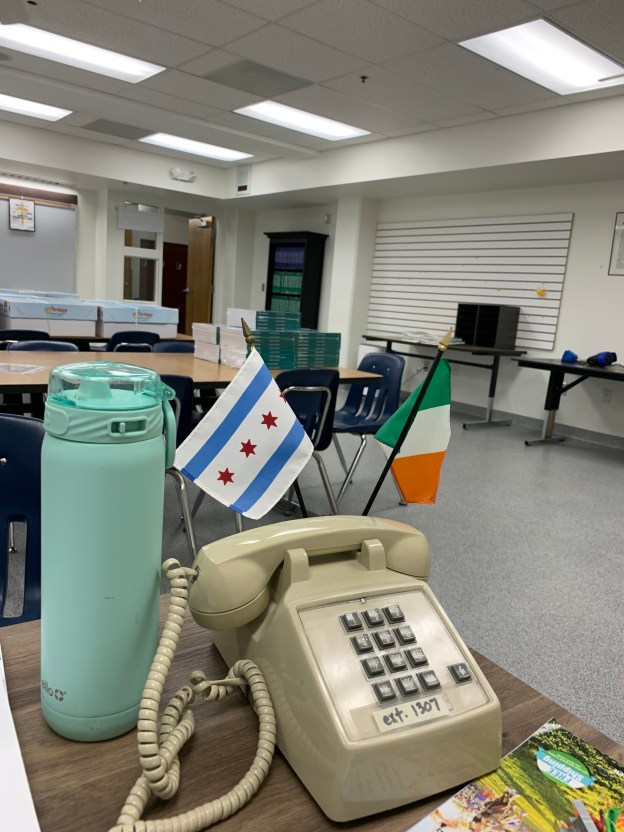
A landline telephone in a classroom.

Electronic Signals

This week, the coalescence of my thoughts over the last few months about how the way we communicate today in 2025 is so rooted in our technology.—Click here to support the Wednesday Blog: https://www.patreon.com/sthosdkane


This week, the coalescence of my thoughts over the last few months about how the way we communicate today in 2025 is so rooted in our technology.


For most of my life I tended to write a lot of ordinary quotidian things out by hand on paper either in notebooks, on notepads, or on the backs of receipts, envelopes, or whatever paper I had around. I kept up a good cursive hand and used it on a regular basis. Yet in the last decade technology has caught up to the humble notepad; a decade ago when I was living in London and trying to write out ideas for my first round of graduate essays on my phone’s Notes app while I was on the train or walking about, I often found that app in particular drained my phone’s battery at a considerable and worrisome rate. Then again, that particular smartphone tended to die if the battery dropped below 40 percent, so it had a bad battery. Still, that led to me continuing with the practice of keeping notes and scribblings in little notebooks or on notepads that I carried with me in a pocket. 

It’s funny then that it’s only now in 2025 that I notice how little I write these same notes anymore by hand; in 2021 when my Mom came to visit me in Binghamton, she brought me a couple of notebooks emblazoned with pictures of various national parks on their covers, a new trend in notebooks that began around then. I was a little taken aback by this gift because by that point I’d largely done away with handwritten notes all together. In fact, my Binghamton years launched me head-first into doing as much as possible on the computer so that I’d have less paper and books to carry back and forth between Upstate New York and Kansas City. Like printed books over digital ones, when I returned to Kansas City I began to write handwritten notes again. This is largely thanks to my employers at the Kauffman Center for the Performing Arts; in our department we still carry around paper performance notes on our shifts. When I started, I was surprised to realize that at some point in the last 5 years I’d stopped carrying a pen with me on a daily basis. Since then, in April 2023, I’ve always had a pen in my pocket.

The pandemic reinforced our digital communications in ways which pushed us firmly forward toward more frequent videocalls and texting to the detriment of the telephone in particular. Most of my friends and family tend to prefer text messages over phone calls, especially among my fellow millennials, to the point that I often second-guess myself as to whether I should try calling someone in the first place. Is a phone call intrusive, whereas a text message is like a telegram or a letter? It can be replied to in the recipient’s own time, though with a text the response time is usually expected to be faster than with a letter that’ll take days to arrive, or even an email, which I see as slightly more formal. Since the invention of Samuel Morse’s electrical telegraph in 1838, our communications have moved into a realm of electricity which was foreign to our conversations and our lives beyond lightning strikes and the daily shocks one gets in a dry climate.

This Spring then, when I was regularly on videocalls–usually over Zoom–with friends, colleagues, and family alike a thought occurred to me that all of our communications are being translated down to electrical signals being sent over wires from one person’s device to another. Those messages, no matter the content, all buzz and fizzle through our wireless data signals and across our telephone wires, through our data centers and bouncing off our satellites all to better communicate to anyone whether on the planet or high above us in orbit or beyond. It’s made us all so much closer to one another. Today, I’m regularly in contact with people in North America, Europe, and Asia and that contact is often almost as instantaneous as if we were together in the same room. It’s what makes my solitary life feel lived in community with the people I like. And yet it’s also spoiled us for the slower communication of the written letter or even the face-to-face conversation that started all these “words, words, words” as Hamlet says that we “might unpack my heart with words.” We communicate to do just that: to speak our thoughts and to live in the strange and beautiful worlds we build around ourselves. So often now, those conversations are not only occurring with the aid of the electrical signals pulsing about our minds telling us how to react and what to say and do, but also through their extracorporeal currents which connect us through our technology across vast distances to one another.

You are listening to my voice filtered by the microphone and my audio editing software being transmitted to anyone with an internet connection. While naturally we aren’t supposed to hear it, as my hearing isn’t quite as good as it should be, I can now hear the differences between sound frequencies in a finer detail yet to the point that if two voices are speaking with the same frequency, I only hear ringing at that frequency and no words or other noise. This was demonstrated to me with dramatic and terrifying effect several years ago when I was nearly t-boned by a Kansas City fire engine roaring along at full speed because I didn’t hear its siren, which wails at the same frequency as the particular section of the 1st movement of Tchaikovsky’s Violin Concerto that I was listening to in my car at the time. So, when you hear my voice what you’re hearing is an electronic recording of my voice being transmitted to you. Often, I sound higher pitched on the recording even by just a half-step, than I do to my ears when I’m doing the recording. I’m a tenor, so I’m okay with that. Still, it’s noticeable especially if I record later in the day or at night, or if I’m nervous.

After I began my graduate studies in History back in August 2017, I started making a practice of recording any conference presentation or invited lecture I gave. I’d usually only make a sound recording, not wanting to deal with a camera. This way too, if someone missed a talk and wanted to see it, I could lay the slides over the recording in iMovie and turn it into a video to send around. This has turned into a wonderful tool for listening to changes in my voice over the years. Yet it’s also interesting now because I not only use this tool for recording the actual performance but also the rehearsals as well, and sometimes when I’m editing papers. I gave a lightning talk last week that was part of a webinar hosted by the Graduate Student Advisory Committee of the Renaissance Society of America about animal intelligence titled “Animals Adapting to Changes in Nature: Perceptions of Animal Intelligence in the Renaissance?” The paper itself was pretty quick and easy to write; it maybe took me an hour to make the first draft several months ago. Yet I began recording rehearsals and making edits after each one up to the minutes before I went live on Thursday morning. I was a bit nervous when I presented, so in the end the cool and practiced pace I’d planned with a mid-range voice ended up being a minute faster than expected and closer to my upper register. When I’ve thought about what to do if anyone asked to hear this talk after the fact, I’ve considered possibly sending out my last rehearsal recording from an hour before the performance, after all many speakers would in decades past make a separate recording of their lectures & speeches from the actual live reading. Yet to keep it authentic to the talk as it went ahead, I also feel inclined to send out the one that I gave on Thursday morning to the 16 other panelists and organizers on the call and the 35 attendees listening in from around the globe. This question gets to the heart of my talk because I made the case that André Thevet’s sloth showed signs of intelligence by refusing food it didn’t want to eat and not falling to the same bad practices as the Frenchmen who captured it or the native Tupinambá who were more familiar with it. Those practices, human faults one might say, include indecision.

Rather than flip a coin or pick another method of choosing, I’m instead going to play for you now the last rehearsal recording for one very simple reason. The main benefit of my recording of the actual talk is that it ought to have captured the organizer’s introduction and the questions that followed my presentation. Yet, my phone’s microphone couldn’t pick any of that up because my computer’s sound output was going into my headphones. So, without any more gilding the lily here are my thoughts on Renaissance sloths adapting to changes in nature, brought to you through a most electronic form of communication.

~

Animals Adapting to Changes in Nature:

Perceptions of Animal Intelligence in the Renaissance?

I want to begin by thanking the members of the RSA Graduate Student Advisory Committee for holding these lightning talks and accepting my proposal among the speakers today. When considering this question of animal intelligence, I’m drawn back to the Aristotelian notions of the animal sensitive soul in contrast to the human rational soul; Erica Fudge put it well, writing that animals can feel, perceive, and move, yet humans are the only natural beings to express intellect.[1] Animals were used as stand-ins for humans in allegory and vivisection, and an over-exertion of passion could drive a human into a state of animality, yet the human was understood to be fundamentally different because of our facilities of reason developed through experience over one’s lifetime.[2]

Newly encountered American animals played a disruptive role in this dynamic. Anatomically, many such animals defied European expectations for their size, or their chimerical character appearing as a composite of unrelated creatures known to exist in the wider Mediterranean World. Chief among these in my research is the three-toed sloth which was described by the French cosmographer André Thevet (1516–1590) in his 1557 book Les Singularitez de la France Antarctique. There are many different aspects of Thevet’s sloth which allowed it to stand out as a singularity among singularities from its appearance as a bear-like ape to its vocalizations “sighing like a little child afflicted with sorrow” to its general disregard by the indigenous Tupinambá people who explained aspects of its manner to Thevet.[3] I’ve written and spoken extensively about this, I know several of you have heard me talk about Thevet’s sloth at a number of conferences in the last several years. Today though, I want to discuss something I haven’t addressed yet in all these presentations; namely the signs in Thevet’s text which point toward some sense of the sloth’s intelligence.

The sloth’s intelligence is seen in its abstention from eating the food Thevet provided it. Thevet wrote “I kept it well for a space of 26 days, where I knew that it never ate or drank, but was always in a similar state.”[4] This reaffirmed Thevet’s assertion that “this beast has never been seen to eat by a living human,” either by the Tupinambá or the French.[5] This abstention from eating could well be understood as a sign of the sloth’s lack of a rational soul which would know to eat; yet I think it is better to perceive the sloth’s abstinence as an active choice made by an animal who didn’t favor the food it was offered. Thevet wrote that “some believe that this beast lives solely on leaves of a tree named in [the Tupi language] Amahut,” which is one of the Cercopia species known to live along the Brazilian coast.[6] Yet a 2021 sloth behavioral study published in the journal Austral Ecology has proven that this claim is less grounded in the genus’s actual experience.[7]

Perhaps the sloth can be best contrasted with the dogs which killed it at the end of that 26-day captivity, or even with the accused descent from humanity by first the Tupinambá and later the French in accusations of cannibalism. Unlike the humans who occupy these stories from France Antarctique who so often fall so far from their rationality to eat each other, the sloth simply refused to eat at all. This small creature, taken from its forest home and left in the care of an unfamiliar human who didn’t know what to feed it, chose to preserve its nature and not eat what was foreign to it. The sloth adapted to changes in the nature around it and expressed an intelligence perhaps more elevated than the humans who captured it. I’m drawn to one of the most poignant lines in Montaigne’s essay “Des cannibales” in which the erstwhile political animal himself wrote “I think there is more barbarity in eating a man alive than in eating him dead; and in tearing by tortures and the rack a body still full of feeling.”[8] In all of the variations on his sloth account, Thevet published this same story twice first in the Singularitez of 1557 and later in the Cosmographie Universelle of 1575, the dominant sense I get from Thevet’s text is one of befuddlement at an animal that defied his expectations in so many ways. In the tradition of animal allegories from Aesop to Renyard the Fox the sloth fills the role of an exotic oddity, a stranger in the canon of European natural history which didn’t quite fit any mold available. Even after Thevet’s sloth was christened by Conrad Gessner an Arctopithecus in 1560 and by Carolus Clusius as an Ignavus in 1605, this fact that it refused to eat or drink what Thevet offered it for 26 days remained a constant in its story. I see in the sloth a sign of intelligence beyond expected human norms and rules which rendered it exceptional. Any assimilation of the sloth was an artifice laid over its character, a colonial imposition. Still, its abstinence fit the framework of the sensitive soul, reflecting a delicate sensitivity toward things it found unfamiliar.

~

How does a 450 year old sloth’s intelligence have any bearing on the electronic signals which carry our communications in this new century? I wouldn’t have been able to study Thevet’s sloth in the way I have without the internet and all our technology. So much of my work is with digitized primary sources, mostly printed books, that I do almost all of my research on the computer. It’s a rare occurrence that I get to go into an archive to look at a source in the flesh. Yet I think there’s another interpretation we can take here: like the sloth we choose how much we are in touch with each other, how much of our lives are spent with our phones in our hands. My weekly screen-time report tends to fall in the 3 hour range per day. Yet I’m not only checking my social media accounts or texting with people on my phone, but I’m also reading books and writing notes and ideas down on my phone or using the camera to try and capture an artful reflection of the lived world around me. Recently on Instagram I saw another person’s screen-time report say they spend 14 hours on their phone per day, which is essentially the entirety of my waking hours. To me that is unhealthy to an extreme. Yet that’s how that individual has chosen to live their life.

I know that no matter where I end up, I will remain connected to others through our technology. Somedays I do miss the slower pace of sending letters or calling family and friends on the phone as things were when I was a child. I’d rather talk with someone face-to-face or voice-to-voice than text. As I wrote in January, I feel that we’ve allowed texting to take the place that videocalls were supposed to hold in the 21st century. We’re not constantly talking to people over monitors beyond Zoom calls that are scheduled and with that pre-arrangement more formal than the quotidian string of text messages. Today, I do have a notepad on my desk, one that was given to me among the materials of a workshop I attended at the École des Hautes-Études en Sciences Sociales in Paris last summer. It’s gotten some use, yet one year later I’m still only halfway through the gridded pages. As with so much of life in general, I feel that I’m trying to find a balance between the digital and the manual, between life online and life in this place where I find myself in a given moment. All I know for certain is that over all else, I long for connection.


[1] Erica Fudge, Brutal Reasoning: Animals, Rationality, and Humanity in Early Modern England(Cornell University Press, 2019), 13.

[2] Fudge, 17.

[3] Thevet, Singularitez (Antwerp, 1558), 99r.

[4] Thevet, Singularitez (Antwerp, 1558), 99v–98r.

[5] Thevet, Singularitez (Antwerp, 1558), 99v.

[6] Thevet, Singularitez (Antwerp, 1558), 98r.

[7] Gastón Andrés Fernandez Giné, Gastón Andrés, Laila Santim Mureb, and Camila Righetto Cassano, “Feeding ecology of the maned sloth (Bradypus torquatus): Understanding diet composition and preferences, and prospects for future studies,” Austral Ecology 47 (2022): pp. 1124–1135, at p. 1132.

[8] Michel de Montaigne, “Of Cannibals,” in The Complete Essays of Montaigne, trans. Donald M. Frame, (Stanford University Press, 1965), 155.

A Sense of Purpose

This week, the third in several scribblings about my research: how studying Thevet and his world fulfills a need to find purpose in life.—Click here to support the Wednesday Blog: https://www.patreon.com/sthosdkane


This week, the third in several scribblings about my research: how studying Thevet and his world fulfills a need to find purpose in life.


Throughout my graduate education the need for new work to compliment, correct, or add to old work has remained a constant theme. It’s critical to our profession, otherwise why devote our time and talent to studying the past if we’re merely rehashing something already said in the generations of our profession’s own history? I passed through the first five of years of my graduate education without that purpose or that drive, and I think it’s what kept me behind some of my colleagues in achievement. Yet when I found something to make my own, a historical topic upon which to pitch my tent and make myself known, I took that chance. Still, I wasn’t entirely sure what value studying Thevet actually brought to the profession. He is an important figure of middling influence in the development of Renaissance natural history, one whose contributions have often been reduced to laughable exemplars of a time before the scientific study of zoology developed. A secondary approach I take to Thevet is to view his work in light of the great contributions to natural history of the great minds of the Enlightenment, active two centuries after the cosmographer, who are often the next great mile marker in the long road that is the history of natural history.

Of these Enlightenment naturalists, the Comte de Buffon (1701–1788) acknowledged the better parts of what Thevet wrote and adopted those as mile markers in his own natural histories. I think Thevet often appears in the eighteenth century because the center of European thought had shifted by that time from Italy, the radiant heart of Renaissance humanism, to France and so the likes of Buffon and Humboldt would’ve been familiar with Thevet as he was one of the more prominent French naturalists whose books were available. Thevet’s notoriety in his own century lay predominately in the transalpine republic of letters, most famously with his Zurich-based admirer Conrad Gessner (1516–1565) who was personally responsible for elevating Thevet’s natural history beyond the original editions to a broader consciousness by including Thevet’s animals in his own Icones animalium and Icones avium omnium of 1560 and his German Thierbuch of 1562. While Thevet’s Singularitez was translated into Italian by the Venetian Giuseppe Horologgi in an edition published by the eminent Venetian printer Gabriele Giolito de’ Ferrari (1508–1578) with the title Historia dell’India America detta altramente Francia Antartica, that volume didn’t carry over the woodcuts which Thevet included in the first edition published in Paris by Maurice de la Porte in 1557 that were copied for Christophe Plantin’s 1558 edition published in Antwerp. This says to me that these pictures didn’t fit the purpose of Giolito’s edition; they especially didn’t fit the sorts of books he anticipated selling Thevet’s alongside. As such, without the pictures Thevet’s work doesn’t seem to have carried as much weight in Italy and is instead better remembered in its original French.

When I was first searching for copies of the Singularitez in August 2019, I initially downloaded a copy of the 1878 Paul Gaffarel edition of the book, which while of great utility especially in its footnotes, isn’t as important as any of the original 1557 or 1558 editions published in Paris and Antwerp to my research. These are the core sources for my work; in particular I used a copy of the 1558 Plantin edition published in Antwerp as my main source for my translation. I can make the case that the Plantin edition is more important in the context of Thevet’s natural history, as it’s the same edition that Gessner acquired and used as the basis for his inclusion of the sloth and toucan in his 1560 pair of Icones books, however in all truth I ended up working with that edition because it was the first one that I found from the sixteenth century. Unlike the two Paris editions (1557 & 1558), Plantin’s edition was not intended for a domestic French audience. The most recent effort of mine toward the publication of my translation was to translate the different royal and imperial privileges and letters to patrons of each translator in order to fully place my own translation within the varied contexts in which each of these contemporary editions existed. It’s interesting to see Thomas Hacket’s 1568 English translation be dedicated to Sir Henry Sidney, who was a major player in the Elizabethan conquest of Ireland and in the early English colonial enterprise. In contrast, Horologgi’s translation begins with a letter to his patron, Paolo Giordano I Orsini (1541–1585), the Duke of Bracciano and like Sidney a noted military man. Thevet himself dedicated his book to Jean de Bertrand, Cardinal of Sens (r. 1557–1560), and in doing dedicated it to the French national cause within which one can best understand the whole French expedition in Brazil.Thevet sought a sense of purpose in his life built upon the travel books he loved to read. He made himself a character in those books, a cosmographer who could be trusted to tell the truth of the faraway because he had seen it with his own eyes. The logic of this always made good sense to me, after all the authority of the historian lies in our expertise and familiarity with our sources. In my case, I’ve found a sense of purpose in my life built upon the travel books I loved to read, and I’ve built my career on my expertise in Thevet’s works. We need to have a sense of purpose in what we do to find life rewarding. I’ve done jobs that’ve been for the money and sure they’ve kept the lights on, but they haven’t been nearly as fulfilling as my research and teaching, which I love doing. The people I’ve met in academia are among my favorite anywhere, fellow experts with whom I can discuss historical topics with a sense of mutual respect and admiration. That’s what I want in my life more than anything else, that community that comes from our profession and a sense of purpose in what we do.


Classics

This week I'm discussing what the word "classical" means to me in musical as well as historical and political terms. — Click here to support the Wednesday Blog: https://www.patreon.com/sthosdkane

During my high school years in Kansas City, I would often listen to either NPR or 1660 AM, the local classical music station, on my 30 minute drive south to St. James Academy. In those years I continued to embrace Classical Music, especially opera, as an art form that remains a particular passion of mine, even to the point of several ill-fated attempts at composing.

Still, it strikes me that our term classical has a rather complicated set of meanings and uses. In the musical sense, it’s used to refer to the most highbrow of our genres, the rare musical tradition that still sees performances of music composed within the last 400 years rather than the decade-based music that usually makes the Pop and Rock charts. Classical Music tends to embrace the trappings of old European and American elite while also providing a gateway for the rest of us to enter that refined space and hear the radiant melodies and harmonies that have been the soundtrack for generations.

I began to explore Classical Music in my middle school years, like many Americans my introduction to this wide scope of music was through jazz and Gershwin’s blending of the classical and jazz orchestras. I’ve been wanting to write a blog post all about my appreciation for Gershwin’s music, though my continuing uncertainty regarding copyright law has kept me from ever publishing it or trying to record a podcast version of it. From Gershwin I jumped backwards to Mozart, Beethoven, and the other big names before settling both in the Baroque world with Lully and in the realm of the Romantics with the likes of Johann Strauss II, Verdi, Wagner, and Mahler. Today, I still love the music from all of those composers, yet I’m also drawn to more recent works written by the likes of Debussy, film music that fits in the 20th Century late Romantic tradition embodied by Prokofiev and the German film composer Gottfried Huppertz, who longtime Wednesday Blog readers and listeners will remember is the composer of the score for Fritz Lang’s 1926 science fiction film Metropolis

In the last couple of years, I’ve returned to my first unwitting introduction to classical music through the film music of the likes of John Williams and Elmer Bernstein and found myself drawn to electronic-classical compositions of Vangelis, which inspired the theme for the Wednesday Blog, and the choral classical-crossover albums of Christopher Tin and 2022’s The Moons Symphony written by Amanda Lee Falkenberg. I’ll gladly spend an afternoon listening to Jerry Goldsmith’s themes for the various Star Trek series and Mr. Williams’s compositions for Star Wars as much as I’ll choose to hear a Mozart piano concerto or Bernard Lallement’s Missa Gallica.

I’ve long thought that classical music saw its greatest innovation in the last century when its venue diversified from the concert hall alone to include the sweeping compositions that breathe life into films. Film music to me fits in the long tradition of ballet music. This comes out of the great silent film tradition of a century ago which reached its zenith in the late 1920s with epics like the original Ben-Hur and Phantom of the Opera films as well as with Metropolis and the other great German expressionist films. Sound film took some of the storytelling need off of the music as now the characters on screen could too be heard, yet the power of music in film was already clear. I relish the chance to hear the Kansas City Symphony perform a concert of film music, because even when it’s disassociated from the pictures that score was originally created to accompany that score often holds up on its own as a concert piece.

It is interesting then to consider that within the world of Classical Music the term “classical” generally only refers to a short span of musical composition within the long history of the wider “classical” genre. The Classical Period in music matches up with the Neo-Classical Period in art, architecture, and literature that ran from around 1750 to 1820. This period includes great composers like Gluck, Haydn, Mozart, Beethoven, and Schubert, all of whom worked in Vienna the beating heart of Europe’s music industry in this period. Yet by this definition the word classical implies a separation from the present, clear limits to its scale and span, and an air of antiquity.

In many other contexts the term classical refers to the far older Classical Antiquity of European History, the centuries during the height of Greek and later Roman civilization from around the 8th century BCE to the 5th century CE. When I write about the classics in my work, I am most often referring to people and ideas conceived during this 13-century long span of time. The classical fathers of Western philosophy––Socrates, Plato, and Aristotle––continue to be required reading in modern philosophy studies, while Aristotle and Pliny the Elder have a foundational role in my own discipline in the History of Natural History. Those two, Aristotle and Pliny, were central influences for the naturalists who defined the Americas in the sixteenth century, people like the focus of my dissertation André Thevet, as well as Gonzalo Fernández de Oviedo and José de Acosta who both wrote natural histories of the Spanish Americas, and Conrad Gessner & Carolus Clusius whose works were written about distant worlds from the comfort of their own homes back in Europe.

Classical is a tricky word because it can be interpreted as something which is removed from common life. It stands apart from popular things because of its high status. I’m often struck by the adoption of mannerisms and norms from the classical music world in popular music, there was one concert I attended nearly a decade ago where the musicians on stage went from dancing in circles playing their violins to suddenly, briskly, taking chairs and sitting in a neat orchestral row in them as though playing the part yet ever with a wink and a nod about it. There has been a general loosening of expectations and normalities in our culture, a sort of reaction to the manners of past generations. I tend to see our present moment as responding to the norms of the 1980s and 1990s, politically we are in a period of unstable transition from the Reagan Conservativism and Clinton centrism of the 80s and 90s, though that needle continues to move forward in time and it does feel now that American conservativism and liberalism now seems to be working in response to the policies of the Bush and Obama Administrations as our youngest generation of voters now were born after the Millennium. I’m happy to see more classical musicians on social media releasing short videos of their performances, rehearsals, and daily practice for all to see. That’s one way for the classical to remain vibrant in the present moment. Still, it worries me that today in 2023 classical and jazz tend to be the exception in popular performance compared to pop, rock, and country.

Travel

Photo by Rakicevic Nenad on Pexels.com

Over this last weekend I went to the Twin Cities for the annual meeting of the Sixteenth Century Society. Their conference, always held over Halloween Weekend, was referred to by one attendee on Twitter as “history camp” and that’s certainly one feeling I got out of the experience. I attended to present my own research into how three-toed sloths were initially compared to monkeys in how they were described in the works of the sixteenth-century naturalist Conrad Gessner (1516–1565), who got his sloth information from the guy at the center of my research, André Thevet (1516–1590). Looking at the world as a sloth historian means there’s always a lot of work to do, but there also always seems to be plenty of time for naps. Not a bad life, eh?

I’ve always been a frequent traveler from my earliest days. Growing up I was very familiar with air travel; I’ve got to say I miss those old phones they used to have in the back of the center seat in each row. So, traveling as an adult is a bit of a continuation of something I’ve enjoyed throughout my life, only more so on my terms. I’ll book a first or business class seat from time to time if I get the chance, as in my trip home a month ago, but perhaps the biggest thing I’ve gotten down is a routine for travel. I don’t have a “go bag” necessarily, but I have gotten the packing down to maximum 30 minutes for most trips. 

These last few years in Binghamton have made travel a bit more complicated than any of my previous trips leaving from Chicago, Kansas City, or London. Binghamton has a local airport, but with only 1 flight per day at the moment to Detroit, a flight that is pretty expensive on most days, so it’s not my first choice. Rather, over the last three years I’ve driven at least an hour to either Scranton, Syracuse, Albany, Newark, or last weekend to LaGuardia to fly to that trip’s destination further afield. I’ve gotten used to the 3 hour drives between Newark and Binghamton, though there are times that I’ll wish I’d flown to a closer airport, especially after my one long haul transatlantic flight that got into Newark after 9 pm, seeing me return to Binghamton at midnight after flying 8 hours from Germany.

I learned early on in the Boy Scouts that what you pack you have to carry, no matter how far that hike will end up being. Because of this, I’ve learned to travel light. My biggest suggestion here is figure out how many clothes and shoes you really need to bring on a given trip. In my own case I’ll usually have the total number of travel days + 1 of underclothes, with a couple shirts, trousers, and sweaters that I can rotate through over a 3 or 4 day trip, and one pair of shoes which I’ve found are better carried in a tote bag separate from the backpack where everything else is, that way when I arrive my clothes don’t smell like my gym shoes. If necessary, as in this conference trip or the family funeral I flew home for last month, I’ll usually wear the suit I intend to wear for the big event (my panel or the ceremony) on the plane, that way it’s not getting wrinkled in my bag. On this trip to the Twin Cities, I did bring a winter coat, folded compactly into my bag alongside all my other clothes and toiletries in that bag. It turned out to be useful to bring that coat, even though it wasn’t ever really cold while I was on the ground in Minnesota (a rare thing), as I was able to put on that coat instead of the suit jacket on several occasions when I wanted to go explore the area, as in my afternoon visit to the Bell Museum’s dioramas across the river from Downtown Minneapolis.

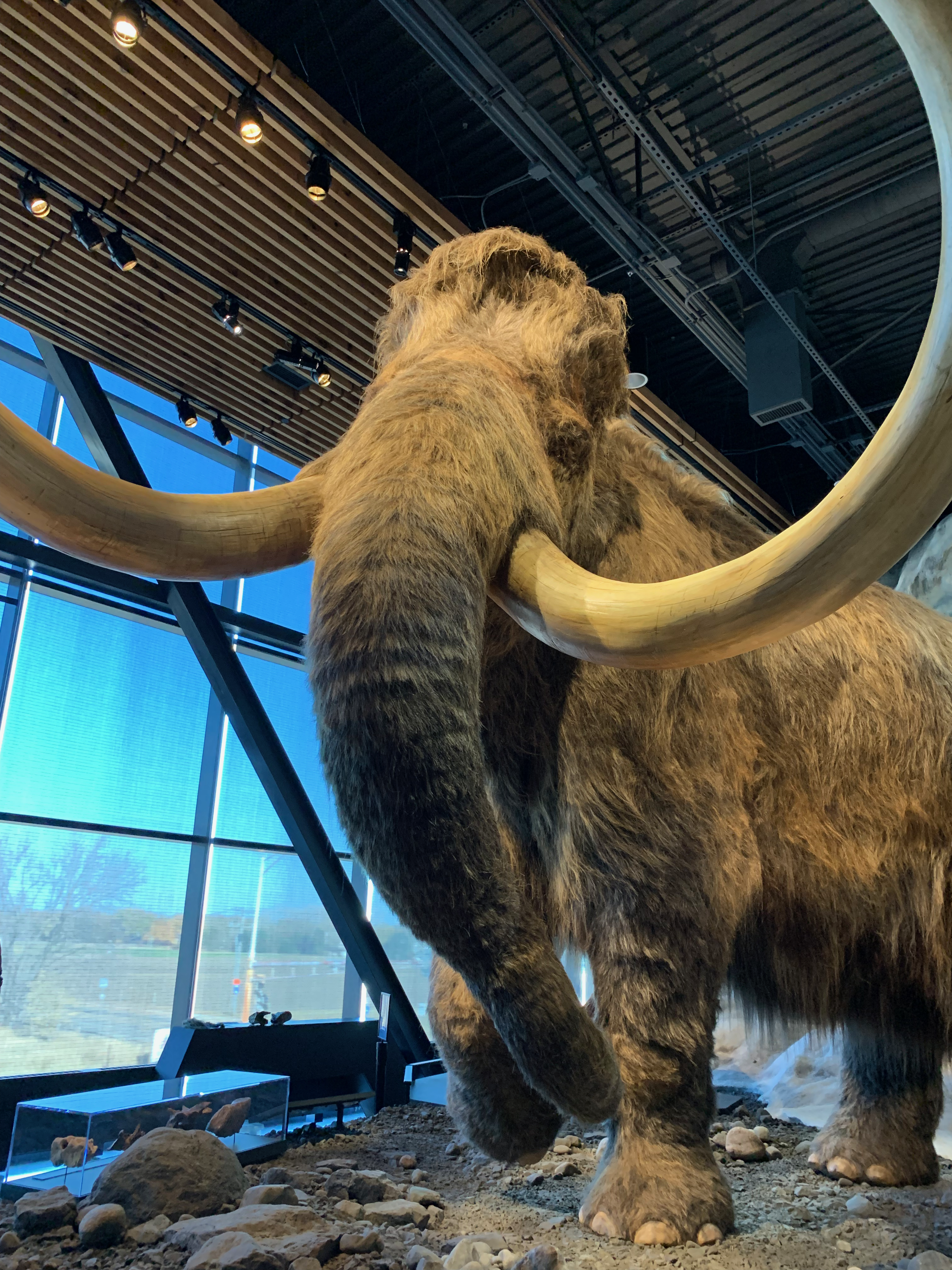
A mammoth at the Bell Museum

The same logic applies to any souvenirs I might want to bring back with me. Anything I buy on the ground has to return in my bag that was already fairly full upon arrival. With this in mind the only new things I returned with were a stack of receipts for funding purposes, some notes from my panel, the conference program, and a printed version of the script for my presentation. I didn’t buy any souvenirs this time around at any of the museums, nor any other knick-knacks while I was there. Again, anything I have with me upon leaving has to either be left behind or carried in my bag for the entire return trip.

That return trip ended up being 15.5 hours long. I was traveling with my good friend Marco Ali’ Spadaccini from the History Department here at Binghamton, and we initially were set to wake up on our return travel day, Halloween, at 3:30 am Central to catch our 7:00 am flight. The first catch appeared when our first flight from MSP to Chicago-Midway was cancelled without any notice as to why. So, at 3:30 am we discovered we were instead leaving Minnesota on an 8:55 am flight to St. Louis. I wasn’t able to go back to sleep, thus starting my own travel clock then at 3:30 am. After getting an Uber to MSP Airport we caught our first flight on time and landed a few minutes early at St. Louis’s busy Lambert Field, where we had a quick hour connection to our flight to LaGuardia. That plane also arrived in New York a few minutes early, which meant in the end after our 3.5 hour drive from LaGuardia back to Binghamton through the Catskills, I returned to my apartment at 7:00 pm instead of 7:30 or 8:00 pm like I had predicted.

At this point I’m used to long travel days, it’s become more of a common thing for me in recent years coming to Binghamton, but even returning to Kansas City can be a taxing experience with the frequent need for connections going into an airport that as of now doesn’t host an airline hub. On this trip Marco and I considered traveling to Minneapolis by train and by car, both would’ve taken longer than flying, though Apple Maps’ estimated drive time was only 90 minutes longer than what it actually took us to fly between MSP and LaGuardia and then drive from Queens up to Binghamton. By train the trip would’ve taken us 30 hours with one connection between the Lake Shore Limited and the Empire Builder in Chicago, but the real kicker to that idea was the $3,000 price tag for two sleeper tickets roundtrip. Flying became the most economical option, and in the end, it was better that I was only fully focused on driving for a good 4 hours getting to LaGuardia rather than a full 17 hours trying to drive the entire route to the conference hotel in Minneapolis.

This was my last fly-away trip from Binghamton, the last in a long line of such trips that I’ve taken since arriving here in August 2019. I think back to one of my first, the trip 3 years ago this weekend to the Sixteenth Century Society Conference in St. Louis, when on the return journey I had a 4 hour connection at O’Hare. That day was the first time that I really felt like a business traveler rather than a guy off on another adventure. It’s a feeling I got throughout this trip too.