Tag Archives: Cosmography

On Sources

This week, the fourth in several scribblings about my research: borrowing from Oscar Wilde, the importance of being earnest with one’s sources.—Click here to support the Wednesday Blog: https://www.patreon.com/sthosdkane—Sources:Ologies Podcast: https://www.alieward.com/ologies"Metropolis," Wednesday Blog 3.20: https://wednesdayblog.org/2023/01/11/metropolis/.Marie V. Alessandro, "The Workers of Metropolis" in Cinema at UMass Boston, (6 November 2020), https://blogs.umb.edu/cinemastudies/2020/11/06/workers-of-metropolis/Surekha Davies, “Here be black holes: Like sea monsters on premodern maps, deep-space images are science’s fanciful means to chart the edges of the known world,” Aeon (13 July 2020), https://aeon.co/essays/how-black-holes-are-like-sea-monsters-at-the-edge-of-our-vision.Chicago Manual of Style, 18th Ed., Notes-Bibliography System Quick Guide, https://www.chicagomanualofstyle.org/tools_citationguide/citation-guide-1.html.Jacob Burckhardt, The Civilization of the Renaissance in Italy, trans. S.G.C. Middlemore, (London, 1878): https://www.gutenberg.org/ebooks/2074.


This week, the fourth in several scribblings about my research: borrowing from Oscar Wilde, the importance of being earnest with one’s sources.


Over the weekend when I was chatting with some friends in my parish choir about the rallies and political protests ongoing in our city and around this country, I made a joke that I went about making my own protest sign, something I’ve been slower to do. I said the sign fit my temperament and was useful for a wide range of protests. This sign, conceived for the sake of a joke, reads “I am rather miffed.” One of my friends retorted that she expected any protest sign of mine would include citations. I laughed and retold one of my favorite stories from my History Master’s program when I wrote a footnote that traced the historiography of a particular concept back through at least four generations of the scholarship to the early nineteenth century; I described this particular citation as a footnote within a footnote within a footnote within a footnote, much to the bemusement of my friends.

This got me thinking more about citations, something I often tend to think about anyway with my work. I do honestly love writing footnotes, it’s one of the more technical aspects of my work that gives me a great sense of pride at accomplishing manually, that is to say without the help of any extra software built to keep track of citations. One of our professors at UMKC introduced my cohort to Zotero, for example, and I flatly refused to consider using it saying, “I memorized the basic formulae in the Chicago Manual of Style in my undergraduate, I don’t need a computer to help me with this.” That’s been my take on this kind of software since. I see the benefit of it, yet I don’t feel the need to adopt it in my own work. I’ve seen so many student essays that copied & pasted text into their footnotes where something went wrong with the formatting that I’d rather just type the text out character by character. There’s something delightfully personal about taking this slower approach because it means I’ve considered every character in the document, and by and large I can avoid typos and errors as a result.

The format of my citations will vary slightly depending on the publication. A proper peer-reviewed article or book chapter will get the full treatment, sort of like the top of the line all-inclusive package they offer at a high price at my local car wash. In contrast, my book reviews rarely include citations beyond those to the book being reviewed, and in that instance, they are mere in-text citations with the page number listed alone. That could be seen as the quick and cheap package at my car wash. Here on the Wednesday Blog, I endeavor to include hyperlinks in all of my citations and in the text of the blog where I first reference a given source. I’ve begun to see more hyperlinks included in peer-reviewed journals as I suspect the vast majority of us who read Isis or Renaissance Quarterly do so on their computers as I do, and thus can click on those links, rather than reading the journal in print when it’s mailed out with each issue. I make an effort to include any citations in the text description box on each of the Wednesday Blog podcast episodes as well, for the benefit of listeners who access this publication through any of the podcast platforms where it is found. I’ve seen the likes of Ologies do this as well, in fact I was inspired by Alie Ward’s thorough efforts at citing her sources on Ologies to do the same on the Wednesday Blog. In my case, it was a question of whether I needed to have the same rigor in this publication as I do in my scholarly writing. I concluded that it was not only needed but that it would be something that could set my work apart from my peers.

My footnotes are the hard workers of my writing, the double-checked cross-references that populate the bottom of my work yet add such vitality to it all the same. Without the footnotes the rest of the essay would lack the depth of meaning that they provide. They root my sentences in a rich soil of past scholarship which can enlighten even the densest lineage. Yet the footnotes require clarity in the text which they elaborate. For them to work I need to ensure that my own text makes sense and is readable, something which often needs a bit more thought after the first draft. I think of the relationship between the text and footnotes in a manner similar to the stratified society in Fritz Lang’s 1927 science fiction masterpiece Metropolis; the footnotes are the hands to the text’s head, the evocation of thought that elaborates on the essay’s thesis.[1] Yet without the footnotes’ deeper connection to the human experience the world above soaring high into the heavens with the foolhardiness of the biblical Babel would awaken to find its words meaningless.
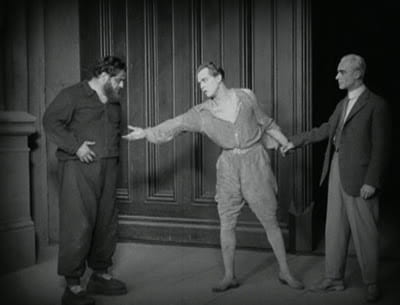
“The Mediator Between the Head and the Hands Must Be the Heart.” Photo source (and a good blog on the workers of Metropolis).

Citations are a form of cross-referencing that was engrained into me from even my elementary school years. I remember seeing footnotes in some of my favorite childhood books, in particular in Watership Down and I believe in The Lord of the Rings trilogy. I wanted to use them on my stories from as early as elementary school but didn’t have a proper need for them until I was an undergraduate writing essays that needed full and clear sources for their work. It’s funny to me now because I do often read peer-reviewed articles that don’t have the same rigorous citation systems in place as the one that I committed myself to over a decade ago now. My rule is that if I make a fact-based claim then I cite it, regardless of how important it is to the argument. I know from my own experience scouring academic databases for secondary sources on André Thevet (1516–1590) and his contemporaries that even the smallest off-hand mention of the man in a source that may have very little to do with him could nonetheless lead me to another source that has a great deal more to offer the Thevet scholar. It made me laugh earlier this week reading one such book that made a fairly large claim about its subject without providing sources for all of the historical figures mentioned in a given sentence, just the ones the author clearly thought were more important.

The way I think of citations resembles how Surekha Davies, one of the leading experts in the field of Renaissance monster studies, described the category of the diagram in a 2020 essay for Aeon. Like Davies’s diagrams, citations “are devised by interpretative communities made up of readers, makers, and practitioners. Each interpretative community has its own distinct pictorial language.”[2] In this context, that language is the style guide for citations in use. Access to the information contained in my citations is eased by using an accepted and standard style, in this case the notes-bibliography system set by the Chicago Manual of Style, which just published its 18th edition last NovemberThere lies the rub of this: citations embed a strong sense of subjective importance in their nature. I try to cite anything and everything that goes into my work, while others will only cite those things which they deem to be the most valuable to their reader. I’ve always looked toward a wider readership, maybe hoping to catch the eye of my colleagues, graduate students, and the odd bookshop aisle walker alike who happens to see my work on the shelf. My more liberal use of footnotes reflects this preference for a wider readership; I try to have enough information in my citations to go around for anyone who may be curious about the connections between my work and its peers and ancestors. I understand the argument that older secondary literature often has less to contribute to contemporary conversations, my dissertation committee for instance asked me to write a new historiography document that only focused on the literature that I’ve used which was published since the millennium. Yet in the twin magnetic poles between which lies my field, Renaissance Studies and the History of Natural History, my historiography begins in the former with Jacob Burckhardt’s 1860 The Civilization of the Renaissance in Italy and in the latter with the likes of Linnaeus adapting new understandings of the natural world from the sixteenth and seventeenth-century perceptions of it which include Thevet’s own cosmography. This is to say that my historiographic timeline begins far earlier than many, and I have to take the full scale as well as the particular scope of it into account.

The earnestness with which I approach my sources is reflected in the quality of my work. I’ve long heard words of warning about particular institutions as places that promote competition between graduate students and between faculty in order to keep the flow of a high level of research and writing. I for one initially heard this and felt a sense of trepidation, why not if I couldn’t keep up with the best of my colleagues. And yet, when I’m in the flow of my writing, things are magnificent. I wrote the first draft of an article of mine that’ll be coming out in the December special issue of Terrae Incognitae in the period of about a week last summer; it uses sources that I’m very familiar with, in fact an expert on, and it makes an argument I’d been thinking about for some time when I sat down to write it. That article’s gone through several rounds of revision since, yet from the beginning one area that needed minimal rewriting were my citations. Today I have another paper I plan on writing in the next few weeks that I initially conceived of in a proposal to another journal special issue, yet I decided to go ahead and write anyway; after all, if that first journal rejects my proposal, I can always send the finished manuscript to somewhere else.

The rub of all of this is that by getting my citations down early, I’ve started my work in a strong place that’s only grown stronger and more resolute with each essay that I write.


[1] S.T. Kane, “Metropolis,” in Wednesday Blog 3.20, (11 January 2023).

[2] Surekha Davies, “Here be black holes: Like sea monsters on premodern maps, deep-space images are science’s fanciful means to chart the edges of the known world,” Aeon (13 July 2020), https://aeon.co/essays/how-black-holes-are-like-sea-monsters-at-the-edge-of-our-vision.
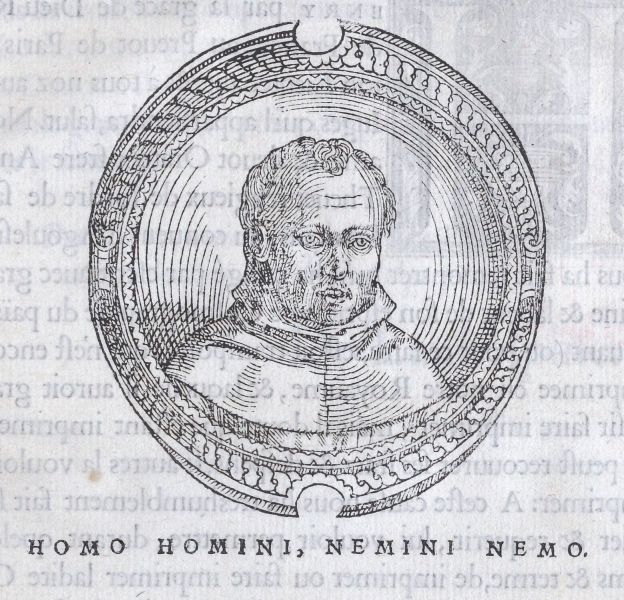

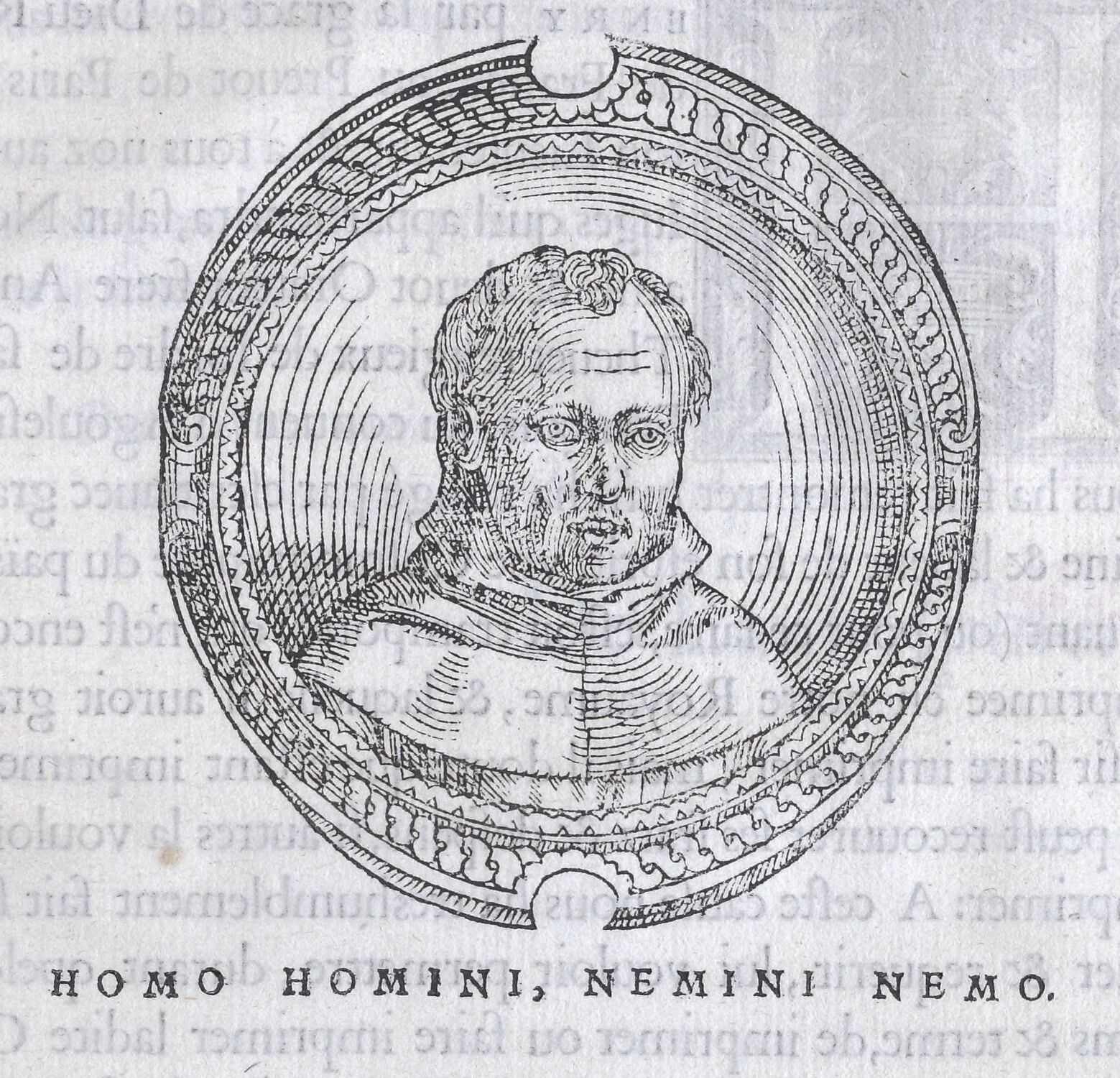
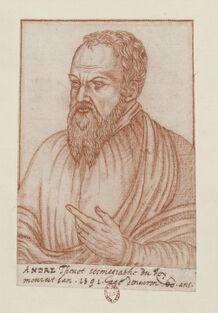
A portrait of André Thevet from 1554

Why André Thevet?

This week, the second in several scribblings about my research: why I chose to study André Thevet and build my career on the mound of his works.—Click here to support the Wednesday Blog: https://www.patreon.com/sthosdkane


This week, the second in several scribblings about my research: why I chose to study André Thevet and build my career on the mound of his works.


I initially chose to focus my dissertation on André Thevet (1516–1590) because of his account of the sloth and because he was French; I speak the language and therefore felt I would not need to learn another language to grasp the sources. Thevet is a figure who I’ve gotten to know over the last 6 years. I first encountered him in Dr. Bill Ashworth’s Renaissance seminar at the University of Missouri-Kansas City. It was in a nice classroom in the southeast corner of the third floor of Haag Hall that welcomed in the midday light as the Sun arced across the sky. We met on Tuesdays and Thursdays, and often I would walk to class from my job working at a cheese shop, the Better Cheddar, at 49th & Pennsylvania on the Plaza. What I didn’t admit at the time but have freely regaled friends and family since is that on Tuesdays the shop’s sommelier would often stop by to offer those of us working at the time wine tastings of the latest vintages. I was hired by the cheesemongers there more for my knowledge of European wines, and because I spoke French, than for my far more limited understanding of cheese going into the job. So, I often went from a delightful morning tasting cabernet francs, pinot noirs, and syrahs to a delightful afternoon sitting in the back third of Dr. Ashworth’s class listening to his stories about the Renaissance.

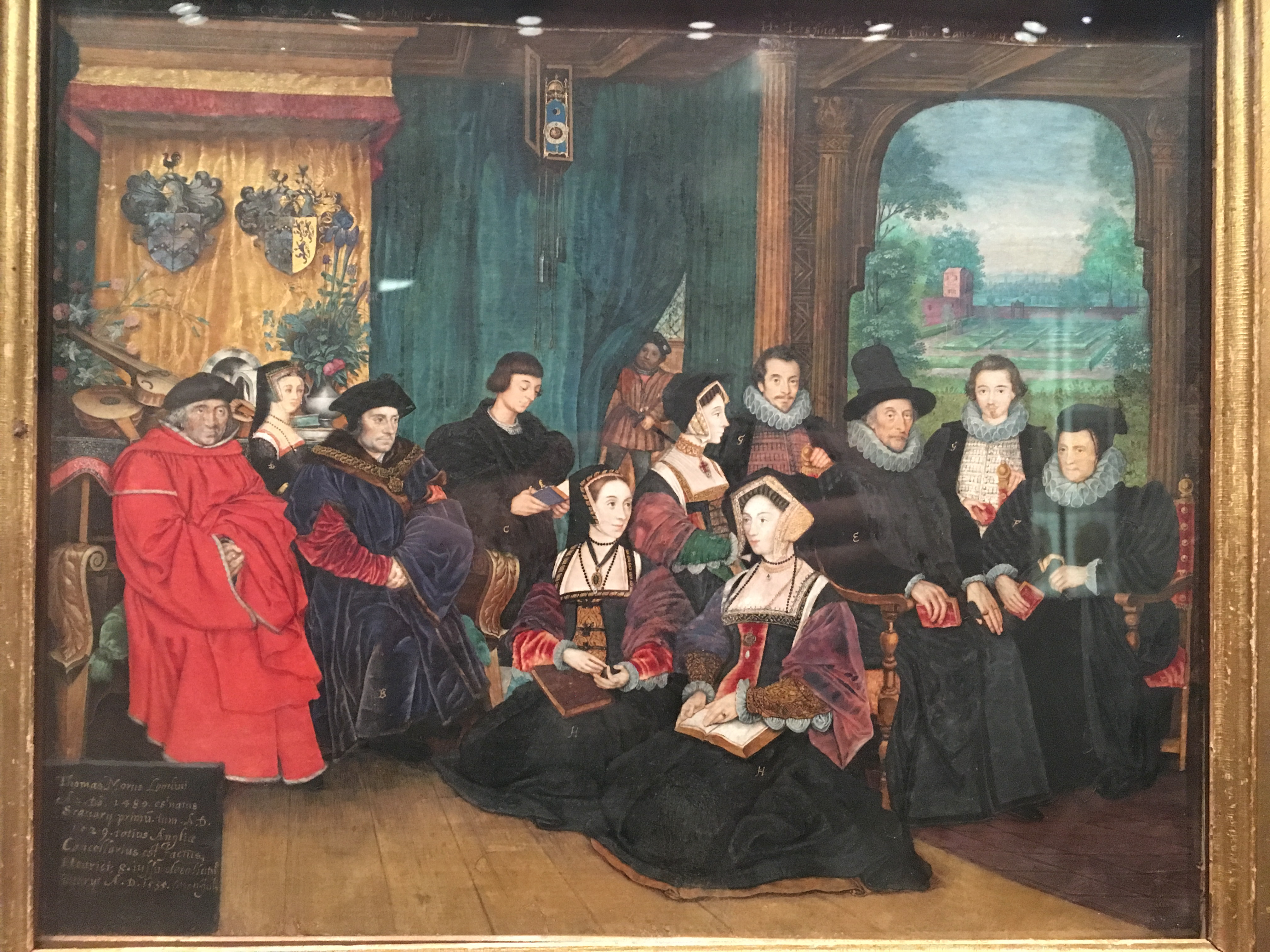
By this point, I was still committed to a largely unfounded master’s thesis project studying crypto-Catholics in the English court of James I and VI, which was born out of a desire that I might find my way back to London perhaps to work as a curator at the Banqueting House or Hampton Court. By Christmas, that project had well and truly died, it was only several years later that I discovered the fantastic work of the late Professor John Bossey on persistent Catholicism in the North of England that I found the anchor and line that would’ve led me toward my original research project idea. As it turned out, I found my way to Thevet through a more traditional Renaissance history master’s thesis about English humanism, specifically the education of Margaret Roper (1505–1544) and Mary Basset (c. 1523–1572), daughter and granddaughter of St. Thomas More (1478–1535). As an English-speaking Catholic of mostly Irish descent, with a fair minority of English ancestors to boot, I was drawn to the More family as models of a Catholic conscience; it is rather fitting that the upsurge of English colonialism in Ireland coincided with the English Reformation. When I lived in London, while I usually attended Mass at the Jesuit church at Farm Street in Mayfair, I would occasionally go to the English Chant Mass at Westminster Cathedral near Victoria Station. All of this came together in my History master’s thesis about Roper and Basset, my second thesis after the one I wrote in London for my degree in International Relations and Democratic Politics at the University of Westminster.

A painting miniature of the family of Sir Thomas More held in the collections of the Victoria & Albert Museum, London.
A painting miniature of the family of Sir Thomas More held in the collections of the Victoria & Albert Museum, London, c. 1527. Photo by the author.

Yet while I was working on this and writing good essays and papers, I kept hearing my friends talk about how the classes they loved the most dealt with the History of Science. One of my greatest regrets from my time at UMKC is that I didn’t take Dr. Ashworth’s Scientific Revolution class. It would’ve proved to be a good foundation considering I’ve taught essentially the same material since, and considering a great deal of the effort of my generation has been focused on deconstructing this perception of a revolution from humanism to science at the turn of the seventeenth century. So, when I discovered to my horror two weeks before leaving Kansas City to begin my doctorate at Binghamton that the thesis of the dissertation I intended to write had been published in a peer-reviewed journal a year before I took the chance to shift gears entirely and dive into the history of science. I used Thevet’s sloth as my diving board.

I met André Thevet in August 2019. We’d been introduced three years before by Bill Ashworth, yet besides the chuckles I gave at seeing his sloth engraving for the first time I turned my mind away from the Franciscan. Through Thevet I was introduced to the Renaissance notion of cosmography, a starkly different use of the term than how I’d heard it. To me, cosmos is most synonymous with Carl Sagan’s book and documentary series, including that series’ remake in the last decade by Neil DeGrasse Tyson and Sagan’s widow Ann Druyan. I kept coming across the word cosmos throughout the years I was in Binghamton in a myriad of windows. On all of my long drives I listened to audiobooks, and I usually remember the books better than the drives themselves. They animated my existence for those days in the Mazda Rua, my car, crossing the eastern half of our country by road. The first day of my August 2021 Long Drive East was so animated first by Alex Trebek’s last book, which he and Ken Jennings co-narrated, and second after I finished that book on I-70 near the Indiana-Ohio border I turned on a reading of Sagan’s Cosmos read by LeVar Burton. I stopped the car at the Ohio Welcome Center, maybe an hour into the book, to try and get another stand hour on my smart watch and was struck at how brilliant the sky above me seemed that clear August night. That day I’d been running from a massive storm that bore down on Iowa, Illinois, and northern Indiana, a derecho, and for the first time all day I couldn’t see the dark billowing clouds with bolts of lightning shooting forth like thanatic trumpets reminding all in their path that we are mere lodgers on this continent owned by Nature itself. Yet in that moment there were no clouds, no storms on the horizon, only stars burning high above.

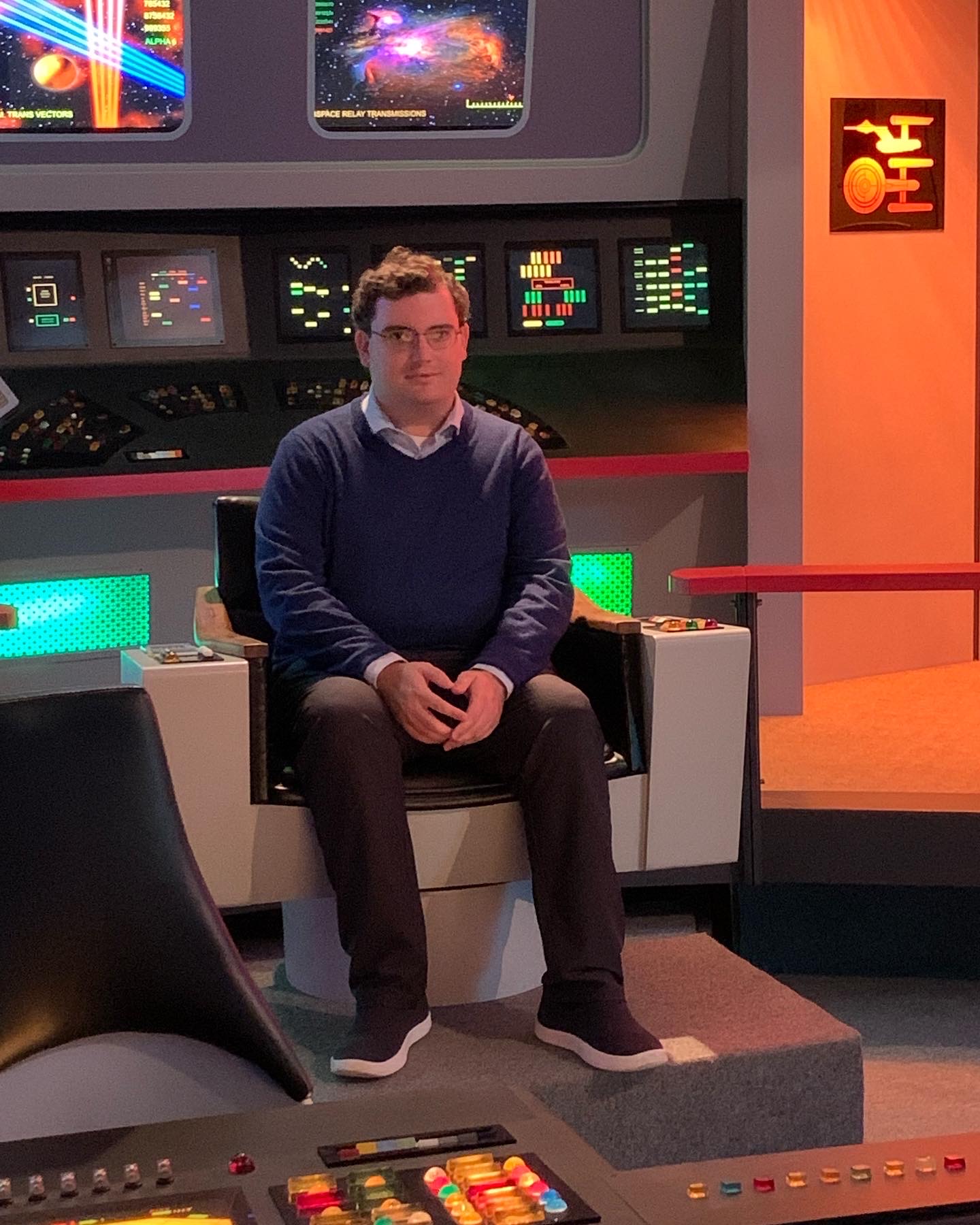
Myself in the captain’s chair at the Star Trek Tour in Ticonderoga, NY. Photo: Alex Brisson.

In another drive on a Sunday in late September 2022, at the end of a delightful weekend I spent with my friend Alex Brisson in Ticonderoga and Albany, I drove southwest through the rolling hills of Central New York toward Cooperstown to visit the Hall of Fame. While I was driving, I listened to Andrea Wulf’s biography of the Prussian naturalist Alexander von Humboldt (1769–1859). On that particular Sunday, I listened as Humboldt’s own book Kosmos was described in depth. It felt to me that I could see some of the inspiration for Sagan’s Cosmos in Humboldt’s magnum opus, and I was left wondering how Thevet’s own Renaissance cosmography fit into this cosmic lineage. As it turns out, Humboldt was familiar with Thevet’s work, and didn’t care for it at all. The Prussian naturalist is one of the earliest figures in my dissertation’s secondary literature, and he is important because he largely dismissed Thevet’s contributions to natural history writing that his vision of the cosmos was too small to warrant that word.[1] In many ways, my approach to Thevet has always been bi-directional: I’ve tried to learn more about the man by finding the books which survive from his library and the books we know he translated while at the same time I’ve always had an eye on Thevet as a starting point for understanding a specifically non-Iberian understanding of the development of the natural history of the Americas beginning in the Renaissance. My own perceptions of natural history are shaped by my childhood introduction to this vast kaleidoscope of the human vision of the rest of nature on display in my hometown natural history museum, the encyclopedic Field Museum on the Chicago lakefront. While as a child I marveled more at the dinosaurs in their upper floor galleries, now as an adult I prefer to spend my time in the museum among the taxidermy and dioramas with one eye drawn to nostalgic escape and the other toward scholarship; the Field Museum contains a specimen of one likely candidate for the species of three-toed sloth that Thevet described in his Singularitez. By taking this multidirectional focus on the history of natural history, on the one side starting with Thevet in the sixteenth century and on the other with Carl Akeley and the collecting expeditions launched by the Field Museum at the turn of the last century, I’ve developed a particular perspective on natural history that is visible in both wide and narrow focuses.

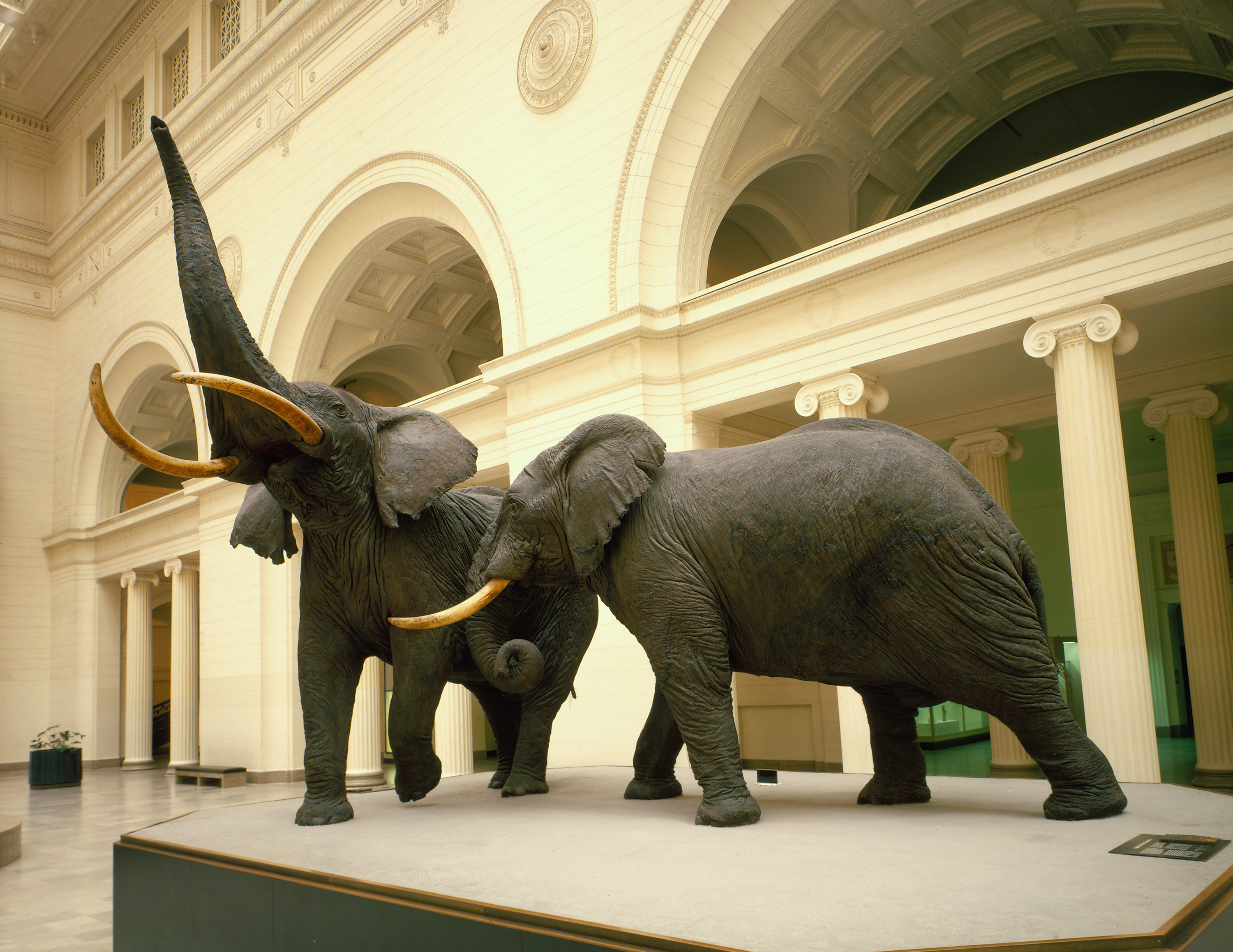
Fighting African Elephants in Stanley Field Hall. Taxidermy by Carl Akeley . 41411 is on the left with two tusks and its trunk is raised. 41410 is on the right, with one tusk. Photo credit: (c) Field Museum of Natural History - CC BY-NC 4.0.
Fighting African Elephants in Stanley Field Hall. Taxidermy by Carl Akeley . 41411 is on the left with two tusks and its trunk is raised. 41410 is on the right, with one tusk. Photo credit: (c) Field Museum of Natural History – CC BY-NC 4.0.
A portrait of André Thevet from 1554

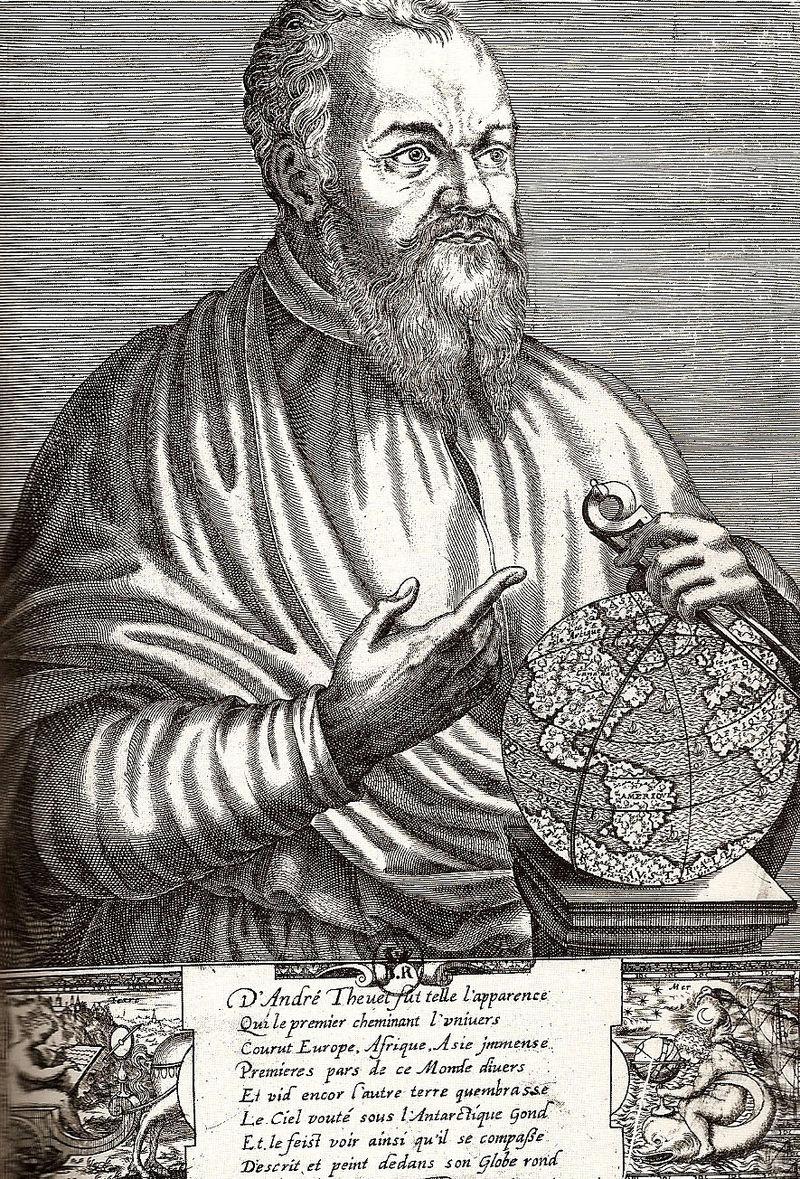
In the six years since, I felt that I not only got to know André Thevet the cosmographer but something of Thevet the man. He was just a few years older than I am when he made his first overseas voyage from France to Constantinople, the Levant, and Egypt in 1551. The most famous portraits of Thevet were published in his 1575 Cosmographie Universelle and 1584 Vrais Pourtraits des Hommes Illustres. These two portraits show Thevet at the height of his career, the cosmographer royal, the keeper of an expansive cabinet of curiosities, and a close confident of the Valois royals. Yet there’s an older portrait of Thevet as a younger man which appears in his first book, the Cosmographie de Levant, published in 1554. In it, Thevet is shown not as the resolute man of his craft but as a humble Franciscan friar. It was a position that he was put in by his father when he was 10 years old in order to give the boy a chance at a good education. I see in these three portraits something of a desire for better and greater things. In the process he crossed some people the wrong way and got a fair few things wrong in his cosmography. I’ve learned to take what Thevet wrote with a fine grain of salt especially later in his life. I wonder though if some of the acrimony that Thevet’s reputation has faced since his death in 1590 isn’t in part because of his close ties to the Valois family who declined from power and were replaced by their Bourbon cousins the year before and largely by the Valois’ infamy in the history of the French Wars of Religion, in which the Huguenots who traveled to Brazil with Thevet in 1555 were so threatened by their country over matters of faith. I recently met a woman at a Kansas City Symphony performance who was wearing a Huguenot cross necklace, and it struck me how her ancestors’ experience living as Protestants in a Catholic state mirrored my own ancestors’ experiences living as Catholics in Ireland during the Protestant Ascendancy and Act of Union with the very Protestant Kingdom of Great Britain in 1800. Like her, I’d grown up with a sense of pride in my Catholic ancestors’ resilience at staying Catholic in spite of the state which ruled over them. Seeing the long shadow of the Wars of Religion which for my people didn’t really end until Good Friday 1998 from this vantage gave me tremendous perspective. How did Thevet view it all? He blamed the Huguenots in part for the fall of France Antarctique in his Cosmographie Universelle, writing that “little of this would have happened without some sedition among the French, which began with the division and parting of four ministers of the new religion sent by Calvin to plant his bloody gospel.”[2] Why did he choose to write that the way he did? Certainly, these religious tensions gave cause for the Portuguese to eliminate the French presence in Brazil, yet wouldn’t the economic threat of the French presence in Brazil toward Portuguese trade be justification enough? Could Thevet have been responding to the political situation he found himself in when he published the Cosmographie Universelle in Paris in 1575?

Thevet in 1584.

I like Thevet because I find the man relatable, I get the sense that we can relate somewhat; like him I’ve felt this constant need to prove myself to my peers. This need has waned somewhat as I’m moving along with my career. Yet I feel the younger Thevet depicted in his Cosmographie de Levant is more relatable to my life today in my early thirties. While not a cleric, I chose to not go down that path, I’m alone in my life with a strong sense of wanderlust. Those wanderings have taken me to Paris twice now in the last two years to get a sense of Thevet from beyond the printed books with which I’m most familiar. In October 2023 I followed a lead which took me to Rue de Bièvre, the street where he lived at the end of his life up to his death in 1590. I walked up and down that little street between Boulevard Saint-Germain and Quai de la Tournelle and stopped in the pocket park on the western side of that street. I felt that this was the closest I’d ever get to him, after all the church where he was buried, the Convent des Cordeliers, was desecrated during the Revolution of 1789-1791 and from what I’ve been able to gather, his tomb disappeared. Yet earlier this year while watching an episode of PBS’s science series NOVA about the graves found in Notre-Dame during its reconstruction, I noticed they pulled out a nineteenth-century book of old Parisian epitaphs. I did a quick search through the BnF’s Gallica database, and found Thevet’s own epitaph there transcribed from the original stone carved in 1592 that lay in the Convent of the Cordeliers. In the original French it reads:

Rue de Bièvre, where André Thevet once lived.

Cy gist venerable et scientifique personne Maistre Andre The-

vet, cosmographe de quatre roys, lequel estant aagé de LXXXVIII (88) ans, se-

roit decedé en ceste ville de Paris, le XXIII jour de Novembre M D XCII. –

Priez Dieu pour luy.[3]

In English, this translates as :

Here lies the venerable and scientific person, Mr. André Thevet,

Cosmographer of Four Kings, who was 88 years of age,

he died in this city of Paris, the 23rd day of November 1592.

God, pray for him.

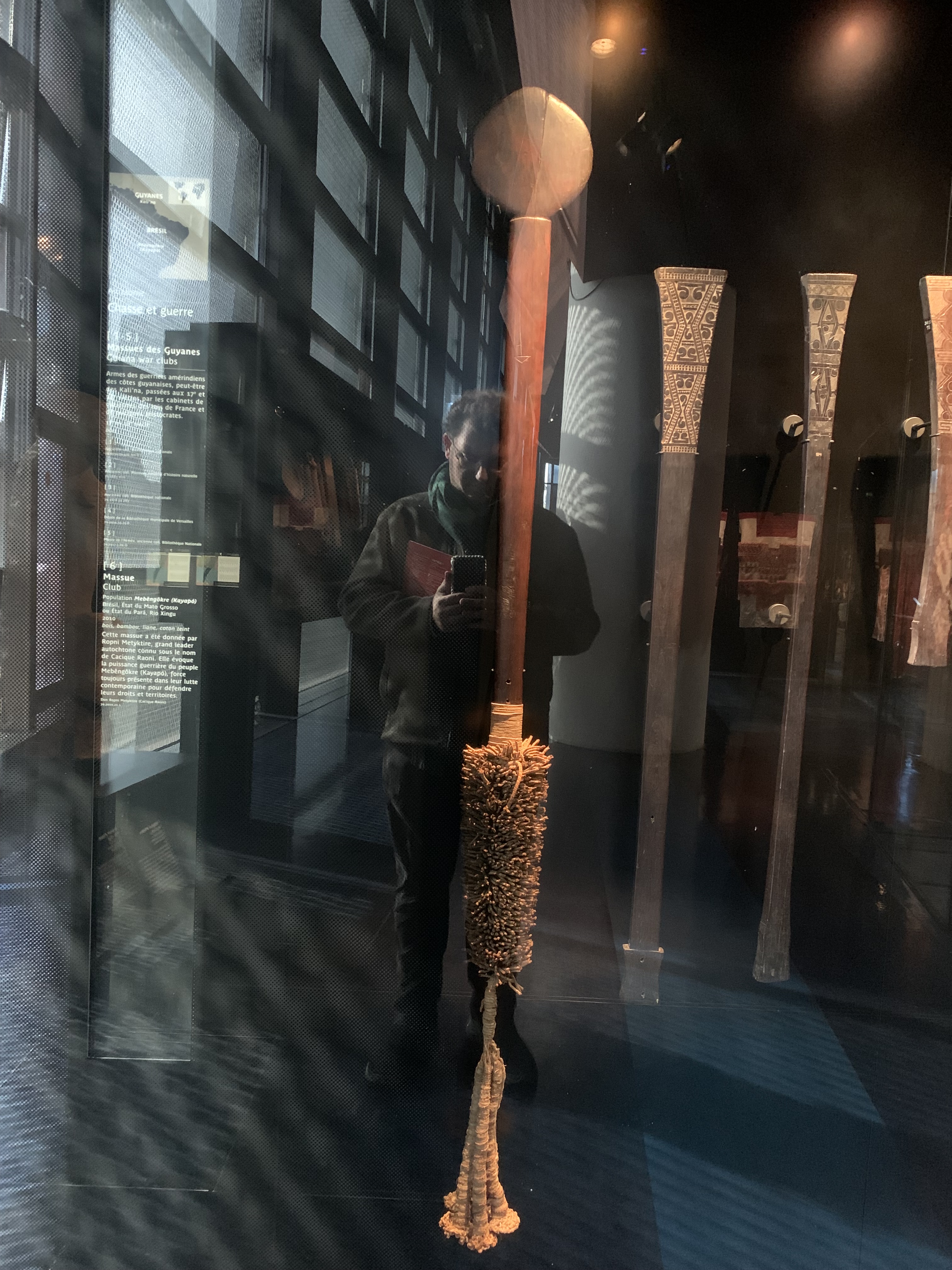
A Tupinambá war club once called “the Sword of Quoniambec” that I’m studying. Thevet brought it to France in 1556.

On that same trip I visited a wooden Tupinambá club which the Musée du Quai Branly records was donated to the royal collections by Thevet and was given to the cosmographer by the Tupinambá leader Quoniambec (d. 1555). I figured this would be the only artifact I’d see that Thevet would’ve himself handled. Little did I realize that eight months later I’d be back in Paris, this time at the BnF’s Richelieu building in the Department of Manuscripts reading through Thevet’s own handwriting. I’d made a visit there that day to read through Thevet’s translation of the Travels of Benjamin of Tudela, a twelfth-century Sephardi Jew from the northernmost reaches of Al-Andalus which told the story of his travels around the Mediterranean world. Tudela’s wanderings took place three centuries before Thevet made his own voyage east into the Mediterranean in 1551. Here, through the window Thevet crafted with his pen over 470 years before, I was reading a story retold in Thevet’s words of events that occurred over 700 years ago. That sunny June day, I spent a few quiet moments reflecting on Thevet’s penmanship, his signature, and how familiar his writing seemed. I’ve read more of Thevet than many others, after all I’ve translated the entirety of his Singularitez, and so when I was working with his Tudela translation, I found the job was made easier by how I could recognize his voice in the flourishes of his pen. I felt that I knew the man, in spite of the centuries between us. Soon after, as I walked from the Richelieu building to a café next to the Sorbonne where I was meeting an editor for a project I’m contributing to, I reflected amid my quick steps crossing the Seine that I was walking the same streets Thevet once walked. They’d changed to be sure, but there were still monuments that he’d recognize, edifices of the Paris he knew.

I chose to study Thevet out of a drive for practicality, a quick solution to a pressing problem of finding a dissertation topic that I could move to when my original plans went up in smoke. In the years since I’ve become known as a Thevet scholar. I’ve given many conference presentations and lectures about the man and his contributions to Renaissance natural history. In fact, I’ll be giving one more on June 12th with the Renaissance Society of America’s Graduate Student Lightning Talks, sponsored by the RSA Graduate Student Advisory Committee. That talk takes a different perspective on Thevet’s sloth than any other I’ve yet given, approaching it as an example of animal intelligence. Tune in to learn more.


[1] Alexander von Humboldt, “Les vieux voyageurs à la Terre Sainte (du XIVe au XVIe siècle),” Nouvelle annales des voyages, de la géographie et de l’histoire 135 (1853): 36–256, at 39.

[2] Thevet, Cosmographie Universelle, Vol. 2, 21.2, ff. 908v–909r.

[3] Émile Raunié, Épitaphier du vieux Paris, recueil général des inscriptions funéraires des églises, couvents, collèges, hospices, cimetières et charniers, depuis le moyen âge jusqu’à la fin du XVIIIe siècle. Vol. 1–3, Paris : 1890-1901), 302, n. 1171.


A frame from Abraham Ortellius's map of the Americas, 1587.

On Toponymy

This week, the first in several scribblings about my research: how I connect historic places in my sources with their modern names.—Click here to support the Wednesday Blog: https://www.patreon.com/sthosdkane


This week, the first in several scribblings about my research: how I connect historic places in my sources with their modern names.


When I started working on my dissertation and began downloading copies of André Thevet’s 1557 book Les Singularitez de la France Antarctique, I was struck by a curious question regarding the identity of some of the places which Thevet described along the disparate shores of the Atlantic Ocean in the middle of the sixteenth century. Some of these were readily accessible, the Portuguese fortress of Elmina for one remained an infamous outpost of the slave trade for centuries after Thevet’s 1555-1556 voyage. Likewise, Thevet made early references to regions like Florida, Mexico, Peru, and Brazil which are still known by those names today. I especially admire how he demonstrated the assimilative power of colonialization in the renaming of the Taíno island of Haiti into a newly christened European island literally called Little Spain, that is Hispaniola. Today, we know Haiti as the name of the western republic on the island of Hispaniola, and the Haitians as a people predominately of African descent, yet that term on its own originated with the indigenous inhabitants of that island and its neighbors.

André Thevet (1516-1590) from his Grande Insulaire.

This new world of names which Thevet hoisted upon the places he sought to describe in his Singularitez place that book in its historical context at the dawn of the European colonization of the broader Atlantic World and also in some cases provides a perspective on precolonial and early contact societies that have otherwise been diminished by the deluge of colonial toponyms which in many places replaced them. Thevet, like his fellow Frenchman Jacques Cartier, tended to use indigenous names for places, flora, and fauna. I’ve written in great detail about this concerning Thevet’s use of a French rendering of the Tupi name for the sloth, Haüt, and my dissertation includes similar analyses of the preservation of indigenous names for toucans, parrots, and macaws from Tupi for Thevet’s own French audience in his work. While his preference for indigenous names certainly added a lure of the exotic to his work, it is clear that he saw the utility of keeping these names and promulgating them to his readers.

When I am approaching a location in Thevet’s work I begin by seeing what the other editors and translators of Thevet down the last 468 years have done to familiarize what Thevet wrote for their audience. Thomas Hacket’s 1568 translation is beneficial to see how an Elizabethan reader might interpret distant Brazil and is useful for connecting Thevet’s Atlantic to Ralegh’s. Likewise, Giuseppe Horologgi’s 1562 translation is beneficial for understanding how Thevet was read by Italian humanists curious about the wider world; these readers were most likely thinking about Thevet’s stories in the context of the wider genre of travel literature typified in Italy by Giovanni Battista Ramusio’s (1485–1557) I Navigationi et Viaggi and for his natural history the collected works of Ulisse Aldrovandi (1522–1605). Moving from Thevet’s contemporaries, I then turn to a nineteenth century French reprint of the Singularites (as they were rendered in Modern French) edited by Paul Gaffarel. This edition was published in 1878 at a time when interest in Thevet and sixteenth-century French Brazil had a resurgence during the Third Republic which lasted into the early career of Claude Lévi-Strauss and Alfred Métraux, the two most prominent French anthropologists to consider the value of Thevet and his rival Jean de Léry as primary sources on early contact Tupinambá culture. Finally, I will turn to the two modern Brazilian translations of Thevet, Estêvão Pinto’s from 1944 and Eugenio Amado’s from 1978. Together these two sources are often my first choice when tracking down taxa of Brazilian flora and fauna and confirming Brazilian demonyms and toponyms. I figure these translators tended to have better access to Brazilian archives and scientific studies concerning their own country than their European counterparts considering the great distance between these continents. Lastly, several partial modern English translations of Thevet exist which provide their own regional analyses, most notable of these is Roger Schlesinger and Arthur Stabler’s 1986 translation of Thevet’s North American chapters which does particular justice to Thevet’s account of Canada. 

The best sort of contributions any of us can make to collective human knowledge is built upon the conclusions and efforts of our colleagues past and present. The academy is a collaborative effort that only survives as long as we believe in the value of our work and of each other. I was reminded of this when I was in Boston during the Renaissance Society of America’s annual conference in March and felt such a potent sense of jubilation at that experience of camaraderie, I felt spending those four days among friends and colleagues. I especially see this among my fellow grad students and early career scholars who are the future of higher education and who are engaged in their work to a degree that in the span of a doctorate we readily become experts in our own disparate fields yet find solace and support in that common experience.

Returning to the task at hand, once I have consulted each of these various editions and translations of Thevet’s Singularitez, I then turn to his Cosmographie Universelle, a two volume magnum opus which was published in 1575. Volume 1 contains his accounts of Asia and Africa, and Volume 2 collected knowledge about Europe and the Americas. Thankfully, the Cosmographie Universelle has a good set of indices crafted by Thevet himself, which make navigating this gargantuan work easier. At this point, six years into my study of the man my PDF files of this book have enough of my own highlights & notes that I’ve added my own layer of internal navigation atop the cosmographer’s original efforts. Often, the Cosmographie Universelle supplements the Singularitez and adds greater depth and detail to it. For one, I first recognized Thevet’s claim that the sloth was an animal which could “live only on air” in the Cosmographie Universelle, only later noting the same claim in Chapter 52 of his Singularitez. In the Cosmographie Universelle it’s actually pulled out as a section heading in the margins of the book.

If again, Thevet either uses the same name for the geographical feature in question without any further context or the feature all together isn’t mentioned I will then turn to his 1586 Grande Insulaire, an unpublished manuscript of his which was edited by the preeminent French Thevet scholar Frank Lestringant and released in book form in 2016 by the Genevan publisher Droz. Lestringant has a long career studying Thevet, and his footnotes on the cosmographer remain among the best around. Often, he’ll be able to identify the places I’m looking for, but again his specialty is the history of French Protestantism in the sixteenth century, so toponymy isn’t necessarily his focus in reading Thevet.

This then leaves the last resort: a quick internet search to see what comes up when I type in Thevet’s sixteenth-century name for a given location. Often, I have better luck searching French or Portuguese Google than English Google (google.fr or google.pt) or even the French or Portuguese editions of Wikipedia, though all results from both the search engine and online encyclopedia need to be taken with a grain of salt and tremendous care. Anything I find online needs to be double-checked with other sixteenth-century sources, often Spanish in origin, to determine where Thevet got his name for the place from.

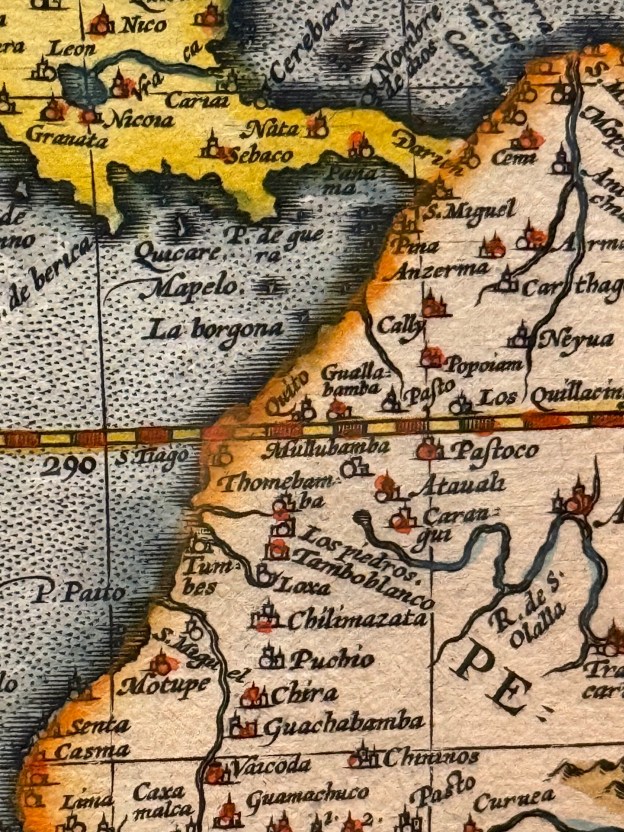
With my method in place, I want to put it to use explaining how I identified one particularly confusing toponym which Thevet used to describe a city on the coast of Peru. First, let me say that Thevet had a very broad understanding of Peru which included the entire side of South America west of the Andes, Panama, most of Central America, and the Caribbean archipelago beyond. Knowing this, I began by ignoring the word Peru and focusing instead on the coordinates Thevet ascribed to this city. He wrote in Volume 2, Book 22, Chapter 8 of his Cosmographie Universelle that this city was located “22 degrees from the Equator.”[1] Thevet used a Ptolemaic system for determining degrees of latitude, writing in the Singularitez that the Earth was divided into “360 degrees, and each degree is divided into 70 miles, which equals 16.5 leagues (96.48 km).”[2] By this calculation, the Earth’s circumference should be 34,732.8 km, which is 5,342.217 km short of the actual circumference at the Equator. This is a fitting comparison to make because the region where this city of “Saint Iacques” was located because it was certainly Equatorial in latitude considering he placed it among the cities of Quito & Ingapirca, which are located in modern Ecuador and Cusco & Cajamarca, which are located in modern Peru. 

A frame from Abraham Ortellius's map of the Americas, 1587.
A frame from Abraham Ortellius’s map of the Americas, 1587, showing Thevet’s Sainct Iacques as S. Tiago.

Generally, I found that Thevet’s degrees of latitude tend to be about double their modern equivalents, though this is a rough and often incorrect assessment. In this instance, that theory led me to search maps of the Peruvian coast around 11ºS looking for towns called Santiago, the Spanish translation of the Middle French Sainct Jacques. After spending a day searching, I gave up on this particular effort for the first time. Weeks later though, I returned to it after a conversation with frequent Wednesday Blog reader and one of my best friends Carmelita Bahamonde, who pointed out to me that her Ecuadorean hometown’s official, long name is Santiago de Guayaquil. I looked into it, and found several pages later hidden amid the text that Thevet had clarified further about this particular city of Sainct Jacques, writing that it was “the old port formerly named Guayaquil.”[3] I put this oversight at not finding this information where it was in that same source to my own poor eyesight, yet I remain grateful to my friend for confirming her hometown’s presence in Thevet’s Atlantic cosmography. He went into further detail about Guayaquil’s Spanish founder, the conquistador Francisco de Orellana (1511–1546) who led the first successful European expedition down the Amazon from the Andes to the Atlantic, losing almost all of his men along the way to desertion, disease, and attacks by the locals who knew to not welcome the Spaniards. In fact, when I began hearing about the lost Amazonian civilization first on PBS’s NOVA and later in one of my magazines, I believe it was in Smithsonian, I nearly leapt from my chair shouting “Thevet wrote about them!”

An engraving from a 16th century book of indigenous Brazilians cutting down trees for their timber.
The Franco-Tupinambá trade partnership in action from Thevet’s Cosmographie Universelle, vol. 2, 21.16, f. 950v. BNF, Public Domain.

The value of André Thevet’s books lie in their character as sources for understanding the Americas just at the moment of these continents’ invention as the fourth part of a larger global world. The Singularitez and Cosmographie Universelle offer stories and perspectives of peoples and places that had not yet been subsumed into the colonial deluge that would submerge so much of the indigenous cultures of these continents in the coming centuries. This week, my colleague (and newly minted Ph.D.) Mary Katherine Newman at Oxford published a blog post with the History Workshop on restoring indigenous historical practices to equal prominence with the written European archive that we historians are trained to use. In many respects, Thevet did this, albeit through the perspective of a sense of civilizational hierarchy which was the accepted norm of his day. Métraux wrote that Thevet was the better of the sixteenth-century travelers to visit Brazil when it came to finding the precolonial and early contact Tupinambá in that same written archive. In my work, I’ve made a strong effort at acknowledging Tupinambá agency in their colonial encounters with the French, who were interested in trading with the locals rather than conquering, colonizing, or converting them. This allowed for a vibrant trading partnership  to develop between the French and the Tupinambá which lasted through the mid 1560s. French colonial efforts might have taken off in Brazil had the colony, named France Antarctique, survived its first decade. Through a mix of sectarian infighting and increasing Portuguese dominance along the Brazilian coast, the French were expelled from France Antarctique by 1567. Still, one French toponym survives; the island where the French built their fort, which they named Fort Coligny, is today still known in Portuguese as Ilha da Villegagnon, after France Antarctique’s governor, Admiral Nicolas Durand de Villegaignon (1510–1571), the man who brought Thevet to Brazil to serve as the colony’s chaplain.


[1] Thevet, Cosmographie Universelle, vol. 2, 22.8, f. 970a.

[2] Thevet, Singularitez, f. 132v.

[3] Thevet, Cosmographie Universelle, vol. 2, 22.8, f. 972a.


Natural History

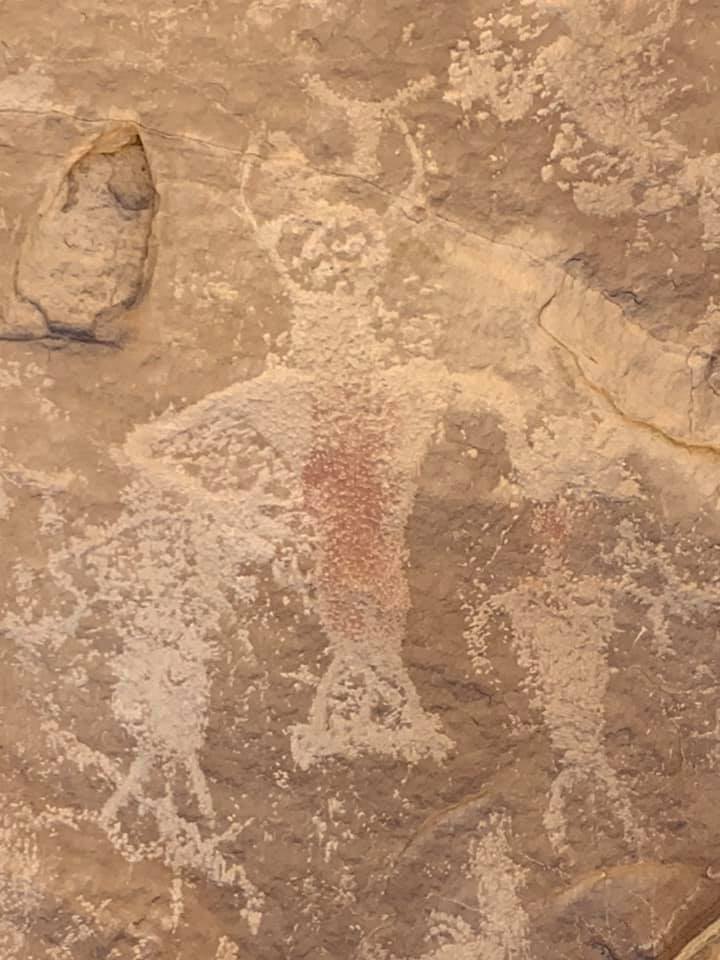
Fremont culture petroglyphs, Dinosaur National Monument. Photo by the author.
This week, I'm thinking about how we humans fit into the structures of natural history.

There’s a big problem with a lot of older anthropology exhibits in natural history museums around the globe, namely that they were built in the last two centuries often using either old and out of date information about the peoples they seek to describe, or like the old bronzes depicting the variety of humanity in the Musée de l’Homme in Paris, they were inherently racist to begin with.

Museums like San Diego’s anthropology museum have sought to rectify this with rebrandings and reorganizations. The museum in question, located in the California Tower building in Balboa Park, has recently renamed itself from the Museum of Man to the Museum of Us. Others like the Musée de l’Homme in Paris have worked to reassess how they display older historic anthropological exhibits like those old bronzes, so that today their primary message is one of “this is how people used to think, but not how we think anymore.” They’ve gone from being scientific teaching tools to historical artifacts.

There needs to be a very fine balance between lumping individual ethnicities with the rest of the natural world and actually considering humanity as a whole as part of nature. We are, after all natural beings, no matter how far we try to remove ourselves from nature with the edifices of civilization we’ve built up around ourselves. In case you’re wondering, this is a pretty central theme to the dissertation that I’m writing. In older generations, the idea of “natural humanity” was inherently understood to mean different peoples who were less civilized than others. It was used in the idea of the savage as a means of demeaning and describing the native peoples of the Americas following the beginning of the Columbian Exchange in 1492 (borrowing a term from one of my favorite historians, Alfred Crosby, here).

I’ve often thought of the world natural as being something good. Natural, or organic, food often tastes far better than the processed stuff. Natural soaps and such are less likely to harm our bodies. There’s even a style of music that I’ve called “natural” before, but only to myself. The liturgical music written by the St. Louis Jesuits, or the album Adiemus by Karl Jenkins would fall into this category.

So, if we’re natural beings, why then shouldn’t we be included in the kaleidoscope of life studied under the big tent of natural history? I for one have developed my own professional career from being an intellectual historian of the Renaissance to being a historian of late Renaissance natural history. That means I study natural history texts written between 1550 and 1600, in particular those which introduced new species from the Americas to audiences in Europe. At the time, natural history was closely related to another field called Cosmography, which while originally a theological study of the Cosmos had by the Renaissance become essentially the study of everything natural and human under the Sun. The first great proto-encyclopedias of our own modern age were descendants of the cosmographies of people like Sebastian Münster and my own focus of study, André Thevet (1516-1590), whose Cosmographie Universelle (1575) basically sought to describe everything, and yes I mean everything, that he knew about.

Today, we live at a turning point in human history. It seems like the last vestiges of the post-World War II order are finally beginning to break off, letting whatever the current century will bring be hatched from that shell born of the last century. Every century’s generations live in the shadows of their forebearers and have to figure out how to deal both with the benefits and the problems those generations left them. So, for us today talking about natural history we have the terrible realities of racism and bigotry which cloud this field and all its constituent studies. I do think humanity ought to be considered a part of natural history, ought to be studied like any other animal, but if we are going to speak of ourselves in those sorts of terms then it ought to do it in the same language across the board for all humanity, recognizing that we are all equal.

Today though, even more than any other time in our past, humanity has a critical role in the future of nature, and the stories that will be told someday in natural history. We’ve entered the beginnings of a new geological epoch, the Anthropocene, when we are the greatest influencers on the natural order of things. I’m seeing this in how many natural history and science museums have extensive exhibits on climate change, and even the handful of older ones on human biology, like my personal favorite at the Natural History Museum in London. We can try to ignore our part in shaping life on Earth, but at the end of the day as much as we’ll ignore it, we’ll end up like the proverbial unicorns who missed the boat. At that point, we will fall victim to our own pride, to our own endless thirst for more raw materials until the nature we need to survive has been stripped away. Human history has always been a part of natural history. Perhaps that’s a key to solving our current crises and all potential crises in the future: we must reckon with nature and our place within it.