Tag Archives: Dante 700

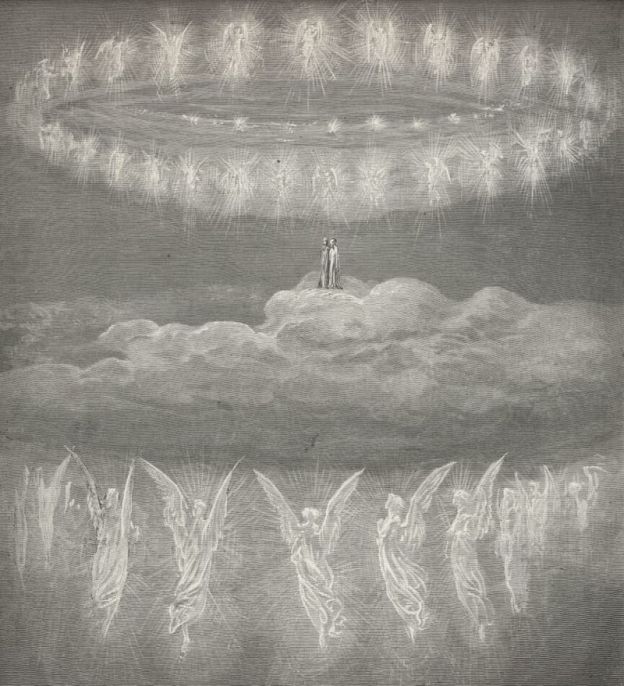
Gustave Doré's depiction of Dante and Beatrice beholding the circles of Paradise.

Paradiso

This week, I conclude my three-part reflection on Dante’s Divine Comedy with the Paradiso. — Click here to support the Wednesday Blog: https://www.patreon.com/sthosdkane


This week’s edition of the Wednesday Blog is dedicated to Micah Holmes.


This week, I conclude my three-part reflection on Dante’s Divine Comedy with the Paradiso.


I’ve long wondered about the nature of the heavens, both scientifically through my passion for astronomy, and theologically drawing from my Catholic education and faith. In the Spring of 2011, I staged a one-act play of my own writing called The Swansong of the King which I wrote in the spirit of the scene in John Boorman’s 1981 film Excalibur where Merlin’s ghost appears to Arthur in a circle of standing stones to reassure him before his great final battle at which he would surely die. I wrote Merlin lines that told the story I’d imagined of the soul’s voyage to Paradise, an island amid a deep blue sea where in a valley in the middle surrounded by lush forests, there stands a city of white stone houses and public edifices. Each house is a garden in its own right, looking like an ancient Roman atrium more than anything else, and when the soul arrives, they find the people they always loved waiting for them there for one last great party.

My vision of Heaven draws from other sources than Dante’s; his is the child of a medieval Italian world with deep and still living Roman roots, while mine has in equal amounts classical and Celtic antecedents, the island in essence being the Irish Tír na nÓg, the Land of Eternal Youth. There’s also a bit of Tolkien in there, with the speech that Gandalf gives to Pippin during the Battle of Minis Tirith in The Return of the King that was so wonderfully acted out by Sir Ian McKellen in the film adaptation. Yet upon reading Dante’s cantica of his travels from the summit of Mount Purgatory to the ultimate light at the apex of all Creation, I can understand where he was coming from even if I found my understanding of his verse fading in and out at times.

Early in the Paradiso, Dante writes in Canto 5 about acknowledging one’s mistakes, in Beatrice’s words “Better for him if he had said: ‘I’m wrong,’ / than to do worse doing it.”[1] So, the vision I’ve held onto since childhood of Paradise may well be lacking, while it makes sense in my understanding I could still very well be wrong in my assessments, and in that I would be joyous to be proven wrong so for that would mean that this affirms one of the greatest truths that I believe in: that there is always more out there for us to learn.

All things that we know exist within creation, Beatrice describes in Canto 7 how all things “come to decay and last no time at all,” on Earth, yet in them something greater can be seen. In Paradise, Dante meets many saints and holy men and women. There too, he lives out the genealogist’s dream by speaking to one of his ancestors, Cacciaguida (c. 1098 – c. 1148), a knight who left Florence to join the Second Crusade during which he was knighted by Emperor Conrad III (r. 1138–1152). When asked who he was, the knight responds to Dante, “My branch and leaf (in whom I was well pleased, / waiting until you came) I was your root.”[2] Yet when Dante asks the question I’ve long wished I could ask my own ancestors from whom I inherited my family name, “Tell me my earliest, my dearest growth / who were your own progenitors? Also, / what years were marked for you as boy and youth?”[3] Cacciaguida replies that his ancestors lived in Florence as did he and Dante, concluding “that’s all you need to hear of my great sires.”[4] Among my own Kane ancestors––the name is variably spelled Keane, Kane and Caine in English but consistently as Ó Catháin in our native Irish––the unbroken recorded link only reaches as far back as my great-grandfather’s great-grandfather who is identified in Griffith’s Land Evaluation in the 1840s as Thady Caine. I’ve surmised that he was likely born at the earliest in the 1790s. The memories of these people who in worldly affairs had little impact yet still existed as a part of our history deserve to be remembered as we still exist as a part of their legacy.

As Beatrice leads Dante higher and higher through the celestial spheres, he notices how her laughter and joy evokes the spirit of their surroundings. In Canto 18, Dante writes that upon turning to Beatrice he:

            “saw the light within her eye so clear,

            so full of laughter that her look and air

            defeated all that these, before, had been.”[5]

One passage, in Canto 19 that struck me as needing particular note concerned the salvation of those who are born outside of Christendom and live good and worthy lives. In Dante’s verse:

            “’A man is born,’ you’ve said repeatedly,

            ‘beside the Indus. And there’s no one there

            Who speaks of Christ, or reads or write of Him.

            And all he does and all he means to do ––

            As far as human minds can tell –– is good,

            sinless alike in living and in word.

            Then, unbaptized, beyond the faith, he dies.

            Where is the justice that condemns him thus?

            Where is his guilt, if he does not believe?”[6]

Here, I feel that Dante is asking about the salvation of his first guide through these three realms, Virgil, who is condemned to eternity in the First Circle of Hell for the fact that he was born and died just too early to have encountered Christianity. It’s a question that I certainly have, having known many people who do not practice this faith yet have lived good and true lives. I don’t have an answer here, like many questions of faith this is something that remains a mystery to me, for I can see both sides of this question. What I can do is hope in love, which Dante writes is the purest and truest emotion evoked from God’s Essence:

            “Love, which in laughter sweetly clothes itself,

            how ardent in those piercing pipes you burned,

            voiced by the breath of holy thoughts alone.”[7]

In that essence of love, Dante sees Beatrice slowly immerse herself into the orbit of God, beginning in Canto 21 and continuing through to the end of the Paradiso in Canto 33. In the first of these two canti, Beatrice warns Dante that he is not ready to see her in her full beauty enhanced by the presence of God:

            “’If I were to smile,’

            so she began, ‘you would become what once

            Semele was, when she was turned to ash.

            For if my beauty (which, as you have seen,

            burns yet more brightly as it climbs the stair

            that carries us through this eternal hall)

            were not now tempered, it would shine so clear

            that all within your mortal power would be 

           a sprig, as this flash struck, shaken by thunder.”[8]

Here Dante drew from the classical inheritance, evoking the story of Semele, daughter of Cadmus of Thebes, the founder of Tyre, who was one of Jupiter’s lovers and was tricked by the jealous Juno to ask to see Jupiter in his full majesty only to be reduced to ash by seeing him.[9] I’m reminded as well of the Irish legend of the return of Oisín to Ireland after spending 200 years in Tír na nÓg with his wife Niamh only to turn to ash when he fell onto mortal soil again, but not before having a long discussion of faith with a certain Christian missionary named Patrick. In both Dante’s use of the myth of Semele and this clear Christianization of the death of Oisín, the one ancient hero who by all druidic accounts still lived in the Irish Paradiso of Tír na nÓg, the new faith could incorporate the old worlds into which its light flooded over the last two millennia.

At long last though, Dante is able to see the “sacred light” in its purest form, and to look again at the face of Beatrice illuminated by this light as one of the righteous. Later again in Canto 21, he proclaims with the exuberance of the Magnificat:

            “O sacred light,

            how love – the freedom of this holy court –

            is all one needs to trace God’s providence.”[10]

Dante can see the truth of Paradise because of the caritas, the charity, “on high that makes us serve / so readily the wisdom of the spheres.”[11] This light overwhelms Dante, even then. This is something that I fully can relate to, having felt much the same throughout my life yet magnified in recent months. In the first lines of Canto 22, the poet writes:

            “Astounded, overwhelmed, I turned to her

            my constant guide, like any little boy

            who’ll run to where his greatest trust is found.

            And rushing there, as mothers always do,

            her shocked, pale, sobbing son, she said to me:

            ‘Do you not know that you’re in Heaven now?

            Or know the heavens are holy everywhere,

            and all here is done is done from zeal?”[12]

Even in this moment when Dante ought not to be afraid, he still felt that most human of instinct at beholding something otherworldly and so beyond what he had seen before then. The immensity of Paradise alone would make anyone of us cower in fear. These verses more than any other spoke to me directly, as something that I could see myself doing in Dante’s place. It reminds me of Moses’s first reaction to realizing whose voice spoke to him from the burning bush:

“I am the God of your father, he continued, the God of Abraham, the God of Isaac, and the God of Jacob. Moses hid his face, for he was afraid to look at God.”[13]

This, dear Reader, is a human experience of the Divine, of something greater than ourselves. I’ve long pondered how best to express my own beliefs concerning these questions, how best to refer to God. Dante sees God as a light emanating from the core of all things, and in my best effort at understanding the inherent paradox of God, for nearly a decade now I’ve come to think of a Divine Essence, as the best metaphysical expression of the Tetragrammaton which in its best English translation is rendered I am that Am. The Latin infinitive of the copula verb is essere, and this is the root of the noun essentia, so it seems prudent to me to write then of this Divine Essence, even if that Essence may seem impersonal. That’s where the three persons in one of the Trinity comes into my own faith.

At the end of Canto 22, Beatrice offers one of her last encouragements to Dante, the man who had loved her since first he saw her when they were children:

            “’You are so close,’ Beatrice said,

            ‘to your salvation here that you must keep

            the light within your eye acute and clear.

            And so, before you further ‘in’ yourself,

            look down and wonder at how great a world

            already you have set beneath your feet,

            so that your heart may show itself, as full

            as it may be, to this triumphant throng

            that rings in happiness the ethereal round.’”[14]

Dante here has a moment to look down on the Earth, on his home, what the great humanist astrophysicist Carl Sagan called the Pale Blue Dot and admire just “how small and cheap it seemed.”[15] I admire how Dante is able to imagine the Earth in one view, to see our entire planet as one common body made up of many separate parts.

Dante’s Paradiso concludes the three cantiche of his Divine Comedy, one of the great works of epic poetry in the western canon. It offers many things to many people; to my medievalist friends it is a window into the cosmology and theology of an Italian at the dawn of the fourteenth century. I would add here my own question of how different this Commedià would be had it been written just a few decades later when the Black Death swept across Europe in the 1340s? To the believer today, it evokes a vision of the afterlife in all its nuance and promises what might become of us once our lives have ended and our souls are weighed for their actions and deeds while living. I see both of these visions in the Commedià and also a poet, someone with whom I share the vocation to craft stories and enrich the human experience with our words, trying to make sense of his own life in exile far from his beloved Florence.

Reading this work has enriched my experience of Dante and reawakened some of that spirit of imagination and faith which I’ve long sheltered from the harsh winds and tempests of these recent verses that I’ve written in the last few years of my life. As much as I look forward to that great garden party in my vision of Tír na nÓg, Dante’s celestial spheres leave me with a warm sense of hope for something better to come.


[1] Dante, Paradiso 5.66–67.

[2] Dante, Paradiso 15.88–89.

[3] Dante, Paradiso 16.22–24.

[4] Dante, Paradiso 16.43.

[5] Dante, Paradiso 18.55–57.

[6] Dante, Paradiso 19.70–78.

[7] Dante, Paradiso 20.13–15.

[8] Dante, Paradiso 21.4–12.

[9] Ovid, Metamorphoses 3.253–86.

[10] Dante, Paradiso 21.73–75.

[11] Dante, Paradiso 21.70–71.

[12] Dante, Paradiso 22.1–9.

[13] Exodus 3:6.

[14] Dante, Paradiso 22.124–132.

[15] Dante, Paradiso 22.135.
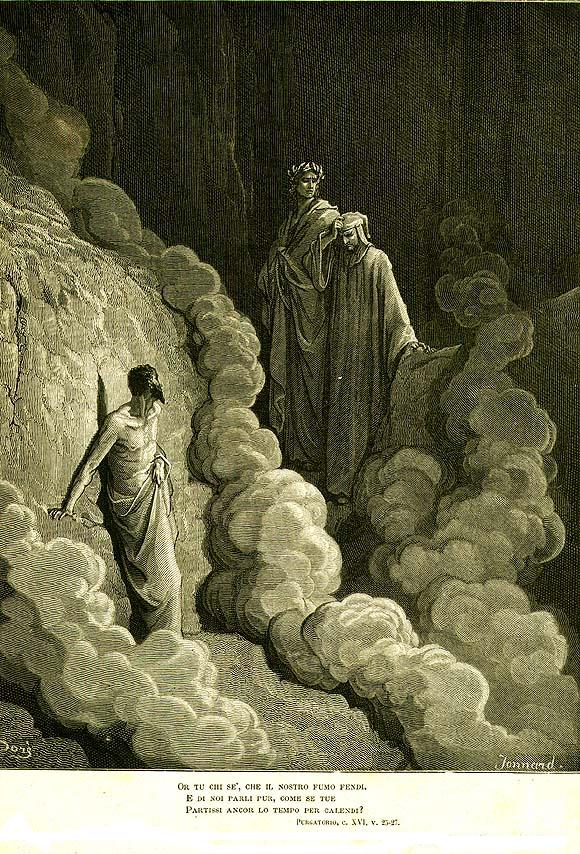

Dante and Virgil meet Marco Lombardo, envisioned by Gustave Doré.

Purgatorio

Last week, I wrote my thoughts on the first cantica of Dante’s Divine Comedy. This week then, the second part, the Purgatorio. All quotations from the Divine Comedy come from Robin Kirkpatrick’s English translation published in the 2012 Penguin edition. — Click here to support the Wednesday Blog: https://www.patreon.com/sthosdkane


Last week, I wrote my thoughts on the first cantica of Dante’s Divine Comedy. This week then, the second part, the Purgatorio.


The sentiment of purgatory isn’t a good one, it’s a place where you don’t want to end up yet often find yourself stuck for longer periods of time. I often have dreams about needing to get somewhere or to do something or find something and getting stuck in an eternal loop of steps along the way and never actually reaching that goal. There are many different ways I could interpret those dreams of mine, yet in this instance I think they may be my subconscious imagination of purgatory. 

Dante’s Purgatorio is an early depiction of this concept, though Jacques Le Goff (1924–2014), the French annaliste medieval historian wrote in the second appendix to his book The Birth of Purgatory that “the noun purgatorium was added to the vocabulary alongside the adjective purgatories.” In the next paragraph, Le Goff dated this addition to the decade between 1170 and 1180.[1] The concept itself is affirmed by the Catholic Church as doctrine today based on an interpretation of three verses from Chapter 12 of the Second Book of Maccabees, in which the author described how Judas Maccabaeus (d. 160 BCE) “exhorted the people to keep themselves free from sin, for they had seen with their own eyes what had happened because of the sin of those who had fallen.”[2] The footnote there in the New American Bible acknowledges that this passage “is the earliest statement of the doctrine that prayers and sacrifices for the dead are efficacious” and that “this belief is similar to, but not quite the same as, the Catholic doctrine of purgatory.” Dante’s depiction of purgatory fits well into this model, though he does write often of souls asking him to pray for them, as prayers for those in purgatory will speed their cleansing that they may enter Paradise again.

In this light, Dante’s purgatory is optimistic and hopeful. Sure, he encounters people who continue to suffer as they did in life from their own actions. In Canto 12, an angel proclaims to the poet and Virgil his guide, using Robin Kirkpatrick’s translation, “O human nature! You are born to fly! / Why fail and fall at, merely, puffs of wind?”[3] The cleansing path that the souls in this realm take requires tremendous effort and faith both in one’s abilities to surmount that path, and the reward for those efforts. Dante remarks later in Canto 12, “How different from the thoroughfares of Hell / are those through which we passed. For here with songs / we enter, there with fierce lamentations.”[4] The dead who walk the paths of purgatory then are working toward something, they know that they will learn in their paths the way into Paradise, it just may take a while.

The Purgatorio is remarkable for how it contrasts with the far more popular Inferno. Again, Dante stops and talks to everyone, and again nearly everyone he encounters is an Italian like him, someone with whom he can relate. He finds his fellow Tuscans among the crowds and makes his own birth well known by speaking Tuscan along his way. In several instances the souls he meets remark on the fact that he must be a Tuscan by his way of speaking, even if they themselves are Lombards, Latins, or from elsewhere. 

I found it fascinating to see him encounter the ruling elite of Europe, the kings and popes who work off their sins. In one instance he sees Henry III of England (r. 1216–1272), one of my favorite medieval English kings, who had a pretty unfortunate and quite long reign. Dante places him among several other failed rulers, including Rudolf I of Germany (r. 1273–1291), Ottokar II of Bohemia (r. 1253–1278), Philip III of France (r. 1270–1285), Henry the Fat of Navarre (r. 1270–1274), Charles I of Naples (r. 1266–1285), and Peter III of Aragon (r. 1276–1285).[5] In Canto 20, Dante meets Hugh Capet (r. 987–996) who succeeded the last of the Carolingians as King of the Franks and founded the great medieval French royal dynasty which still exists as the Royal Family of Spain today. Capet sees his old life as something distant from himself: 

“I was, down there, called Hugh Capet once.

From me were born those Louis and Philippes

by whom in these new days our France is ruled.

I was from Paris, and a butcher’s son.

And when the line of ancient kings died out ––

All gone, save only one who wears a monk’ dark cowl ––

I found my hands were tight around the reins

That govern in that realm, and so empowered

In making that new gain, with friends so full,

that, to the widowed crown my son’s own head

received advancement. And from him began

our lineage of consecrated bones.”[6]

In this world which he devised, Dante created tangible settings where the soul is cleansed after its life and before its final entry into Paradise. Dante himself climbed high until by the time he reached Canto 15, the suffering and toil of purgatory cleansed his own soul, so that in place of any other emotion “caritas burns brighter.”[7] The distinction in Latin between caritas and amor is something that I remember being discussed at length in my undergraduate theology classes at Rockhurst. These Latin terms are in turn translations of the Greek originals ἀγάπη and ερως, which I’ve come to understand as a distinction between charity and romance. The higher Dante and the penitents climbed up Mount Purgatory, the purer their souls became so that the affection they felt for their fellows and for all things was less a love that desired something of each other rather than a love that wished only to exist in communion with each other. In my fraternal order, the Ancient Order of Hibernians (AOH), our motto of “Friendship, Unity, and Christian Charity” speaks to this vision of love as charitable, unifying, and amicable. Purgatory was intended to replace fear and “penitential tears” with charitable love:

            “If love, though, seeking for the utmost sphere,

            should ever wrench your longings to the skies,

            such fears would have no place within your breast.

            For, there, the more we can speak of ‘ours’,

            the more each one possesses of the good.

            and, in that cloister, caritas burns brighter.”[8]

In purgatory, the penitents seek to cleanse themselves, and to cleanse the world in time as well. In Canto 16, the medieval Italian courtier Marco Lombardo remarked to Dante that societal corruption stems from the government:

            “So — as you may well see — bad government

            is why the world is so malignant now.

            It’s not that nature is corrupt in you.”[9]

The hopes then of the penitent are that not only will they enter the Gates of Paradise but that all those who they left behind on the Earth will also join them and God among the heavenly spheres in their own time. Marco Lombardo remarked to Dante that “of better nature and of greater power / you are free subjects. And you have a mind / that planets cannot rule and stars concern.” In this, Marco reminds Dante that the key to Paradise is accepting one’s responsibility for one’s actions and life and being honest and free about one’s mistakes. Dante experiences this at the end of the Purgatorio, when he at last arrived in the Garden of Eden, located at the top of Mount Purgatory. There, he encounters his beloved Beatrice, the love of his life who sent the poet Virgil from the first circle of Hell (Limbo) to guide Dante to this point where he will at last be reunited with her.

Yet when Beatrice sees Dante standing there in the garden, she admonishes him for his sins and faults when she was alive and afterwards. She challenges him to be better, and to give up the last of his fear and worry, he had not come to her in the usual way after his own death. Beatrice challenged Dante, silencing him with sharp words that he did not expect of her:

            “Respond to me. Your wretched memories

            Have not been struck through yet by Lethe’s stream.”[10]

To advance further, and to be with his beloved again, Dante needed to forgo his feelings of fear and worry, remorse and sorrow, and instead embrace the moment in which he was living, standing there in her sight and hearing her voice.

            “And yet –– so you may bear the proper shame

            your error brings and, hearing, once again,

            the siren call you may show greater strength ––

            put to one side the seed that nurtures tears.”[11]

Beatrice is the first one in the entire Purgatorio who calls Dante by his name, the first to properly recognize him for who he is, more than just the wandering Tuscan poet or the Italian. I’ve often thought about how I would reveal characters’ names in my stories. I like to slowly peel away the layers of fog surrounding a narrative and let the audience discover the characters’ names in a more natural fashion. In a story I’ve begun to write, a sort of cleansing purgatory for the main character, his name is not uttered until after he has passed through these great circles of repentance in his own wandering way home.The Purgatorio concludes in a very mystical fashion, heralding the beginning of the Paradiso that follows. The symbols of the heavens abound, as Dante leaves fatherly Virgil behind to return to his own circle and follows instead his muse Beatrice toward the highest heights anyone in this cosmos can hope to achieve. That then, is where we will continue next week.


[1] Jacques Le Goff, The Birth of Purgatory, (Chicago: University of Chicago Press, 1984), 362.

[2] 2 Macabees 12:42–45 (NAB).

[3] Dante, Purgatorio 12.95–96.

[4] Dante, Purgatorio 12.112–114.

[5] Dante, Purgatorio 7.

[6] Dante, Purgatorio 20.49–60.

[7] Dante, Purgatorio 15.57.

[8] Dante, Purgatorio 15.52–57.

[9] Dante, Purgatorio 16.103-105.

[10] Dante, Purgatorio 31.11–12.

[11] Dante, Purgatorio 31.43–46.


All quotations from the Divine Comedy come from Robin Kirkpatrick’s English translation published in the 2012 Penguin edition.


Inferno

A while ago, I began reading Dante's Divine Comedy. So, over the next three weeks I will be writing my own reflections on each of its three parts. This week then, I begin with the Inferno. — Click here to support the Wednesday Blog: https://www.patreon.com/sthosdkane — Dante: Inferno to Paradise, https://dantedocumentary.com The Blues Brothers, "Everybody Needs Somebody to Love and Sweet Home Chicago," https://youtu.be/FrLZoQUl2mQ?si=g9rLDM6ZPM7tXJ97 Molly Fischer, "The Tyranny of Terrazzo: Will the millennial aesthetic ever end?", The Cut: New York Magazine, (3 March 2020), https://www.thecut.com/2020/03/will-the-millennial-aesthetic-ever-end.html Ian McKellen's performance in Macbeth "Tomorrow, tomorrow, and tomorrow" speech (5.5.17–28): https://youtu.be/4LDdyafsR7g?si=3qgAmsaKW6oKJKXq


A while ago, I began reading Dante’s Divine Comedy. So, over the next three weeks I will be writing my own reflections on each of its three parts. This week then, I begin with the Inferno.


Three years ago marked the 700th anniversary of the death of the great Italian poet Dante Alighieri, the author of the Divine Comedy, whose Tuscan dialect is widely regarded as foundational for the modern standardized Italian language taught today. I will write at length about language standardization in the future, if I haven’t already, yet today, dear Reader, I wish to address his Commedià itself. Around the time of his great anniversary, the Center for Medieval and Renaissance Studies (CEMERS) at my university held a variety of lectures concerning Dante. In one such instance, I became critically self-aware of the fact that I was likely one of the few people in the room who had not read the work.

I finally got around to reading the Commedià in the last month when a new two-part documentary on the life of Dante aired on PBS. I realized then that even though I hadn’t read his magnum opus, I still knew a great deal about it because of how closely tied it is to my Catholic culture. The concepts of Hell, Purgatory, and Heaven as I grew up understanding them have clear support from Dante’s vision of these three realms. Yet like Dante, my own vision of these three is just as drawn from far older classical and biblical sources. He recognized the importance of connecting the beliefs of his own age with those that they replaced.

This is a point I made in conversation with a friend and fellow historian: Dante was a man of his own time. In his moment, it is fitting to see the great classical heroes, philosophers, and poets resting on the outer most layers of the Inferno because they had no introduction to God during their lives. Even more unsettling is his placement of the Prophet Muhammad within the eighth circle’s ninth bolgia as one of the “Sowers of discord.” Again, this fits in Dante’s own time and place, living at the same time as the Crusaders lost Acre in 1291, nine years before when the Commedià is set.

The Inferno is proof of four great truths which I wish to discuss in the remainder of this week’s post. The first of these is that faith often requires trust in more tangible things that one can see and touch and most importantly imagine. This past weekend on Trinity Sunday, I was moved by how my pastor––Fr. Jim Caime, SJ––described his relationship with the Trinity in his own prayer life. I believe in the Trinity, though what draws me towards that belief at this moment in my life is an appreciation for the mystery of the Trinity. It’s funny there, I appreciate the mystery of the most important doctrines of the faith yet when it comes to things that are more tradition than anything else, my faith is still built on a foundation that is strikingly tangible in its nature. At times I’ve thought that superstition might stick with me more because it’s something that is more tangible and everyday than some of the more metaphysical elements of my Catholic faith. Faith needs to be lived in “to live, thrive, and survive” in the words of the great Elwood Blues.

Second, I’m not a fan of iconoclasm. Culture is built by individuals yet adopted by communities. We live in a present moment which is layered upon the past. In those layers we can see bygone moments, years, decades, generations, centuries, millennia, and ages when our past thought something they made was worth cherishing even for a moment. Everything from the eternal grace of the great monuments of human endeavor, and our striving for greater truths is just as central to these ringed layers that form our culture as are the passing fads that come and go year by year. An article I read over the weekend in New York Magazine‘s style outlet The Cut about the millennial aesthetic that has defined the tastes of my generation in the last decade asked if “the tyranny of terrazzo” will ever end. The article concludes with a foreboding of the dominance of bright yellow among the style choices of our successors, Generation Z. I for one felt a similar sense of dread the last time I went clothes shopping at Target only to discover everything in the menswear section was geared to younger generations than my own. I continue to shop at Macy’s when I’ve gotten a nice paycheck and Costco when my parents are around with their membership.

If you’ll pardon that digression, the iconoclastic spirit would burn down the terrazzo of my generation’s invention and inspiration and would replace the soft hues with new and reactive bright colors. It would respond to decades of slow burning negotiation and working within the status quo with a fierce clamor to fight and resist even if the odds aren’t in your favor that your resistance will do you any good in the long run. I’ve been there and found that sort of thinking didn’t accomplish much and so settled for Dr. Franklin’s approach to change, make friends with as many people as possible and nudge them to do things you think important. In this light, my vote tends to be cast for more moderate candidates than my own views, and I’ll freely admit my own views on issues have changed with my own changing sense of frustration and irritation towards others whose voices are perhaps projected louder than necessary through social media.

So, I appreciate how Dante kept the voices and spirit of the pre-Christian past alive in his Inferno, that he was guided by the great poet Virgil, whose Aeneid I became quite familiar with in my senior year Latin IV class (Grātiās tibi agō, Bob Weinstein). It never seemed strange to my faith that the old faiths of Europe or any other religions could also exist within our understanding of Heaven, Hell, and all the rest. Again, Dante was a man of his time and his place, so to fit in the great heroes of Ancient Greece and Rome into his vision of the afterlife is only natural. Iconoclasm only harms us and our posterity by robbing all of us of the riches of our past and the finest parts of the great human inheritance. The iconoclast’s tradition to destroy what came before will only lead to their own destruction in turn by their posterity. Third, as powerful some may be in life it is the writers who will preserve their memories for eternity. Chaucer and Dante both preserved the memories of their enemies in a way that has led to the survival of those men’s names. Yet their names are not spoken kindly, so the world would do well to heed the power of the pen. They can live long beyond their memory ought to have otherwise. While more ancient stories began and lived for generations told orally and remembered from that recitation, we now in our learned state require things be written if they are to be remembered. In Shakespeare’s words, written for the Scottish King to utter upon news of his wife’s death:

She should have died hereafter;

There would have been a time for such a word.

— To-morrow, and to-morrow, and to-morrow,

Creeps in this petty pace from day to day,

To the last syllable of recorded time;

And all our yesterdays have lighted fools

The way to dusty death. Out, out, brief candle!

Life’s but a walking shadow, a poor player

That struts and frets his hour upon the stage

And then is heard no more. It is a tale

Told by an idiot, full of sound and fury

Signifying nothing. (Macbeth 5.5.17–28)

The writer helps human memory survive long after each generation is gone. Before our carbon dating or genetic coding of the remains of beings now dead, writing remains the original technology by which we recorded our nature and taught our learning, and dare I say our wisdom, to those who come after us.

Fourth, I admired how Dante cast himself as both observer and listener to the plight of the damned. In every circle he chose to stop and ask the souls he encountered their names and to tell him about their lives and why they were where they ended up. This more than anything else is a model we ought to emulate, as I’ve written before here, we ought to listen to each other more. I believe this would solve a fair number of the problems we face in our lives. Pope Francis’s message from the balcony after his election eleven years ago echoed this sentiment when he simply asked that we pray for him as he began this new ministry in his life. This is something that I want to get better at; I am so used to my own solitary company that I often have to consciously remind myself to make smaller gestures of gratitude toward the people around me.

Dante often offered to speak to the loved ones of those who he recognized on his journey through Hell or to pray for their souls. Yet where I saw the greatest pity was at the bottom circle when he beheld the three great traitors of his world being devoured by the heads of the Devil: Judas Iscariot, Brutus, and Cassius. After reading this Canto, I wondered if the Inferno were to be written by an American who might be our three great traitors? Yet here my own beliefs divert from Dante’s, as I find it distasteful to say with any authority what the spirituality of anyone else might be.

I recently finished listening to the most recent Star Was anthology book From a Certain Point of View: Return of the Jedi which is a collection of stories told from the perspectives of minor characters who appear in the film in question. One of the last stories was the main one I was looking forward to the most. It was from the eyes of Anakin Skywalker after his redemption from 23 years living under his evil alter ego as Darth Vader. What struck me here was that despite everything Anakin did in his life, the Force and his best friend Obi-Wan Kenobi, whose force ghost beckoned him into the next life, forgave him. I don’t claim to have any authority over whether one person or another ended their life in one state or another because of the power of forgiveness. Forgiveness is a deep expression of love that we ought to express and inhabit more. Forgiveness it isn’t something that necessarily came naturally. Most of the bullies I faced in my childhood got a silent response from me later in life. I’m not proud of how I’ve reacted to certain people and situations in a way that echoes my own fear and anger, because I know I can do better. Fear isolates us from love, after all.

As I continue reading, I’m eager to see how Dante grapples with forgiveness and with the love that fuels it. I for one am eager to climb from the depths of Hell alongside Dante and Virgil onto the slopes of Mount Purgatory, a cantica which I expect I might allow myself to read in my usual pre-bedtime hour. I chose to spare my dreams of the Inferno, figuring I give myself enough nightmares of my own invention as it is.

Next week then, I will write to you about the Purgatorio and Dante’s climb towards the climax of his literary life.


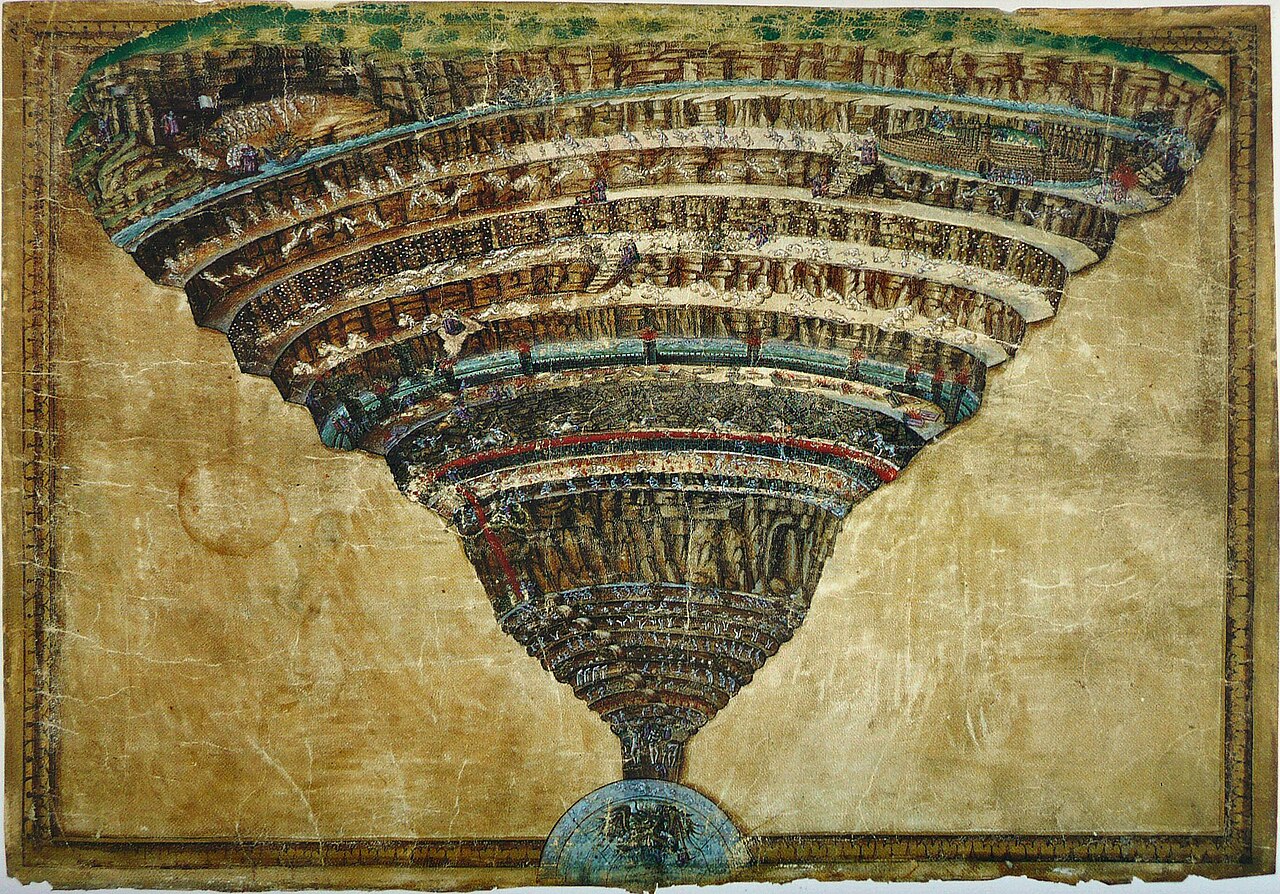
Dante’s vision of the circles of Hell.