
Tag Archives: Death

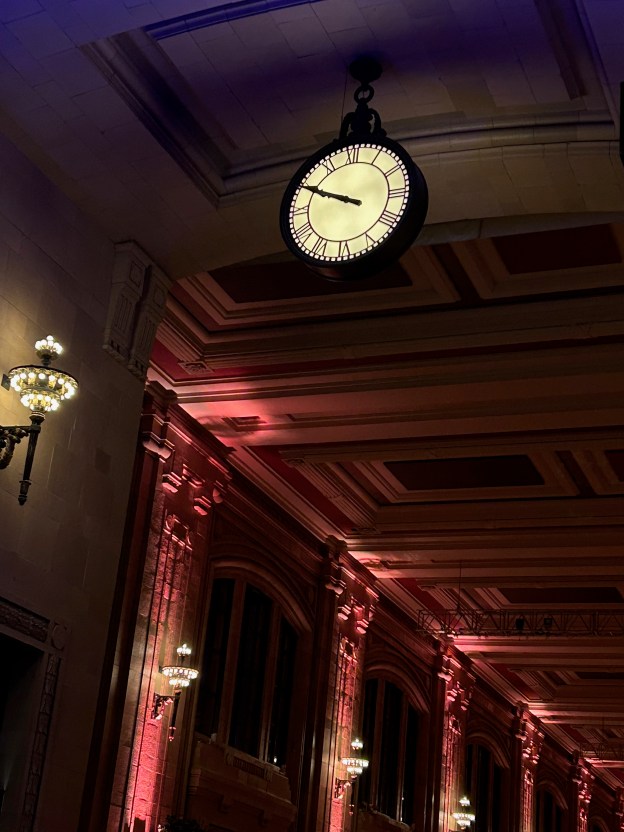
A picture of the great clock at Kansas City Union Station at night.

The Poetics of Finality

The Poetics of Finality Wednesday Blog by Seán Thomas Kane

This week, some words on endings.—Click here to support the Wednesday Blog: https://www.patreon.com/sthosdkane


This week, some words about endings.


On the morning of Flag Day, I went to the Linda Hall Library with my parents to see the classic 1951 science fiction film The Day the Earth Stood Still. I knew about this film, but this was my first time seeing it. Beside the story, what struck me most about this film was its tone, pacing, and overall character. After I finished my other two events of the day, the Plaza No Kings Rally where I watched the crowd of 11,000 people rally for democracy, and Mass that afternoon, I returned home tired yet eager to find that same tone. I went looking for it in Rod Serling’s classic series The Twilight Zone. Released between 1959 and 1964 in its first incarnation, this series had scared me a bit the previous times I’d sat down to watch an episode or two. It has an air of fear to it that is reminiscent of the reasons why I generally stay away from horror films. And yet on closer inspection, Serling’s stories tell something that is far less frightening than I first imagined because it’s a theme with which I’m all too familiar.

I came to indirectly know more about Mr. Serling when I moved to his hometown, Binghamton, New York, to undertake my doctoral studies in August 2019. His image isn’t all over town, but it’s a visible reminder of Binghamton’s history and place in the fabric of American culture. In fact, much of the stories that I’ve now watched in The Twilight Zone fit the character of that interior part of the Northeast where I lived from August 2019 to December 2022 quite well. In some ways, not too much of the built environment has changed from Serling’s day 60 years ago. Still, I noticed time and again how the optimism of that postwar era had faded. The same town was there, but some of the energy it once knew was long gone. Having lived my life to date in Chicago, Kansas City, and London, all cities with layers of history and memory, I’ve seen how the current generations have chosen to craft their own layer. 

London is a city that holds mementos to its ancient and medieval past while largely built in the form of its eighteenth, nineteenth, and twentieth century growth at the height of the British Empire. Yet today there are enough futuristic buildings and settings in the capital that it was used as a setting standing in for the space-age galactic capital of Coruscant in the latest Star Wars series Andor. I delighted in seeing familiar places from the Barbican Estate and Canary Wharf in the show.

Chicago has some of the same American character of Binghamton and the Northern states as a whole, a common history. Yet Chicago is the powerhouse of this country, the beating heart of our transportation network, the real crossroads of this nation. Where other industrial cities in the Great Lakes faltered in the 1970s, 1980s, and 1990s Chicago instead continued to power on for its sheer size and the diversity of its industry. Today, it has a very particular character which I believe makes it the most American city this country has to offer for its marriage of American settler culture and all the different indigenous, migrant, and immigrant communities that make America the patchwork of peoples in one great republic that it is.

Kansas City meanwhile saw more of the downturn for its smaller size and some of its traditional industries haven’t translated as well into the current information revolution. Kansas City once thrived as another great railway hub: the Gateway to the Southwest as the last major Midwestern metropolis along the Santa Fe Railroad as it drove across the prairies toward New Mexico, Arizona, and Southern California. Today, our interstate highways direct traffic through Kansas City more from Texas, Colorado, the Dakotas, Iowa, Minnesota, and points east than in the old northeast-to-southwest alignment of the rails. Recently while I was in downtown Kansas City, I remarked on how underwhelmed I felt visiting there for the first time after the business and thrill of going with my parents down to the Loop on weekends when we still lived in Chicago. Kansas City however has seen a renaissance of its own in the last twenty-five years that has filled in many of the gaps left by urban renewal and restored this city’s vitality. That more than anything else made my move to Binghamton a tremendous culture shock: going from a growing city to one that was a shadow of its former self struggling to invest in its future.

For every Twilight Zone episode there seems to be a fearsome unknown menace looming over the story; something that the character can perceive the effects of yet can’t quite see. Yet if there is any common thread to this menace it’s that it is a fear of the unknown. In the original pilot that launched the Twilight Zone, titled “The Time Element,” Serling’s rational psychoanalyst foil to the main character trapped in his dreams concludes through his logic that his dreams that he goes back in time from 1958 to Pearl Harbor on December 6th, 1941 could not be real because any incident that happened in this dreamed 1941, if real, would impact the patient as he lived in 1958. Yet reason is proven unequipped to address the irrational, how can it explain what it intrinsically is not? I’ve argued time and again here in the Wednesday Blog that this is where there exists room for belief in a life lived rationally. Still, having watched a fair number of Mr. Serling’s stories now, I think I can say something to this menace’s true character.

There is an intrinsic fear that comes with knowledge of seeing that we do have an ending. On a biological level, our bodies can only continue working for so long. We drift apart from our lives as they were in one moment or another, apart from friends who we admired and loved in a given moment, apart from jobs that consumed our waking and sleeping thoughts, apart from situations which challenged us to become better versions of ourselves. Yet, all those lived moments will continue on in our memory, at least for a time. I was stunned to find how well I could remember very particular moments of minute detail earlier this year when prompted by a sudden and wonderful realization about how I want to live in my life to come. Even the smallest of details that my senses perceived were there, locked away. The antidote to any fear is joy, and for me it was the most radiant joy I’ve felt in years which unlocked those memories for me of moments which led to that jubilation. Still, fear in moderation is a good counsel, a wise friend. It’s what makes me watch for traffic when I’m crossing the street here in Kansas City, or that advises me to make certain decisions over other ones at a very fundamental level to keep me alive. This is one interpretation of what the infamous tree in Genesisportended: that once humanity ate its fruit we would never again be able to be innocent from seeing flaws in the beauty of nature and in the beauty of ourselves.

Over the weekend then, I went to see the new Stephen King film The Life of Chuck starring Tom Hiddleston as Charles Krantz. I particularly grew to like young Chuck’s grandfather played by Mark Hamill. If I were to compare Stephen King’s writing to any other American storyteller of the last century it would be Rod Serling. Both tell stories of this same menacing fear. Yet in King’s Life of Chuck, the monster who’s revealed in the last scene is far more familiar, ordinary, and known to us all that I saw it less as a menace and more as a companion. There is intense poetry in both Serling’s Twlight Zone and King’s Life of Chuck around endings. They tell us that the finality of moments in our lives and of our lives all together give our lives greater meaning and purpose. I’ve found in the various projects and events I’ve helped organize that we get more done when we have goals we’re trying to achieve and a timeline by when we want to achieve those goals. I often work better when I have deadlines because if I begin to feel impatient at how long something might take, I know there’s an end date to look forward to. I feel that about little things but not the big ones, not the experiences that’ll one day make for good stories or about my life itself.

I for one don’t want to live forever, I worry that’d take some of the meaning out of my life. I would like to be remembered for my writing, for being a good person, for the history I research and leave for generations of graduate students to muddle through in their coursework. On a recent digital security Zoom call that I attended we were asked to search our names on several search engines and see what came up. Should there be anything we didn’t want searchable we could then get that removed. I was delighted to see that after my website, social media profiles, and various conference programs came page after page filled with essays published here on The Wednesday Blog. I suppose that’s one benefit of writing this weekly for the last four years: my thoughts written here will be remembered at least by the search engines. Yet I think the Wednesday Blog will have more meaning when I decide to set it aside and turn my staff to other facets of “my so potent art” to borrow from Prospero. Because then anyone who is curious enough to glance through these pages will be able to see them in their totality and know these essays are artifacts of the time when they were written in the early 2020s at a time of my life of doctoral study that feels so very close to ending.

This is not the last time you’ll hear from me on the Wednesday Blog, rather I’ve decided to end my weekly publication of this blog at the end of the current season. This is Season 5 of the podcast, or Book 6 of the blog itself. I feel that it’s had a wonderful run, and it’s been a great outlet for me while I’m biding my time as my career slowly begins. Yet now, I’ve got a lot more writing to do from new research papers to submit for peer-review to book reviews that it’ll be nice to take this off my docket. This is the 25th issue of this season, and I have a further 15 issues planned before the end. Thank you to all my readers over the last four years and all my listeners over the last three. I hope this will be an ending worthy of your curiosity.

Utopia Lost

This week, I have a short story for you that I wrote three years ago after the death of a dear friend. — Click here to support the Wednesday Blog: https://www.patreon.com/sthosdkane


This week, I have a short story for you that I wrote three years ago after the death of a dear friend.


How does one convince a civilization to accept it’s moved beyond the known and into an entirely unknown and new age? How does one convince oneself of this terrifying and very real fact? It takes loss, grief, and sorrow for humanity to recognize and embrace change, world wars, revolutions, or sudden bouts of violence to remind us that time continues ever onward. Yet for me, one guy living in this world moving along, strong, pulsing like the tempo in the fourth movement of Shostakovich’s Fifth Symphony, it takes something even more personal for me to admit one act in my life is ending, and that after a turbulent period of intermission that another will shortly begin. It often takes moving out of my skin, out of the comforts of my upper middle-class normality, my tree-lined block in my beautiful neighborhood in the heart of my city, out into places I’d never really desired to visit. And yet, after she died, I found the need to flee far from home, like Gilgamesh seeking a cure for death itself in the lands beyond the water.

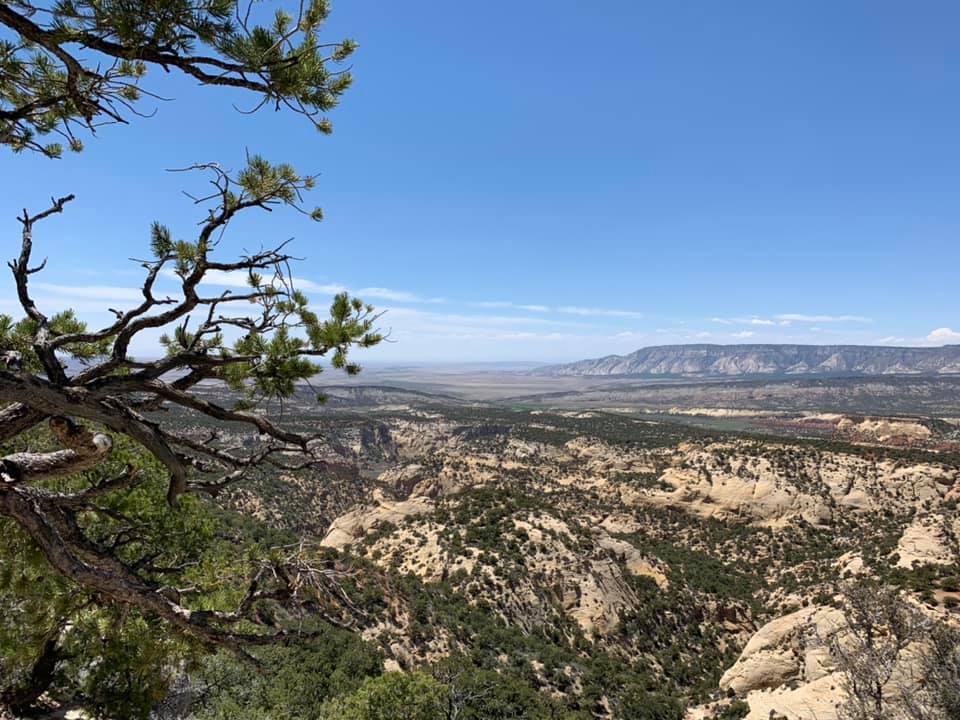
These thoughts danced through my mind as I stood atop the rim of a canyon, a thousand miles from home, in the high deserts of the Colorado Plateau, exposed and in the open; a danse macabre moving out of place in the desert setting of a Dali or Georgia O’Keeffe painting. I was struck by the silence of the scene, the extreme quietude that reminded me of many a hymn and prayer the Jesuits and Franciscans alike offered about finding God in all things. Nature certainly is God’s canvas, just as van Gogh understood it when he painted his own vision of that Creation, and just as I, a guy trying to understand grief had heard but never fully appreciated until I saw it for myself. The starkness of the desert, the browns, greys, and dusty oranges, seemed so different from the many shades of green, the vibrant spectrum of flowers that decorate the parks and gardens of my city. Yet it was there, in that environment, so far from home, that I felt drawn to. I’d been in the desert before, in Arizona, and found it lacking in beauty, seeming to be hostile, dangerous by nature, unbefitting for someone of my origins or health. Yet this desert, as alien as it was to me, seemed gentler in a way, less severe, more textured in its variety. Here where the Yampa River flows into the Green River, on federally protected land, the wilderness seemed to sing with all its resplendent harmony. Nature cried out on the wind as if to Elijah in a whisper, in its own language, its own song. I could recognize it, but I had a hard time understanding it. I, a city guy, knew only the manicured nature of my urban homeland. I knew the landscape that had been remade in the image of the Eastern cities and their European forebearers, a landscape of verdant trees and gardens which conquered the native prairie grasses in the wake of the settlers who conquered the native peoples who had called those prairies home.

I knew my home was artificial, and so it was not fit to help me through my sorrows. When she died, laying there on the veterinarian’s table, her face was calm, at peace; she looked as though she were having the best of dreams. Long suffering from a lack of tears, even when I wanted them, I felt as if I cried enough to fill the stormy Atlantic and more. She was my dearest of friends, the one who was always first to comfort me, the one who would go on adventures with me through the parks and along the trails. She was my companion at the sidewalk cafés, her with her water bowl and a couple treats, me with my tea and a pastry or two. Neither of our lives would’ve been possible without our artificial world, we were both born in an industrial, global, civilization, created out of the migrations of countless dogs and people from throughout the globe who would carry out a few begats until we were born in our own times. Yet even then, in her long life, her sixteen years of naps and treats and play, she saw our world change again from that industrial world of our forebearers into a world of the digital, a world where ideas were spread not on paper but on screens, where her favorite toys would inevitably come not only from the local pet shop and groomers, but often from some distant warehouse, a distribution center built to cater to the needs of millions, even billions of “consumers,” as we’d become known. To them, we were just numbers, her existence was acknowledged by the fact we purchased from the dog section, but her gifts inevitably were counted among my numbers. We’d created this world where if we really wanted to, and had the means, we could ensure that we would never wont for anything again. We’d created a world where instead of settling for the same old cooking shows that she loved to watch (she knew the names of all the foods), we could now tune into cooking shows from Europe, as I learned French, hoping she might pick those food words up too. I dreamed of a reality where we would always be together, where she would be as wonderful and dear a friend to my kids in the coming decades as she has been to me. Yet time marches on, and with it we age. Unlike Gilgamesh, I knew I couldn’t stop death, like the Swedish knight, I knew even if I kept the game going, eventually Death would reach checkmate, yet in my dreams at least she was still with me, still snoring next to me every night, still leading me from one blade of grass to another around the neighborhood as she sniffed for traces of her dog friends’ adventures.

In my dreams then, I hoped I might hear a familiar pattering of her paws on the rocks leading to the canyon rim, only to turn about and see her trotting over to me, tail wagging with glee. Perhaps a part of me truly believed if I went out into the desert, I might just see her again, if only in a greater clarity in my mind’s eye, in my memories. I stood there on the canyon rim, and listened to the silence, hoping dearly she was coming, wishing she could’ve seen that sight as I was seeing it that day. I could hear her snorting, and smelled that she needed a bath, something she was often proud of, though never appreciative of when she was bathed. Yet I knew, all too well, I wouldn’t see her again until I too had crossed the water, however distant that day would be. As much as I spent our days together worrying about the world around us, and what might well be beyond what we know, she spent those same days curious about few things, simple things, but most of all she was sure about love, and its importance and meaning. I understood it in those last moments before she died as she kissed my face for a final time. It was clear to me that as much as I could speak French when in Paris or Montréal, so too I could communicate with her, by letting her do “gross” things like jump on my chest and kiss my chin, or listen to her growl and whine at me, to let her have her say. I would reply each time, telling her “I love you,” and meaning it. Even if I was leaving the house to shovel the snow in the winter, I would look her in the eyes and say, “I love you,” so that she knew it well. She was as innocent as she was mischievous, her favorite game was running around the house with the end of a roll of toilet paper in her mouth, decorating the rooms and halls with that ribbon of white. It annoyed my family to no end, but I could see she was having so much fun doing it.

The desert, a place I traditionally thought of as dead, hot, lonely, seemed full of life, and while I could not see birds fluttering around the far rim of the canyon, I knew they were there. I could feel the breeze as if it were in part propelled across the chasm by the fluttering of many little pairs of wings beyond. It was as though they were singing their own hymn to being alive, to the radiant Sun in the blue sky, to the scrub and the rocks laid down there over millions of years. This place had seen many ages even before the coming of the first humans. To it, my little artificial urban island in the seas of prairie grass must have seemed both a cute human attempt at recreating nature in humanity’s own image, and a threat to the current vitality of the wilderness itself. Far overhead, the trails of passenger jets remained the only sign of the civilization beyond the canyonland before me. Sitting in those planes, focused on evading humanity’s worst bogeyman, a specter named boredom, the passengers surely didn’t notice what wilderness was below them, and if they did look out the windows, from 30,000 feet they would well have been at a loss to truly appreciate what they were speeding over on their way to the great cities of this country and beyond.

I thought of Elijah, hearing the Voice of God in the faintest whisper of the wind, and imagined what the Divine might say to me. Quickly though, unlike other daydreamed dialogues, I found myself at a loss for imagined words and banter, unsure of how to speak for such a concept as an omnipotent and omniscient God. Maybe then that’s the real beauty of Elijah’s experience, he heard God in a whisper because we humans can’t really understand what it even means to hear such a Voice. I tried fantasizing about it even more though, doggedly not wanting to give up too easily, and found myself afraid, scared at the idea of even hearing such words, the power and presence they would command would be the same that creates realities. The idea itself was but a micro fraction of a particle of a grain of sand when compared to the consequences of the Divine. My importance was duly minute, yet without my imaginations would I really recognize any of this? Would I hold out hope that my dog recently deceased would appear to me wanting to play there on the canyon rim knowing all I know about how this reality operates? In the great cosmic totality, I began to wonder how much her life really had meant. A little eleven-pound dog, who couldn’t put on a fierce face to anyone, or serve as much of a herder. If anything, she was best at being a friend, the best of friends. 

If her life had any consequence, I realized, it was in loving everyone and everything she met, in that unblemished innocence, that unconditional affection for life itself. She served as a role model of sorts for all the rest of us, especially for me, having lived with her for so many years. Even someone as little as her could plant a seed of love and charity in the minds of others that one day could restore the Utopia that seemed lost to me at her death. I stood there as the day continued on, and through the setting of the Sun, and watched as Venus, the evening star, rose overhead, bearing behind it the curtain of darkness that is the twilight and eventual nightfall. I was soon laying on my back on the canyon rim, not caring about the dust or the bugs, just awestruck at the sights above me as one star after another appeared in the darkening sky. The ancients believed the dead could be found among the stars, though my own ancestors passed down a belief of an earthly paradise on an island of eternal youth, something which as skeptical and scientific our world becomes, I still find myself believing in. If for nothing else, that light in the darkness of even the emptiest of cloud covered nights has kept me warm company in my thoughts. From that far distant island I thought I could hear her calling, her bark and wagging tail inviting me to come, but in my own time, not too soon. Even in this most dystopian of days, I thought, tears streaming down my cheeks again like on the day she died, there is still hope to be found, utopia restored, after all behind every cloud glows the light of some distant star. I laid there looking up into the starry night, through my tears singing a song I used to sing to her, hoping, believing, knowing somewhere she was listening.

Someday, however soon or far, I knew I’d see her again, once the boatman calls upon me. Funny enough, for someone who enjoys life as much as I do, the simple belief that I will see my dearest and sweetest of friends again is enough for me to look forward to that reunion across the water on the far shore.