

Utopia Lost – Wednesday Blog by Seán Thomas Kane
This week, I have a short story for you that I wrote three years ago after the death of a dear friend.
How does one convince a civilization to accept it’s moved beyond the known and into an entirely unknown and new age? How does one convince oneself of this terrifying and very real fact? It takes loss, grief, and sorrow for humanity to recognize and embrace change, world wars, revolutions, or sudden bouts of violence to remind us that time continues ever onward. Yet for me, one guy living in this world moving along, strong, pulsing like the tempo in the fourth movement of Shostakovich’s Fifth Symphony, it takes something even more personal for me to admit one act in my life is ending, and that after a turbulent period of intermission that another will shortly begin. It often takes moving out of my skin, out of the comforts of my upper middle-class normality, my tree-lined block in my beautiful neighborhood in the heart of my city, out into places I’d never really desired to visit. And yet, after she died, I found the need to flee far from home, like Gilgamesh seeking a cure for death itself in the lands beyond the water.
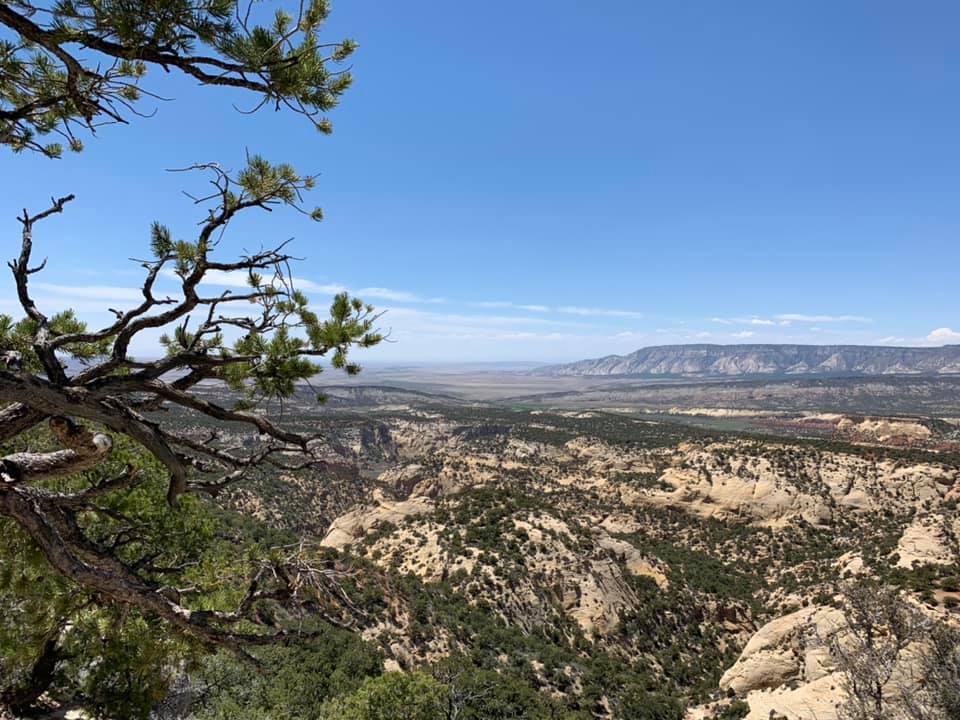
These thoughts danced through my mind as I stood atop the rim of a canyon, a thousand miles from home, in the high deserts of the Colorado Plateau, exposed and in the open; a danse macabre moving out of place in the desert setting of a Dali or Georgia O’Keeffe painting. I was struck by the silence of the scene, the extreme quietude that reminded me of many a hymn and prayer the Jesuits and Franciscans alike offered about finding God in all things. Nature certainly is God’s canvas, just as van Gogh understood it when he painted his own vision of that Creation, and just as I, a guy trying to understand grief had heard but never fully appreciated until I saw it for myself. The starkness of the desert, the browns, greys, and dusty oranges, seemed so different from the many shades of green, the vibrant spectrum of flowers that decorate the parks and gardens of my city. Yet it was there, in that environment, so far from home, that I felt drawn to. I’d been in the desert before, in Arizona, and found it lacking in beauty, seeming to be hostile, dangerous by nature, unbefitting for someone of my origins or health. Yet this desert, as alien as it was to me, seemed gentler in a way, less severe, more textured in its variety. Here where the Yampa River flows into the Green River, on federally protected land, the wilderness seemed to sing with all its resplendent harmony. Nature cried out on the wind as if to Elijah in a whisper, in its own language, its own song. I could recognize it, but I had a hard time understanding it. I, a city guy, knew only the manicured nature of my urban homeland. I knew the landscape that had been remade in the image of the Eastern cities and their European forebearers, a landscape of verdant trees and gardens which conquered the native prairie grasses in the wake of the settlers who conquered the native peoples who had called those prairies home.
I knew my home was artificial, and so it was not fit to help me through my sorrows. When she died, laying there on the veterinarian’s table, her face was calm, at peace; she looked as though she were having the best of dreams. Long suffering from a lack of tears, even when I wanted them, I felt as if I cried enough to fill the stormy Atlantic and more. She was my dearest of friends, the one who was always first to comfort me, the one who would go on adventures with me through the parks and along the trails. She was my companion at the sidewalk cafés, her with her water bowl and a couple treats, me with my tea and a pastry or two. Neither of our lives would’ve been possible without our artificial world, we were both born in an industrial, global, civilization, created out of the migrations of countless dogs and people from throughout the globe who would carry out a few begats until we were born in our own times. Yet even then, in her long life, her sixteen years of naps and treats and play, she saw our world change again from that industrial world of our forebearers into a world of the digital, a world where ideas were spread not on paper but on screens, where her favorite toys would inevitably come not only from the local pet shop and groomers, but often from some distant warehouse, a distribution center built to cater to the needs of millions, even billions of “consumers,” as we’d become known. To them, we were just numbers, her existence was acknowledged by the fact we purchased from the dog section, but her gifts inevitably were counted among my numbers. We’d created this world where if we really wanted to, and had the means, we could ensure that we would never wont for anything again. We’d created a world where instead of settling for the same old cooking shows that she loved to watch (she knew the names of all the foods), we could now tune into cooking shows from Europe, as I learned French, hoping she might pick those food words up too. I dreamed of a reality where we would always be together, where she would be as wonderful and dear a friend to my kids in the coming decades as she has been to me. Yet time marches on, and with it we age. Unlike Gilgamesh, I knew I couldn’t stop death, like the Swedish knight, I knew even if I kept the game going, eventually Death would reach checkmate, yet in my dreams at least she was still with me, still snoring next to me every night, still leading me from one blade of grass to another around the neighborhood as she sniffed for traces of her dog friends’ adventures.
In my dreams then, I hoped I might hear a familiar pattering of her paws on the rocks leading to the canyon rim, only to turn about and see her trotting over to me, tail wagging with glee. Perhaps a part of me truly believed if I went out into the desert, I might just see her again, if only in a greater clarity in my mind’s eye, in my memories. I stood there on the canyon rim, and listened to the silence, hoping dearly she was coming, wishing she could’ve seen that sight as I was seeing it that day. I could hear her snorting, and smelled that she needed a bath, something she was often proud of, though never appreciative of when she was bathed. Yet I knew, all too well, I wouldn’t see her again until I too had crossed the water, however distant that day would be. As much as I spent our days together worrying about the world around us, and what might well be beyond what we know, she spent those same days curious about few things, simple things, but most of all she was sure about love, and its importance and meaning. I understood it in those last moments before she died as she kissed my face for a final time. It was clear to me that as much as I could speak French when in Paris or Montréal, so too I could communicate with her, by letting her do “gross” things like jump on my chest and kiss my chin, or listen to her growl and whine at me, to let her have her say. I would reply each time, telling her “I love you,” and meaning it. Even if I was leaving the house to shovel the snow in the winter, I would look her in the eyes and say, “I love you,” so that she knew it well. She was as innocent as she was mischievous, her favorite game was running around the house with the end of a roll of toilet paper in her mouth, decorating the rooms and halls with that ribbon of white. It annoyed my family to no end, but I could see she was having so much fun doing it.
The desert, a place I traditionally thought of as dead, hot, lonely, seemed full of life, and while I could not see birds fluttering around the far rim of the canyon, I knew they were there. I could feel the breeze as if it were in part propelled across the chasm by the fluttering of many little pairs of wings beyond. It was as though they were singing their own hymn to being alive, to the radiant Sun in the blue sky, to the scrub and the rocks laid down there over millions of years. This place had seen many ages even before the coming of the first humans. To it, my little artificial urban island in the seas of prairie grass must have seemed both a cute human attempt at recreating nature in humanity’s own image, and a threat to the current vitality of the wilderness itself. Far overhead, the trails of passenger jets remained the only sign of the civilization beyond the canyonland before me. Sitting in those planes, focused on evading humanity’s worst bogeyman, a specter named boredom, the passengers surely didn’t notice what wilderness was below them, and if they did look out the windows, from 30,000 feet they would well have been at a loss to truly appreciate what they were speeding over on their way to the great cities of this country and beyond.
I thought of Elijah, hearing the Voice of God in the faintest whisper of the wind, and imagined what the Divine might say to me. Quickly though, unlike other daydreamed dialogues, I found myself at a loss for imagined words and banter, unsure of how to speak for such a concept as an omnipotent and omniscient God. Maybe then that’s the real beauty of Elijah’s experience, he heard God in a whisper because we humans can’t really understand what it even means to hear such a Voice. I tried fantasizing about it even more though, doggedly not wanting to give up too easily, and found myself afraid, scared at the idea of even hearing such words, the power and presence they would command would be the same that creates realities. The idea itself was but a micro fraction of a particle of a grain of sand when compared to the consequences of the Divine. My importance was duly minute, yet without my imaginations would I really recognize any of this? Would I hold out hope that my dog recently deceased would appear to me wanting to play there on the canyon rim knowing all I know about how this reality operates? In the great cosmic totality, I began to wonder how much her life really had meant. A little eleven-pound dog, who couldn’t put on a fierce face to anyone, or serve as much of a herder. If anything, she was best at being a friend, the best of friends.
If her life had any consequence, I realized, it was in loving everyone and everything she met, in that unblemished innocence, that unconditional affection for life itself. She served as a role model of sorts for all the rest of us, especially for me, having lived with her for so many years. Even someone as little as her could plant a seed of love and charity in the minds of others that one day could restore the Utopia that seemed lost to me at her death. I stood there as the day continued on, and through the setting of the Sun, and watched as Venus, the evening star, rose overhead, bearing behind it the curtain of darkness that is the twilight and eventual nightfall. I was soon laying on my back on the canyon rim, not caring about the dust or the bugs, just awestruck at the sights above me as one star after another appeared in the darkening sky. The ancients believed the dead could be found among the stars, though my own ancestors passed down a belief of an earthly paradise on an island of eternal youth, something which as skeptical and scientific our world becomes, I still find myself believing in. If for nothing else, that light in the darkness of even the emptiest of cloud covered nights has kept me warm company in my thoughts. From that far distant island I thought I could hear her calling, her bark and wagging tail inviting me to come, but in my own time, not too soon. Even in this most dystopian of days, I thought, tears streaming down my cheeks again like on the day she died, there is still hope to be found, utopia restored, after all behind every cloud glows the light of some distant star. I laid there looking up into the starry night, through my tears singing a song I used to sing to her, hoping, believing, knowing somewhere she was listening.
Someday, however soon or far, I knew I’d see her again, once the boatman calls upon me. Funny enough, for someone who enjoys life as much as I do, the simple belief that I will see my dearest and sweetest of friends again is enough for me to look forward to that reunion across the water on the far shore.
 Wednesday Blog by Seán Thomas Kane