
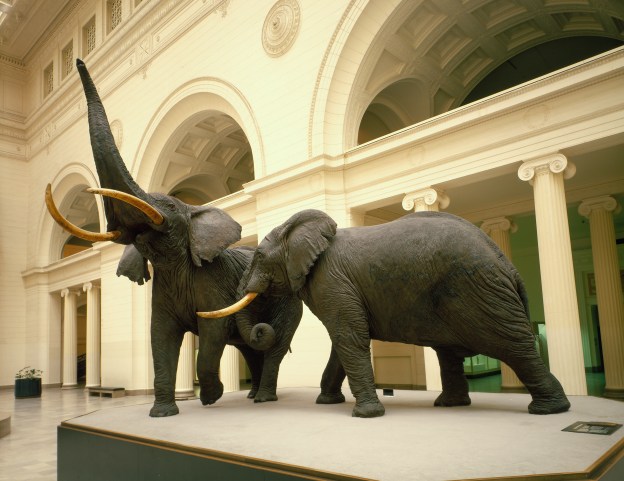
Photo Credit: Fighting African Elephants in Stanley Field Hall. Taxidermy by Carl Akeley. 41411 is on the left with two tusks and its trunk is raised. 41410 is on the right, with one tusk. © Field Museum of Natural History – CC BY-NC 4.0.

Elephant Tails – Wednesday Blog by Seán Thomas Kane
This week, some animalistic thoughts.
I wonder if the reason why we take our children to zoos and natural history museums to see the animals is because there’s a deep sense where we recognize our own animality? I still go to these places today, to revel in the same sense of wonder I felt at spying the animals, living and dead, that grace the halls and paths of these scientific institutions. For me and many others these are places where we were first introduced to wild things when we too were wild in our own way.
On Tuesday morning I made one of my regular visits to the Kansas City Zoo, to enjoy a cool late summer morning, and yes to see the animals who live there. I’ve come to appreciate more elements of these zoo visits the older I’ve gotten, where before I might love to see the lions and imagine them in the hunt; today, I admire the power, strength, and grace of their forms, and their wisdom at sleeping for nearly 20 hours per day. On this visit the African elephants were out on a morning buffet run through their long enclosure, while families and zookeepers gazed on from the footpaths that line the west side of the elephant enclosure. We didn’t stay long at the elephants on this visit, instead watching them as we passed by. These animals are intelligent and powerful and reflect some of the noblest values we cherish in our fellow humans in their own way.
Perhaps that is why we seek after collecting other animals and housing them in zoos while living or in museums after they are dead. Jay Kirk’s biography of Carl Akeley (1864–1926), the father of American taxidermy, described how on 24 June 1910, while on a collecting expedition for the American Museum of Natural History in Kenya and Uganda, Akeley was taken by surprise by a great bull elephant.[1] Akeley had the distinct impression that he “was being hunted as well, and was now engaged in a mortal contest with this bull.”[2] In the furor of the moment the safety of his rifle caught, after which he threw it aside and grabbed hold of one of the elephant’s tusks “as it lanced past him with the force of a sharpened swinging log.” Akeley held on between the two tusks as the elephant “plowed him into the ground,” and gored off part of his face, breaking enough of his body to convince the Kikuyu porters who joined his expedition 14,000 feet up Mount Kenya that he was dead.[3] Thankfully, Akeley wasn’t dead, and by the end of the expedition had gathered enough mammals to begin building his African Hall of Mammals at the American Museum of Natural History in New York where many generations of visitors have learned about these species in the century since.
I see an educational purpose to zoos and museums; they allow us to view these animals up close where otherwise we would have to travel to their native habitats or watch nature documentaries of their lives. These are places where the city dweller can explore the natural world in a controlled and comfortable manner. We demarcate ourselves from the rest of nature by our inventions and our buildings and our tool-use, yet other animals have been seen to do all these things in their own way. What sets us apart perhaps is that we build worlds meant only for ourselves in which we expect other species to exist on our terms. My parents didn’t buy new rugs for their house until after our last two pets, Noel the shih-poo and Kitty the American shorthair cat both died of old age, knowing that those two and our other dogs, cats, horses, goats, ponies, and even a turtle were going to do what they needed to when and where they needed to.
The same goes for these animals living in zoos: today they have enclosures that seek to mimic their native habitats, and to keep them busy and engaged in the thrill of life even while in captivity. Where once they were kept in cages, now they are housed in enclosures. The good people of Kansas City therefore are able to see Sumatran tiger, Red pandas, and Orangutans all in the same general vicinity of each other in the Asian zone of the Kansas City Zoo with minimal risk to life or limb. I say minimal because for all the efforts to contain the natural ways of these animals, we still have the human factor to consider.
In the last week I’ve read a fair bit on chaos theory, first devised by meteorologist Edward Lorenz in the 1960s to describe seeming anomalous elements in weather patterns. Lorenz defines chaos as having a “sensible dependence” which is inherently deterministic by its sensibility.[4] Chaos “appears to involve chance,” which can be statistically estimated, yet those results are mere estimates.[5] One might say that the size of the human species alone, all 8.2 billion of us, would be enough data points to fulfill the conditions for chaos. Yet even then, there is a finite number which can be calculated, so even the uncertainty of the human factor in building environments for safe encounters between the rest of nature and ourselves for the mutual benefit of all is not uncertain enough to fulfill the need for an infinitely large sample size required for chaos to exist.[6]
Perhaps then, the best way to try to quantify the roots of chaos in the human factor would be to attempt to quantify the countless thoughts of we 8.2 billion humans? I imagine it like filling Stanley Field Hall at the Field Museum in Chicago and the balcony galleries above it to just beyond the fire code maximum capacity and then trying to count the number of thoughts each individual there might have in a given moment. In order to safely move those people out of the building to avoid overcrowding you not only would need to coax each individual to move in such an unsafely large crowd, but you’d need to keep all of those individuals calm and compliant to avoid a panic and stampede. At the end of the day, we are all humans, and humanity is inherently animalistic. A chaotic system is one dependent less on external factors, the fire marshal on a bullhorn directing the crowd out the north and south doors, and more on interior changes in initial conditions.[7] External changes then are predictable, while the human consciousness remains a wonder and a liability in situations when too many of us are in the same place at the same time. It’s a real wonder that the 2016 Cubs World Series Parade, which saw 5 million of us humans gather along the route from Wrigley Field down to Grant Park, didn’t result in any casualties or fights. I’ve argued before that this event is a sign of the inherent benevolence of the human spirit, and that we evolved with good intentions first and foremost.
Here though we’re moving from my philosophical interpretation of a branch of mathematics into matters of theology; and that doesn’t feel like an appropriate direction to take this, so I am avoiding matters of faith this week. When done right our museums and zoos allow us to learn about the rest of nature at a distance, a safe distance for both ourselves and everyone else. With all I’ve read in the last few weeks about polar bears, I’d rather just view them at the zoo, or the standing bears frozen in taxidermic eternity behind glass at the Field Museum. They might appreciate meeting me in life during their summer fast, though that’s entirely irr-elephant.
[1] “Akeley Expedition to British East Africa (1909-1911),” American Museum of Natural History Archives, https://data.library.amnh.org/archives-authorities/id/amnhc_2000084.
[2] Jay Kirk, Kingdom Under Glass: A Tale of Obsession, Adventure, and One Man’s Quest to Preserve the World’s Great Animals, (New York: Picador, 2010), 220.
[3] Kirk, 221-222.
[4] Edward N. Lorenz, The Essence of Chaos, (Seattle: University of Washington Press, 1993), 8.
[5] Lorenz, 9.
[6] Lorenz, 10-12.
[7] Lorenz, 24.
 Wednesday Blog by Seán Thomas Kane