Tag Archives: English

The author on a blue background wearing Apple AirPods.

On Machinery

This week, for the penultimate post of the Wednesday Blog, how machinery needs constant maintenance to keep functioning.—Click here to support the Wednesday Blog: https://www.patreon.com/sthosdkane—Sources:%5B1%5D Surekha Davies, “Walter Raleigh’s headless monsters and annotation as thinking,” in Strange and Wonderous: Notes from a Science Historian, (6 October 2025).[2] “Asking the Computer,” Wednesday Blog 5.26.


This week, for the penultimate post of the Wednesday Blog, how machinery needs constant maintenance to keep functioning.


I am just old enough to remember life before the ubiquity of computers. I had access to our family computer as long as I can remember, and to my grandparents’ computer at their condo when we stayed with them in the Northwest Suburbs of Chicago. Yet even then my computer usage was limited often to idle fascination. I did most of my schoolwork by hand through eighth grade, only switching from writing to typing most of my work when I started high school and was issued a MacBook by my school. I do think that a certain degree of whimsy and humanity has faded from daily life as we’ve so fully adopted our ever newly invented technologies. Those machines can do things that in my early childhood would’ve seemed wonderous. Recently, I thought how without knowing how powerful and far-reaching my computer is as a vehicle for my research and general curiosity, I would be happy, delighted in fact, if my computer could conduct one function, say if it had the ability to look up any street address in the United States as a device connected to the US Postal Service’s database. That alone would delight me. Yet that is the function of not just one application on my computer but merely one of many functions of several such programs I can load on this device, and not only can I look up addresses in the United States but I can look up addresses in any country on this planet.

With the right software downloaded onto this computer I can read any document printed or handwritten in all of human history and leave annotations and highlights without worrying about damaging the original source. Surekha Davies wrote warmly in favor of annotating in her newsletter this week, and I appreciated her take on the matter.[1] In high school, I was a bit of a prude when it came to annotating; I found that summer reading assignment in my freshman and sophomore English classes to be almost repulsive because I see a book as a work of art crafted by its author, editor, and publisher to be a very specific way. To annotate, I argued, was like drawing a curly-cue mustache on the Mona Lisa, a crude act at best. Because of this I process knowledge from books differently. I now often take photos of individual pages and organize them into albums on my computer which I can then consult if I’m writing about a particular book, in much the same fashion that I use when I’m in the archive or special collections room looking at a historical text.

All of these images can now not only be sorted into my computer’s photo library, now stored in the cloud and accessible on my computer and phone alike, but they can also be merged together into one common PDF file, the main file type I use for storing primary and secondary sources for my research. With advances in artificial intelligence, I can now use the common top-level search feature on my computer to look within files for specific characters, words, or phrases to varying levels of accuracy. This is something that was barely getting off the ground when I started working on my doctorate six years ago, and today it makes my job a lot easier; just my file folder containing all of the peer-reviewed articles I’ve used in my research since 2019 contains 349 files and is 887.1 MB in size.

Our computers are merely the latest iterations of machines. The first computer, Charles Babbage’s (1791–1871) counting machine worked in a fairly similar fashion to our own albeit built of mechanical levers and gears where ours have intricate electronics in their hard drives. I, like many others, was introduced to Babbage and his difference engine by seeing the original in the Science Museum in London. This difference engine was a mechanical calculator intended to compute mathematical functions. Blaise Pascal (1623–1662) and Gottfried Wilhelm Leibniz (1646–1716) both developed similar mechanisms in the seventeenth century and still older the Ancient Greek 2nd century BCE Antikythera mechanism can complete some of the same functions. Yet between all of these the basic idea that a computer works in mathematical terms remains the same even today. For all the linguistic foundations of computer code, the functions of any machine burn down to the binary operations of ones and zeros. I wrote last year in this blog about my befuddlement that artificial intelligence has largely been created on verbal linguistic models and was only in 2024 being trained on mathematical ones.[2] Yet even then those mathematical models were understood by the A.I. in English, making their computations fluent only in one specific dialect of the universal language of mathematics making their functionality mostly useless for the vast majority of humanity.

Yet I wonder how true that last statement really is? After all, I a native English speaker with recent roots in Irish learned grammar like many generations of my ancestors through learning to read and write in Latin. English grammar generally made no sense to me in elementary school, it is after all very irregular in a lot of ways, and so it was only after my introduction to a very orderly language, the one for which our Roman alphabet was first adapted, that I began to understand how English works. The ways in which we understand language in a Western European and American context rely on the classical roots of our pedagogy influenced in their own time by medieval scholasticism, Renaissance humanism, and Enlightenment notions of the interconnectedness of the individual and society alike. I do not know how many students today in countries around the globe are learning their mathematics through English in order to compete in one of the largest linguistic job markets of our time. All of this may well be rendered moot by the latest technological leap announced by Apple several weeks ago that their new AirPods will include a live translation feature acting as a sort of Babel Fish or universal translator depending on which science fiction reference you prefer.

Yet those AirPods will break down eventually. They are physical objects, and nothing which exists in physical space is eternal. Shakespeare wrote it well in The Temepst that 

“The solemn temples, the great globe itself,

Yea, all which it inherit, shall dissolve,

And, like this insubstantial pageant faded,

Leave not a rack behind. We are such stuff

As dreams are made on, and our little life

Is rounded with a sleep.” (4.1.170-175)

For our machines to last, they must be maintained, cleaned, given breaks just like the workers who operate them lest they lose all stamina and face exhaustion most grave. Nothing lasts forever, and the more those things are allowed to rest and recuperate the more they are then able to work to their fullest. So much of our literature from the last few centuries has been about fearing the machines and the threat they pose. If we are made in the Image of God then machines, our creation, are made in the image of us. They are the products of human invention and reflect back to us ourselves yet without the emotion that makes us human. Can a machine ever feel emotion? Could HAL-9000 feel fear or sorrow, could Data feel joy or curiosity? And what of the living beings who in our science fiction retrofitted their bodies with machinery in some cases to the extent that they became more machine than human? What emotion could they then feel? One of the most tragic reveals for me in Doctor Who was that the Daleks (the Doctor’s main adversaries) are living beings who felt so afraid and threatened that they decided to encase the most vital parts of their physical bodies in wheelchair tanks, shaped like pepper shakers no less, rendering them resilient adversaries for anyone who crossed them. Yet what remained of the being inside? I urge caution with suggestions of the metaverse or other technological advances that draw us further from our lived experiences and more into the computer. These allow us to communicate yet real human emotion is difficult to express beyond living, breathing, face-to-face interactions.

After a while these machines which have our attention distract us from our lives and render us blind to the world around us. I liked to bring this up when I taught Plato’s allegory of the cave to college freshmen in my Western Civilization class. I conclude the lesson by remarking that in the twenty-first century we don’t need a cave to isolate ourselves from the real world, all we need is a smartphone and a set of headphones and nothing else will exist. I tried to make this humorous, in an admittedly dark fashion, by reminding them to at least keep the headphones on a lighter mode so they can hear their surroundings and to look up from their phone screen when crossing streets lest they find themselves flattened like the proverbial cartoon coyote on the front of a city bus. 

If we focus too much on our machines, we lose ourselves in the mechanism, we forget to care for ourselves and attend to our needs. The human body is the blueprint for all human inventions whether physical ones like the machine or abstract like society itself. As I think further about the problems our society faces, I conclude that at the core there is a deep neglect of the human at the heart of everything. I see this in the way that disasters are reported on in the press: often the financial toll is covered before the human cost, clearly demonstrating that the value of the dollar outweighs the value of the human. In abdicating ourselves to our own abstractions and social ideals we lose the potential to change our course, repair the machinery, or update the software to a better version with new security patches and fixes for glitches old and new. In spite of our immense societal wealth, ever advancing scientific threshold, and technological achievement we still haven’t gotten around to solving hunger, illiteracy, or poverty. In spite of our best intentions our worst instincts keep drawing us into wars that only a few of us want.The Mazda Rua, my car, is getting older and I expect if I keep driving it for a few years or more it’ll eventually need more and more replacement parts until it becomes a Ship of Theseus, yet is not the idea of a machine the same even if its parts are replaced? That idea is the closest I can come to imagining a machine having a soul as natural things like us have. The Mazda Rua remained the Mazda Rua even after its brakes were replaced in January and its slow leaking tire was patched in May. Yet as it moves into its second decade, that old friend of mine continues to work in spite of the long drives and all the adventures I’ve put it through. Our machinery is in desperate need of repair, yet a few of us see greater profit from disfunction than they figure they would get if they actually put in the effort, money, and time to fix things. If problems are left unattended to for long periods of time they will eventually lead to mechanical failure. The same is true for the machinery of the body and of the state. Sometimes a good repair is called for, reform to the mechanisms of power which will make the machine work better for its constituent parts. In this moment that need for reform is being met with the advice of a bad mechanic looking more at his bottom line than at the need of the mechanism he’s agreed to repair. Only on this level the consequences of mechanical failure are dire.


[1] Surekha Davies, “Walter Raleigh’s headless monsters and annotation as thinking,” in Strange and Wonderous: Notes from a Science Historian, (6 October 2025).

[2] “Asking the Computer,” Wednesday Blog 5.26.
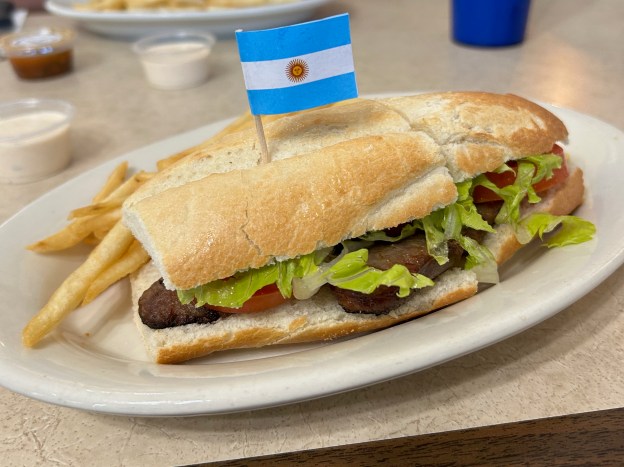

A choripán sandwich from Los Hornos Argentinian Flavors in Kansas City, Missouri photographed by the author just before it was eaten by the same.

On Language Acquisition

On Language Acquisition Wednesday Blog by Seán Thomas Kane

This week, how living in a culture is required to speak a language in depth.—Click here to support the Wednesday Blog: https://www.patreon.com/sthosdkane—Sources: [1] “A Letter from San Juan,” Wednesday Blog 3.29.[2] “The North American Tour,” Wednesday Blog 5.34.


This week, how living in a culture is required to speak a language in depth.


The languages which I speak are directly responsible for the ways my life has turned, its winding path a result of the words I use and the ideas they represent. Language is the voice of culture; it evokes the rich harmony of thought that comes from seeing things from certain points of view. At the University of Westminster, I was regularly in classes where there were maybe 10 or 20 languages spoken between each of the students, if not more. English remained our common language and the language of instruction, yet how many of us must have been switching between English and their own native language as they thought about the readings and topics in political philosophy and science which we discussed on a given day? Even then, my English is not the same as the King’s English, nor is it the same as the English I heard spoken when I drove through Alabama in July 2022. Language then reflects our individual circumstances of experience. Knowledge is gained through experience first and foremost, whether that experience be theoretical through books or practical through lived experience. I make this distinction because I often feel that when I’m reading a particularly well written book that I can actually imagine the characters as real people who I might meet in my life. The best TV shows and films are like that, their casts that we see regularly begin to seem like old friends who we look forward to visiting again and again.

Language acquisition is a lot like this for me. Today, I speak three languages: English, Irish, and French, and I can read Latin, Italian, Catalan, Spanish, and Portuguese and some Ancient Greek. I break my languages down into these two categories by their utility in my life. The handful which I can read are those which I’ve worked with in my historical capacity. I’ve spoken Italian and Spanish from time to time, yet those moments of elocution are few and far between. The same could be said for my German, though it’s now been five years since I last spoke that language in Munich, and at time of writing I can’t say that I’d be much use in remembering it today. This is even more true for my Mandarin, a language which I studied for a semester in between my two master’s degrees out of pure curiosity. I can remember the pronouns, a couple of verbs, and a noun or two but that’s about it. All this to say that I may know something about German and Mandarin yet it’s little more than a foundation for the future when I might be faced with a desire or need to learn the language properly.

I’ve been thinking lately that of any of these I need to work most on my Spanish, the most useful of these languages for me to speak here in the United States. I can understand Spanish fine yet speaking it remains a challenge. On Sunday evening after my shift I decided to reopen the Spanish course on the app Busuu––one which I used for Spanish before my March 2023 trip to the Renaissance Society of America’s annual meeting in San Juan, Puerto Rico––and try it out again.[1] That time I got through the A1 level before life got in the way, and I gave it up feeling frustrated with the process. I did not resume any online Spanish courses before my trip to Mexico last November for the History of Science Society meeting in Mérida, instead choosing the less preparatory method of winging it.[2] That worked with fits and spurts, my best Spanish conversations were in taxis with locals, though I was mostly thinking about how I would say things in French and then Hispanifying them based on my minimal knowledge of Spanish grammar. On Sunday, after I retired for the evening from my Spanish lessons on the app I realized what it was I missed so much in these apps: the human connection. Busuu prides itself on its crowd-sourced learning method; throughout the course learners are asked to submit spoken or written answers to the computer’s prompts which learners of other languages who speak the target language then correct. I like this system overall, and it does give this sense of community, yet I feel that it could go further.

After English, the second language I learned was Irish, my ancestral language. I started studying the Irish language when I was fourteen and have been focused on it to varying degrees for the last eighteen years. It really took until 2022 for me to connect with the language though, in spite of the fitful starts and stops because in that year I began to build a community around the Irish language. First on Zoom through Gaelchultúr, an Irish language school in Dublin, I met other speakers from across North America and beyond who like me were descendants of Irish immigrants old and new. I looked forward to seeing some of the same people term after term. Yet after returning to Kansas City, I began to look locally for Irish classes and came across the community that my friend Erin Hartnett has built at the Kansas City Irish Center. Through Erin I’ve met some really good friends and from our mutual appreciation for our ancestral language we’ve found a lot more in common from mutual histories to mutual appreciations for rugby. Without this community I would speak Irish but not terribly well. Now, not only do I speak Irish daily, but I also write in Irish every day. It has truly surpassed French as my second language, something I’m proud of yet not too concerned about when it comes to my Francophonic abilities.

French exists in a different sort of place for me than Irish. It’s not an ancestral language with deep family ties. Rather, it’s a language that I gravitated toward out of a fascination with French culture and history. I may have written here in the Wednesday Blog before that my first exposure to French came at sunset on a Sunday in February 2001 when my Mom put a “Learn French” cassette tape into the tape player in our family car when we were driving through the hills of northwestern Illinois toward Dubuque, Iowa. She and I were preparing for a trip to London and Paris that summer, the first European trip that I could remember, and she wanted to put in the effort for us to have some French before we arrived on the Eurostar from Waterloo Station at Paris-Gare du Nord. I didn’t like Paris much on that first visit, I found the language barrier to be too great for me to really feel a sense of connection with the place. On my next visit to France in March 2016 with three years of undergraduate French under my belt I found that I not only got the place more, but I appreciated the nuances of French culture more than I had as a child.

I owe a great deal to my undergraduate French professors M. Kathleen Madigan and Claudine Evans. It’s through their classes that I gravitated toward my career studying the French Renaissance. When I get asked why I chose to study the French I keep it simple and say it was a matter of pure convenience: I already spoke French, so I wouldn’t need to learn a new language (Spanish or Portuguese) to read my primary sources. That’s how I ended up studying André Thevet (1516–1590). I chose him because he happened to write about a sloth and for me the idea of being a sloth historian made me laugh. It’s as simple as that. I loved studying French in college, and even more teaching it with the online Beginner French course I built for the Barstow School in 2023 and 2024. I found that going through the same textbook I used a decade before I was not only teaching the students who in the future would go through my course, I was also renewing my own French education and learning things that I’d missed on my first go around. This is a critical point in language acquisition: few people are going to get a language on their first try, it’ll take multiple goes to understand what’s being said and to make oneself heard as well. It took me three tries to get Irish down, and the same is the case for Latin. Failure in the moment is merely a setback which can, and ought to be overcome in future endeavors. After all, remember that if we’re paying attention to our lives we’ll learn from our experiences.

I grew to really embrace a lot about the Francophonie to the point of paying Sling TV for access to TV5 Monde, France’s global TV channel which now broadcasts several different channels. I personally enjoy TV5 Monde Style, which tends to broadcast documentaries and cooking shows, though I don’t watch it as much as I might like. I read a lot of French books for my research, after all I work with source material that has largely only been written about in French and to a lesser extent in Portuguese. I am able to do what I do with those sources because I can read them and the secondary literature about them in French. All this made it all the easier for me to go to France and Belgium in the last several years and be able to switch from English to French as soon as I walked off the plane. I found when I was flying back to the United States in June 2024 after spending about a week speaking mostly French in Paris that I was consistently responding with the quick phrases “please, thank you, you’re welcome,” and the like bilingually with the French followed by the English as I’d heard so many people do in shops and the museums during that visit. It took me a while to get past doing this and just say things in English again after I returned.This then is why I think I’ve had so much trouble with learning Spanish. It’s the first language that I’ve given a big effort to learning outside of a classroom on my own. At least in the classroom you have fellow students around you to practice with. When you’re on your own you’re on your own, a wise-sounding craic which is to say that when alone you have no one else to talk with. I have friends here in Kansas City who speak Spanish, and I know all I have to do is ask, yet it’s finding the free time to sit down with them and work on it that I need to figure out. To truly gain a footing in a language one needs to immerse oneself in the culture. Apps and online learning will only take you so far. A classroom learner will blend into their own classroom idiolect of the language in that particular space where it exists in their life. Only if they move beyond classroom and begin to converse and live with people in places where that language is spoken will they begin to speak it in a manner which is more recognizable to native speakers.


[1] “A Letter from San Juan,” Wednesday Blog 3.29.

[2] “The North American Tour,” Wednesday Blog 5.34.


On Names

Season 4 Finale: This week, to celebrate Christmas I’ve decided to write a bit about naming conventions that I’ve come across, and to explain why I use my full name professionally. Nollaig shona daoibh | Merry Christmas! — Click Here to Support the Wednesday Blog: https://www.patreon.com/sthosdkane


Season 4 Finale: This week, to celebrate Christmas I’ve decided to write a bit about naming conventions that I’ve come across, and to explain why I use my full name professionally.


In American culture middle names have a bad reputation. They’re most famously used in our childhoods to scold us, and in adulthood they most often appear in legal matters. A writer naming non-descript American characters John Booth or Lee Oswald might get away with it but include their middle names Wilkes and Harvey and you have two of the most notorious assassins in American history. Most accused or convicted murderers in our legal system tend to be known in the press by their full names: first, middle, and last. There’s an odd cadence to it when these people are identified by the police or the courts. It’s one of the more common times when middle names get used.

I go by my full name professionally. On my website, in my email signature, and in every conference program and academic publication that I’ll ever appear in I’m identified as Seán Thomas Kane. Trust me, I didn’t intend to draw any connection between myself & the men mentioned in the last paragraph who killed two Presidents who I’ve always looked up to. In my case, the use of my middle name has a different sort of significance. In my extended family I often get called Seán T., in part because I have many relatives who are named Thomas, one of whom goes by T. among the family. Whether intentional or not, my parents gave me one of the most traditional Irish names they could have. Irish names are traditionally patronymic, meaning the person is so-and-so, son or daughter of so-and-so, descendant, son, or daughter of so-and-so. Those last names (or surnames if you aren’t American) that begin with O’ refer to families who are descended from a specific person who lived centuries ago. The ones that begin with Mc however are Anglicizations of the Irish word mac, meaning “son” of a specific person who lived centuries ago. My father’s name is Thomas, so in Irish my name is Seán mac Tomás, or Seán, son of Thomas. Kane is an Anglicization, or better an English phonetic rendering of the Irish name Ó Catháin, pronounced two different ways depending on where you’re from in Ireland (for those reading this, listen to the podcast to hear those two pronunciations.) Cathán was a more common Irish given name in the Early Middle Ages and derives from the word cath meaning battle.

This was in the back of my mind when I decided to start going by my full name professionally. It was 9 March 2016 and I had a few hours without much to do while waiting for a car to pick me up at Lyon-Saint-Exupéry Airport on my way to the eastern French city of Besançon, the capital of the Franche-Comté region and a city which Caesar mentioned in his book about the Gallic Wars (De Bello Gallico 1.38). That cold and rainy Wednesday in March there was a national railway strike in France and I ended up booking a back seat of a Renault Clio driven by a Frenchwoman who spoke little English alongside two other Frenchwomen who again spoke little English from Saint-Exupéry Airport outside of Lyon to Besançon, a good 4 hour drive. Right before they arrived though, I was on Facebook posting an update about my trip and thinking about how I wasn’t entirely sold on sticking with Seán Kane as my name professionally, after all when you search Seán Kane on Google you get a fair handful of results. There on Facebook I noticed that my friend Luis Eduardo Martinez, a fellow graduate student in International Relations and Democratic Politics at the University of Westminster, and a gentleman who I consider a good friend to this day, used his middle name professionally. I felt inspired and changed my name on my Facebook profile from Seán Kane to Seán Thomas Kane then and there standing in the airport parking lot.

Where the last paragraph took place.

This proved to be even more advantageous when the Renault carrying the three Frenchwomen arrived as the driver stepped out and proved that the way Seán is spelled makes little sense to a monolingual French speaker. I remembered when I started studying French at Rockhurst University and we chose French names to use in class how I immediately was discontented with being called Jean alone, as I’d rather be called Jean-Thomas because that’s essentially a French translation of my name coming from Irish. So, I suggested that she call me “Seán-Thomas” which was heard as “Jean-Thomas.” Et voilà, that’s how it all got started. For the record: the Irish name Seán is in fact just an Irish spelling of the twelfth century Norman French pronunciation of that French name Jean, which is also the source of the English name John. You can hear the connections better in an English accent than in my own American one where the oh sound in John has shifted closer further forward in the mouth.

This wasn’t the first time I’d changed my name on my Facebook profile. For a while in high school, I went by my Irish name, Seán Ó Catháin, and that was the name on my early membership cards with the Ancient Order of Hibernians. Yet as much as I was inspired by the Gaelic revival and wanted to do my part to restore our ancestral language, I found that it was impractical to use in America and that deep down I do identify more with Kane than Ó Catháin because that’s the name my grandparents, my dad, and most of my paternal relatives use. Kane itself began as a misspelling by the U.S. Army draft sergeant processing my great-grandfather Thomas Keane when his number was drawn in 1918. He enlisted and served as an artilleryman in France and eventually became an American citizen as Thomas Kane because the sergeant told him if he wanted that first e added back into Keane on his papers he would have to go back to the back of the line and start the process over again. 

So, to answer a question I often get in Kansas City: no, I’m not related to any other Kanes in this city except my Dad, and in fact outside of my Dad and his brother’s family all of my living paternal relatives who share our family name on either side of the Atlantic spell it Keane. I suppose I could change mine back to that one, I suspect my granddad’s cousin and longtime Wednesday Blog reader Sr. Mary Jo Keane would’ve approved of that, yet at this point the name dispute feels moot especially considering the Keane spelling only goes back another generation or two to about the 1850s before which in the official British government records written in English my great-grandfather’s great-grandfather’s name was written as Thady Caine. In Irish his name would’ve been Tádhg Ó Catháin, and we know he spoke Irish as his first language. So, what was his name? I’m honestly not sure.

I like how different naming conventions reflect different cultures in their own ways. Our Irish patronymic system is really more Gaelic than Irish, after all it’s the same system that’s used by our Scottish Gaelic speaking cousins and it mirrors a very similar system used in Welsh. In fact, my Welsh ancestors’ family name was Thomas, which derives from the Welsh ap Tomos. Fitting, eh?

When I teach about the Vikings I like to bring up the Norse patronymic system too and explain that Leif Erikson (as we call him in English) was actually Leifr Eiríksson in Old Norse, and that following this tradition as it’s today practiced in Iceland were I born there, or should I someday immigrate to that island republic I’d probably start going by an Icelandic version of my name: Jón Tómasson, dropping the Ó Catháin/Kane family name all together in regular use there to better fit Icelandic society while still retaining it outside of Iceland. I see this as similar to how patronymics are used in Russian, where Tolstoy’s tragic character Ivan Ilyich is known by his first and middle name and not by his first and family names Ivan Golovin as we’d do in the English-speaking world. There, for the record, Seán mac Tomás would translate as Иван Томасaвич (Ivan Tomasavich).[1] In a hypothetical blending of cultures where Irish speakers interacted more with French speakers in North America than with English speakers I could see our patronymic system developing into the French system of having double names, thus why when I still published a French translation of my C.V. I would write my name as Seán-Thomas with the hyphen which I don’t use in English.

Another set of naming systems that I’ve encountered that I appreciate are those originating on Iberia where the family names of both the mother and father are included. My same friend Luis Eduardo Martinez’s full name, and the name I first read when I met him in September 2015 is Luis Eduardo Martinez Mederico. In this Spanish naming custom, his father’s family name appears first followed by his mother’s family name. This is opposite to the Portuguese where the maternal family name precedes the paternal one. So, in the Spanish custom my name would be Seán Thomas Kane Duke, while in the Portuguese custom it would be Seán Thomas Duke Kane. My parents and I actually refer to our family as the Duke-Kane Family, and we’ve joked about what my life would’ve been like if I’d been given both family names at birth in that order. I often conclude that including the East Yorkshire name Duke alongside Kane would’ve made me sound more English.

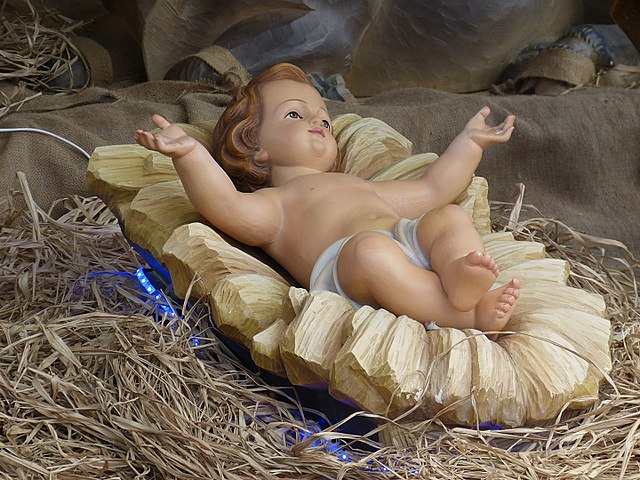
Then there are the professional names like Smith or Miller. These derive from the first bearer’s profession, so Jefferson Smith had an ancestor somewhere in the distant unwritten past of that Frank Capra film’s imagination who was a blacksmith. Today, on Christmas, we celebrate someone who has such a name, that being Jesus. I get annoyed with my fellow Americans who see “Christ” as Jesus’s last name because it’s not a name at all but a title in the first stage of becoming a name. This name as we understand it ought to be written in English as Jesus the Christ, from the Greek Ἰησοῦς Χριστός through the Latin Iesus Christus, but that word Χριστός is merely a Greek translation of the Hebrew word māšiah (מָשִׁיחַ), which again is usually rendered in English as Messiah, the name of Handel’s most famous oratorio and what Brian certainly wasn’t (he was a very naughty boy.) This is a kingly title, fitting with our view in Christianity of Jesus as priest, prophet, and king appears most prominently this time of year in the Feast of Christ the King, something we celebrate in the Catholic Church at the Liturgical New Year, which was 24 November this year.

Jan van Eyck’s depiction of Christ the King from the Ghent Altarpiece (1426)

A brief digression here: this past Feast of Christ the King I learned that the official name of the day is the Solemnity of Our Lord Jesus Christ, King of the Universe. While that last title might sound overly grandiose in the twenty-first century it actually comes from Ancient Mesopotamia, where the most powerful monarchs of those city states as far back as Sargon of Akkad (r. c. 2334–2284 BCE) claimed this as their imperial title: šar kiššatim, which actually meant King of Kish, the primate of all Mesopotamian cities and according to the older Sumerian King List it was the first city to crown its kings following the Great Flood. So, in essence this title places Jesus, a humble carpenter who was incarnate as God the Son as the true “King of Kings (forever, and ever) and Lord of Lords (for ever and ever)” to quote from the Handel.

Now, back to that rendering Christ as Jesus’s last name. In his lifetime, Jesus was known as Jesus of Nazareth, and in earlier times Christians were known as Nazarenes (Acts 24:5). This word is still used to describe Christians in Hebrew in the form notsrí (נוֹצְרִי) and in Arabic with naṣrāniyy (نَصْرَانِيّ). Thus, he was known more by a locator name than by a last name in the modern American sense. Furthermore in John’s Gospel, St. Philip referred to Jesus as “Jesus, son of Joseph, from Nazareth.”[2] So, in the culture in which Jesus was born he would’ve been known most fully in this way rather than with any last name that we may recognize. It’s important to remember that Jesus’s ministry took place 2,000 years ago, and contrary to some popular belief he didn’t speak English. English wasn’t even a language then, though an older form of Irish was around, just probably not heard as much in Galilee or Judaea.

So, let me conclude with the bits that seem to have started as identifiers that came at the end of people’s names before there were family names in the sense that we use them today. These are often locators of where the person in question was from. In the case of Leonardo da Vinci, da Vinci merely refers to the fact that Leonardo was born in the Tuscan commune of Vinci. These particles of place tend to denote nobility in some names, see the French, Spanish, and Portuguese de, the Italian de’ and di, and the German von. However, I see the utility in having this locator in someone’s name to make it clear that even though they’re a Booth they’re not related to every other Booth around. That way a random John Booth living in 1865 would’ve had less trouble because of his more infamous counterpart’s scheming that Good Friday. I’d ask though, in my own case whither would such a locator in my name identify? Where would it refer to? Would it stick just with me, saying that my original hometown is Wheaton, Illinois, so I’d be Seán Thomas Kane of Wheaton? Or would it go back to the origins of my particular Kane/Keane/Caine/Ó Catháin family in the Derryhillagh townland outside of Newport, County Mayo, in Ireland? In Irish the way this would be written would either be with a different Irish preposition ó (yep, there are at least two of these), or with the preposition as. In my Irish as I speak it, I say as in this context more than ó, as in to say “Is as Meiriceá mé,” or “I am from America.”

We don’t do these in Irish names, in part because of our patronymic system which does a fine job on its own. Sometimes when I’m writing stuff in Latin and I want to adopt the style of the Renaissance humanists who I read in my research I’ll try to Latinize my name with one of these locators, rendering my hometown of Wheaton, Illinois by using the name of the Roman goddess of what, Ceres, and essentially making a town name from there. Thus, Wheaton becomes Ceresia. The tricky thing is that when I’m translating my name into Latin, something that was done in academia more into the nineteenth century but is almost never done today, I have a conundrum of whether to start from Kane or from Ó Catháin. I for one don’t like how a Latinized Kaniussounds, so instead I do go from Ó Catháin and use Cahanius, or Ioannes Thomae Cahanius Ceresius in full.

Names are important, and they say as much about the person who bears them as the people who named that person and the culture to which they belong. I’ve played around with my own name a fair bit, as you’ve seen. Today I’m more used to being called Seán-Thomas in French than in English, though the latter has happened more and more. I’ve even noticed that people have started calling me Thomas seeing that name and recognizing it faster than they do Seán, especially with the fada on the a. I smile and acknowledge them, after all I’m happy to be mistaken for my Dad. Looking forward, should I be fortunate enough to name my own children I’ll say these two things: first I’m not the one who’ll be pregnant with them for nine months, so I shouldn’t get first call on their names, and second there’s that Irish tradition that offers a simple answer to this conundrum. Will my first-born son be named Thomas as well then? Yeah, maybe. We’ll have to wait and see how this poorly named lifetime membership with one of the dating apps works out for me. I certainly hope I’m not putting my name out there for the rest of my life, though you can bet I’ll be using that lifetime membership joke for as long as I can.

Nollaig shona daoibh a léithoirí rúin! | Merry Christmas, dear readers!


[1] NB: I’m using Russian as the example here because that’s the one I’m more familiar with. No political inclinations toward the Kremlin in their invasion of Ukraine are intended.

[2] John 1:45 (New American Bible), see more here.


Our First Languages

Last week, I listened to an essay from the New York Times Magazine about the possibility that one might lose their first language if they use another too much. Today then, I write to my own experience in this matter. — Click here to support the Wednesday Blog: https://www.patreon.com/sthosdkane

Last week, I listened to an essay from the New York Times Magazine about the possibility that one might lose their first language if they use another too much. Today then, I write to my own experience in this matter.


We choose how we sound to the extent that our physical bodies can allow. This means that our voices and body language can change as we move between environments and groups. I’ve seen this, and even noticed it in myself. My jokes change depending on the setting for one, yet also my tone and accent will deviate to the slightest degree when I move from one group to the next. This change is all the more dramatic when I’m speaking a different language to any significant degree. Last October, when I was in Brussels and Paris, I was speaking French far more than English. On two occasions when I met with friends who I normally speak with in English, I noticed something strange was happening to my voice: my accent was dulled. 

I like to compare the human voice to a pen, in the right hands and with the right training it can move with fluid precision. When at my best moments I can glide in and out of a series of registers with ease and use those different registers to accentuate the point I’m making. You’ve heard some of this here on the Wednesday Blog, those who listen to the podcast that is. The range of sounds I can make is far broader than the mere 26 letters of the English alphabet; this is thanks to my experience speaking other languages, French and Irish in conversation, and to the years of singing Latin hymns at Mass and practicing reciting Ovid and Virgil in my high school Latin classes. I can make myself understood in German, Italian, and Spanish as well if needs be, thanks to the other four I’ve spoken most frequently.

So, at those two dinners, one in Paris and the other a few days later in Brussels, I found that the usual fluidity of my speech was lacking, that I couldn’t quite make all the sounds I usually can. It occurred to me then that speaking French so much had made it harder to switch back into English after all the exercise that my vocal muscles had parler français produced different results to my usual practice speaking English. The author of the essay in the Times Magazine, Madeleine Schwartz, writes about losing recall of one language as much as the physical difficulty of making the sounds not made in the language, she uses the most. For her, the American English r sound was especially challenging after saying the French r so often. For me, my version of the French /ʁ/ is in fact an approximation that I make based on the Irish /ɣ/ sound as in the word dhá, a variation of the number two. These two sounds are approximates of each other, the French /ʁ/ is an uvular fricative while the Irish ɣ is a velar fricative. This means that the French /ʁ/ is produced further back in the mouth than the Irish /ɣ/. Still, my American English /r/ becomes a challenging sound to make when I’ve been saying /ɣ/ or /ʁ/ all day.

On top of this, I’ve steadily worked on mastering another r sound, the trilled r sounds. I say sounds because there are a variety of these that an individual speaker can make depending on where on the tongue you produce the sound. I can make three of these sounds, one which is more of a clipped r that I picked up from Peter Cushing’s performance as Grand Moff Tarkin in the original Star Wars that I think of as more high-brow stage English, the second is a fuller trill, scientifically called a velar fricative, not quite at the tip of the tongue that I use at the beginnings and middles of Irish words, and in Latin and when I’ve spoken Italian and Spanish, and the third is a wisping of air just beyond the tip of the tongue that I use to make the r sound at the ends of Irish words. This last r is called a palatized fricative. These have all taken practice to learn and even more practice to begin doing on a regular basis. Again, I chose to speak the way that I do, and to change registers when I am speaking to a public audience, what you hear here, compared to when I’m speaking with family and friends.

I find that the letter r is important for getting down any accent, because it is so particular to each. It’s a sort of in-between sound that is a consonant yet can act like a vowel in some ways. It’s perhaps fitting then that this same Irish velar fricative ɣ is spelled dh, a digraph which is also pronounced in my Irish as the schwa vowel, /ə/. In my speech, I want to be understandable to my audience, yet also express an aspect of myself in a way that will appeal to that person. While my first language is English, my own urban Midwestern variety of it, my experiences and travels have transformed my idiolect into something that transcends regional boundaries now with bits of London and the Northeastern American English accents that I’ve been exposed to filtering in alongside the ways that my family and community here at home talk amongst ourselves.

One question I still have, one which I’ve pondered for years, is does our modern code switching reflect the abilities of our prehistoric ancestors and perhaps the early evolutionary history of language and human speech? Are other animals able to change how they communicate to reach the widest possible audience? It’s notable to me that a great deal of evidence shows that adult domesticated cats only meow to humans, a vocalization they normally only make as kittens to their mothers. So, in the cat’s meow we hear a conscious change in vocal expression intended to get whatever they’re feeling or thinking across to us. Had I not become a historian, I would have probably chosen to pursue anthropology, focusing on the evolution of human communication and human language.

What do you think about this? Do you intentionally change how you speak to be understood by specific audiences? Let me know in the comments on this blog post at wednesdayblog.org, or on the social media platforms where I share this: Facebook, Instagram, LinkedIn, and X (formerly Twitter). You can also share your comments on the Wednesday Blog Patreon feed where I share these blog posts with more of an introduction from me and a bit before they go onto the social media channels.


A Matter of Grammar

This week, after going down the rabbit hole of the Chicago Manual of Style's monthly Q&A newsletter, I thought I'd talk a bit about grammar. — Click here to support the Wednesday Blog: https://www.patreon.com/sthosdkane


This week, after going down the rabbit hole of the Chicago Manual of Style‘s monthly Q&A newsletter, I thought I’d talk a bit about grammar.


One of my favorite newsletters to read is the Chicago Manual of Style‘s monthly Q&A email which tries to answer some pressing questions regarding the English language in this particularly formal academic setting that I often write in professionally. We historians in the United States use the Chicago Manual of Style as our main style guide, both for its system of extensive footnotes and for its grammatical rules. I am familiar and have used several other systems, including the AP Style Guide, and the MLA, APA, and Harvard citation systems, yet my preference remains Chicago for its clarity. Chicago is the preferred style guide for us historians as well as the basis of the style used by the American Anthropological Association.

English is an unusual language in that we don’t have a single central authoritative language academy as does French, Spanish, Irish, and German. Our best bet is to see what our two major dictionaries say: the Oxford English Dictionary and the Merriam-Webster Dictionary. The former is the standard in the United Kingdom and throughout the Commonwealth, while the latter is the American standard developed first during the Early Republic when its initial author Noah Webster sought to better differentiate American English from its imperial counterpart, the better to craft a specifically republican national language fit for our young Union. I’ve had my problems with Webster’s dictionary for a while now in part because I don’t see the point of most of his spelling reforms, and for a good part of my teens and twenties I used British spellings over American ones. Today though, I’ve reverted to the American standards in what might well be a sign of my general weariness of the constant fight over so many different topics and issues; this was one that fell by the wayside.

This month then, the Chicago Manual‘s Q&A included a question about whether it was fine for an academic writer to write in the first or second person, to use the pronouns I and you. We are taught to always restrict our writing to the third person, to avoid the subjectivity that is implicit in the first person. I’ve begrudgingly accepted this, to the extent that amid the 96,276 words that comprise the ninth draft of my dissertation only three of those are the pronoun I. All three instances where I drift into the first person are in the footnotes where it is necessary to explain my decisions regarding certain translations or connections that would otherwise not be possible in the English language. By contrast, I use this pronoun a great deal here in the Wednesday Blog, where I am writing to you, dear reader, in a more personal manner that I hope is evident in this text. Of the 189,993 words that I’ve written for the Wednesday Blog before this week, 3,360 of those are the pronoun I.

The response in the Q&A about using the pronoun I spoke to that concern for subjectivity, yet also spoke of a need that our academic writing ought to be “more lively and personal.” I see both sides of this, more and more books written by my fellow academics do include more of the first person in them, yet at the same time Kate Turabian’s writer’s manual––an abridged version of the Chicago Manual––suggests that writers “avoid beginning your sentences with I believe or I think (which go without saying).” I am often frustrated to hear people use fillers like these, or like “it goes without saying,” or “to be honest,” when those are things I hope they would be adhering to in the first place. On the other hand, I’ve heard papers at conferences where the author reads out “this author finds that _____,” which sounds ludicrous. Two weeks ago, at the Renaissance Society of America’s conference I did make it clear where I was presenting my own theories based on the evidence that my primary sources provided. A spoken context is different than a written one, not only can there be more repetition of material to bring a point home, one can also use more personal elements, bring oneself into the topic and show the audience why they ought to care about it the way you do.

Academic writing is quite formal, and it follows set patterns and standards. It is in many ways an intricate dance, whether a waltz or an older minuet, which we follow in order to write to one another in the same methods and manners that we will all recognize. One may want to deconstruct some of these Elements of Style, to borrow a title, yet those standards exist to facilitate communication. Language proscription has its place along with all the innovations that happen each and every day in speech and writing. I might use this pronoun more in my academic writing in the future, especially if I choose to write a prologue which tells my reader why I am fascinated by a topic that will invite them to consider it as well.

I would like it if there were an English Language Academy in the same vein as the Académie Française, yet I would prefer to have a say in its decisions. Is that bold of me, sure. Yet that academy’s function is best served by the continued writing and publication of those of us who use the English language to express our thoughts on a daily basis. For every article or book I submit for publication about the history of animals in the Renaissance there will be countless other works published in all manner of settings which demonstrate the versatility of this language and its uses. We academics have just as much a claim to it as anyone else, and my own English is not everyone’s English. Still, we have our common grammar that keeps this language together, and that is something worthwhile.


Corrections

3 April 2024: Soon after publication, I corrected this week’s blog post for grammar, naturally.

Lost in Translation

This week, I talk about my experiences as a translator. — Click here to support the Wednesday Blog: https://www.patreon.com/sthosdkane

Over the last three years I have consistently worked in the background of my dissertation research and all the other things I’m doing, including this blog, on translating one of my dissertation’s most important primary sources from Middle French into Modern English. That book, André Thevet’s Les Singularitez de la France Antarctique was initially published in 1557 and then translated into English only 11 years later in 1568 by a man named Thomas Hacket. However, since 1568 Hacket’s translation has been the only one that English-speaking readers wanting to explore Thevet’s Singularites have had available to them. 

There are some partial translations out there, most notably Roger Schlesinger and Arthur Stabler’s 1986 book André Thevet’s North America: A Sixteenth-Century View, yet Hacket’s remains the only full translation into English. So, not only is the work I’ve been doing helpful for my own research, yet it is also groundbreaking in reopening that dusty door that leads into Thevet’s life and work for a great many English-speaking readers and scholars. It’s my hope that people find my translation of The Singularites of France Antarctique both useful and fascinating to read, as it offers a window into a worldview that in some cases makes sense while in others appears far out of place in our own world.

I have always had a fascination with and love for languages. As long as I can remember I’ve had memories, and many of those memories are of long hours engrossed in one language or another, like many of my relatives taking watches apart to see how they work I often do the same with language, learning how each grammar and mode of thinking developed in a common lineage and dialogue with its neighbors and relations. My own language studies began with Latin, which I first tried to learn 20 years ago as a 10 year old, though it wasn’t for another four years until I started high school at St. James Academy that I really began to understand what I was looking at. Around the same time, I also started studying Irish in the evenings at the Irish Center of Kansas City. Both languages are ones that I still study, and enjoy reading, speaking, and writing. 

In the years since, I’ve learned French to a level that when I’m there I can go about my life in France without using English. Translating Thevet’s Singularites has really helped with that, as three years of intense reading of his Singularites really gave me a strong impression on how French, albeit in an older form, works. One of the big differences with my translation of the Singularites is that I took a lot of time to consult page-by-page several modern Portuguese translations of his work published in 1978 by Eugenio Amado and in 2018 by Estêvão Pinto. Thanks to their common Latin heritage, and to the general use of Spanish around me for much of my life, I find reading Portuguese and Spanish to not be very difficult at all. 

There are languages out there which I can read, and to a degree write in, but cannot speak very well. Portuguese and Spanish fall into this group, as does Ancient and Modern Greek. I studied Classical and Koine Greek, two ancient variants, in high school and college at Rockhurst, yet I just don’t have the training or experience with either forms of Greek to be as comfortable or confident in Greek as I’d like. Eventually, I do want to spend the time to learn Ancient Greek as well as Biblical Hebrew, yes at some point I’d like to study the Bible in the way that I’ve studied the works of the humanists from the fifteenth and sixteenth centuries.

I’ve also here and there studied Bulgarian, Mandarin Chinese, Māori, and Egyptian Hieroglyphs. Again, all of these came out of pure curiosity on my part, and while I’m unable to speak the first three or properly read the latter, I do know a thing or two about each. Thanks to my work with Bulgarian, I can read the Cyrillic alphabet, and I do remember a few things, though I haven’t used any of it in quite a while. During the opening ceremony of the Beijing Winter Olympics last year, I ran through what I could remember from my Mandarin Chinese class in the Spring semester of 2017, and found that I still had the pronouns, some verbs, and a handful of nouns, which was more than I expected. In past years I’ve found I can make out text in various Polynesian languages because of the time I spent in 2014 and 2015 learning about how Māori works. Egyptian Hieroglyphs are another animal. I found my curiosity with Ancient Egypt reignited in the Summer of 2019, and pursued the task of learning how to read this most ancient of script with a passion. I can make out some characters, and I remember a fair bit about how the various forms of the Ancient Egyptian language fit in with its Coptic descendants.

Last week, I found myself reading about the Coptic language and its various dialects. I was most interested in how older pharaonic Egyptian place names and terms had survived the millennia into the Coptic that persists today in Egypt and among the Coptic diaspora. It struck me how because the Coptic alphabet is modeled after Greek, I could read most Coptic words, and where there were unfamiliar letters all I needed to do was look to the Demotic script used alongside the more formal Hieroglyphs, and I’d find the source of those letters. Each of these languages are vehicles for the perspective of a particular people at a particular time and place in the long human story. They allow us to get closer to understanding how other people see their own world, and their place in it.

Thevet often referred to his own people as “Christians” and less frequently as “our Europe.” He lived at a time when the older idea of Christendom––comprising of Syriac, Greek, and Latin churches that traced their roots back to classical antiquity––began to fade away with the triple influences of the collapse of the last vestiges of the Roman Empire in Constantinople, the Protestant Reformations, and the beginning of the First Age of Exploration. This Christendom steadily became known in the sixteenth century as Europe, and eventually with the establishment and flourishing of transoceanic European settler colonies as the West. Reading Thevet’s works, looking through his eyes, I now understand how he saw his own world at least a little better.

Contemporary English

This week, I'm proposing that we've entered a new period in the history of the English language.

Could it be good for us to start thinking about a new period in the history of the English language? A bold question if ever there was one, after all that would imply that we’ve moved past Modern English and into something that could potentially be “Postmodern”? Heaven forbid I go into “post-this” and “pre-that”, things which we academics love to play with on a daily basis in our writing. I’d argue that we may well have moved past “Modern English” as it has been known for the last five hundred years, since its birth in the Renaissance, and into something new. This change isn’t dramatic, it’s been happening over a very long time; even though English has been in its modern phase since the sixteenth century, it’s continuously evolved with each passing generation.

So, what makes today any different than yesterday? Why make the break here between Modern English and whatever we’re going to define the next period of English as? I’d argue this is in large part because of the influx of a great many more voices speaking and writing in English than ever before. Not only is English now a global language, spoken by hundreds of millions of people around our planet, but it’s become one of only a handful of languages through which most global affairs, whether economic, political, or social, are conducted. English is influenced by the introduction of popular words like woke just as much as it is by the theorizing of scholars like me trying to invigorate those ancient Germanic and Latinate elements still living in the fibers of our tongue.

My own native form of English, American English, is a great example of how the language is changing. I argue that one of the main reasons why many American English speakers differ in their phonology and word choice from both the old colonial Americans of the East, as well as our English cousins across the water, is because we have far more ethnically diverse immigrant elements in our English. There are hints of the Irish, Finnish, Flemish, Swedish, and Welsh in my English that my ancestors spoke, just as there are traces of the German that many the immigrants who settled in my native Midwest spoke. Our ancestors may have spoken “broken English” when they first arrived, but that broken English has become our English, another thread in the beautiful and diverse tapestry that is this most diverse of languages. 

Yet alongside the influx of new words, and ways of expressing ideas that have proliferated in English are new circumstances that have forced us to come up with new words to express ideas we hadn’t considered before. Just as Modern English was born out of the dramatic transformations in the European understanding of their world and the globe at large in 1500, so too our English is being changed by our own growing understanding of our now global world and its place in the Cosmos. This may be a good time to begin to talk about a Second Age of Exploration, this time not out across the oceans but instead out among the stars. And just as the English of Caxton developed into the English of Shakespeare by way of the English of More, so too our English has developed from the English of Asimov, Heinlein, and Sagan into an English that can prove useful to humanity as it tries to make sense of the wonders previously unknown that our explorers are sure to encounter in Space.

So, what do we call this new English? Perhaps we could take after the oft-quoted George Orwell and call it Newspeak? After all, dystopian visions of the future are just as much in vogue today as stories of violent moments in our past ever are. Or we could call it Global English, to better reflect the geosocial nature of our language as a new lingua franca for all humanity? I see the point in both arguments, but I have less a taste for dystopia and more for utopia, expressed in my love for the stories told in Star Trek, and as much as I’d say it’s good to acknowledge the global nature of English in naming this new period in the history of the language “Global English”, that name also smacks of hegemony and empire, something to be avoided. Instead, I suggest we consider something like “Contemporary English”. This reflects that a change has occurred from Modern English, while effectively meaning the same thing. In short, it’s a perfectly politically safe bet.

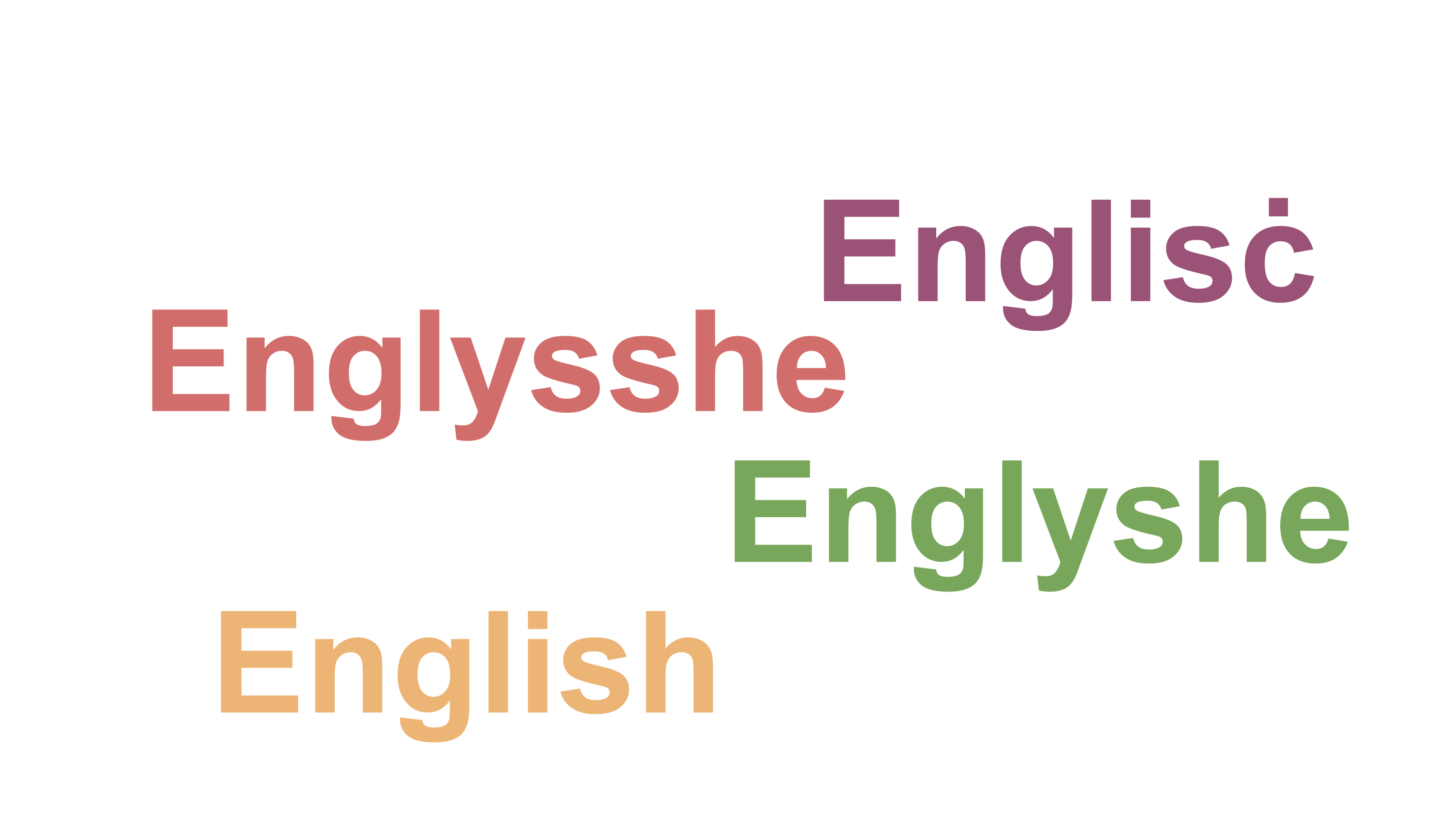
Think of how this language is changing every day. There are more efforts at either being gender neutral in speech or inclusive of the diversity of gender which we are all quickly learning about. Think of the extreme irregularity in spelling personal names. My own given name, Seán, has at least four different spellings. For the record, I spell it the Irish way, Seán. English spelling really hasn’t been purely phonetic for centuries, yet today I often meet people who do have phonetic spellings of their names. The funny thing is, at first situations like that throw me for a loop because I’m so used to the idiosyncratic ways that we spell words, including names, in English. This new phonetic spelling is one big influence that the diversity of English speakers has had on our common language. I do think there should be more cultural awareness of the underlying rules in English, but that’s more a problem of poor English education than anything else, something I’ve written about previously.How we react to the diversity of English speakers will dictate how this language continues to evolve in the coming generations. Just as the first English explorers’ interpretations of indigenous American names and languages reflected the culture of their time, so too the ways we interpret what to us are foreign words and ideas will reflect upon our own time. In this Second Age of Exploration, I hope we can learn from our history and explore with a passion for learning far more than any desires for conquest. Our English will be a reflection of our intentions as much as it will be a tool for our usage.

Human or Man?

In English should we say that Jesus "became human" or "became man"? Join me as I work through the history of the Nicene Creed and how this most pivotal of beliefs was interpreted first by the Greek speaking Church Fathers who wrote the Creed, later by the Latin speaking Catholic Church, and today by us English speakers. You can read a transcript of the full episode here. Written, read, and produced by Seán Thomas Kane. © Seán Thomas Kane, 2021.

On Saturday I took the opportunity to go to 4:00 pm Mass at my home parish here in Kansas City, MO while I was in town for Thanksgiving. It was wonderful getting to see the place again, and even though it’s only been 3 months since I left town for the semester a part of me doubted I’d actually see these places that are so dear to me anytime soon.

During the Nicene Creed as I recited the words I’ve known at least since freshman year of high school, the proclamation of the Faith, kind of a Pledge of Allegiance that we Catholics still have mostly in common with our Orthodox and Protestant cousins, I noticed something that made perfectly good sense but I hadn’t thought of yet. A friend who was standing near me said that Jesus “became human” instead of “became man.” It caught me off guard for a number of reasons. Firstly, the official English translation that we use in the US does use the older word “man” rather than the newer “human” but secondly, I had a feeling from what I could remember of the Latin translation that our English one is more closely based on that “human”, “homō” in Latin, might actually be the noun used.

That evening I made a point of going to the source. I looked up the Creed in Latin and sure enough the line there is “et homō factus est,” which I’d translate in my schoolroom Latin as “and he was made human.”1

The one catch here is that the Creed wasn’t originally written in Latin but in Greek. So, in order to get to the original meaning and intent of the Church Fathers at the Council of Nicaea (325) that wrote the Creed we still say nearly 17 centuries later, I’d need to call up my admittedly elementary and rusty knowledge of Greek. Unlike Latin, which I studied all through my high school years, have picked up again twice since, and use professionally on a regular basis as a historian of Renaissance natural history, I haven’t been lucky enough to use much of my Greek. I took Classical Greek in my senior year of high school after finishing my last required math credit the summer before, and then took a semester of Koine Greek (aka New Testament Greek) in my sophomore year of undergrad at Rockhurst. So yeah, my Greek is rusty. I can still read the alphabet pretty well and I know enough about etymologies that I can get by, but I never really got it the way I got Latin or French.

Still, I was determined to spend at least a few minutes of my Saturday evening at home working through this question: what was the original Greek line that the Latin translator rendered as “et homō factus est“?2 I went to a pretty reliable source that has both the Latin and Greek versions and started scouring the Greek, figuring I was either looking for one of two words: ἄνθρωπος (anthropos) meaning human or ᾰ̓νήρ (anḗr) meaning man.3

One of the big tricks that I’ve learned after now a few years of working with sixteenth-century printed books that are often not in English is the quickest way to find a particular word you’re looking for is basically to just focus on finding that word, don’t pay too much attention to the rest of the text. Once you’ve found the word you’re looking for then go and read the rest of it to put that word into context.

One example of a 16th century printed book that I’ve worked with.

Anyway, back to the story.

So, I scanned through the Greek original version of the Nicene Creed and was left stumped. I couldn’t find either ἄνθρωπος or ᾰ̓νήρ anywhere. I began to wonder if there was some third Greek word for human or man that I didn’t know about, and knowing what I do know about Greek there being three words for the same concept isn’t at all out of the question. Looking for clues, I turned then to the previous line, “and by the Holy Spirit was incarnate of the Virgin Mary”. In the Latin this appears as “Et incarnātus est, ex Spirītū Sānctō ex Marīā Virgine“. A great trick for any researcher working in a second or third language, or better yet one that they have a passing familiarity with is to always keep an eye out for personal names or other proper nouns: those will usually be more prominent, and when it comes to the BVM (Māter Deī, Θεοτόκος [Theotókos]) you can bet her name will be prominent. Sure enough, I quickly found mention of a Μαρίας τῆς Παρθένου (Marias tés Parthenou) meaning the Virgin Mary and kept looking along that line for something that resembled either ἄνθρωπος or ᾰ̓νήρ. Two words over came my answer: a fittingly long Greek verb ἐνανθρωπήσαντα (enanthrōpōpésanta).

I quickly returned to my favorite English-Greek dictionary and found the root form of the verb in question, ἐνᾰνθρωπέω (enanthrōpéō), meaning “to put on human/man’s nature,” or more essentially “to become human/man.” The only job left to do was to take out that clunky slash and acknowledge which noun, ἄνθρωπος or ᾰ̓νήρ was at the heart of that verb. As it turned out, and as you can see, it’s ἄνθρωπος.

Thus, to the best of my efforts as a scholar and translator, and as you can see, I’d argue that in English saying that Jesus “became human” works, perhaps even better than “became man”. Why? Well, remember that English has changed a lot as a language in the past century. We have so many more people and ideas using this language than ever before, and to be honest while the English noun man began as both a word meaning males in both gender and sex (ever a complicated series of terms) and our entire species in general, it has steadily come to lose that second, neuter meaning in favor of solely being a masculine noun. Neil Armstrong’s first words when he stepped onto the Moon’s surface in 1969 were “it’s one small step for man, one giant leap for mankind.” For a guy in 1969 that worked. But for the astronauts that will be setting foot on the lunar surface again in the next few years with the Artemis program, I firmly believe that man won’t cut it anymore.

A few years ago, I wrote a blog post that was a predecessor to this now weekly Wednesday Blog about why I prefer to say “you guys” rather than “y’all”. Long story short: I’m not a Southerner, and I’ll fully admit when I hear “y’all” I don’t tend to think of much besides the people who drug our country into a Civil War 160 years ago because they couldn’t accept the fact that it was morally corrupt to own other human beings. The fact that their heirs are still fighting against racial equity in this country makes my case for me. In that same blog post I also argued that we should move away from the word mankind, and towards something that more closely reflects a more gender neutral word for our species: humanity. On a small side note here (in a paragraph begun with a side note) I don’t like humankind because it combines the very Germanic -kind with the very Latin human. Instead, Latin gives us the word humanity, derived from the Latin hūmānitās. Let’s use that instead. It works, and frankly as we do become far more globally interconnected (which, guys, really isn’t a bad thing at all), it translates far better than humankind ever will.

All this said, getting back to the main point after a brief stop in the politics and history of American English, I think it’s actually a lot better and more profound to refer to Jesus as God becoming human instead of God becoming man. It means that Jesus came to be among all of us, to be one of all of us. I’ve written before in an academic setting about why I believe it’s flawed to refer to God in gendered terms: gender is cultural, it’s fundamentally human, and it keeps the blinders on us to the extent that we can’t make a true effort at seeing, and by seeing hopefully we can get closer to understanding the fullness of God. From there, I’ll leave the writing about how to understand the fullness of God to the theologians and clergy.


Footnotes

  1. Why the difference between the official “became” and “was made” in my translation of the Latin passive verb factus est? Factus est is the passive perfect 3rd person singular form of the verb faciō, which my old stalwart dictionary William Whitaker’s Words translates into the English verbs “do, make, create; acquire; cause, bring about, fashion; compose; accomplish.” So, while “became” is more poetic, “was made” is more accurate to the verb in question. But, theologically was Jesus the passive recipient of the blessing of being made human? After a significant amount of time for what I thought would be a short search I found an entry in the Liddell, Scott, and Jones Ancient Greek Lexicon (LSJ) on the Perseus database that listed the original Greek verb that was translated into Latin as factus est, namely ἐνανθρωπήσαντα, as an aorist participle singular active masculine verb in the accusative case. So basically, while the Latin factus est is in the perfect passive voice (meaning it’s describing an event that fully happened to the subject in the past), the Greek verb is an event that happened in the past without any time specified as to when it happened (kinda like a French passé simple?) This alone shows the complexity of trying to translate from Greek into Latin and then by extension into English. One final note here: while the Greek verb grammatically has a masculine gender (see above in this oversized footnote) I’d stress that that gender designation is referring to Jesus who it’s generally accepted was biologically male. In the process of trying to figure out how the Greek verb in question (ἐνανθρωπήσαντα, in case you forgot) was conjugated, I found an interesting article from the Orthodox Christian Studies Center at Fordham University discussing how best to translate this very verb in the Nicene Creed from the Greek original into English. So, to return to the original question that led me to write this footnote that would outrun the Gettysburg Address in length: the fact that Jesus in the Latin was apparently the passive recipient of his humanity, given to Him by the Holy Spirit is more or less a “it’s the best we can do” translation from the original Greek where Jesus actively “became human”. So, in English while the best translation from the Latin is “was made” human, when taking the Greek into account the official Catholic “became” human works a lot better, because it recognizes that at the end of the day Jesus and the Holy Spirit are consubstantial with the Father, meaning they all share the same Substance, i.e. they are all One. “Three Persons in One God” as my notes from my undergrad freshman Honors Christianity I notes say.
  2. For my fellow grammar constables out there, yes I put the quotation mark outside the quotes. There’s a reason for that, it’s not a part of the quote so I don’t see why it should be included in the quotes. I’m going to write another blog post about this eventually.
  3. For my Greek friends and all Greek scholars out there: to my understanding ᾰ̓νήρ is the Ancient Greek word for “man.” To my understanding the more familiar and modern word άνδρας is descended from the accusative singular (direct object form) of ᾰ̓νήρ.

Shucks!

If there was a word that could fully express a sense of regular melancholy at yet another well laid plan turning out poorly, it is my favorite expression of this sort of sighing shrug of the shoulders: shucks! It’s a word that seems well suited to resignation and repeated failure, one that speaks to the lovable loser in all of us.

I often use “shucks” to mean many of these things. It’s a way of expressing a sense of humility in the face of great odds. It is the sort of Charlie Brown inside of me, the guy who’s just living his life despite all the failures and problems that come his way. Shucks then is a word that seems friendly and warm, a relief when I’d want to cry out in frustration.

All that said, while researching this favorite of exclamations, I learned its etymology comes from a portmanteau of two of English’s more ordinary and yet colorful words. It’s a combination of two of this language’s oldest terms, the noun shit and the verb fuck. It turns out then, that my favorite melancholic exclamation originally had both a fecal and a sexual connotation. Shucks!

Understanding Others and Communicating Well, Pt. 2: English

Introduction

In the week since I published my last little mumbling about why Latin scholars today should use the macron, see here, I’ve had more conversations than normal with those of you who’ve been reading this about ways we can improve communication and education in and for English. Ours is a very complicated language, one that has effectively assimilated aspects from other languages, grafting them onto its strong oaken Germanic trunk, and created new ways of explaining things both familiar and foreign. English’s complexity is due to all of this adopting and assimilating, to the fact that we have two words for many things, especially if it’s something that we both live with on a regular basis, like a cow, and something that we eat, like beef.

English has also tended to play somewhat loosey-goosey with how to spell these assimilated words. Take my name for example, Seán Kane. Over the 28 years I’ve been around, I’ve seen people spell my first name four different ways, and my last name in even more variations. There’s Seán/Sean, Shawn, Shaun, and even Shon. With my last name, itself an English version of the Irish Ó Catháin, there’s the two spellings used in my family, Keane and Kane, as well as Cane, Caine, Cain, Kayne, Cayne, and Keene. When it comes to my first name, my given name, it’s easy, it’s Seán. Yeah, it’s not an English name, it’s still very Irish. Often, a name will tend to be one thing that’s assimilated that stays truest to its native form. But over time, as a name gains popularity, it’ll adapt to fit how an individual speaker figures it ought to be spelled.

English spelling on its own is a tricky topic, as anyone who’s studied English as a second language can affirm. Why is it that the words through and pew rhyme, but not trough and new? Simply put, English spelling began to be standardized with the introduction of the printing press in England in the late fifteenth century. The first English presses largely came from Dutch and Flemish-speaking printers in the Low Countries (modern Belgium, Luxembourg, & the Netherlands), who essentially began to use their own preferred spellings of English words in their books and pamphlets. Thus, we got an extra “h” in ghost where one was not present before. English spelling has generally stayed the same in the intervening 500 years, even while the language itself has changed.

So, today, I thought I might discuss a few changes I think could be helpful for us Anglophones, and for everyone else stuck learning this language. These are generally based off of things I’ve appreciated from other languages, you can guess which ones.

Possessives

When I was taught how to write the English possessive in elementary school, I was told that all you have to do is add an ‘s to the end of a word. So, if I wanted to write about the wings of a bird outside the window, all I had to write was the bird’s wings. But what if I wanted to write about something that a guy named James owned? Would I write James’ or James’s? At the time, my teacher told my class, “You choose which one you want to use, they both mean the same thing.” And for about fifteen years, I wrote James’. But when I was living in London, going through St. James’s Park tube station one day, I started wondering is there a difference between James’ and James’s?

The issue here is that saying it’s alright for people to write about a singular noun ending in an s possessing something as s’ only confuses that noun with any other plural noun. Why should the singular possessive James’ and the plural possessive birds’ have the same ending? I realized then why that station is called St. James’s Park, because it’s a park dedicated to only one of the two St. Jameses, not to both of them (which one remains to be seen). So, really the rule should be that the possessive ending of a noun ending in s should be s’s, and that the plural possessive in all cases in English should be s’. Why wasn’t I taught this? Probably because of custom, habit, or because that particular question hadn’t been thought about by that teacher or anyone else they had discussed it with.

If we clear up how to write a possessive ‘s ending on a noun, we’ll save a lot of people a lot of trouble. More often than not one this is one of my most frequent grammatical corrections on assignments that I grade. Explaining to students that the possessive of Athens is not Athen’s but Athens’s. If we explained the rule this way, there’s a better chance people would make sense of it and we’d clear up one big confusion.

And, or &

The conjunction and is a very solid word. It’s clear what it’s used for, and it’s usually hard to mess it up. But what it I told you there was a way to make its use even clearer? In Latin, the main word for and is et, but there is another way of expressing this particular conjunction. Latin has the capacity of adding a suffix, -que to a word to express a version of and that’s closer in proximity than the usual and. Take the classic name of the old Roman state: Senatus Populusque Romanus (SPQR). Usually, traditionally, this is translated as the Senate and People of Rome, but I personally prefer the Roman Senate and People because Romanus is an adjective.

But notice here the use of -que to mean and. Latin’s -que is not the same as English’s and in its purest form. Rather, -que refers to a close proximity between the two nouns being connected by it. In this case, it implies that the Roman Senate and the Roman People are arm in arm united in government. (Note, implies; political names are always ideals). Our and as it’s written can be interpreted to mean that same idea as -que a closer, more intimate sort of and, but not without context and interpretation. That said, we do have a symbol which means and, the ampersand (&), which itself is a stylized form of the Latin word et. So, why not adopt the very informal & into formal written English as our very own intimate conjunction?

Jack and Jill went up the hill together right? So, they went to fetch that proverbial pail of water as Jack & Jill. And what about a couple of newlyweds, surely they deserve to be represented in print as one grammatical phrase, united by a neat and tidy &. Instead of translating Senatus Populusque Romanus (SPQR) as the Roman Senate and People, a better translation, noting the ideal of the Roman state, would be the Roman Senate & People.

Spelling

Let’s go back to English spelling for a minute. When it comes to spelling, English is a lot like Spanish, by and large the language is spelled the same way anywhere English is spoken, with two main versions: UK & Commonwealth English, and US English. The differences here largely come from the work of one Noah Webster (1758-1843), who in his 1806 Compendious Dictionary of the English Language decided the new American republic ought to have its own version of English, distinct from the King’s English, so he decided to adopt some spellings over others as he saw fit. For example, we in the US spell honor closer to how it’s spelled in Latin, rather than as honour, which derives its spelling from Norman French. All this would be firmly established 22 years later in Webster’s more famous work the American Dictionary of the English Language, the first edition of the modern Webster’s Dictionary.

Today, though English doesn’t have an official academy or institution dictating the rules of the language or how it should be spelled, like French’s Académie Française, or Spanish’s Real Academia Española. English does have two main dictionary editorial boards that effectively do the same job. For UK & Commonwealth English there’s the Oxford English Dictionary (OED), and for US English there’s Merriam-Webster’s Dictionary (MW). (Naturally, in true American fashion the double name is due to a corporate acquisition). These two dictionaries set the rules and standards within each of the varieties of written English, and provide standards for style and citation guides, like the friend of many a US-based historian, the Chicago Manual of Style (CMOS).

As a result of this, English spelling reflects written conventions far more than it does the spoken language. As I noted in my post about Latin, each of the five, sometimes six, written vowels represent at least three sounds each in my own idiolect. This is thanks to the many layers of speech introduced to the language by waves of immigration to the Midwestern United States, which included all of my ancestors. There are hints of my ancestral languages in there: Irish, as well as some odd echoes of Welsh, Finnish, Swedish, and Flemish included. There’s also a sizable chunk of German phonology in the varieties of Midwestern American English, thanks to the predominance of German Americans in our part of the country.

It would then, quite possibly, be better for learners if we spelled English phonetically rather than per centuries-old written conventions. But if we do that, then each local variety of English would be spelled differently from the next. And how would we determine how to spell words? The only really good option would be to switch to spelling everything using IPA, the International Phonetic Alphabet. bʌt ɪf wi spɛl θɪŋz fəˈnɛtɪkli ˈjuzɪŋ aɪ-pi-eɪwoʊnt ɪt luz sʌm ʌv ɪts ˌlɛʤəˈbɪləti?1

Conclusion

English, it’s a tricky language to figure out. I only started with a couple things that I’d like to see changed with it, things that could well be improved upon. What are some things you’d like to see done with English? Please leave your comments below.


1 But if we spell things phonetically using IPA, won’t it loose some of its legibility?


Corrections

24 March 2021: Added the Real Academia Española into the section about spelling in reference to the role that language academies play in French and Spanish.