Tag Archives: english-grammar

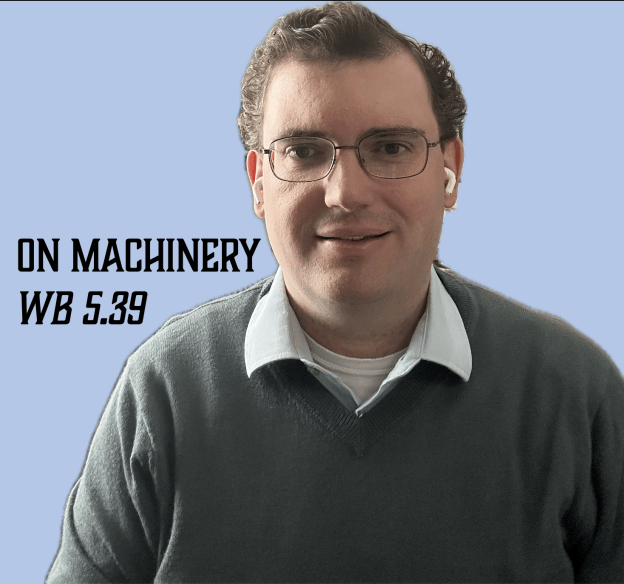
The author on a blue background wearing Apple AirPods.

On Machinery

This week, for the penultimate post of the Wednesday Blog, how machinery needs constant maintenance to keep functioning.—Click here to support the Wednesday Blog: https://www.patreon.com/sthosdkane—Sources:%5B1%5D Surekha Davies, “Walter Raleigh’s headless monsters and annotation as thinking,” in Strange and Wonderous: Notes from a Science Historian, (6 October 2025).[2] “Asking the Computer,” Wednesday Blog 5.26.


This week, for the penultimate post of the Wednesday Blog, how machinery needs constant maintenance to keep functioning.


I am just old enough to remember life before the ubiquity of computers. I had access to our family computer as long as I can remember, and to my grandparents’ computer at their condo when we stayed with them in the Northwest Suburbs of Chicago. Yet even then my computer usage was limited often to idle fascination. I did most of my schoolwork by hand through eighth grade, only switching from writing to typing most of my work when I started high school and was issued a MacBook by my school. I do think that a certain degree of whimsy and humanity has faded from daily life as we’ve so fully adopted our ever newly invented technologies. Those machines can do things that in my early childhood would’ve seemed wonderous. Recently, I thought how without knowing how powerful and far-reaching my computer is as a vehicle for my research and general curiosity, I would be happy, delighted in fact, if my computer could conduct one function, say if it had the ability to look up any street address in the United States as a device connected to the US Postal Service’s database. That alone would delight me. Yet that is the function of not just one application on my computer but merely one of many functions of several such programs I can load on this device, and not only can I look up addresses in the United States but I can look up addresses in any country on this planet.

With the right software downloaded onto this computer I can read any document printed or handwritten in all of human history and leave annotations and highlights without worrying about damaging the original source. Surekha Davies wrote warmly in favor of annotating in her newsletter this week, and I appreciated her take on the matter.[1] In high school, I was a bit of a prude when it came to annotating; I found that summer reading assignment in my freshman and sophomore English classes to be almost repulsive because I see a book as a work of art crafted by its author, editor, and publisher to be a very specific way. To annotate, I argued, was like drawing a curly-cue mustache on the Mona Lisa, a crude act at best. Because of this I process knowledge from books differently. I now often take photos of individual pages and organize them into albums on my computer which I can then consult if I’m writing about a particular book, in much the same fashion that I use when I’m in the archive or special collections room looking at a historical text.

All of these images can now not only be sorted into my computer’s photo library, now stored in the cloud and accessible on my computer and phone alike, but they can also be merged together into one common PDF file, the main file type I use for storing primary and secondary sources for my research. With advances in artificial intelligence, I can now use the common top-level search feature on my computer to look within files for specific characters, words, or phrases to varying levels of accuracy. This is something that was barely getting off the ground when I started working on my doctorate six years ago, and today it makes my job a lot easier; just my file folder containing all of the peer-reviewed articles I’ve used in my research since 2019 contains 349 files and is 887.1 MB in size.

Our computers are merely the latest iterations of machines. The first computer, Charles Babbage’s (1791–1871) counting machine worked in a fairly similar fashion to our own albeit built of mechanical levers and gears where ours have intricate electronics in their hard drives. I, like many others, was introduced to Babbage and his difference engine by seeing the original in the Science Museum in London. This difference engine was a mechanical calculator intended to compute mathematical functions. Blaise Pascal (1623–1662) and Gottfried Wilhelm Leibniz (1646–1716) both developed similar mechanisms in the seventeenth century and still older the Ancient Greek 2nd century BCE Antikythera mechanism can complete some of the same functions. Yet between all of these the basic idea that a computer works in mathematical terms remains the same even today. For all the linguistic foundations of computer code, the functions of any machine burn down to the binary operations of ones and zeros. I wrote last year in this blog about my befuddlement that artificial intelligence has largely been created on verbal linguistic models and was only in 2024 being trained on mathematical ones.[2] Yet even then those mathematical models were understood by the A.I. in English, making their computations fluent only in one specific dialect of the universal language of mathematics making their functionality mostly useless for the vast majority of humanity.

Yet I wonder how true that last statement really is? After all, I a native English speaker with recent roots in Irish learned grammar like many generations of my ancestors through learning to read and write in Latin. English grammar generally made no sense to me in elementary school, it is after all very irregular in a lot of ways, and so it was only after my introduction to a very orderly language, the one for which our Roman alphabet was first adapted, that I began to understand how English works. The ways in which we understand language in a Western European and American context rely on the classical roots of our pedagogy influenced in their own time by medieval scholasticism, Renaissance humanism, and Enlightenment notions of the interconnectedness of the individual and society alike. I do not know how many students today in countries around the globe are learning their mathematics through English in order to compete in one of the largest linguistic job markets of our time. All of this may well be rendered moot by the latest technological leap announced by Apple several weeks ago that their new AirPods will include a live translation feature acting as a sort of Babel Fish or universal translator depending on which science fiction reference you prefer.

Yet those AirPods will break down eventually. They are physical objects, and nothing which exists in physical space is eternal. Shakespeare wrote it well in The Temepst that 

“The solemn temples, the great globe itself,

Yea, all which it inherit, shall dissolve,

And, like this insubstantial pageant faded,

Leave not a rack behind. We are such stuff

As dreams are made on, and our little life

Is rounded with a sleep.” (4.1.170-175)

For our machines to last, they must be maintained, cleaned, given breaks just like the workers who operate them lest they lose all stamina and face exhaustion most grave. Nothing lasts forever, and the more those things are allowed to rest and recuperate the more they are then able to work to their fullest. So much of our literature from the last few centuries has been about fearing the machines and the threat they pose. If we are made in the Image of God then machines, our creation, are made in the image of us. They are the products of human invention and reflect back to us ourselves yet without the emotion that makes us human. Can a machine ever feel emotion? Could HAL-9000 feel fear or sorrow, could Data feel joy or curiosity? And what of the living beings who in our science fiction retrofitted their bodies with machinery in some cases to the extent that they became more machine than human? What emotion could they then feel? One of the most tragic reveals for me in Doctor Who was that the Daleks (the Doctor’s main adversaries) are living beings who felt so afraid and threatened that they decided to encase the most vital parts of their physical bodies in wheelchair tanks, shaped like pepper shakers no less, rendering them resilient adversaries for anyone who crossed them. Yet what remained of the being inside? I urge caution with suggestions of the metaverse or other technological advances that draw us further from our lived experiences and more into the computer. These allow us to communicate yet real human emotion is difficult to express beyond living, breathing, face-to-face interactions.

After a while these machines which have our attention distract us from our lives and render us blind to the world around us. I liked to bring this up when I taught Plato’s allegory of the cave to college freshmen in my Western Civilization class. I conclude the lesson by remarking that in the twenty-first century we don’t need a cave to isolate ourselves from the real world, all we need is a smartphone and a set of headphones and nothing else will exist. I tried to make this humorous, in an admittedly dark fashion, by reminding them to at least keep the headphones on a lighter mode so they can hear their surroundings and to look up from their phone screen when crossing streets lest they find themselves flattened like the proverbial cartoon coyote on the front of a city bus. 

If we focus too much on our machines, we lose ourselves in the mechanism, we forget to care for ourselves and attend to our needs. The human body is the blueprint for all human inventions whether physical ones like the machine or abstract like society itself. As I think further about the problems our society faces, I conclude that at the core there is a deep neglect of the human at the heart of everything. I see this in the way that disasters are reported on in the press: often the financial toll is covered before the human cost, clearly demonstrating that the value of the dollar outweighs the value of the human. In abdicating ourselves to our own abstractions and social ideals we lose the potential to change our course, repair the machinery, or update the software to a better version with new security patches and fixes for glitches old and new. In spite of our immense societal wealth, ever advancing scientific threshold, and technological achievement we still haven’t gotten around to solving hunger, illiteracy, or poverty. In spite of our best intentions our worst instincts keep drawing us into wars that only a few of us want.The Mazda Rua, my car, is getting older and I expect if I keep driving it for a few years or more it’ll eventually need more and more replacement parts until it becomes a Ship of Theseus, yet is not the idea of a machine the same even if its parts are replaced? That idea is the closest I can come to imagining a machine having a soul as natural things like us have. The Mazda Rua remained the Mazda Rua even after its brakes were replaced in January and its slow leaking tire was patched in May. Yet as it moves into its second decade, that old friend of mine continues to work in spite of the long drives and all the adventures I’ve put it through. Our machinery is in desperate need of repair, yet a few of us see greater profit from disfunction than they figure they would get if they actually put in the effort, money, and time to fix things. If problems are left unattended to for long periods of time they will eventually lead to mechanical failure. The same is true for the machinery of the body and of the state. Sometimes a good repair is called for, reform to the mechanisms of power which will make the machine work better for its constituent parts. In this moment that need for reform is being met with the advice of a bad mechanic looking more at his bottom line than at the need of the mechanism he’s agreed to repair. Only on this level the consequences of mechanical failure are dire.


[1] Surekha Davies, “Walter Raleigh’s headless monsters and annotation as thinking,” in Strange and Wonderous: Notes from a Science Historian, (6 October 2025).

[2] “Asking the Computer,” Wednesday Blog 5.26.

On Editing

This week, I want to write to you about the revealed joys found in the experience of editing. — Click here to support the Wednesday Blog: https://www.patreon.com/sthosdkane


This week, I want to write to you about the revealed joys found in the experience of editing.


I spent most of last Thursday editing a chapter I’m contributing to a new book about Shakespeare’s play The Tempest. My contribution argues that the bard was inspired in his descriptions of Caliban and the play’s island setting by André Thevet’s accounts of Tupinambá beliefs and the role of magic in their society, and the sense of Brazil as the archetype of the insular natural world across the sea at the turn of the seventeenth century. There’s a lot in its 32 pages, and it’s been a good effort on my part since I first saw the call for papers for this book two years ago. I wrote the first draft between March and June of this year both here at home in Kansas City, and while I was on my European trip this June; I spent most of my time in the San Francisco International Airport G Concourse United Club writing paragraphs for this chapter. 

Until last Thursday, I’d only edited it on my computer. This is a far faster way to edit text, it allows me to work as I’m reading through the draft. This method is still relatively new to me, I feel fortunate that I was taught to write by hand first and to edit with pen and paper. That’s been more challenging with my dissertation, in Binghamton I didn’t own a printer and because I could never figure out how to use the university printers, I relied heavily on the local print shop across the road from the University to print anything I needed. That meant then that up until the sixth or seventh draft I never saw it on paper, always on the computer screen for both economical and environmental reasons.

The week before last Thursday, when I returned to my Tempest chapter after finishing several other major projects, I found myself thinking that it could benefit my editing if I printed this document out at least for my last full read through before sending it off to the editor. So, returning to it just before noon on Thursday, I decided to print draft 4 of the full document, all 34 pages of it. As it turned out, there was something heartwarming about editing this chapter with pen and paper. Sure, I knew I’d save myself time by editing it while I was reading it on my computer, but I’ve found more and more that if I really need to work on a sentence, I’ll have to copy it out of the draft and into a separate document where I can look at it on its own separate from the rest of the text. This works, and this is what I often end up doing, but it’s not a problem I have reading lines on a printed page. I find I can read faster when reading something printed rather than something digitized, and now that I’m doing so many more things than just writing and editing my dissertation, moving towards these postdoctoral projects, I’m finding that I’m returning to how I read and wrote before I fully adopted all this technology.

Even though I now edit using more review bubble comments and review tracking on Microsoft Word or Google Docs than the old shorthand symbols that I learned in my elementary school English classes, I could still return to them with an ease that felt native to my sensibilities and origins as a writer and a reader. I even left the odd marginal note on draft 4 of my Tempest chapter should anyone else ever find this printed copy to see some of the things I was referencing in the additions and changes I made to this draft.

One of the greatest lessons I’ve yet learned about writing came from a policy writer who at the time worked for the offices of the European Union in Brussels. He came to the University of Westminster for a couple of days in March 2016 to run a policy writing workshop for all of us who were interested. I joined in and wrote a brief about a hypothetical crisis along the Danube between Hungary, Croatia, and Serbia (I think). While I’m less likely to become a professional political policy writer anytime soon, the most impactful thing he taught us was to leave whatever it is we’re writing aside once we’re done with a draft and return to it later. Like a good dough, our writing needs to rise for a while before we return to it and work on it some more. I took a week between finishing draft 4 and returning to it to complete the edits that make up draft 5 of this Tempest chapter, and I’m certain the finished draft benefits from that gap. It’s something I do here with the Wednesday Blog on those weeks when I’m able to write things in advance. The words you’re reading, or hearing, now were written on Thursday afternoon about an hour after I sent draft 5 off to the editor. I’ll return to them sometime on Tuesday, October 15th, and read through them again when I record them for the podcast.

The Wednesday Blog podcast actually grew out of my editing sessions for the blog. You see, I traditionally edit by reading my writing aloud; if it doesn’t make sense to my ear then it needs to be rewritten. Nearly three years ago then, at the end of November 2021, I decided one night after dinner to start recording those read-throughs and release them as a podcast version of my blog. Of course, the version you get in your podcast player each week is more polished than the first draft, but with these essays I usually don’t need to do as many edits. This is a different style of writing than my academic work, less formal, and more personal.

Editing also reminds me to express what I’m thinking in a clearer way. An early lesson in teaching that I received, and nearly all of my lessons in teaching have been on the job while I’m teaching, was to speak to my audience in their own language. This is a no-brainer when it comes to speaking French in Paris, or German in Vienna, yet what I mean here is speaking to your audience in a way that they’ll understand. I like to use the words they’ve just used in my answers. This is a grammatical thing in Irish where instead of having words for yes or no we instead say the positive or negative of the verb in question. I’ve begun doing this in my English too: responding not only with a yes or a no but with a yes, I do or yes, I can, or no, I don’t understand. Clarity is the best friend of writing and good communication. A common comment I get from editors is that what I’m trying to say is just under the surface or not quite clear yet. This is a symptom of how I developed my writing voice first in poetry and plays and later in short stories and now factual and highly researched non-fiction blog posts and academic essays. It’s been a weakness in my writing up until now that I’ve had a hard time getting over, but I think I may have figured it out by closely reading what I’ve already done with those comments up on a screen where I can clearly see them as I read.

Sometimes the thesis or plot of what I’m writing will change significantly in the edit. There are times where my original argument simply doesn’t work, and I need to adjust drastically to save the essay or story. This happened early on with this Tempest chapter, and I’m glad I saw the flaws in my original approach as early as I did because it made the chapter I’ve written in the five drafts since all the stronger. While that may be frustrating at first, I love the way that things work when all the pieces of the story or all the sources behind the thesis line up. I love how a good edit can inspire me to keep writing and get closer to my record average of writing 1000 words per hour. This is more possible outside of my academic writing where I often stop to consult a source to make sure I’m getting it right, but even there when I can write with a great fluidity, and I know what I’m trying to say it reminds me why I do what I do.


Correction: in my initial publication of this blog post I miswrote my average writing speed as “1000 words per minute,” when I meant to say “1000 words per hour.” I’m not Lt. Cmdr. Data.

A Matter of Grammar

This week, after going down the rabbit hole of the Chicago Manual of Style's monthly Q&A newsletter, I thought I'd talk a bit about grammar. — Click here to support the Wednesday Blog: https://www.patreon.com/sthosdkane


This week, after going down the rabbit hole of the Chicago Manual of Style‘s monthly Q&A newsletter, I thought I’d talk a bit about grammar.


One of my favorite newsletters to read is the Chicago Manual of Style‘s monthly Q&A email which tries to answer some pressing questions regarding the English language in this particularly formal academic setting that I often write in professionally. We historians in the United States use the Chicago Manual of Style as our main style guide, both for its system of extensive footnotes and for its grammatical rules. I am familiar and have used several other systems, including the AP Style Guide, and the MLA, APA, and Harvard citation systems, yet my preference remains Chicago for its clarity. Chicago is the preferred style guide for us historians as well as the basis of the style used by the American Anthropological Association.

English is an unusual language in that we don’t have a single central authoritative language academy as does French, Spanish, Irish, and German. Our best bet is to see what our two major dictionaries say: the Oxford English Dictionary and the Merriam-Webster Dictionary. The former is the standard in the United Kingdom and throughout the Commonwealth, while the latter is the American standard developed first during the Early Republic when its initial author Noah Webster sought to better differentiate American English from its imperial counterpart, the better to craft a specifically republican national language fit for our young Union. I’ve had my problems with Webster’s dictionary for a while now in part because I don’t see the point of most of his spelling reforms, and for a good part of my teens and twenties I used British spellings over American ones. Today though, I’ve reverted to the American standards in what might well be a sign of my general weariness of the constant fight over so many different topics and issues; this was one that fell by the wayside.

This month then, the Chicago Manual‘s Q&A included a question about whether it was fine for an academic writer to write in the first or second person, to use the pronouns I and you. We are taught to always restrict our writing to the third person, to avoid the subjectivity that is implicit in the first person. I’ve begrudgingly accepted this, to the extent that amid the 96,276 words that comprise the ninth draft of my dissertation only three of those are the pronoun I. All three instances where I drift into the first person are in the footnotes where it is necessary to explain my decisions regarding certain translations or connections that would otherwise not be possible in the English language. By contrast, I use this pronoun a great deal here in the Wednesday Blog, where I am writing to you, dear reader, in a more personal manner that I hope is evident in this text. Of the 189,993 words that I’ve written for the Wednesday Blog before this week, 3,360 of those are the pronoun I.

The response in the Q&A about using the pronoun I spoke to that concern for subjectivity, yet also spoke of a need that our academic writing ought to be “more lively and personal.” I see both sides of this, more and more books written by my fellow academics do include more of the first person in them, yet at the same time Kate Turabian’s writer’s manual––an abridged version of the Chicago Manual––suggests that writers “avoid beginning your sentences with I believe or I think (which go without saying).” I am often frustrated to hear people use fillers like these, or like “it goes without saying,” or “to be honest,” when those are things I hope they would be adhering to in the first place. On the other hand, I’ve heard papers at conferences where the author reads out “this author finds that _____,” which sounds ludicrous. Two weeks ago, at the Renaissance Society of America’s conference I did make it clear where I was presenting my own theories based on the evidence that my primary sources provided. A spoken context is different than a written one, not only can there be more repetition of material to bring a point home, one can also use more personal elements, bring oneself into the topic and show the audience why they ought to care about it the way you do.

Academic writing is quite formal, and it follows set patterns and standards. It is in many ways an intricate dance, whether a waltz or an older minuet, which we follow in order to write to one another in the same methods and manners that we will all recognize. One may want to deconstruct some of these Elements of Style, to borrow a title, yet those standards exist to facilitate communication. Language proscription has its place along with all the innovations that happen each and every day in speech and writing. I might use this pronoun more in my academic writing in the future, especially if I choose to write a prologue which tells my reader why I am fascinated by a topic that will invite them to consider it as well.

I would like it if there were an English Language Academy in the same vein as the Académie Française, yet I would prefer to have a say in its decisions. Is that bold of me, sure. Yet that academy’s function is best served by the continued writing and publication of those of us who use the English language to express our thoughts on a daily basis. For every article or book I submit for publication about the history of animals in the Renaissance there will be countless other works published in all manner of settings which demonstrate the versatility of this language and its uses. We academics have just as much a claim to it as anyone else, and my own English is not everyone’s English. Still, we have our common grammar that keeps this language together, and that is something worthwhile.


Corrections

3 April 2024: Soon after publication, I corrected this week’s blog post for grammar, naturally.