

On Exploration – Wednesday Blog by Seán Thomas Kane
This week, some words on two books about exploration that I’ve read this summer: Hampton Sides’s The Wide Wide Sea, and Michael Palin’s Erebus.
I may well be one of a few millennials who regularly watch CBS Sunday Morning. I remember finding it a comforting and calming way to start Sunday when I was little, and now that they publish the stories from each week’s broadcast on YouTube, I tend to watch the program there. So, in April I was excited to see a storyabout Captain Cook was airing on the program. It was an interview with Hampton Sides, an award winning non-fiction writer whose new book The Wide Wide Sea tells the story of Cook’s third and final voyage into the Pacific which left England just days after the thirteen of Britain’s American colonies declared their independence, only returning home again four years later. On this voyage, Cook’s ships the HMS Resolution and HMS Discovery became the first European ships to reach the Hawaiian Islands, where Cook would meet his own demise in February 1779.
I’ve been fascinated by Cook’s voyages for a long time now; his was one of the great explorers whose names I’ve known since childhood. The notion of exploration is intrinsic to our American culture, as a settler society, and Cook’s third voyage was the last time that any of our countrymen participated on a British voyage of exploration as British subjects. Sides makes note that Dr. Benjamin Franklin lobbied his colleagues to provide Cook’s expedition special immunity, and if needed to provide them with safe passage as they conducted their business for the betterment of the scientific knowledge of all humanity. Cook’s voyages have a troubling legacy as they were the forebearers of the later colonists, merchants, and missionaries whose ships soon plied the waters of the Pacific from Arctic to Antarctic. We can learn a great deal then from Cook’s expeditions in how best to interact with other worlds, and what to avoid doing.
I started reading this book on my flight in June from San Francisco to London; I knew I wanted to bring this book with me even though it’s quite large and heavy, there was something about it that struck me as fitting for this trip. I began referring to it as the “Captain Cook Book” with the pun fully intended and when not watching Citizen Kane and The Donut King on that 11 hour flight I opened Hampton Sides’s new book and took in the story of the last full measure of one of the great explorers of the last age of exploration.
When I arrived in London, I tried to visit museums that I hadn’t walked through on my last trip in October. One of these was my old favorite, the National Maritime Museum in Greenwich. When I lived in the British capital in 2015 and 2016, I often would wander southeast towards Greenwich and take in the baroque architecture of the Old Royal Naval College, now the University of Greenwich, and explore the National Maritime Museum’s exhibits on the colonial and exploratory history of the British. This time, I was surprised to find the museum under renovation, and so the main entrance that faces toward the Thames was closed. Instead, I entered through the back of the building. Yet where I was left wanting more in past visits, this time I was pleasantly surprised at how the galleries were set up to tell the story of Britian’s maritime past. I acknowledged the portraits of Cook in the ground-floor Pacific gallery; yet I was more thrilled to see several uniform coats worn by Lord Nelson, including the coat he wore on his last day at the Battle of Trafalgar in 1805. Even more so, I loved seeing relics from the British Antarctic and Arctic expeditions which included Cook’s third voyage.
The Arctic held an appeal for British navigators because they hoped they might find the fabled Northwest Passage above the top of North America, which would be a quicker route for ships to reach China and Japan without passing through the Spanish and Portuguese controlled waters of South America and the fearsome currents and winds of Cape Horn on Tierra del Fuego at the bottom of South America. Martin Frobisher’s three expeditions to the Arctic between 1576 and 1578 were among the first English voyages to the region in search of the famed passage. Frobisher is known to have brought with him the 1557 second French edition of André Thevet’s Les Singularitez de la France Antarctique and Thomas Hacket’s 1568 English translation of that book The New Founde Worlde, or Antartike on at least one of his Arctic voyages. This, dear reader, is the book that I’ve translated as The Singularties of France Antarctique. (More there to come).
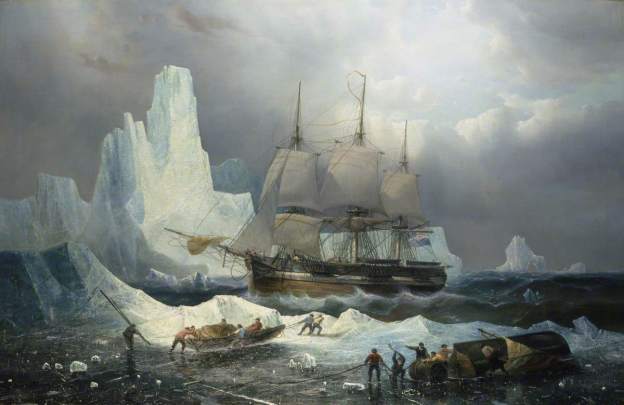
With the Arctic and Antarctic on my mind as I finished my tour of the galleries, I wandered into the gift shop, as one does, and saw they had copies of Michael Palin’s book Erebus, a history of the HMS Erebus which sailed to within both polar circles in the 1830s and 1840s only to disappear in the Arctic ice in the mid-1840s under the command of Sir John Franklin. When this book was first published in 2018, I remember being intimidated by the subject: I knew about the Erebus and her sister-ship the HMS Terror, yet in my mind this sounded more like a history written as a horror novel than anything else, and I’m not one for horror. So, I waited until this sighting of it to buy a copy. I started reading it later that afternoon while taking the Elizabeth line from Canary Wharf back into Central London to Bond Street and was immediately engrossed in the story.
There’s something funny to me about the settings where I start reading books: they become as much a part of my experience and memory of reading those books as the stories themselves. I began reading Judith Herrin’s history of Byzantium on the DLR in mid-summer 2016, and to this day when I glance at it on my shelves or when I’ve taught about Constantinople and the Eastern Roman Empire, I will think not only of that book but also of the DLR elevated line going into Tower Gateway station. In this instance, Palin’s Erebus is connected for me with the darkened-purple hue of the lighting in that Elizabeth line train as we rushed beneath Central London toward the West End.
Now with both books in hand, I proceeded to change my strategy for how I’d read them: I decided that as long as the course which Cook took between 1776 and 1779 mirrored the course that James Clark Ross, captain of the Erebus on its Antarctic expedition between 1839 and 1843, I would go back and forth between each book chapter-by-chapter. That lasted until about Tasmania, where the Erebus first encountered Sir John Franklin, then Lieutenant Governor of the colony, and where Cook and his men had a jolly shore leave before their monumental and historic crossing of the Pacific. What struck me most was how similar these stories felt despite the 70 year gap between their visits to Tasmania. By the time Ross and his crew arrived in Hobart in August 1840, sails were beginning to give way to steam as the main propulsion of ships, and when Erebuswas refitted for its Arctic expedition under Sir John Franklin in 1845, the ship was given an engine from a steam locomotive from the London and Greenwich Railway to help propel it forward into the polar north.
After the two books diverged in their stories I set aside Michael Palin’s Erebus for a while until I finished Hampton Sides’s The Wide Wide Sea, wanting to experience his retelling of Cook’s third voyage in its fatal fullness before reading Palin’s retelling of Franklin’s fateful and more mysterious Arctic expedition. This happened around the 16th of July, a mere six days after Hampton Sides gave a talk here in Kansas City about The Wide Wide Sea. As I switched gears from Cook to Franklin, I listened to as many podcasts as I could find about Cook’s third voyage from our local NPR interview with Hampton Sides in conjunction with his talk, to Melvyn Bragg’s episode of In Our Time from BBC Radio 4 about Captain Cook.
I then picked up Michael Palin’s book again and set off with him in the wake of the Erebus and Terror on their voyage north past the Orkneys and Greenland and into the Canadian Arctic. I came into these chapters with a different sort of prior knowledge about this expedition. On 2 September 2014, the CCGS Sir Wilfrid Laurier, a Canadian icebreaker, sent north by Parks Canada to search for the lost Erebus and Terror discovered one of the ships which a month later was confirmed to be Erebus. I remembered just before moving to London watching an episode of NOVA on PBS about the search, which after reading another article about this expedition in either National Geographic or Smithsonian earlier this year I watched again. So, now instead of a horror-themed history book, I found Palin’s chapters about the Arctic expedition to be a familiar and tragic history of an expedition gone awry.
It struck me in particular that the majority of the last section of his book is devoted to the aftermath of Erebusand Terror’s disappearance entering Baffin Bay in August 1845. Palin told the story as it was uncovered by British and American expeditions sent north to find the lost ships in the 1840s, 50s, and 60s. From all that I’ve read and watched about this voyage, it is likely that we will learn more of what truly happened to Erebus, Terror, and their crews in the coming years as more evidence is found in Nunavut, the Canadian territory in whose waters the ships sank.
There is something to be said for how my fascination for exploration has informed my professional life. While I style myself a historian of Renaissance natural history, I am equally focused on exploration, for it was the explorers whose eyewitness accounts first described the animals about which I write. I’ve even considered trying out a voyage of my own just to see what an oceanic crossing by sail is like. What brings both of these books into being in my imagination is that both authors have experienced the places they’re describing and have spent copious time in the archives and libraries and talking to people connected even across the generations to those whose experiences they seek to describe. They truly bring these stories to life. They allow the reader to explore a world now fading, and perhaps even to see how close we are today to Cook, Ross, Franklin, and all their fellow explorers who lived in centuries now gone.


 Wednesday Blog by Seán Thomas Kane