Tag Archives: Fanfare for the Common Man

An Election Year Independence Day

An Election Year Independence Day Wednesday Blog by Seán Thomas Kane

This week, I’m writing to you with this week’s holiday in mind, with some of my aspirations and hopes for America. — Click here to support the Wednesday Blog: https://www.patreon.com/sthosdkane

This week, I’m writing to you with this week’s holiday in mind, with some of my aspirations and hopes for America.


While I have colonial ancestors who settled New Haven, Connecticut and Newark, New Jersey, and who at the time of the American Revolution were living in Pennsylvania, Maryland, and North Carolina, I more closely associate with my recent immigrant ancestors. I’m one of those hyphenated-Americans who holds onto elements of a culture and identity that transcends the Atlantic and provides connections not only to this country but to the places where my ancestors came from. One aspect of the political philosophy of American nationalism that I don’t agree with says that you have to conform to a particular American identity when you come here. My ancestors did that, to varying degrees, and I’m more American than anything else, yet it’s all those other elements that give our Americanness its richness of character.

So, when I think of the music that embodies the soul of America, it’s music written by a fellow hyphenated-American, Aaron Copland, the dean of American classical music. When I tried my hand at musical composition in college, I wrote a four-movement trio sonata that told the story of a voyage from Ireland to America by St. Brendan and his monks in the sixth century. My addition to the fable was to have the tone of the music switch from being very Irish in the first and second movements to taking after Copland’s sound in the third and especially the fourth movement as they reached this side of the water. I’ve long wanted to write a blog post all about my admiration for Copland’s music, but thanks to the copyrights on his recordings I’m waiting for a few more decades. For now, go listen to Appalachian Spring and Rodeo after you’re done listening to, or reading, this.

Copland’s music speaks to me now in 2024 especially as we approach an election year. This is the most sacred task that we American citizens fulfill in our obligations to our republic: we do our duty by voting for whom we want to represent us on all levels of government, and on the host of ballot measures found further down-ballot. This election feels far more pivotal than any we’ve seen in my lifetime. For context, I was born exactly one month before the elder President Bush stood aside for President Clinton. While I may have disagreed with the policies of both Presidents Bush, they still seemed to be decent men. It’s hard to say that this year about one of the two candidates who flooded Thursday night’s debate on CNN with so many half-truths and outright lies that the network did nothing to check live on air. I was baffled watching it to think that the network’s executives and news directors didn’t choose to lay out better safeguards considering this is the same man whose rhetoric and refusal to admit his loss in 2020 led to the storming of the Capitol on January 6th, 2021.

When I think of a President who I want leading our country, I think of Copland’s Fanfare for the Common Man.I want someone who best represents the best ideals of America, someone who can speak with all of us and for all of us. I hope for someone who can work with Congress and the states to execute legislation that will lead to an overall improvement in our national well-being. I was disappointed to see the President perform so poorly during the debate on Thursday, yet of our choices this year he is the closest to embodying that ideal of the common man.

This year’s election is not politics as usual, there are deep intrinsic questions at stake over the future of our country and what sort of government we want to have. I was deeply unsettled to read the transcript of David Brooks’s recent interview with Steve Bannon, who Brooks called a Trotsky-figure for the MAGA movement. From the interview, and from the way Bannon positioned himself as a leader of that movement, he made it clear that there is no room for communication with their political opponents, who Bannon termed in a far more affrontive manner as their enemies. That is the most essential element of good government, something that all the great political philosophers recognized: we need to be able to communicate with each other and grow together as one body politick made up of a great many parts. I’ve seen the same problem on the left as on the right, a disinterest in listening and in compromising to achieve a higher ideal or a common good that will benefit everyone. Yet the greater threat is coming from the faction who’ve gained enough sway that they now control their party and their leader is again a candidate for the Presidency.

This Independence Day, Americans around the globe will celebrate the invention of our republic from an ideal written on paper during a hot and humid Philadelphia summer 248 years ago. I’ve heard it said that that was the first time that anyone thought to write down the idea that “all men are created equal.” Think about that for a moment: that was the first time that the notion of universal equality, or better universal equity, had ever been considered. The President is the President, and I respect him for serving in that office as I feel respect for the office itself. It is a monument to self-sacrifice when done well, and a trap of self-aggrandizement when the oath is taken for the wrong reasons. Yet when a sitting President leaves the office on Inauguration Day, they may still be Former President, but they are now again just another citizen who’s offered to carry that mantle in the relay until the next candidate will take it up.

The burdens of preserving, protecting, and defending the Constitution of the United States are greater than one person can carry on their own. The office holder ought to have us, we the people who come first in the Constitution, supporting them as long as they keep their oath, and do their duty for as long as their term lasts. It is a humbling thing to serve in such an august role. It is something that truly should not be taken lightly, or brought on by a candidate for any other reason than for service.
The Art of Joy

This past weekend, the Nelson-Atkins Museum of Art debuted a new retrospective exhibit on the life and work of Franco-American artist Niki de Saint Phalle. One of her great initiatives was to express rebellious joy in her art, especially later in her career. — Click here to support the Wednesday Blog: https://www.patreon.com/sthosdkane


This past weekend, the Nelson-Atkins Museum of Art debuted a new retrospective exhibit on the life and work of Franco-American artist Niki de Saint Phalle. One of her great initiatives was to express rebellious joy in her art, especially later in her career.


I wasn’t familiar with the name Niki de Saint Phalle (1930-2002) before the Nelson-Atkins Museum of Art announced they would be hosting the first American retrospective exhibition of her work, yet having seen aspects of it, particularly her Nanas, I find that I do remember seeing these around here and there. The exhibit begins with her early work, highlighting her tirs paintings (1961–63) which involved her shooting paint-filled collages of popular material objects each with their own cultural meanings, until they bled their paint out. I found these hard to appreciate, the violence at the core of these pieces and the claustrophobic nature of their assemblages filled me with a sense of dread.

Yet, it was the latter two thirds of the Saint Phalle exhibit which I returned to, the section radiating and erupting in light and color in a manner that felt welcoming and brilliant as though it were made to bathe in the warm rays of the Sun. These portions of the gallery were filled with her Nanas (1964–73) and other works in the same style. Saint Phalle created her Nanas as an evocation of the power of women, often drawing from ancient fertility figurines like the Venus of Willendorf, today housed at the Museum of Natural History in Vienna. Even the serpentine figures which I would normally be wary of felt warm and cheering.

So, what then is it about Saint Phalle’s work and this dramatic change between her early creations in the 1960s and 1970s to her later works in the 1980s, 1990s, and early 2000s that the latter ones feel so different? In my two visits thus far I’ve gotten a sense that early on she was fighting back against oppressive forces and that her resolve was to take hold of the ancient model of fighting violence with violence, while later once she felt liberated from these old shadows, as much as she could’ve been, she began to create in a spirit of wonderous joy.

I’ve had a hard time with joy lately, and I’m usually the eternal optimist. In many respects, I feel my emotions have had a softening in the last year and a half out of fatigue more than anything else. After I finished my teaching job in the Fall, I could not feel much for a good two weeks; I was so tired that Christmas came and went with only a passing acknowledgement from me. I gave every last drop of my enthusiasm and optimism in that job, knowing that I would have to do no less if I wanted to do that job justice. Joy then, the emotion that I felt even in the darkest and most terrifying days of the pandemic as I dreamed of better tomorrows, is something distant from me even now.

Yet I prefer to be optimistic, to live joyfully, rather than to be consumed by the trends of pessimism and destruction that are well in vogue now. There are horrific things happening in our world every single day, and I applaud those who are fighting to stop those horrors from spreading. The great fight of our time is one to defend democracy in a year when it is very well and truly under threat. It might seem naïve to some, yet I feel it is my vocation to try to keep a positive outlook and remind the people around me of all the good things we’re fighting for. What good is war if we give up any hope of finding peace again? Like Saint Phalle, I see joy in color and light. Where years ago, I would want to keep the shutters closed on my windows today I love having the sunlight dance between their opened gates and radiate an exuberance that reminds me of St. Francis wandering the fields around Assisi 800 years ago. There are great horrors in our world, and we need heroes who will face them and restore them to their box, yet we also need people to remind us of the good times so that we have a reason to envelop that darkness in light.

In the arts, the greatest periods in recent American history of optimism and joy are the New Deal and the Great Society, two moments when the political will to make life better for all Americans translated into an artistic awakening which sings the spirit of the times. The New Deal policies of President Franklin Delano Roosevelt responded to a time of great pessimism and trouble for America and the globe, when at the heart of the Great Depression he and his brain trust found ways to invigorate society through economic and financial reforms as well as new funds for the arts that had not been known at any time before. Here in Kansas City, we look to the paintings of our local artist Thomas Hart Benton (1889–1975) to evoke the regionalist style of the day, or nationally to the works of Georgia O’Keefe, Edward Hopper, and Grant Wood. I often associate O’Keefe’s art with the bright colors and lights of the desert Southwest, a region that was conquered by the United States from Mexico in 1848 yet not fully realized into our national mentality until after World War II.

For me, the great voice of this optimism is Aaron Copland, whose music evokes the same regional influences of the painters just mentioned. A long standing question in American classical music is how best do we define our national voice? I say we here because the compositions created in this country live or die by the audience’s appreciation. I found it fitting then when I read that the Kansas City Symphony’s first European tour, happening this August, will include performances of Copland’s Third Symphony in Berlin and Hamburg alongside performances of the works of three other great American composers: Bernstein, Gershwin, and Ives. In Copland’s music there’s a sense of the enduring youth of this country, the optimism of a new society building itself from these foundations.[1]

I love how the third symphony uses his famed Fanfare for the Common Man as a central theme, this idea that while in other countries fanfares would be reserved for only the great and the good descending down to our common level on their golden escalators, in our country that fanfare is open to anyone who is willing to live their best life. We are all capable of greatness as long as we live within that brilliant sunlight that so dominates the most optimistic periods in our art.

The greatest challenge that we humans have ever received is to love one another, to be kind and generous with our compassion, and to work for the betterment of all of us. I see that message fading somewhat today, its brilliance drowned in the neon glow of our own individualism and aspirations for fame and riches. It runs contrary to our culture as it has developed that we ought to prefer charity over transactionalism, that we ought to be kind to each other for no other reason than because it’s the right thing to do. I worry that this is lost amid all the revolving cycles of fads and trends that catch our attention for but a moment only to be overshadowed by the next.

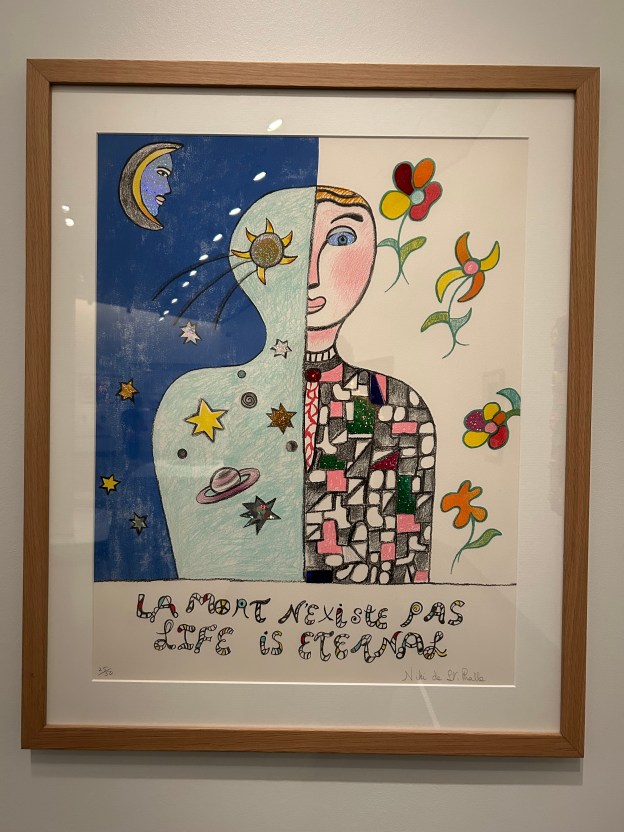
So then, perhaps what I appreciated the most about Niki de Saint Phalle’s later works was as much the longevity of their creation as it was their brilliant colors and joyous expressions. These are works which are meant to last so that generations of people will see them and perhaps in their forms feel a sense of their creator’s joy. I certainly felt that, even now 22 years after Saint Phalle’s death. I took one photo in the exhibit, of a color lithograph she made with a dualistic figure, on the one side with a human face and body and on the other the human frame surrounded by planets, moons, and stars. Beneath the dual figure Saint Phalle wrote in French and English, “La mort n’existe pas / Life is eternal.” I believe through our joy, no matter how childlike it may be, we can live on even after death. As St. Paul wrote, “Rejoice! Your kindness should be known to all.” (Phil. 4:4–9)


[1] Yes, there’s a great deal of problems with that new society’s foundations in the conquest and colonization of this continent.


Niki de Saint Phalle: Rebellion and Joy is on view in the Bloch Building at the Nelson-Atkins Museum of Art from 27 April through 21 July 2024. More information can be found here.

The Guy

This week on the Wednesday Blog, some thoughts on what it means to be a man in 2023 inspired by Greta Gerwig's new film Barbie. Yes, there are a handful of mild spoilers. — Click here to support the Wednesday Blog: https://www.patreon.com/sthosdkane

This week on the Wednesday Blog, some thoughts on what it means to be a man in 2023 inspired by Greta Gerwig’s new film Barbie. Yes, there are a handful of mild spoilers.

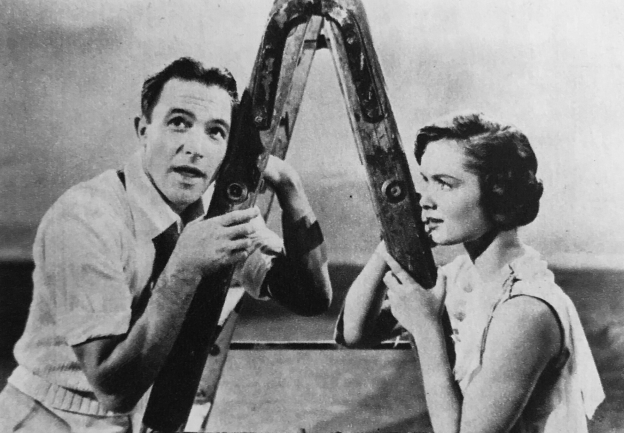
On Saturday I went to see the new and widely acclaimed Barbie film after many weeks of hearing glowing reviews. I was particularly caught by one review in the New York Times which discussed how a dance scene featuring multiple Kens, Barbie’s male companion, was reminiscent of and even nodding towards the work of the late great Irish American song and dance man Gene Kelly, one of my favorite actors. So, I went into this movie with that anticipation at seeing something approaching Mr. Kelly’s work again on the screen, and with a good humor about the whole experience knowing this is a film about a toy.

And yet as the film progressed it became clear that it was not just a film about a toy but a story about the roles which people hold in society as they are traditionally inspired and determined by their gender. It became clear to me that this film was both deep in its commentary and clever in its camp. I particularly loved the moments where the characters in speech more so than in action broke the fourth wall and joined the audience in the joke. Yet the core idea that there is a parallel world off the Pacific coast called Barbieland where the dolls created by Mattel live happy lives knowing what good they’ve brought to the human world is something with far older roots.

To me, this idea fit in with a sort of sense of Heaven, a land beyond our mortal imaginings where those who have made a good impact on the people around them end up and rest on their sunny laurels side-by-side with other do-gooders. The idea of a place where the streets are paved with gold, and where people go to be good neighbors fits too with the idealized image I admit to conjuring in my own imagination of California, especially on our darkest, coldest, and snowiest days here in the Midwest. I know all too well that this sunny dream is far from the reality of the Golden State or any other place on Earth, yet without that dream how can we bring such a place to life?

In the Barbie film, the characters that I felt were intended to be my proxies in the story were the Kens, Barbie’s doting male companions and besides the one Allan the only guys in Barbieland. To be honest though, none of the Kens really stood out to me as someone who I could recognize in myself. Sure, when I’ve had crushes or begun to feel affection for a particular woman, I’ve longed for her to notice me and signal that the affection is mutual, yet the idea that men ought to be like the Kens in the same way that each Barbie represents a different type of accomplished woman feels limiting to me.

I actually felt more of a connection to the one Allan in Barbieland because he at least could see what was going on around him, in part because of his isolation from everyone else. Michael Cena played the awkwardness of being the only person with a level of realization about the goings on around him that fits those of us who often watch the social scene unfold around them. What struck me most about the Kens was how extreme their swings were, from docile doting admirers of the Barbies to overacting and overcompensating defenders of patriarchy with a strange fascination for horses. Ryan Gosling’s Ken in particular seemed to draw a great deal of his character, especially when he took over Barbieland, from William Zabka’s character Johnny Lawrence in the Karate Kid franchise and most recently the wonderfully silly Cobra Kai series on Netflix. All the flaws of that hypermasculinity best characterized in the muscle-man action films of the 80s was visible in Gosling’s Ken, and this represents one image of the ideal American man which we still see in our society. He’s the kind of person who has the potential to gain power or high status in business yet lacks the depth and self-awareness to make him an emotionally mature adult.

I’ve known a lot of people like this, and in many ways, they are one side of the big spectrum of what I’d call the guy, the average American male. I’ve been thinking about writing something called The Guy for a while, and I may still go all the way and write a novel with that title describing an average man just trying to go about his life. To me, when I think of this guy, he’s somewhat of a cross between Harold Lloyd’s character in The Freshman (1925), or Robert Petrie on the Dick Van Dyke Show, or more recently Adam Scott’s character Mark Scout in the recent Apple TV series Severance. The guy is the straight man in his world, yet he could be the comic to those around him and not be in on the joke. He sees his life as not quite what he dreamed of but he appreciates what he has and dreams of better things. He might be in a relationship or married, he might be gay or straight, he could be of any ethnic or racial background, what’s important is that he knows who he is and has found a culture to make his own.

In some ways, I tend to think of myself as the guy. I certainly haven’t had a normal American story, I’ve traveled and am only now at 30 starting my first full-time job, yet in many ways I recognize that I have less control over the world around me than I’d like, and so I hang on to what I can and go with the flow. The guy relies on others, whether consciously or not, and appreciates being seen and heard, even if he may not be comfortable admitting it. The guy might like watching sports but isn’t necessarily an athlete. All around, the guy is the Illinois of American males, about as ordinary and run-of-the-mill as you could imagine with some interesting bits here and there in his life.

So, watching the Kens take the stage together in that Gene Kelly-inspired dance number at the end of Barbie, I got what they were trying to do, but they were all on such a far extreme end of being a guy from me that I had a hard time emotionally connecting with them. But then again, they represent the ideal American male in our popular culture, the popular guys in school who became the fraternity brothers in college and eventually the corporate executives in their careers. That’s not me, and I’m okay with that. I like it when I see other people accept that they don’t fit this ideal definition of manhood, yet I worry when some who do accept that fact then also lose interest in trying to better themselves, when they lose interest in becoming their own ideal self. That goal should never be forgotten for the sake of convenience. The best thing about the guy, above all else, is that in his finest moments he remembers to dream of better tomorrows, and will even find a way to make it happen. 

Our society needs guys like that to keep imagining a better future and how we can make that happen. They are the ones who Aaron Copeland honored with his New Deal era Fanfare for the Common Man. When I picture the guy in my mind, it is often in the style of the New Deal artists, the WPA painters whose murals decorate many public buildings across this country now 90 years after the New Deal began. Like all of Gene Kelly’s characters, the guy can dream, and will be remembered as a someone who makes those dreams come to life.