Tag Archives: Fiction Writing

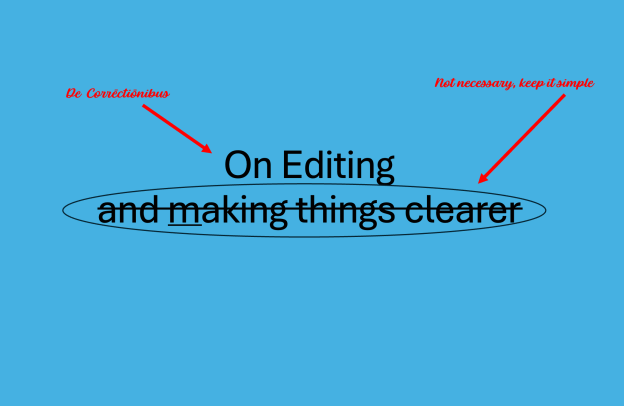
On Editing

This week, I want to write to you about the revealed joys found in the experience of editing. — Click here to support the Wednesday Blog: https://www.patreon.com/sthosdkane


This week, I want to write to you about the revealed joys found in the experience of editing.


I spent most of last Thursday editing a chapter I’m contributing to a new book about Shakespeare’s play The Tempest. My contribution argues that the bard was inspired in his descriptions of Caliban and the play’s island setting by André Thevet’s accounts of Tupinambá beliefs and the role of magic in their society, and the sense of Brazil as the archetype of the insular natural world across the sea at the turn of the seventeenth century. There’s a lot in its 32 pages, and it’s been a good effort on my part since I first saw the call for papers for this book two years ago. I wrote the first draft between March and June of this year both here at home in Kansas City, and while I was on my European trip this June; I spent most of my time in the San Francisco International Airport G Concourse United Club writing paragraphs for this chapter. 

Until last Thursday, I’d only edited it on my computer. This is a far faster way to edit text, it allows me to work as I’m reading through the draft. This method is still relatively new to me, I feel fortunate that I was taught to write by hand first and to edit with pen and paper. That’s been more challenging with my dissertation, in Binghamton I didn’t own a printer and because I could never figure out how to use the university printers, I relied heavily on the local print shop across the road from the University to print anything I needed. That meant then that up until the sixth or seventh draft I never saw it on paper, always on the computer screen for both economical and environmental reasons.

The week before last Thursday, when I returned to my Tempest chapter after finishing several other major projects, I found myself thinking that it could benefit my editing if I printed this document out at least for my last full read through before sending it off to the editor. So, returning to it just before noon on Thursday, I decided to print draft 4 of the full document, all 34 pages of it. As it turned out, there was something heartwarming about editing this chapter with pen and paper. Sure, I knew I’d save myself time by editing it while I was reading it on my computer, but I’ve found more and more that if I really need to work on a sentence, I’ll have to copy it out of the draft and into a separate document where I can look at it on its own separate from the rest of the text. This works, and this is what I often end up doing, but it’s not a problem I have reading lines on a printed page. I find I can read faster when reading something printed rather than something digitized, and now that I’m doing so many more things than just writing and editing my dissertation, moving towards these postdoctoral projects, I’m finding that I’m returning to how I read and wrote before I fully adopted all this technology.

Even though I now edit using more review bubble comments and review tracking on Microsoft Word or Google Docs than the old shorthand symbols that I learned in my elementary school English classes, I could still return to them with an ease that felt native to my sensibilities and origins as a writer and a reader. I even left the odd marginal note on draft 4 of my Tempest chapter should anyone else ever find this printed copy to see some of the things I was referencing in the additions and changes I made to this draft.

One of the greatest lessons I’ve yet learned about writing came from a policy writer who at the time worked for the offices of the European Union in Brussels. He came to the University of Westminster for a couple of days in March 2016 to run a policy writing workshop for all of us who were interested. I joined in and wrote a brief about a hypothetical crisis along the Danube between Hungary, Croatia, and Serbia (I think). While I’m less likely to become a professional political policy writer anytime soon, the most impactful thing he taught us was to leave whatever it is we’re writing aside once we’re done with a draft and return to it later. Like a good dough, our writing needs to rise for a while before we return to it and work on it some more. I took a week between finishing draft 4 and returning to it to complete the edits that make up draft 5 of this Tempest chapter, and I’m certain the finished draft benefits from that gap. It’s something I do here with the Wednesday Blog on those weeks when I’m able to write things in advance. The words you’re reading, or hearing, now were written on Thursday afternoon about an hour after I sent draft 5 off to the editor. I’ll return to them sometime on Tuesday, October 15th, and read through them again when I record them for the podcast.

The Wednesday Blog podcast actually grew out of my editing sessions for the blog. You see, I traditionally edit by reading my writing aloud; if it doesn’t make sense to my ear then it needs to be rewritten. Nearly three years ago then, at the end of November 2021, I decided one night after dinner to start recording those read-throughs and release them as a podcast version of my blog. Of course, the version you get in your podcast player each week is more polished than the first draft, but with these essays I usually don’t need to do as many edits. This is a different style of writing than my academic work, less formal, and more personal.

Editing also reminds me to express what I’m thinking in a clearer way. An early lesson in teaching that I received, and nearly all of my lessons in teaching have been on the job while I’m teaching, was to speak to my audience in their own language. This is a no-brainer when it comes to speaking French in Paris, or German in Vienna, yet what I mean here is speaking to your audience in a way that they’ll understand. I like to use the words they’ve just used in my answers. This is a grammatical thing in Irish where instead of having words for yes or no we instead say the positive or negative of the verb in question. I’ve begun doing this in my English too: responding not only with a yes or a no but with a yes, I do or yes, I can, or no, I don’t understand. Clarity is the best friend of writing and good communication. A common comment I get from editors is that what I’m trying to say is just under the surface or not quite clear yet. This is a symptom of how I developed my writing voice first in poetry and plays and later in short stories and now factual and highly researched non-fiction blog posts and academic essays. It’s been a weakness in my writing up until now that I’ve had a hard time getting over, but I think I may have figured it out by closely reading what I’ve already done with those comments up on a screen where I can clearly see them as I read.

Sometimes the thesis or plot of what I’m writing will change significantly in the edit. There are times where my original argument simply doesn’t work, and I need to adjust drastically to save the essay or story. This happened early on with this Tempest chapter, and I’m glad I saw the flaws in my original approach as early as I did because it made the chapter I’ve written in the five drafts since all the stronger. While that may be frustrating at first, I love the way that things work when all the pieces of the story or all the sources behind the thesis line up. I love how a good edit can inspire me to keep writing and get closer to my record average of writing 1000 words per hour. This is more possible outside of my academic writing where I often stop to consult a source to make sure I’m getting it right, but even there when I can write with a great fluidity, and I know what I’m trying to say it reminds me why I do what I do.


Correction: in my initial publication of this blog post I miswrote my average writing speed as “1000 words per minute,” when I meant to say “1000 words per hour.” I’m not Lt. Cmdr. Data.
Author vs Writer

Today, on Chiefs Parade Day, I thought it'd be interesting to consider the distinctions between an author and a writer. Click here to support the Wednesday Blog: https://www.patreon.com/sthosdkane

Recently I noticed when someone referred to a guy as “the author of x”, in my mind I thought about what it means that they were called “the author” and not “the writer.” This whole question came to me considering that in Irish, I’d introduce myself with “Is staraí agus scríbhneoir mé,” or rather “I’m a historian and a writer,” and the same goes in French « Je suis historien et écrivain, » yet in neither context would I introduce myself at a party as “I’m an author.” Both words have their origins and similar yet separate meanings in every language, and that distinction is worth noting.

Author comes to us from the Latin auctor via Old French autor, it’s a cognate of the modern French auteur. The Irish version of this, údar also comes from the Latin auctor, demonstrating that the core idea of an author may well have spread northwards with the Romans. On the other hand, writer is an inherently English word, a writer is most fundamentally someone who writes. I like words that make their function this clear, words that are built off of the verb that they accomplish. When I’ve thought about trying to emulate Tolkien’s work it’s been less to create my own massive legendarium of fantasy literature and more to devise new ways of understanding the world through constructed languages like his own Quenya and Sindarin. In those thought experiments one of the key principles, I’ve wanted to address is crafting a language where there is a relatively small vocabulary because every word is a stem upon which one adds grammatical endings to make it a noun, adjective, verb, or adverb, or to include prepositional elements to it. This is something you see in older languages like Latin with its declensions and conjugations or in Finnish with its 14 noun cases. So, these simplest of English words like writer that demonstrate what they do as efficiently as possible are among my favorites.

Author too in its Latin origins was a word like writer. An auctor is someone who increases or nourishes their object (augeō in Latin). In classical literature the story comes from the muses, In the Loeb translation Ovid began his Metamorphoses acknowledging “my mind is bent to tell” the stories that will follow, for “ye gods, for you yourselves have wrought the changes, breathe on these my undertakings, and bring down my song in unbroken strains from the world’s very beginning even unto the present time.” (Met. 1.1.1–4) Shakespeare picked up on this in his reading and began Henry V with the chorus uttering the line 

            “O, for a muse of fire that would ascend

            The brightest heaven of invention!” (Henry V, 1.0.1–2.)

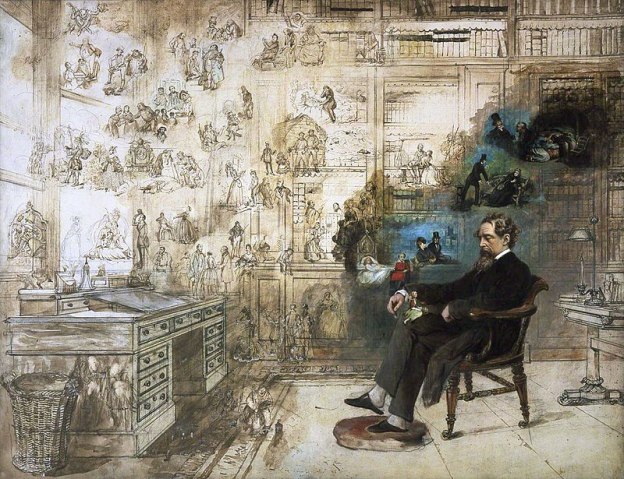
In my mind an author is both someone who has received inspiration for their work and an active participant in the creation of those works. There is a wonderful print of Dickens dreaming at his desk with all his myriad of characters he nourished into existence in his stories floating about him. I sometimes wish that this is the way that I’ll be remembered, as a storyteller who crafted so many lives that while they only exist in my writings therein is encapsulated a little world, an imagined reality all its own. In this act of creation, I am an author, but I am also a writer, for it’s my job to translate these worlds from my imagination onto paper where others can experience these characters’ lives.

A writer is a craftsman busy in their workshop devising new ways of getting information across. They could be writing serious factual information, reports of the events of the modern world, or setting the scene of stories more fantastical than anyone before could’ve imagined. I think of Dr. Franklin in his printing shop as the archetypal writer his sleeves rolled up hard at work, a stark contrast to the image of Dickens asleep in his chair dreaming of his many creations. Yet we rarely have authors without writers anymore, they are of course more often than not the same person, still in older times there were stories that existed without the written word. The Gaelic file tradition which I hope my own stories can be worthy heirs to is one such form of authorship beyond the boundaries of the written word.

So perhaps I don’t like to introduce myself as an author because of the world-building implications of authorship. Day-to-day I am a writer, a craftsman of words, scrawled onto paper, typed into a computer, and printed onto the page. I am an author of some stories, there are characters you’ve met here on the Wednesday Blog like Dr. Noël Felix and Captain Amelia Daedalus from a few weeks ago. I hope to get back into writing more fiction again in the coming months and years, to telling those kinds of stories. Yet perhaps because my authorship is so much more personal than my craftsmanship as a writer, I am left preferring to keep my creations closer to my chest and instead hold my craft out for all the world to see.


Fiction

This week, I want to explain how fiction is necessary for my survival.

I am in the business of writing serious, analytical, and factual accounts about the human experience. As a historian, that’s my job. I do write fiction as well, though I keep both as separate as the church and state are supposed to be in this country. Still, as much as I enjoy my work, as much as I like the feeling of getting my academic writings on paper and presenting them at conferences, when I’m looking for some fun reading, I usually turn to fiction. Fiction is fundamental to the human spirit, it allows us to dream, to imagine alternate possibilities, to envision possible futures.

At any given moment I’m usually reading 2 or 3 books for fun, normally there’s at least one sci-fi novel, maybe a memoir, and possibly something relating to natural history. I admit, 2 out of 3 of those are nonfiction, depending on how you understand the truth of that memoir, but if I had to choose between those three genres when I’m sitting alone in a restaurant at lunch or dinner or looking for something to read before bed, I’ll go for the fiction ahead of the others. I also tend to disagree with the trend of late that prefers dystopian fiction over anything else. There are so many of those stories out there, from the Ender’s Game books by Orson Scott Card, to the Blade Runner and Mad Max films, to even my old favorite Douglas Adams’s A Hitchhiker’s Guide to the Galaxy. I don’t like dystopia, and I don’t honestly understand how it could be enjoyable to read or watch a story talking about such a future. 

Rather, I prefer the opposite, utopian fiction, stories that offer us a vision of what our future could be like. I think that’s why I’ve been drawn to Star Trek since the pandemic began, and have now watched several of the TV series, a few of the films, and even read some of the accompanying novels. There’s something about a vision of humanity’s future as a contributing member of an interstellar community that really seems heartening to me, that as distant as that potential future seems now, we might well reach it someday. This is one area where my work and my favorite stories intersect; my historical research deals squarely with exploration, in my case mostly set in Brazil in the 1550s. In many respects, my research is a cautionary story of all the horrible things that the explorers fanning out from Europe did to the peoples they encountered. Normally, academic history books aren’t read by many people, and certainly there are only a few that get much public attention. So, I hope that if anyone eventually reads my work, they’ll recognize in it my efforts at warning our own generations and generations to come of the rocks and shoals that threaten any present or future explorer who seeks to venture out without harming others in the process.

So yes, my love of fiction does influence my work, but only indirectly. When it comes to my writing, when I need to refresh and rethink my work, I’ll turn to those same novels and bask in their eloquence and style. As a writer, as a dreamer, as an optimist, fiction is necessary to my survival.

Keeping Fiction Alive

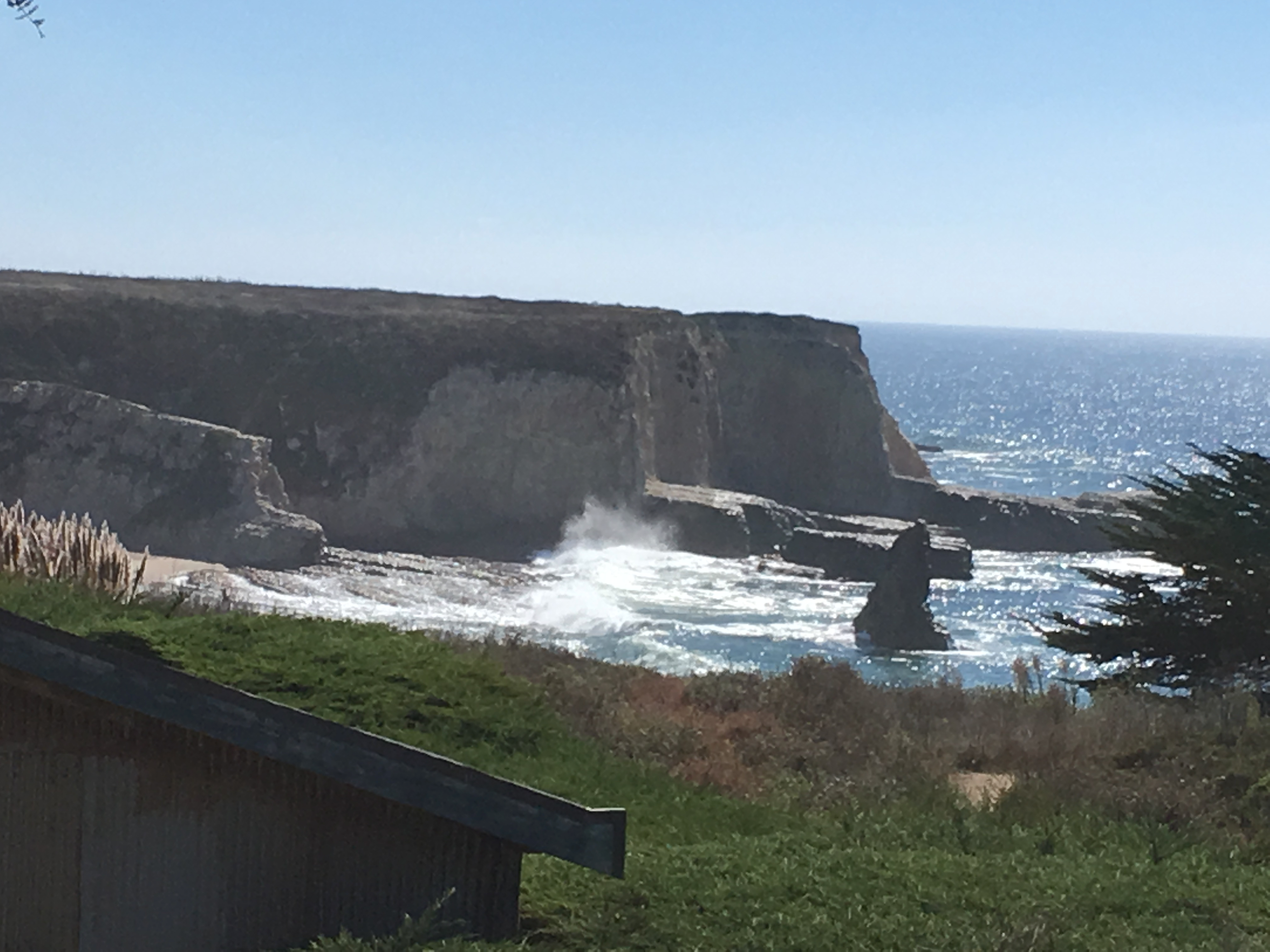
A picture I took of Shark Tooth Rock in Davenport, CA (13 October 2018)

A few years ago when I started working on my PhD here at SUNY Binghamton I arrived not only with a game plan in mind for getting this job done but with 4 chapters written of the sequel to my novel Erasmus Plumwood. That sequel, Plum in the Sun, follows Plumwood west to San Francisco where he’s started working on his dream job in a Silicon Valley company called Technophilia. The only problem is that when he arrives there he finds the job to be far from the dream he hoped it’d be, in particular because of a really awful boss named Don Basil who has it out for Erasmus.

I tried a few times to keep writing Plum in the Sun in my first semester in Binghamton but I found the task was a lot more difficult to do now that my mind was so squarely focused on the doctorate and setting myself up for success academically here. With that in mind I set the novel aside figuring I’d come back to it eventually. It’s only been in the last couple of months that I’ve started to think about working on it again, and while I’m certainly not going to do much of anything with it as I’m in the middle of the doctorate right now, I’m nevertheless beginning to think about working on that novel again.

The next chapter on the list to write is another of my fictionalizations of my own memories, replacing the real people who were with me in the moment with the characters populating this story. The basic premise of the chapter is that the two main characters, Erasmus Plumwood and his girlfriend Marie-Thérèse Merlinais, get more comfortable being together in California on a Sunday drive along the Pacific Coast Highway around Half Moon Bay, something my Mom and I did in October 2018 in what was one of my favorite days yet. I’m looking forward to describing the indescribable beauty of the redwoods and the coastline, the bird song and the feel of the sea breeze on my face.

But this is a story that I have to be in the right sort of mood to write. It’s not something I can do when I’m annoyed or tired or grumpy in any way, it has to be something I write when I’m in a really good mood, not all that different to how I was feeling on the day of. There’ll be some things that will be different between the real event and its fictionalized counterpart; for one thing we made that drive in October and the characters will do it in June, but considering that like it was for me it’ll be Erasmus and Marie-Thérèse’s first time seeing those sights I think my experience can still inform theirs even if I didn’t see it all in Summer.

I do intend to finish Plum in the Sun. If I’m being honest the plot and the characters are a lot stronger than the original book in what’s becoming a series. I was joking a few years ago with a friend that if I did make a series out of Erasmus Plumwood and Plum in the Sun then I might try and make it sound grandiose, if in a mocking way, and call it the Plumwoodiad. I do have a third book in the back of my head wrapping up at least this part of the lives of my characters, but considering I’m putting a dissertation ahead of Plum in the Sun on my writing assembly line, any third book in this Plumwoodiad is well further down the line and won’t be seen for a while.

So as I keep moving through my doctorate, I can’t help but smile when I think of what awaits me when I eventually do get to writing this chapter. It’ll be a wonderful few days spent intensely remembering that day and all I saw in one of the most beautiful parts of this country.