

On Translation – Wednesday Blog by Seán Thomas Kane
This week, how I take nuance and particularity into account in my efforts as a translator.
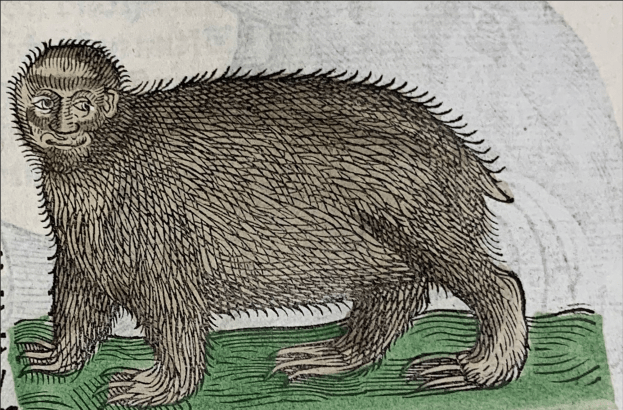
When I chose to study André Thevet (1516–1590) and the three-toed sloth in August 2019 I did so because I already knew French and the need to learn a new language was less pressing than if I’d chosen to study another source in the history of natural history. I chose Thevet because it was practical, and I chose the sloth because the thought of being a sloth historian made me laugh. From the first day working on Thevet, I found that my understanding of his books was heightened when I took the time to type out my own translations of his text. Thevet wrote in Middle French that is native to the middle decades of the sixteenth century. I arrived at this project very familiar with Early Modern English, the contemporary form of this language to Thevet’s time, as my history master’s thesis delt with sources in that chronological variety of English from Thevet’s generation and the one just before. I’ve never had much trouble understanding the most prolific author of Early Modern English literature, Shakespeare, but I think I’ve had a tolerance for varieties in speech that’s allowed for me to try to think beyond my own millennial Midwestern metropolitan American English and be willing to understand the likes of Shakespeare from a young age.
So, when I began translating passages from Thevet’s Singularitez de la France Antarctique for my own professional use in my dissertation, I decided that as long as I was translating that book I might as well translate it with the intention of sharing Thevet’s words beyond the scholarly analysis and critique which lie at the heart of my work as a historian. This first draft is built around the 1558 French edition published by Christophe Plantin (c. 1520–1589) in Antwerp and contains footnotes drawn from the 1878 French edition by Paul Gaffarel published in Paris, two Brazilian Portuguese translations by Sergio Amado (1978) and Estêvão Pinto (1944, using the 2018 reprint), and the partial 1986 English translation by Arthur Stabler and Roger Schlesinger which contains only Thevet’s North American chapters.
I finished the first draft of this translation in Summer 2023 and am now looking ahead toward the second draft which is the next stage of the project, and I hope the last one before I feel confident in formally writing to the publishing editors whose press sales agents I’ve spoken with about this project at conferences over the last two years. The second draft will consist of two main stages. First, I will cross-reference my translation and the 1558 Antwerp edition on which it is primarily based with the 1557 first and 1558 second editions published in Paris by Maurice de la Porte, two Venetian editions translated into Italian by Giuseppe Horologgi and published by Gabriel Giolito de’ Ferrari (c. 1508–1578) in 1561 and 1584, and the 1568 full English translation by Thomas Hacket published in London by Henry Bynneman. Second, I will seek to make my translation more understandable for a 21st century English-speaking reader while endeavoring to preserve Thevet’s particular mannerisms and voice, a writing style with which I’ve become quite familiar in the last 6 years to the point that I can now confirm at least two French translated manuscripts in the Bibliothèque nationale’s collections in Paris are verifiably written by Thevet. He had a way of writing that’s unmistakable.
These two competing axes create a binary star system around which my translation revolves. On the one hand, I want to be true to the original text, to preserve the author’s voice and something of their spirit which remains in those words. On the other hand, I need to make my efforts readable for my own contemporaries. Thevet and his contemporaries are notorious for long run-on sentences that would make Hemingway shake his head in earnest frustration. Where do I break up a long sentence while preserving its overall integrity? Furthermore, at what point should I decided to remove the bracketed notations of page breaks in the original text? There the 1558 Antwerp edition is most fully evident as its pagination has several quirks that make it stand out from the 1557 & 1558 Paris editions. At this point, Plantin published books with folio numbers rather than page numbers, so the first two pages were in fact folios 1 recto (1r) and 1 verso (1v). These names refer to the custom that scribes traditionally started writing on the back side of the vellum (recto in Latin) and then flipped the skin over once ready to continue writing on the verso, or opposite side. In several instances the folio numbers actually decrease in the book, notably in Thevet’s chapter on the sloth, which makes the footnotes on that core element of my research particularly confusing if you’re paying close enough attention. So, in summation the inclusion of the page breaks with the folio numbers keeps my translation grounded in Plantin’s edition, however that may break up the text in an uncomfortable way for some readers.
Ultimately, I am not the author of this book, merely a herald relaying it on for our time. My voice is there in the handful of introductory chapters I’ve written to go along with this book. These chapters describe Thevet as a reader of travel literature and place his accounts of the Americas beyond what he himself saw in Brazil in the context of their French and Spanish sources. I see my efforts in this as a means of introducing the reader to Thevet, a man who today exists on the furthest margins of the popular imagination of the First Age of Exploration in the English-speaking world. Thevet remains present in academic circles, there were at least four papers presented at this weekend’s annual meeting of the Renaissance Society of America in Boston which discussed Thevet, mine included. I hope this book will be useful to fellow academics and perhaps will entice curious readers to learn more about this man who I’ve spent the last 6 years of my life getting to know.I find myself drawn as much to the effort of a translator as I do to the work of a historian these days. We live in such a fractious time when reasoned debate and earnest discourse is riddled with dangers and seemingly improbable to undertake. I feel as though I’m constantly translating my thoughts and character for others to understand me. It’s why I enjoyed my time in Boston because that city has a large enough Irish American population that when I’d tell my name to a cashier to put on a carry-out order they’d actually spell it in the proper Irish manner; this never happens in Kansas City. That said, I felt that I had to translate my expectations and personal limits to be able to live even for just a few days in a city as expensive as Boston where I was often paying double what I’d normally pay at home in restaurants. In translating I recognize that each of us think in slightly different ways and see the world in which we all live in just as unfamiliar terms to one another. Difference enhances our common humanity and elevates our manner to something greater than ourselves.
 Wednesday Blog by Seán Thomas Kane