Tag Archives: French

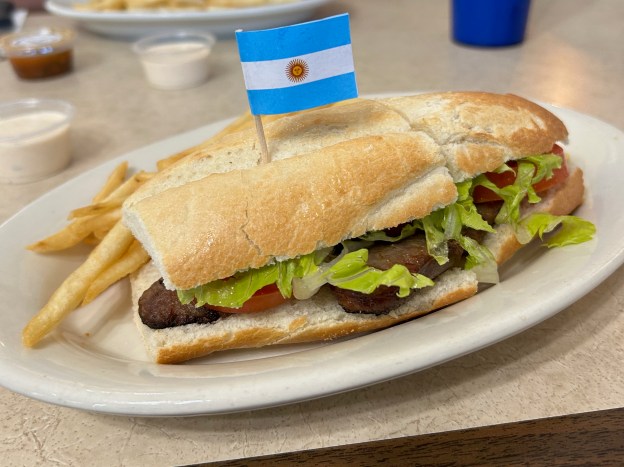
A choripán sandwich from Los Hornos Argentinian Flavors in Kansas City, Missouri photographed by the author just before it was eaten by the same.

On Language Acquisition

On Language Acquisition Wednesday Blog by Seán Thomas Kane

This week, how living in a culture is required to speak a language in depth.—Click here to support the Wednesday Blog: https://www.patreon.com/sthosdkane—Sources: [1] “A Letter from San Juan,” Wednesday Blog 3.29.[2] “The North American Tour,” Wednesday Blog 5.34.


This week, how living in a culture is required to speak a language in depth.


The languages which I speak are directly responsible for the ways my life has turned, its winding path a result of the words I use and the ideas they represent. Language is the voice of culture; it evokes the rich harmony of thought that comes from seeing things from certain points of view. At the University of Westminster, I was regularly in classes where there were maybe 10 or 20 languages spoken between each of the students, if not more. English remained our common language and the language of instruction, yet how many of us must have been switching between English and their own native language as they thought about the readings and topics in political philosophy and science which we discussed on a given day? Even then, my English is not the same as the King’s English, nor is it the same as the English I heard spoken when I drove through Alabama in July 2022. Language then reflects our individual circumstances of experience. Knowledge is gained through experience first and foremost, whether that experience be theoretical through books or practical through lived experience. I make this distinction because I often feel that when I’m reading a particularly well written book that I can actually imagine the characters as real people who I might meet in my life. The best TV shows and films are like that, their casts that we see regularly begin to seem like old friends who we look forward to visiting again and again.

Language acquisition is a lot like this for me. Today, I speak three languages: English, Irish, and French, and I can read Latin, Italian, Catalan, Spanish, and Portuguese and some Ancient Greek. I break my languages down into these two categories by their utility in my life. The handful which I can read are those which I’ve worked with in my historical capacity. I’ve spoken Italian and Spanish from time to time, yet those moments of elocution are few and far between. The same could be said for my German, though it’s now been five years since I last spoke that language in Munich, and at time of writing I can’t say that I’d be much use in remembering it today. This is even more true for my Mandarin, a language which I studied for a semester in between my two master’s degrees out of pure curiosity. I can remember the pronouns, a couple of verbs, and a noun or two but that’s about it. All this to say that I may know something about German and Mandarin yet it’s little more than a foundation for the future when I might be faced with a desire or need to learn the language properly.

I’ve been thinking lately that of any of these I need to work most on my Spanish, the most useful of these languages for me to speak here in the United States. I can understand Spanish fine yet speaking it remains a challenge. On Sunday evening after my shift I decided to reopen the Spanish course on the app Busuu––one which I used for Spanish before my March 2023 trip to the Renaissance Society of America’s annual meeting in San Juan, Puerto Rico––and try it out again.[1] That time I got through the A1 level before life got in the way, and I gave it up feeling frustrated with the process. I did not resume any online Spanish courses before my trip to Mexico last November for the History of Science Society meeting in Mérida, instead choosing the less preparatory method of winging it.[2] That worked with fits and spurts, my best Spanish conversations were in taxis with locals, though I was mostly thinking about how I would say things in French and then Hispanifying them based on my minimal knowledge of Spanish grammar. On Sunday, after I retired for the evening from my Spanish lessons on the app I realized what it was I missed so much in these apps: the human connection. Busuu prides itself on its crowd-sourced learning method; throughout the course learners are asked to submit spoken or written answers to the computer’s prompts which learners of other languages who speak the target language then correct. I like this system overall, and it does give this sense of community, yet I feel that it could go further.

After English, the second language I learned was Irish, my ancestral language. I started studying the Irish language when I was fourteen and have been focused on it to varying degrees for the last eighteen years. It really took until 2022 for me to connect with the language though, in spite of the fitful starts and stops because in that year I began to build a community around the Irish language. First on Zoom through Gaelchultúr, an Irish language school in Dublin, I met other speakers from across North America and beyond who like me were descendants of Irish immigrants old and new. I looked forward to seeing some of the same people term after term. Yet after returning to Kansas City, I began to look locally for Irish classes and came across the community that my friend Erin Hartnett has built at the Kansas City Irish Center. Through Erin I’ve met some really good friends and from our mutual appreciation for our ancestral language we’ve found a lot more in common from mutual histories to mutual appreciations for rugby. Without this community I would speak Irish but not terribly well. Now, not only do I speak Irish daily, but I also write in Irish every day. It has truly surpassed French as my second language, something I’m proud of yet not too concerned about when it comes to my Francophonic abilities.

French exists in a different sort of place for me than Irish. It’s not an ancestral language with deep family ties. Rather, it’s a language that I gravitated toward out of a fascination with French culture and history. I may have written here in the Wednesday Blog before that my first exposure to French came at sunset on a Sunday in February 2001 when my Mom put a “Learn French” cassette tape into the tape player in our family car when we were driving through the hills of northwestern Illinois toward Dubuque, Iowa. She and I were preparing for a trip to London and Paris that summer, the first European trip that I could remember, and she wanted to put in the effort for us to have some French before we arrived on the Eurostar from Waterloo Station at Paris-Gare du Nord. I didn’t like Paris much on that first visit, I found the language barrier to be too great for me to really feel a sense of connection with the place. On my next visit to France in March 2016 with three years of undergraduate French under my belt I found that I not only got the place more, but I appreciated the nuances of French culture more than I had as a child.

I owe a great deal to my undergraduate French professors M. Kathleen Madigan and Claudine Evans. It’s through their classes that I gravitated toward my career studying the French Renaissance. When I get asked why I chose to study the French I keep it simple and say it was a matter of pure convenience: I already spoke French, so I wouldn’t need to learn a new language (Spanish or Portuguese) to read my primary sources. That’s how I ended up studying André Thevet (1516–1590). I chose him because he happened to write about a sloth and for me the idea of being a sloth historian made me laugh. It’s as simple as that. I loved studying French in college, and even more teaching it with the online Beginner French course I built for the Barstow School in 2023 and 2024. I found that going through the same textbook I used a decade before I was not only teaching the students who in the future would go through my course, I was also renewing my own French education and learning things that I’d missed on my first go around. This is a critical point in language acquisition: few people are going to get a language on their first try, it’ll take multiple goes to understand what’s being said and to make oneself heard as well. It took me three tries to get Irish down, and the same is the case for Latin. Failure in the moment is merely a setback which can, and ought to be overcome in future endeavors. After all, remember that if we’re paying attention to our lives we’ll learn from our experiences.

I grew to really embrace a lot about the Francophonie to the point of paying Sling TV for access to TV5 Monde, France’s global TV channel which now broadcasts several different channels. I personally enjoy TV5 Monde Style, which tends to broadcast documentaries and cooking shows, though I don’t watch it as much as I might like. I read a lot of French books for my research, after all I work with source material that has largely only been written about in French and to a lesser extent in Portuguese. I am able to do what I do with those sources because I can read them and the secondary literature about them in French. All this made it all the easier for me to go to France and Belgium in the last several years and be able to switch from English to French as soon as I walked off the plane. I found when I was flying back to the United States in June 2024 after spending about a week speaking mostly French in Paris that I was consistently responding with the quick phrases “please, thank you, you’re welcome,” and the like bilingually with the French followed by the English as I’d heard so many people do in shops and the museums during that visit. It took me a while to get past doing this and just say things in English again after I returned.This then is why I think I’ve had so much trouble with learning Spanish. It’s the first language that I’ve given a big effort to learning outside of a classroom on my own. At least in the classroom you have fellow students around you to practice with. When you’re on your own you’re on your own, a wise-sounding craic which is to say that when alone you have no one else to talk with. I have friends here in Kansas City who speak Spanish, and I know all I have to do is ask, yet it’s finding the free time to sit down with them and work on it that I need to figure out. To truly gain a footing in a language one needs to immerse oneself in the culture. Apps and online learning will only take you so far. A classroom learner will blend into their own classroom idiolect of the language in that particular space where it exists in their life. Only if they move beyond classroom and begin to converse and live with people in places where that language is spoken will they begin to speak it in a manner which is more recognizable to native speakers.


[1] “A Letter from San Juan,” Wednesday Blog 3.29.

[2] “The North American Tour,” Wednesday Blog 5.34.

Two Cities

This week, a few words about the trip I just completed to London and Paris. — Click here to support the Wednesday Blog: https://www.patreon.com/sthosdkane


This week, a few words about the trip I just completed to London and Paris.


If there’s anywhere in Europe, I’ve visited more than anywhere else it’s London and Paris. 

When I was eight my Mom took me on a two week tour of those two cities which I found to be life changing for how they opened my eyes to a far wider world than what I’d previously known. My fascination for European history began on that trip; it’s a fascination that I’ve made into my career. I remember that February she put a “Learn French” cassette tape on while our family was driving through the hills of northwestern Illinois from Chicago to visit relatives at Mount Carmel, the Motherhouse of the Sisters of Charity of the Blessed Virgin Mary in Dubuque. I still think of that evening, watching the sunset over those hills, as the moment when I was first introduced to French, a language that I have come to define a great deal of my brand as a historian, writer, and translator by.

I remember thinking after our return from Paris in June 2001 that before that trip when I thought of what I was most excited about it was the Space Shuttle, dinosaurs, cowboys, and American history. Yet after that trip, while still thrilled by these things they still felt dulled somewhat by a new passion for medieval castles and far older history than what we had in our young republic. What’s funny to me about this is that these same thoughts returned in the days before I left for Europe. While normally Memorial Day wouldn’t have as much of an impact upon me, I think it’s pairing this year with the 80th anniversary of D-Day left me far more profoundly moved with pride in our republic, and what our people have accomplished across these generations. I returned to Europe then in much the same mindset that I had when I first visited London and Paris 23 years before, albeit with those 23 years of experience framing my thoughts.

London remains a home-away-from-home for me, having lived there for a time. Some of the optimism I remember feeling in that city in 2015 and early 2016 seemed to be renewed, if slightly, by the prospect of the upcoming General Election which will likely see a change in the governing party for the first time since 2010. I arrived there not entirely wanting to cross the Atlantic on June 6th. I always feel a hint of fear when I travel, especially overseas; this has been magnified since the pandemic when international borders were closed and for years afterward travel remained severely limited. The thought of being stranded somewhere away from my family leaves me shuddering, and has given me more pause when considering travel since 2020. Still, the flights, trains, lodgings, and some museum visits booked, I left home on the morning of June 6th and flew west to San Francisco, where I caught my transatlantic flight on United to Heathrow.

Why go west to go east? I tend to use my miles to fly international, and it was 30,000 miles cheaper to fly through San Francisco than my usual connections in Chicago, Newark, or Washington, or even through Toronto on Air Canada. Like last time, I felt a renewed sense of welcome when I arrived in London, and throughout my stay with friends in the Home Counties, I knew that this remained a place where I could build myself a home if the opportunity or need arose. One key difference from my last trip in October was that I was less concerned with visiting every single place I wanted to see from my time living there. I didn’t feel that desperation or passion to see and do everything that I’ve long known. Rather, I was content to be there again, and to enjoy what I was able to see and do. I prioritized seeing special exhibits at the museums alongside the permanent collections and was thrilled to visit the Tropical Modernism Architecture and Independence exhibit at the V&A, an exhibit on birds at the Natural History Museum, and two exhibits at the British Museum. 

The first of the British Museum exhibitions spoke to the initial field of study I wanted to pursue after finishing my MA in International Relations and Democratic Politics at the University of Westminster. It followed the life of a Roman legionary during the reign of Trajan, and provided a full introduction to the legions and auxiliaries of the Roman Army during the height of the Empire. In 2016, when I chose to return to History from Political Science, I wanted to study the expansion of Roman citizenship to provincial subjects either after the Social War during the late Republic or during the reign of Caracalla when in 212 CE the emperor extended citizenship to all free men in the Roman Empire. That initial interest eventually led me to where I am today studying the natural history of the Americas in the Renaissance, by admittedly a circuitous route. The second British Museum exhibition was closer to what I study today in its chronology as it covers the life and works of Michelangelo Buonarroti (1475–1564). It was inspiring to see his own self-portrait gazing out at us visitors, and to see his letters and sonnets in his own hand on paper there in the exhibit gallery.

After a weekend in London, I traveled south to Paris for a conference on collecting in early modernity that was held at the École des Hautes Études en Sciences Sociales (the School for Advanced Studies in the Social Sciences) in their building on Boulevard Raspail in the 6th Arrondissement. The building in question is important in the historical profession as it is where the French Annales school has been based since 1947, the Annalistes being quite influential in introducing new methods and theories of studying history to the profession globally in the postwar years. There, I presented my research into the provenance of two Tupinambá ritual artifacts today housed in the Musée du Quai Branly, also in Paris, which were likely brought to France by André Thevet in 1556 as gifts from the Tupinambá leader Quoniambec (d. 1555).

I’d intended to use the majority of my time in Paris to work in the various departments of the Bibliothèque nationale de France and Archives nationales to look at some sources I didn’t have online access to, but instead in the months leading up to the trip I was able to find and request several of these documents be emailed to me, while others were restricted due to their poor physical condition. As a result, I only viewed one document, Thevet’s 1553 French translation of the Travels of Benjamin of Tudela, a 12th century Sephardic traveler who toured the Mediterranean. I spent a lovely morning sitting in the ornate Department of Manuscripts in the BNF Richelieu site reading and photographing Thevet’s translation. It was the first time I’d ever seen Thevet’s handwriting in person and gotten somewhat of an unscientific sense of the man himself between the lines. Looking at the folios, I had a sense of familiarity in a man who started with elegant pen-strokes which with each turn of the page became quicker and impatient. The last significant work that I wrote out by hand, a play I wrote in 2011 titled The Poet and the Lamb, had the same feel to it. I enjoyed writing it by hand, but it proved to be more of a burden than the art I intended it to be when I eventually typed it all out after all.

My theory is that considering Thevet took the time to translate Tudela’s travels into French, all 56 folios (112 pages) of it, that he likely modeled his own Mediterranean travel account La Cosmographie de Levant and his later Atlantic travel account Les Singularitez de la France Antarctique on aspects of Tudela’s work. I found my efforts at reading his Tudela translation were aided by my deep knowledge of the Singularitez, which I’ve translated into English. Thevet has a particular style and verbiage that you get to know after translating an entire book of his, a project that for the first draft alone took me three years to complete.

Without any other archival visits scheduled, I spent the rest of the week enjoying a few days of life in Paris. I visited several museums each day, wandered about the city from bakery to bakery (it’s not just a joke I tell about the bakery crawl being my favorite type of walk), and looking around bookshops selling both general titles, specialized academic titles, and several antique bookshops selling volumes largely published in the 18thand 19th centuries, though there were several I browsed through printed in the 17th century.

All around, this was a pleasant trip. When I returned home to the United States on Bloomsday, the holiday commemorating Leopold Bloom’s day about Dublin on 16 June 1904, I was left with an unsettling feeling that both in climate and in history that I fit in better in Europe than in America. For one, none of the muscular or joint pains I often feel walking around Kansas City are present when walking similar distances in either London or Paris. For another, the pace of life and the dearth of car dependency is certainly better all-around than how we’ve built our cities and lives here in the United States. I’d happily take the bus around town at home, if the temperature dropped below 90ºF (32ºC) during the day, and if the bus schedule worked with my own.

In these two cities I’ve grown to become much of the guy who I am today. This was my sixth visit to Paris, and a return to an old hometown of mine in London once again. In them, to draw the Dickens analogy out further, I’ve seen some of the best of times, and yes some of the worst of times, yet I’ve learned now to go with the flow, to not worry too much, and to embrace the opportunity to travel to these places. Travelling has made our world far smaller than ever before, so that the 4,500 miles (7,242 km) between Kansas City and Paris seem not as far as it really is. After all, before aviation it would’ve taken close to 10 days to travel between these two cities, whereas now it’ll take only a day.


Our First Languages

Last week, I listened to an essay from the New York Times Magazine about the possibility that one might lose their first language if they use another too much. Today then, I write to my own experience in this matter. — Click here to support the Wednesday Blog: https://www.patreon.com/sthosdkane

Last week, I listened to an essay from the New York Times Magazine about the possibility that one might lose their first language if they use another too much. Today then, I write to my own experience in this matter.


We choose how we sound to the extent that our physical bodies can allow. This means that our voices and body language can change as we move between environments and groups. I’ve seen this, and even noticed it in myself. My jokes change depending on the setting for one, yet also my tone and accent will deviate to the slightest degree when I move from one group to the next. This change is all the more dramatic when I’m speaking a different language to any significant degree. Last October, when I was in Brussels and Paris, I was speaking French far more than English. On two occasions when I met with friends who I normally speak with in English, I noticed something strange was happening to my voice: my accent was dulled. 

I like to compare the human voice to a pen, in the right hands and with the right training it can move with fluid precision. When at my best moments I can glide in and out of a series of registers with ease and use those different registers to accentuate the point I’m making. You’ve heard some of this here on the Wednesday Blog, those who listen to the podcast that is. The range of sounds I can make is far broader than the mere 26 letters of the English alphabet; this is thanks to my experience speaking other languages, French and Irish in conversation, and to the years of singing Latin hymns at Mass and practicing reciting Ovid and Virgil in my high school Latin classes. I can make myself understood in German, Italian, and Spanish as well if needs be, thanks to the other four I’ve spoken most frequently.

So, at those two dinners, one in Paris and the other a few days later in Brussels, I found that the usual fluidity of my speech was lacking, that I couldn’t quite make all the sounds I usually can. It occurred to me then that speaking French so much had made it harder to switch back into English after all the exercise that my vocal muscles had parler français produced different results to my usual practice speaking English. The author of the essay in the Times Magazine, Madeleine Schwartz, writes about losing recall of one language as much as the physical difficulty of making the sounds not made in the language, she uses the most. For her, the American English r sound was especially challenging after saying the French r so often. For me, my version of the French /ʁ/ is in fact an approximation that I make based on the Irish /ɣ/ sound as in the word dhá, a variation of the number two. These two sounds are approximates of each other, the French /ʁ/ is an uvular fricative while the Irish ɣ is a velar fricative. This means that the French /ʁ/ is produced further back in the mouth than the Irish /ɣ/. Still, my American English /r/ becomes a challenging sound to make when I’ve been saying /ɣ/ or /ʁ/ all day.

On top of this, I’ve steadily worked on mastering another r sound, the trilled r sounds. I say sounds because there are a variety of these that an individual speaker can make depending on where on the tongue you produce the sound. I can make three of these sounds, one which is more of a clipped r that I picked up from Peter Cushing’s performance as Grand Moff Tarkin in the original Star Wars that I think of as more high-brow stage English, the second is a fuller trill, scientifically called a velar fricative, not quite at the tip of the tongue that I use at the beginnings and middles of Irish words, and in Latin and when I’ve spoken Italian and Spanish, and the third is a wisping of air just beyond the tip of the tongue that I use to make the r sound at the ends of Irish words. This last r is called a palatized fricative. These have all taken practice to learn and even more practice to begin doing on a regular basis. Again, I chose to speak the way that I do, and to change registers when I am speaking to a public audience, what you hear here, compared to when I’m speaking with family and friends.

I find that the letter r is important for getting down any accent, because it is so particular to each. It’s a sort of in-between sound that is a consonant yet can act like a vowel in some ways. It’s perhaps fitting then that this same Irish velar fricative ɣ is spelled dh, a digraph which is also pronounced in my Irish as the schwa vowel, /ə/. In my speech, I want to be understandable to my audience, yet also express an aspect of myself in a way that will appeal to that person. While my first language is English, my own urban Midwestern variety of it, my experiences and travels have transformed my idiolect into something that transcends regional boundaries now with bits of London and the Northeastern American English accents that I’ve been exposed to filtering in alongside the ways that my family and community here at home talk amongst ourselves.

One question I still have, one which I’ve pondered for years, is does our modern code switching reflect the abilities of our prehistoric ancestors and perhaps the early evolutionary history of language and human speech? Are other animals able to change how they communicate to reach the widest possible audience? It’s notable to me that a great deal of evidence shows that adult domesticated cats only meow to humans, a vocalization they normally only make as kittens to their mothers. So, in the cat’s meow we hear a conscious change in vocal expression intended to get whatever they’re feeling or thinking across to us. Had I not become a historian, I would have probably chosen to pursue anthropology, focusing on the evolution of human communication and human language.

What do you think about this? Do you intentionally change how you speak to be understood by specific audiences? Let me know in the comments on this blog post at wednesdayblog.org, or on the social media platforms where I share this: Facebook, Instagram, LinkedIn, and X (formerly Twitter). You can also share your comments on the Wednesday Blog Patreon feed where I share these blog posts with more of an introduction from me and a bit before they go onto the social media channels.


Lost in Translation

This week, I talk about my experiences as a translator. — Click here to support the Wednesday Blog: https://www.patreon.com/sthosdkane

Over the last three years I have consistently worked in the background of my dissertation research and all the other things I’m doing, including this blog, on translating one of my dissertation’s most important primary sources from Middle French into Modern English. That book, André Thevet’s Les Singularitez de la France Antarctique was initially published in 1557 and then translated into English only 11 years later in 1568 by a man named Thomas Hacket. However, since 1568 Hacket’s translation has been the only one that English-speaking readers wanting to explore Thevet’s Singularites have had available to them. 

There are some partial translations out there, most notably Roger Schlesinger and Arthur Stabler’s 1986 book André Thevet’s North America: A Sixteenth-Century View, yet Hacket’s remains the only full translation into English. So, not only is the work I’ve been doing helpful for my own research, yet it is also groundbreaking in reopening that dusty door that leads into Thevet’s life and work for a great many English-speaking readers and scholars. It’s my hope that people find my translation of The Singularites of France Antarctique both useful and fascinating to read, as it offers a window into a worldview that in some cases makes sense while in others appears far out of place in our own world.

I have always had a fascination with and love for languages. As long as I can remember I’ve had memories, and many of those memories are of long hours engrossed in one language or another, like many of my relatives taking watches apart to see how they work I often do the same with language, learning how each grammar and mode of thinking developed in a common lineage and dialogue with its neighbors and relations. My own language studies began with Latin, which I first tried to learn 20 years ago as a 10 year old, though it wasn’t for another four years until I started high school at St. James Academy that I really began to understand what I was looking at. Around the same time, I also started studying Irish in the evenings at the Irish Center of Kansas City. Both languages are ones that I still study, and enjoy reading, speaking, and writing. 

In the years since, I’ve learned French to a level that when I’m there I can go about my life in France without using English. Translating Thevet’s Singularites has really helped with that, as three years of intense reading of his Singularites really gave me a strong impression on how French, albeit in an older form, works. One of the big differences with my translation of the Singularites is that I took a lot of time to consult page-by-page several modern Portuguese translations of his work published in 1978 by Eugenio Amado and in 2018 by Estêvão Pinto. Thanks to their common Latin heritage, and to the general use of Spanish around me for much of my life, I find reading Portuguese and Spanish to not be very difficult at all. 

There are languages out there which I can read, and to a degree write in, but cannot speak very well. Portuguese and Spanish fall into this group, as does Ancient and Modern Greek. I studied Classical and Koine Greek, two ancient variants, in high school and college at Rockhurst, yet I just don’t have the training or experience with either forms of Greek to be as comfortable or confident in Greek as I’d like. Eventually, I do want to spend the time to learn Ancient Greek as well as Biblical Hebrew, yes at some point I’d like to study the Bible in the way that I’ve studied the works of the humanists from the fifteenth and sixteenth centuries.

I’ve also here and there studied Bulgarian, Mandarin Chinese, Māori, and Egyptian Hieroglyphs. Again, all of these came out of pure curiosity on my part, and while I’m unable to speak the first three or properly read the latter, I do know a thing or two about each. Thanks to my work with Bulgarian, I can read the Cyrillic alphabet, and I do remember a few things, though I haven’t used any of it in quite a while. During the opening ceremony of the Beijing Winter Olympics last year, I ran through what I could remember from my Mandarin Chinese class in the Spring semester of 2017, and found that I still had the pronouns, some verbs, and a handful of nouns, which was more than I expected. In past years I’ve found I can make out text in various Polynesian languages because of the time I spent in 2014 and 2015 learning about how Māori works. Egyptian Hieroglyphs are another animal. I found my curiosity with Ancient Egypt reignited in the Summer of 2019, and pursued the task of learning how to read this most ancient of script with a passion. I can make out some characters, and I remember a fair bit about how the various forms of the Ancient Egyptian language fit in with its Coptic descendants.

Last week, I found myself reading about the Coptic language and its various dialects. I was most interested in how older pharaonic Egyptian place names and terms had survived the millennia into the Coptic that persists today in Egypt and among the Coptic diaspora. It struck me how because the Coptic alphabet is modeled after Greek, I could read most Coptic words, and where there were unfamiliar letters all I needed to do was look to the Demotic script used alongside the more formal Hieroglyphs, and I’d find the source of those letters. Each of these languages are vehicles for the perspective of a particular people at a particular time and place in the long human story. They allow us to get closer to understanding how other people see their own world, and their place in it.

Thevet often referred to his own people as “Christians” and less frequently as “our Europe.” He lived at a time when the older idea of Christendom––comprising of Syriac, Greek, and Latin churches that traced their roots back to classical antiquity––began to fade away with the triple influences of the collapse of the last vestiges of the Roman Empire in Constantinople, the Protestant Reformations, and the beginning of the First Age of Exploration. This Christendom steadily became known in the sixteenth century as Europe, and eventually with the establishment and flourishing of transoceanic European settler colonies as the West. Reading Thevet’s works, looking through his eyes, I now understand how he saw his own world at least a little better.