Tag Archives: Future

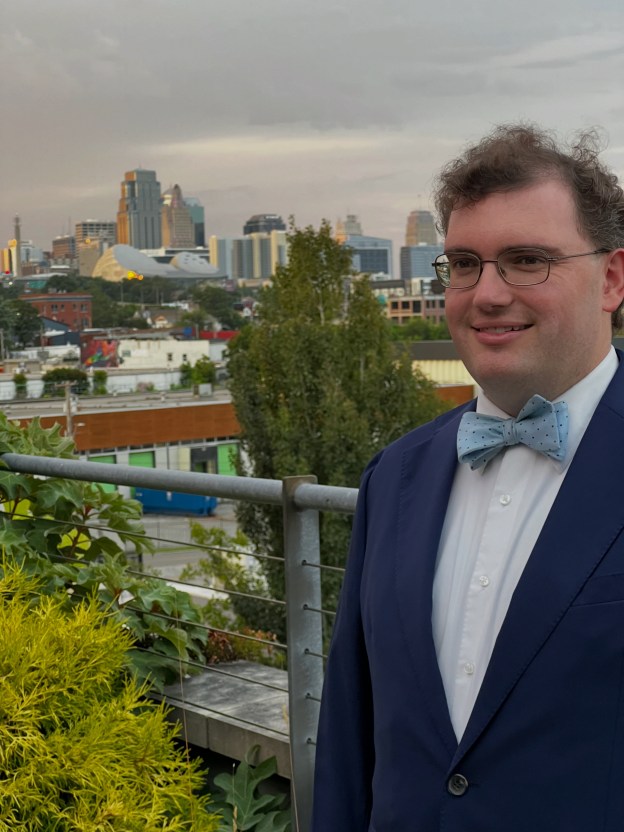
The author posing in front of the Kansas City skyline in July 2025.

The Wednesday Blog

This week, to conclude what I’ve been saying.—Click here to support the Wednesday Blog: https://www.patreon.com/sthosdkane—Sources:%5B1%5D “Signs,” Wednesday Blog 1.10.[2] “On Servant Leadership,” Wednesday Blog 6.15.[3] Percy Bysshe Shelley, “Ozymandias,” Poetry Foundation.


This week, to conclude what I’ve been saying.


I’ve said over the four years that I’ve been writing the Wednesday Blog weekly that I would stop writing this when it ceased to be fun. That’s a good rule for life overall that I’ve found: devote your life to things you love doing and keep them fun in the process. I tend to put on a very dry public face; a friend recently commented that I didn’t seem like one to scream or cheer at a concert, I affirmed that statement and demonstrated my own gentle “hurray!” to great amusement. This blog has changed with the times. It began as a project for me to write about things I enjoy outside of my research. I like to point to an early blog post all about my favorite state highway signs as a good example of this.[1] Yet I’ve found the topics I write about are changing, they’re becoming more academic, outlets where I can introduce some of the ideas I’m working on in my professional life and workshop them in a public forum. It’s a bald faced way of getting more readers to the Blog, I admit, yet so far, it’s worked.

I continue to cover politics here when I feel there’s a need to say something. Yet I’ve tried to balance what I’m writing to keep it positive, or at least to ensure that what I end up publishing suggests ways we can move forward out of the current crises we face. After all, there are enough writers out there pointing out the crises of the moment, some of us should be looking to the future to offer a light ahead that we all can reach for. This Spring, I was inspired by the commemorations in Boston of the 250th anniversary of the start of the American Revolution and the rallies for democracy here in Kansas City to focus that positive attention on popular action, the root of any good political system. I believe that government must act with the consent and full participation of the governed, and that through our elected representatives at all levels we ought to consider ourselves both governed and government. It sounds paradoxical, I know, and to an extent I believe that paradoxes are often a good thing. I devised one of my favorite phrases, “the extraordinary acts of ordinary people” to express this sentiment, that it is people acting out of the ordinary, out of what is considered ordered, which propels political change and keeps our politics fresh.[2] In 2023 one of the fads of the year on the internet was women asking men how often they think of the Roman Empire. I was asked this by one of my colleagues over lunch at the Nativity Parish School and remarked that because I was teaching the Romans at the time they were front of mind. Beyond this however, as much as I am familiar with the remains of the Empire, I am more drawn to the Republic and its ideals of popular government, even if they were never realized. The founders of the United States sought to model this federal republic on Roman models, yet they kept the Constitution they framed fresh for its day, an American constitution living in its ability to be amended to fit the changing times and passage of each generation rather than a Roman one deemed sacred through association with the old Republic’s gods and ancient institutions. Our republic is secular because for it to be sacred is to make it inviolate and unchanging, a monolith which will grow ever more distant from the people it was meant to govern, until like Shelley’s Ozymandias it is left as a mere pedestal of itself adrift in the sands of time.[3]

I want to stay a while longer with this phrase because I am so proud of it. To trumpet the extraordinary acts of ordinary people is to say that everyone has a voice and an impact upon the rest of us. In the first few years of the Wednesday Blog, my political essays tended to get lower readership across the board. I started writing the Blog in March 2021, a year after the January 6th insurrection showed how much the Republic was corrupted by the refusal to concede the 2020 election which caused that attack on the Capitol. I’ve seen a steady decline in political readership for my writing since the 2016 election, yet after 2020 that readership dropped off a cliff. American politics today is not a happy thing to write about, and at the moment it only seems to be getting worse. Yet by focusing less on the people in power and more on the people engaged for the common good I saw my readership grow on these political essays until they tended to be level with my other non-academic writing. A great inspiration for me here lies in the revolutionary era anthem Chester, sung by the New Englanders in the Continental Army and one of the older tunes in this country’s patriotic songbook. I’d been listening to it here and there without realizing for months, yet once I figured out what it actually was, when I was in Boston in March no less, I found that it spoke to my sentiment in a far greater way than I anticipated. I’m listening to William Schuman’s arrangement in his New England Triptych (1956) as I write this now, a New Deal era work intended to celebrate the democratic spirit of the cradle of the revolution.

There is a great deal of history behind my politics, naturally I notice that being a trained historian, and having taught American and British history on several occasions and having read a great deal in Irish history I can point out the various threads which I’ve coalesced into a logical genealogy of my political philosophy. Suffice to say, I believe it is better to look to the future and enact political policy which will build a future that we can all be proud of. At the core of this is listening to the people around us, hearing what they have to say, and listening to our own logic and empathy, two things which should always work together in our decisions. In writing about the extraordinary acts of ordinary people I look to those who will appear from the crowd as the leaders from my millennial generation and those coming up behind us in Generations Z and Alpha. We have inherited a great mess, and we have a lot of work to do. There are plenty of people arguing and advocating on what needs to be reformed, I feel better suited to provide an optimistic voice of what we could look forward to. By putting ordinary people front and center, I hope to make clear that policy should address problems from the bottom up, help reinforce and support the poorest in society that the whole structure grows stronger in kind. You might call this trickle-up economics, to speak to the Reaganites. We could build a future where everyone has good work, they can be proud of, enough to eat, a roof over their heads, and where every child learns how to read. We could have this future where people feel that law is meant to support them rather than push them down. I see this every day when I’m out around town: I suspect that the general sentiment behind people who run stop signs, red lights, or drive in transit only lanes is that the law has never worked in their favor, always rather beaten them down and stripped them of their humanity, so why should they follow the law? We must find our humanity in each other if we are ever going to grow out of this time of crises and begin to build a better future.

I enjoy thinking about the future in other languages, not just in the sense of the future tense but in the mentality of the language. How do they express things which haven’t happened but will come? In English we have the word future as a monolith on its own, derived from French and originally from the Latin futūrus, an irregular future active participle of the to be verb sum. In English, the future is as much a place as it is a time, it’s the destination we’re going to. Yet is it not better to think of the future as the scenery about to pass by as we go down the line like the trees and fields that we pass on a train? The present is momentary, here and gone in the blink of an eye, each millisecond the present, and the past a great gulf of memory whence we came. Yet the future is something both unknown and recognizable. It is both what we can see ahead of us along the way and what is just over the next horizon. It is an irregular version of being which will come someday. French expresses the concept of the future like this, whereas futur refers to the tense, l’avenir is instead the noun I’ve heard used most to describe the concept of the future. Yet l’avenir instead merely is the crafting of a phrase, temps à venir (time to come) into a noun, avenir, or that which is coming. We don’t know in truth what it is, what it will feel like when it comes, yet we know that someday we will see it and live in it. The future is inevitable, yet it is not singular by nature. Rather, if there is one past and present those are merely the choices made by actors in those moments which were chosen from the multitude that is possible from what could come. 

Irish expresses this sense of the future well because Irish really has no specific word for future. There is a future tense, which in some ways is more regular in its formation than the Irish present tense. Instead, Irish uses a phrase which breaks down the future into its core concepts:  An rud atá le teacht, or the thing which is coming. Therein lies the future in its baldest form: it is merely the thing that is coming next out of all the possibilities. Another topic which I seemed to write about a fair deal for a while was faith, self-help, and religion. My Catholicism is influential to my cosmovision and political philosophy in my core belief of the paradoxical nature of God, that God can exist yet also be omnipotent and omniscient. Because of this, I like to say, “anything is possible in the Eyes of God,” or for short, “anything is possible.” As I think about the end of my doctoral writing and needing a dedication to affix on my dissertation, I’ve found myself thinking about this phrase, and about who my audience is. After all, you now reading this sentence in my future, just as I wrote it in your past. It is possible that just about anyone could be reading this now, and so rather than dedicate my work to one person in particular in the moment in which I am writing it, perhaps I ought to instead dedicate it to the possible, or rudaí indéanta in Irish. That second word indéanta is a neat one because it comes from the verb déan, meaning to do, thus the possible is something that might be done. In English and French, I say, “I am studying” or « J’étudie, » yet in Irish, I say, “Déanaim ag staidéar,” or “I am doing study,” which makes the study more of an act than a state of being. The future has and always will be something acted, something done by individuals in our own small ways that creates great change in the collective form.

I study history because of all the things I am interested in it is history which brings them together. So far, history is a human creation made in our image and likeness which seeks to tell our story as best as we can recall it. We’ve devised historical methods of a similar manner to understand other histories, salvation history, church history, and natural history to name three. I returned to natural history as an adult yearning for the halcyon days of curiosity and wonder from my early childhood and built my career on my study of André Thevet’s (1516–1590) sloth. It’s become my gateway into the history of natural history, and through it I’m beginning to make my name as a sloth historian. I do not believe in prescriptivism, the notion that history in inexorably leading to some great moment in the future when the final form of human nature will announce itself. I think this is limiting, claustrophobic in fact. It’s far too simplistic to say that we will all wake up someday and find the morning sunlight is just a little bit brighter, the grass and trees greener, and the sky a prettier shade of blue because there’ll be somebody among us who will find something contrary about the experience. I for one an enjoying the gray skies outside my window today, it’s finally cool enough in mid-October for me to open the blinds in my room and let some sunlight in without making it too hot. Rather, history teaches us that the future is what we will make of it. I chose to not study the twentieth century because I felt this dolorous pain in my heart that there were so many things which happened in the last century which could have been avoided, choices which could have been different. In studying recent history, I worried I would be faced with the ghosts of the world wars, Great Depression, and all the troubles faced by humanity in general and my fellow Irish Americans in particular throughout my working life. 

Instead, I looked deeper into the past, first to the Roman Republic with an interest in studying the expansion of Roman citizenship in the late Republic after the Social War of the 90s and 80s BCE and later to the Renaissance, a period that seemed similar enough, Latinate to be sure, yet full of people and stories who I felt I could relate to better than the ancients. I found Thevet almost accidentally, and through his sloth I feel that I’ve found balance in my life that sustains me today, makes me feel more fulfilled in my efforts than I was before. My history is fundamentally interdisciplinary, historical zoology adopts zoological methods and theories to determine the true nature of historical animals, layering their scientific taxa upon their far older human memory and legendaria. In Thevet I am able to work with the ancients, looking especially Aristotle and Pliny, yet soon after I can turn around and look ahead to Buffon and Linnaeus and see how they interpreted what Thevet wrote in order to establish a clear lineage through the historical record for the animal in question. There is nothing sure about this history, often the historical sources are lacking with detail about a given animal, or the zoological data may not have enough detail about an extinct species to offer a clear picture of what it is I am describing. Both are limited by the foggy memory of the human past, yet together they can offer a light with which to move ahead and keep exploring those parts of our cosmos which are still strange and unfamiliar to us today.

I write because it is the greatest way I’ve yet found to express myself. I can say far more in an essay such as this than I could in a conversation. The Wednesday Blog remains less formal than my academic writing, here I use the first person. Yet with the passage of time, I’ve found the Blog has become more academic to the point that friends have told me they got an education about Thevet that they never expected. The Blog has several antecedents, including earlier less regular blog posts which you can find on this same website from before 2021 that all form the roots of this project. I’m proud of the writing I’ve done here, the Wednesday Blog now is comprised of 238 essays and 200 podcast episodes, I’ve written 521 pages, and the total word count is over 300,000. The future is defined as much by its potential as the fact that once it comes to be what was present will then be past. To see an end gives all things meaning. It is for this reason, at the end of the sixth book of the Wednesday Blog, and fifth season of the podcast, that I’ve decided to end this particular publication. This remains a fun thing to write, yet I have so much more to do today, and I only see that workload growing as I try my hand at more peer-reviewed articles, books, and translations in the coming decades. I hope the Wednesday Blog will be a testament to who I was at this point in my life in the years after the COVID-19 Pandemic and during my long years of doctoral study. Let these essays remain a monument of the first half of the 2020s, a sign of where we’ve been and where I hope we will be going.


[1] “Signs,” Wednesday Blog 1.10.

[2] “On Servant Leadership,” Wednesday Blog 6.15.

[3] Percy Bysshe Shelley, “Ozymandias,” Poetry Foundation.


How to Know the Unknown

How to Know the Unknown Wednesday Blog by Seán Thomas Kane

This week I want to talk about how we can recognize the existence of unknown things. — Click here to support the Wednesday Blog: https://www.patreon.com/sthosdkane

This week I want to talk about how we can recognize the existence of unknown things.


At the beginning of the month when I was preparing for my copyright post, I looked into an old interest of mine that had always been there, yet wasn’t quite active in the last few years, the effort by an organization called Thank You Walt Disney to restore the building that his first studio, Laugh-O-Gram, occupied at 31st & Forest here in Kansas City called the McConahay Building. To this end, I made a detour by the old building one afternoon on the way back from the central post office at Union Station and saw a good deal of work underway on that block, and after some back and forth I found a book written by some members of that organization called Walt Disney’s Missouri that I requested from the Kansas City Public Library.

I found Disney’s early years in Marceline, Chicago, and Kansas City quite familiar; his passion and drive to create art and tell stories in a new and inventive way using the skills and talents he developed over those early years remind me deeply of many of the ideas and projects I’ve worked on since my high school days. The sky truly is the limit in this mindset. I find the young Walt Disney to be a familiar face, someone who is quite relatable to all of us who have adopted Kansas City as our canvas for the many things we create.

Yet Kansas City is not like many other great American cities, for unlike New York, Los Angeles, or even Chicago we aren’t on a shoreline, we don’t look out onto an endless expanse of water far out to the horizon. Instead, we have the vast sightlines of the prairies and Great Plains extending out from our city in every direction. The astounding sunsets that glowed across the prairies out to the west of our old family farm are some of the great images of my childhood that will forever be burned into my memory.

When I was reading about Disney returning to Marceline, Missouri as an older man, I felt intensely familiar with the setting having grown up in the Midwest; familiar with the vast scale of the prairie that overwhelms me in how small it makes me, and the few built-up edifices of our civilization feel amid the tall grass Prairie. Our interventions only emptied this landscape and rebuilt it anew with the farms & ranches that have largely replaced the native roots. We have changed this landscape to suit ourselves, and yet this landscape remains its own because its fundamental character is too distinct for us to fully comprehend in our vision of a normal inspired by the great woodlands and old colonies of the East Coast and even older cultivated and measured forests and farmland growing around the ancient generational villages and towns of Europe.

My research focuses on the unknown entities that were too far-fetched to be imagined on the edge of the European imagination, particularly animals whose proportions were exaggerated to a degree that set them and the world they inhabited apart from the well-known and measured Mediterranean World at the heart of the European cosmos. This question of how we can begin to describe the unknown has stood out to me for a while and it’s something that both thrills and scares me at the same time. I feel a profound sense of humility thinking of all the things that we don’t know that exist beyond our world, whether they be lifeforms deep in the still largely unexplored oceans or entities deep in the void of Space. Yet I love stopping to think of these things and the endless horizon they represent as it gives me a sense of things still to accomplish.

Imagine, dear reader if you will, what it would be like to witness something you never before knew appear before your own eyes, or even those things which you do know about but only in stories and fables happening in real life. Shakespeare asked his audience to use their imaginations to fill in the breadth and depth of his world. In the prologue of Henry V, the Chorus asks the audience to imagine that the actors on the stage might

“on this unworthy scaffold bring forth 

so great an object. Can this cockpit hold 

the vasty fields of France? Or may we cram

within this wooden O the very casques

that did affright the air at Agincourt?

O pardon, since a crooked figure may

attest in little place a million,

and let us, ciphers to this great account,

on your imaginary forces work.

Suppose within the girdle of these walls

Are now confined two mighty monarchies,

Whose high upreared and abutting fronts         

the perilous narrow ocean parts asunder.”

Henry V, Prologue 11–23

Our imaginations are perhaps our greatest assets, after all we call ourselves Homo sapiens, wise humans. We pride ourselves on our capacity for thought, on our ability to imagine possibilities for ourselves and our posterity. We need the unknown to give us hope that there will be something new to discover tomorrow, for even if that new thing is familiar to others, it will still invoke wonder in us. Hope is what the greatest human endeavors are built upon, the hope that even if a cause seems doomed in the short term that someday it will succeed.

I feel this sense of potential success is central to my nature. I grew up with this hopeful maxim from three sources, my Catholic faith in things inexplicable, my Irish heritage informed by the experiences of generations who hoped for home rule and justice under a colonial government, and more light-heartedly from my lifelong passion for the erstwhile lovable losers, the Chicago Cubs. Robert Emmet perhaps put it best in his speech from the dock that he knew someday his epitaph would be written, someday someone yet unknown to him in 1803 would be able to judge his efforts towards Irish independence. “Let my character and my motives repose in obscurity and peace, till other times and other men can do them justice. Then shall my character be vindicated; then may my epitaph be written.” 

We cannot truly know what our future will hold, though we can predict what variable futures might come to exist. I wonder if a young Walt Disney would have imagined the man he would become, and how his name would be known by what surely is a majority of humanity alive today, 123 years after his birth. All of that was unknown in his childhood, just as all the things that will happen tomorrow and every day after that are still to a certain degree unknown to us today. That might be the closest we come to touch the unknown, to recognize its ambiguous feel, yet while that fine cloth of silk might seem somewhat familiar in its unfamiliarity, we ought to always remember that it extends far enough from our view and beyond all our horizons into infinity. There is, and likely will always be, more unknowns than knowns in the Cosmos.

A historian restores things forgotten from the vast silk threads of the unknown and weaves those fibers back into the great tapestry of human knowledge. I just started reading a book yesterday which does this with the understanding that religion and science have always been at odds when it comes to the age of the Earth. Perhaps I will write about that book, Ivano Del Prete’s On the Edge of Eternity: The Antiquity of the Earth in Medieval & Early Modern Europe in this publication later this year. That, good people, remains well and truly among those strands of the great yet smooth silky unknown sea which lies behind us, beyond our vision as the Greeks understood the future to be. The future is perhaps more unknown to us than the past because we at least have means and methods to uncover the past we’ve long forgotten and left behind, whereas the future remains unwritten and daunting to behold.

Perhaps that is why I chose to become a historian, because I find a comfort in imagining and reading about the past that is absent when I imagine the future. There is some truth there that the future I behold is colored in the same hues as my present, which I know will not be realized as the future will certainly be its own creation, inspired by our current moment yet distinct from it all the same. The characters who grace this “kingdom for a stage” will have taken their last bow by the time many of these events I imagine in the future occur; and at the culmination of the future lies the greatest unknown of all, one about which we tell many stories and ascribe many tenants, all to humanize it and make it more familiar.Our memories keep past ideas, people, places, and things alive in our knowledge. I hope the people at Thank You Walt Disney are successful in restoring the McConahay Building which housed Disney’s Laugh-O-Gram Studio so that the memory of that time when so many creative minds, so many animators, lived in this city is preserved; so that Kansas Citians in the present and unknown future remember that art can be created here, and dreams first imagined here can grow into wonders for all humanity to behold.


A Sunrise

This week on the Wednesday Blog, a reflection on the rising Sun. — Click here to support the Wednesday Blog: https://www.patreon.com/sthosdkane


This week on the Wednesday Blog, a reflection on the rising Sun.


Last Friday as I drove south to reach my classroom in the morning I was awed by the pink and yellow rays of the rising Sun that appeared in the east. It seemed to echo some sort of hope of things to come. These last months have felt as though I’ve been caught up in a storm both unfamiliar and of my own shaping, and it has left much of my life from my part time work to even this Wednesday Blog to be written at the eleventh hour each week. Unable to set foot on solid ground over these months, I’ve prioritized staying upright in my life while putting my best efforts into my work. Still, even that hasn’t seemed to be enough to balance everything.

I am more used to the pattern of having several part-time jobs which fit together however imperfectly, so the introduction of a full-time position on top of everything else sank all those other things that I previously worked on to the detriment of all. There were weeks when I even ignored my own needs as my new duties required every shred of focus, every aspiration of my emotions. This has left me exhausted of many of the things which kept me going and I feel hollowed out by the harsh tides of the world.

This sunrise then spoke to me of hope. It was a sunrise that only the long nights of winter could forebode, a bright eastern glow whose radiance was more pronounced because it followed a long, dark night. I gazed up at it when I could on my drive south and thought of all that had transpired, and all the possible futures that these next months and years might hold. I know, of course, that the Sun appears to rise as our planet continues in its revolutionary course, the Earth spinning on its axis with each passing day so that this sunrise has surely been seen by many before and will indeed return again to grace our mornings. Yet amid all that the sciences can tell my emotions speak louder in my interpretation of its very natural phenomena.

There have been many sunrises in my life that have moved me, after all I’m traditionally far more a night owl than an early bird, so until recently I rarely saw the sunrise. In my childhood my bedroom looked out to the west and each evening was warmed in the glow of the setting sun. With all our popular fears and worries about endings today, they are far louder than any wonderings about new beginnings, it seems that we as a civilization looks to the setting more than the rising Sun. We see our future as a fading echo of distant glories, our lives existing in the ruined monuments of earlier generations. Our stories are populated with more Ozymandiases and fewer Abrahams and Jacobs in spite of the newness of so much of our built world here in the Americas and the other old settler colonies.

I think our transition from the early decades of this new century into the first of the middle decades has a great deal to do with all of this. The generations now being born will surely see the last century as something in the past existing behind a veil just remote enough to not be touched. When I show pictures from my travels of old monuments today my audience and I are both struck that often they were infants or even yet to be born in that same moment. The first decades of this century are to them what the 1970s and 1980s are to me; and as we continue our inevitable march forward in time we will move ever further away from those years and generations in which our world here in the United States, and especially here in the Great Plains and West, was still young. It seems to me that we have a great deal to learn of change; that we will always need a reminder that the passage of time is something to be admired as much as it is feared. The oldest people I knew as a child would now be reaching their centenary if they were still alive, and surely someday I too will be in that moment where the power of my life fades as my time recedes from life and into memory.

The rising Sun speaks to me then of both hope and the truth that after many sunrises there will be one which will be seen in a moment when my world and all who I know are gone. There will be a sunrise after my time, yet in the meantime I hope I can make all the days that follow the sunrises of my life fruitful. With that light there are a great many things I can see, a great many marvels to behold; for all of us are individual marvels in all our complexity, our wants, our passions, and our fears. As long as I am able, I yearn to experience those marvels like that pink and yellow sunrise from a few days ago and live to the fullest of my ability.


The End of an Era

This week on the Wednesday Blog, my perspective on the last century and a half as a time of tremendous change. — Click here to support the Wednesday Blog: https://www.patreon.com/sthosdkane

This week on the Wednesday Blog, my perspective on the last century and a half as a time of tremendous change.


On my first day in London this October I walked from the British Museum, my first stop in the capital, to Charing Cross Road where I made my way into Foyles, my favorite bookstore in that city. Foyles has a wider variety of titles than I’ve seen in most bookstores, and especially titles that catch my attention time and again. I didn’t plan on walking out with a new book, and I stuck to that plan, yet I saw several books which I’ve since acquired in other ways since I got home (I do kind of feel bad about that.) I didn’t pack for this trip with new acquisitions in mind, leaving little room for anything new in my luggage.

Still, I loved wandering through the aisles and shelves of Foyle’s and catching up on the latest that the British publishing industry has to offer, five years after my last visit to that island. Here in the United States, I see some reviews of books printed in Britain, usually in the New York Times or through interviews on NPR, but by and large I’d cut myself loose from the British press that I read, listened to, and watched throughout my adult years. Unlike previous trips back to London, a city that became a home-away-from-home for me in 2015 and 2016, I felt like I’d missed a great deal and had a lot of new things to discover on this trip.

One book that caught my eye several times was Michael Palin’s new book Great-Uncle Harry: A Tale of War and Empire which tells the story of the author’s own great-uncle Harry Palin whose life saw the end of an era and the beginning of our own tumultuous time. Harry Palin was working on a farm on the South Island of New Zealand when Great Britain and its Empire entered the First World War in August 1914 and enlisted with the New Zealand Expeditionary Force, one-half of the famed Australian and New Zealand Army Corps (ANZACs). The elder Palin survived the Gallipoli Campaign and for a while on the Western Front until he died during the Battle of the Somme in 1916. 

Two weeks after seeing Great-Uncle Harry on the shelves of Foyles I was reminded of it by something else and bought a copy of the audiobook on Audible to listen to, read by the author, in the car on my way to and from the school where I currently work. The life and story of Harry Palin animated my drives to and from the school where I now work over the last two weeks and left me both inspired to think about the end of the nineteenth century, a period in our recent history that I’ve always been fascinated by, and horrified by what became in the twentieth century.

I chose to not study the end of the nineteenth century and turn of the twentieth century professionally because of the looming specters of the World Wars ever on the horizon of my memory of those moments in history. Harry Palin’s story reminded me of what I love about that period as much as at the end of his life what horrifies me about the experiences of his generation.

The world that existed in 1914 was one which had a continuity with the generations that came before it. There were some major shifts, the revolutions at the end of the 18th century and in 1848 come to mind, yet none of those in Europe were permanent. The needle of change wavered throughout the century leading up to the First World War. All of that changed as old institutions, which had long weathered the storms and basked in the sunshine of Europe’s history now collapsed under the tides of change released by the hands of their own officials. That war is perhaps the greatest example of hubris among any political leaders yet seen in our long history. Men who thought they could expand their empires, enhance their prestige and honor by waging war against each other instead lost their crowns and left millions dead in the wake of the conflict they unleashed.

When I read histories of this period, I often want to shout at the characters to look out, to be wary of what is coming; for in a Dedalian way I worry we can become too complacent and hawkish yet again. Our caution is well learned, now after a century which saw two world wars and countless other conflicts born from those furnaces. In the wake of the first war a great instability allowed for experimentation to occur. This is a natural thing, something I see in the Renaissance and Wars of Religion (the period which I study) yet in the context of the twentieth Century it marks something far darker. This experimentation in politics and economics led to a further world war in which the three new dominant ideologies –– communism, liberal democracy, and fascism –– collided. Out of it, fascism fell but not before taking millions with it, and a cold war simmered which defined the rest of the century.

In my own life, a further reduction in the formalization of conflicts has played itself out. Now instead of great armies facing off in large-scale battles like those known in the world wars, or even the proxy wars fought by the superpowers we see violence wrought through terrorism. The front lines are not so far away when the threat of violence, whether foreign or domestic could be around the corner. Our children practice for the possibility of an active shooter in our schools because such an incident has happened time and again, and I’ve internalized the reality that in my profession I’m likely to experience such an attack as long as I continue to teach.

I go to places like Foyles to get away from these worries and horrors, to discover new ideas and ways of looking at the world that I was previously unaware of. On this trip, it occurred to me several days before my return to London that I was left bereft of worries, a feeling of calm that I hadn’t felt in a very long time. It almost left me feeling a loss for something I’d long known. I chose to work on a time period further removed from the present to have a refuge in my work from the horrors of the recent past that shaped my world; yet this is still my world, our world, and for as many problems as it has there is a lot that I feel nostalgic for about the century now passed. Even as I write now in 2023 and will likely be remembered as a voice of the twenty-first century, I will always think of myself just as connected to the twentieth, in which I was born and during which a great many of my formative memories occurred.

It occurs to me now that as much as we live in a continuation of the new era born out of the First World War, perhaps the general crisis we find ourselves in now, from the wars my country fought throughout my teens and twenties to the climate crisis we now witness, is bringing us into an even newer era. I hope it will be better than the last, and that maybe this time we’ll find a way to live up to the highest ideals of our predecessors.


The Potential of America

The Potential of America Wednesday Blog by Seán Thomas Kane

This week, the Wednesday Blog is coming out a day early in honor of our Independence Day. — Click here to support the Wednesday Blog: https://www.patreon.com/sthosdkane

I am certainly not an expert on the American Revolution, though I am a recipient of its fruits, my life one small result of its effects. The revolution echoed a time in our past when people of all classes in thirteen of the British colonies along the East Coast took up arms to defend what they saw as their inalienable rights against the forces of an overbearing imperial power. The union that came out of the revolutionary generation between those colonies, then independent states, and now federally united in one country is a testament to the marriage of idealism and realism in politics which proclaims that all of us can participate in our government, and moreover have a right and a duty to do so.

Our history has seen this country’s fortunes ebb and flow between prosperity and adversity. There are times when the United States has seen its great successes echo optimism and others when our internal divisions, sown from even before the Revolution, find division among us yet again. In the last twenty years we’ve seen ourselves into a deep abyss in which our factions and parties have driven us further apart from one another than we have seen in a good while. Bad news sells far better than good news. Many of our stories, both ancient and modern, have told of how fear is a quick and easy source of power and strength. Yet at the end that fear will only last for so long, and those who sought to use it will be left powerless and afraid.

I’m saddened this Fourth of July to look at our country and see just how forlorn our dreams have become amid the churning fury of all our rage. There are many victims in our country, victims whose lives over generations were torn apart by the greed, vice, and rage of others who sought power over them. I’m saddened to see how the symbols of all the hope and aspiration that this country represents are being used today by those who seek to exclude many of us from this country’s full bounty.

America truly is a country of near limitless possibility. We have so much potential as a country made up of an infinite diversity of people in infinite measures whose common roots only stretch back a few generations. Lin Manuel Miranda put it well in his musical Hamilton when he called this country a “great unfinished symphony” for there is so much about our culture that remains unwritten, in our future compared to other older societies. We certainly share a common heritage with those older societies, yet by our own geographic isolation and breadth we Americans have forged our own path divergent from that heritage.

I believe that so many of the problems we face today are born out of deep mistrust leading us to refuse to talk with one another, let alone listen to one another. Amid all the troubles of the present moment a bright future awaits us for my generation and Generation Z behind us are proving to be more active in our civic life, more willing to go out and vote, more concerned for the future than prior generations have as a whole seemed to be. There are proposals out there to reform society in order to fix many of the great problems that continue to plague us, reforms that probably could work, if only they were considered by those in power.So, on this Independence Day, I invite you to not only look to the past, to the Revolution and the Founding Fathers, but to look to the future as well, to all that we may yet accomplish in this young century.

National Mall

Mr. Lincoln
This week, I want to tell you about a trip I took last weekend to Washington, D.C. Links: The Smithsonian's Futures Exhibit: https://aib.si.edu/futures/ The Planetary Society's Sailing the Light documentary premiere live stream: https://youtu.be/NnKsHlV1NhA

Of all the cities in the east, Washington remains my favorite. It’s place at the emotional heart of our republic, the center of the Union that my lifelong hero President Lincoln fought to preserve, makes me yet another Mr. Smith every time I return to the capital. This week I made such a trip back to some of my favorite museums, some powerful monuments, and some good weather after months of cold and snow in Upstate New York. I decided that I wanted to make my trip a bit of an adventure and chose to drive down from Binghamton rather than fly, an easier option. This led me to an occasionally tense journey down Interstates 81 and 83 through Pennsylvania and Maryland to the BWI Amtrak station where I decided to leave my car for the weekend, figuring it’d be better to not try to drive and park in the District if possible.

Arriving in D.C. on the Acela, currently this country’s fastest passenger train, something the train nerd in me specifically chose to do, I had a similar arrival to Jimmy Stewart’s Mr. Smith at Union Station, its high vaulted ceilings designed by Chicago’s own Daniel Burnham over a century ago. Unlike Smith I didn’t see the capitol dome from the station, instead looking downward trying to find the nearest metro station to get to my hotel.

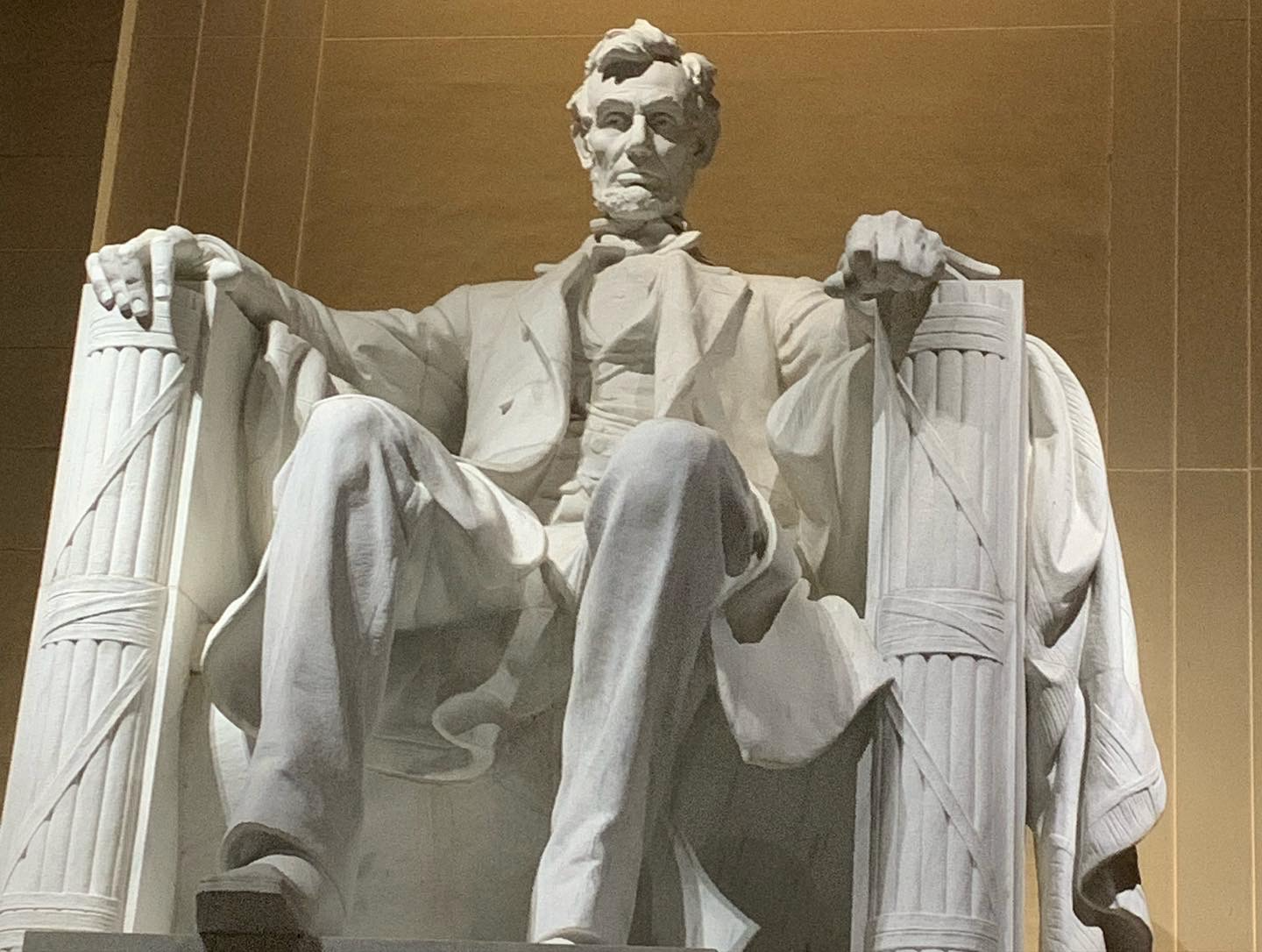
Seeing the monuments at night is always a special treat. As elegant as they are in the daytime, and some like the Vietnam Memorial are better seen under the Sun, there’s a special artistry in seeing the work of sculptors and architects illuminated with floodlights. That’s how I saw the Washington, Lincoln, and MLK Memorials, lit up solemnly. Mr. Lincoln and Dr. King looked as though they were great titans of antiquity in the glow of their memorials’ lights. 

At this time in our history, Lincoln’s struggle to save the Union and end slavery in this country once and for all seems all the more present. In the week since my last post (episode for those listening) the Russian military has invaded Ukraine. I alluded to those threats last week, but now threats have become a living nightmare for the Ukrainian people and a great storm cloud over the rest of Europe that threatens to engulf all of humanity. How do we embrace the true and righteous words of Mr. Lincoln to do the right thing and feel no evil towards others, even those like President Putin who have so brutally attacked their neighbors? I don’t have an answer to that question yet, nor am I certain that I ever will. But today’s feast, Ash Wednesday for us Catholics, fits well into this narrative as an annual reminder “Remember you are dust, and to dust you shall return.”

I spent a good deal of time on Saturday in several of the Smithsonian museums, returning to the Natural History Museum that I visited in July to double check a label for a sloth for my dissertation, and revisiting an old favorite in the Asian Art Museum. I also visited the American History Museum for the first time in over a decade and enjoyed it quite a bit more. The previous time in 2011 it seemed to be sparse in actual history, yet this time I could notice the nuance in the stories it told in the objects on display in what little space it had available.

The most insightful museum visit though was to the Futures exhibit currently housed in the Arts and Industries Building on the south side of the Mall next to the Smithsonian Castle. This exhibit, which asks visitors to imagine how our future could be a sign of human life improving offered a much needed antidote to the troubles of the world. There were examples of carbon-neutral and renewable building techniques and materials, electric cars, air taxis, and hyperloops. There was a new model of a space suit that was far less bulky than those used by astronauts today and a model of Light Sail 2, a spacecraft sent into orbit by the Planetary Society, a space advocacy organization of which I’m proud to say that I’m a member. There is no one future but many for us to choose from. It’s up to us to determine how we want our future to be written, to be designed, to be imagined.

The National Mall is the emotional heart of this country. It speaks to me of generations of memory, passion, and possibility. On this trip as well though I could imagine myself there in the future, introducing the next generation and later generations to come to that heart, to the ideals and hopes and dreams of this republic. Now at the end of my 20s, my visits to the capital mean something different to me than they did in the last decade. They represent my own future, its infinite possibilities, and how I might be able to do my part, however small it may be, to influence and improve upon our experiences.

Fiction

This week, I want to explain how fiction is necessary for my survival.

I am in the business of writing serious, analytical, and factual accounts about the human experience. As a historian, that’s my job. I do write fiction as well, though I keep both as separate as the church and state are supposed to be in this country. Still, as much as I enjoy my work, as much as I like the feeling of getting my academic writings on paper and presenting them at conferences, when I’m looking for some fun reading, I usually turn to fiction. Fiction is fundamental to the human spirit, it allows us to dream, to imagine alternate possibilities, to envision possible futures.

At any given moment I’m usually reading 2 or 3 books for fun, normally there’s at least one sci-fi novel, maybe a memoir, and possibly something relating to natural history. I admit, 2 out of 3 of those are nonfiction, depending on how you understand the truth of that memoir, but if I had to choose between those three genres when I’m sitting alone in a restaurant at lunch or dinner or looking for something to read before bed, I’ll go for the fiction ahead of the others. I also tend to disagree with the trend of late that prefers dystopian fiction over anything else. There are so many of those stories out there, from the Ender’s Game books by Orson Scott Card, to the Blade Runner and Mad Max films, to even my old favorite Douglas Adams’s A Hitchhiker’s Guide to the Galaxy. I don’t like dystopia, and I don’t honestly understand how it could be enjoyable to read or watch a story talking about such a future. 

Rather, I prefer the opposite, utopian fiction, stories that offer us a vision of what our future could be like. I think that’s why I’ve been drawn to Star Trek since the pandemic began, and have now watched several of the TV series, a few of the films, and even read some of the accompanying novels. There’s something about a vision of humanity’s future as a contributing member of an interstellar community that really seems heartening to me, that as distant as that potential future seems now, we might well reach it someday. This is one area where my work and my favorite stories intersect; my historical research deals squarely with exploration, in my case mostly set in Brazil in the 1550s. In many respects, my research is a cautionary story of all the horrible things that the explorers fanning out from Europe did to the peoples they encountered. Normally, academic history books aren’t read by many people, and certainly there are only a few that get much public attention. So, I hope that if anyone eventually reads my work, they’ll recognize in it my efforts at warning our own generations and generations to come of the rocks and shoals that threaten any present or future explorer who seeks to venture out without harming others in the process.

So yes, my love of fiction does influence my work, but only indirectly. When it comes to my writing, when I need to refresh and rethink my work, I’ll turn to those same novels and bask in their eloquence and style. As a writer, as a dreamer, as an optimist, fiction is necessary to my survival.

Stargazing and the Future

Vega, photo by Stephen Rahn.

For some reason, whenever I spend time at night outside stargazing, I find myself thinking about how timeless the experience is. How I could be anywhere on the Earth and still probably be able to see at least some of the same stars up above me in the night sky. It’s a beautiful and humbling thought, but as much as the starlight itself often takes years to reach the Earth, so too I find myself thinking in those moments about how in years to come, I may well be able to see the same old sight. Yet then, in ten or twenty years when, if I’m lucky enough to be a parent, I might be sitting out on a hillside somewhere looking up in the night sky with my kid or kids, I’ll be seeing light that might well have left those stars at the time I’m writing this now.

The whole concept of light years, that the light of distant stars takes years to travel to Earth, and that one can measure distance in light years, is such a neat way to understand things, let alone a beautiful correspondence between space and time, in what tends to now be called spacetime. One of my favorite stars, Vega, is 25 light years away, meaning the light from Vega that I saw that night recently overlooking the Green River in Dinosaur National Monument left that star when I was 3 years old, right at the beginning of my consistent memories. Like a postcard stuck in a long delivery loop, a postcard sent in 1996, that light which glowed from Vega’s face reached my vision as a memory of a time now seeming well past.

When the light glowing from Vega’s surface today, in 2021, is seen by stargazers here on Earth, in 2046, I will be 54, living a life built on the memories of 2021, just as much as it will be on the more distant echoes of 1996, yet I’ll be as much the same person yet still very different from who I am today. Who knows what thoughts and context will go through my mind then, ideas that will be descendants of those that crossed my mind a few weeks ago when I sat back in the high desert and stared up at Vega well into the night.