Tag Archives: Gaeilge

Tóg go bog é | Take it easy

Tóg go bog é | Take it easy Wednesday Blog by Seán Thomas Kane

This week, a few words on taking life slower.—Click here to support the Wednesday Blog: https://www.patreon.com/sthosdkane


This week, a few words on taking life slower.


Where I grew up first in the Chicago suburbs and later on the western edge of Kansas City, Kansas the average speed limits were around 35 mph (56 km/h). I think there’s something to be said about a life that’s taken at those sorts of speeds, that the speed we drive from place to place reflects in how we approach other aspects of our lives all the same. By comparison, in the year that I lived in London I fell out of practice with my driving, instead I knew how to navigate by walking speed, closer to 3 mph (5 km/h). Perhaps this is one of the reasons that I found Binghamton to be such an incongruent place to live because the average speed limit is 30 mph on the local streets and roads in that valley.

When I learned to drive then, the average speed that I found myself at hovered around 35 mph. Furthermore, I learned to drive on the highways before I learned city driving, as most of my early daily drives were on the highway K-7 between our home in Piper and my high school in western Lenexa, Kansas. It was a 30 minute commute each way to school every day, and one that I don’t remember getting that old too fast. In more recent memory, I found that driving a good 20-25 minutes every day down to the school I taught at in Leawood, Kansas did grow taxing to the point that now I’m less willing to drive quite as far in town as I did even a few short years ago.

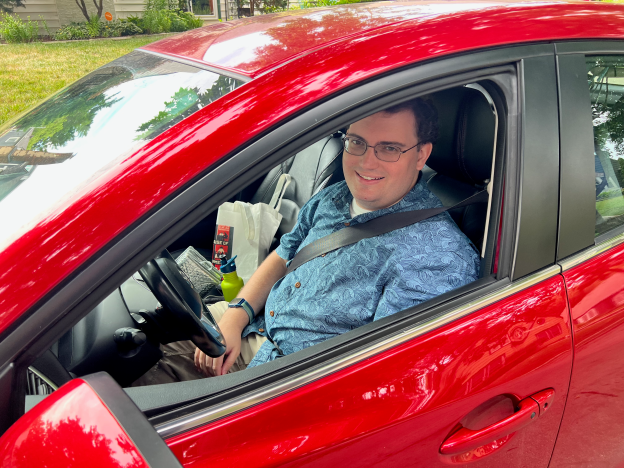
I’ve noticed several types of driving and several variations on speed that my car will embody depending on how I’m feeling on a given day. There are times when I am so attuned to my surroundings and to my car, which I lovingly named the Mazda Rua 6 years ago, that it will feel as though we are one in the same, that my car will adjust its direction and speed with the slightest turn of my hands, or the flick of my eyes from one direction to another. This feeling was especially pronounced on my 14 long drives between Kansas City and Binghamton that I undertook between August 2019 and December 2022. On those drives, I would usually keep a steady pace of around 75-80 mph (120-129 km/h) on the Interstates between the Catskills on the eastern edge of my route and the Great Plains to the west. When I’m out on the open road I’ll still sometimes set my car into cruise control at this sort of speed, which tends to be the pace of highway traffic anyway and let the day’s drive go by.

Yet I’ve noticed more and more in my drives around town, I’m not going quite as fast as I used to. I tend to drive a few times per week between my home in Brookside and my place of work in the Crossroads, always on the city streets and always in a decent amount of traffic for Kansas City. Yet the pace of traffic has slowed somewhat; where before I’d keep to that 35 mph threshold, now I’m fine if I’m hovering between 30 and 35 mph (48 and 56 km/h). Just before writing this, I drove home from a haircut with my cousin Richard Morrissey at his salon in Mission, Kansas and I found that I didn’t particularly care that the traffic was going 30 mph, especially when I crossed the border and merged onto the northern reaches of Ward Parkway. Nor did I mind the slower speeds when I decided to turn off that major boulevard and onto a side street that goes up Sunset Hill toward Loose Park where traffic really ought to be moving no faster than 15 mph (24 km/h). I didn’t mind the slower pace because I didn’t feel the need for speed.

My generation grew up with the role models of our parents and grandparents whose generations worked day in and day out for decades and who built our sprawling metropolises in which we need cars to get around. I’ve accepted this world that I was born into and its hurried tempo and made myself far busier than I probably need to be. On a recent day when I had 3 meetings in a row in the span of 3 hours I was struck by the fact that when I was still in Binghamton I was busy but not this busy; that the reason why I’ve not been keeping up with podcasts or TV shows the way I used to is because I simply don’t have as much time in the day for them.

The key here is a learned moderation which goes a long way to what I find is a happier life. There are things which I hope for and want with an eagerness that inspires me to plow on forward yet I’ve learned that the best things I can hope for are those which occur in the quiet moments of calm between those rushing evocations of the modern life. I for one would much prefer to just be an academic spending my days reading and writing about historical zoology and having deep and enriching discussions with friends and colleagues. I would much rather listen to my colleagues about what they’re researching, and about the things they’re learning in their own particular topics. And yet, when I was with my colleagues at the Renaissance Society of America’s conference the week before last in Boston, I felt that I stood out in some ways from them by all the different fires I have going at once. I’ve always been one with many different projects in the works. Even now, alongside this weekly blog and my dissertation I have two articles in the review and editing stage, a third that I’m hoping to submit to a journal soon, two books on the way that I will be reviewing, and a short story I’m plodding through writing. 

On top of this I hold several different committee assignments in the Fr. Bernard Donnelly AOH alongside my primary recording secretary duties. I also work part-time as an usher team captain for the Kauffman Center for the Performing Arts and now have somewhat of a hands off approach to my Mom’s efforts in leading and organizing a local progressive protest organization called Blue Brookside. Simply put, I have to persist at this higher speed to keep track of everything.

One of the first phrases I learned when I started studying Irish in 2007 was one which I initially misheard: Tóg go bog é, which translates as “Take it easy!” This is a nice sentiment, and one which I’m trying to live, to be less worried, to inflict less stress upon myself. Perhaps even though I didn’t identify it as such this may well be what I’m trying to give up for Lent this year. You might say it’s working in some stripes yet not in others. What remains is a key question about how I can grow from finding this balance between busyness and nonchalance? Maybe this is something we all need, time away from the constant stream of information and news and worry. I’ve recently begun responding when people talk about social media that I admire those who’ve dropped away from it; were it not such a good way of staying in touch with friends and family near and far I probably would do that too.Let this be a motto for us to aspire to: tóg go bog é, take it easy.

An Equine Etymology

This week, I discuss the two Irish words for the horse, and what they tell us about the history of the Irish language. — Click here to support the Wednesday Blog: https://www.patreon.com/sthosdkane


This week, I discuss the two Irish words for the horse, and what they tell us about the history of the Irish language.


The word that we’re taught in Irish classes, in fact the word which is listed in the 1959 English-Irish Dictionary for the English word horse is capall. I like this word; it sounds to me like the clopping of a horse’s hooves on stone. Yet it actually derives from the Latin caballus, a word borrowed into Latin from the Gaulish *kaballos that gradually replaced the Classical Latin equus in late antiquity.[1] Capall then is a relative of the French chevalas well as the Welsh ceffyl. Yet Irish also has another word for horse, each, which fell out of use in favor of capall at some point in the past. Even still, each survives in words deriving from the concept of horsemanship, or equestrianism if you prefer Latin roots over the former’s Germanic ones.

How then did capall replace each, and when might Irish have come into contact with the Latin caballus that did this deed? T. F. O’Rahilly argued in the 1930s that capall may be one of several Brittonic loan words in Irish, owing to its similarities to the Welsh ceffyl.[2] I’m less sold on this idea myself, as it presumes that capallentered Irish earlier than the arrival of Christianity, though it does speak to the presence of interisland trade between the Britons and Gaels in the Iron Age.

Each derives from the Proto-Celtic *ekwālos, itself a descendant of the Proto-Indo-European *h1ékwos. Other Celtic languages derived words for horse from this root, including the Welsh word cyfeb referring to a mare in foal and ebol referring to a colt or a foal. Gaulish appears to have had the word epos for horse, existing alongside the aforementioned *kaballos, which in turn appears similar to the Gallo-Roman horse goddess Epona. 

Each remains the more common Scottish Gaelic word for horse to this day, which to me rules out a possible Norman introduction, as the influence of Norman French was felt in both Ireland and Scotland in the twelfth century. Rather then, considering the Welsh connection to their word ceffyl, it seems to me that capall was introduced to Ireland by the Roman monks who brought Christianity to the Gaels in the fifth and sixth centuries. In the stories of St. Patrick, the holy man studied for the priesthood not in his native Britain but in Gaul, where again this Latin word caballus found its origins.

The recurring problem with this question is one of sources. I am trained to study texts looking for answers to historical quandaries. In the case of Irish, few textual sources from before the coming of Christianity survive. We have an idea of what life was like in Ireland before St. Patrick’s mission through the ancient epics and stories that have survived and been embellished down the generations, yet there is something lost deep within our past that could only survive as the faintest whisper of a thought in our memory.

How then do we address older stories in the historical narrative? In my mind, I am able to separate these stories from the factual accounts which I study in the same way that I am able to delineate the different spheres of the scientific from the spiritual. It doesn’t matter to me if there was never a man named Amergin Glúingel whose song on the eve of the Milesian invasion of Ireland to wrest control of the land from the Tuatha Dé Dannán, led to a peaceful division of that island home between the two peoples. What matters instead is that the story tells us to seek peace rather than war, dialogue instead of revenge as Amergin’s brothers sought in their invasion. I don’t use these stories in my research, yet I’d gladly tell them beyond the analytical sphere of my writing.

Yesterday morning, I read in the Guardian the analysis of one nostalgia expert that we historians are often drawn to study the past because of a yearning to experience a time different from our own. This story was written in the context of the 25th anniversary of the computer game Age of Empires II, which I too played in my youth. From my vantage, I see myself very much as one of the wider diasporas that came from the homelands of my ancestors. I grew up with far more connections to the Irish diaspora here in America, and so have come to know myself more as an Irish American than by any other appellation. At the heart of that sense of being Irish American is the sense that even if we today are well at home in America, our families came here as exiles, deoraithe in Irish, and in some sense, we feel that weight even today generations later.

There is a sense that something is lost when one is ever yearning for the land of their ancestors, the lives they might have lived. I’ve been to the town around which most of my paternal ancestors came, Newport, County Mayo, and I was struck on the one hand by how many of the people were the spitting images of their cousins that I’ve known in Chicago, and on the other hand how as beautiful the country around Clew Bay is I’d much prefer the city over living there. For me then, I’ve turned to the language, to Gaeilge, as a way of keeping that connection with our roots alive and flourishing like some great tree amid the physical and spiritual droughts of the world today.

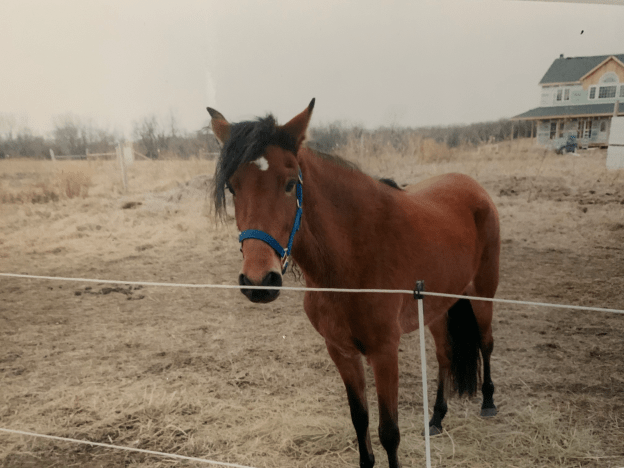
My eye as a historian is drawn to finding the roots of the things that I come across, both in my studies and in my curiosities. It struck me then to see in my Fócloir Gaeilge-Béarla that different equine words in Irish retained traces of this older word for the horse: each. In my likely forlorn search for some trace of the oldest roots of the Irish language, and by extension of my own ancestors, I feel the need to understand where these two words come from. Horses are important in their own way, albeit replaced in most uses by cars, trains, and airplanes today. Despite moving to a farm when I was six in order to have horses, I don’t think I’ve ridden a horse in at least 15 years, if not a full score. When you ride a horse, you are working with the horse to move about the world. Wherever you look, the horse will wander that direction. It’s key to remember that the horse is more than just a vehicle, it is a living being with thoughts and wishes all its own.

Having two words for this animal show that the perceptions of it have changed down the generations. This word each today is used to describe people or activities which relate to horses in the same way we use the word equine in English. That English word however derives from the Latin equus, while each is a relative of the same generation as the Latin. Meanwhile, capall is the horse as the everyday being: the beast of burden, the bearer of riders, and yes the friend. As with most things concerning the origins of the Irish language, I can’t yet say for certain when or how capall entered the language though I am more certain that each was already there if only because I know that equus predates caballus in Latin, and because the most innate relationship humanity can have with a horse, as the rider, is reflected in Irish with the word eachaí

There is much we can learn from our past, and how we lived within nature and alongside other natural things in those distant days. I do hope we can learn more as we continue on in our lives on this Earth.


[1] The use of the asterisk in these Gaulish, Proto-Celtic, and Proto-Indo-European words denote that they are theoretical reconstructions.

[2] Myles Dillon, “Linguistic Borrowing and Historical Evidence,” Language 21, no. 1 (1945): 12–17, at 13. (JSTOR)


Dúlra

This week, how it’s good to pause and notice the ways we supersede older things with the new while benefiting from the old all the same. — Click here to support the Wednesday Blog: https://www.patreon.com/sthosdkane

This week, how it’s good to pause and notice the ways we supersede older things with the new while benefiting from the old all the same.


One thing I seek to understand the most about the Irish language is how different external influences have changed the language. I first learned the word nádúr before learning dúlra. Both words mean the same thing on a broad level: they both refer to the concept of nature. Yet nádúr comes from the Latin nātūra with the early medieval monks. It was an import to Ireland that arrived with Christianity and the Latin alphabet, a Roman concept of nature that perhaps fits better in the classical sense of civilization than the Gaelic model which was highly developed around forts and homesteads rather than cities or towns. I’ve often challenged my students to consider that while civilization at its core refers to cities, the ways in which it has developed around the globe differ in their own methods.

Take, if you will, the different origins of writing. Whereas our own Latin alphabet derives from a Mediterranean sphere of the written word whose roots trace back to Egyptian hieroglyphs, the history of writing in East Asia goes back to the earliest forms of writing in ancient China on the oracle bones. In the countries whose writing systems derive from this Chinese source, they still largely use logographic or syllabic forms of writing while there is a greater diversity of form among the descendants of these old Egyptian hieroglyphs. We, the Greeks, and Cyrillic writers, have devised alphabets in which both consonants and vowels are written out. Other cultures that have adopted this Mediterranean tradition of writing only write the consonants, as in Arabic and Hebrew. Still others have syllabic systems in which individual written characters represent a syllabic sound: a consonant and vowel combination.

Each system is equal in its utility, and each represent the diversity of human experiences with their own worlds. They are each their own response to a common question. So it is with nātūra and dúlra, one is a Latin way while the other a Gaelic one. Nature, in this Latin perception is quite monolithic and abstract in my view; I’m thinking of Lucretius’s book De rērum nātūra, or On the Nature of Things, whose title I’ve surely ripped off a good many times in the last fifteen years. We can talk about nature this and nature that, yet we need further context to properly understand what is meant by nature. It could be a reference to the non-human world, places untouched by civilization. That certainly fits the Renaissance perception of nature which I study. Or it could stand in for instinct and feeling. My Instagram feed was filled earlier this week with videos of people who have pet panthers and tigers for some reason. Sure, they may seem like big, cute kittens but unlike domesticated cats (Felius cattus) these animals don’t have generations of domestication and breeding to be willing to live around humans like their smaller distant cousins do. So, pets they may be, but they are still pets that could, and quite likely will, rip your face off if given the chance.

What I like about dúlra is that it comes from another Irish word, dúil, which is a very abstract concept in English yet specific in that it refers to the most fundamental aspects of one’s nature. Dúil can be used to refer to the elements of one’s existence, or to a creature as something created. In English we have several words that all generally refer to other fauna: there’s animal, the most common one which has the Latin anima meaning “spirit” at its core, creature, which sounds slightly more menacing yet at the same time speaks to the thing’s nature as a created being, and finally beast which comes into English through French from the Latin bēstiawhich implies a strong sense of danger in its name. These three words offer a gradient of distinction from humanity, and even a scale by which we humans have judged each other. Dúil then fits closer to the English word creature in the sense that a creature is created and is constituted of elements which allow it to exist.

Are these elements then immutable, or can they change with their experiences? There is a story in the March/April 2024 issue of Smithsonian Magazine by conservation journalist Ben Goldfarb about the negative impacts that roads are having on the forests of the American West. In many places roads were the forward guard of civilization, along those roads came the hunters and loggers, the miners and sightseers all of whom transformed these forests to better fit that classical view of a civilized and maintained wilderness that isn’t truly wild. Today, Goldfarb writes, in the contiguous United States “it is impossible to travel further than 22 miles (35 km) from the nearest road.” Think about that for a moment: in the Lower 48 states, which occupy an area of 3,119,884.69 mi2 (8,080,464.3 km2), you can’t go very far from running into a road. I’ve often noticed how if you look at a road map of the 48 states you’ll see how tightly packed the roads are in the eastern half of the country, and once you go out further west they are still there but often more in a clear grid pattern. Goldfarb describes how Idaho’s Nez Perce-Clearwater National Forests have a road density which exceeds that of New York City even.

These roads then are not natural to the landscape, and those which were built on older Native American footpaths and trade routes are now so widened and imprinted upon the landscape as to make them less thoroughfares through the woods and more barriers for the denizens of the woods going straight through their home turf. Think of Arthur Dent’s exasperation at waking up in his comfortable English house to find a bulldozer outside his front door ready to pull the house down to build a bypass. The same goes for the bears and birds and deer and all the other wild things that live in this continent’s forests.

Roads often stand for a level of sophistication and civility which hearkens back to the Romans, whose roads famously all led to Rome. Like the Roman coloniae which reshaped the great forests of Northern and Western Europe two millennia ago, our own settlements changed this continent in a way which better reflects the aspirations of one society seeking to assert their sense of civility and right upon all others they encounter. Roads are tangible symbols of empire which aid the movement of goods and people from one place to another. They tie this continent together in its most fundamental way, before the railways or airways brought us even closer together. Yet Goldfarb makes a good point: at what cost have we strung these ribbons of highway across the North American continent?

The suggestion which Goldfarb describes is pulling out less used roads, old timber roads no longer operated by the companies who built them, and letting the wilderness restore itself. At first, I was hesitant to support this cause, after all how else would I, a city guy, be able to venture out west into the woods to see nature and admire the wonders of the Rockies? Yet as I read his article which features conservationists in Idaho and Montana, I began to see his point. These roads are destructive, and perhaps the better way to see nature, to experience dúlra in its fullness on this continent is to pull out some of these more remote roads, let the brush take over again, and force any would-be visitors to hike in and out. Let it be a reminder that whenever we are in that world that we are guests in someone else’s house.

In the coming weeks, I hope to write more about this question of mine of what exactly makes us human? What is the dúil at the core of our existence? And how can we understand our own dúil, our own essence, in a way which coexists with all other life rather than living above all others as some sort of self-appointed superior? Perhaps that famous line in the Book of Genesis where God commissions Adam and Eve as stewards of the Earth ought to be understood not as “having dominion over nature” but “tending to the balance of nature.” As humanity becomes more urbanized, as civilization becomes more city-orientated, perhaps we will see the land around our cities return to the wild. The Australian mammalogist, paleontologist, environmentalist, conservationist, explorer, and science communicator Tim Flannery argues this could be the case. To conclude his book Europe: A Natural History, Flannery describes a future around 2100 where most of Europe’s human population live in cities and the open land between them has been turned into wildlife reserves, national parks, and restored to its primeval forests. As long as we can assure that our food supplies, fresh drinking water, and sanitation persist if not improve, and that overcrowding doesn’t become too much of a problem in these cities then I have little issue with this idea.

It is interesting to me that even in the context of the word dúlra there is a clear distinction between that and humanity, that dúlra represents the essence of the non-human world, something far less orderly than what we’ve created. It doesn’t necessarily follow laws in the same manner as nātūra, laws whose order can be discerned with careful examination. There is something pure to the chaotic origins of life in this word dúlra, and that’s something I appreciate.


Eclipse simulation using Stellarium

The Eclipse

This Monday, North America experienced its second total solar eclipse in the last decade. — Click here to support the Wednesday Blog: https://www.patreon.com/sthosdkane


This Monday, North America experienced its second total solar eclipse in the last decade.


I remember being over-the-moon excited when we began preparing for the Total Solar Eclipse in August 2017. Several weekends before the eclipse, my parents and I drove north from Kansas City into the path of totality to scout out possible places where we might travel on Eclipse Day to see the phenomenon for ourselves. Eclipse Day 2017 also happened to be my first day as a history graduate student at the University of Missouri-Kansas City. That morning a sudden summer thunderstorm rolled through Kansas City and as the day continued the clouds persisted in our skies. When the moment of totality arrived around 12:55 pm on 21 August, we watched it through darkened clouds and heard the birds and insects around us revert to their nocturnal states and songs.

I was excited to have experienced a total solar eclipse yet disappointed that I wasn’t able to see it. So, when the prospect of traveling for this week’s total solar eclipse appeared, I seriously considered going afield to Texas to observe it. That trip didn’t end up working out because of a series of scheduling conflicts, and so instead seeing that the cloud forecast across North America called for most places along the path of totality to be obscured, I decided to stay here in Kansas City and observe our partial solar eclipse. At its greatest extent, the April 2024 solar eclipse reached about 90.5% totality. I was able to see that extent, yet the feel of it was quite different than 100% totality from seven years ago. We were watching Everyday Astronaut and the Planetary Society’s live broadcast from the Society’s Eclipse-o-rama event in Fredericksburg, Texas while observing the eclipse here at home, and what they experienced was far more dramatic than what we observed. I do regret not travelling for this eclipse, yet at the same time in the circumstances as they fell, I’m glad I chose to stay home all the same.

This concept of an eclipse is one that speaks to me both astronomically, as a big space nerd, historically, and linguistically. Eclipses are phenomena that have made their mark on the psyche of more than just us humans, note how the birds began singing their twilight songs when the Moon passed in front of the Sun. I have never put much theological potency into eclipses because we have been able to predict their occurrences with increasing accuracy for generations now. Religion, in many ways, relies on our perceptions of things. Some see in an eclipse a threat to divine order in the Cosmos. This view reminds me of Mozart’s final opera, near to my favorite of his works, Die Zauberflöte (The Magic Flute) in which the Queen of the Night is defeated by Sarastro, the high priest of the Temple of the Sun. Sarastro proclaims victory for the good and right, singing: 

Die Strahlen der Sonne

Vertreiben die Nacht.

Zernichtet der Heuchler

Erschlichende Macht.

The rays of the sun

Drive away the night.

Destroyed  is the hypocrites’  

Surreptitious power.

(Source: Aria-Database.com, trans. Lea Frey)

Sarastro’s triumphant finale in Die Zauberflöte sung by Josef Greindl with the RIAS Symphonie-Orchester Berlin.

The divine hand is better seen in the wisdom of devising a manner to mathematically ascertain the revolutions of these celestial orbs, to borrow the title of Copernicus’s magnum opus, De revolutionibus orbium coelestium. In our ability to ascertain our surroundings, and to make sense of nature we see a loving design.

Still, knowledge of the movements of the Sun, planets, moons, and stars across our night skies have had their impact in our history. During his fourth voyage, on 1 March 1504, after 9 months stranded in Jamaica, Christopher Columbus (1451–1506) used his knowledge of eclipses from an almanac he brought with him written by the Castilian Jewish astronomer Abraham Zacuto (1452 – c. 1515) to inspire the Taíno caique of that part of Jamaica to give Columbus’s men food and provisions. Columbus wrote in his journals that he pointed at the Moon and told the Taíno that “God caused that appearance, to signify his anger against them for not bringing the food” to Columbus and his men.[1] Several years ago then, when discussing this story with a friend and fellow Renaissance historian, I decided to use the Stellarium astronomy program to simulate this lunar eclipse as Columbus and those with him in Jamaica saw it. Our ability to track the movements of these celestial orbs is good enough that our computers can show exactly what was visible in the night sky (baring any atmospheric data) at any moment in the past or future.

My simulation of the March 1504 Lunar Eclipse as seen from St. Ann’s Bay, Jamaica using Stellarium.

This ability to calculate the dates and locations of eclipses came in handy when researchers look at mentions of eclipses in ancient literature to seek to date the events of the stories. Plutarch and Heraclitus both argued that the Odyssey contains “a poetic description of a total solar eclipse,” which astronomers Carl Schoch and P.V. Neugebauer proposed matched an eclipse which occurred over the Ionian Sea on 16 April 1178 BCE, though a more recent article in the Proceedings of the National Academy of Sciences by Constantino Baikouzis and Marcelo O. Magnasco offer doubts concerning this proposition owing to the difficulty of finding exact matches in spite of centuries of the Odyssey‘s transmission through the oral tradition before it was written.[2] Still, that eclipses are so readily discernible and measurable with our mathematics speaks to the potential that they could be used to date moments long remembered only in heroic literature like Odysseus’s return to Ithaca in Book 20 of the Odyssey (20.356-57). In this effort, where others divine gods, we make tools out of the Sun and Moon to better understand ourselves.

The way we describe an eclipse speaks to our culture’s relationship with the phenomenon. Our Modern English word derives from the same word in Old French, which developed from the Latin eclīpsis, which in turn was borrowed from the Ancient Greek ἔκλειψις (ékleipsis), which comes from the verb ἐκλείπω (ekleípō)meaning to abandon, go out, or vanish.” Eclipse eclipsed the Old English word āsprungennes, which derives from the past participle of the verb āspringan, meaning “to spring up, to spread out, to run out, to cease or fail.” As an adjective, āsprungen meant that something was defunct or deficient, so perhaps this sense of an eclipse meant that it seemed for a moment as though the Sun had run out of energy and ceased to burn? Again, this speaks to the idea that nature had limits as humanity does, to an older understanding of nature from the perspective of a limited human lifespan. 

In Irish, there is the Hellenic word éiclips, yet there’s an older Gaelic word which means the same thing, urú. Now, usually students of the Irish language will learn of urú in the context of Irish grammar, an urú or eclipsis is one way that Irish handles both consonant clusters and situations when one word ends in a vowel and the following word begins with another vowel. So, in that sense the word gets eclipsed by this urú which preserves some of the integrity of the language. Yesterday’s eclipse then was less an urú focail (word eclipse) and more a urú gréine (solar eclipse). That both the Sun and the words we speak in Irish can be eclipsed makes this astronomical phenomenon all the more ordinary and measurable. 

We use this word eclipse beyond astronomy in many cases; it seems to me today that the old guard of the Republican Party has been eclipsed by an orange political pulsar whose violent rhetoric and chaotic behavior have eaten away at their party’s support in these last 8 years, not unlike a pulsar discovered by NASA’s Swift and Rossi X-Ray Timing Explorer satellites in 2007. An eclipse is something wonderous to behold yet ordinary in how readily we can predict when they will appear. They have given us a great deal of cultural qualifications that continue to influence how we see our world.

On Monday then, when the sky began to darken as the Moon passed in front of the Sun, I noticed that the color spectrum that I’ve always known began to change. Before my eyes the colors seemed to take on a sort of metallic glow, as if the light which illuminated them was shifting into a spectrum that seemed unnatural to the natural world I’ve known. The Sun is fundamental to how we understand the world around us. Its light is what illuminates our senses, and without it, or even with partial changes to its glow, we would find ourselves observing a very different world.


[1] Christopher Columbus, “The Fourth Voyage,” Select Letters of Christopher Columbus: With Other Original Documents Relating to the Four Voyages to the New World, trans. and ed. R. H. Major, (London: Haklyut Society, 1847), 226.

[2] Constanino Baikouzis and Marcelo O. Magnasco, “Is an eclipse described in the Odyssey?” Proceedings of the National Academy of Sciences 105, no. 26 (2008): 8823–8828, nn. 1, 12–14.


The Essence of Being

This week, to begin Season 4 of the Wednesday Blog podcast, I want to talk about what it means to exist. I know, small topic for a Wednesday. — Click here to support the Wednesday Blog: https://www.patreon.com/sthosdkane


This week, to begin Season 4 of the Wednesday Blog podcast, I want to talk about what it means to exist. I know, small topic for a Wednesday.


Two weeks ago, I started teaching a new class that I’m calling Bunrang Ghaeilge, Beginner Irish. The students come from my fellow members of the Fr. Bernard Donnelly Division of the Ancient Order of Hibernians and their relatives, and in the first two weeks we’ve progressed slower than I initially expected yet we’re still progressing through the materials. The first verb which I taught my current students in English translates as to be, yet in Irish as two forms: is for a more permanent being and  in a more impermanent circumstance. In the moment I explained this difference by noting how I say is as Chicago mé (I am from Chicago), as in I was born in the Chicago area, but I say tá mé i mo chónaí in Kansas City (I live in Kansas City). We don’t have this distinction in English, either between the permanent and impermanent versions of the to be verb or in the clear distinction between where you’re from at birth and where you currently live; that distinction is far more subtle in English.

At the same time, I am learning Italian for a trip this summer, my own version of the Grand Tour, and on the Busuu app where I’m learning Italian they taught that I should say sono di Chicago però abito a Kansas City,as in I was born in Chicago, but I inhabit today in Kansas City. This distinction between a place that is central to our essence, the place where we were born, and the place where we now live seem important, yet it flies in the face of the American sense of reinvention that we can make ourselves into whomever we want to be. It’s struck me when I’ve met people who would rather see themselves as from the place where they currently live than the place where they were born. That is a different view from my own, born out of different lived experiences and different aspirations.

This word essence developed from the Latin word essentia, which the 1st century CE Stoic philosopher Seneca wrote was coined by the great orator Cicero as a translation of the Greek word οὐσία (ousia), a noun form of the Ancient Greek verb εἰμί (eimi), meaning “to be.” (Sen., Ep. 58.6) It refers to an innate idea that the ultimate goal of philosophy and learning in general is to better understand the self; the most famous inscription in the ancient Temple of Apollo at Delphi read γνῶθι σαυτόν (gnōthi sauton), or “know thyself.” I add to that goal the aspiration that one can improve oneself. 

This time of year, I find myself thinking more and more about what it means for me to be an Irish American. This past weekend we celebrated St. Patrick’s Day, a day of great celebration for the global Irish diaspora and our cousins back in Ireland as well. I’ve written before here about how my communities’ immigrant connections to Ireland often predate the current century, if not the twentieth century as well and how we are in many respects far more American than Irish. In recent years, I began to refer to myself in this subject as an American cousin, after all as much as I have Irish roots and I come from an Irish family, I’m an American and have lived an American life to date. I’m not as far removed from Ireland as many I know, yet this year marks the 110th anniversary of my great-grandfather Thomas Kane’s arrival in America.

There’s something about being Irish American which doesn’t quite fit neatly into any of the official boxes. In Ireland, to be Irish is to be from Ireland or to be a close enough descendant that you qualify for Irish citizenship, like my father does. In America, there’s a sense that the old stereotypes of Irish immigrants are fair caricatures to still uphold, especially on our communities’ holiday in much the same way that the sombreros are donned on Cinco de Mayo. Yet there’s a lot more to it. On both sides of the Atlantic, our communities have the same deeply intertwined connections between families near and far, friends in common, and a sense of nostalgia that I see especially strong among those of us born in America.

Perhaps the Irish language can offer the best answer here. In Irish, I’ll say to Irish people, as I wrote a few paragraphs ago, “Is col ceathrair Meiriceánach mé.” Yet the official Irish name for us Irish Americans is “na Gael-Meiriceánigh”, or Gaelic Americans. I think this speaks to something far older and deeper than any geographic or political connections. We come from common ancestors, share common histories and stories that wind their way back generations and centuries even. We are who we are because of whom we’ve come from. I hope to pass this rich legacy in all its joys and struggles onto the next generation in my family; perhaps I dream of those not yet born hoping they’ll be better versions of my own generation. I hope they’ll still feel this connection to our diaspora like I do even as we continue on our way along the long winding road of time further and further from Ireland.

I am the child of my parents, the grandchild of my grandparents, and great-grandchild of my great-grandparents. In so many ways, I am who I am today because of those who’ve come before me. The geography of my life was written by them, by a choice among other immigrants from County Mayo my ancestors found their way to Chicago instead of Boston, New York, or Philadelphia. My politics reflect my ancestors’ views as well, in the Irish context the legacies of the Home Rule Crisis of 1912-1916, the Easter Rising of 1916, the War of Independence of 1919-1921, and the Civil War of 1922-1924 all have as much of a presence in my political philosophy as does their American contemporaries: the Progressive Era and its successor in the New Deal coalition. Yet I am my own person, and from these foundations I’ve built my own house in as much of an image of the past as it is a hope for the future.

What does it mean then to be ourselves? We hear a great deal today about how people identify, in a way which seems to be a radical departure from older norms and expectations both in the English language and in how we live. We constantly seek answers to all of our questions because we anticipate that all of our questions can be answered, yet the mystery of being is one of my great joys. I love that there are always things which I do not know, things with which I’m unfamiliar and uncertain. This is where belief extends my horizons beyond what my knowledge can hold, a belief born from the optimistic twins of aspiration and imagination. I know that the essence of my being, the very fundamental elements of who I am, draw far more from these twins than any other emotion. I am what my dreams make of me, I see my world with eyes colored by what my mind imagines might be possible; and in that possibility I find the courage to hope for a better tomorrow.


How Irish Understands the World

After I released my previous episode “Summer School in Irish” back at the beginning of August, I had a good conversation with one of my best friends and one of my most frequent listeners, past Wednesday Blog guest Alex Brisson, about the utility of keeping smaller languages like Irish alive. How do these languages benefit humanity when we’re moving toward a time of greater linguistic conformity, when there are a handful of global human linguae francae, such as English, Mandarin, Russian, Arabic, Spanish, and French (the official languages of the United Nations)?

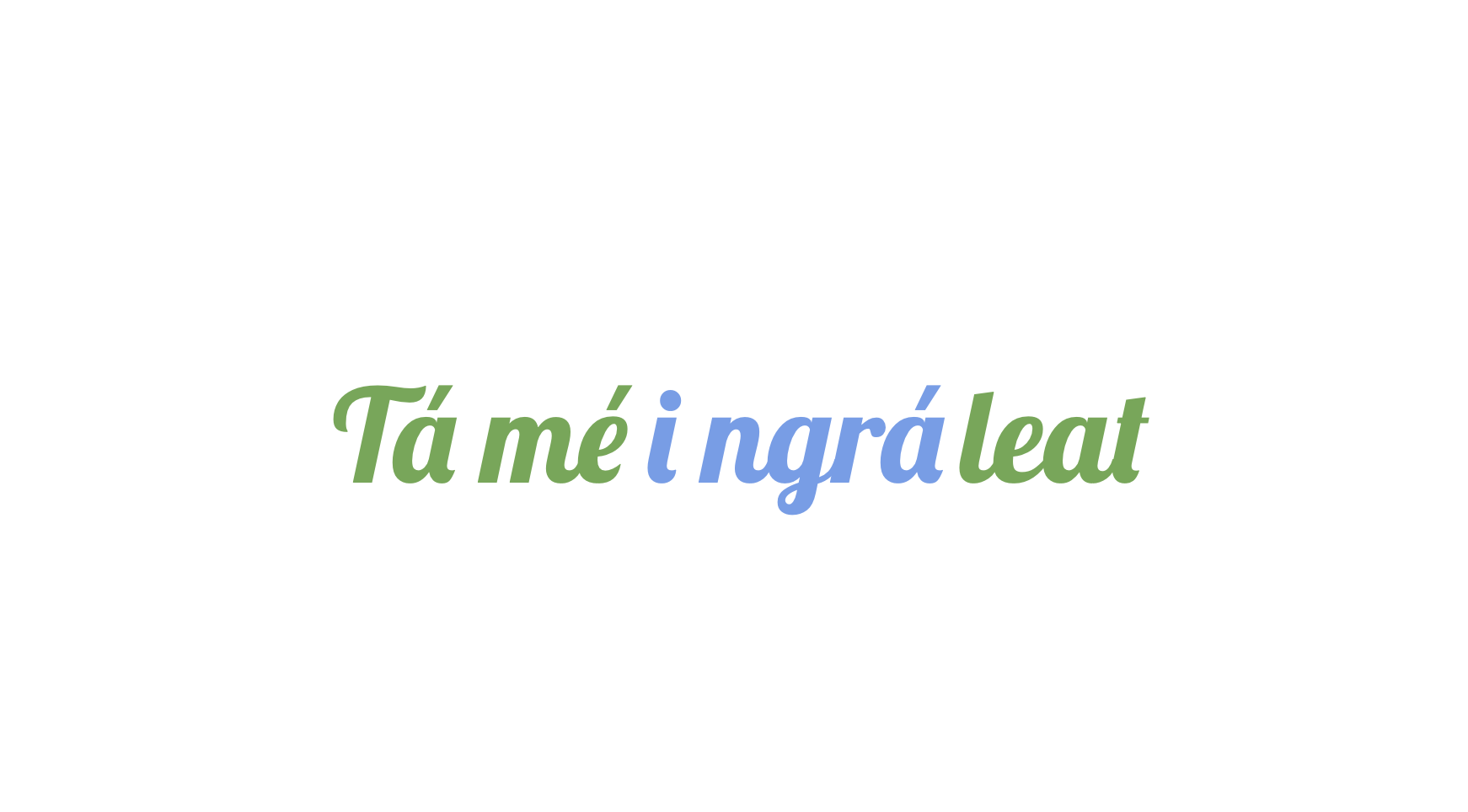
I responded by lauding the beauty of Irish, by the fact that Irish helps the speaker understand the nature and world around them differently. Take the phrase Tá mé i ngrá leat for example. This means “I love you,” though not quite in the same sense as the English. In English, there’s the subject “I” who’s doing an action “love” to the object “you.” This is the same way that this sentiment is expressed in many other languages from German “Ich liebe dich” to French “Je t’aime” to Spanish’s “Yo te amo” or more simply “Te amo.” 

Irish, on the other hand takes a less forceful approach, instead having the subject “mé” being in a state of love ” i ngrá” with the object “leat.” Thus, in Irish the expression Tá mé i ngrá leat says less that one person is expressing love toward another and more that both people are in a state of love with each other, a model of relationship that I personally prefer far more. Losing a language like Irish loses this elegant worldview, it takes away one particular means of understanding how one group of humans has long perceived the world around them.

Another way that Irish does things differently from English is in the use of a habitual copular verb. In plain English this means there’s a version of “to be” that expresses an action that’s done on a regular basis, so Bím ag scríobh colún gach seachtain a The Wednesday Blog atá air. | I write a column every week which is called The Wednesday Blog. This particular verbal construction of Bím rather than the present active tense Tá mé as seen in the last example helps express the regularity of the action, the writing of the blog and podcast itself. It demonstrates that I, Seán, am on a weekly basis writing this string of ideas which you, dear reader or listener, then choose to read or listen to. It also offers a sense of much needed hope that yes, I’ll actually keep writing The Wednesday Blog, something which I’m always not sure about. Today though, looking back at the 40 episodes already written and the 38 blog posts that came before the launch of the podcast, I’d like to think I’ve gotten myself into a good rhythm.

If there’s any other chief argument I’ve made in the past for why Irish ought to be kept alive, even taken off life support one day and spoken as another one of Europe’s vibrant languages, it’s that so many echoes of its once and future vitality still exist on the face of our world today. Take my name, Seán Thomas Kane, which though not intentional is a highly traditional Irish name. In Irish, my name is Seán mac Tomás Ó Catháin, or Seán, son of Thomas, descendant of Cathán. Cathán was a King of Ulster who ruled in the late 9th century CE about the same time as Alfred the Great was on the throne of Wessex. Thomas is my Dad, Tom Kane, meaning that my name actually works quite well seeing as I am actually Seán mac Tomás, or in the more clunky English Seán, son of Thomas. You can often tell when a family over here in the U.S. are Irish Americans by the fact that the parents and kids tend to have similar Irish names like Brigid, Patrick, Maureen, Brendan, or Molly, among others. While we’ve generally lost our ancestral language through the generations spent living in English-speaking countries, we’ve still kept aspects of that culture alive.

One thing I would love to see someday is a vibrant, if spread out, Irish-speaking community here in North America. It would be neat to have that sort of communal connection through our ancestral language preserved and even slightly transformed by our own distinct experiences living in North America from the Irish that’s spoken today in Ireland. Perhaps this would be seen in the gradual creation of a North American dialect of Irish alongside the three modern dialects of Connacht, Munster, and Ulster Irish. I for one am finding it easiest to speak a bit of a mix of Connacht Irish (the dialect spoken by my family) and Ulster Irish, though I’ve also learned many a Munster mannerism and mode of doing things as well.

Here in the United States our monolingualism has so greatly influenced our way of thinking that it is strange to consider a life where one might speak one language at home and one out in society. This is something done by people everywhere, even here in the US. In that future, even if we do come up with some sort of universal translator that just renders all linguistic barriers largely null and void, there would still be room for people to speak their own languages in their own way among themselves.

Go raibh maith agaibh go héisteacht! Thanks for listening!

Deacrachtái na Teanga – Problems of Langauge – Des problèmes de langue

Kansas City – Ba shcríobh mé as Gaeilge aréir sa mo dialann in ionad as Béarla. Is labhaim Gaeilge ach tá trioblóid scríoim Gaeilge agam. Tá sé mo Gaeilge neamhliteartha murab ioann agus mo Laidin, mo Fraincis, agus mo Béarla. Ní suim ar mo trioblóid sin! Bhí mé shcríobh as Gaeilge!

So, as I was saying as Gaeilge, in Irish, I decided last night to write my daily journal entry (so whoever takes my place as family archivist can have fun seeing what I did everyday). As it turned out, and as I knew when undertaking this daunting task, my written Irish is about as good as the whereabouts of Mohamed Morsi are known to the Western media (or the general public for that matter. So, I decided enough was enough, I was going to tackle this rather major issue, considering I tend to be known as a Gaeilgeóir, an Irish speaker, in the community at large. My plan is simple, write every one of my daily journal entries as Gaeilge from here on out, unless I’m somewhere like France or Belgium, in which case I’d probably go en français

Alors, je disais en anglais ce mon écrit irlandais n’est pas très bien, comme mon parlant français. J’ai appris les langues romantiques, ma latin et mon français avec leurs formes écrites. C’est au contraire avec mon irlandais, qu’est orale.

The point of this entry, rather than having a more useful function, is rather to show that multiple languages can flow together, somewhat. I admit, this might come out sounding nicer and flowing better if I were writing this say in mid afternoon rather than almost at 23.00, but I’m writing it now because it’s coming to mind now. And in any case, it’s almost time to go and write down today’s goings on as Gaeilge. Wish me luck on Day No. 2!