Tag Archives: History PhD

The Lotus-Eaters

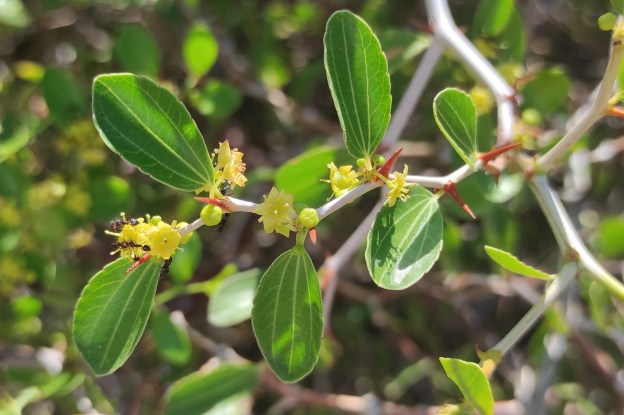
This week, comparing the benefits of pleasure with the rewards of good work.—Click here to support the Wednesday Blog: https://www.patreon.com/sthosdkane—Sources:Photo: © Juan Valentín CC BY-NC 4.0 https://www.inaturalist.org/photos/427040191. No modifications made. Available under public license. Image slightly cropped length-wise for podcast episode art.[1] André Thevet, Les Singularitez de la France Antarctique, (Antwerp, 1558), 4v ; Aristotle, Situations and Names of Winds 973b, 12–13.[2] Homer, Odyssey 9.106–110, trans. Robert Fagles, (Penguin, 1996), 214.[3] Homer, Odyssey 9.110–117, trans. Fagles, 214.[4] Aristotle, Nicomachean Ethics 1118a.[5] Aristotle, Nicomachean Ethics 1118a, 8.

Photo: Ziziphus lotus, © Juan Valentín CC BY-NC 4.0 https://www.inaturalist.org/photos/427040191. No modifications made. Available under public license.


This week, comparing the benefits of pleasure with the rewards of good work.


A recurring challenge of my life is finding a good work-life balance. Perhaps central to this conundrum is the fact that I simply enjoy the work that I do, so I’m more willing to approach something work-related at all hours because it brings me joy. There are plenty of things that I need to do with my time, and plenty more that I know I will someday accomplish, yet I feel less pressed to push through any weariness or writer’s block to finish a given project today than I have in the past. For most things, I have a wide enough gap leading up to project deadlines that I can afford to work as I will on a given project. This is a luxury of the moment, which was foreign to me even a year ago, and I know well that the ample time I have now is a singular moment in my life that will likely not repeat often again. So, as long as I have the time to spend working on the Wednesday Blog and the handful of articles and book chapters that I’m writing, I’ll use that time to the best of my ability.

Each of us operates within the structures of our civilization, and within the cultural edifices built up over millennia that define our very identities. No one exists in true solitude everyone comes from somewhere. There are plenty of stories of loosening the burdens of life for the splendid abandon. Life is hard for all of us; one of the great unifying factors of the human experience is struggle. I doubt that either the richest or the poorest people alive today are fully happy and content in their present state. There are certainly things I would like to change about my life, things that I’m now approaching with the same resolve that I dedicate to my work and I see that among my family and friends too, such potent dedication to completing tasks difficult and easy alike that when all is said and done the doer can rest proud of their work.

Still, there is value to taking time to rest. I’ve developed a bad habit of sitting at my desk until I’m so tired that I can’t sit up straight, or even to the point that I find one eye closing so that I can keep reading with the other. These make for good stories but they’re bad habits overall. It seems to me like there’s so much to learn and not enough time to commit it all. We Americans are particularly bad at our work-life balance. While we have a strong work ethic in this country, we don’t give ourselves enough time to enjoy the fruits of our labor. I now work at some of the places where otherwise I would go to rest, places like the Kauffman Center for the Performing Arts where when I returned to Kansas City in December 2022, I was a frequent patron of the Kansas City Symphony’s performances until March 2023 when I signed on as a Team Captain of the Volunteer Usher Corps. Now, I work at the Kauffman Center and while I don’t get to relax and soak in the music there anymore, I’m proud of the work that I do and I work with people who I genuinely enjoy being around. In fact, working at the Kauffman Center has magnified the value of my historical research and writing even more. That’s what I love most in all the things that I do because it’s what I’m best at, and it’s through academia that I’ve met some of the people I most admire in all the world. The last two months then when I singularly devoted my attention to researching, writing, and editing a new and better introduction to my dissertation I poured all my effort and energy into the task and the work shows it. Yet I also drained myself of that same strength and realized that the working hours I kept four years ago when I was reading 12 hours a day in preparation for my comprehensive exams were no longer tenable. Life moves on, and with the changes in my life so too my stamina for these sorts of long hours have changed. I’m doing a lot more now than I was during the height of the pandemic in January, February, and March of 2021. Thus, it’s reasonable to say that I cannot do quite as much of the same things that I once did.

There are times when I can get so caught up in what it is I’m doing in the moment that I miss the world going by. I mourn a little bit how fast 2025 has been for me, there are things I wish I had done in the first half of this year that I failed to do for one reason or another. Often those reasons were out of my control. Yet they remain monuments to things that could have been. In other cases, though those things are goals which I turned away after finding better things to pursue. I’ve learned that I must remain open to change, flexible in my ways of living and doing things. How many times have I thought I was done with my dissertation only to be told that there was still more work to do? I know that endeavor defines my career and will continue to do so as long as I’m contributing to the scholarship of Renaissance natural history. Still, at times the idea of abandoning my efforts and falling into a state of rest has its appeal. At this moment, I would appreciate a vacation, even if only 24 hours away from my work. I took some time to enjoy the friendly company of my brother Hibernians and their families, and my Gaelgeoir friends this weekend at the Kansas City Irish Fest. It was lovely using that time to be with people whose company I enjoy, yet it was just as great a joy to return to my work this week and especially now that I’ve finished this round of work on my dissertation’s introduction to return to editing my translation of André Thevet’s 1557 book Les Singularitez de la France Antarctique. I had a delightful day spent reading through the Loeb Classical Library and the Perseus database hunting down Thevet’s Greek and Roman references on the geography, ethnography, and zoology of Sub-Saharan Africa.

The legacy of those ancient authors lies heavy on the European perception of their southern neighbors. The Greeks especially perceived Libya, their name for Africa, as the great desert landmass on the southern edge of their world. Thevet wrote that Libya was named by the Greeks for the southwestern wind, or Lips (Λίψ), a notion he got from Aristotle’s book the Situations and Names of Winds.[1] Thus, while Libya was the Greek name for Africa as a whole in antiquity, that the name was associated more with the southwest than the south suggests that their notion of Libya was west of Egypt and in the general vicinity today known as Libya. Further west along the Mediterranean coast of Africa lay an island where Homer records that Odysseus’s ship made a beachhead born by the north wind across what Robert Fagles translates as “the fish-infested sea.” On the tenth day “our squadron reached the land of the Lotus-eaters,” who Homer described as “people who eat the lotus, mellow fruit and flower.” Odysseus’s crewmen “snatched a meal by the swift ships” and found as “they mingled among the natives” that they “lost all desire” to do their duties 

“much less return

their only wish to linger there with the Lotus-eaters,

grazing on lotus, all memory of the journey home

dissolved forever.”[2]

The lotus-eaters of the Odyssey who live in bliss induced by the plant. Their worries carried far away they could bask in the glow of their sun and live out their days in a sense of peace. Yet Odysseus saw in this idyll a great distraction from what must be done, he and his crew needed to still return home to Ithaca. The king in his wisdom continued his story,

“But brought them back, back

To the hollow ships, and streaming tears––I forced them,

Hauled them under the rowing benches, lashed them fast

And shouted out commands to my other, steady comrades:

‘Quick, no time to lose, embark in the racing ships!’––

So none could eat the lotus, forget the voyage home.”[3] (9.92-117)

The danger lay less in an immediate threat to life and limb but rather in a threat to mission, to vocation. Odysseus knew his charge was to shepherd as many of his men home as he could; what a tragedy it was that after all his efforts he returned home alone. The threat of the lotus-eaters lay in their carefree abandon of the need of self-preservation. Eventually, had the King of Ithaca and his men stayed on the island they would have faded in body and in spirit, dying not in war but by becoming stale and wasting away slowly until they had not even their memory to keep alive. Too much of a good thing becomes a bad thing, just as everything changes over the long dance of time.

Moderation then is the best way of living, to do things such that we humans not only survive but thrive in the conditions in which we find ourselves. Aristotle expresses this best in his Nicomachean Ethics that for every sort of action or feeling there is an excess and a deficiency and between them a mean which is the moral virtue. Thus, the lotus-eaters lived in a state of self-indulgent excess, born from their love of the lotus plant and the way it can make all their troubles disappear.[4] Aristotle argued that “temperance and profligacy are concerned with those pleasures which man shares with the lower animals, and which consequently appear slavish and bestial.”[5] It is human to have passions, desires, and urges to do one thing over another, yet it is an entirely different thing to give into those passions and abandon control over one’s own life. I think it is a greater sorrow to give up this control thoughtlessly than it is to have that control taken from you, even if the act of subjugation remains in the eye of the subduer and only as powerful as society wills it to be. This is something we too often forget: so many of the bad things that go on in our world are things of our own making. We choose to allow rampant gun violence in our country, or to let the institutions of our democracy crumble, or to let people go hungry, die from treatable diseases, and remain illiterate all because people in positions of power benefit from having others in need. I suspect that we don’t have to live like this. Perhaps the root of these societal woes comes from an understandable inability to understand death, that final act of life which often is so very unfair to the dying and those left behind. So long as the greatest inequity exists then why should we bother with trying to fix our own problems?Dear reader, I’ve been writing this Wednesday Blog now for four and a half years, and I’ve always said that my one rule for this publication is that I will end it once it’s no longer fun to write. Just before the pandemic during a family gathering, one of my uncles remarked that he had no interest in retiring soon because he loves the work he does. This struck me because it explains why I’ve stuck around in academia in spite of all the trouble I’ve been through in these past few years. I do this work because I love it; I write because I enjoy writing, and I’m writing to you today to suggest that we could make our world a better place to live for ourselves and our children and grandchildren who’ll come after us, we just have to leave the island and its lotuses and climb back into our boat and set out onto the fish-infested sea again. For all that I’ve learned about a great many topics, I still often need reminding to do basic things like stop reading or writing late at night and go to bed. I suspect that’s the case for most of us, that we get caught up in the worries or passions of the day and lose sight of the good things that we can do to really find true peace. Here in the United States the first big step that we ought to take is reconsider how we prioritize work to such a degree that it becomes life itself. We ought to work to live, not live to work. On this Labor Day week that’s as good a starting place as any.


[1] André Thevet, Les Singularitez de la France Antarctique, (Antwerp, 1558), 4v ; Aristotle, Situations and Names of Winds 973b, 12–13.

[2] Homer, Odyssey 9.106–110, trans. Robert Fagles, (Penguin, 1996), 214.

[3] Homer, Odyssey 9.110–117, trans. Fagles, 214.

[4] Aristotle, Nicomachean Ethics 1118a.

[5] Aristotle, Nicomachean Ethics 1118a, 8.
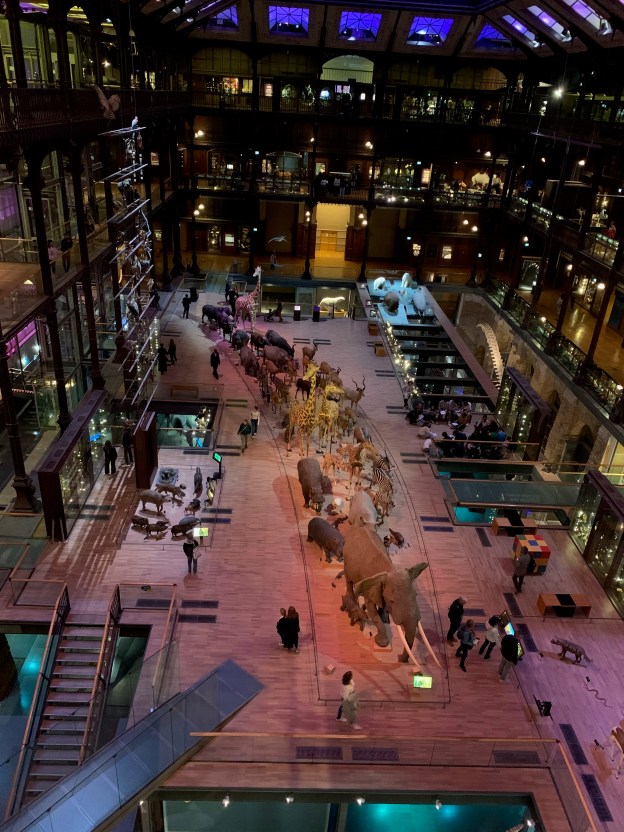

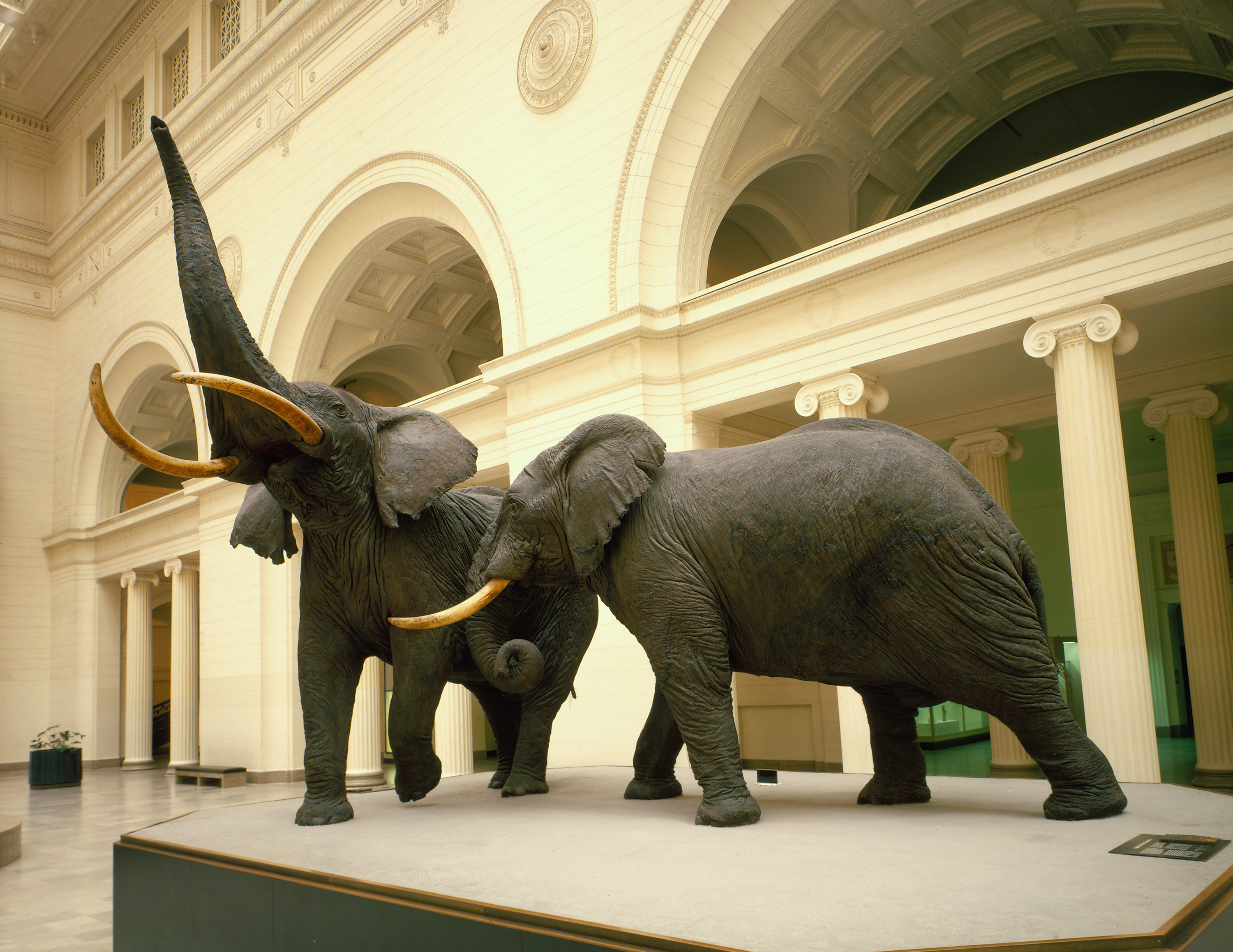
A photograph of the Parade of African Mammals in the Grand Gallery of Evolution at the National Museum of Natural History in Paris taken by the author from the 3rd floor.

On Systems of Knowing

This week, I argue that we must have some degree of artifice to organize our thoughts and recognize the things we see in our world.—Click here to support the Wednesday Blog: https://www.patreon.com/sthosdkane—Sources:%5B1%5D For my recent essays referring to this current historiographic project see “On Sources,” Wednesday Blog 6.22, “On Writing,” Ibid., 6.27, and “On Knowledge,” Ibid., 6.29.[2] Lee Alan Dugatkin, Mr. Jefferson and the Giant Moose, (University of Chicago Press, 2009).[3] Staffan Müller-Wille, “Linnean Lens | Linnaeus’ Lapland Journey Diary (1732),“ moderated by Isabelle Charmantier, virtual lecture, 12 May 2025, by the Linnean Society of London, YouTube, 1:04:18, link here.[4] Jason Roberts, Every Living Thing: The Great and Deadly Race to Know All Life, (Random House, 2024), 45–49.[5] Roberts, 20.[6] Roberts, 115–125.[7] Roberts, 109.[8] André Thevet, Les Singularitez de la France Antarctique, (Antwerp, 1558), 16r–16v. The translation is my own.[9] Roberts, 109.[10] Damião de Góis, Chronica do Felicissimo Rei Dom Emanuel, 4 vols., (Lisbon, 1566–1567).[11] Geraldine Heng, The Invention of Race in the European Middle Ages, (Cambridge University Press, 2018), 190.[12] Roberts, 110.[13] Michael Wintroub, A Savage Mirror: Power, Identity, and Knowledge in Early Modern France, (Stanford University Press, 2006), 42.[14] Roberts, xii.[15] Roberts, 107.[16] Roberts, 96–98.[17] Michael Allin, Zarafa: A Giraffe’s True Story, from Deep in Africa to the Heart of Paris, (Delta, 1998).


This week, I argue that we must have some degree of artifice to organize our thoughts and recognize the things we see in our world.


Near the end of June on a Sunday afternoon visit to the Barnes & Noble location on the Plaza here in Kansas City when we were picking out books to gift to family, I espied a copy of Jason Roberts’s new paperback Every Living Thing: The Great and Deadly Race to Know All Life. In the Plutarchan model it is a twenty-first century Parallel Lives of Carl Linnaeus (1707–1778) and Georges-Louis Leclerc, Comte de Buffon (1707–1788), two of the eighteenth century’s most prolific naturalists. I saved it as fun reading once I thought I’d done enough of my proper historical work. That moment came after I finished writing the first draft of the new introduction to my dissertation, a rather large addition to my doctoral study which is mostly historiographic in nature.[1] I’ve been reading Roberts’s book in my free time and delighting in the vibrant portraits he paints of the two men in question. I am a newer Fellow of the Linnean Society of London, elected in January 2025, and so I arrived to this particular book with a happy perspective on Linnaeus, whose Systema Naturae is cited in my dissertation as the first identification of the three-toed sloth by the genus Bradypus. At the same time, I’ve referenced Buffon’s Histoire Naturelle far more frequently in those moments when I’m following the legacy threads of my own Renaissance naturalists into the Enlightenment. After all, Buffon cited Thevet on several occasions where the savant referred to the same animals which the earlier cosmographer described two centuries before.

In spite of my own Linnean affiliation, and my use of Buffon’s corpus in the earliest stages of my broader historiography, I am still largely unfamiliar with these two men. I first knew of Buffon for his famous comments on his presumption of the diminutive nature of American animals when compared with their Afro-Eurasian counterparts, to which Thomas Jefferson retorted by sending Buffon evidence of an American moose.[2] I also know very little about Linnaeus, most of what I know of the Swede comes from lectures presented at the Linnean Society online including a recent lecture given in May by Staffan Müller-Wille, Professor in the History and Philosophy of the Life Sciences at Cambridge about Linnaeus’s Lapland diary from his northern expedition in 1732.[3] There is a new biography of Linnaeus by Gunnar Broberg titled The Man Who Organized Nature: The Life of Linnaeus which I have an eye on yet haven’t gotten a copy of quite yet. So, reading Roberts’s book is a quick introduction for me to this man who for me is most influential with his method of binominal taxonomy which has appeared time and again here in the Wednesday Blog. Yet this system followed after Linnaeus’s earlier alphabetical system for identifying plants by sexual characteristic. The basic premise here is that if there are 26 letters in the alphabet, we can then use that familiar framework to organize other complicated concepts for easy recognition. Linnaeus used this to categorize plants by their male and female sexual characteristics in his 1730 booklet Praeludia Sponsaliorum Plantarum, or Prelude to the Betrothal of Plants.[4] Therefore, Linnaeus could go around the botanical garden at the University of Uppsala in 1730 and quickly identify a plant as a J plant or a G plant. First reading this I thought of the way that letters are used by the Federal Reserve System to identify specific regional branches. Thus, J represents the Federal Reserve Bank of Kansas City and G the Federal Reserve Bank of Chicago. 

I like the idea behind Linnaeus’s alphabetic system yet having only 26 categories to describe the entire plant kingdom seems doomed to be flawed as it relies on a belief that all the plants that are known to exist are the ones that exist, that there’s nothing new under the Sun to be discovered. Roberts frames this in a biblical context, describing how Olof Celsius (1670–1756), one of Linneaus’s first professors, met the young Linnaeus when he was working on a project called the Hierobotanicum or Priestly Plants which was intended to be a compendium of all 126 plants mentioned in the Old and New Testaments.[5] Why would Linnaeus need more than 26 categories to contain all the plants known to the Ancients and to the Bible? Naturally, the flaws were apparent in this from the start by using a system of knowing which originated in the more arid landscape of the Levant rather than in the cooler and damper climate of Sweden. I’ve noticed this in my own life, how many cultural elements which we practice in the United States, notably the seasons, better fit the natural climate of New England and England proper than they do here in the Midwest with its far more variable conditions depending on the time of year, or even the given hour. Roberts deconstructed Linnaeus’s early efforts near the end of Part I of his book when he described Linnaeus’s first scholarly collision with Buffon after the Frenchman’s appointment by Louis XV to the position of Intendant of the Jardin des Plantes in Paris.[6] In a debate which Roberts calls “the Quarrel of the Universals” Linnaeus argued that species could be recognized from individual type specimens while Buffon countered that this ran the great risk of minimizing the diversity of life and eliminating potential variations in nature.

This got me thinking about systems of knowing, thus I decided to render the title of the original file for this blog post that you’re now reading (or listening to) De Systemarum Scientis in the full Latinate tradition of my own scholarship, or “On Systems of Knowing” in English. Why is it, for instance, that our Roman alphabet begins with A and ends with Z? The first half of that question is easier to answer: the Romans adapted our alphabet from the Greeks who started it off with α alpha, β beta, thus the noun alphabet itself. Yet the Greek alphabet ends with ω omega rather than ζ zeta, so why does ours end with Z? What I’ve heard about this is that the Greek letters that were adopted into the Roman alphabet were tacked onto the end of the line, or at least this is what I remember being taught when I learned to recite the alphabet in French in my undergraduate years. French calls the letter Y y-grec, or the Greek i. Likewise, everyone except for we Americans call the final letter of the Roman alphabet some variation of zed, which is a shortening of the Greek zeta. This better reflects that letter’s original sound in Greek, just as the cursive lowercase z is the lowercase Greek ζ just adopted straight into the Roman alphabet without any major changes.

So, when it comes to the organization of our knowledge there are things that we know in this same alphabetical order or in relation to this alphabetical order. Because the Roman alphabet is written left to right, we know that when it’s used to set up a coordinate system on a printed map that A will always appear to the top left, orientating the way the map should be held. Likewise, a reader can quickly scan through an index in any language written in the Roman alphabet by following along with the order of the letters. How individual languages index objects from that point on differs, but the foundational element remains the same. The Roman alphabet works best for Latin, the language for which it was originally developed, so it tends to be adapted in its phonetic values depending on which language is using it. This is why English uses the letter W to represent a [w] sound while German and in loanwords French uses W to represent a [ˈv] sound. Meanwhile, Irish represents the [w] and [ˈv] sounds with two digraphs, bh and mh that represent both depending on the context. Typically, bh represents [ˈv] while mh represents [w], but it depends on context. The reasoning behind this is that when the Roman alphabet was adapted by Latin speakers to fit Old Irish in the fifth and sixth centuries CE they approximated the phonology of their Latin in rendering the Roman alphabet usable for Irish. So, to these monks the Irish [ˈv] sound in a Gaelic name like Medbh sounded enough like how the letter b was used at the time that they used that letter to approximate this [ˈv] sound. It’s notable to me that in Modern Greek the letter β is today pronounced veta and in the Cyrillic alphabet the letter В represents this same [ˈv] sound while the letter Б represents the [b] sound that we English-speakers associate with the letter B. Cyrillic and its predecessor the Slavonic alphabet were being developed around the same time that the Roman alphabet began to be used for Irish so there must’ve been something going on with the pronunciation of people’s Bs becoming closer to Vs in late antiquity. Thus, the ways in which our alphabets represent specific sounds today reflect the prestige dialects of our two classical languages–Latin and Greek–as they were spoken over a millennium ago.

Consider then how we distinguish technical, scientific, or artistic terminology depending on the prestige language of that field. History has largely become a vernacular field, where we adapt terms that will be more familiar to the non-professional enough to initiate them into what Ada Palmer calls the History Lab. Yet often these terms will have etymologies beyond English itself. Consider the word photograph, or its more common shortened form photo. This word comes purely from Greek, the classical language more associated with science and technology. It blends the Greek φωτο-, the blending form of φῶς (phôs), or light with the suffix –γρᾰ́φος, from the verb γρᾰ́φω meaning to draw, sketch, or write. So, photography at its core is light writing. Neat! The word photography entered English from the French photographie, that etymology referring to the French origins of the art and craft of photography itself in the middle of the 1820s. Yet the linguists who modernized Irish a century ago decided to favor indigenous terminologies, rendering this word grianghraf using the Irish word grian for Sun instead of a variation of φωτο- (light) while adopting the Greek –γρᾰ́φος suffix to center this new Irish conception of the term within the same technological corpus as the English photograph. While consequential to have a particular Irish name for this technology that elevated the Irish use of photography as equal to any other culture’s photography and particular within the Irish language, it still remains rooted in the same western tradition of grounding our names for scientific and technical things in Greek.

Language directly influences how we know things because it is the vehicle by which we recognize those things around us. I know that a photograph is something made by “light writing” therefore I will also recognize that anything else beginning with “photo” also refers to “light” and that anything ending with “graph” refers to some form of record or writing. I come from a culture where light is connected with goodness and dark with ill. Likewise, for me I think of blue and green as happier colors rather than red or orange which are angrier colors. There is safety in light, in the daytime we can see people or things coming toward us easier than in the dark of night. At the Easter Vigil the celebrant lights the Paschal Flame which is then passed around the church so that we all share in the Light of Christ (Lux Christi) returned to the world with the Resurrection. The central question in my dissertation is linguistic: what did André Thevet (1516–1590) mean when he referred to the Americas overall as sauvage? This French word translates into English as both savage and wild, yet I chose to retain the original French to better represent the original concept which encompasses both concepts in English. This word was not necessarily racial in the modern sense, rather Thevet used sauvage to describe people, places, and things which existed beyond civilization. This word itself betrays its original meaning, that is city life. Thevet himself understood the sauvage to be the antonym of this city life. I describe it in the introduction to my dissertation in terms of light and dark, following the cultural connotations already illuminated: the city is the sun whence radiates the light of civilization. The further one goes from that sun, the darker things become and the less civilized they remain. Thevet’s sauvage existed at that furthest extreme in the dark. I imagine the character of Gollum in this sort of darkened existence, deep beneath the Misty Mountains uninterested in light save for the Ring of Power which consumed his day rendering it eternal night. In the literature of Thevet’s time a fine sauvage characterization is Caliban in Shakespeare’s Tempest, wild as the waters which wrecked King Alonso and his men on the island in Act 1 of that play.

Roberts notes how these linguistic attributes influenced Linnaeus’s systemization of humanity in the 1735 second edition of his Systema Naturae. The Swede divided humanity into four subcategories described by color over any other facet.[7] Roberts spends the following five pages questioning Linnaeus’s methodology, asking “why four?” and why these specific colors? There is some historical context for Linnaeus’s choice to refer to Black Africans, even Thevet referred to the varied peoples of Africa as “black” in his Singularitez de la France Antarctique. Thevet hints at a possible environmental cause for blackness, writing that the peoples “of Barbary” who are “the blackest” are “of the same manners and conditions as their region is hotter than others.”[8] Thevet’s understanding of African geography is somewhat uncertain, so his definition of Barbary may not align with the Berbers from whom the Barbary Coast of the Maghreb was named. Still, it hints at an understanding that the hotter, or more torrid, the climate got the darker the skin of the people would become. Roberts notes that the Portuguese were the first to use the “word negro to signify African origin or descent” in the middle of the sixteenth century.[9] This makes sense considering the Portuguese were the first European power to sail down the West African coast in the fifteenth century. That Roberts notes this Portuguese definition of blackness first appears in the middle of the sixteenth century likely refers to Damião de Góis’s (1502–1574) Chronica do Dom Emmanuel I of 1566 to 1567 which is an early source that I’ve consulted for information on the voyages of Vasco da Gama (d. 1524).[10] Geraldine Heng, the leading authority on medieval notions of race, wrote in her 2018 book The Invention of Race in the European Middle Ages that blackness was already well established as an element in religious and secular iconography by the beginning of the First Age of Exploration.[11] Roberts concludes his discussion of this particular racial element of Linnaeus’s great contribution to taxonomy sullenly noting that it’s thanks to Linnaeus that this cultural connotation of blackness with darkness was given scientific credence which continues to support racist ideologies to this day.[12]

How do we use our own words to describe things to which they are not suited, in turn transforming the nature of those things that they may become part of our own world? My research is most interested in understanding these questions of how those things at the boundaries of knowledge were understood by André Thevet using the tools afforded to him during the French Renaissance of the sixteenth century. Thevet used the word sauvage to do this and create a category of life against which he could measure and proclaim the existence of something civilized closer to home. Michael Wintroub, Professor Emeritus of Rhetoric at Cal-Berkeley, wrote in his 2006 book A Savage Mirror that Thevet’s countrymen sought to “civilize the barbarians” to make up for an insecurity they felt at being called barbarians themselves by Italian intellectuals at the turn of the sixteenth century during the French invasion of Italy under King Charles VIII (r. 1483–1498).[13] As long as there was someone else who the French could look down upon beyond their own cities they felt secure in their own civility. Yet the sauvage exists within a larger framework of singularities, a word which is central to Thevet’s cosmography. Thevet used the word singularity to describe those things which were exotic, wonderous, and immensely collectable in his eye and hopefully in the eyes of potential readers who would buy his books. I see various layers and categories of singularities in Thevet’s cosmography, for instance he only included images of certain animals in his book of the same name, the aforementioned Singularitez of 1557. The sloth and toucan were depicted as well as described, yet the mysterious Ascension Island aponar remained a bird worthy only of a textual description. This suggests that somethings were more singular than others, or more worthy of attention and the money needed to produce these woodcut images than others. These systems of knowing framed around the singularity are the subject about which I intend to write my first academic monograph. Classifying something as singular gives it an appeal which sets it aside from both the civil and the sauvage as belonging to a higher level of category which can include both the urbane and the agrestic.

Jason Roberts describes Buffon and Linnaeus’s mutual missions to make something of themselves and to rise above their provincial origins to the heights of society. I laughed out loud reading Roberts’s introduction to Linnaeus’s character, what felt like an iconoclasm of sorts for this Fellow of the Linnean Society. “Carl Linnaeus was a Swedish doctor with a diploma-mill medical degree and a flair for self-promotion, who trumpeted that ‘nobody has been a greater botanist or zoologist’ while anonymously publishing rave reviews of his own work.”[14] Buffon by contrast took advantage of a golden opportunity to build his own demi-paradise at his manor in the Burgundy countryside until his good reputation as a botanist brought him to royal attention and the appointment as Intendent of Jardin du Roi.[15] The Jardin des Plantes, as Buffon’s charge is today known, is perhaps a better place to conclude than most. Situated in the Fifth Arrondissement across Boulevard de l’Hôpital and Rue Buffon from Gare d’Austerlitz, the Jardin is an urban oasis created for the purpose of crafting systems of knowing. Its original intent was to serve as a medicinal garden existing beyond the purview of the Sorbonne, Paris’s sole licensed teaching medical school in the seventeenth century.[16] I’ve spent several happy hours wandering through the Jardin, home to the Muséum National d’Histoire Naturelle’s Grande Galerie de l’Évolution, the Galerie de Paléontologie et d’Anatomie compare, and the Ménagerie du Jardin des Plantes, which was home to Paris’s first resident giraffe whose story is delightfully told by Michael Allin in his 1998 book Zarafa: A Giraffe’s True Story, from Deep in Africa to the Heart of Paris.[17] While Allin’s heroine Zarafa is not today on display in the Grande Galerie de l’Évolution (she is instead today to be found in the Muséum d’Histoire naturelle de La Rochelle), the taxidermy in the Parade of African Mammals that is the centerpiece of the Grande Galerie represents a system of knowing animal life in itself.An elephant leads the parade followed by hippopotami, zebras, and giraffes with two such camelopards standing erect their long necks rising toward the upper galleries at the center of the procession. Behind them come the horned mammals, rhinoceroses, and at the rear a crouching lion watching its prey. This is a system that Buffon would have appreciated more than Linnaeus, one which represents the nature of individual beings more than species. Each stuffed specimen seems to have its own character, its own personality. They look about as one would expect they would in life. The great artifice of this is the idea of a parade itself, a very human notion indeed, and one that is infrequent enough to be nearly singular in character, a reason for a day out, worth putting in the social calendar of a city, town, or village no matter how large or small. A parade is its own system of knowing.


[1] For my recent essays referring to this current historiographic project see “On Sources,” Wednesday Blog 6.22, “On Writing,” Ibid., 6.27, and “On Knowledge,” Ibid., 6.29.

[2] Lee Alan Dugatkin, Mr. Jefferson and the Giant Moose(University of Chicago Press, 2009).

[3] Staffan Müller-Wille, “Linnean Lens | Linnaeus’ Lapland Journey Diary (1732),“ moderated by Isabelle Charmantier, virtual lecture, 12 May 2025, by the Linnean Society of London, YouTube, 1:04:18, link here.

[4] Jason Roberts, Every Living Thing: The Great and Deadly Race to Know All Life(Random House, 2024), 45–49.

[5] Roberts, 20.

[6] Roberts, 115–125.

[7] Roberts, 109.

[8] André Thevet, Les Singularitez de la France Antarctique(Antwerp, 1558), 16r–16v. The translation is my own.

[9] Roberts, 109.

[10] Damião de Góis, Chronica do Felicissimo Rei Dom Emanuel4 vols., (Lisbon, 1566–1567).

[11] Geraldine Heng, The Invention of Race in the European Middle Ages, (Cambridge University Press, 2018), 190.

[12] Roberts, 110.

[13] Michael Wintroub, A Savage Mirror: Power, Identity, and Knowledge in Early Modern France, (Stanford University Press, 2006), 42.

[14] Roberts, xii.

[15] Roberts, 107.

[16] Roberts, 96–98.

[17] Michael Allin, Zarafa: A Giraffe’s True Story, from Deep in Africa to the Heart of Paris, (Delta, 1998).


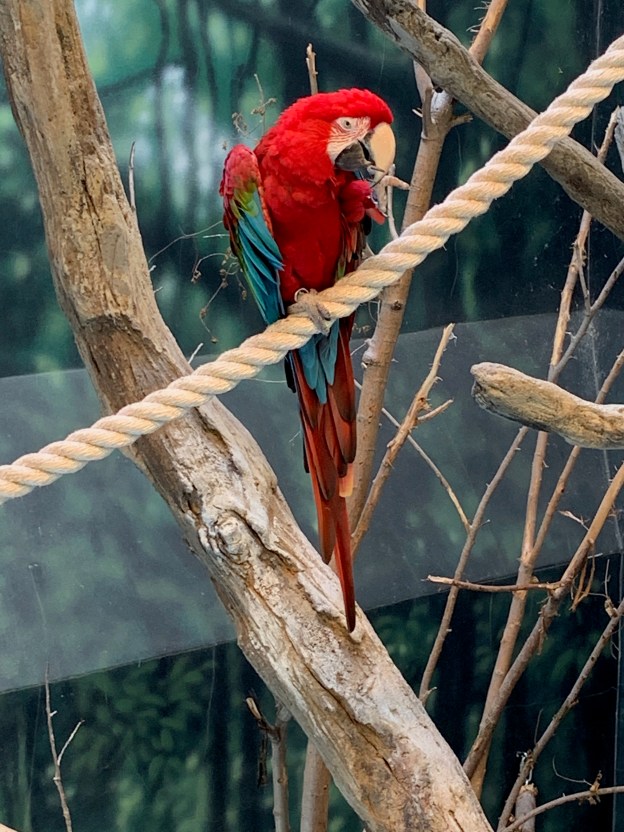
A macaw

On Skepticism

This week, I express my dismay at how fast time seems to be moving for me of late and how it reflects the existence of various sources of knowledge in our world.—Click here to support the Wednesday Blog: https://www.patreon.com/sthosdkane—Sources:%5B1%5D Ada Palmer, Inventing the Renaissance: The Myth of a Golden Age, (University of Chicago Press, 2025), 603.[2] If this word epistemology leaves you confused, have no fear, for my own benefit as well I wrote a blog post explaining this word alongside two of its compatriots. “Three Ologies,” Wednesday Blog 6.6 (podcast 5.6).


This week, I express my dismay at how fast time seems to be moving for me of late and how it reflects the existence of various sources of knowledge in our world.


I first noticed the passage of time on my tenth birthday, that is to say I remember remarking on how from that day on for the rest of my life, I would no longer be counting my years in single digits. I remember distinctly the feeling of surprise at this, a sense that I could never go back to my earliest years. That was especially poignant for me as those first six years lived in the Chicago suburbs held a nostalgic glow in my memory then as they do now. In those early years I felt that time moved slowly; I remember once as a kid I fretted over a 3 minute cooking timer, worrying that I would be unable to stand there and watch the flame over which I was cooking eggs for a full 3 minutes. Today that sounds silly, yet I believe it is vital to remember how I felt all those years ago lest I lose my empathy with my past self or anyone else I may encounter with similar concerns over things I see as minute.

Soon after my tenth birthday, I found a new method of getting through things that I found tedious or even odious to endure. I realized that if I tricked myself into enjoying the moment that the tedium would pass by quicker than if I wallowed in my annoyance and misery. Perhaps there was a degree of pessimism in this realization: that the good moments don’t seem to last as long as the bad ones in my recollection of things, or that it’s in fact easier to remember the bad more than the good. This is something I’ve been struggling with lately, that when I find my thoughts sinking to these depths of my greatest uncertainty and grief that I need to remind myself of all the good in my life. Time seems to move faster today than it did before. The days fly by more than linger, and there’s always something new or old that I need to do. I’ve long thrived on work, a trait I inherited from my parents. Often my happiest days are those spent dedicated to a specific task; those days are made happy by my sense of accomplishment once the task has progressed or even is done. I’ve learned to accept that good things won’t often be finished in a day. I’ll push myself instead to do as much as I feel I can do in the span of a day and see where that leaves me when I go to bed at night. With the new introduction to my dissertation this meant that it took me 9 days to write all 105 pages of it. This is one of those times where I feel that I’m on a roll and in my writer’s paradise when I can write and write and write and not run out of ideas to commit to paper.

Yet I worry about that quicker passage of time because I feel that there are less things that I’m able to do in a given day than I would like. I sacrifice rest sometimes in order to see a project to completion, or I choose to try and find a balance between my work and the rest of my life only to see one side, or another overwhelm its counterpart leaving me feeling unfulfilled when I retire for the night. I do worry that the time I’m afforded is limited, and that I’m not going to do everything I want to undertake. There are plenty of things I want to write, so much I want to say, yet so little time in a given day to say it. I’m still young, just a few weeks over halfway to my 33rd birthday. I have this lingering feeling that there’s so much that I want to do with the life I have and an indeterminate amount of time with which to do those things. Am I content with what I’ve done with my life so far? Yes. Is there so much more I want to do? Absolutely.

I suspect this shock at time moving faster is my own realization of my mortality. Everything has a beginning and an end, the mystery lies in not knowing either terminus directly. How many of us can remember our own birth? I certainly can’t. By the same token we can’t necessarily interview the dead after they’ve shuffled off this mortal coil because, in the words of Dr. McCoy, they’re dead. Thus, we remain doubters of our own mortality, our limits. I often hear older friends talk about how the young feel invincible and immortal and make mistakes which reinforce that sentiment of invincibility all while, if they’re particularly bold or just unlucky, asserting their mortality with a sudden abandon. Our doubts are aimed at established sources of knowledge, authorities to whom we feel no particular duty to abide even if we begrudgingly accept their precepts out of bare necessity. I see enough people every day ignore pedestrian crossing lights even though they are there on the city’s authority to protect us pedestrians when crossing the streets that we’ve abdicated to vehicles. It usually leaves me at least frustrated at the ignorance of the driver, at most even angry when I’ve gotten close to being hit by such an ignoramus.

Skepticism is a significant marker in Renaissance studies as a transitional element from the classically inspired scholarship of the fifteenth and sixteenth centuries into the empirical knowledge-making that traditionally we’ve said was emblematic of the Scientific Revolution. I have many colleagues who are working now on disproving the existence of that Scientific Revolution; I admire that cause and yearn to read what they’re writing even though one of my stock courses to teach is called “the Scientific Revolution: 1500-1800.” Ada Palmer calls Michel de Montaigne, in some ways the inspiration for my Wednesday Blog, “the avatar of this moment” when skepticism became a driving force in Renaissance thought.[1] I argue in my dissertation that the American experience drove the course of skeptical thought in the Renaissance; all the things which André Thevet called singular in the Americas represented a dramatic break from classical standards of knowledge which required a new epistemology to explain them.[2] The key here is that we should never be complacent that our current knowledge is all there is to know, after all a well-lived life is a life spent learning. I’m skeptical about many things and have a drive to continue learning, to continue exploring. Curiosity hasn’t killed this cat yet.[3]I find then that my time is best spent in pursuit of this knowledge, and as much as one can learn alone in the solitude of their study reading and thinking quietly to oneself like a monk, it is far better to learn in communion with others. Since the pandemic began, I’ve grown particularly fond of Zoom lectures, webinars, and workshops as much for the expertise on show as for the community they build. Even if we only communicate through these digital media I still look forward to seeing these people, to experiencing that one part of life with them. We learn so that we might have richer experiences of our own lives, so that we might find comfort in our knowledge, so that we might, in Bill Nye’s words, “change the world.” In the time that I have afforded to me I want to learn more than anything else, to learn about the people around me, about our common heritage, about what our future may hold, and about myself. If I can do that, then when I am “no more, cease to be, expired and gone to meet my maker, become a stiff, bereft of life and resting in peace” I’ll be content in my leave-taking. Hopefully unlike the dead parrot they won’t nail me to my perch like Bentham’s auto-icon which greets knowledge-seekers in the South Cloisters of University College London, though that could be a rather humorous way to go.


[1] Ada Palmer, Inventing the Renaissance: The Myth of a Golden Age, (University of Chicago Press, 2025), 603.

[2] If this word epistemology leaves you confused, have no fear, for my own benefit as well I wrote a blog post explaining this word alongside two of its compatriots. “Three Ologies,” Wednesday Blog 6.6.

[3] Meow.


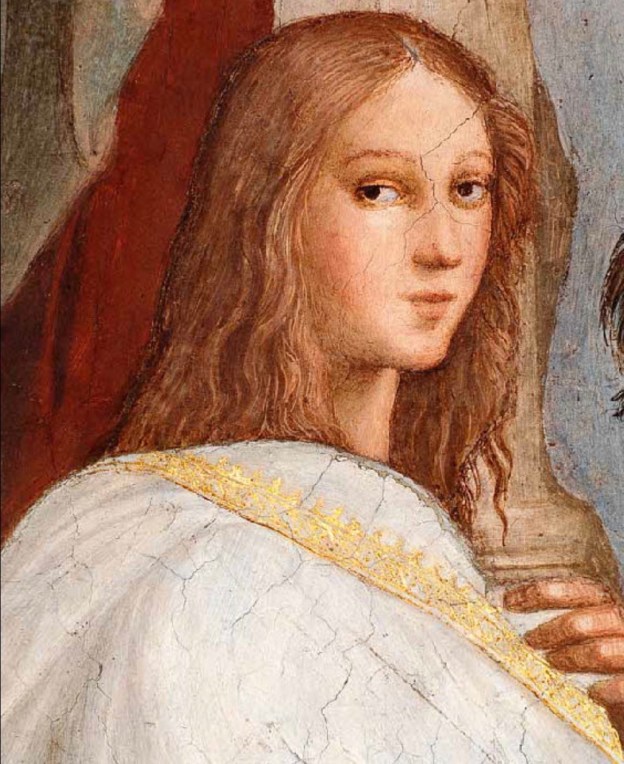
A figure from Raphael's "The School of Athens" variously identified as Francesco Maria della Rovere, Pico della Mirandola, or Hypatia of Alexandria.

On Knowledge

This week, I want to address how we recognize knowledge in comparison to the various fields of inquiry through which we refine our understanding of things.—Click here to support the Wednesday Blog: https://www.patreon.com/sthosdkaneArtRaphael, The School of Athens (1509–1511), Apostolic Palace, Vatican Museums, Vatican City. Public Domain.Sources“On Writing,” Wednesday Blog 6.27.Surekha Davies, Humans: A Monstrous History, (University of California Press, 2025).Marcy Norton, The Tame and the Wild: People and Animals After 1492, (Harvard University Press, 2024), 307.Dead Poets Society, (1989) "What will your verse be?" Video on YouTube.


This week, I want to address how we recognize knowledge in comparison to the various fields of inquiry through which we refine our understanding of things.


Lately my work has been dedicated to a thorough review of the historiography within which I’m grounding my dissertation. I wrote about this two weeks ago in an essay titled “On Writing.”[1] My research is historical, yet it touches on secondary literature which operates within various fields within the discipline of history. These include Renaissance history, and its larger sibling early modern history, the history of cartography, the history of animals, the history of botany, and more broadly the history of early modern science. Methodologically, I owe a great deal to two great twentieth-century Francophone anthropologists, Alfred Métraux (1902–1963) and Claude Lévi-Strauss (1908–2009). While Métraux and Lévi-Strauss aren’t considered directly in the historiographic section of the new introduction that I’m writing for my dissertation, which is limited to sources published since the millennium, they nevertheless stand tall in the background of my history.

Today we often talk within academia about a desire for interdisciplinarity in our work and our research. We’ve found ourselves too narrowed by our ever shrinking fields and seek greener common pastures for grazing as our intellectual and pastoral ancestors alike once knew. In my case, this interdisciplinarity lies more in my efforts to incorporate historical zoology into my work, a methodology which seeks to use zoological methodology and theory to explain historical animals. I have friends who study many things. Among them is one whose passion for history, classics, and mathematics has come together to craft a dissertation which seeks to demonstrate the intersections between those three to better understand the great transitions in human inquiry. Another seeks to follow the medical connections across oceans between disparate regions in the Americas and Europe that nevertheless existed even if they seem remarkable today. Still more, I have a friend who applies basic economic need to explain a complex diplomatic situation that once existed between the Venetian Republic and the Ottoman Empire in the Adriatic Sea. All of these historians of whom I write are applying a degree of interdisciplinarity to their work that reflects their own disparate interests and curiosities. In early modern history we talk about curiosities as objects which were collected from disparate and exotic lands into cabinets to display the erudite collector’s prestige and wealth. I say our curiosity is something to be collected by those worthy archives, libraries, museums, or universities that will employ us in the near future and for us to feed with new ideas and avenues of investigation that we will never be bored with life.

In all of these things, there is an underlying genre of knowledge which I am addressing. I’ve written thus far about history alone, yet it is the same for the anthropologists, astronomers, planetary scientists, and physicists who I know. Likewise for the literature scholars and the linguists. Our fields of inquiry all grow on the same planet that comprises of our collected knowledge. In English, this word knowledge is somewhat nebulous. To me, it says that we know things broad or specific. In London, for instance, the Knowledge is the series of tests which new cabbies must complete in order to learn every street within a certain radius of Charing Cross. The Latin translation of this word, scientia, makes things even more complicated as that is the root of the English word science. Thus, when we refer to Renaissance science, there is always a caveat in the following sentence explaining that “this is not science as we know it but a sort of protoscience.” I was advised, similarly, after a particularly poorly received presentation at a workshop at the Museum of Natural Sciences in Brussels in October 2023 that I shouldn’t refer to “sixteenth-century conservation” because no such concept existed at the time; instead, it would be better to discuss a “genealogy of conservation.” This sense that modern terms, in use since the Enlightenment of the eighteenth century, ought not to be pulled further back into the past I think loses some of the provenance of those terms and how the Enlightenment philosophes first came across them. 

I find it telling that the Ancient Greek translation of knowledge, γνῶσις (gnôsis), is a word with which I’m more familiar from theology and the concept of Gnosticism whereas scientia reminds me of philosophy and the other fields of inquiry which grew from that particular branch of the tree of human curiosity. One might even say that philosophy and theology are a pair, siblings perhaps? They seek to understand similar things: on the one hand an inquiry into thought, and ideally wisdom, and on the other a search for the nature of the Divine, which at least in my Catholicism we can know because we are made in the Image of God. The division here between the Ancient Greek term being affiliated with faith and the Latin one with reason I think speaks to the Latin roots of my own education in Catholic schools and at a Jesuit university, where I learned about Plato and Aristotle, yet I recognized Aristotle’s Historia animalium (History of Animals) by its Latin name by which it was generally known in Western Europe for centuries before the rise of vernacular scholarship rather than by its Greek original Τῶν περὶ τὰ ζα ἰστοριῶν (Ton peri ta zoia historion). Note that the English translation of this title, History of Animals reflects better the Latin cognate of ἰστοριῶν rather than the better English translation of that Greek word, Inquiry.

Added onto these classical etymologies, in my first semester Historiography class at Binghamton University I was introduced to the German translation of scientiaγνῶσις, and knowledge. Wissenschaft struck me immediately because I saw the German cognate for the English word wizard in its prefix, and because I knew that the -schaft suffix tends to translate into English as -ship. Thus, my rough Anglicization of Wissenschaft renders Wizardship, which is rather nifty. Yet this word Wissenschaft instead was seen in the nineteenth century as a general word which could be translated into English as science. This is important for us historians trained in the United States because our own historiographic tradition, that is our national school of historians traces our roots back to German universities in the early and middle decades of the nineteenth century. I remember long sessions of my historiography class at UMKC discussing the works of Leopold von Ranke (1795–1886), the father of research-based history. I felt a sense that this concept of Wissenschaft seemed relatable, and as it turned out that was because Irish has a similar concept. 

Whereas in English we tack on the suffix -ology onto any word to make it the study of that word, in Irish you add the suffix -ocht. So, geology is geolaíocht and biology is bitheolaíocht. Yet note with the second example that the suffix is not just -ocht but an entire word, eolaíocht. This is the Irish word for science, added onto the end of bitheolaíocht to demonstrate that this word refers to the study of bith- a prefix combining form of the word beatha, meaning life. So, biology then is the science of life itself. Powerful stuff. I appreciate that Irish linguists and scholars have sought overall to preserve our language’s own consistency with its scientific terminology. It means that these fields of study, these areas of knowledge, can exist purely within the purview of the Irish language without any extra need to recognize that their prefixes or suffixes come from Latin, Greek, or English. There are some exceptions of course: take zó-eolaíocht, the Irish word for zoology, which effectively adopts the Greek word ζῷον perhaps through the English zoo into Irish. Would it not have been just as easy for whoever devised this hyphenated word to instead write ainmhíeolaíocht, translated into English as the science of animals? Here though I see more influence from English because this language adopts as much as it can from other languages out of prestige and a desire for translingual communicability. As an English speaker, I find scholarly works often easier to read because we share common etymologies for our words relating to knowledge. English’s sciencegeology, biology, and zoology are French’s sciencegéologie,biologie, and zoologie. In English, we drop any pretense of Englishness to clothe ourselves in a common mantle familiar to colleagues from related cultures around the globe. In academia this is to our mutual benefit, after all so much of our work is international. I’m regularly on webinars and Zoom calls with colleagues in Europe for instance. I believe this is the lingering spirit of the old scholarly preference for Latin as a lingua franca which at least to me seems close enough in the past that it’s tangible yet realistically it’s surely been a very long time since any serious scholarly work beyond classics was published in Latin for the benefit of a broad translingual readership?

I for one admire the Irish word eolaíocht and its root eolas, which translates into English as knowledge, that is an awareness of things because eolaíocht represents a universal concept while retaining its own native nature. So often in my research I am discussing the early assimilation of indigenous cosmovisions, to borrow a Spanish word put to good use by Surekha Davies in her latest book, into the nascent global world centered on Europe.[2] I see how these cosmic conceptions faded until they were rendered in Gothic or Latin letters on the voluminous pages of encyclopedic Renaissance general and natural histories which remain among the most often cited primary sources for these indigenous cultures who Marcy Norton argued in her 2024 book The Tame and the Wild: People and Animals After 1492 had their own classical past made remote from their colonial present by European contact, conquest, and colonization.[3] Seeing these indigenous perspectives fade into their categorized and classified statuses within the cosmos defined by Europe’s natural philosophers I feel fortunate that my own diaspora (which was also colonized) has retained this element of our individual perspective. I first came across the -ocht suffix in the word poblacht, the Irish word for republic. A famous story from the birth of the Irish Free State during the Anglo-Irish Treaty negotiations in 1921 tells of British Prime Minister David Lloyd-George, a Welsh speaker, remarking to Michael Collins, an Irish speaker, that their choice of a republic was unusual because none of the Celtic languages naturally have a word for republic. That word evokes its Roman roots in the ancient Res publica Romana, the Roman Republic, whose northward expansion across the Alps led to the gradual death of the Continental Celtic languages, whose speakers’ descendants today are largely the Western Romance speakers of French, Romansh, Occitan, Catalan, Spanish, Galician, and Portuguese, among others. Romance languages are noted for their common descent from Latin, whence they all derive variations on the Latin word scientia; English gets science through Old French. “How are you going to name your new government in the Irish language?” Lloyd-George asked. Collins replied something along the lines of “a kingdom is called a ríocht, so this government of the people (pobal) will be called a poblacht. Thus, the Republic of Ireland is named in Irish Poblacht na hÉireann. Naturally, this word pobal derives from the Latin populus, so the shadow of Rome hovers even over unconquered Hibernia. Yet that is another topic for a different essay.

Let me conclude with a comment on the difference between knowledge and wisdom, as I see it. The former is far more tangible. We can know things through learning embodied best in living and in reading. I know for instance to look both ways before crossing a street because plenty of people in the last 140 years have been hit by cars, buses, and trucks, and you can never be too careful. Likewise, I know everything I do about the things I study through reading what others have written about these topics. It’s my job then to say what I will. In Whitman’s words made immortal by our recitation, the answer to the eternal question, “that the powerful play goes on, and you may contribute a verse.” That’s history, people! Reading the powerful play of what others have written and summoning up the courage to take the podium and have your say. I first heard this particular poem, as did many in my generation, recited by Robin Williams in the 1989 film Dead Poets Society. Knowledge is the recitation of these facts we’ve learned. Wisdom is understanding how these facts fit together and speak to our common humanity. What makes us human? I believe it’s as much what we know as what we remain ignorant of. Our ignorance isn’t always a curse, rather it’s another foggy field we’ve yet to inquire about, a place where someone’s curiosity will surely thrive someday. It is another evocation of eolas still to come in our long human story. How wonderous is that?


[1] “On Writing,” Wednesday Blog 6.27.

[2] Surekha Davies, Humans: A Monstrous History(University of California Press, 2025).

[3] Marcy Norton, The Tame and the Wild: People and Animals After 1492, (Harvard University Press, 2024), 307.


The author pulling a face at the camera.

On Writing

This week, some words about the art, and the craft, of writing.—Click here to support the Wednesday Blog: https://www.patreon.com/sthosdkane—Links in this episode:Patrick Kingsley, Ronen Bergman, and Natan Odenheimer, “How Netanyahu Prolonged the War in Gaza to Stay in Power,” The New York Times Magazine, (11 July 2025).John McWhorter, “It’s Time to Let Go of ‘African American’,” The New York Times, (10 July 2025).Bishop Mark J. Seitz, D.D., “The Living Vein of Compassion’: Immigration & the Catholic Church at this moment,” Commonweal Magazine, (June 2025), 26–32.“On Technology,” The Wednesday Blog 5.2.“Artificial Intelligence,” The Wednesday Blog 4.1.


This week, some words about the art, and the craft, of writing.


In the last week I’ve been hard at work on what I hope is the last great effort toward completing my dissertation and earning my doctorate. Yet unlike so much of that work which currently stands at 102,803 words across 295 U.S. Letter sized pages inclusive of footnotes, front matter, and the rolling credits of my bibliography I am now sat at my desk day in and day out not writing but reading intently and thoroughly books that I’ve read before yet now find the need for a refresher on their arguments as they pertain to the subject of my dissertation: that André Thevet’s use of the French word sauvage, which can be translated into English as either savage or wild, is characteristic of the manner in which the French understood Brazil as the site of its first American colony and the Americas overall within the broader context of French conceptions of civility in the middle decades of the sixteenth century. I know, it’s a long sentence. Those of you listening may want to rewind a few seconds to hear that again. Those of you reading can do what my eyes do so often, darting back and forth between lines.

As I’ve undertaken this last great measure, I’ve dedicated myself almost entirely to completing it, clearing my calendar as much as I see reasonable to finish this job and move on with my life to what I am sure will be better days ahead. Still, I remain committed to exercising, usually 5 km walks around the neighborhood for an hour each morning, and the occasional break for my mind to think about the things I’ve read while I distract myself with something else. That distraction has truly been found on YouTube since I started high school and had a laptop of my own. This week, I was planning on writing a blog post which compared the way that my generation embraced the innovation of school-issued laptops in the classroom and the way that starting next month schools and universities across this country will be introducing artificial intelligence tools to classrooms. I see the benefits, and I see tremendous risks as well, yet I will save that for a lofty second half of this particular essay.

I’ve fairly well trained the YouTube algorithm to show me the sorts of videos that I tend to enjoy most. Opening it now I see a segment from this past weekend’s broadcast of CBS Sunday Morning, several tracks from classical music albums, a clip from the Marx Brothers’ film A Night at the Opera, the source of my favorite Halloween joke, and a variety of comic videos from Conan O’Brien Needs a Friend to old Whose Line is it Anyway clips. Further down are the documentary videos I enjoy from history, language, urbanist, and transportation YouTubers. Yet in the last week or so I’ve been seeing more short videos of a minute or less with clips from Steven Spielberg’s 2012 film Lincoln. I loved this film when I saw it that Thanksgiving at my local cinema. As longtime readers of the Wednesday Blog know, I like to call Mr. Lincoln my patron saint within the American civic religion. As a young boy in Illinois in the ‘90s, he was the hero from our state who saved the Union and led the fight to abolish slavery during the Civil War 130 years before. Now, 30 years later and 160 years out from that most horrific of American wars I decided to watch that film again for the first time in a decade. In fact, I’m writing this just after watching it so some of the inspiration from Mr. Lincoln’s lofty words performed by the great Daniel Day-Lewis might rub off on my writing just enough to make something inspirational this week before I return in the morning to my historiography reading.

Mr. Lincoln knew what every writer has ever known, that putting words to paper preserves them for longer than uttering even the longest string of syllables can last. What I mean to say is they’ll remember what you had to say longer if you write it down. He knew for a fact that the oft quoted and oft mocked maxim that the pen is mightier than the sword is the truth. After all, a sword can take a life, as so many have done down our history and into our deepest past to the proverbial Cain, yet pens give life to ideas that outlive any flesh and bone. I believe writing is the greatest human invention because it is the key to immortality. Through our writing generations from now people will seek to learn more about us in our moment in the long human story. I admit a certain boldness in my thinking about this, after all I’ve seen how the readership and listener numbers for the Wednesday Blog ebb and flow, and I know full well that there’s a good chance no one in the week I publish this will read it. Yet I hold out hope that someday there’ll be some graduate student looking for something to build a career on who might just stumble across my name in a seminar on a sunny afternoon and think “that sounds curious,” only to then find some old book of my essays called The Wednesday Blog and then that student will be reading these words. 

I write because I want to be heard, yet I’ve lived long enough to know that it takes time for people to be willing to listen, that’s fair. I’ve got a growing stack of newspaper articles of the affairs of our time growing while my attention is drawn solely to my dissertation. I want, for instance, to read the work of New York Times reporters Patrick Kingsley, Ronen Bergman, and Natan Odenheimer in a lengthy and thorough piece on how Israeli Prime Minister Netanyahu “prolonged the War in Gaza to stay in power” which was published last Friday.[1] I also want to read John McWhorter’s latest opinion column “It’s Time to Let Go of ‘African American’”; I’m always curious to read about suggestions in the realm of language.[2] Likewise there are sure to be fascinating and thoughtful arguments in the June 2025 issue of Commonweal Magazine, like the article titled “’The Living Vein of Compassion’: Immigration & the Catholic Church at this moment” by Bishop Mark Seitz, DD of the Diocese of El Paso.[3] I’m always curious to read what others are writing because often I’ll get ideas from what I read. There was a good while there at the start of this year when I was combing through the pages of Commonweal looking for short takes and articles which I could respond to with my own expertise here in the Wednesday Blog. By writing we build a conversation that spans geography and time alike. That’s the whole purpose of historiography, it’s more than just a literature review, though that’s often how I describe what I’m doing now to family and friends outside of my profession who may not be familiar with the word historiography or staireagrafaíocht as it is in Irish. 

Historiography is writing about the history that’s already been written. It’s a required core introductory class for every graduate history program that I’m familiar with, I took that class four times between my undergraduate senior seminar (the Great Historians), our introductory Master’s seminar at UMKC (How to History I), and twice at Binghamton in courses titled Historiography and On History. The former at Binghamton was essentially the same as UMKC’s How to History I while the latter was taught by my first doctoral advisor and friend Dr. Richard Mackenney. He challenged us to read the older histories going back to Herodotus and consider what historians in the Middle Ages, Renaissance, Enlightenment, and Nineteenth Century had to say about our profession. Looking at it now, the final paper I wrote for On History was titled “Perspectives from Spain and Italy on the Discovery of the New World, 1492–1550.” I barely remember writing it because it was penned in March and April 2020 as our world collapsed under the awesome weight of the Coronavirus Pandemic. Looking through it, I see how the early stages of the pandemic limited what I could access for source material. For instance, rather than rely on an interlibrary loan copy of an English translation, perhaps even a more recent edition, of Edmundo O’Gorman’s The Invention of America, I instead was left working with the Spanish original that had been digitized at some point in the last couple decades. Likewise, I relied on books I had on hand in my Binghamton apartment, notably the three volumes of Fernand Braudel’s Civilization and Capitalism, in this case in their 1984 English translations. I wrote this paper and then forgot about it amid all the other things that were on my mind that Spring, only to now read it again. So, yes, I can say to the scared and lonely 27 year old who wrote this five years ago that someone did eventually read it after all.

What’s most delightful about reading this paper again is I’m reminded of when I first came across several names of fellow historians who I now know through professional conferences and have confided in for advice on my own career. The ideas first written in the isolation of lockdown have begun to bear fruit in the renewed interactions of my professional life half a decade later. What more will come of those same vines planted in solitude as this decade continues into its second half? Stretching that question further back in my life, I can marvel at the friendships I’ve cultivated with people I met in my first year of high school, now 18 years ago. That year, 2007, we began our education at St. James Academy where many of us were drawn to the promise of each student getting their own MacBook to work on. I wrote here in March 2024 about how having access to that technology changed my life forever.[4] So, in the last week when I read in one of my morning email newsletters from the papers about the soon-to-be introduction of artificial intelligence to classrooms across this country in much the same way that laptops in classrooms were heralded as the new great innovation in my youth I paused for a few moments longer before turning to my daily labor.

I remain committed to the belief that having access to a laptop was a benefit to my education; in many ways it played a significant role in shaping me into the person I am today. I wrote 14 plays on that laptop in my 4 years in high school, and many of my early essays to boot. I learned how to edit videos and audio and still use Apple products today because I was introduced to them at that early age. It helps that the Apple keyboard comes with easy ways to type accented characters like the fada in my name, Seán. Still, on a laptop I was able to write much the same that I had throughout my life to that point. I began learning to type when I was 3 years old and mastered the art in my middle school computer class. When I graduated onto my undergraduate studies though I found I could take notes far better that I could remember by hand than if I typed them. This is crucial to my story: the notes that I took in my Renaissance seminar at UMKC in Fall 2017 were written by hand, in French no less, and so when I was searching for a dissertation topic involving Renaissance natural history in August 2019, I remembered writing something about animals in that black notebook. Would I have remembered it so readily had I typed those notes out? After all, I couldn’t remember the title of that term paper I wrote for On History in April 2020 until I reopened the file just now.

Artificial intelligence is different than giving students access to laptops because unlike our MacBooks in 2007, A.I. can type for the student, not only through dictation but it can suggest a topic, a thesis, a structure, and supporting evidence all in one go. Such a mechanical suggestion is not inherently a suggestion of quality however, and here lies the problem. I’ve read a lot of student essays in the years I’ve been teaching, some good, some bad. Yet almost all of them were written in that student’s own voice. After a while the author’s voice becomes clear; with my current round of historiography reading, I’m delighting in finding that some of these historians who I know write in the same manner that they speak without different registers between the different formats. That authorial voice is more important than the thesis because it at least shows curiosity and the individual personality of the author can shine through the typeface’s uniformity. Artificial intelligence removes the sapiens from we Homo sapiens and leaves our pride in merely being the last survivor of our genus rather than being the ones who were thinkers who sought wisdom. Can an artificial intelligence develop wisdom? Certainly, it can read works of philosophy both illustrious and indescribably dull yet how well can it differentiate between those twin categories to give a fair and reasoned assessment of questions of wisdom?These are some of my concerns with artificial intelligence as it exists today in July 2025. I have equally pressing concerns that we’ve developed this wonderous new tool before addressing how it will impact our lived organic world through its environmental impact. With both of these concerns in mind I’ve chosen to refrain from using A.I. for the foreseeable future, a slight change in tone from the last time I wrote about it in theWednesday Blog on 7 June 2023.[5] I’m a historian first and foremost, yet I suspect based on the results when you search my name on Google or any other search engine that I am better known to the computer as a writer, and in that capacity I don’t want to see my voice as soft as it already is quieted further by the growing cacophony of computer-generated ideas that would make Aristophanes’ chorus of frogs croak. Today, that’s what I have to say.


[1] Patrick Kingsley, Ronen Bergman, and Natan Odenheimer, “How Netanyahu Prolonged the War in Gaza to Stay in Power,” The New York Times Magazine, (11 July 2025).

[2] John McWhorter, “It’s Time to Let Go of ‘African American’,” The New York Times, (10 July 2025).

[3] Bishop Mark J. Seitz, D.D., “The Living Vein of Compassion’: Immigration & the Catholic Church at this moment,” Commonweal Magazine, (June 2025), 26–32.

[4] “On Technology,” The Wednesday Blog 5.2.

[5] “Artificial Intelligence,” The Wednesday Blog 4.1.


On Sources

This week, the fourth in several scribblings about my research: borrowing from Oscar Wilde, the importance of being earnest with one’s sources.—Click here to support the Wednesday Blog: https://www.patreon.com/sthosdkane—Sources:Ologies Podcast: https://www.alieward.com/ologies"Metropolis," Wednesday Blog 3.20: https://wednesdayblog.org/2023/01/11/metropolis/.Marie V. Alessandro, "The Workers of Metropolis" in Cinema at UMass Boston, (6 November 2020), https://blogs.umb.edu/cinemastudies/2020/11/06/workers-of-metropolis/Surekha Davies, “Here be black holes: Like sea monsters on premodern maps, deep-space images are science’s fanciful means to chart the edges of the known world,” Aeon (13 July 2020), https://aeon.co/essays/how-black-holes-are-like-sea-monsters-at-the-edge-of-our-vision.Chicago Manual of Style, 18th Ed., Notes-Bibliography System Quick Guide, https://www.chicagomanualofstyle.org/tools_citationguide/citation-guide-1.html.Jacob Burckhardt, The Civilization of the Renaissance in Italy, trans. S.G.C. Middlemore, (London, 1878): https://www.gutenberg.org/ebooks/2074.


This week, the fourth in several scribblings about my research: borrowing from Oscar Wilde, the importance of being earnest with one’s sources.


Over the weekend when I was chatting with some friends in my parish choir about the rallies and political protests ongoing in our city and around this country, I made a joke that I went about making my own protest sign, something I’ve been slower to do. I said the sign fit my temperament and was useful for a wide range of protests. This sign, conceived for the sake of a joke, reads “I am rather miffed.” One of my friends retorted that she expected any protest sign of mine would include citations. I laughed and retold one of my favorite stories from my History Master’s program when I wrote a footnote that traced the historiography of a particular concept back through at least four generations of the scholarship to the early nineteenth century; I described this particular citation as a footnote within a footnote within a footnote within a footnote, much to the bemusement of my friends.

This got me thinking more about citations, something I often tend to think about anyway with my work. I do honestly love writing footnotes, it’s one of the more technical aspects of my work that gives me a great sense of pride at accomplishing manually, that is to say without the help of any extra software built to keep track of citations. One of our professors at UMKC introduced my cohort to Zotero, for example, and I flatly refused to consider using it saying, “I memorized the basic formulae in the Chicago Manual of Style in my undergraduate, I don’t need a computer to help me with this.” That’s been my take on this kind of software since. I see the benefit of it, yet I don’t feel the need to adopt it in my own work. I’ve seen so many student essays that copied & pasted text into their footnotes where something went wrong with the formatting that I’d rather just type the text out character by character. There’s something delightfully personal about taking this slower approach because it means I’ve considered every character in the document, and by and large I can avoid typos and errors as a result.

The format of my citations will vary slightly depending on the publication. A proper peer-reviewed article or book chapter will get the full treatment, sort of like the top of the line all-inclusive package they offer at a high price at my local car wash. In contrast, my book reviews rarely include citations beyond those to the book being reviewed, and in that instance, they are mere in-text citations with the page number listed alone. That could be seen as the quick and cheap package at my car wash. Here on the Wednesday Blog, I endeavor to include hyperlinks in all of my citations and in the text of the blog where I first reference a given source. I’ve begun to see more hyperlinks included in peer-reviewed journals as I suspect the vast majority of us who read Isis or Renaissance Quarterly do so on their computers as I do, and thus can click on those links, rather than reading the journal in print when it’s mailed out with each issue. I make an effort to include any citations in the text description box on each of the Wednesday Blog podcast episodes as well, for the benefit of listeners who access this publication through any of the podcast platforms where it is found. I’ve seen the likes of Ologies do this as well, in fact I was inspired by Alie Ward’s thorough efforts at citing her sources on Ologies to do the same on the Wednesday Blog. In my case, it was a question of whether I needed to have the same rigor in this publication as I do in my scholarly writing. I concluded that it was not only needed but that it would be something that could set my work apart from my peers.

My footnotes are the hard workers of my writing, the double-checked cross-references that populate the bottom of my work yet add such vitality to it all the same. Without the footnotes the rest of the essay would lack the depth of meaning that they provide. They root my sentences in a rich soil of past scholarship which can enlighten even the densest lineage. Yet the footnotes require clarity in the text which they elaborate. For them to work I need to ensure that my own text makes sense and is readable, something which often needs a bit more thought after the first draft. I think of the relationship between the text and footnotes in a manner similar to the stratified society in Fritz Lang’s 1927 science fiction masterpiece Metropolis; the footnotes are the hands to the text’s head, the evocation of thought that elaborates on the essay’s thesis.[1] Yet without the footnotes’ deeper connection to the human experience the world above soaring high into the heavens with the foolhardiness of the biblical Babel would awaken to find its words meaningless.

“The Mediator Between the Head and the Hands Must Be the Heart.” Photo source (and a good blog on the workers of Metropolis).

Citations are a form of cross-referencing that was engrained into me from even my elementary school years. I remember seeing footnotes in some of my favorite childhood books, in particular in Watership Down and I believe in The Lord of the Rings trilogy. I wanted to use them on my stories from as early as elementary school but didn’t have a proper need for them until I was an undergraduate writing essays that needed full and clear sources for their work. It’s funny to me now because I do often read peer-reviewed articles that don’t have the same rigorous citation systems in place as the one that I committed myself to over a decade ago now. My rule is that if I make a fact-based claim then I cite it, regardless of how important it is to the argument. I know from my own experience scouring academic databases for secondary sources on André Thevet (1516–1590) and his contemporaries that even the smallest off-hand mention of the man in a source that may have very little to do with him could nonetheless lead me to another source that has a great deal more to offer the Thevet scholar. It made me laugh earlier this week reading one such book that made a fairly large claim about its subject without providing sources for all of the historical figures mentioned in a given sentence, just the ones the author clearly thought were more important.

The way I think of citations resembles how Surekha Davies, one of the leading experts in the field of Renaissance monster studies, described the category of the diagram in a 2020 essay for Aeon. Like Davies’s diagrams, citations “are devised by interpretative communities made up of readers, makers, and practitioners. Each interpretative community has its own distinct pictorial language.”[2] In this context, that language is the style guide for citations in use. Access to the information contained in my citations is eased by using an accepted and standard style, in this case the notes-bibliography system set by the Chicago Manual of Style, which just published its 18th edition last NovemberThere lies the rub of this: citations embed a strong sense of subjective importance in their nature. I try to cite anything and everything that goes into my work, while others will only cite those things which they deem to be the most valuable to their reader. I’ve always looked toward a wider readership, maybe hoping to catch the eye of my colleagues, graduate students, and the odd bookshop aisle walker alike who happens to see my work on the shelf. My more liberal use of footnotes reflects this preference for a wider readership; I try to have enough information in my citations to go around for anyone who may be curious about the connections between my work and its peers and ancestors. I understand the argument that older secondary literature often has less to contribute to contemporary conversations, my dissertation committee for instance asked me to write a new historiography document that only focused on the literature that I’ve used which was published since the millennium. Yet in the twin magnetic poles between which lies my field, Renaissance Studies and the History of Natural History, my historiography begins in the former with Jacob Burckhardt’s 1860 The Civilization of the Renaissance in Italy and in the latter with the likes of Linnaeus adapting new understandings of the natural world from the sixteenth and seventeenth-century perceptions of it which include Thevet’s own cosmography. This is to say that my historiographic timeline begins far earlier than many, and I have to take the full scale as well as the particular scope of it into account.

The earnestness with which I approach my sources is reflected in the quality of my work. I’ve long heard words of warning about particular institutions as places that promote competition between graduate students and between faculty in order to keep the flow of a high level of research and writing. I for one initially heard this and felt a sense of trepidation, why not if I couldn’t keep up with the best of my colleagues. And yet, when I’m in the flow of my writing, things are magnificent. I wrote the first draft of an article of mine that’ll be coming out in the December special issue of Terrae Incognitae in the period of about a week last summer; it uses sources that I’m very familiar with, in fact an expert on, and it makes an argument I’d been thinking about for some time when I sat down to write it. That article’s gone through several rounds of revision since, yet from the beginning one area that needed minimal rewriting were my citations. Today I have another paper I plan on writing in the next few weeks that I initially conceived of in a proposal to another journal special issue, yet I decided to go ahead and write anyway; after all, if that first journal rejects my proposal, I can always send the finished manuscript to somewhere else.

The rub of all of this is that by getting my citations down early, I’ve started my work in a strong place that’s only grown stronger and more resolute with each essay that I write.


[1] S.T. Kane, “Metropolis,” in Wednesday Blog 3.20, (11 January 2023).

[2] Surekha Davies, “Here be black holes: Like sea monsters on premodern maps, deep-space images are science’s fanciful means to chart the edges of the known world,” Aeon (13 July 2020), https://aeon.co/essays/how-black-holes-are-like-sea-monsters-at-the-edge-of-our-vision.


A Sense of Purpose

This week, the third in several scribblings about my research: how studying Thevet and his world fulfills a need to find purpose in life.—Click here to support the Wednesday Blog: https://www.patreon.com/sthosdkane


This week, the third in several scribblings about my research: how studying Thevet and his world fulfills a need to find purpose in life.


Throughout my graduate education the need for new work to compliment, correct, or add to old work has remained a constant theme. It’s critical to our profession, otherwise why devote our time and talent to studying the past if we’re merely rehashing something already said in the generations of our profession’s own history? I passed through the first five of years of my graduate education without that purpose or that drive, and I think it’s what kept me behind some of my colleagues in achievement. Yet when I found something to make my own, a historical topic upon which to pitch my tent and make myself known, I took that chance. Still, I wasn’t entirely sure what value studying Thevet actually brought to the profession. He is an important figure of middling influence in the development of Renaissance natural history, one whose contributions have often been reduced to laughable exemplars of a time before the scientific study of zoology developed. A secondary approach I take to Thevet is to view his work in light of the great contributions to natural history of the great minds of the Enlightenment, active two centuries after the cosmographer, who are often the next great mile marker in the long road that is the history of natural history.

Of these Enlightenment naturalists, the Comte de Buffon (1701–1788) acknowledged the better parts of what Thevet wrote and adopted those as mile markers in his own natural histories. I think Thevet often appears in the eighteenth century because the center of European thought had shifted by that time from Italy, the radiant heart of Renaissance humanism, to France and so the likes of Buffon and Humboldt would’ve been familiar with Thevet as he was one of the more prominent French naturalists whose books were available. Thevet’s notoriety in his own century lay predominately in the transalpine republic of letters, most famously with his Zurich-based admirer Conrad Gessner (1516–1565) who was personally responsible for elevating Thevet’s natural history beyond the original editions to a broader consciousness by including Thevet’s animals in his own Icones animalium and Icones avium omnium of 1560 and his German Thierbuch of 1562. While Thevet’s Singularitez was translated into Italian by the Venetian Giuseppe Horologgi in an edition published by the eminent Venetian printer Gabriele Giolito de’ Ferrari (1508–1578) with the title Historia dell’India America detta altramente Francia Antartica, that volume didn’t carry over the woodcuts which Thevet included in the first edition published in Paris by Maurice de la Porte in 1557 that were copied for Christophe Plantin’s 1558 edition published in Antwerp. This says to me that these pictures didn’t fit the purpose of Giolito’s edition; they especially didn’t fit the sorts of books he anticipated selling Thevet’s alongside. As such, without the pictures Thevet’s work doesn’t seem to have carried as much weight in Italy and is instead better remembered in its original French.

When I was first searching for copies of the Singularitez in August 2019, I initially downloaded a copy of the 1878 Paul Gaffarel edition of the book, which while of great utility especially in its footnotes, isn’t as important as any of the original 1557 or 1558 editions published in Paris and Antwerp to my research. These are the core sources for my work; in particular I used a copy of the 1558 Plantin edition published in Antwerp as my main source for my translation. I can make the case that the Plantin edition is more important in the context of Thevet’s natural history, as it’s the same edition that Gessner acquired and used as the basis for his inclusion of the sloth and toucan in his 1560 pair of Icones books, however in all truth I ended up working with that edition because it was the first one that I found from the sixteenth century. Unlike the two Paris editions (1557 & 1558), Plantin’s edition was not intended for a domestic French audience. The most recent effort of mine toward the publication of my translation was to translate the different royal and imperial privileges and letters to patrons of each translator in order to fully place my own translation within the varied contexts in which each of these contemporary editions existed. It’s interesting to see Thomas Hacket’s 1568 English translation be dedicated to Sir Henry Sidney, who was a major player in the Elizabethan conquest of Ireland and in the early English colonial enterprise. In contrast, Horologgi’s translation begins with a letter to his patron, Paolo Giordano I Orsini (1541–1585), the Duke of Bracciano and like Sidney a noted military man. Thevet himself dedicated his book to Jean de Bertrand, Cardinal of Sens (r. 1557–1560), and in doing dedicated it to the French national cause within which one can best understand the whole French expedition in Brazil.Thevet sought a sense of purpose in his life built upon the travel books he loved to read. He made himself a character in those books, a cosmographer who could be trusted to tell the truth of the faraway because he had seen it with his own eyes. The logic of this always made good sense to me, after all the authority of the historian lies in our expertise and familiarity with our sources. In my case, I’ve found a sense of purpose in my life built upon the travel books I loved to read, and I’ve built my career on my expertise in Thevet’s works. We need to have a sense of purpose in what we do to find life rewarding. I’ve done jobs that’ve been for the money and sure they’ve kept the lights on, but they haven’t been nearly as fulfilling as my research and teaching, which I love doing. The people I’ve met in academia are among my favorite anywhere, fellow experts with whom I can discuss historical topics with a sense of mutual respect and admiration. That’s what I want in my life more than anything else, that community that comes from our profession and a sense of purpose in what we do.


A portrait of André Thevet from 1554

Why André Thevet?

This week, the second in several scribblings about my research: why I chose to study André Thevet and build my career on the mound of his works.—Click here to support the Wednesday Blog: https://www.patreon.com/sthosdkane


This week, the second in several scribblings about my research: why I chose to study André Thevet and build my career on the mound of his works.


I initially chose to focus my dissertation on André Thevet (1516–1590) because of his account of the sloth and because he was French; I speak the language and therefore felt I would not need to learn another language to grasp the sources. Thevet is a figure who I’ve gotten to know over the last 6 years. I first encountered him in Dr. Bill Ashworth’s Renaissance seminar at the University of Missouri-Kansas City. It was in a nice classroom in the southeast corner of the third floor of Haag Hall that welcomed in the midday light as the Sun arced across the sky. We met on Tuesdays and Thursdays, and often I would walk to class from my job working at a cheese shop, the Better Cheddar, at 49th & Pennsylvania on the Plaza. What I didn’t admit at the time but have freely regaled friends and family since is that on Tuesdays the shop’s sommelier would often stop by to offer those of us working at the time wine tastings of the latest vintages. I was hired by the cheesemongers there more for my knowledge of European wines, and because I spoke French, than for my far more limited understanding of cheese going into the job. So, I often went from a delightful morning tasting cabernet francs, pinot noirs, and syrahs to a delightful afternoon sitting in the back third of Dr. Ashworth’s class listening to his stories about the Renaissance.

By this point, I was still committed to a largely unfounded master’s thesis project studying crypto-Catholics in the English court of James I and VI, which was born out of a desire that I might find my way back to London perhaps to work as a curator at the Banqueting House or Hampton Court. By Christmas, that project had well and truly died, it was only several years later that I discovered the fantastic work of the late Professor John Bossey on persistent Catholicism in the North of England that I found the anchor and line that would’ve led me toward my original research project idea. As it turned out, I found my way to Thevet through a more traditional Renaissance history master’s thesis about English humanism, specifically the education of Margaret Roper (1505–1544) and Mary Basset (c. 1523–1572), daughter and granddaughter of St. Thomas More (1478–1535). As an English-speaking Catholic of mostly Irish descent, with a fair minority of English ancestors to boot, I was drawn to the More family as models of a Catholic conscience; it is rather fitting that the upsurge of English colonialism in Ireland coincided with the English Reformation. When I lived in London, while I usually attended Mass at the Jesuit church at Farm Street in Mayfair, I would occasionally go to the English Chant Mass at Westminster Cathedral near Victoria Station. All of this came together in my History master’s thesis about Roper and Basset, my second thesis after the one I wrote in London for my degree in International Relations and Democratic Politics at the University of Westminster.

A painting miniature of the family of Sir Thomas More held in the collections of the Victoria & Albert Museum, London.
A painting miniature of the family of Sir Thomas More held in the collections of the Victoria & Albert Museum, London, c. 1527. Photo by the author.

Yet while I was working on this and writing good essays and papers, I kept hearing my friends talk about how the classes they loved the most dealt with the History of Science. One of my greatest regrets from my time at UMKC is that I didn’t take Dr. Ashworth’s Scientific Revolution class. It would’ve proved to be a good foundation considering I’ve taught essentially the same material since, and considering a great deal of the effort of my generation has been focused on deconstructing this perception of a revolution from humanism to science at the turn of the seventeenth century. So, when I discovered to my horror two weeks before leaving Kansas City to begin my doctorate at Binghamton that the thesis of the dissertation I intended to write had been published in a peer-reviewed journal a year before I took the chance to shift gears entirely and dive into the history of science. I used Thevet’s sloth as my diving board.

I met André Thevet in August 2019. We’d been introduced three years before by Bill Ashworth, yet besides the chuckles I gave at seeing his sloth engraving for the first time I turned my mind away from the Franciscan. Through Thevet I was introduced to the Renaissance notion of cosmography, a starkly different use of the term than how I’d heard it. To me, cosmos is most synonymous with Carl Sagan’s book and documentary series, including that series’ remake in the last decade by Neil DeGrasse Tyson and Sagan’s widow Ann Druyan. I kept coming across the word cosmos throughout the years I was in Binghamton in a myriad of windows. On all of my long drives I listened to audiobooks, and I usually remember the books better than the drives themselves. They animated my existence for those days in the Mazda Rua, my car, crossing the eastern half of our country by road. The first day of my August 2021 Long Drive East was so animated first by Alex Trebek’s last book, which he and Ken Jennings co-narrated, and second after I finished that book on I-70 near the Indiana-Ohio border I turned on a reading of Sagan’s Cosmos read by LeVar Burton. I stopped the car at the Ohio Welcome Center, maybe an hour into the book, to try and get another stand hour on my smart watch and was struck at how brilliant the sky above me seemed that clear August night. That day I’d been running from a massive storm that bore down on Iowa, Illinois, and northern Indiana, a derecho, and for the first time all day I couldn’t see the dark billowing clouds with bolts of lightning shooting forth like thanatic trumpets reminding all in their path that we are mere lodgers on this continent owned by Nature itself. Yet in that moment there were no clouds, no storms on the horizon, only stars burning high above.

Myself in the captain’s chair at the Star Trek Tour in Ticonderoga, NY. Photo: Alex Brisson.

In another drive on a Sunday in late September 2022, at the end of a delightful weekend I spent with my friend Alex Brisson in Ticonderoga and Albany, I drove southwest through the rolling hills of Central New York toward Cooperstown to visit the Hall of Fame. While I was driving, I listened to Andrea Wulf’s biography of the Prussian naturalist Alexander von Humboldt (1769–1859). On that particular Sunday, I listened as Humboldt’s own book Kosmos was described in depth. It felt to me that I could see some of the inspiration for Sagan’s Cosmos in Humboldt’s magnum opus, and I was left wondering how Thevet’s own Renaissance cosmography fit into this cosmic lineage. As it turns out, Humboldt was familiar with Thevet’s work, and didn’t care for it at all. The Prussian naturalist is one of the earliest figures in my dissertation’s secondary literature, and he is important because he largely dismissed Thevet’s contributions to natural history writing that his vision of the cosmos was too small to warrant that word.[1] In many ways, my approach to Thevet has always been bi-directional: I’ve tried to learn more about the man by finding the books which survive from his library and the books we know he translated while at the same time I’ve always had an eye on Thevet as a starting point for understanding a specifically non-Iberian understanding of the development of the natural history of the Americas beginning in the Renaissance. My own perceptions of natural history are shaped by my childhood introduction to this vast kaleidoscope of the human vision of the rest of nature on display in my hometown natural history museum, the encyclopedic Field Museum on the Chicago lakefront. While as a child I marveled more at the dinosaurs in their upper floor galleries, now as an adult I prefer to spend my time in the museum among the taxidermy and dioramas with one eye drawn to nostalgic escape and the other toward scholarship; the Field Museum contains a specimen of one likely candidate for the species of three-toed sloth that Thevet described in his Singularitez. By taking this multidirectional focus on the history of natural history, on the one side starting with Thevet in the sixteenth century and on the other with Carl Akeley and the collecting expeditions launched by the Field Museum at the turn of the last century, I’ve developed a particular perspective on natural history that is visible in both wide and narrow focuses.

Fighting African Elephants in Stanley Field Hall. Taxidermy by Carl Akeley . 41411 is on the left with two tusks and its trunk is raised. 41410 is on the right, with one tusk. Photo credit: (c) Field Museum of Natural History - CC BY-NC 4.0.
Fighting African Elephants in Stanley Field Hall. Taxidermy by Carl Akeley . 41411 is on the left with two tusks and its trunk is raised. 41410 is on the right, with one tusk. Photo credit: (c) Field Museum of Natural History – CC BY-NC 4.0.
A portrait of André Thevet from 1554

In the six years since, I felt that I not only got to know André Thevet the cosmographer but something of Thevet the man. He was just a few years older than I am when he made his first overseas voyage from France to Constantinople, the Levant, and Egypt in 1551. The most famous portraits of Thevet were published in his 1575 Cosmographie Universelle and 1584 Vrais Pourtraits des Hommes Illustres. These two portraits show Thevet at the height of his career, the cosmographer royal, the keeper of an expansive cabinet of curiosities, and a close confident of the Valois royals. Yet there’s an older portrait of Thevet as a younger man which appears in his first book, the Cosmographie de Levant, published in 1554. In it, Thevet is shown not as the resolute man of his craft but as a humble Franciscan friar. It was a position that he was put in by his father when he was 10 years old in order to give the boy a chance at a good education. I see in these three portraits something of a desire for better and greater things. In the process he crossed some people the wrong way and got a fair few things wrong in his cosmography. I’ve learned to take what Thevet wrote with a fine grain of salt especially later in his life. I wonder though if some of the acrimony that Thevet’s reputation has faced since his death in 1590 isn’t in part because of his close ties to the Valois family who declined from power and were replaced by their Bourbon cousins the year before and largely by the Valois’ infamy in the history of the French Wars of Religion, in which the Huguenots who traveled to Brazil with Thevet in 1555 were so threatened by their country over matters of faith. I recently met a woman at a Kansas City Symphony performance who was wearing a Huguenot cross necklace, and it struck me how her ancestors’ experience living as Protestants in a Catholic state mirrored my own ancestors’ experiences living as Catholics in Ireland during the Protestant Ascendancy and Act of Union with the very Protestant Kingdom of Great Britain in 1800. Like her, I’d grown up with a sense of pride in my Catholic ancestors’ resilience at staying Catholic in spite of the state which ruled over them. Seeing the long shadow of the Wars of Religion which for my people didn’t really end until Good Friday 1998 from this vantage gave me tremendous perspective. How did Thevet view it all? He blamed the Huguenots in part for the fall of France Antarctique in his Cosmographie Universelle, writing that “little of this would have happened without some sedition among the French, which began with the division and parting of four ministers of the new religion sent by Calvin to plant his bloody gospel.”[2] Why did he choose to write that the way he did? Certainly, these religious tensions gave cause for the Portuguese to eliminate the French presence in Brazil, yet wouldn’t the economic threat of the French presence in Brazil toward Portuguese trade be justification enough? Could Thevet have been responding to the political situation he found himself in when he published the Cosmographie Universelle in Paris in 1575?

Thevet in 1584.

I like Thevet because I find the man relatable, I get the sense that we can relate somewhat; like him I’ve felt this constant need to prove myself to my peers. This need has waned somewhat as I’m moving along with my career. Yet I feel the younger Thevet depicted in his Cosmographie de Levant is more relatable to my life today in my early thirties. While not a cleric, I chose to not go down that path, I’m alone in my life with a strong sense of wanderlust. Those wanderings have taken me to Paris twice now in the last two years to get a sense of Thevet from beyond the printed books with which I’m most familiar. In October 2023 I followed a lead which took me to Rue de Bièvre, the street where he lived at the end of his life up to his death in 1590. I walked up and down that little street between Boulevard Saint-Germain and Quai de la Tournelle and stopped in the pocket park on the western side of that street. I felt that this was the closest I’d ever get to him, after all the church where he was buried, the Convent des Cordeliers, was desecrated during the Revolution of 1789-1791 and from what I’ve been able to gather, his tomb disappeared. Yet earlier this year while watching an episode of PBS’s science series NOVA about the graves found in Notre-Dame during its reconstruction, I noticed they pulled out a nineteenth-century book of old Parisian epitaphs. I did a quick search through the BnF’s Gallica database, and found Thevet’s own epitaph there transcribed from the original stone carved in 1592 that lay in the Convent of the Cordeliers. In the original French it reads:

Rue de Bièvre, where André Thevet once lived.

Cy gist venerable et scientifique personne Maistre Andre The-

vet, cosmographe de quatre roys, lequel estant aagé de LXXXVIII (88) ans, se-

roit decedé en ceste ville de Paris, le XXIII jour de Novembre M D XCII. –

Priez Dieu pour luy.[3]

In English, this translates as :

Here lies the venerable and scientific person, Mr. André Thevet,

Cosmographer of Four Kings, who was 88 years of age,

he died in this city of Paris, the 23rd day of November 1592.

God, pray for him.

A Tupinambá war club once called “the Sword of Quoniambec” that I’m studying. Thevet brought it to France in 1556.

On that same trip I visited a wooden Tupinambá club which the Musée du Quai Branly records was donated to the royal collections by Thevet and was given to the cosmographer by the Tupinambá leader Quoniambec (d. 1555). I figured this would be the only artifact I’d see that Thevet would’ve himself handled. Little did I realize that eight months later I’d be back in Paris, this time at the BnF’s Richelieu building in the Department of Manuscripts reading through Thevet’s own handwriting. I’d made a visit there that day to read through Thevet’s translation of the Travels of Benjamin of Tudela, a twelfth-century Sephardi Jew from the northernmost reaches of Al-Andalus which told the story of his travels around the Mediterranean world. Tudela’s wanderings took place three centuries before Thevet made his own voyage east into the Mediterranean in 1551. Here, through the window Thevet crafted with his pen over 470 years before, I was reading a story retold in Thevet’s words of events that occurred over 700 years ago. That sunny June day, I spent a few quiet moments reflecting on Thevet’s penmanship, his signature, and how familiar his writing seemed. I’ve read more of Thevet than many others, after all I’ve translated the entirety of his Singularitez, and so when I was working with his Tudela translation, I found the job was made easier by how I could recognize his voice in the flourishes of his pen. I felt that I knew the man, in spite of the centuries between us. Soon after, as I walked from the Richelieu building to a café next to the Sorbonne where I was meeting an editor for a project I’m contributing to, I reflected amid my quick steps crossing the Seine that I was walking the same streets Thevet once walked. They’d changed to be sure, but there were still monuments that he’d recognize, edifices of the Paris he knew.

I chose to study Thevet out of a drive for practicality, a quick solution to a pressing problem of finding a dissertation topic that I could move to when my original plans went up in smoke. In the years since I’ve become known as a Thevet scholar. I’ve given many conference presentations and lectures about the man and his contributions to Renaissance natural history. In fact, I’ll be giving one more on June 12th with the Renaissance Society of America’s Graduate Student Lightning Talks, sponsored by the RSA Graduate Student Advisory Committee. That talk takes a different perspective on Thevet’s sloth than any other I’ve yet given, approaching it as an example of animal intelligence. Tune in to learn more.


[1] Alexander von Humboldt, “Les vieux voyageurs à la Terre Sainte (du XIVe au XVIe siècle),” Nouvelle annales des voyages, de la géographie et de l’histoire 135 (1853): 36–256, at 39.

[2] Thevet, Cosmographie Universelle, Vol. 2, 21.2, ff. 908v–909r.

[3] Émile Raunié, Épitaphier du vieux Paris, recueil général des inscriptions funéraires des églises, couvents, collèges, hospices, cimetières et charniers, depuis le moyen âge jusqu’à la fin du XVIIIe siècle. Vol. 1–3, Paris : 1890-1901), 302, n. 1171.


Montaigne and the Ages of Life

Montaigne and the Ages of Life Wednesday Blog by Seán Thomas Kane

This week, reflections on Michel de Montaigne’s perception of his changing character throughout his life.—Click here to support the Wednesday Blog: https://www.patreon.com/sthosdkane


This week, reflections on Michel de Montaigne’s perception of his changing character throughout his life.


I’m currently reading Philippe Desan’s biography of Michel de Montaigne, the French philosopher and statesman and the father of the essay. Montaigne is an influence for me in how the Wednesday Blog has developed over the last four years that I’ve been writing this weekly. He is also one of the figures on the orbit of my dissertation, and one of the most important sources for critical analysis of the events which I describe in that doctoral work. Philippe Desan in turn is one of, if not the most prolific Montaigne scholar of our time. So, it’s been a delight to read his biography of this man who I’ve gotten to know however faintly through the frame of his Essays in my research.

Most of my work deals with his famous essay “On the Cannibals” found in Volume 1 of that three volume collection. “Des cannibales,” as it’s known in its original French, was published in the first collection of Montaigne’s essays in 1580, and it’s this collection with which I’ve been the most invested in my work. The cannibals of Montaigne’s focus speak to questions of humanity and human dignity which I pose in my dissertation, which is titled “Understanding the Sauvage in André Thevet’s Brazil: 1555-1590.” 

Yet it is in the third volume of Essays where Desan established a crucial connection between Montaigne the man and Montaigne the humanist of the late Renaissance preserved in the amber of his words. In the essay titled “On Vanity” Montaigne poses a fascinating self-reflection looking back at his life as he remembered it and who he was at the time he wrote that particular essay near the end of his days. Quoting here from Donald Frame’s 1965 translation, Montaigne wrote that in the years since he published his first edition of essays in 1580 “I have grown older by a long stretch of time; but certainly I have not grown an inch wiser.” Here whether out of humility or in refutation of Aristotle’s maxim that age and experience begats wisdom, Montaigne sees himself as the same light as before. Despite this, Montaigne continued to observe that “myself now and myself a while ago are indeed two; but when better, I simply cannot say.”[1] This struck me that the essayist could see such a simple yet profound difference between himself as he was when first he wrote and published his magnum opus and the man he later was publishing his third and final volume of essays nearly a decade later.

From my earliest days of extensive writing in my high school years I found myself looking ahead to a time late in my life when I would return to the places of my teenage youth and reflect on what once was and who I’d become. I suppose there’s some vanity of my own in having this profound sense of legacy even from what was then quite an early point in my life. Still, in recent weeks I’ve been reintroduced to younger versions of myself as my family carries out a Spring cleaning and we’ve found decades old boxes of photographs and postcards that I still remember taking and sending yet which haven’t seen the light of day since their capture. I was humbled and heartened to see in particular how loved was the boy I once was, and how inventive and imaginative he could be. Looking at these photos, especially from around my family’s great move from Chicago to Kansas City in 1999, I remember each and every one of them being taken. I remember the sights and sounds, the smells, the prairie winds and the things I was thinking in those first days of my life in Kansas City. These memories have always been there in my mind, yet the subsequent quarter-century has piled many more atop them so that they are now rendered foundations for the memories that comprise me today.

I suspect these days spent pouring over decades-old photos removed some sort of mental block I’d put up out of stress that’s kept my imagination in check in recent months. I longed to have the same expansive dreams and wandering thoughts that’ve populated so much of my consciousness, and now again I find it easy to tap into that deep reservoir which too is built into my memories yet also grows out from them into things which are wonderous and extend beyond the limits of reality toward the possible. Am I then wiser than I was when first I began writing essays in my adolescent and early teenage years? I’d like to think so, at least in some respects. I have a sense of calm today which was lacking in earlier years, and while the stresses of my life are great, as they are for all of us, I know how to accept them and tamper down some of their effects.

Yet in so many ways I do feel that I too am a different person from the kid who moved west all those years ago. Likewise, I see a clear distinction between the student starting high school in the years after the turn of the millennium and imagining his future in the last decades of this century. I’ve learned to live more in the moment in which I find myself, to influence that moment to fit what I aspire it to be. A complex turn of this answer is to consider all the potential lives I might have led, a thought experiment which I’ve considered developing into a short story with some sort of science fiction shenanigans. In one version of this, a broken-down elevator occurring simultaneously across parallel realities as a sort of mirror image resulted in contemporary alternative versions of myself ending up stuck in the same elevator all at once. I could see it either being a bit of a laugh-fest as one version of myself attempted to out-wit the others, or a simmering cauldron of irritation. 

What all this speaks to is the complexity of our personalities. We are all multifaceted with so many different competing thoughts and desires and inclinations and perceptions. I’ve thought more recently that perhaps my academic career would be further along if I limited myself to only focusing on my research, yet then again, I’ve always had multiple hats in the ring so why would I stop doing all these different things now? The Wednesday Blog for one remains a sort of release-valve for me to write about things which I’m curious about yet don’t directly relate to my research. I look to my colleagues, and I see people with similar interests and in some cases similar paths they’ve taken to get to where they are today. Several days ago, when I was dwelling in a particular bout of melancholy thinking about the long winter that has grayed the skies over my own doctoral candidacy when compared to my peers, I felt a sense of pride at noticing just how I’ve persisted in my efforts and my work in spite of all the challenges which the last six years have brought. Perhaps it is this combination of trial and hope which forms a person; it’s what formed me into the historian I am today.

When I started writing the Wednesday Blog in March 2021 I did so because I felt such a profound sense of nostalgic hope at one particular memory that surfaced after a sleepless night amid my comprehensive exam studying that I felt compelled to share it with the world. I know for a fact that I am a different person today than I was four years ago when I wrote that blog post about an Air France commercial I remembered seeing on ITV and Channel 4 five years before when I lived in London. The difference lies in the added layers of experience laid by all the trials which I’ve endured and the hopes which’ve kept me going. When I had such tremendous trouble unlocking my imagination and letting myself daydream in the latter months of 2024, I recognized that I am happier when I allow my mind to wander and craft stories that no one else will ever know. These are often stories of the future I hope I might live and the wonders I might come to know and explore. That imagination, that connection with my own consciousness, is the thread that runs all throughout my life and connects these different versions of myself that I’ve grown into and out of with the passing of time.

When Montaigne picked up a copy of the 1588 edition of his Essais, containing all three volumes of musings, he took a pen to it and steadily began correcting things he found beneath the standards he’d developed at that late moment in his life. I don’t often read my own writing after I’ve finished editing a document. I’ll occasionally return to an old blog post when I’m referencing it in a newer one, and even more occasionally if I’ve cited a source before in a previous paper, I’ll open that paper to aid me in citing the same source again in the research project of the moment. Yet, I rarely sit down just to read my own writing. The last time I did I ended up switching from a PDF file back to the Word document version so I could edit as I read. In fact, when I was moving into my apartment in Binghamton in August 2019, I found an essay I wrote in my sophomore year of high school when I was 15 years old. It was a near 20 page essay that attempted to summarize the history of religion in Britain and Ireland from the Stone Age to St. Patrick. Reading it then at the start of my doctorate and thinking about it as an essay that I might grade, I would’ve given it a low B- or maybe a C+.

I need to remember that my old writing fits into a particular time and place in my life and ought to remain in that setting for as long as I can muster the strength to not try to refine it further. These ages in my life mirror those in everyone else’s, and I hope that as I dream about the ages to come, I will be able to share them and live them to their fullest potential. Montaigne died in September 1592, almost 400 years before my own birth. At that point, he’d made his name in politics and in philosophy. The Wednesday Blog is essentially my collection of essays of varying length and quality. I hope that when I wander off in my own time that my life in all its ages will have been as fulfilled and prolific as the great essayist.


[1] Montaigne, Essais (EB) 3.9.433r, Frame, 736.


Essay Writing

Photo by picjumbo.com on Pexels.com

I’m at a rather fun point in my doctoral studies. Today, I get to spend my days working on my dissertation and serving as a Teaching Assistant for a class. In my TA duties here at Binghamton, I’ve been assigned two sections of 25 students each, so when they submit essays, I find myself grading 50 of those in the course of a few days. It’s a lot of work, and in the moment the grading inspires a variety of emotions in me, from joy at a wonderfully written essay to disappointment at one that could’ve done better with just a little more effort.

One of the greatest boons to my work as a teacher is that now, after 12 years in college and 27 years overall as a student, I’ve finally made sense of how to write an essay. This word, used so often in academic writing, never really clicked for me. I knew I was supposed to write a research paper that had a introduction, body, and conclusion, but never really got the structure my teachers and professors were going for beyond that. It took my own transition from student to teacher for me to really understand that an essay is an extended argument. 

It also took for me to start studying Renaissance French Humanism and Natural History for me to really understand the origins of the essay with Michel de Montaigne’s 1580 book of Essays, where the term originated. These were reflections on a variety of topics, from children’s education to cannibalism and everything in between. My own Wednesday Blog is in some ways a nod to Montaigne in format. Montaigne’s essays sought to describe his world as he saw it and understood it, in all its rich detail and complexity.

In the academic essays that I write, from the quick 3 to 5 page papers I used to write for my undergrad history classes at Rockhurst to my dissertation, which in many aspects is itself a long essay, all have the same core structure and spirit. Yes, at its barest bones the essay is made up of an introduction, body, and conclusion, but there’s so much more rich detail to a good essay than just that. 

This semester it really occurred to me that the introduction ought to be made up of three main things: something to catch the reader’s attention, a thesis statement laying out the essay’s argument, and a brief summary of the main points with some context in the existing literature included if you’re writing on a graduate or professional level. Any of my colleagues reading or listening to this will either find their eyes are glazing over here or are instead laughing that I only really figured this out this late in the game as I was writing my dissertation.

The body is more than just the main points of the essay, it’s the real meat of the work, the rich quotes and analyses of the sources, the connections made to other works in all their intricate splendor, the quotable lines that help the essay stick in the reader’s memory and look forward to reading more of your work in the future. I still would say though that the thesis remains more important than the body, after all the body isn’t going to make sense without a strong central argument, a beating heart at the core of the entire work. I often tell my students this and have even begun advising them to underline their thesis statements to help them keep that heart in mind as they continue to flesh out the rest of their written creation.

Finally, there’s the conclusion. It’s a summary of the main points of the essay, a restating of the thesis with the memory of the body fresh in the reader’s mind. The conclusion is a chance to leave your reader with a really strong impact from your essay, something to find them wanting more. 

For a while now I’ve often thought of the essay as a form functioning for scholarship and literature as the symphony functions for music. In both cases there are different styles and methods of elevating the pure form into an art that reflects the writer or composer’s personality and craft, that leaves the audience feeling something different, something that they can best describe as emblematic of that work’s author. In symphonic music there are clear distinctions between the classical composers like Haydn & Mozart and the romantic composers like Beethoven & Brahms. Sometimes, the best way to end an essay is to borrow an idea from the romantic symphonies and even the romantic operas of composers like Gounod and Wagner: let the main themes finish and then have a sigh to really round things off. If you listen to the finale of Wagner’s Götterdammerung, you’ll hear this very sigh, as if all the energy built up in the composition over the last few hours is nearly extinguished but has one last breath. If you can write an essay like that then bravo.

I’m writing this in the midst of an extensive round of edits to my dissertation, going line by line making corrections, clarifications, and all around tightening down my work until it really just elevates the core form of my thesis. In the last year since I started writing this dissertation, I’ve learned a great deal about how to do this job, and I hope I will in future avoid some of the great pitfalls that I’ve caught myself up in time and again in my studies.If you’re a fellow academic, or interested in academic writing, I highly suggest you go listen to my friend Kate Carpenter’s podcast Drafting the Past, which is all about the process of writing history. It’s a wonderful service to the profession that Kate’s doing. Enjoy your week!