Tag Archives: History

Three Ologies

This week, talking through three terms I’ve historically had trouble understanding: epistemology, ontology, and teleology.—Click here to support the Wednesday Blog: https://www.patreon.com/sthosdkane


This week, talking through three terms I’ve historically had trouble understanding.


A major turning point in my life came at the end of 2014 when I decided to drop my philosophy major to a minor and not take the final class that I needed to complete that major. The class in question was Continental Philosophy, and it remains one of those decisions that I regret because it closed some doors for me in the long run even while it seemed like a reasonable decision in the short term. A year later, now working on my master’s degree in International Relations and Democratic Politics at the University of Westminster, I was reminded daily that I really should’ve just taken that last class because so much of what we were studying was based in continental philosophy.

I initially pursued a triple major in History, Philosophy, and Theology and a double minor in French and Music at Rockhurst University. I was quite proud of the fact that up to that point in my seven completed semesters at Rockhurst that I’d been able to juggle those three majors and the two minors while still having an active and fulfilling social life on campus. I went into Rockhurst with several vague ideas of what I might want to do with these degrees when I was finished; notably I remember both considering doing a Ph.D., likely in History, and possibly going from Rockhurst either into the Jesuit novitiate or into a diocesan Catholic seminary to become a priest. The first four years of Catholic seminary is comprised of that philosophy bachelor’s degree, so it felt like a good idea to undertake that at Rockhurst and keep the door open.

Now ten years after I would’ve finished my undergraduate with that philosophy degree, I realize that even as I continued to consider holy orders that I may well have properly begun to close that door in my early twenties, not feeling that the priesthood was the right fit for me in spite of what many people have said. Even then, most of the other professions that I’ve considered have been shrinking in one way or another in my lifetime. It feels here as in so many other aspects of my life that I was born at a high point in our society’s capacity to consider the arts, humanities, and even the sciences and that as I’ve gotten older that capacity has diminished time and again. Even while I continue to be frustrated to remain in these wilderness years, I nevertheless continue to learn and to grow in my understanding of what is possible for me to do in my career.

In the last seven years I’ve reasserted myself as a historian first and foremost, settling into the Renaissance as my period of study in late 2017 and gradually shifting from considering the history of Englishwomen’s education to the history of translation to now the history of natural history. Yet all of these disciplines lie under the common umbrella of intellectual history. My manner of writing the history I craft tends to speak toward French notions of mentality and perception, while the economics I still occasionally encounter in my work speak to Max Weber’s notions of capitalism as a broader Cross-Channel enterprise including Brittany and Normandy alongside England, Picardy, Flanders, and the Dutch Republic. I’m beginning to try out a new method of writing history that draws on the natural sciences to better understand the animals and other natural things described by my Renaissance cosmographers and natural historians.

Amid all of this, three words continue to appear, three words which I have often had trouble remembering their meaning. These three are epistemology, ontology, and teleology. In spite of my training in Ancient Greek, I still have trouble keeping these three apart. They represent three central tenants of philosophy which help make sense of how we understand things. It may not sound like the strongest topic for a riveting podcast episode, but for those of you listening bear with me.
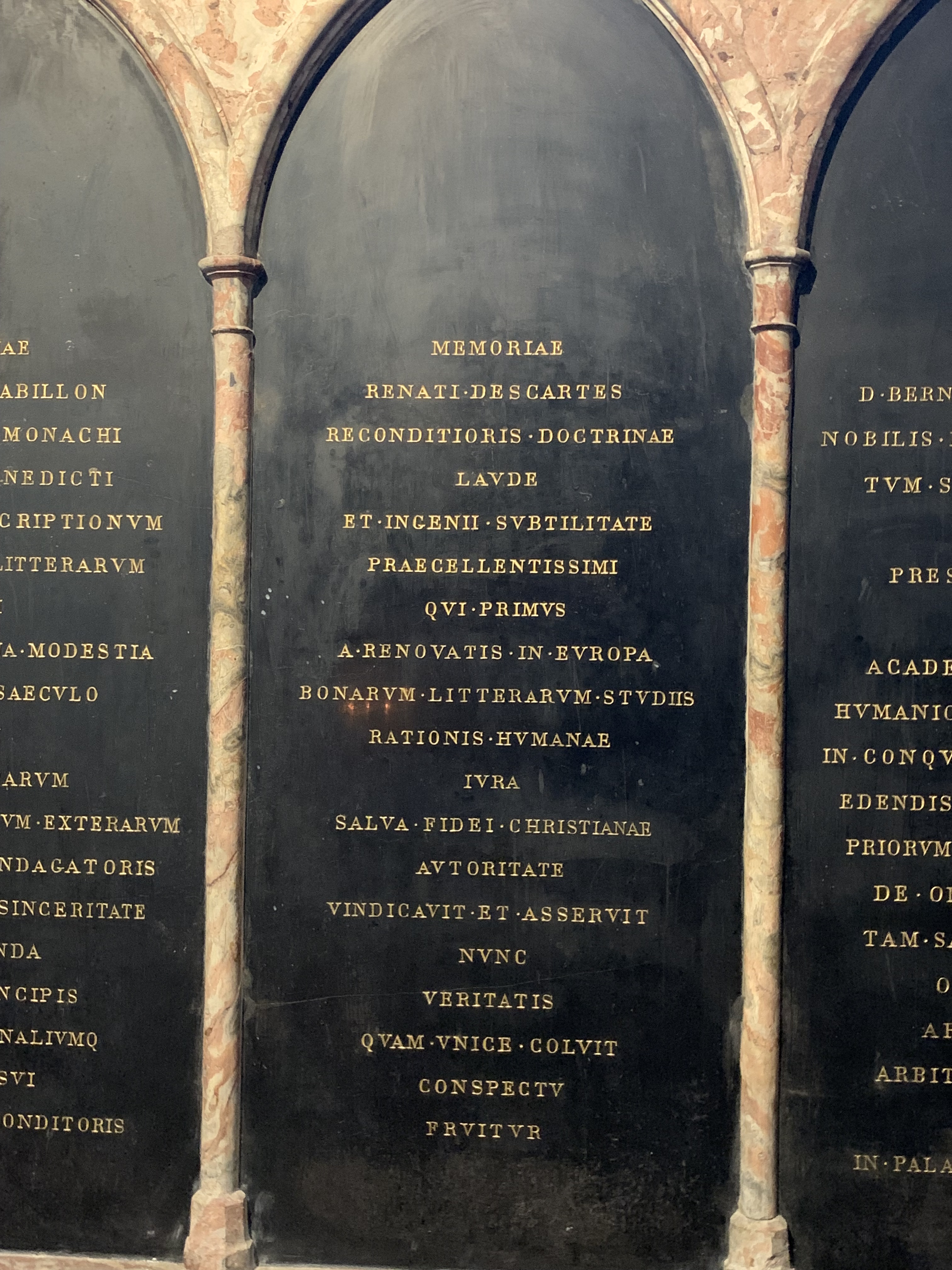
Descartes’s tomb, photo by the author.

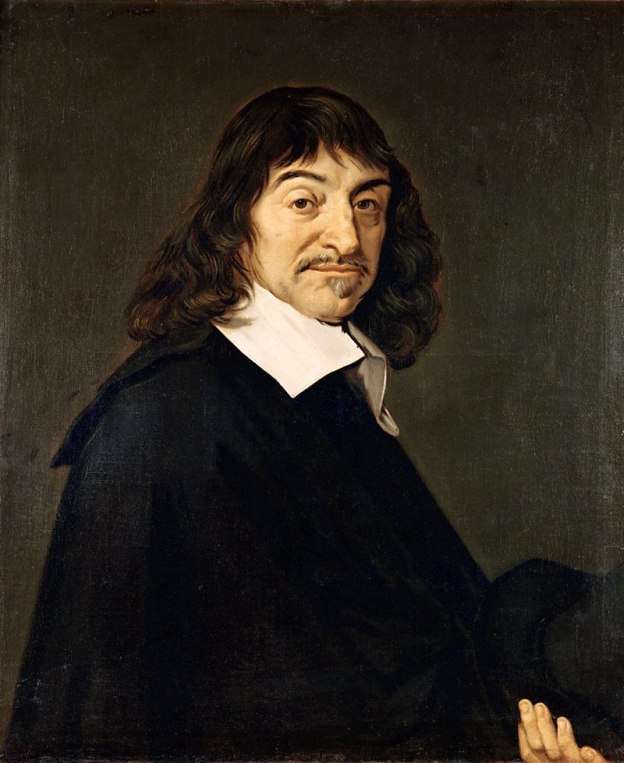
Epistemology is the theory of knowledge. It distinguishes things which are justified from mere opinions. This theory of knowledge considers propositions about facts, practices which form knowledge, and familiarity with an object thus allowing the subject to know it. This word episteme in Greek (ἐπιστήμη) translates into English as both knowledge and science. Science itself is a word which at its core refers to knowledge, for the root Latin verb sciō means “to know.” We know for instance that we exist because we can recognize our existence, in Descartes’s famous words “I think, therefore I am.” I made a point of visiting Descartes’s tomb in the Abbey Church of St. Germain-des-Prés when I was in Paris in October 2023 because so much of my own philosophy is Cartesian in its origins. I reject the principle that we could be living in a simulation on the grounds that based on what we can know and perceive we are not inclined to accept such a suggestion.

The second of these words is ontology, a branch of metaphysics dealing with the nature of being. This word derives from the present participle of the Greek to-be verb εἰμί. I stand by my assertion that the life we are living is real because we can recognize it in large part because the best explanation that I’ve found for the course our history has taken is reliant on us having the freedom to decide the courses of our own lives. This free will explains how a society can seem to take steps backward even while the chaos those retreats cause is to the society’s detriment. The method which I am developing in my research to understand the nature of historical animals using modern scientific research is ontological in character. I can test if this method will work by applying it to particular individual animals who appear in the historical record and determining their true character by a process of eliminating candidate species until the animal’s own species is determined. In this search for the nature of these animals I hope to prove that the historical past, before the development of the scientific method in the seventeenth century, is valuable to the natural sciences as a means of understanding the longer-term nature of other animals during the period in which human influence upon nature was growing toward the Anthropocene which we find ourselves in today.

I like to think of ontology in the linguistic context of how the copular to be verb appears in our literature. Think, for instance, of how God is identified in the Bible. In the story of the burning bush, the Divine is referred to as “I Am that I Am,” or rather the purest expression of existence. For this reason, when I was an undergraduate in my theology major, I began to refer to God as the Divine Essence owing to the root of essence in the Latin copular verb. English recognizes a far wider set of states of being than does Irish. Where in English I might say “I am sad,” in Irish I would say “sadness is upon me,” or “Tá brón orm.”

The third of these words is teleology. This is the explanation of phenomena in terms of their purpose rather than the manner of their invention. Τέλος (telos) is the Greek word for an end, an aim, or a goal. The purpose of something’s existence then is at focus here. I do question this idea that we have a specific purpose in life, perhaps because mine has not gone quite how I expected. In my Catholicism, the most teleological concept we retain is the idea of a vocation either to holy orders, marriage, or to the single life. The teleology at play here speaks to some sense of destiny which I feel stands in opposition to our free will. Perhaps there is some purpose to life, at its initial conception in the first moments that matter began to form in the void that became our Universe, yet I do not believe that I can perceive any intended influence beyond the flick of the first domino at the Big Bang. We may not even be sure that the Big Bang was the beginning of everything, after all there had to be energy to build up to cause such a tremendous explosion in the first place. In a theological view I would point to the Incarnation of Jesus as an example of telos in our history, I am a Catholic after all. My lingering question is where should that theological teleology interact with the other ways of knowing?

I’ve written here before about my view that belief and knowledge are two distinct yet interrelated things. One must believe in one’s senses to know, yet there are things in which one can believe without knowing which one cannot know without believing. The prime example of this is God; “I believe in One God,” it’s something I say every week at Mass in the Creed, “Credo in unum Deum,” in the Latin original of our Roman Missal. Yet God alone is a tremendous challenge to know because God is both paradoxical and far greater than the extent of my knowledge. For this reason, we had the Incarnation, as we recite in the Creed:

“I believe in one Lord Jesus Christ,

The Only Begotten Son of God,

Born of the Father before all ages.”

For God to be knowable God needed to come down to our human level in the person of Jesus, God the Son. This was Jesus’s telos, to be known, to be heard, and as we believe restore faith in God and cleanse humanity of original sin. Here there is a collision of belief and knowledge, where something clearly happened about 2,000 years ago because a new profusion of faith occurred, beginning in Judaea and spreading around the Mediterranean World in the Roman Empire and beyond to become Christianity. That new religion adapted to fit the cultures it encountered, so as to be more acceptable to its new converts. Today that collision continues in the Eucharist, the most sacred of all seven sacraments, in which we Catholics alongside our Orthodox brothers and sisters believe that God becomes flesh again in the sacramental bread and wine. Can we know that it happens? Not by any scientific measure, yet something does happen. That something is perceptible through belief, and it is the Great Mystery of the Faith that has kept me in the Catholic Church in spite of the ecclesiastical politics and divisions of our time.

My Irish Gaelic ancestors understood Christianity in their own way, aspects of which survive into the present day. That collision of belief and knowledge looks to some lingering folk belief, or superstition if you will, that I’ve inherited of particular days in the calendar when the worlds of the living and the dead could collide. We see this most pronounced in the old Gaelic calendar on Samhain, which developed through Catholicism into Halloween, the Day of the Dead, and All Souls’ Day around the beginning of November. I see All Saints’ Day fitting into this as well, after all the Saints are our honored dead all the same. Likewise, Bealtaine, the celebration of the coming of Summer at the beginning of May is also the Catholic celebration of the Crowning of Mary, something I attended at Rockhurst on several occasions.

What in all of this can I actually know? I know the stories that have survived from before St. Patrick and the coming of Christianity to my ancestors 15 centuries ago, even if those stories are Christianized in some way or another. I know this just as much as I know that Jesus existed in the first century CE because there are effects of these stories in the lives and histories that are remembered down the generations. If these stories have any teleology, it’s to teach us lessons about life that our ancestors learned so that we might not have to face the same trouble all over again. The folly of humanity is that we are resistant to having a clear purpose or end to our aims. Through our free will we know that there are always many options to choose between.I don’t know if I made the right choice in dropping that philosophy major at the last moment. In many respects, it was a poor decision. I learned from that experience and many others in my early life to stick with things until their conclusion. This learning is something that has been tested to grow beyond mere opinion through belief into something that is verifiable. When I look at my prospects in my doctoral program, I always decide to stick with it because I don’t yet know what my prospects will be like once I’ve earned it, something that I do know having 2 master’s degrees and a bachelor’s degree to my name. I have gained a great deal of epistemic experience through all these memories that have informed the nature of my character. Yet where they lead I cannot say, for the purpose of my life is something I continue to decide day by day.
On Numbers

This week, how numbers are both a universal language and symbols representing deeper meaning.—Click here to support the Wednesday Blog:https://www.patreon.com/sthosdkane


This week, how numbers are both a universal language and symbols representing deeper meaning.


Consider, if you will, what meaning a number holds if unaffixed to an object for calculation or counting? What does six mean if disassociated from the rest of its sentence? Some numbers are recognizable for their meanings due to the broader cultural connotations held by those definitions. A learned reader who sees 3.14 written on a page will recognize that as the first three digits of the value of π, yet without the decimal a Midwesterner will recognize 314 as the telephone area code for the City of St. Louis. Similarly, while 23 holds significance as Michael Jordan’s jersey number to millions if not billions of us who remember the greatest Bull play around the millennium, to others 23 is just another prime number.

Numbers in themselves can only exist beyond the abstract if they account for something. The life is blown into the Music Man’s best known song by the “76 Trombones”; Professor Harold Hill’s exhortation to the people of River City, Iowa would’ve fallen flat if he called on them to raise the funds and enthusiasm for “76” alone. Perhaps the patriotic connotation of that number, 1776 was the year of this country’s birth, might’ve stirred some hearts, but a number alone cannot bring a parent to tears quite as well as hearing their child blow the life out of a trombone for the first time.

It generally annoys me to hear numbers be used with minimal context. I don’t always know what the speaker is referring to when I hear a given number, and in that instance while mathematics may be the universal language the way we use it requires greater linguistic framing. Language can readily transform numbers that otherwise would be subordinated into defined objects of their own. Consider the penny; on the one hand it is merely 1/100th of a dollar in this country or 1/100th of a pound in the U.K. Yet a penny saved is a penny earned, and if Poor Richard’s maxim is to be believed a penny in itself is something beyond its diminutive status in hard currency. The value of the penny has shrunk a tremendous amount in the last century to the point that for the last quarter-century it’s cost the U.S. Mint more to make an individual penny than the value of the penny itself.

The penny is in a less stable place today because of inflation and our society’s transition toward digital currency. How often do you see products priced at 1¢ in stores anymore? With all electronic payments for things, no coins or banknotes are needed to complete the transaction. The unfortunate incident of coming up a few pennies short when paying for something is no longer a problem unless your card is denied. Yet for the cash-users among us losing the penny means they can no longer aim for exactness when paying for things. If a product is priced at $4.99 and you give the cashier a $5 bill you won’t get that penny back. I’d probably shrug it off, but still, I’d feel a twinge of unfulfillment and a residual sense that that shop now owes me money, even if it’s practically worthless. There lies the one great flaw in this plan: the penny is so ingrained in our culture; it’s been one of our coins since independence and even before then pennies go back to Charlemagne’s denarius (thus why in pre-decimal Britain and Ireland the penny was abbreviated d.) The Carolingian denarius of the 8thcentury CE was in turn borrowed from the Roman denarius which was introduced during the Second Punic War (218-201 BCE). So, the penny has been around far longer than most other coins we use here in the United States, and its name transcends this country where it represents 1 cent. The penny still gets used in Britain as the 1 pence coin, there even that word pence is another plural which is synonymous with our pennies.

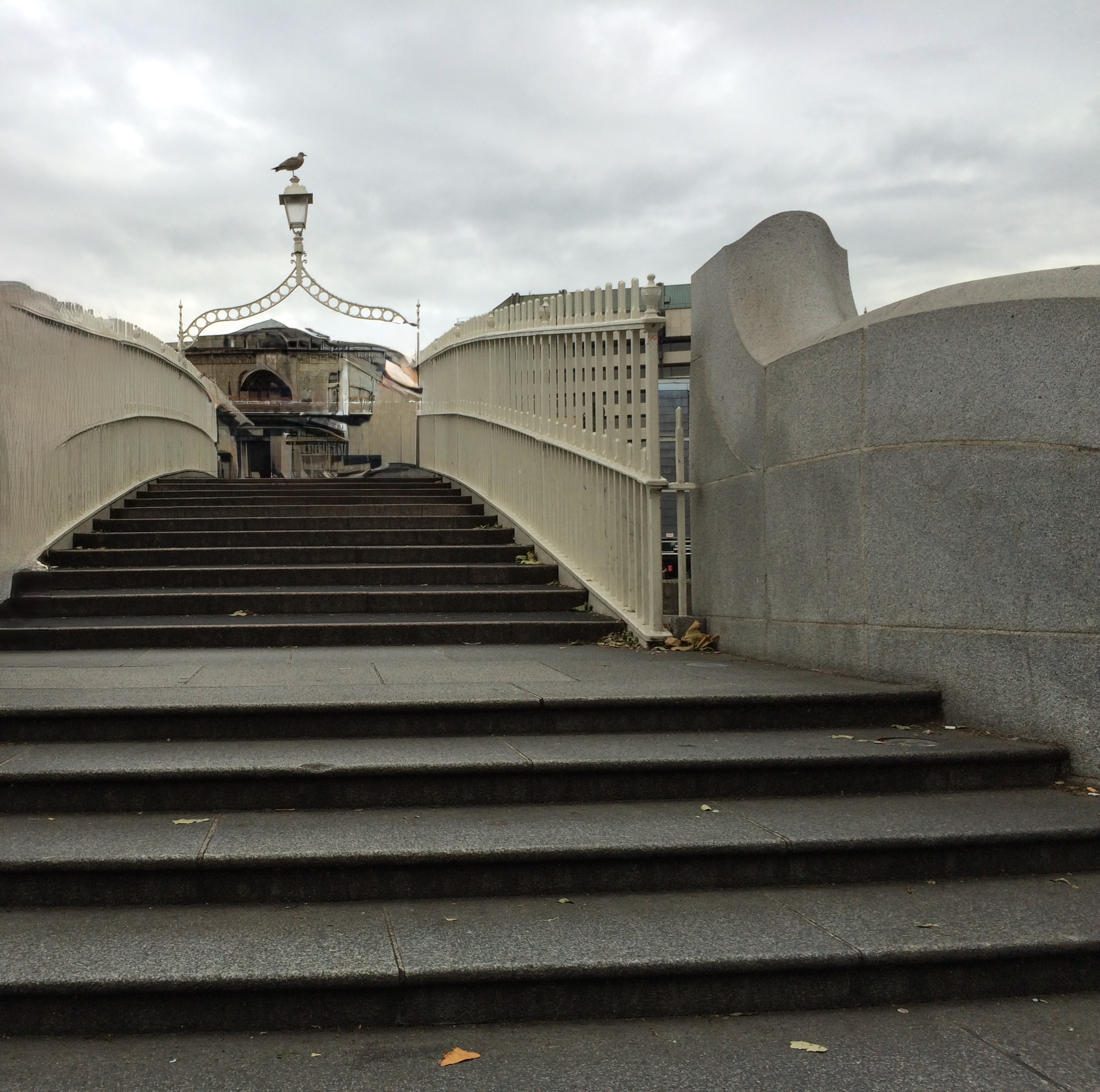
My photo of the Ha’penny Bridge from August 2016.

In older songs and stories, we still remember when the penny was valuable enough to be subdivided into ha’pennies, or half a penny. At that time, the British penny was worth 1/240th of a pound, in a pre-decimal system that was replaced in 1970 with the current pound-pence system. Dublin’s Ha’penny Bridge is named for the tolls that used to be collected to cross it. Even smaller denominations of the pre-decimal pound such as the farthing (1/4d.), and half farthing (1/8d.) were also minted. Clearly then the penny had more value in the past than it does today. I was struck when I moved to London in 2015 how you could still find goods for sale in the groceries priced less than £1, especially bread. That is almost unheard of in my own country anymore. I think this also speaks to a broader transition in the way we think away from older pre-decimal systems toward ones that work better for computers. After all, the primary method by which we interact with numbers anymore is through our computers who tend to do most all of the calculations for us.

One effect of that shift is that fractions now feel less practical. I was taught fractions in school well before being taught about decimal places in what now feels like one of these pre-decimal holdovers. To an extent I still think in fractions, perhaps thanks to our continued use of the quarter (1/4th) among the coins of the US dollar or the weighing of meat in fractions of a pound. Fractions on their own require that they represent a portion of another number, they cannot exist independently. ¾ is three-quarters of something, yet again here context is key. A musician will look at that fraction and read it as ¾ time, or a 3 beat measure where the quarter note gets the beat. Yet again there: this refers to a quarter note. That musical note may be the default note that gets played, with the ascending and descending scales of note length from that point, yet it still is ¼ of the length of a whole note. I love how in English we’ve mixed Latin and Germanic terms together to describe quarters, halfs, wholes, and such. This word quarter is Latin in origin, coming from the ordinal number fourth in that language: quartus. A quarter then is a fourth of an object.

I remember learning my fractions in school, and I still use them a great deal in my daily life. They’re practical when I know the total number of objects I’m dealing with and when I need to subdivide those objects to ensure maximum efficiency or spread. If I have 4 slices of bread left and I know I won’t be able to make it out of the house for a day or so because of snow, I’ll portion those slices out, so I don’t run out until I have the next loaf in hand. For tangible things that exist in the physical world comparing them as fractions (that is dividing the portion by the whole) helps me understand the numbers I’m dealing with.

Yet again, the quotient produced by that division, the result of that fraction is almost always written in decimals. I think of decimals as a product of the development of the metric system in the late eighteenth century. They are fundamentally more rational, and easier to program into a computer. Rather than asking a computer to translate from the more human fraction one can instead speak to the computer in its own language and let it do its computations faster and more efficiently. Today then, I use decimals far more than fractions. What’s more, each decimal number can exist independently of any other figure. 0.25 is simply 0.25, it’s not inherently a quarter of something else. When I see that price tag of $4.99 in the shop, I think of it as just a hair below $5, and am willing to hand over a $5 bill despite that being worth more than the product I’m buying. If I get my penny back or not is less of a concern, after all in this decimal mindset the penny is almost worthless, so what’s the bother if I lose a few cents here or there? Consider that sentence again though: a penny is a cent, or 1 percent of a larger number, namely $1. Even here when contemplating the penny as 1 cent or $0.01 it is still 1/100th of a dollar. Sure, eventually losing those pennies in every transaction will add up, but it’s going to take long enough that it doesn’t register as a problem for me.

Percentages are another sort of number that’ve grown in importance in my thinking in recent years. We mostly encounter percentages in tipping these days. There’s a tender balance here between tipping a percentage digitally or a whole dollar depending on the initial value of the bill of sale. When doing my own mental math, if I get a rough idea of what 20% of something will be I might decide to round up to the nearest whole dollar when writing a tip on a receipt. Yet those tip screens we see at nearly every business changes the dynamic slightly. Instead of leaving room for that rounding up they offer us the exact sum of 20% of the total bill down to the nearest cent. There’s something lifeless yet efficient about this. This is a number to be sure, yet it represents something human and social that ought to be seen in that light rather than just numerically.Mathematics is the purest language, it’s the one most often looked to as a solution for how we might communicate with other intelligent life who surely wouldn’t know how to speak any of our human languages. Yet all numbers are infused with emotion and have a myriad of deeper meanings than the sum of their parts. In balancing budgets, we could just look at the numbers and cut where seems fitting, yet there is always a human side to every budget line. Each cut is something taken away from someone, a potential line of funding removed that otherwise would’ve contributed to someone’s livelihood and helped them make something new and exciting. Numbers can and do reflect people, and they always have. They can exist in both the abstract as just numbers and the real as representations of people and objects. More often than not, we see them in the latter context. The mathematician is warranted to consider the human in their calculations, lest they clip one cent too many and leave too many of us people without the values we need to survive and thrive in this world we’ve built for ourselves.


On Genealogy

This week, I discuss how my experience working with genealogy databases helped prepare me to be a professional researcher. — Click here to support the Wednesday Blog: https://www.patreon.com/sthosdkane


This week, I discuss how my experience working with genealogy databases helped prepare me to be a professional researcher.


One of the things that struck me about the history that I liked to read as a child was that few of my own ancestors’ names appeared in those books. I remember sitting up late at night in my elementary school years reading these fifty or sixty year old children’s histories of the Vikings and the Romans and imagining the illustrations to life. I could convince myself that I could hear, even on the softest level, the oars of the longships pushing with the current of the Thames as the ropes that tied their sterns to the pillars of the old Roman London Bridge grew taught. I’d return to my regular school day the following morning, to Mass and eight hours of classes introducing me to everything from basic mathematics to orthography and English grammar to music, yet when we had our hour in the school’s library the books I knew to search for were the histories.

My elementary school, St. Patrick’s in Kansas City, Kansas, was founded in 1949 and most of the history books dated from the late ‘40s and early ‘50s, by modern standards they were historical artifacts in themselves. Moving forward I didn’t have access to the same kind of library after my middle school years, my high school had a “media center” that functioned like a library, yet I never remember finding books to read there. So, one of the first places that I went on arriving at Rockhurst University in August 2011 was the upper floor of the Greenlease Library to wander around with my new friends and see what books lived there. I made great use of that library during my four years at Rockhurst, and before the pandemic continued to occasionally check books out with my alumnus privileges.

Yet when I was probably 8 or 9, on one trip back to Chicago my grandmother Mary Lou Kane gave me a book about Irish folklore, and I began to hear stories about my family’s history from her and other relatives. I’d known our ancestors were Irish for as long as I could remember, I was 7 when my grandfather’s aunt Catherine McDonnell died; she was one of the last immigrants and probably the last native Irish speaker in our family. Just before my 10th birthday on a trip to England I met my Welsh cousins who introduced me to that side of my maternal family. We kept in contact writing letters back and forth every now and again. 

This all led to my formal introduction to genealogy when I was 13. At that point I talked my way into starting as a volunteer at the institution then known as the Irish Museum and Cultural Center, now the Irish Center of Kansas City. The director at the time thought I was 16 but let me stay after I showed I could be responsible. There were days where I was the only one in the little office we had in the lower level of Union Station, and among my responsibilities was to help the frequent visitors with genealogy questions about their own Irish ancestors. I became familiar with the different genealogical databases around then and steadily built up a good knowledge of where to look for what sorts of records and had the occasional success finding a long-lost relative for someone. I continued volunteering at the Irish Center until around my 19th birthday, when now an undergraduate at Rockhurst with a growing list of clubs on top of my three majors and two minors I stopped volunteering at the Irish Center.

I’ve had a fair bit of luck with researching my own family history. My own database is built upon the work of several relatives on both my paternal and maternal sides who did a lot of the initial research. What I’ve done is to fill in some of the gaps and to elaborate on the circumstances of these people’s lives. This has come into handy here and there, I was fortunate enough to visit the building where my Finnish 4th great grandfather worked as the town judge in the southwestern port town of Rauma in the mid-nineteenth century. Moreover, my Dad wouldn’t have his Irish citizenship through descent were it not for the research done by myself and several others that helped find his grandparents’ birth certificates.

My one genealogy position as an adult that I undertook was as a volunteer in the genealogy reading room of the National Archives’ Kansas City regional office. I regularly attended to this position for a good year and a half while I was beginning my M.A. in History at UMKC. It was fun at times, though in many other occasions it could become quite dolorous as the cases I was often presented with were unsolvable or restricted in some ways or another. I left that position as my work at UMKC began to grow, around the time I started writing my second M.A. thesis in fact.

All this research that I’ve undertaken for myself and others in genealogy helped prepare me for my work as a professional historian where so much of what I do is search through databases looking for archival sources that will offer the glimpses into the past that I need to write my work. At some point once I feel confident that I’ve done enough historical research to earn my first professorship I intend to turn to the boxes of family papers collected by long-time Wednesday Blog reader Sr. Mary Jo Keane, one of my grandfather’s cousins, whose research is the foundation of what I know about my paternal family in Mayo. When she died, I took those boxes with me with the intention of writing some sort of family history like the one she intended to write in her last years.

We often talk in the historical profession about history from below as one of the newer genres of history-writing. I’ve liked this idea since I first heard about it, and in some sense, I’ve tried writing from the perspective of the animals which are at the heart of my professional research to varying success. Genealogy is often history from below because as much as we may hope to find some famous ancestor––at one point Ancestry.com claimed to prove my relations to several famous people––it really ought to be a recognition of who our family has been in the generations that we can still find. It is a supplement to memory even as that living memory of our past fades. At Kane family funerals I would often learn something new about the immigrant generation in my family, my great-grandparents, that would explain their lives just a bit more. Those stories turn these people from just being figures on paper into memories that have some of the color and life of those illustrations in my childhood history books. I want to know more about my family’s past to understand how I fit into our world today with its progress and troubles all the same. In the first half of the last century that generation lived through world wars, the Irish War for Independence and Civil War, the Great Depression, and a global pandemic. And through it all they took the bold step of leaving home and starting a new life for our family in Chicago. That life was the one I was born into at the end of the last century, and even after my parents & I moved to Kansas City that life in Chicago still forms the bedrock of my life and perception of things today. None of this would be nearly as personal or as impactful if I knew nothing about the ancestors I never met. It’s thanks now to all this research in genealogy that they live on in my memory today.


On Names

Season 4 Finale: This week, to celebrate Christmas I’ve decided to write a bit about naming conventions that I’ve come across, and to explain why I use my full name professionally. Nollaig shona daoibh | Merry Christmas! — Click Here to Support the Wednesday Blog: https://www.patreon.com/sthosdkane


Season 4 Finale: This week, to celebrate Christmas I’ve decided to write a bit about naming conventions that I’ve come across, and to explain why I use my full name professionally.


In American culture middle names have a bad reputation. They’re most famously used in our childhoods to scold us, and in adulthood they most often appear in legal matters. A writer naming non-descript American characters John Booth or Lee Oswald might get away with it but include their middle names Wilkes and Harvey and you have two of the most notorious assassins in American history. Most accused or convicted murderers in our legal system tend to be known in the press by their full names: first, middle, and last. There’s an odd cadence to it when these people are identified by the police or the courts. It’s one of the more common times when middle names get used.

I go by my full name professionally. On my website, in my email signature, and in every conference program and academic publication that I’ll ever appear in I’m identified as Seán Thomas Kane. Trust me, I didn’t intend to draw any connection between myself & the men mentioned in the last paragraph who killed two Presidents who I’ve always looked up to. In my case, the use of my middle name has a different sort of significance. In my extended family I often get called Seán T., in part because I have many relatives who are named Thomas, one of whom goes by T. among the family. Whether intentional or not, my parents gave me one of the most traditional Irish names they could have. Irish names are traditionally patronymic, meaning the person is so-and-so, son or daughter of so-and-so, descendant, son, or daughter of so-and-so. Those last names (or surnames if you aren’t American) that begin with O’ refer to families who are descended from a specific person who lived centuries ago. The ones that begin with Mc however are Anglicizations of the Irish word mac, meaning “son” of a specific person who lived centuries ago. My father’s name is Thomas, so in Irish my name is Seán mac Tomás, or Seán, son of Thomas. Kane is an Anglicization, or better an English phonetic rendering of the Irish name Ó Catháin, pronounced two different ways depending on where you’re from in Ireland (for those reading this, listen to the podcast to hear those two pronunciations.) Cathán was a more common Irish given name in the Early Middle Ages and derives from the word cath meaning battle.

This was in the back of my mind when I decided to start going by my full name professionally. It was 9 March 2016 and I had a few hours without much to do while waiting for a car to pick me up at Lyon-Saint-Exupéry Airport on my way to the eastern French city of Besançon, the capital of the Franche-Comté region and a city which Caesar mentioned in his book about the Gallic Wars (De Bello Gallico 1.38). That cold and rainy Wednesday in March there was a national railway strike in France and I ended up booking a back seat of a Renault Clio driven by a Frenchwoman who spoke little English alongside two other Frenchwomen who again spoke little English from Saint-Exupéry Airport outside of Lyon to Besançon, a good 4 hour drive. Right before they arrived though, I was on Facebook posting an update about my trip and thinking about how I wasn’t entirely sold on sticking with Seán Kane as my name professionally, after all when you search Seán Kane on Google you get a fair handful of results. There on Facebook I noticed that my friend Luis Eduardo Martinez, a fellow graduate student in International Relations and Democratic Politics at the University of Westminster, and a gentleman who I consider a good friend to this day, used his middle name professionally. I felt inspired and changed my name on my Facebook profile from Seán Kane to Seán Thomas Kane then and there standing in the airport parking lot.

Where the last paragraph took place.

This proved to be even more advantageous when the Renault carrying the three Frenchwomen arrived as the driver stepped out and proved that the way Seán is spelled makes little sense to a monolingual French speaker. I remembered when I started studying French at Rockhurst University and we chose French names to use in class how I immediately was discontented with being called Jean alone, as I’d rather be called Jean-Thomas because that’s essentially a French translation of my name coming from Irish. So, I suggested that she call me “Seán-Thomas” which was heard as “Jean-Thomas.” Et voilà, that’s how it all got started. For the record: the Irish name Seán is in fact just an Irish spelling of the twelfth century Norman French pronunciation of that French name Jean, which is also the source of the English name John. You can hear the connections better in an English accent than in my own American one where the oh sound in John has shifted closer further forward in the mouth.

This wasn’t the first time I’d changed my name on my Facebook profile. For a while in high school, I went by my Irish name, Seán Ó Catháin, and that was the name on my early membership cards with the Ancient Order of Hibernians. Yet as much as I was inspired by the Gaelic revival and wanted to do my part to restore our ancestral language, I found that it was impractical to use in America and that deep down I do identify more with Kane than Ó Catháin because that’s the name my grandparents, my dad, and most of my paternal relatives use. Kane itself began as a misspelling by the U.S. Army draft sergeant processing my great-grandfather Thomas Keane when his number was drawn in 1918. He enlisted and served as an artilleryman in France and eventually became an American citizen as Thomas Kane because the sergeant told him if he wanted that first e added back into Keane on his papers he would have to go back to the back of the line and start the process over again. 

So, to answer a question I often get in Kansas City: no, I’m not related to any other Kanes in this city except my Dad, and in fact outside of my Dad and his brother’s family all of my living paternal relatives who share our family name on either side of the Atlantic spell it Keane. I suppose I could change mine back to that one, I suspect my granddad’s cousin and longtime Wednesday Blog reader Sr. Mary Jo Keane would’ve approved of that, yet at this point the name dispute feels moot especially considering the Keane spelling only goes back another generation or two to about the 1850s before which in the official British government records written in English my great-grandfather’s great-grandfather’s name was written as Thady Caine. In Irish his name would’ve been Tádhg Ó Catháin, and we know he spoke Irish as his first language. So, what was his name? I’m honestly not sure.

I like how different naming conventions reflect different cultures in their own ways. Our Irish patronymic system is really more Gaelic than Irish, after all it’s the same system that’s used by our Scottish Gaelic speaking cousins and it mirrors a very similar system used in Welsh. In fact, my Welsh ancestors’ family name was Thomas, which derives from the Welsh ap Tomos. Fitting, eh?

When I teach about the Vikings I like to bring up the Norse patronymic system too and explain that Leif Erikson (as we call him in English) was actually Leifr Eiríksson in Old Norse, and that following this tradition as it’s today practiced in Iceland were I born there, or should I someday immigrate to that island republic I’d probably start going by an Icelandic version of my name: Jón Tómasson, dropping the Ó Catháin/Kane family name all together in regular use there to better fit Icelandic society while still retaining it outside of Iceland. I see this as similar to how patronymics are used in Russian, where Tolstoy’s tragic character Ivan Ilyich is known by his first and middle name and not by his first and family names Ivan Golovin as we’d do in the English-speaking world. There, for the record, Seán mac Tomás would translate as Иван Томасaвич (Ivan Tomasavich).[1] In a hypothetical blending of cultures where Irish speakers interacted more with French speakers in North America than with English speakers I could see our patronymic system developing into the French system of having double names, thus why when I still published a French translation of my C.V. I would write my name as Seán-Thomas with the hyphen which I don’t use in English.

Another set of naming systems that I’ve encountered that I appreciate are those originating on Iberia where the family names of both the mother and father are included. My same friend Luis Eduardo Martinez’s full name, and the name I first read when I met him in September 2015 is Luis Eduardo Martinez Mederico. In this Spanish naming custom, his father’s family name appears first followed by his mother’s family name. This is opposite to the Portuguese where the maternal family name precedes the paternal one. So, in the Spanish custom my name would be Seán Thomas Kane Duke, while in the Portuguese custom it would be Seán Thomas Duke Kane. My parents and I actually refer to our family as the Duke-Kane Family, and we’ve joked about what my life would’ve been like if I’d been given both family names at birth in that order. I often conclude that including the East Yorkshire name Duke alongside Kane would’ve made me sound more English.

Then there are the professional names like Smith or Miller. These derive from the first bearer’s profession, so Jefferson Smith had an ancestor somewhere in the distant unwritten past of that Frank Capra film’s imagination who was a blacksmith. Today, on Christmas, we celebrate someone who has such a name, that being Jesus. I get annoyed with my fellow Americans who see “Christ” as Jesus’s last name because it’s not a name at all but a title in the first stage of becoming a name. This name as we understand it ought to be written in English as Jesus the Christ, from the Greek Ἰησοῦς Χριστός through the Latin Iesus Christus, but that word Χριστός is merely a Greek translation of the Hebrew word māšiah (מָשִׁיחַ), which again is usually rendered in English as Messiah, the name of Handel’s most famous oratorio and what Brian certainly wasn’t (he was a very naughty boy.) This is a kingly title, fitting with our view in Christianity of Jesus as priest, prophet, and king appears most prominently this time of year in the Feast of Christ the King, something we celebrate in the Catholic Church at the Liturgical New Year, which was 24 November this year.

Jan van Eyck’s depiction of Christ the King from the Ghent Altarpiece (1426)

A brief digression here: this past Feast of Christ the King I learned that the official name of the day is the Solemnity of Our Lord Jesus Christ, King of the Universe. While that last title might sound overly grandiose in the twenty-first century it actually comes from Ancient Mesopotamia, where the most powerful monarchs of those city states as far back as Sargon of Akkad (r. c. 2334–2284 BCE) claimed this as their imperial title: šar kiššatim, which actually meant King of Kish, the primate of all Mesopotamian cities and according to the older Sumerian King List it was the first city to crown its kings following the Great Flood. So, in essence this title places Jesus, a humble carpenter who was incarnate as God the Son as the true “King of Kings (forever, and ever) and Lord of Lords (for ever and ever)” to quote from the Handel.

Now, back to that rendering Christ as Jesus’s last name. In his lifetime, Jesus was known as Jesus of Nazareth, and in earlier times Christians were known as Nazarenes (Acts 24:5). This word is still used to describe Christians in Hebrew in the form notsrí (נוֹצְרִי) and in Arabic with naṣrāniyy (نَصْرَانِيّ). Thus, he was known more by a locator name than by a last name in the modern American sense. Furthermore in John’s Gospel, St. Philip referred to Jesus as “Jesus, son of Joseph, from Nazareth.”[2] So, in the culture in which Jesus was born he would’ve been known most fully in this way rather than with any last name that we may recognize. It’s important to remember that Jesus’s ministry took place 2,000 years ago, and contrary to some popular belief he didn’t speak English. English wasn’t even a language then, though an older form of Irish was around, just probably not heard as much in Galilee or Judaea.

So, let me conclude with the bits that seem to have started as identifiers that came at the end of people’s names before there were family names in the sense that we use them today. These are often locators of where the person in question was from. In the case of Leonardo da Vinci, da Vinci merely refers to the fact that Leonardo was born in the Tuscan commune of Vinci. These particles of place tend to denote nobility in some names, see the French, Spanish, and Portuguese de, the Italian de’ and di, and the German von. However, I see the utility in having this locator in someone’s name to make it clear that even though they’re a Booth they’re not related to every other Booth around. That way a random John Booth living in 1865 would’ve had less trouble because of his more infamous counterpart’s scheming that Good Friday. I’d ask though, in my own case whither would such a locator in my name identify? Where would it refer to? Would it stick just with me, saying that my original hometown is Wheaton, Illinois, so I’d be Seán Thomas Kane of Wheaton? Or would it go back to the origins of my particular Kane/Keane/Caine/Ó Catháin family in the Derryhillagh townland outside of Newport, County Mayo, in Ireland? In Irish the way this would be written would either be with a different Irish preposition ó (yep, there are at least two of these), or with the preposition as. In my Irish as I speak it, I say as in this context more than ó, as in to say “Is as Meiriceá mé,” or “I am from America.”

We don’t do these in Irish names, in part because of our patronymic system which does a fine job on its own. Sometimes when I’m writing stuff in Latin and I want to adopt the style of the Renaissance humanists who I read in my research I’ll try to Latinize my name with one of these locators, rendering my hometown of Wheaton, Illinois by using the name of the Roman goddess of what, Ceres, and essentially making a town name from there. Thus, Wheaton becomes Ceresia. The tricky thing is that when I’m translating my name into Latin, something that was done in academia more into the nineteenth century but is almost never done today, I have a conundrum of whether to start from Kane or from Ó Catháin. I for one don’t like how a Latinized Kaniussounds, so instead I do go from Ó Catháin and use Cahanius, or Ioannes Thomae Cahanius Ceresius in full.

Names are important, and they say as much about the person who bears them as the people who named that person and the culture to which they belong. I’ve played around with my own name a fair bit, as you’ve seen. Today I’m more used to being called Seán-Thomas in French than in English, though the latter has happened more and more. I’ve even noticed that people have started calling me Thomas seeing that name and recognizing it faster than they do Seán, especially with the fada on the a. I smile and acknowledge them, after all I’m happy to be mistaken for my Dad. Looking forward, should I be fortunate enough to name my own children I’ll say these two things: first I’m not the one who’ll be pregnant with them for nine months, so I shouldn’t get first call on their names, and second there’s that Irish tradition that offers a simple answer to this conundrum. Will my first-born son be named Thomas as well then? Yeah, maybe. We’ll have to wait and see how this poorly named lifetime membership with one of the dating apps works out for me. I certainly hope I’m not putting my name out there for the rest of my life, though you can bet I’ll be using that lifetime membership joke for as long as I can.

Nollaig shona daoibh a léithoirí rúin! | Merry Christmas, dear readers!


[1] NB: I’m using Russian as the example here because that’s the one I’m more familiar with. No political inclinations toward the Kremlin in their invasion of Ukraine are intended.

[2] John 1:45 (New American Bible), see more here.


On Democracy

This week, for my birthday I want to write to you about my belief in all of us and how democracy remains our best hope. — Click here to support the Wednesday Blog: https://www.patreon.com/sthosdkane


This week, for my birthday I want to write to you about my belief in all of us and how democracy remains our best hope.


One of those great efforts with which human history is concerned is the question of what our original nature was at our beginning and if and how we have changed that nature. The French anthropologist Claude Lévi-Strauss’s notion of the primitive as “closer to humanity’s origins” and living in a state without the societal and technological innovations “that obscure their nature” evokes this original nature, what in Christianity is called our original sin, or biologically our evolved state as a particular form of bipedal mammals among other lifeforms.[1] The seeming natural state of human societies until very recently has been toward forms of monarchy and aristocracy, the Tory Party in Britain today still refers to itself as the natural party of government because they descend through many generations from the old Cavaliers who supported Charles I and the aristocrats in the Parliaments of the Stuart and Georgian centuries who opposed the liberal reforms of the Whigs. Here in the United States, our own whiggish political tradition sees its modern manifestation in the old establishment wing of the Republican Party, also known as the Grand Old Party or G.O.P., whose founders in the 1850s included former Northern members of the Whig Party once led by our own aristocrats, men like Henry Clay and John Quincy Adams in the early republic.

Yet those same men stood for something beyond just preserving their own aristocratic power within their own society. These American Whigs and their Republican and Democratic successors aspired to a high ideal of human nature that entrusted power in the hands of the many rather than in those of a few or the one. Dr. Heather Cox Richardson recently wrote in her Letters from an American about how the Secessionists who dragged this country into our Civil War in 1860 and 1861 were trying to assert their own aristocratic vision of the republic that would benefit the few at the disregard of most and the expense of the many. As James J. Sheehan reminded us in his essay in the December 2024 issue of Commonweal, Tocqueville wrote that the chief difference between the source of power in an aristocracy or a monarchy, or their corrupted forms oligarchy and a tyranny, and the source of power in a democracy is that “despotism may govern without faith, but liberty cannot.”[2] The despots rely less on our trust in their rule, and in many of the cases we see today they sew discontent in government, the economy, and for all of us with each other in order to assert their authority and keep hold of power. 

Democracy is a far harder thing to keep, as Dr. Franklin knew well. The inclusion of more and more people complicates any organization, yet it also allows that organization to better reflect all involved. Democracy requires the efforts of all of us to survive; if left unwatered and unnourished by each generation it will wither and die like any other flower or fruit on the vine. Throughout my life, I’ve looked to heroes in our history from Lincoln, Mandela, Óscar Romero, Popes Francis and St. John XXIII, to people closer to my own life. What all of them have in common is a desire to improve the lot of humanity, and in the case of Lincoln and Mandela to promote democracy in their homelands. When I look ahead and worry about what might be coming in these next four years, I often wonder if I would be safer, happier, healthier, and living a more fulfilled life elsewhere in another country where I can leave the troubles of my own behind. Yet I remember these heroes, MacDonagh and MacBride, and Connolly and Pearse, my great-grandfathers who fought in the two World Wars, the dreamers and optimists who organized and marched non-violently for civil rights here in America and in Ireland too, and looking again at our own day I pause. This is our time to make life better for our successors while we live to overcome the long winter of fear before us. If I left now, could I look those heroes of mine in the eye when my time ends?

I believe in democracy because it is the best form of government we’ve yet imagined. I believe in representative government because I would rather have a say in my neighborhood, my city, my county, my state, and my country than not. I believe in democracy because I believe in humanity and that all of us can make something better if only we believed in ourselves and in each other. I believe that before that original sin there was original grace, original goodness; that before the first frown there was the first smile; that before the first thoughts of lust there were thoughts of love. I believe in democracy because I need to believe that I will have a future, that all the things which I’ve done in these last 31 years are building up to something which will, in Bill Nye’s words, “change the world,” no matter how small that change may be. To do any of this, to see any of this goodness in our hearts, to believe in ourselves again we need to be willing first to acknowledge our faults and second to forgive ourselves and put in the effort to make our lives better. For all our technology and our ever increasingly complicated ways of life, we are still the same humans as our ancestors living in Lévi-Strauss’s primitive manner. We retain the same bodies and souls. Because of this, we can build a future for our posterity in a spirit of grace, compassion, and optimism that would make the heroes of old proud.


[1] Claude Lévi-Strauss, From Montaigne to Montaigne, trans. Robert Bononno, (Minneapolis: University of Minnesota Press, 2019), 25.

[2] James J. Sheehan, “Democracy and Its Discontents,” Commonweal, December 2024, 13.


The Versatility of Storytelling

The Versatility of Storytelling Wednesday Blog by Seán Thomas Kane

This week, how the same tools can be used to weave a variety of different stories. — Click here to support the Wednesday Blog: https://www.patreon.com/sthosdkane


This week, how the same tools can be used to weave a variety of different stories.


My favorite sorts of stories are the ones where I feel that I’ve gotten to know the characters and can relate to them on a personal level; that these characters are either real people who I’ll never meet or entirely fictional is beside the point. I often remember the stories I was reading, or watching, or listening to more than the experiences from my own life that surrounded new tellings of those stories. This potent relationship is heightened in moments when my own life is dull or foreboding, as in the height of the recent Pandemic when I passed the long days of isolation in my Binghamton apartment or at home in Kansas City watching and reading stories in the Star Trek franchise which I only really began to discover in February and March of 2020.

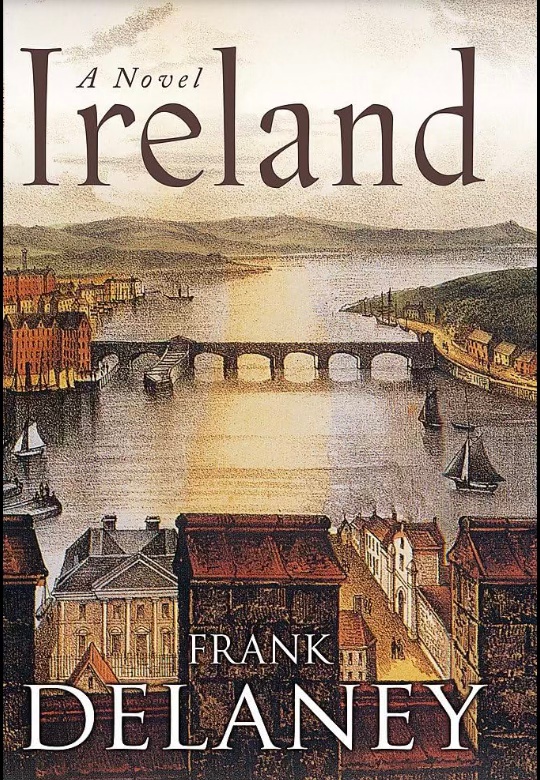
I wanted to be a storyteller from my youth. I read a book by the Irish journalist Frank Delaney called Ireland which followed a young man as he discovered his own passion for storytelling by listening to the seanchaí who often visited his family’s home. I began to write for myself around this time, though my efforts were focused more on poetry and plays at first. A decade ago, I built up the endurance to write a longer-form short story called “Abducted and Abandoned,” and around that time started writing what today is The Wednesday Blog. By the time I was working on my first master’s degree in 2015 and 2016 I’d begun writing a longer work, my book Travels in Time Across Europewhich I self-published in 2017. That one tells the stories I collected from my year living in London, stories of my own adventures traveling from the British capital to other cities across Europe. At the time I imagined that it could become a sort of valuable source for readers seeking to understand the world as it was in that last year before the Brexit referendum and the rise of Trumpism swept across Britain and the United States.

Dr. Olivia Stephens, the main character of “Ghosts in the Wind.”

Like the main character of Delaney’s Ireland, I too went to university to study history, to use my passion for storytelling, and as things came about, I’m now close to earning my doctorate in the field. Today, besides my efforts here with the blog I largely am just writing things related to my research. Alongside my dissertation I currently have one encyclopedia entry soon to be published, a book chapter and a scholarly article submitted for editing and am now writing another article related to my translation of André Thevet’s Singularitez. I still try to write the odd bits of fiction, like “Carruthers Smith’s Museum” which I released two weeks ago, or “Ghosts in the Wind” which I’m quite proud of. Yet I haven’t written anything to be acted in years. That’s striking to me, because my first big scribal efforts were for the stage and screen in my high school years. I do have an idea for a play that I might turn to someday in the next few years, yet even writing that here fills me with a sense of loss because it could well become another project that I’m excited about and have good ideas for yet don’t ever get to.

What I love most about writing for the stage and screen is that there’s a chance I’ll get to hear my words interpreted into lived experiences. Ideas that once only existed in my mind could be seen by many others played out before them and enlivened by the actors who utter those words & all the designers of sets, sound, lighting, props, effects, and music who flesh out that lived experience into something relatable and emotional in its truth. In short, to see my words brought to life in performance is to see a world created from what was once my thoughts, the smallest and most intimate of stages that I alone know.

To this end then, I am awed by the versatility of those storytellers who create these worlds in their performances. My erstwhile dissertation advisor Dr. Richard Mackenney, a man for whom I have the deepest respect and consider a friend, often talked about his own experiences on stage playing characters created by Shakespeare alongside many of the greats of the British theatre. In his lectures I saw a performance like any revival of King Lear or any of the Henrys or Richards that Shakespeare wrote. My own lecturing has taken on this same quality, yes at least in part in flattery, because I saw how he kept the rapt attention of most of the 150 or so students in the lecture hall with his art.

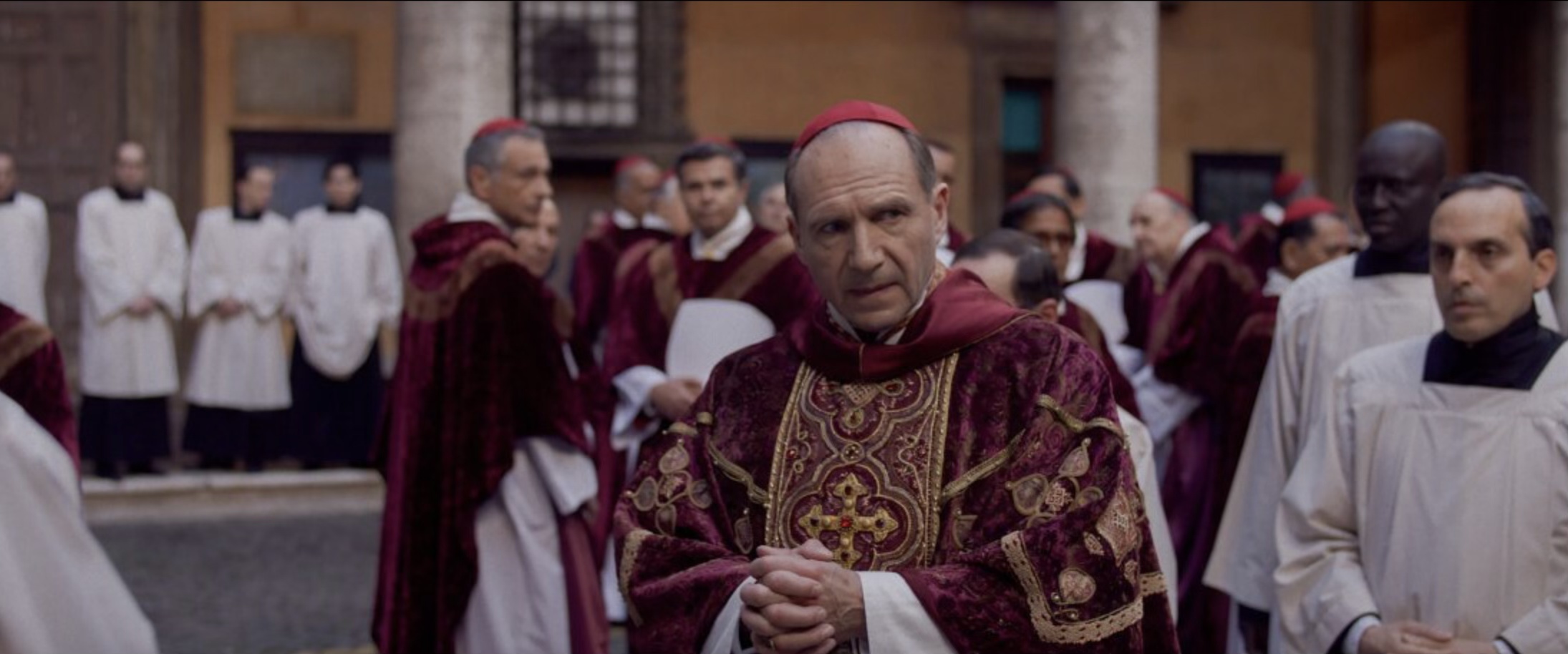
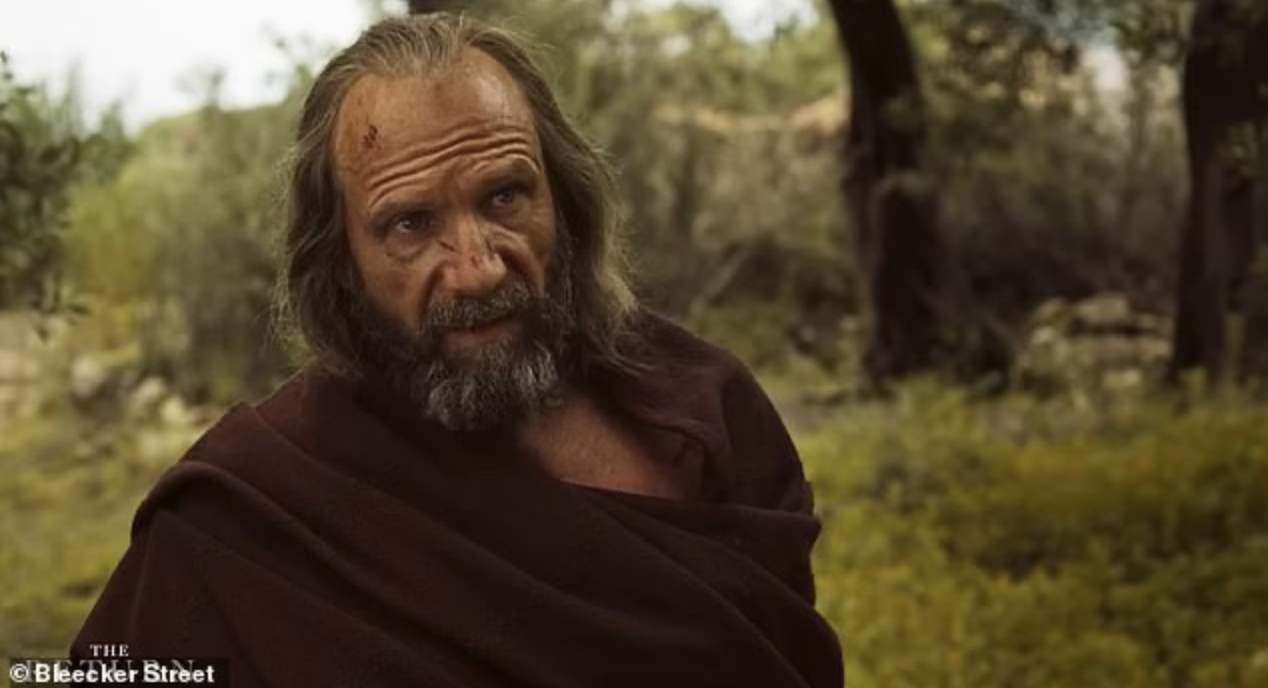
In recent weeks I had the pleasure to see the English actor Ralph Fiennes play two very different yet still akin parts in the films Conclave and The Return. In the former, Fiennes plays Cardinal Thomas Lawrence, the Dean of the College of Cardinals who is tasked with managing a papal conclave on the death of the Pope. In the latter, Fiennes returns to the screen a mere month after he appeared cassocked as an English cardinal this time dressed in rags as Odysseus returned to Ithaca after 20 years away at war against Troy. To see the same man inhabit two characters who on the surface could not be more distinct is a profound testament to the man’s mastery of his art. Both films are pieces of theatre imagined with the realism of a certain type of cinema that is more European than American, with less effects and a minimalist score that has its roots in the French New Wave. In the American context it’s reminiscent of the minimalism that we see in some of the television dramas produced recently for their streaming service by Apple.

I felt that I could instantly relate to Cardinal Lawrence in spite of his high office. The finest leaders I’ve met, whether cardinals and bishops or mayors, senators, and ambassadors are all people first and foremost. They acknowledge the trappings of their offices yet retain the everyman spirit that makes them relatable. I saw this in Cardinal Lawrence more than in many of the other characters who populate the halls of the Vatican in Conclave. That he is an English Catholic cardinal speaks to the post-Reformation moment in which we now live when the old sectarian wars of religion feel behind us and reflects on the Catholic Church in England and Wales that I know from my year living there and going to Mass in London. He speaks for a certain Anglophonic ideal that is democratic yet still upholding of tradition and custom.

Ralph Fiennes as Cardinal Thomas Lawrence and Odysseus, in performances which premiered within a month of each other.

Odysseus in contrast is a man who has seen much and endured much more than I ever hope to. His pain is written across his mostly silent face, and in this role, Fiennes says more with a tortured look than with words. That he only acknowledges his own identity verbally once in the film is telling. This is a man who fears that he won’t be the man that his family have waited for over these twenty long years that he was away. I can merely relate in that I’ve noticed time and again how my home and my city change each time that I’m away. On this most recent return of my own from Mérida on 10 November I was startled in the weeks that followed to see that the last vestiges of the long summer we had in this region at last faded away into a brief Fall before receding into the winter cold far sooner than I expected. Even more dramatic was the city I found on my return from London at the end of August in 2016. Kansas City wasn’t the same place it had been even 8 months before when I flew home for Christmas. There were plenty of stories I’d missed while I was away, one relative who’d been born and who I met for the first time at a far later date than any of her cousins in the youngest generation of my family. In that loss that comes with being far from home I can relate, yet in the pain he suffered and inflicted while he was away at war, I am thankful to lack that experience.

Yet the brilliant versatility of storytelling here expresses itself in Fiennes’s ability to say so much with so little about the war he fought and the trials he faced on his homeward voyage. Odysseus suffered for his efforts, and in his suffering, I see his humanity & feel that I can relate to him. At the end of the film, I felt that I got to know Odysseus for the man he’d become, and that in spite of the Bronze Age setting and the far looser garments, in a film whose costumes are marked by a combination of loincloth & cloak, than anything I would wear, I felt that I could see myself, my own humanity in that moment in time on the island of Ithaca in the second millennium BCE, perhaps the 12th century BCE as the polymath Eratosthenes of Cyrene (276–194 BCE) dated the fall of Troy to 1183 BCE.Where both Conclave and The Return succeed is in placing the lives of their characters in moments and settings which feel real. Odysseus’s Ithaca feels as lived in as Cardinal Lawrence’s Vatican, yet the former seems to be set in a far brighter and younger world with different morals and values than the darker and starker built world which succeeded it in the monumental edifices of the Vatican. Yet both are in my imagination places which I now have visited & seen, and both are places that I would recognize again if I ever returned to them in my memory of those films, or should I ever venture there in my own life to the Vatican or to the Ionian Islands and Peloponnese where the filmmakers created their vision of Ithaca. That stage is as lived in as any seemingly sparser platform that Shakespeare’s Muse might have evoked in Henry V; it is as alive as any other that can be imagined in our art.


A Keepsake

This week, I take you along on an investigation I undertook recently into a family heirloom from World War II. — Click here to support the Wednesday Blog: https://www.patreon.com/sthosdkane


This week, I take you along on an investigation I undertook recently into a family heirloom from World War II.


Of all the bad things that came out of the flood which struck my family home two weeks ago, there were several intriguing finds in old boxes, chests, and crates that hadn’t been opened in several years. Two days after the flood, I finally got around to opening my Donnelly great-grandparents’ blanket chest, which held most of the surviving physical records of their lives. It was deeply dolorous to lose these pieces of their memory, and to know that while we will have photographs of these artifacts going forward, most of the artifacts themselves were ruined by the sewage that flooded into our basement.

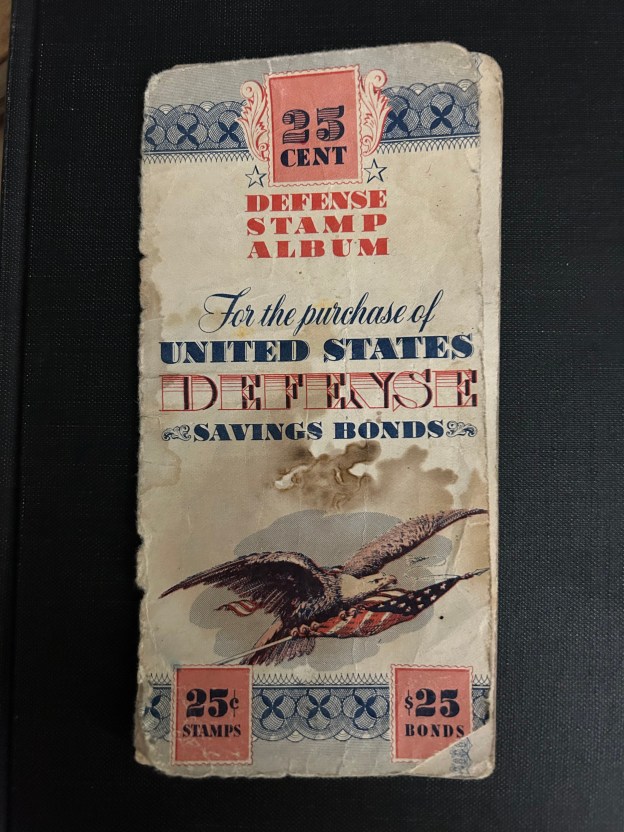
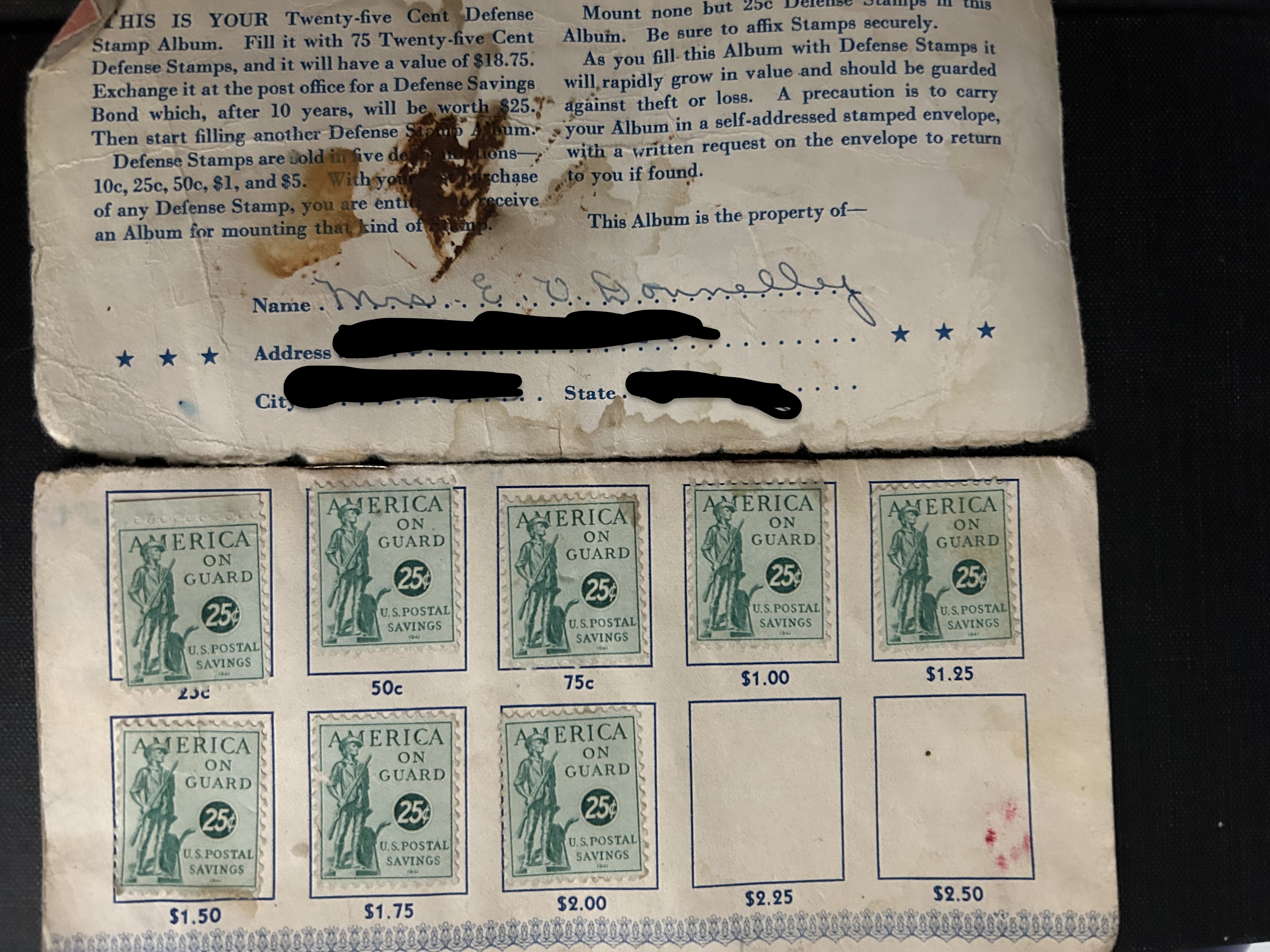
One of these artifacts that caught my eye was an album of United States Defense Savings Bond Stamps dating from likely 1942. These were printed for civilians to purchase and collect 25¢ stamps which they could then turn in after the war at their local post office for savings bonds which could then accrue value over time. My great-grandmother Ruth Donnelly bought this stamp album when she was living in Glendale, Arizona where my great-grandfather was stationed when the Imperial Japanese Navy attacked Pearl Harbor. He was a cavalryman, just a few years out of Rockhurst College, my alma mater as well. When the war began, the U.S. Army decided to not send the cavalry overseas with their horses, seeing how poorly the Polish Cavalry fared against the German Wehrmacht in 1939, and being too tall to serve in the tank corps he was reassigned to the infantry.

I’ve often wondered what it was like for my Donnelly great-grandparents when he was away in the Army during both World War II and Korea. When I used to volunteer at the Kansas City Irish Center at its old location in the lower level of Union Station, I’d often find myself in that grand old building later in the evening and would walk up into the great hall and think about them there when he deployed. That was during my high school years when the Afghanistan and Iraq Wars were at their height and reports & stories of deployments, reunions, and the planes returning fallen servicemen and women were a frequent fixture on NPR and on the morning & evening news.

Of all the artifacts that we recovered then, I decided it would be good to see if I could turn in the stamps my great-grandmother, or G.G. as my cousins & I called her, for anything today. Surely, over 80 years they would have gained some monetary value. My first stop was to my local bank branch, where I took them to the counter and with a smile explained my unusual visit. The tellers who were working that afternoon gathered at the window to look at the album, having never seen its kind before. One read the fine print and suggested that I needed to go to the local post office first and see if the Postal Service still would collect these stamp albums in exchange for savings bonds. After all, if the coins and bills of the U.S. Dollar don’t expire, then why should this stamp album that could be exchanged for savings bonds expire?[1]

With this in mind, I drove from my bank branch to the nearest post office and joined the queue. The postal clerk there was just as surprised to see this album as the bank tellers were. She had never seen an album like this before and suggested I should go to the Kansas City Main Post Office at Union Station where there might be some veteran postal workers who would have possibly exchanged these albums for savings bonds near the turn of the millennium. That made sense to me, and following the trail further I drove downtown to Union Station. At the moment there is a major exhibition from the Walt Disney Company honoring the studio’s centenary, so Disney music is echoing from the loudspeakers all around the building where once they would have announced arriving and departing trains. The Main Post Office moved about 20 years ago across Pershing Road to its current place in Union Station after the old post office building was converted into the Kansas City IRS regional offices.

My last visit to the Main Post Office for more than just buying stamps or dropping off letters was in the hot summer of 2012 when I got my passport photo taken there. It was at the same time that the Opening Ceremonies of the Summer Olympics were underway in London, though they weren’t televised live in the U.S., instead being shown in primetime later on NBC. I always laugh when I look at that passport photo: I wore a suit and tie and between the over-exposure of the image and the buckets of sweat on my face I looked quite silly.

This visit to the Main Post Office was greeted by the same voice of surprise from the clerk as the three other people who I’d taken this album to so far. I explained what I knew about it, that it was likely 80 to 82 years old, and that I wanted to see if the stamps inside could be exchanged for savings bonds still. I opened it to show the clerk that my G.G. had only collected $2 worth of stamps, so it wasn’t a full album. He wasn’t sure what was the best answer and retreated to the offices behind the counter, returning a few minutes later with the name, address, and phone number of a stamp auction house in town that I could consult for a better answer.In short, I could not exchange these stamps for savings bonds anymore. The people who would know how to do that were long since retired from the Postal Service. After three stops, I was ready to hear this, and returned home, where I called the auction house and spoke with its owner. He explained that these stamps have some collectable value, but nothing of any real significance. At the end of the day, while the capitalist in me was disappointed, I was overall pleased with the result of this research. I called my grandmother to tell her the news, saying that this stamp album would make a nice keepsake for future generations to find again, and if this Wednesday Blog is also lost, to research again. Who knows, maybe in another century it might end up on Antiques Roadshow.[2]


[1] United States Federal Reserve FAQs, accessed 27 August 2024. https://www.federalreserve.gov/faqs/currency_12768.htm#:~:text=No%2C%20you%20do%20not%20have,of%20when%20it%20was%20issued.

[2] I hope the set decoration of that show still keeps that eternal 1980s & 90s feel in the 2120s.


On Exploration

This week, some words on two books about exploration that I’ve read this summer: Hampton Sides’s The Wide Wide Sea, and Michael Palin’s Erebus. — Click here to support the Wednesday Blog: https://www.patreon.com/sthosdkane


This week, some words on two books about exploration that I’ve read this summer: Hampton Sides’s The Wide Wide Sea, and Michael Palin’s Erebus.


I may well be one of a few millennials who regularly watch CBS Sunday Morning. I remember finding it a comforting and calming way to start Sunday when I was little, and now that they publish the stories from each week’s broadcast on YouTube, I tend to watch the program there. So, in April I was excited to see a storyabout Captain Cook was airing on the program. It was an interview with Hampton Sides, an award winning non-fiction writer whose new book The Wide Wide Sea tells the story of Cook’s third and final voyage into the Pacific which left England just days after the thirteen of Britain’s American colonies declared their independence, only returning home again four years later. On this voyage, Cook’s ships the HMS Resolution and HMS Discovery became the first European ships to reach the Hawaiian Islands, where Cook would meet his own demise in February 1779.

I’ve been fascinated by Cook’s voyages for a long time now; his was one of the great explorers whose names I’ve known since childhood. The notion of exploration is intrinsic to our American culture, as a settler society, and Cook’s third voyage was the last time that any of our countrymen participated on a British voyage of exploration as British subjects. Sides makes note that Dr. Benjamin Franklin lobbied his colleagues to provide Cook’s expedition special immunity, and if needed to provide them with safe passage as they conducted their business for the betterment of the scientific knowledge of all humanity. Cook’s voyages have a troubling legacy as they were the forebearers of the later colonists, merchants, and missionaries whose ships soon plied the waters of the Pacific from Arctic to Antarctic. We can learn a great deal then from Cook’s expeditions in how best to interact with other worlds, and what to avoid doing.

I started reading this book on my flight in June from San Francisco to London; I knew I wanted to bring this book with me even though it’s quite large and heavy, there was something about it that struck me as fitting for this trip. I began referring to it as the “Captain Cook Book” with the pun fully intended and when not watching Citizen Kane and The Donut King on that 11 hour flight I opened Hampton Sides’s new book and took in the story of the last full measure of one of the great explorers of the last age of exploration.

When I arrived in London, I tried to visit museums that I hadn’t walked through on my last trip in October. One of these was my old favorite, the National Maritime Museum in Greenwich. When I lived in the British capital in 2015 and 2016, I often would wander southeast towards Greenwich and take in the baroque architecture of the Old Royal Naval College, now the University of Greenwich, and explore the National Maritime Museum’s exhibits on the colonial and exploratory history of the British. This time, I was surprised to find the museum under renovation, and so the main entrance that faces toward the Thames was closed. Instead, I entered through the back of the building. Yet where I was left wanting more in past visits, this time I was pleasantly surprised at how the galleries were set up to tell the story of Britian’s maritime past. I acknowledged the portraits of Cook in the ground-floor Pacific gallery; yet I was more thrilled to see several uniform coats worn by Lord Nelson, including the coat he wore on his last day at the Battle of Trafalgar in 1805. Even more so, I loved seeing relics from the British Antarctic and Arctic expeditions which included Cook’s third voyage.

The Arctic held an appeal for British navigators because they hoped they might find the fabled Northwest Passage above the top of North America, which would be a quicker route for ships to reach China and Japan without passing through the Spanish and Portuguese controlled waters of South America and the fearsome currents and winds of Cape Horn on Tierra del Fuego at the bottom of South America. Martin Frobisher’s three expeditions to the Arctic between 1576 and 1578 were among the first English voyages to the region in search of the famed passage. Frobisher is known to have brought with him the 1557 second French edition of André Thevet’s Les Singularitez de la France Antarctique and Thomas Hacket’s 1568 English translation of that book The New Founde Worlde, or Antartike on at least one of his Arctic voyages. This, dear reader, is the book that I’ve translated as The Singularties of France Antarctique. (More there to come).

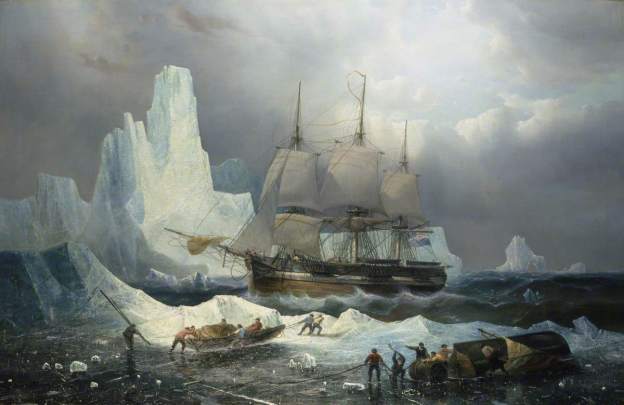
With the Arctic and Antarctic on my mind as I finished my tour of the galleries, I wandered into the gift shop, as one does, and saw they had copies of Michael Palin’s book Erebus, a history of the HMS Erebus which sailed to within both polar circles in the 1830s and 1840s only to disappear in the Arctic ice in the mid-1840s under the command of Sir John Franklin. When this book was first published in 2018, I remember being intimidated by the subject: I knew about the Erebus and her sister-ship the HMS Terror, yet in my mind this sounded more like a history written as a horror novel than anything else, and I’m not one for horror. So, I waited until this sighting of it to buy a copy. I started reading it later that afternoon while taking the Elizabeth line from Canary Wharf back into Central London to Bond Street and was immediately engrossed in the story.

There’s something funny to me about the settings where I start reading books: they become as much a part of my experience and memory of reading those books as the stories themselves. I began reading Judith Herrin’s history of Byzantium on the DLR in mid-summer 2016, and to this day when I glance at it on my shelves or when I’ve taught about Constantinople and the Eastern Roman Empire, I will think not only of that book but also of the DLR elevated line going into Tower Gateway station. In this instance, Palin’s Erebus is connected for me with the darkened-purple hue of the lighting in that Elizabeth line train as we rushed beneath Central London toward the West End.

Now with both books in hand, I proceeded to change my strategy for how I’d read them: I decided that as long as the course which Cook took between 1776 and 1779 mirrored the course that James Clark Ross, captain of the Erebus on its Antarctic expedition between 1839 and 1843, I would go back and forth between each book chapter-by-chapter. That lasted until about Tasmania, where the Erebus first encountered Sir John Franklin, then Lieutenant Governor of the colony, and where Cook and his men had a jolly shore leave before their monumental and historic crossing of the Pacific. What struck me most was how similar these stories felt despite the 70 year gap between their visits to Tasmania. By the time Ross and his crew arrived in Hobart in August 1840, sails were beginning to give way to steam as the main propulsion of ships, and when Erebuswas refitted for its Arctic expedition under Sir John Franklin in 1845, the ship was given an engine from a steam locomotive from the London and Greenwich Railway to help propel it forward into the polar north.

After the two books diverged in their stories I set aside Michael Palin’s Erebus for a while until I finished Hampton Sides’s The Wide Wide Sea, wanting to experience his retelling of Cook’s third voyage in its fatal fullness before reading Palin’s retelling of Franklin’s fateful and more mysterious Arctic expedition. This happened around the 16th of July, a mere six days after Hampton Sides gave a talk here in Kansas City about The Wide Wide Sea. As I switched gears from Cook to Franklin, I listened to as many podcasts as I could find about Cook’s third voyage from our local NPR interview with Hampton Sides in conjunction with his talk, to Melvyn Bragg’s episode of In Our Time from BBC Radio 4 about Captain Cook.

I then picked up Michael Palin’s book again and set off with him in the wake of the Erebus and Terror on their voyage north past the Orkneys and Greenland and into the Canadian Arctic. I came into these chapters with a different sort of prior knowledge about this expedition. On 2 September 2014, the CCGS Sir Wilfrid Laurier, a Canadian icebreaker, sent north by Parks Canada to search for the lost Erebus and Terror discovered one of the ships which a month later was confirmed to be Erebus. I remembered just before moving to London watching an episode of NOVA on PBS about the search, which after reading another article about this expedition in either National Geographic or Smithsonian earlier this year I watched again. So, now instead of a horror-themed history book, I found Palin’s chapters about the Arctic expedition to be a familiar and tragic history of an expedition gone awry.

It struck me in particular that the majority of the last section of his book is devoted to the aftermath of Erebusand Terror’s disappearance entering Baffin Bay in August 1845. Palin told the story as it was uncovered by British and American expeditions sent north to find the lost ships in the 1840s, 50s, and 60s. From all that I’ve read and watched about this voyage, it is likely that we will learn more of what truly happened to ErebusTerror, and their crews in the coming years as more evidence is found in Nunavut, the Canadian territory in whose waters the ships sank.

There is something to be said for how my fascination for exploration has informed my professional life. While I style myself a historian of Renaissance natural history, I am equally focused on exploration, for it was the explorers whose eyewitness accounts first described the animals about which I write. I’ve even considered trying out a voyage of my own just to see what an oceanic crossing by sail is like. What brings both of these books into being in my imagination is that both authors have experienced the places they’re describing and have spent copious time in the archives and libraries and talking to people connected even across the generations to those whose experiences they seek to describe. They truly bring these stories to life. They allow the reader to explore a world now fading, and perhaps even to see how close we are today to Cook, Ross, Franklin, and all their fellow explorers who lived in centuries now gone.


Two Cities

This week, a few words about the trip I just completed to London and Paris. — Click here to support the Wednesday Blog: https://www.patreon.com/sthosdkane


This week, a few words about the trip I just completed to London and Paris.


If there’s anywhere in Europe, I’ve visited more than anywhere else it’s London and Paris. 

When I was eight my Mom took me on a two week tour of those two cities which I found to be life changing for how they opened my eyes to a far wider world than what I’d previously known. My fascination for European history began on that trip; it’s a fascination that I’ve made into my career. I remember that February she put a “Learn French” cassette tape on while our family was driving through the hills of northwestern Illinois from Chicago to visit relatives at Mount Carmel, the Motherhouse of the Sisters of Charity of the Blessed Virgin Mary in Dubuque. I still think of that evening, watching the sunset over those hills, as the moment when I was first introduced to French, a language that I have come to define a great deal of my brand as a historian, writer, and translator by.

I remember thinking after our return from Paris in June 2001 that before that trip when I thought of what I was most excited about it was the Space Shuttle, dinosaurs, cowboys, and American history. Yet after that trip, while still thrilled by these things they still felt dulled somewhat by a new passion for medieval castles and far older history than what we had in our young republic. What’s funny to me about this is that these same thoughts returned in the days before I left for Europe. While normally Memorial Day wouldn’t have as much of an impact upon me, I think it’s pairing this year with the 80th anniversary of D-Day left me far more profoundly moved with pride in our republic, and what our people have accomplished across these generations. I returned to Europe then in much the same mindset that I had when I first visited London and Paris 23 years before, albeit with those 23 years of experience framing my thoughts.

London remains a home-away-from-home for me, having lived there for a time. Some of the optimism I remember feeling in that city in 2015 and early 2016 seemed to be renewed, if slightly, by the prospect of the upcoming General Election which will likely see a change in the governing party for the first time since 2010. I arrived there not entirely wanting to cross the Atlantic on June 6th. I always feel a hint of fear when I travel, especially overseas; this has been magnified since the pandemic when international borders were closed and for years afterward travel remained severely limited. The thought of being stranded somewhere away from my family leaves me shuddering, and has given me more pause when considering travel since 2020. Still, the flights, trains, lodgings, and some museum visits booked, I left home on the morning of June 6th and flew west to San Francisco, where I caught my transatlantic flight on United to Heathrow.

Why go west to go east? I tend to use my miles to fly international, and it was 30,000 miles cheaper to fly through San Francisco than my usual connections in Chicago, Newark, or Washington, or even through Toronto on Air Canada. Like last time, I felt a renewed sense of welcome when I arrived in London, and throughout my stay with friends in the Home Counties, I knew that this remained a place where I could build myself a home if the opportunity or need arose. One key difference from my last trip in October was that I was less concerned with visiting every single place I wanted to see from my time living there. I didn’t feel that desperation or passion to see and do everything that I’ve long known. Rather, I was content to be there again, and to enjoy what I was able to see and do. I prioritized seeing special exhibits at the museums alongside the permanent collections and was thrilled to visit the Tropical Modernism Architecture and Independence exhibit at the V&A, an exhibit on birds at the Natural History Museum, and two exhibits at the British Museum. 

The first of the British Museum exhibitions spoke to the initial field of study I wanted to pursue after finishing my MA in International Relations and Democratic Politics at the University of Westminster. It followed the life of a Roman legionary during the reign of Trajan, and provided a full introduction to the legions and auxiliaries of the Roman Army during the height of the Empire. In 2016, when I chose to return to History from Political Science, I wanted to study the expansion of Roman citizenship to provincial subjects either after the Social War during the late Republic or during the reign of Caracalla when in 212 CE the emperor extended citizenship to all free men in the Roman Empire. That initial interest eventually led me to where I am today studying the natural history of the Americas in the Renaissance, by admittedly a circuitous route. The second British Museum exhibition was closer to what I study today in its chronology as it covers the life and works of Michelangelo Buonarroti (1475–1564). It was inspiring to see his own self-portrait gazing out at us visitors, and to see his letters and sonnets in his own hand on paper there in the exhibit gallery.

After a weekend in London, I traveled south to Paris for a conference on collecting in early modernity that was held at the École des Hautes Études en Sciences Sociales (the School for Advanced Studies in the Social Sciences) in their building on Boulevard Raspail in the 6th Arrondissement. The building in question is important in the historical profession as it is where the French Annales school has been based since 1947, the Annalistes being quite influential in introducing new methods and theories of studying history to the profession globally in the postwar years. There, I presented my research into the provenance of two Tupinambá ritual artifacts today housed in the Musée du Quai Branly, also in Paris, which were likely brought to France by André Thevet in 1556 as gifts from the Tupinambá leader Quoniambec (d. 1555).

I’d intended to use the majority of my time in Paris to work in the various departments of the Bibliothèque nationale de France and Archives nationales to look at some sources I didn’t have online access to, but instead in the months leading up to the trip I was able to find and request several of these documents be emailed to me, while others were restricted due to their poor physical condition. As a result, I only viewed one document, Thevet’s 1553 French translation of the Travels of Benjamin of Tudela, a 12th century Sephardic traveler who toured the Mediterranean. I spent a lovely morning sitting in the ornate Department of Manuscripts in the BNF Richelieu site reading and photographing Thevet’s translation. It was the first time I’d ever seen Thevet’s handwriting in person and gotten somewhat of an unscientific sense of the man himself between the lines. Looking at the folios, I had a sense of familiarity in a man who started with elegant pen-strokes which with each turn of the page became quicker and impatient. The last significant work that I wrote out by hand, a play I wrote in 2011 titled The Poet and the Lamb, had the same feel to it. I enjoyed writing it by hand, but it proved to be more of a burden than the art I intended it to be when I eventually typed it all out after all.

My theory is that considering Thevet took the time to translate Tudela’s travels into French, all 56 folios (112 pages) of it, that he likely modeled his own Mediterranean travel account La Cosmographie de Levant and his later Atlantic travel account Les Singularitez de la France Antarctique on aspects of Tudela’s work. I found my efforts at reading his Tudela translation were aided by my deep knowledge of the Singularitez, which I’ve translated into English. Thevet has a particular style and verbiage that you get to know after translating an entire book of his, a project that for the first draft alone took me three years to complete.

Without any other archival visits scheduled, I spent the rest of the week enjoying a few days of life in Paris. I visited several museums each day, wandered about the city from bakery to bakery (it’s not just a joke I tell about the bakery crawl being my favorite type of walk), and looking around bookshops selling both general titles, specialized academic titles, and several antique bookshops selling volumes largely published in the 18thand 19th centuries, though there were several I browsed through printed in the 17th century.

All around, this was a pleasant trip. When I returned home to the United States on Bloomsday, the holiday commemorating Leopold Bloom’s day about Dublin on 16 June 1904, I was left with an unsettling feeling that both in climate and in history that I fit in better in Europe than in America. For one, none of the muscular or joint pains I often feel walking around Kansas City are present when walking similar distances in either London or Paris. For another, the pace of life and the dearth of car dependency is certainly better all-around than how we’ve built our cities and lives here in the United States. I’d happily take the bus around town at home, if the temperature dropped below 90ºF (32ºC) during the day, and if the bus schedule worked with my own.

In these two cities I’ve grown to become much of the guy who I am today. This was my sixth visit to Paris, and a return to an old hometown of mine in London once again. In them, to draw the Dickens analogy out further, I’ve seen some of the best of times, and yes some of the worst of times, yet I’ve learned now to go with the flow, to not worry too much, and to embrace the opportunity to travel to these places. Travelling has made our world far smaller than ever before, so that the 4,500 miles (7,242 km) between Kansas City and Paris seem not as far as it really is. After all, before aviation it would’ve taken close to 10 days to travel between these two cities, whereas now it’ll take only a day.


Leadership

I've long wondered about what kind of leader I want to be. This week a coalescing of those ponderings. — Click here to support the Wednesday Blog: https://www.patreon.com/sthosdkane


I’ve long wondered about what kind of leader I want to be. This week a coalescing of those ponderings.


Leadership is one of the great qualities which we yearn for today, particularly in this country agreement among our leaders on the same basic principles of democracy and integrity. We seek the same fundamental truths even while truth is far more diffuse a concept than ever before. To take the first step towards this restoration we need to begin talking to each other again and really work towards rebuilding our mutual understanding of who we are and what we want out of our Union.

Throughout my life I’ve looked up to certain types of leaders: a citizen like Abraham Lincoln, a unifier like Eleanor Roosevelt, and a servant like Pope Francis. Each of these figures took their own stands in their own circumstances of time and place and worked to their own ends, and in some respects they were successful. 

I’ve been humbled to serve as a leader at varying moments and in several capacities and my own efforts are often rewarded by how I can connect with the people around me. I make a point of working with people, of listening to their ideas and trying to incorporate them into something all of us working together can be proud of.

Today then, I want to present to you a paper that I wrote at the end of my time as a Master’s Student at the University of Missouri-Kansas City in November and December of 2018. I presented this paper “Erasmus’s Enchiridion militis Christiani and the Humanist Knight in early-sixteenth-century England” at the American Catholic Historical Association’s 2019 annual meeting, co-current with the American Historical Association conference at the old Stevens Hotel, now the Hilton, on South Michigan Avenue in Chicago on Friday, 4 January 2019. I hope this offers two visions of leadership from the Renaissance, one rooted in Erasmus’s Christian Humanism which hearkens towards the social justice-rooted morality of my own Catholicism, and from the realpolitik of Niccolò Machiavelli in his timeless book The Prince.


Erasmus’s Enchirdion militis Christiani (The Handbook of the Christian Knight) was one of the most popular books of its day in Western and Central Europe; translated into eight languages between 1519 and 1542. Its most popular and widely disseminated edition was that published by Johann Froben in Basel in 1518. The Enchiridion‘s enduring popularity throughout the first half of the sixteenth century is a testament to its relevance at a time when Europe was witnessing tremendous social and religious upheaval through the Reformations of Luther, Calvin, and Henry VIII. The Enchiridion was intended to be a guide for Europe’s many princes, kings, and lesser lords on how to be good moral rulers, how to be “soldiers of Christ” as the title states. Through this role as a guide for good governance, the Enchiridion can be seen as a Christian Humanist equivalent to Machiavelli’s The Prince as a guide in Renaissance political philosophy. In considering the Enchiridion‘s role as a book of political philosophy, this study will consider both the 1518 Froben edition[1], and the 1523 Alnwick manuscript[2], the earliest known English translation of the Enchiridion, from which all quotes derive.

Originally written in 1502, the Enchiridion was said to be inspired by an unpleasant evening that Erasmus experienced in the castle of a knight recorded as “John the German.”[3] The knight’s wife begged Erasmus to write a treatise offering her husband guidance on better manners, thus resulting in the Enchiridion.[4] While the Enchiridion was first published in 1503 by Maartens in Antwerp[5] it did not achieve widespread fame until its first publication by Froben in 1515.[6] The Enchiridion‘s philosophical inspirations come from a number of different sources, both Biblical and Classical, from Moses, Solomon, and David to Julius Caesar and his nephew Augustus to the heroes of the Iliad and the Aeneid. While this work takes great influence from Platonic philosophy, it nevertheless bathes Platonism in a deep bath of Christian theology before allowing it to enter into the main work.

As a work of Christian Humanism, the Enchiridion contains a thorough retelling of the many morality stories found in the Bible. It appears, through the wording of the Biblical quotes in Froben’s Latin edition, that Erasmus used his own revised translation of the New Testament throughout the Enchiridion, which had been published by Froben in its most widely read form in 1516.[7] Nevertheless, Erasmus draws just as heavily from the Old Testament, looking at Moses, David, and Solomon as good and worthy models for the Christian knight of his day. For Erasmus, a Christian ruler should follow closely the teachings of the Church and its Old Testament forbearers. Countering Machiavelli’s view that the two safest manners for a prince to control a population is to either “destroy them or reside there,”[8] Erasmus argued that it is a “grete obomynation … if a man forsake his fynge or theiss lorde [Christ].”[9] For Erasmus, temporal power was secondary to spiritual wellbeing, arguing later in the same chapter of the Enchiridion that the death of the soul is far more consequential than the death of the body, as the death of the soul “is extreme misery,”[10] even greater than bodily death. The key difference here is that Machiavelli wrote as a politician, while Erasmus set his words to paper as a theologian. 

The disparity between the political realities of early sixteenth century Italy and the theological expectations on morality at the same time are stark. Erasmus’s chief concern is the wellbeing of the soul, while Machiavelli’s is the accumulation of power and its subsequent preservation. Erasmus’s knight is a moralist, while Machiavelli’s prince is a pragmatist. Yet where Machiavelli’s vision of rulership is often shown as a testament to the various leaders in Italy during the Italian Wars, Erasmus’s shows the theological ideal of a Christian Humanist ruler, akin in character to Plato’s philosopher kings who should rule in a conjunction between “political power and philosophical intelligence.”[11] Both Erasmus and Machiavelli reference Moses as fine examples of leadership, the former spending the first chapter of his Enchiridion discussing Moses’s role as leader of the Hebrews and his loyalty to God’s will and light[12], while Machiavelli names Moses alongside Cyrus, Romulus, and Theseus as “the most excellent”[13] of princes. While Machiavelli considered striking Moses from this list because he was “a mere executor of things, that were made ordained by God,”[14] and thus less a prince in his own right and more a vassal for a Higher Power, he nevertheless respected Moses’s leadership of the Hebrews and saw him as an equal to Cyrus, Romulus, and Theseus through his deliverance of the Hebrews out of slavery.[15]

Erasmus’s Enchiridion makes great use of Platonic philosophy, referring back to the Athenian academic’s teachings time and again in his work. Erasmus noted in the fifth chapter of his Enchiridion, entitled “Off the dyusitue of affeccions” that Plato and the later Stoics both saw  “philosophy to be nothing else but a remembrance of Deth.”[16] Interestingly, in Froben’s 1518 Latin edition this line reads, “with nothing else [Plato] thinks Philosophy however to be a meditation of death.”[17] The differences in meaning between the words remembrance and meditation is striking. While they are synonyms, the former appears to have changed in meaning over the centuries, becoming today a manner of meditation about a person or event that takes place only after that person has died, while a meditation can happen when they are still living. For the translator of the Alnwick Manuscript, this difference does not appear to have been as profound, and by and large it would appear that, at least in that translator’s eyes, remembrance and meditation are a good pair of cognates. 

Machiavelli’s text looks at death as an inevitability and in many cases a means to an end, especially for men who “forget more quickly the death of the father than the loss of their inheritance.”[18] In Machiavelli’s view, while the living may mourn the dead, they celebrate in the riches left behind by the deceased and seek to improve their own fortunes off of the demise of their fathers. Machiavelli accepts that this degree of swift respect for the dead is tantamount to theft, yet he dismisses any degree of moral ambiguity by noting how common and easy the practice can be, writing, “it is always easy to find cause to take away property,” and “anyone who lives by theft will always find reasons to occupy the things of others.”[19] For Erasmus, death is a moment of great spiritual significance, one to be taken seriously in securing the sanctity of one’s soul; yet for Machiavelli, death is a moment of great personal significance, one to be taken seriously in securing one’s fortune and power from the deceased, whether they be one’s father or another.

If philosophy is merely a meditation on death, as Erasmus argued, then what is life but a march towards that inevitable fate and, if one is fortuitous enough, Heaven, which “is promysed to hym that fighteth swftely.”[20]The Humanist Knight, therefore, should strive to fight their battles with speed, and in doing so keeps in mind the prospect of eternal life in Heaven, and end the suffering of those whom they are fighting sooner. Fighting should only be a last resort, as the Humanist Knight should consider their moral and spiritual wellbeing before taking up arms against another. The promise of Heavenly reward drives the Humanist Knight, sending them into their world with the purpose of ensuring their own moral wellbeing and salvation. One’s soul should be “refresshed with manna from heven and with water that kame oute of the harde Rock,”[21] consuming the heavenly donation and fortifying oneself so that “neither strength neither hie / nor lowe : nor no other Creature shall seperat us from the love of god which is Christ [Jesus].”[22] In this sense, Erasmus argued that the rewards of mortal riches and conquests should not come before the spiritual rewards awaiting the Humanist Knight, faithful to Christ, in Heaven.

In contrast, Machiavelli argued in favor of prolonged war, if only to secure a prince’s authority over their own people and supremacy over their adversaries. A prolonged war, according to Machiavelli, is sometimes necessary to secure the authority of the prince against threats both foreign and domestic, and while one might lose some territory, or even some cities, as in the case of Philip V of Macedon, yet the loss of a few cities ranks lower as a threat to the stability and security of a prince’s power.[23] For Machiavelli, Philip V was a strong leader because he acted when others would have passively watched as events unfolded in front of them. He stands as a good example of the Machiavellian prince, as he was willing to make sacrifices of his cities and territories, their populations included, in order to preserve his power. In contrast, for Machiavelli a bad prince is one who loses “their principalities after so many years of rulership not because of fortune but because of their own sloth.”[24] The Machiavellian prince is an active ruler, directing their supporters on the ground with a tenacity that is matched in the Humanist Knight by the latter’s desire to ensure the purity of their soul, despite the devilish business of the titular Enchiridion, not only a handbook but also a hand dagger.

Both the Machiavellian Prince and the Humanist Knight have agency, the chief difference is in how they use it. For the Prince, their agency is best utilized through the fortifying of oneself and one’s possessions to weather any future assaults or other attempts at threatening the Prince’s standing. The Prince acts only to ensure the stability of their power and its continued vitality, standing on one’s own two feet rather than with the support of another. As Machiavelli wrote, the only sure way to preserve one’s power is through one’s own “virtue” or “power”, depending on the translation.[25] The use of the word virtù for both “virtue” and “power” in Italian is striking, showing the intense relationship between one’s morality and one’s authority. With virtue and power standing hand-in-hand, Machiavelli’s perspective comes clearer to light. He is writing not just as a pragmatist, but also as a political veteran of his times, advising princes how to seek virtue, much like Erasmus’s advice to the Humanist Knight, only Machiavelli’s idea of virtue is clothed in the unstable trappings of the Italian Wars that raged throughout his life and deeply affected the world of the Italian city states.

For Erasmus, virtue comes from God, and is shared by all humanity; thus, Erasmus writes to the Humanist Knight “thow shalt be able to do all thing in the power of God”[26] but in order to do this the Knight must “take hede that thow be a member of the body”[27] It is interesting here that the Alnwick manuscript translator of the Enchiridion does not conjugate thow shalt be as thow shalt art or thow shalt beest as was used in some dialects of Early Modern English. This particular pair of lines in the Alnwick manuscript do not match exactly the Latin in Froben’s edition, where in English the Knight can do all things “in the power of God” in Latin they will be able to achieve the same “in capite”, who is identified in the previous sentence as Christ. Two points can be taken from this, firstly that Early Modern English verb conjugations inherited the structures of their Germanic roots, moving the conjugation onto the modifiers as in German and Old English. Thus, the verb appears as thow shalt be rather than thow shall art, which mirrors this verb’s Modern descendant you should be. Secondly, the translator of the Alnwick manuscript rephrased and adapted the text to fit the expectations of an English-speaking audience, especially when translating from a language with more fluid word order like Latin to one with strict rules like English.

The relationship between the Humanist Knight and the Machiavellian Prince shows the diverging perspectives of Renaissance Humanists on both sides of the Alps. Whereas Italy was embroiled in war between rival city states supported by distant powers, fueling the pragmatic political philosophy of The Prince, the political structures of Northern Europe remained largely stable, with the old kings, princes, and magnates ruling over the continent. Erasmus’s Humanist Knight seeks power, but only through the blessing and support of God. Thus, the Humanist Knight must remain a moral and upright person, standing firm in the warm glow of God’s grace. While the Prince believes he will find victory through his own exploits and prowess as both a politician in the government of his principality, and as a commander on the battlefield, the Knight believes that victory is “putt hole in the handes of God and by hym in our handes.”[28] The greatest difference between the Knight and the Prince is their understanding of virtue. For the Knight this comes from God’s favor of one’s good deeds, while for the Prince it results from political stability. 

What can be seen in Erasmus’s Enchiridion and Machiavelli’s Prince are two very different views of the role of the ruler and the source of that ruler’s power. This reflects the differing political situations between Italy and Northern Europe in the early sixteenth century, when both authors were writing. Furthermore, when translated into English in the form of the Alnwick manuscript, the Enchiridion offers the modern reader not only an idea of what the ideal knight was for Erasmus and the manuscript’s translator through the translator’s interpretation of Erasmus, but also an image of the role of the faith in the promulgation of Humanist values amongst the English gentry and aristocracy in the first decades of the sixteenth century.


Thank you for bearing with an admittedly unusual Wednesday Blog this week. This idea began somewhat differently than it ended. I hope to return to this topic of leadership again and write about Pope Francis’s vision of the servant leader which I find quite compelling.


[1] Desiderius Erasmus, Enchiridion militis Christiani cum alijs quoru[m] Catalogum pagellae, (Basel: Johann Froben, 1518), http://www.mdz-nbn-resolving.de/urn/resolver.pl?urn=urn:nbn:de:bvb:12-bsb10164787-8.

[2] “A compendus tretis of the sowdear of Christ called enchiridion which Erasmus Roteradame wrote unto a certen courtear & Frende of his,” [1523], Additional Manuscripts, 89149, British Library, London.

[3] Anne M. O’Donnell, S.N.D., “Rhetoric and Style in Erasmus’s Enchiridion militis Christiani,” Studies in Philology, Vol. 77, No. 1: (Winter 1980), 26-49, at 30.

[4] Brian Moynahan, William Tyndale: If God spare my Life: A Story of Martyrdom, Betrayal, and the English Bible, (London: Abacus, 2003), 26-27.

[5] Judith Rice Henderson, “Language, Race, and Church Reform: Erasmus’ ‘De recta pronuntiatione’ and ‘Ciceronianus’, Renaissance and Reformation / Renaissance et Réforme, Vol. 30, No. 2: (Spring / Printemps 2006), pp. 3-42, at 8.

[6] Diane Shaw, “A Study of the Collaboration Between Erasmus of Rotterdam and His Printer Johann Froben at Basel During the Years 1514 to 1527,” Erasmus of Rotterdam Society Yearbook, Vol. 6: (1986), pp. 31-124, at 35.

[7] Erasmus, Novum Instrumentum omne, (Basel: Johann Froben, 1516), http://www.mdz-nbn-resolving.de/urn/resolver.pl?urn=urn:nbn:de:bvb:12-bsb11059002-1.

[8] Niccolò Machiavelli, Il libro del principe, (Florence: Bernardo di Giunta, 1532), 7a, http://catalogue.bnf.fr/ark:/12148/bpt6k852526w; the original Italian reads “tal che la più sicura a via è, spegnerle, ó habitarvi.”

[9] “A compendus tretis of the sowdear of Christ called enchiridion which Erasmus Roteradame wrote unto a certen courtear & Frende of his,” [1523], Additional Manuscripts, 89149 f.3v (1:140-141), British Library, London. In the Latin, “Quantus pudor, quanta penè publica humani generis execratio, cum à duce principe deficit homo?”

[10] “A compendus tretis,” BL Add. MS 89149 f.5v (1:235-6). In Froben’s Latin edition this reads as “At animam mori, infelicitatis extremæ est,” Erasmus, Enchiridion militis Christiani, (Basel: Froben, 1518), 6.

[11] Plato, Republic 5.473d in Plato in Twelve Volumes, Vols. 5 & 6 trans. Paul Shorey, (Cambridge, MA: Harvard University Press; London, William Heinemann Ltd., 1969) in the original Greek, δύναμίς τε πολιτική καὶ φιλοσοφία.

[12] “A compendus tretis,” BL Add. MS 89149 f.1v-f.9r (1:1-397); Froben’s: Enchiridion, 1-9.

[13] Machiavelli, Il libro del principe, 7b, “li più eccellenti.”

[14] Machiavelli, “E benché di Moisè non si debbe ragionare, essendo stato un’mero esecutore delle cose, che gli erano ordinate da Dio.”

[15] Machiavelli, “Era adunque necessario à Moise trovare il Popolo d’Israel in Egitto schiano, et opresso da gli Egittii: accioche quelli, per usare di servitù, se disponessino à seguirlo.”

[16] “A compendus tretis,” BL Add. MS 89149 f.28v (5:39-41)

[17] Froben’s Enchiridion, 30, “cum nihil aliud putat esse Philosophiam, cumque mortis meditationinem.”

[18] Machiavelli, Il libro del principe, 26a, “per che gli huomini dimenticano più tosto la morte del padre, che la perdita del patrimonio.”

[19] Machiavelli, “Di poi le cagioni del torre la robba non macono mai,” and “e sempre colui, che comincia à vivere con rapina, truova cagioni d’occupare quel d’altri.”

[20] “A compendus tretis,” BL Add. MS 89149 f.5r (1:208); Froben’s Enchiridion, 5, “Cœlum promittitur strenue pugnanti.

[21] Machiavelli, f.10v (2:114-115); Froben’s Enchiridion, 12, “quam esset manna cœlesti, et aqua de petra scatente refectus.”

[22] Machiavelli, f.18v (2:554-556); Froben’s Enchiridion, 20, neque fortitudoneque altitudo, neque pfundum, neque cretura alia, poterit nos se parare à charitate dei, quæ est in Christo Iesu.” This is a quote from Romans 8:38-39. The Greek original reads οὔτε δυνάμεις, οὔτε ὔφωμα, οὔτε βάθος οὔτε τις κτίσις ἐτέρα δυνήσεται ἠμᾶς χωρίσαι ἀπὸ ἀγάπης τοῦ θεοῦ τῆς ἐν Χριστῶ Ἰησοῦ. The Vulgate and Erasmus’s Novum Instrumentum differ in their translations of the Greek, in the Vulgate, neque fortitudoneque altitudo, neque profundum, neque cretura alia poterit nos separare a caritate Dei, quæ est in Christo Jesu” while in Erasmus’s NIOneque futuraneque altitudo, neque profunditas, neque ulla cretura alia, poterit nos separe a dilectione dei, quæ en in Christo Iesu”. The NASB translates this verse as “… nor powers, 39 nor height, nor depth, nor any other created thing, will be able to separate us from the love of God, which is Christ Jesus…” The NIO leaves out neque fortitudo, jumping from neque futura to neque altitudo.

[23] Machiavelli, Il libro del principe, 38.

[24] Machiavelli, “Per tanto questi nostri Principi; i quali molti anni erano sta ti nel loro Principato, per haverlo di poi perso; non accusino la fortuna, ma la ignavia loro.”

[25] Machiavelli, Il libro del principe, 38b, “Et quelle difese solamente sono buone, certe, et durabili; che dipendono da te proprio, et da la virtù tua.” 

[26] “A compendus tretis,” BL Add. MS 89149 f.8r (1:367); Froben’s Enchiridion, 9, “et omnia poteris in capite.”

[27] BL Add. MS 89149 f.8r (1:366); Froben’s Enchiridion, 9, “Tu modo cura ut sis in corpore.”

[28] “A compendus tretis,” BL Add. MS 89149 f.8r (1:373); Froben’s Enchiridion, 9, neuticibus à fortuna pendeat victoriased eaomnis in manu sita sit deiac per eum nostris quoquibus in manibus.”