Tag Archives: History

Living Memory

This week, a consideration of how memories survive as stories. — Click here to support the Wednesday Blog: https://www.patreon.com/sthosdkane

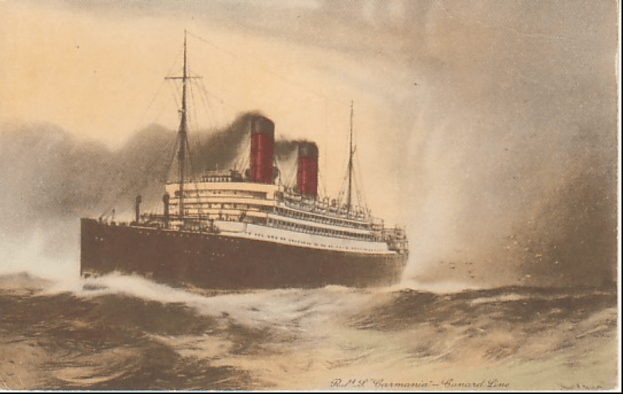
The Header Image on this Week’s Post is of the RMS Carmania, which carried my great-grandfather to America in April 1914.

A few weeks ago, when I visited Mount Carmel Bluffs and the Motherhouse of the Sisters of Charity of the Blessed Virgin Mary (known more commonly as the BVMs) in Dubuque, Iowa I was struck at how even though it had been 8 years since my last visit and 14 years since the last time I was there for a family funeral, the memory of those relatives, my great-aunt Sr. Therese Kane in particular, still lived on in the sisters who came up to us throughout the day telling stories of times now long past and all the people they knew who lived in those moments. It had been so long since I’d seen Sr. Therese that it felt strange to still call her “Sister” as we all did in the Kane family when she lived.

That visit to Dubuque was in honor of Sister and my grandfather’s cousin, Sr. Mary Jo Keane, who died in April only a few weeks after having moved into her community’s retirement facility called Mount Carmel Bluffs. At her wake I noted to the attending sisters, relatives, and friends that she was one of the very last in my family who knew her parents’ generation who came to Chicago from County Mayo in the first half of the last century. Moreover, she was the very last person living who attended my great-grandfather Kane’s funeral in 1941, the last one who could tell some of the stories she heard as a child of life in Mayo at the end of centuries of colonial rule.

At Sister’s funeral lunch in 2009 I remember hearing Sr. Mary Jo, my grandfather, and their cousin Fr. Bill McNulty telling these stories about their parents, some of which I had never heard before then, of how hard it was for them to come to America, and of the trouble they faced in Ireland that led to their immigration. Some of these stories were still in the air at Sr. Mary Jo’s funeral lunch, told by my cousin Rosemary, yet as that first generation born in America leaves us so too their stories begin to fade away.

In the last week I slowly began to acknowledge the news of the lost submersible Titan which left St. John’s in Newfoundland for the wreck of the RMS Titanic and upon its descent beneath the surface was never seen again. At first, I acknowledged it was happening yet didn’t pay the story much heed, yet as my parents began to give it more attention and talk about it over dinner, I slowly started paying attention more. The Titan‘s mission to take tourists down to the remains of the Titanic 2.5 miles (3.8 km) beneath the surface of the North Atlantic is as much an act of nostalgia as any pilgrimage or historical tour can be. For $250,000 passengers were brought to the ocean floor to see the great ship as it rests slowly decaying away with the passage of time. I’ll admit the idea of seeing it for myself is intriguing, though even before the Titan was reported lost at sea, I doubt I’d ever take that opportunity to visit the Titanic.

One disaster resulted from fascination in another disaster. The sinking of the Titanic is a curious event for me because it is just on the horizon of what I consider recent events to my own life. Many of the last survivors––who themselves were old enough to remember the event––died around the time I was born, 80 years after the ship sank into the cold North Atlantic. What’s more, the generation of young immigrants in their 20s and 30s who left Ireland for America at the time of its sinking included my Kane great-grandparents who arrived in this country in 1914 and 1920 respectively. The Titanic followed the same course that my great-grandfather’s ship the RMS Carmania sailed between Cobh (then called Queenstown) and New York two years later in April 1914, and there is a point in my mind where it’s clear that had circumstances been different, had he sailed at age 20 instead of age 22, he very well could’ve been on the Titanic.

It’s always been strange to me to talk with people for whom recent memory is far shorter. When I started teaching at Binghamton University I expected my students, all New Yorkers, would have more vivid memories of 9/11 or perhaps had families who were directly involved, yet these students could tell me little about it, saying they were either too young or had not been born yet when the attacks took place 22 years ago. I think to my own early childhood, to my understanding of world events as the happened right before my birth in December 1992, and I at least have known a fair deal about events like the 1992 Presidential Election or the Fall of the Soviet Union in August 1991 for most of my life. I thank an insatiable curiosity and old Saturday Night Live re-runs for much of what I know about those events. Still, for most of my childhood memories of people who lived in the nineteenth century persisted, and so for me my great-grandfather Thomas Kane, who died 51 years before I was born, feels today closer than might be expected of someone who was born 100 years before me.

On Monday night this week I found myself diving deep down rabbit holes reading about Titanic survivors. It’s rather morbid to say that someone’s sole distinction is that they’re the last Titanic survivor of a certain demographic, that’s certainly something I’d have trouble being proud of. My reading led me to the story of an Englishwoman named Millvina Dean, who was a 9-week old infant at the time of the sinking, who was on her way to Kansas City with her parents to start a new life here on the prairies. 

The Washington Post reported in 1997 on the completion of her long voyage when “85 years after setting out for Kansas City” she finally arrived here to meet cousins long separated by the waters of the Atlantic. The article in question mentioned where her uncle who the Dean family was planning on staying with lived, on Harrison Street, leading me to old city directories to see where on Harrison. The most likely address is at the corner of Harrison St. and Armour Blvd. on the eastern side of Midtown near where many of my maternal Donnelly relatives lived in the 1910s. Ms. Dean herself died in May 2009, I remember reading about her death when it happened; and on the centenary of the sinking of the Titanic, I noticed the date come and go. There was a story that weekend on CBS This Morning, yet for me the main emotion was a strange feeling of an event which had always been there in the edge of memory of the people I knew fading ever further into the distance, less a lived event that my relatives read about in the papers when it happened and more a historical event.

In time all our lives will reach that threshold, our memories recorded will survive as relics of people, places, and moments long past, and those that were only spoken or thought yet never written down will fade away. There is so much I wish I knew about the immigrant generation in my family, I’ve seen pictures, heard stories, been told I look like my great-grandfather Kane in a striking way, yet beyond those things I’ve never really known them. We are fortunate in our time to have so many audio and video recordings of our world, to an extent that our memories will hopefully survive long after we are all gone. The democratization of these technologies is a gift, it means that when future generations want to yearn for the early 21st century they will have the cornucopia of our recorded memories to relive. For older generations, we are left with visions of the past defined by movies, talking and silent alike, which the New York Times columnist Maureen Dowd wrote about this week, her own father almost boarded the Titanic on his Atlantic Crossing from Ireland. Like the French anthropologist Claude Lévi-Strauss seeking the most remote of peoples in Brazil, to get an idea of what first contact was like in 1500, we are left with less recognition of the spirit behind these historical events the further they move away from us, until in a tragic ending to our story they are ancient history to us.
Doctoral Study

Photo by Ricardo Esquivel on Pexels.com

I was 27 when I arrived here in Binghamton at the start of August 2019. I made a big move out here, with immense help from my parents, and set up shop in a good-sized one bedroom apartment that’s remained my sanctuary in this part of the country ever since. I’d wanted to continue my education up to the PhD since my high school days, and it’s a plan I’ve stuck with through thick and thin. After a false start in my first attempt to apply to PhD programs in 2016, which led to two wonderful years working on a second master’s in History at the University of Missouri-Kansas City (UMKC), I applied again, now far better positioned for a PhD program and ended up here through the good graces and friendly insight of several people to whom I’m quite grateful.

Arriving in Binghamton though I found the place very cold and quite lonely. In recent months I’ve begun to think more and more about getting rid of some of my social media accounts only to then remember that Facebook, Instagram, and Twitter were some of my greatest lines of communication with friends and family back home in Kansas City and elsewhere around the globe throughout these last three years. That first semester was tough, very tough, and while the second semester seemed to get off to a good start it was marked by the sudden arrival of the Coronavirus Pandemic and the end of my expectations for these years in Binghamton. 

I spent about half of 2020 and 2021 at home in Kansas City, surrounded by family and finding more and more things to love about my adopted hometown with each passing day. When I was in Binghamton it was to work, in Fall 2020 to complete my coursework and in Spring 2021 to prepare for my Comprehensive Exam and Dissertation Prospectus defense. I still did a good deal of the prospectus work at home rather than here, though the memories of those snowy early months of 2021 reading for the comps here at this desk where I am now always come to mind when I’m in this room.

As the Pandemic began to lessen in Fall 2021 and into the start of this year, I found myself in Binghamton at a more regular pace. There was something nice about that, sure I wanted to be home with my family, but I also felt like I was getting a part of the college experience of going away for a few years to study that was reminiscent of the year I spent working on my first MA at the University of Westminster in London. I started to venture further afield in the Northeast again, traveling to Boston, New York, Philadelphia, Baltimore, and Washington again. When I first decided to come here one of the things, I decided was I’d take the opportunity of being in the Northeast to see as much of this region as possible.

2022 saw another transition, I wasn’t in one of the newer cohorts in my department anymore. Now, in Fall 2022 I’m one of the senior graduate students. It’s a weird thing to consider, seeing as it felt like 2020 and 2021 evaded the usual social life of the history graduate students here, thanks to the ongoing pandemic. I also began to look more seriously at my future, applying for jobs in cities across this country, and even looking again at some professorships, something I doubted for a while would be an option for me. If there’s anything about life that I’ve learned over the past three years spent here, it’s that you always need to have things beyond your work to look forward to. Whether that be a long walk in the woods on the weekends or a day trip to somewhere nearby, or even the latest episode of your favorite show in the evenings. Doing this job without having a life beyond it is draining. 

For me the best times here in Binghamton were in Fall 2021 and Spring 2022 when I truly began to feel like I had a place here that I’d made my own. I was confident in my work, happy with how my TA duties were going, and really enjoying my free time as I began to spend my Friday evenings up at the Kopernik Observatory and Sundays at the Newman House, the Catholic chapel just off campus. I was constantly reading for fun as well, something I’d lost in 2020, even falling behind with the monthly issues of my favorite magazines National Geographic and Smithsonian. There were many weeknights I’d spend out having dinner alone reading natural history, science fiction, anthropology, and astronomy books. 

It’s interesting looking back on myself from six years ago when I was in London, the months that summer when I decided I wanted to get back into history after a year studying political science. My motivations were to earn a job working at one of the great museums I’d spent countless hours in during that year in the British capital. While I studied for my MA in International Relations and Democratic Politics, I was still spending my free time looking at Greek and Roman statuary and wandering the halls of Hampton Court or watching the hours of history documentaries on BBC 4 in the evenings. And now that I’m back in History as much as I do appreciate and love what I do, I find my free time taken up by science documentaries and books.

It’s important if you do want to get your PhD in the humanities and social sciences to figure out why it is you want to do this before you start. Have a plan in mind, have a big research question in mind, and focus your attentions onto that question. My own story has many twists and turns from an interest in my early 20s in democratic politics to a brief dalliance with late republican Roman history before settling into the world of English Catholics during the Reformation. I ended up where I am today because of another series of events that led me to moving from the English Reformation to the French Reformation, and from studying education to natural history. So, here I am, a historian of the development of the natural history of Brazil between 1550 and 1590, specifically focusing on three-toed sloths. In a way there are echoes of all the work I’ve done to date in what I’m doing now, thus as particular as this topic is it makes sense in the course of my life as a scholar.

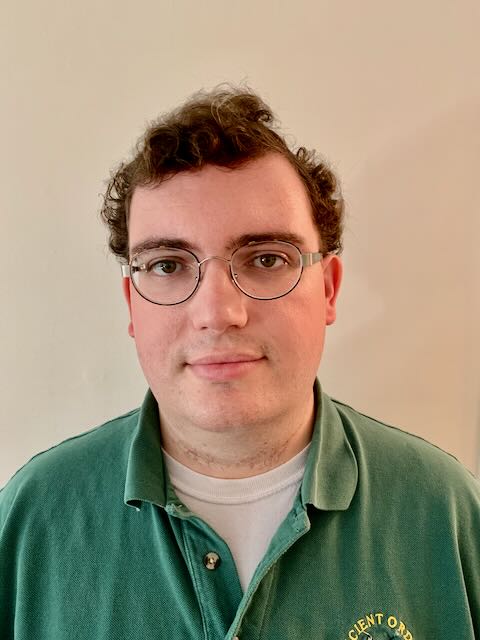
A month from now will be my 30th birthday, a weird thing to write let alone say aloud. My twenties have been a time of exploration of both the world around me and of myself. When I look at my photo on my Binghamton ID card, the best way to describe my appearance would be grumpy yet optimistic. Just as I was a decade ago, a sophomore in college, so now I am today, looking ahead to the next decade with excited anticipation of what it’ll bring, and hopeful that all the work I’ve done in this decade will find its reward in the next.

Me upon arrival in Binghamton, August 2019.

The Puzzle of the Source Material used by my Primary Sources

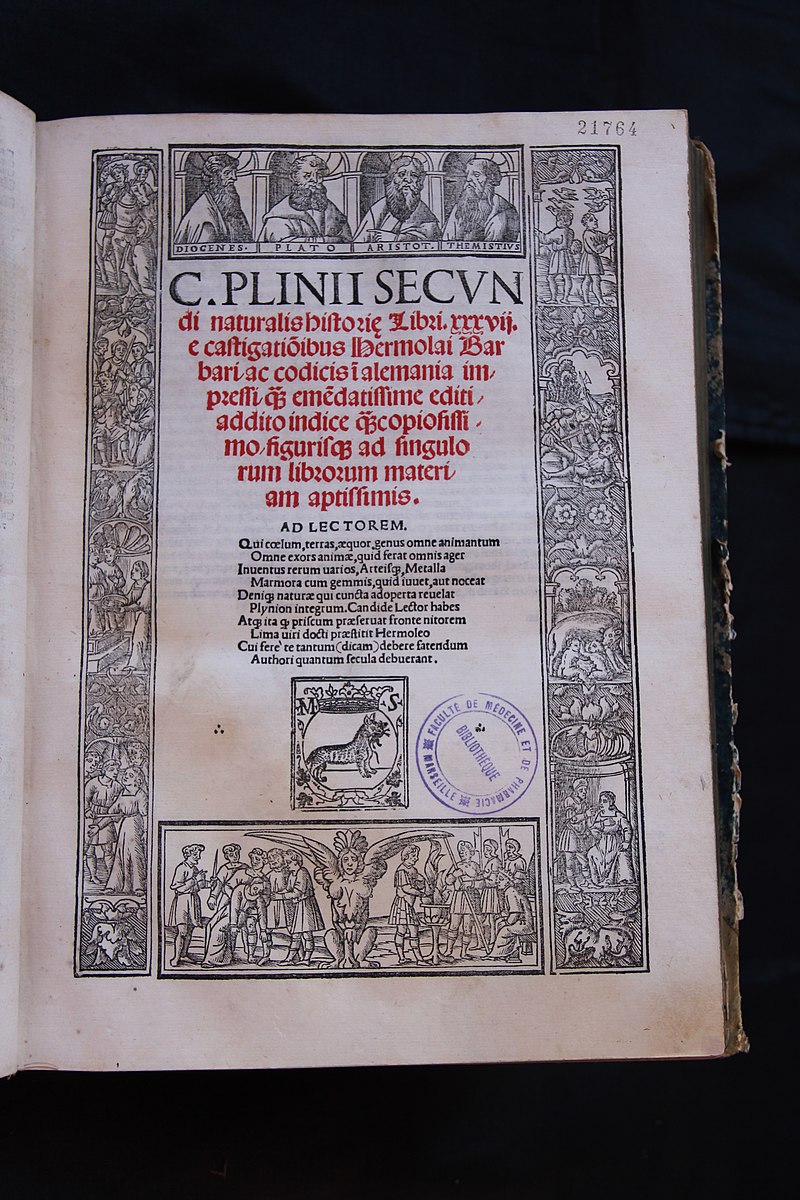
Title page of Pliny’s Natural History. Source: Wikimedia Commons, uploaded by user LDove (2018).

This is a rare blog post that deals directly with my day job. For those of you who aren’t aware, I’m currently a PhD Student in History at Binghamton University. I study sixteenth century French natural history discussing Brazil, drawing particularly from the works of André Thevet (1516–1590) and Jean de Léry (1536–1613). As such, my main primary sources are pretty straightforward: Thevet’s Les Singularitez de la France Antarctique (1557) and Cosmographie Universelle (1575) and Léry’s Histoire d’un voyage fait en la terre du Brésil (1578) form the backbone of my work. But beyond those sources is another layer of source material that those two authors used to ground their own writing. In the case of natural history, Renaissance Natural History is largely founded on Pliny’s Natural History (published 77–79 CE) and Aristotle’s works on natural philosophy and zoology, in particular his History of Animals (4th c. BCE).

Thankfully, I came into this project already fairly familiar with Pliny, having used his Natural History in a project on classical geography and the legacy of the voyages of Pytheas of Massalia (c. 350–306 BCE) in my undergrad. I’ll admit I’m less familiar with Aristotle outside of his works on ethics, but luckily for me and all other scholars there are plenty of resources available today that can give you everything from a quick citation to a thorough discussion of Aristotle. My two favorite are the Loeb Classical Library side-by-side Greek-English translations and the Perseus database provided by Tufts University. These are often the best resources I’ve found, and have in a sense made buying copies of these classical texts unnecessary, which my budget appreciates.

That said, in the context of Renaissance Natural History how much should I really be using these twentieth and twenty-first century editions of these classical sources? If I really want to be accurate to the period I’m writing about, I ought to be using sixteenth-century editions of both authors. The easiest and most accurate way to do this would be to figure out which editions were used by my authors and look for copies of those that have been digitized and are available online. But more often than not it’s not that easy to figure out which editions exactly were used. The secondary literature about Renaissance editions of Pliny and Aristotle provide some clues as to how the early printed editions differ from our modern edited ones, both in the original languages and in translation, but those articles and books don’t quite take the runner to home plate.

The best guide then seems to be using the examples and patterns set by other books that I know for sure were owned and read by these authors and use those to guess at which editions of Pliny and Aristotle they would most likely have known. One good lead for Thevet at least appears to be the fact that he had a connection to the court of François I (r. 1515–1547) who like Thevet came from the provincial city of Angoulême. This means if there’s a specific edition noted as being present in François I’s library, then that might be a good lead to follow to see what Thevet was reading. Looking at the nine books known to have been owned by Thevet, curiously all of them were in French, none in Latin. Generally, I’ve taken this to mean that he probably preferred to read in his native language, so he may have preferred a French translation of both Pliny and Aristotle rather than reading editions in Latin and Greek.

At the end of the day as much as I see a profound benefit in using these sixteenth-century editions of Pliny and Aristotle to really establish my research in the natural history being written in the Late Renaissance, I’m still going to keep my modern edited versions of those same classical works handy. After all, they’re much easier to search than any sixteenth-century version, so if anything the modern editions will continue to prove to be good road maps to help me navigate through their centuries old forbearers.

Rhyme Time

Taken on the grounds of Dover Castle, 14 May 2016

My fellow regular daily viewers of Jeopardy, that classic American TV game show, hosted until earlier this year by the legendary and dearly missed Alex Trebek, will no doubt recognize the title of this post. I admit, it’s an homage of sorts to that daily bread which my parents and I partake in five days a week around dinner time. I love how the Jeopardy clue writers play with English, and occasionally other languages, in their clues, the twists and turns, even the multipart answers that often I tend to have trouble with.

This post isn’t about Jeopardy, however, but instead is about rhymes in time. My old boss, Dr. Becky Davis, at UMKC, to whom I am deeply grateful, often used the old Mark Twain quote, “History doesn’t repeat itself, it rhymes” (or something to that effect) to help contextualize how themes seem to reappear throughout history, especially American history. I’ve found that to be a handy way of thinking about history, and our place in it, because as odd as it may sound there are certain times in history that do seem to me to rhyme with our own. There are moments in the past that seem far more familiar than others, far more relatable than others.

Consequently, those tend to be moments well documented among my fellow academic historians; they’re the popular topics of the day. I wasn’t always interested in being a Renaissance Europeanist and Atlanticist (yeah, those are real words), I kind of settled into these fields out of a combination of circumstance and curiosity. Luckily, neither has killed this cat yet.1 I looked into a pretty wide range of historical fields before settling on this one. They included late republican Rome, early medieval Ireland, late medieval England, Renaissance England (my MA thesis), early Stuart England, Georgian London, Dutch colonial New Amsterdam, French Upper Louisiana (aka Missouri), the First French Empire (aka Napoleonic France), (1804–1815), France under the July Monarchy (1830–1848), the history of Baseball, Old Hollywood, and the history of the US restaurant industry. As one of my friends said, I’m interested in too many things for my own good.

Of those considered fields, I do see clear rhyme times with our present moment in a couple, most notably with Georgian Britain, and the late eighteenth century in general. Our social narrative seems to have taken itself to a similar moment where we are at Robert Frost’s diverging two roads. One could take us towards progress, towards addressing our societal ills, the other toward likely political instability and society becoming fed up with the gridlock resulting likely in revolution.

Like Georgian Britain, we live in a highly class-conscious society, one where wealth defines much. Like Georgian Britain, our society has come to value profit over welfare, the maintained power of the few over the well-being of the many. Like Georgian Britain, just as in late republican Rome, a vast majority feel unheard by the ruling big wigs. We’ve seen divergent camps of the unheard, the have nots to borrow a term from a later early Victorian writer of note, who have adopted varying messages and manifestos born out of similar fears and troubles.

Times are not the only things that rhyme: often, I’ve found, our ideas, our hopes, and especially our troubles have a tendency to rhyme as well. Let’s talk about those rhymes, because there’s a chance that beyond the demographics that often divide us are commonalities that could well unite us. Maybe that’ll take us down the better road, the one that’ll benefit everyone. After all, no one of us can walk down it without the rest of us carried along. We will rise together, or we will fall together. It’s up to us to heed our rhymes.

Notes

1 Meow

Why We Need Explorers

I’ve always loved the idea of exploration. I remember on the evening of Sunday, 31 May 2015, I decided to take my dog Noel for a drive down State Line Road here in Kansas City. We kept going south until the Sun started to set, making it as far as about 300th Street. Lately, during my time in Binghamton this Spring, I made a point of doing some sort of weekend drive into the surrounding countryside, just choosing a cardinal direction and driving until I decided to turn around. I suppose it makes sense then that I’d end up training as a historian of Renaissance explorers and travelers in the Americas.

When I decided to write about this topic rather than another post about grammar (you’re welcome), I started wondering why is it that so many of our history’s greatest explorers and most pivotal encounters happened at times of great social unrest at home? Columbus’s world-defining 1492 voyage launched the most recent great Age of Exploration, which I would say lasted from 1492 to around 1800, 1 yet much of that same period is also characterized by a series of disastrous internal conflicts in Europe collectively known as the Wars of Religion and the later eighteenth century dynastic wars of succession, and the first truly global war, the Seven Years’ War (the French and Indian War here in English-speaking North America). Why would a civilization so focused on its own internal divides, the prejudices and hatreds of its own communities, polities, churches, and states, also want to invest so much time, effort, and capital in exploring places in what were ostensibly other worlds across vast hitherto impassable oceans?

I think one main reason was well expressed by a Bonnie Tyler song, originally from the 1984 film Footloose, that my friends and I happened to lovingly use for the theme tune of our YouTube series The Awesome Alliance (2008–2013), they needed a hero, someone ambitious and daring who was wiling to push the boundaries of what was believed possible and achieve something extraordinary. In these cases, the extraordinary is encountering previously unknown worlds.

I wonder what might have become of a Europe wracked by generations of successive wars, after all, it’s important to remember that many of the continent’s major powers were at war with each other before the Reformation and Wars of Religion began. At that point, the European wars were largely dynastic fights between royal families like the Habsburgs, the Valois, and the Tudors. Naturally then, once the Wars of Religion had generally fallen out of fashion after the disastrous Thirty Years’ War, Europe settled down into a familiar pattern of dynastic warfare, only now between the Habsburgs in Austria and Spain, the Bourbons in France and also in Spain, and Hanoverians in Britain.2

All throughout the sixteenth, seventeenth, and eighteenth centuries, with some very real continuations into the nineteenth and twentieth centuries (here lies another historical debate), explorers traveled from their homes to faraway places. Their travels inspired people to keep looking beyond what was known, to keep pushing the boundaries of knowledge and society. The diversity that characterizes our world today wouldn’t have been possible without the explorers of 500 years ago challenging the mould of their day.

Today, we need to continue to celebrate and fund our explorers, to embrace them. We need their efforts to inspire us to remind us that we can to amazing things. When we reach for the stars as our astronomers and astronauts do, we discover new horizons over which we can glimpse. And when we wander into a new city or country where we might not’ve been before, taken that road less traveled, we meet people who enrich our lives with their stories, their experiences, their memories.

Wherever my next trip takes me, off into some place I may not have been before, I hope it’ll be somewhere exciting, somewhere new. Once we’re past the pandemic, and travel is easier and safer again, I hope to use my time in Binghamton to visit more of the Northeast, to see the Green Mountains of Vermont or to visit Boston again for the first time in 20 years. Maybe, if my timing works out right, I can drive down to the Space Coast in Florida and see one of the Artemis mission launches in 2022 and beyond, and see that new class of astronauts begin their long voyage to establish the first human outpost on the Moon.

Eventually, I hope, we’ll have a new name for the Moon as we discover and settle on many other moons and the planets they orbit. The horizon continues eternally, and while chasing after it might seem quixotic, it only means there’s always another adventure to be had, another place to explore out there.

“Holding out for a Hero,” the “Awesome Alliance” theme song

Notes

1 My fellow historians will no doubt recognize the fertile ground for historiographical debate here. For the sake of the sanity of my readers, I’m going to leave that for a later publication.

2 This is a gross over-simplification of 17th and 18th century European political history, especially coming from someone who’s TAing a class called “Europe Since 1500” at the moment.

The Constancy of the Modern

Embed from Getty Images

If we can learn anything from history, it is that our story has always been acted out and subsequently recorded by people, not unlike us. Each successive generation has done their part to immortalise their greatest tales through stories, both oral and written, into the collective memory of society. As time has passed, each generation of historians has endeavoured to best tell these stories of their predecessors in a way which their own generation can well understand. To the historians of the Renaissance, the millennium immediately proceeding their own time quickly gained the pejorative name the Dark Ages, while its architecture was equally appallingly disparaged as Gothic.

To the Renaissance and subsequent Enlightenment historians, the time to hearken back to with all glory was that of Classical Antiquity, of Greece and Rome. The intervening millennium in between the Fall of Rome in 476 CE and the rebirth of classical learning in the Italian city-states in the late fifteenth century was merely a setback in the onward march of human progress. It was a setback defined by religious fervour and superstition, when science was equated to wizardry and the light of literacy confined to only a select class of clerics and aristocrats.

Each generation of historians has strived to understand the past both in the light of their own times and in the understanding of how those in the past understood themselves. Yet for the analytical nature of the study of history in our present scientifically-centred age to be properly propped up, contemporary historians must continue to classify and divide history into particular periods, places, and categories. Political history must remain distinct from cultural history and social history, while the aforementioned Renaissance must somehow be understood as different from the Medieval period that came before it.

What is most striking is the division of the discipline into broad spans of time, particularly concerning European history. One has a choice of diving deep into the past with Ancient history, a concentration primarily focused upon the Mediterranean world from the earliest communities to the fall of the Western Roman Empire in 476 CE. Or perhaps one would prefer to study Medieval History, focusing on Europe during the ten centuries between the aforementioned fall of the Western Roman Empire and the eventual fall of the Eastern Roman Empire in 1453.

Or, if that does not suit one’s fancy, one could try one’s hand at Early Modern History, covering the period of time between the turn of the sixteenth century to the French Revolution. While modern, this period still has its fair share of the medieval about it to make it more remote. Then there are the modernists, those whose focus is squarely on recent European history, the stuff that has happened since the fall of the Ancien Régime in 1792 and the rise of modern European liberal democracy through the nineteenth and twentieth centuries.

What this model of understanding European history is founded on is the old Renaissance understanding that Europe will always be dominated by the legacy of Rome; therefore all European history must be understood in relation to the glories of the Roman Empire. The medieval is a giant leap backwards in the ruins of the once great imperial edifice, while the rise of modernity marks the return of European society to its former Roman glory. The other thing that this model is focused on is we modern man. Since it was first devised in the seventeenth century, this understanding of history has always held modernity as the pinnacle of human achievement, at least to that point.

The term modern itself comes from the Late Latin modernus, an adjectival modification of the Classical Latin adverb modo, meaning “just now.” Modernus in turn developed into the Middle French moderne by the fourteenth century, indicating that something similar to our understanding of the present time as modern was in use as early as what we would now call the Late Middle Ages. True, to my generation devices like the digital tablet, electric car, or the ability to make videocalls are decidedly modern, our grandparents could equally have said the same fifty years ago for the television, jet airplane, and IBM 7080 computer were equally modern to their own time. Likewise for our great-grandparents the very idea of a subway, car, or airplane on its own was incredibly modern.

The way I see it, the term modern is the hour hand on the clock of time; it is the pointer that marks where we are on the cycle that is human history. Just as Edward III was a modern monarch for his own time so too Elizabeth II is for ours. Likewise, while Geoffrey Chaucer may well have been seen as a modern writer for his day and age, working into the late hours of the night in his rooms within the edifice of London’s Aldgate, so too someone like me is all too modern for my own time. Though I write so often about the past, and do my best to draw connections between what has been and what is present, I cannot help but understand the people, places, and things that have already come and gone through the lens of my own times, of my modernity.

Therefore to define ourselves as modern is not to make us anymore unique than our predecessors. Rather, to do so we not only continue on the legacies of their respective modernities, and write our own story, always utilising this most constant of chronological labels.