Tag Archives: Hope

On Boston

This week, some comments about my trip to Boston last month and reflections on that resilient city.—Click Here to Support the Wednesday Blog: https://www.patreon.com/sthosdkane


This week, some comments about my trip to Boston last month and reflections on that resilient city.


I’ve been to Boston several times now, once in my childhood on a family vacation and twice for work. It’s the furthest of the east coast cities from Kansas City, and in some ways it’s rather hard to get to from here. Yet, the influence of Boston in particular, of Massachusetts in general, and of New England overall is quite pronounced here in the Midwest. When I was in the first semester of my History MA program at the University of Missouri-Kansas City one of my favorite books from the American History Colloquium I took discussed the patterns of westward settlement from the old eastern states during the Early Republic. From this, I learned that the reason why New York and New England felt more familiar to me was in part because it was New Yorkers and New Englanders who settled the parts of Northern Illinois that became the metropolis of my birth, Chicago, as well as many of the original towns in Kansas. One aspect of the Bleeding Kansas conflict of the 1850s, an overture of sorts to the American Civil War of the 1860s, was that Missourians with southern roots found their culture clashed with Kansans who were recently arrived pioneers from the North.

I remember really enjoying my childhood visit to Boston for a great many reasons. We did most all of the touristy things in that city, though I realized later on that we hadn’t visited some of the finer art museums in town like the Museum of Fine Arts or the Isabella Stewart Gardner Museum. That thought rested in the back of my mind for about twenty years until I returned to Boston as a doctoral candidate in October 2021 on a mission to see how the first French published translation of the Odyssey translated the Greek word ­ἄγριοι, which Robert Fagles translated into English as “hard men, savages.”[1] The French translator in question, the sixteenth-century humanist Jacques Pelletier du Mans (1517–1582) rendered ­ἄγριοι as “rude and uncivilized men.”[2] The copy I accessed of this book is housed in Harvard’s Houghton Library, and so I made a trip out of a word-search and found so much to admire about Boston and the surrounding suburbs in the few days I was there.
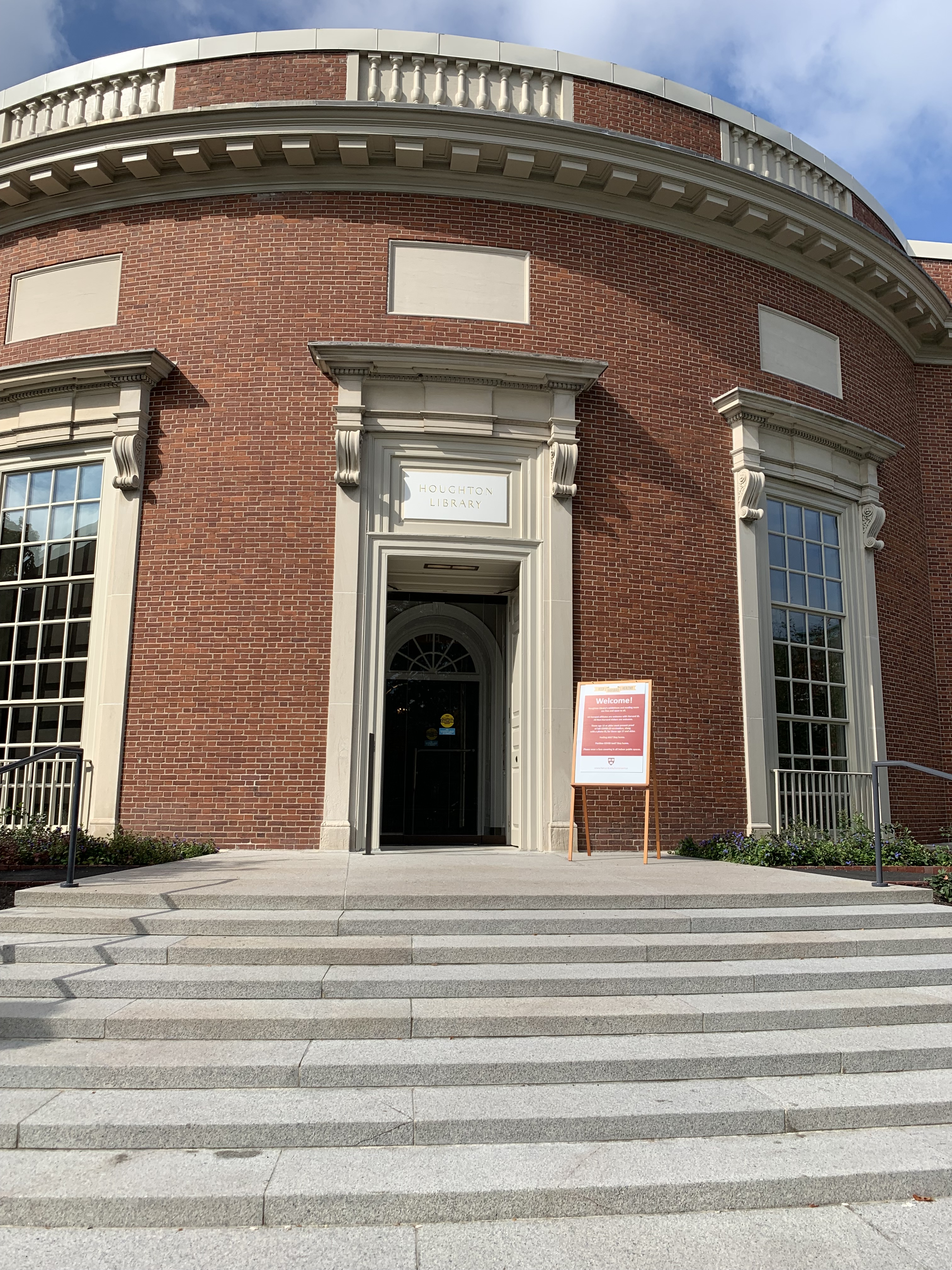
Harvard’s Houghton Library in October 2021

For one, the vintage of that region as one of the great nests of Anglo-American culture has always felt familiar to me, as that is in many respects the roots of my own culture albeit with many more layers of immigrant influence stacked atop it that form my idea of America. When I drove to Boston from Binghamton in October 2021 amid the incandescence of the Fall leaves I kept remarking on the smaller size of so many a Massachusetts village and town each of which was founded in the eighteenth or even seventeenth century. Where towns in Colorado celebrate their altitude and towns across America commend their population, in that Commonwealth each town’s age is celebrated as a mark of pride. My appreciation for this was less driven by an amazement at seeing such old places, I’ve been to many an old city, town, and village in Europe. I’ve even stayed in buildings that were erected 500 years ago like the place I chose in Besançon. What struck me most here was that these old houses were present here in America, in the United States. After all, my homeland in the Midwest has few colonial buildings left for us to mark with signs or commemorate as local landmarks. The French presence was far stronger along the Mississippi south of the Missouri River than in Chicago or Kansas City. Both of my home cities trace their founding to dates after American independence in 1776 and the birth of the republic in 1787.
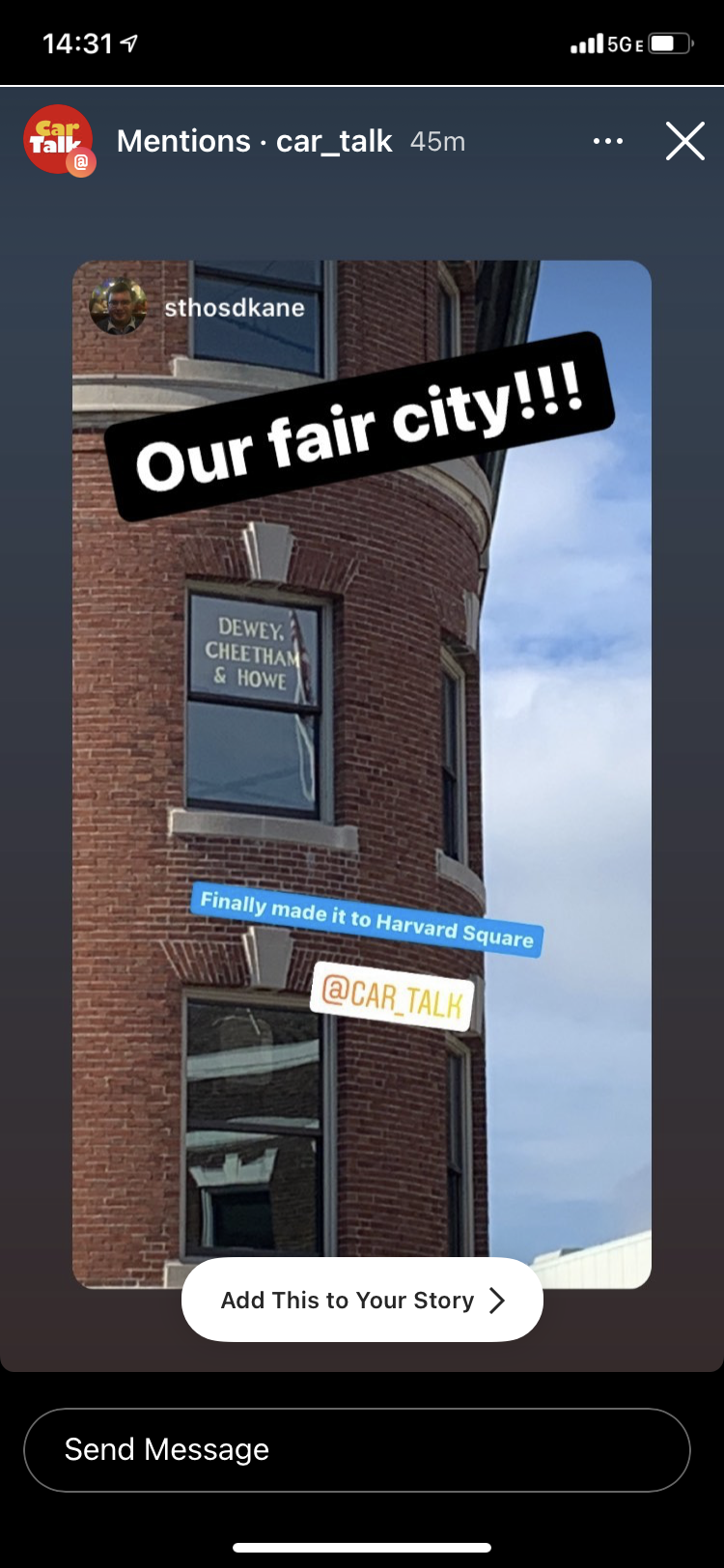
In October 2021, I fulfilled a childhood dream of seeing the Car Talk offices in Harvard Square from street level. Yeah, I’m an NPR nerd.

Where I have seen this fortitude in a city in the middle third of the country is in San Antonio, an old Spanish settlement founded in 1718 at a time when it fit into a world among the vast global empire of the Spanish crown, connected more to the Canary Islands in settler population than to even more distant England or her colonists’ descendants who moved southwest into Texas a century later leading to that region’s independence and later annexation by the United States. The English-inspired east then annexed the Spanish-inspired southwest in the same manner that thirty years earlier it’d purchased the French-inspired Midwest. In this way, I’ve found New England more reminiscent of England itself than of so many other parts of the United States. It shares more of a common culture and history with England, and in many respects remains the child that chose to go its own way when it could and embrace republicanism in contrast to continued English royalism. I’m sure there’s something I could say here about Cromwell, but I’ll leave that particular figure of English colonial ambitions in Ireland for a less sentimental blog post.
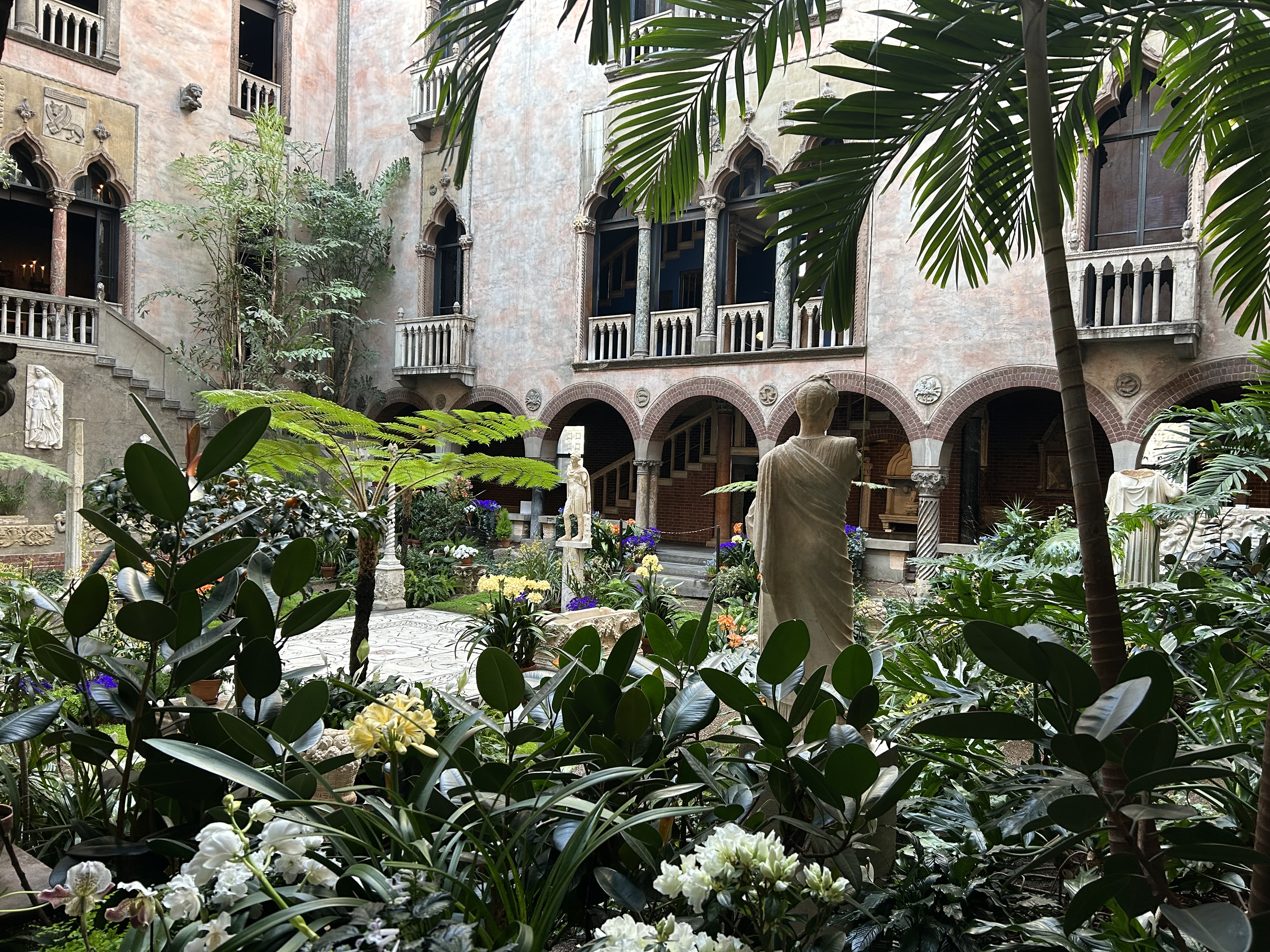
The courtyard garden of the Isabella Stewart Gardner Museum, Boston.

This time, I traveled to Boston to attend the 2025 meeting of the Renaissance Society of America at the Marriott Copley Place in the Back Bay neighborhood to the south of downtown. What’s funny to me is that I don’t remember going anywhere near Copley Square or Back Bay on any of my previous trips to Boston, though I did pass underneath both the square and neighborhood on the Green Line trolley in October 2021 when after completing that wordsearch at Harvard I decided to take the afternoon to visit the Museum of Fine Arts. I remember being impressed by the collection I saw, though I got overwhelmed in some of the galleries and feeling a bit tired after a long day I returned to my friends’ house in the suburbs. On this most recent trip I elected to visit the Isabella Stewart Gardner Museum instead of its neighbor, the Museum of Fine Arts, having heard so much about Ms. Gardner and that museum’s infamous midnight robbery in 1990. I was happy to see how lovely a museum it was, from the garden at the base of its courtyard to the spiraling series of galleries largely unchanged since the museum was built at the turn of the last century. In the museum there is a portrait of Ms. Gardner full of life and joy which was so personal that her husband asked it to remain away from public view until after he died, resulting in the room in which it lives being closed to the public until after his death in 1898. Gardner was friends with many of the American artists of the late nineteenth and early twentieth centuries who I greatly admire, including John Singer Sargent and James McNeill Whistler whose paintings in the Smithsonian’s Freer Gallery of Art in Washington contribute to that gallery being one of my favorites of the Smithsonian Museums.
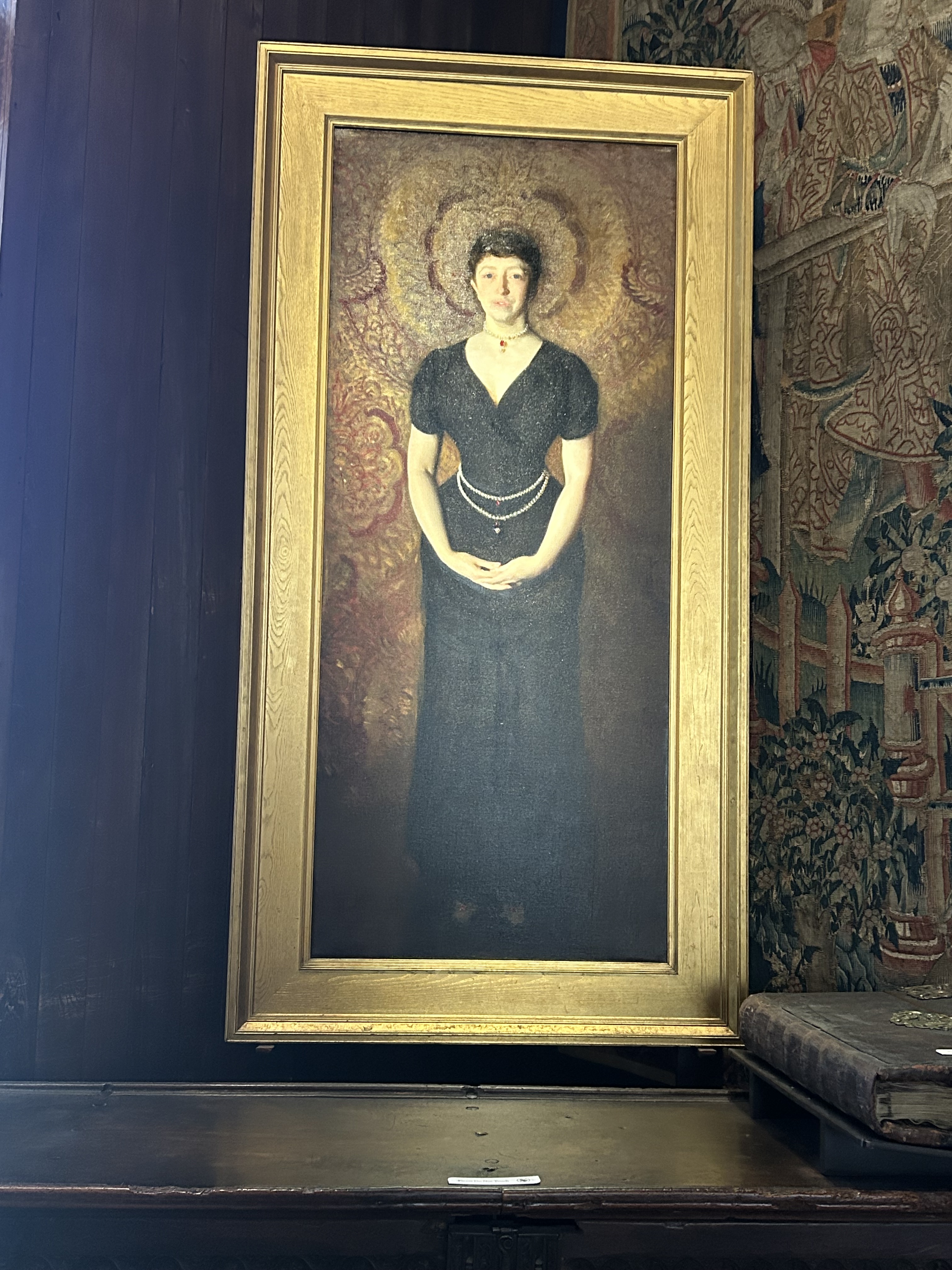
Isabella Stewart Gardner, 1888 painting by John Singer Sargent.

To reach the Gardner Museum meant taking the trolley through the campus of Northeastern University along Huntington Avenue. Over the few days I was in Boston I also visited two other local universities, Harvard to visit their Museum of Natural History and to attend a concert of medieval liturgical music at St. Paul’s in Harvard Square, and UMass Boston to visit the John F. Kennedy Presidential Library right at the end of my trip. What struck me most about this trip, and what filled me with a greater sense of relief and, yes, joy was seeing how many students were out and about in that city. It felt as though the storm clouds that hover over all of us could be held back if even as a reflection on water by a sense of camaraderie that proved elusive only a few days later when the first wave of student deportations swept up a fellow doctoral candidate at Tufts University in that same city. Still, in the days I spent around the students of Boston and among my fellow Renaissance scholars I was struck by how profound that sense of camaraderie was that in spite of the troubles we see around us we are going to chart a course through the ice and out into calmer, open waters again.
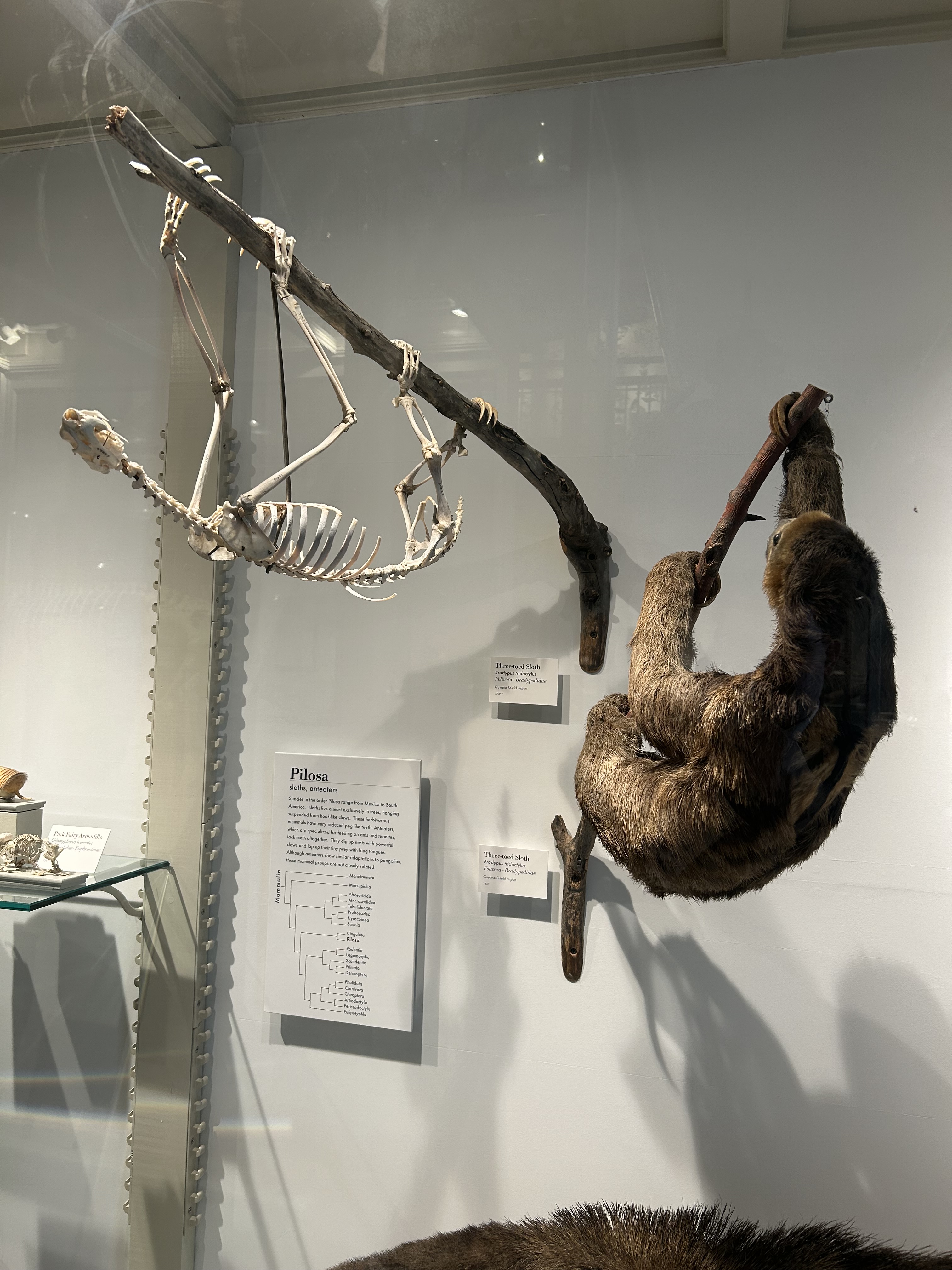
A brown-throated sloth, stuffed, at the Harvard Museum of Natural History

Boston has seen a great many generations live on its headlands and about its bays in these last 395 years since its founding as the capital of the old Massachusetts Bay Colony. In the weeks since, with that trip still fresh in my memory I was reminded of the illustrious revolutionary history of that city and of Massachusetts and the resilience of its people and their peculiar traditions of democracy which have influenced the spread of representative government across this continent through the ideals of the United States and our Constitution. I’m sure it will weather this storm as it has so many before it. Knowing too my own profession, my desire to find a professorship or museum job first and foremost, I suspect I may find my way back to Boston again. After all, not only are there many universities there with healthy endowments, however rare those may become in the years and decades to come, that city remains a vibrant city, a living city, a city that hasn’t carved itself out for sprawl in the way that so many others have. I was struck by how profound that sense of connection and community was there.

Nice place.

The glass atrium at the JFK Library.

[1] Homer, Odyssey 1.230, trans. Robert Fagles, (London: Penguin, 1996), 84.

[2] Homer, Premier et Second Livre de l’Odissée d’Homère, trans. Jacques Pelletier du Mans, (Paris: Claude Gautier, 1571), 10v.

On Democracy

This week, for my birthday I want to write to you about my belief in all of us and how democracy remains our best hope. — Click here to support the Wednesday Blog: https://www.patreon.com/sthosdkane


This week, for my birthday I want to write to you about my belief in all of us and how democracy remains our best hope.


One of those great efforts with which human history is concerned is the question of what our original nature was at our beginning and if and how we have changed that nature. The French anthropologist Claude Lévi-Strauss’s notion of the primitive as “closer to humanity’s origins” and living in a state without the societal and technological innovations “that obscure their nature” evokes this original nature, what in Christianity is called our original sin, or biologically our evolved state as a particular form of bipedal mammals among other lifeforms.[1] The seeming natural state of human societies until very recently has been toward forms of monarchy and aristocracy, the Tory Party in Britain today still refers to itself as the natural party of government because they descend through many generations from the old Cavaliers who supported Charles I and the aristocrats in the Parliaments of the Stuart and Georgian centuries who opposed the liberal reforms of the Whigs. Here in the United States, our own whiggish political tradition sees its modern manifestation in the old establishment wing of the Republican Party, also known as the Grand Old Party or G.O.P., whose founders in the 1850s included former Northern members of the Whig Party once led by our own aristocrats, men like Henry Clay and John Quincy Adams in the early republic.

Yet those same men stood for something beyond just preserving their own aristocratic power within their own society. These American Whigs and their Republican and Democratic successors aspired to a high ideal of human nature that entrusted power in the hands of the many rather than in those of a few or the one. Dr. Heather Cox Richardson recently wrote in her Letters from an American about how the Secessionists who dragged this country into our Civil War in 1860 and 1861 were trying to assert their own aristocratic vision of the republic that would benefit the few at the disregard of most and the expense of the many. As James J. Sheehan reminded us in his essay in the December 2024 issue of Commonweal, Tocqueville wrote that the chief difference between the source of power in an aristocracy or a monarchy, or their corrupted forms oligarchy and a tyranny, and the source of power in a democracy is that “despotism may govern without faith, but liberty cannot.”[2] The despots rely less on our trust in their rule, and in many of the cases we see today they sew discontent in government, the economy, and for all of us with each other in order to assert their authority and keep hold of power. 

Democracy is a far harder thing to keep, as Dr. Franklin knew well. The inclusion of more and more people complicates any organization, yet it also allows that organization to better reflect all involved. Democracy requires the efforts of all of us to survive; if left unwatered and unnourished by each generation it will wither and die like any other flower or fruit on the vine. Throughout my life, I’ve looked to heroes in our history from Lincoln, Mandela, Óscar Romero, Popes Francis and St. John XXIII, to people closer to my own life. What all of them have in common is a desire to improve the lot of humanity, and in the case of Lincoln and Mandela to promote democracy in their homelands. When I look ahead and worry about what might be coming in these next four years, I often wonder if I would be safer, happier, healthier, and living a more fulfilled life elsewhere in another country where I can leave the troubles of my own behind. Yet I remember these heroes, MacDonagh and MacBride, and Connolly and Pearse, my great-grandfathers who fought in the two World Wars, the dreamers and optimists who organized and marched non-violently for civil rights here in America and in Ireland too, and looking again at our own day I pause. This is our time to make life better for our successors while we live to overcome the long winter of fear before us. If I left now, could I look those heroes of mine in the eye when my time ends?

I believe in democracy because it is the best form of government we’ve yet imagined. I believe in representative government because I would rather have a say in my neighborhood, my city, my county, my state, and my country than not. I believe in democracy because I believe in humanity and that all of us can make something better if only we believed in ourselves and in each other. I believe that before that original sin there was original grace, original goodness; that before the first frown there was the first smile; that before the first thoughts of lust there were thoughts of love. I believe in democracy because I need to believe that I will have a future, that all the things which I’ve done in these last 31 years are building up to something which will, in Bill Nye’s words, “change the world,” no matter how small that change may be. To do any of this, to see any of this goodness in our hearts, to believe in ourselves again we need to be willing first to acknowledge our faults and second to forgive ourselves and put in the effort to make our lives better. For all our technology and our ever increasingly complicated ways of life, we are still the same humans as our ancestors living in Lévi-Strauss’s primitive manner. We retain the same bodies and souls. Because of this, we can build a future for our posterity in a spirit of grace, compassion, and optimism that would make the heroes of old proud.


[1] Claude Lévi-Strauss, From Montaigne to Montaigne, trans. Robert Bononno, (Minneapolis: University of Minnesota Press, 2019), 25.

[2] James J. Sheehan, “Democracy and Its Discontents,” Commonweal, December 2024, 13.


On October Baseball

This week, a great celebration commences in our national pastime. — Click here to support the Wednesday Blog: https://www.patreon.com/sthosdkane


This week, a great celebration commences in our national pastime.


Several years ago, near the start of the podcast version of my Wednesday Blog, I wrote two of my favorite stories in this continuing publication of mine about my love for baseball at the beginning of the 2022 season. I seem to remember even playing a poor rendition of Take Me Out to the Ballgame on the digital keyboard provided on GarageBand, where I do all my recording and editing. Don’t worry, I’m not planning on doing that again.

Today, I want to write instead about my joy at how this postseason is beginning. The 2024 season had plenty of potential for my beloved Chicago Cubs and my adopted second-favorite team the Kansas City Royals, and while the Cubs didn’t quite make it far enough to earn a wild card spot, the Royals did in spite of themselves. This is being released on the morning of Game 2 of the Wild Card series, following a 1-0 Royals win in Baltimore against the Orioles. So, should the Royals win again today they will advance to face the Yankees, a matchup that brings to mind the stories my Mom likes to tell of watching the Royals teams of the ‘80s face up against the Bronx Bombers in the American League playoffs.

Meanwhile in the National League the team that excites me the most in these Wild Card series is the San Diego Padres, a perennial favorite of the last four years to win the World Series. Their resounding 4-0 win at home over the Atlanta Braves last night in Game 1 proved to be a good alternative to the Vice Presidential Debate that was occurring at the same time from CBS News’s headquarters in New York. You might think it odd that someone as politically engaged as me would choose to watch a ballgame over a debate, and yes, I started the 8 pm hour watching Governor Walz of Minnesota and Senator Vance of Ohio face off on CBS, but as soon as the first question concerning the increasing odds of war between Israel and Iran occurred, I decided to seek some escapism.

There are a lot of things that we all are worried about today, and with good reason. Whereas for most of my life I’ve looked to the future with eagerness, today I’m scared about the future and what we are doing to ourselves. Over the weekend, I watched an episode of the PBS documentary series In Their Own Words about Jim Henson in which he said his inspiration for creating his 1980s children’s television show Fraggle Rock was to make something that could inspire world peace. To paraphrase the visionary creator of the Muppets, Henson believed the best chance we have at solving our problems is to speak to the youth who aren’t already jaded by the weariness of life and are more willing to imagine a good future. He spoke to the inner child in all of us, a part of me that I’ve found slinking back from the foreground as the world seems evermore scary and dangerous.

Even when I don’t have a team in the playoffs, and let’s face it as a Cub and Royal fan that’s most years, I still religiously watch the baseball playoffs because I love this sport. It’s the sport my parents introduced me to as a kid watching Sammy Sosa, Kerry Wood, and the great Cubs of the late ‘90s and early 2000s skirt so close to the glory of winning the World Series in 1998 and 2003. It’s the one sport that I played with even the remotest success. It’s a sport that I shared with generations of my family that I understood, and today it’s a nice antidote to the weekends of American football, which let’s face it I get but still don’t really understand. Baseball is one of those core things that makes me feel more American, and one of the parts of American life that I missed the most when I lived in England.

Locally here in Kansas City I feel that the Royals have lost some of their connection with the community in the wake of their failed bid to get a renewal on the stadium sales tax here in Jackson County, which would help them to fund a new stadium along Truman Road in the Crossroads neighborhood. I was one of those voters on the fence who wanted to support a downtown stadium but were really unhappy with the plan they laid out and repeatedly changed in the days and weeks leading up to the vote. Since the playoffs began, I found it harder to put on my Royals hat when going out. I’m having a hard time putting my faith in an organization that doesn’t seem to want to trust the city it represents. I hope this Royals playoff run, 10 years after their monumental and near triumphant 2014 run will revive some of that jubilation that I felt in Kansas City that year. I remember during the World Series that year driving down 47th Street in the Plaza and nearly everyone out walking down the sidewalks was wearing Royal blue jerseys and hats, and I even saw Commissioner of Baseball Bud Selig’s motorcade parked outside the Classic Cup Café at 47th and Central. I want to feel that kind of community spirit again in Kansas City, where the team and the city are open with each other and working together in a productive manner.

So, who am I picking to win the World Series this year? Well, even though we’re down to the last handful of teams, and even though I have a horse in the race this time around, it’s still too hard for me to say. I want the Royals to win again, that’s for sure, though were they not playing against the Orioles I’d be excited for Baltimore’s chances this year. In the National League though it’s a two horse race for me between the Dodgers and the Padres. While Los Angeles has one of the greatest baseball players of our time – Shohei Ohtani – on their team, the Padres have been red hot in the second half of the season, and I stand by my long held claim that the weekend I spent in San Diego in 2021 was one of the best I’ve had in the last few years. What I want to see most is amazing baseball that makes me want to watch the guys on the field play more and more and more; and by the end of this month to long for March and Spring Training.

Writing this tells me one thing for certain: even when I’m trying to celebrate something I love as much as baseball, the muddied waters of the world still appear, yet even then I remain hopeful of better tomorrows.


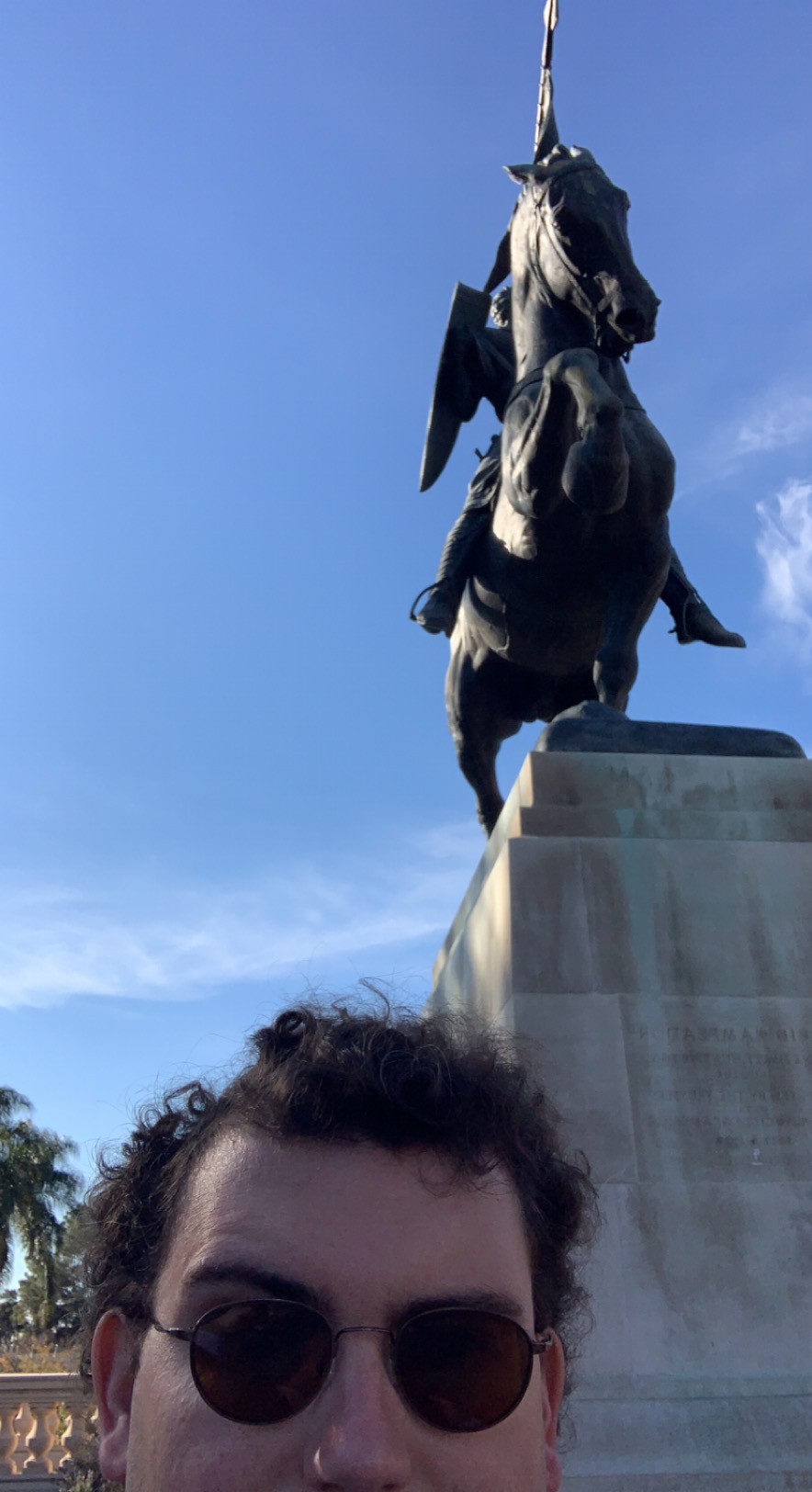
A selfie I took beneath the statue of El Cid in Balboa Park’s Plaza de Panama in San Diego on Halloween 2021.

Olympic Optimism

In celebration of the last few weeks of the Summer Olympics in Paris, I want to write to you about the optimism that the Olympics embody. — Click here to support the Wednesday Blog: https://www.patreon.com/sthosdkane


In celebration of the last few weeks of the Summer Olympics in Paris, I want to write to you about the optimism that the Olympics embody.


I’m an optimist at heart. I think that’s what has gotten me through these last 10 years of graduate school, and what keeps me going through the hard times we find ourselves in. Every two years, my optimism is renewed by the staging of the Olympic Games, summer and winter. Each Olympiad resides in my memory in its own different way, the character of the host city and the joy of the individual athletes shining through the broadcast of the games. Here in the U.S., the Olympics are actually the one big thing that I think of when I watch NBC, while Rio 2016 was a rare Olympiad that I missed most of being in London at the time with the events at odd hours for Europe. The Olympics reinforce that optimism that we humans can truly work together for our mutual betterment. We have the potential to grow beyond what Carl Sagan called “our adolescence as a species” dominated in the last two centuries by nationalism, division, war, and genocide toward a better future where societies work for the betterment of all.

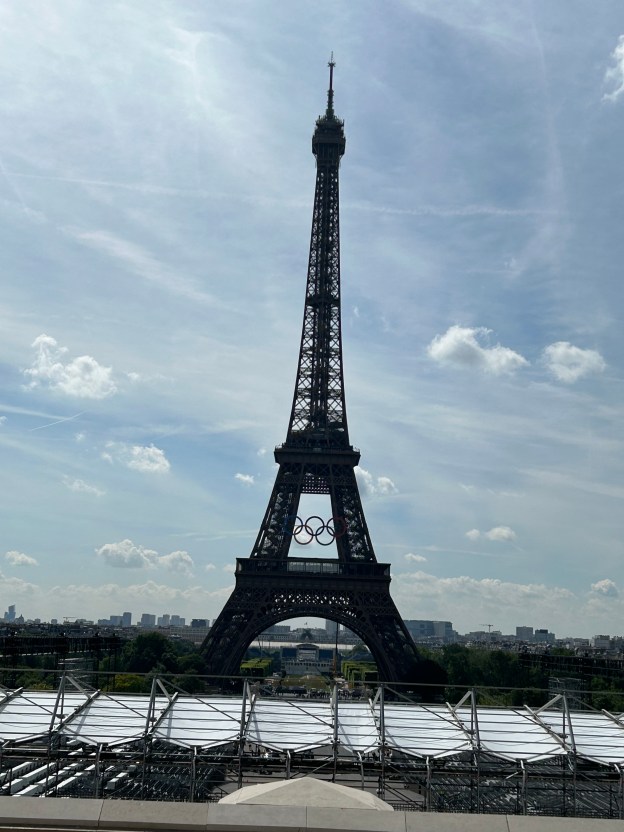
This year, I was in Paris a short while before the games began and got to see aspects of the Olympiad in preparation. The rings were mounted on the north face of the Eiffel Tower in early June when I visited the Musée national de la marine at Trocadéro, and all around the city the lavender-colored placards advertising directions to Olympic venues were hung in the metro. It gave me a sense of what it might be like to be in this city a few weeks later when the games began. Paris is a city which has such a long history of both oppression and liberation that it speaks better than many others to the collective human experience. It truly was a wonderful city for this Olympiad to be held at a time of tremendous pessimism and conflict around our globe.

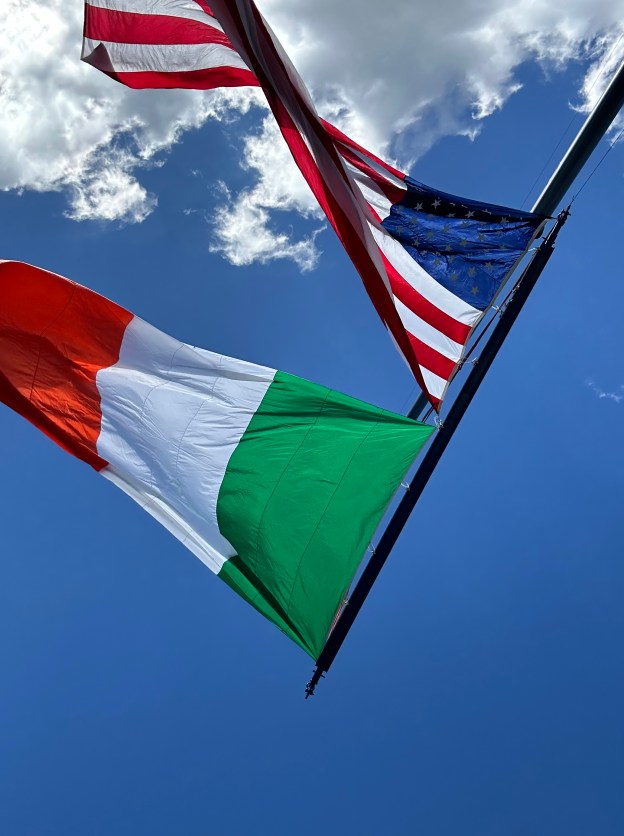
I set up alerts on the Paris Olympics app on my phone for Team USA and Team Ireland, and for several specific events which I wanted to follow, especially the Fencing, I was a saber fencer in my pre-teen years for a while. While I wanted to support my own national team and the national team of my ancestral homeland, I still cheered on whoever was competing at a given moment. I like to say often that it’s better to have a wide margin of victory when I have a team in the competition: I’d rather see my Cubs win by 5 or 6 runs than by 1 run in a late season or playoff game. Yet, when I’m happy to see the competition itself and see these athletes perform their best on a stage watched by billions, I love seeing a tight race. For me then, as much as I love seeing Team USA march into the Opening Ceremony, or in this year’s case float down the Seine on their boat as the second-to-last to launch from Pont d’Austerlitz, I love even more the moment when the national flags join together and march toward the podium following the Olympic flag. All nations united in a common cause empowered by their hope and joy.There’s a song that was composed for the Rugby World Cup, which is just as pertinent here, World in Union, set to Holst’s Jupiter theme from The Planets which ought to be sung here too. The idea that every two years we all can join together, for several weeks, and form that very same world in union is what fuels my optimism that our days of division and strife are impermanent. I recognize the realists who say that we need to focus solely and whole-heartedly on the trials of our time, the wars and oppression happening in our midst; yet we should also keep this hope in mind that we might one day grow beyond war and beyond feeling the need to oppress each other. There should be as many diplomats and negotiators offering a chance at peace as there are soldiers carrying on the fight because at the end of any war there will be peace again, and the form that that peace takes will determine if any other wars will follow on.


The Power of Hope

This past weekend, history was made when President Biden dropped out of the 2024 presidential race. The next 48 hours inspired tremendous hope again. — Click here to support the Wednesday Blog: https://www.patreon.com/sthosdkane


This past weekend, history was made when President Biden dropped out of the 2024 presidential race. The next 48 hours inspired tremendous hope again.


During my senior year at Rockhurst, now a decade ago, the BBC released the first of two seasons of a new series of Shakespearean adaptations called The Hollow Crown. These films were realist adaptations of the Henriad plays Richard II, Henry IV Parts I and II, and Henry V. This first season seized my attention and enthusiasm with a tremendous rush of emotion and energy. I wrote my undergraduate capstone in History on Richard II partially because of how these films brought these medieval kings to life for me. Shakespeare’s plays have tremendous power because they speak to common human emotions and experiences, it’s why they’ve been adapted by Akira Kurosawa from their original settings to feudal Japan, and why contemporary adaptations of these plays can work even if they can also leave something to be desired. 

Yet the greatest power that Shakespeare’s plays have is in their quotability. William Shakespeare was one of the greatest writers to use the English language to tell his stories, and to breathe life into his characters and settings that the most fantastical magic of The Tempest can seem just as believable as Richard II’s grief at losing his crown. For me, one of the most readily quotable lines in Richard II comes not from the deposed king but from his uncle John of Gaunt, Duke of Lancaster, who in a speech which Jeremy Irons described as one coming from a medieval Brexiteer, offered the truism “small showers last long, but sudden storms are short.” (2.1). I think of this often in many different situations. Our politics of these last 8 years have been somewhere in the middle, an 8 year on-going rain that may seem tempestuous throughout but that has merely brought together several of these sudden storms in quick succession.

For most of my life I’ve heard the argument that ordinary people like us cannot do much to change our politics, and that we are better off leaving politics to the politicians who are going to do whatever they want anyway. I’ve grown up surrounded by this apathy, yet my parents instilled in me from my earliest memories a duty to vote, to speak up, and to play my part as a citizen. I’ve been frustrated in the last year in particular hearing so many people express a distaste in our electoral system because the two candidates running for President this year were men who seemed so out of touch and disconnected from the rest of us that we felt little need to participate. For myself, by the time the Missouri Primary came around for my party, our candidate had already secured enough delegates to claim victory in the primaries, and so this was one rare election when I didn’t vote.

All of that changed on Sunday at 12:46 Central Time when our sitting President, my party’s candidate, Mr. Biden announced he would no longer seek reelection to the Presidency this November. I was out at lunch with my parents when I got the news, and my first reaction was akin to many: fear at what would come next. I was on the fence whether President Biden should drop out of the race, unsure of what the result might be; and today writing this 48 hours later I’m still afraid of what could happen.

Yet my fears have been assuaged somewhat at the sight of how much the tone of this election has changed in my party. Where so many were going to vote for the President in order to keep his opponent out of power, in the last 48 hours our new candidate, Vice President Harris, has received more than 28,000 offers from ordinary people to volunteer for the Harris campaign. In the last 48 hours the Harris campaign and the Democratic Party have raised about $250 million in donations and pledges; of those donations more than 888,000 were from ordinary people wanting to pitch in. The tone has changed, where before last month’s debate we hoped that President Biden could lead the campaign to eke out enough moderate and undecided voters to support the Democratic side and defeat his opponent, now we have a campaign that is built less on fear of the opposition and more on the hope of what our new candidate has promised to do and could do if elected President.

Hope is far stronger than fear because it offers us a chance to aspire to something greater than ourselves. The most successful President of the twentieth-century, Franklin Delano Roosevelt, ran on a platform of hope and reform that would pull the country out of the Great Depression, and in his later campaigns defend liberal democracy from the growing tides of authoritarianism around the globe. All Democratic Presidents since Roosevelt have been judged on what FDR accomplished, and few have risen close to his level. The two that initially come to mind are Lyndon Banes Johnson, who served as President from President Kennedy’s assassination in November 1963 until January 1969, and our now outgoing President Biden. In spite of a staunch and illiberal opposition built around the premise that any and all legislation proposed by the Democrats must be blocked at all costs, even at the expense of the country, the Biden-Harris Administration has passed several landmark pieces of legislation which have been notable in the good they’ve done while being overshadowed by claims to the opposite from the clamoring gallery in the opposition.

Most of the Biden-Harris Administration’s major legislation occurred when the Democrats had a majority in both houses of Congress through the end of 2022. These included in 2021: 

  • The American Rescue Plan Act, which injected $1.9 trillion into the economy to help ordinary people during the hard times of the recent pandemic.
  • The Bipartisan Infrastructure Investment and Jobs Act, which is funding infrastructure improvements and new projects across the country. 

In 2022, Biden signed: 

  • The Inflation Reduction Act, which included elements of his failed Build Back Better Act offering significant investment in climate and energy production and a three-year extension to the Affordable Care Act.
  • The Bipartisan Safer Communities Act which is the first major federal gun control law passed in the last three decades.
  • The CHIPS and Science Act which bolstered American semiconductor manufacturing.
  • The Honoring our PACT Act, which expanded health care for US veterans.
  • The Electoral Count Reform and Presidential Transition Improvement Act which adds procedures to the Electoral Count Act of 1887 to avoid a repeat of the stalling measures to keep President Biden’s election from being certified during the January 6th attack on the Capitol.
  • The Respect for Marriage Act which codified same-sex and interracial marriage.

And finally, in 2023, Biden signed:

  • The Fiscal Responsibility Act which restrained federal spending during fiscal years 2024 and 2025, and suspended the debt ceiling until the beginning of 2025.
  • In September 2023, he established the American Climate Corps, in a Rooseveltian manner to help facilitate the national response to the climate crisis.

What is striking about Biden’s presidency is both how much he accomplished in four years, and how little most people seem to know about it. He could not fully live up to FDR’s legacy because he lacked the majorities in Congress throughout his term that would have allowed him to continue to pass legislation. In the last month, it’s become clear that what new policies his Administration announces will be intended less as viable things to be accomplished in what remains of his term, but rather as signs of hope of what his party would do if they retain the Presidency and win back a majority in the House of Representatives.

That hope now has a face and a name in the Democratic presumptive nominee for President, Kamala Harris. The Democrats would do well to recognize that the power of hope for the things she and her Administration and the congressional party can accomplish together are far more powerful than all the fears we have of what would happen should the opposition regain the Presidency and retain its majority in the House. Hope is stronger than fear because it builds on the idea that there’s something better to be had than what we now have. I believe that hope is what will unite us together in the Democratic big tent this year to win this election. The circumstances aren’t great, President Biden’s withdrawal was far later in the race than I would have liked, and in the coming weeks I want to write here about the flaws in our electoral systems that his withdrawal lays bare.

This week though, let me leave you with what I believe to be true: the Harris campaign is in a strong place with its grassroots enthusiasm, fundraising, and organizing, and has the legislative accomplishments of the Biden-Harris Administration as a strong foundation for a successful, if unexpected, campaign. It’s up to all of us to hope that she can provide better promises than her opponents, and to act on that hope and vote in November.


The Promise of Hope

Last week, the 7th of May 2024, marked the 200th anniversary of the premiere of Ludwig van Beethoven's Symphony No. 9. Today then, I want to talk with you about the hope which runs through that Ode to Joy. The recordings of Beethoven's Ninth Symphony heard in this episode came from the 1956 album by the ProMusica Symphony Orchestra and Chorus under the direction of Jascha Horenstein and are free to use under the Public Domain Mark 1.0 Universal label and can be found in full at archive.org. — Click here to support the Wednesday Blog: https://www.patreon.com/sthosdkane

Last week, the 7th of May 2024, marked the 200th anniversary of the premiere of Ludwig van Beethoven’s Symphony No. 9. Today then, I want to talk with you about the hope which runs through that Ode to Joy.


Last time on the Wednesday Blog, I wrote to you in what I hoped would appear to be an optimistic tone that still acknowledged the troubles and trials I find before me, and to an extent I think that worked. While I did not intend to write a sequel to that post, this week’s topic is one which fits well enough, and which I feel quite fervent about as to warrant mention here in the Wednesday Blog.

I began to explore the world of classical music around the time I started high school. Quite honestly, my big introductions were the music of George Gershwin and the original cast album of Phantom of the Opera. Yet around that time I was introduced to an ensemble called the William Baker Summer Singers and joined them for the 2008 season when we performed Beethoven’s Ninth in Grace & Holy Trinity Cathedral in Downtown Kansas City. I was not the best singer by a long shot, still very new to the whole experience, yet it was the start of my off-and-on tenure singing with choirs around Kansas City.


The first measures of the 1st Movement

Beethoven’s Ninth thunders into life with the opening measures of its first movement, as though the hope and joy which makes this piece so famous is born from something elemental deep beneath the ground, rising out and toward the audience with the orchestra as its first voice. This then makes the chorus out to be some even deeper root of the spirit of this work, its power growing throughout the first three movements leading up to the tremendous clamoring second movement. I’ve always imagined the second movement told the story of a fast paced and clattering horse and rider making their way through fields and farms to pass on good news to some learned recipient.

The third movement is far softer than the first, yet again it speaks to something grand as yet only being revealed to the audience. There is a sense in the third movement of a fundamental truth as of yet untold, whose voice could raise both the living and the dead to new heights of human dignity and grace. Through music, Beethoven captured the full spectrum of human aspiration and expressed our innate confidence in our own abilities to improve our lives. It reminds me of the “Et incarnatus est” movement in Beethoven’s Missa Solemnis, which is written in the Dorian mode, giving it a distinct feeling of rising from a deep ether into the light of a new day. The Missa Solemnis was also written in 1824, premiering on the 7th of April of that year.


The 3rd Movement’s climax

I hear something inherent in Beethoven’s optimism, that even with all the troubles of his life there near its end he could still dream that we might become better versions of ourselves. The tempo marker for the first movement Allegro ma non troppo e un poco maestoso (Quick but not too much and a little majestic) might well be a good motto for life; a good life ought to be taken at a fair pace, yet not too fast, and with some majesty for one’s nature. We can hope for something better because we are born with minds capable of dreaming of better tomorrows.

At the heart of the Ninth Symphony and in particular its choral fourth movement is a fairly simple melody, one that I learned quickly during my time rehearsing it. That melody has taken on a life of its own beyond Beethoven’s original composition and become something ubiquitous in many respects. There are two church hymns set to its tune in the hymnal we use in my current parish choir, “Joyful, Joyful, We Adore Thee,” and the slightly more modern, yet traditionally formal, “Joyful, Joyful, We Adore You.” What I love about this melody is that it is easy to learn, easy to adapt, and so upbeat.


The Ode to Joy theme from the 4th Movement

The words which Beethoven set to that tune were written by the German poet Friedrich Schiller (1759–1805) in the summer of 1785. They are an outgrowth of the Enlightenment and the fervent calls for acknowledging our common humanity that grew from this reassessment of our relationship with Nature. Those words speak volumes to me, that joy makes brothers and sisters of us all, revealing our original state of nature to us amid all the nebulous fog of our lived expectations. It’s easy to forget that beneath all the mantles of identity we hoist upon ourselves that we are all the same in our life and yes in our mortality.

There is a deep promise here that with hope we can accomplish tremendous things. Hope alone will not solve our problems, we will always need to act to improve ourselves and our communities. True hope, pure and fulfilling hope, is such that it requires we all act together to our common benefit, that we think of each other more than of ourselves. I have such a hope in humanity, after all I’ve seen moments in my own life and in our history in which we’ve come together to work for a higher purpose than any one of us. Again, quoting from Schiller’s poem:

“Seid umschlungen, Millionen!
Diesen Kuß der ganzen Welt!”

            “Be embraced, all ye millions!

            With a kiss for all the world!”

This promise of hope is something that is sacred because it offers us a chance at redemption no matter how terrible the things we may have done. There is something truly divine about it, that we can become better versions of ourselves not in spite of who we’ve been but rather because we are willing to improve who we are and how we live with our neighbors.

That is a promise that I hope we can fulfill.


The recordings of Beethoven’s Ninth Symphony heard in this episode came from the 1956 album by the ProMusica Symphony Orchestra and Chorus under the direction of Jascha Horenstein and are free to use under the Public Domain Mark 1.0 Universal label and can be found in full at archive.org.


The Essence of Being

This week, to begin Season 4 of the Wednesday Blog podcast, I want to talk about what it means to exist. I know, small topic for a Wednesday. — Click here to support the Wednesday Blog: https://www.patreon.com/sthosdkane


This week, to begin Season 4 of the Wednesday Blog podcast, I want to talk about what it means to exist. I know, small topic for a Wednesday.


Two weeks ago, I started teaching a new class that I’m calling Bunrang Ghaeilge, Beginner Irish. The students come from my fellow members of the Fr. Bernard Donnelly Division of the Ancient Order of Hibernians and their relatives, and in the first two weeks we’ve progressed slower than I initially expected yet we’re still progressing through the materials. The first verb which I taught my current students in English translates as to be, yet in Irish as two forms: is for a more permanent being and  in a more impermanent circumstance. In the moment I explained this difference by noting how I say is as Chicago mé (I am from Chicago), as in I was born in the Chicago area, but I say tá mé i mo chónaí in Kansas City (I live in Kansas City). We don’t have this distinction in English, either between the permanent and impermanent versions of the to be verb or in the clear distinction between where you’re from at birth and where you currently live; that distinction is far more subtle in English.

At the same time, I am learning Italian for a trip this summer, my own version of the Grand Tour, and on the Busuu app where I’m learning Italian they taught that I should say sono di Chicago però abito a Kansas City,as in I was born in Chicago, but I inhabit today in Kansas City. This distinction between a place that is central to our essence, the place where we were born, and the place where we now live seem important, yet it flies in the face of the American sense of reinvention that we can make ourselves into whomever we want to be. It’s struck me when I’ve met people who would rather see themselves as from the place where they currently live than the place where they were born. That is a different view from my own, born out of different lived experiences and different aspirations.

This word essence developed from the Latin word essentia, which the 1st century CE Stoic philosopher Seneca wrote was coined by the great orator Cicero as a translation of the Greek word οὐσία (ousia), a noun form of the Ancient Greek verb εἰμί (eimi), meaning “to be.” (Sen., Ep. 58.6) It refers to an innate idea that the ultimate goal of philosophy and learning in general is to better understand the self; the most famous inscription in the ancient Temple of Apollo at Delphi read γνῶθι σαυτόν (gnōthi sauton), or “know thyself.” I add to that goal the aspiration that one can improve oneself. 

This time of year, I find myself thinking more and more about what it means for me to be an Irish American. This past weekend we celebrated St. Patrick’s Day, a day of great celebration for the global Irish diaspora and our cousins back in Ireland as well. I’ve written before here about how my communities’ immigrant connections to Ireland often predate the current century, if not the twentieth century as well and how we are in many respects far more American than Irish. In recent years, I began to refer to myself in this subject as an American cousin, after all as much as I have Irish roots and I come from an Irish family, I’m an American and have lived an American life to date. I’m not as far removed from Ireland as many I know, yet this year marks the 110th anniversary of my great-grandfather Thomas Kane’s arrival in America.

There’s something about being Irish American which doesn’t quite fit neatly into any of the official boxes. In Ireland, to be Irish is to be from Ireland or to be a close enough descendant that you qualify for Irish citizenship, like my father does. In America, there’s a sense that the old stereotypes of Irish immigrants are fair caricatures to still uphold, especially on our communities’ holiday in much the same way that the sombreros are donned on Cinco de Mayo. Yet there’s a lot more to it. On both sides of the Atlantic, our communities have the same deeply intertwined connections between families near and far, friends in common, and a sense of nostalgia that I see especially strong among those of us born in America.

Perhaps the Irish language can offer the best answer here. In Irish, I’ll say to Irish people, as I wrote a few paragraphs ago, “Is col ceathrair Meiriceánach mé.” Yet the official Irish name for us Irish Americans is “na Gael-Meiriceánigh”, or Gaelic Americans. I think this speaks to something far older and deeper than any geographic or political connections. We come from common ancestors, share common histories and stories that wind their way back generations and centuries even. We are who we are because of whom we’ve come from. I hope to pass this rich legacy in all its joys and struggles onto the next generation in my family; perhaps I dream of those not yet born hoping they’ll be better versions of my own generation. I hope they’ll still feel this connection to our diaspora like I do even as we continue on our way along the long winding road of time further and further from Ireland.

I am the child of my parents, the grandchild of my grandparents, and great-grandchild of my great-grandparents. In so many ways, I am who I am today because of those who’ve come before me. The geography of my life was written by them, by a choice among other immigrants from County Mayo my ancestors found their way to Chicago instead of Boston, New York, or Philadelphia. My politics reflect my ancestors’ views as well, in the Irish context the legacies of the Home Rule Crisis of 1912-1916, the Easter Rising of 1916, the War of Independence of 1919-1921, and the Civil War of 1922-1924 all have as much of a presence in my political philosophy as does their American contemporaries: the Progressive Era and its successor in the New Deal coalition. Yet I am my own person, and from these foundations I’ve built my own house in as much of an image of the past as it is a hope for the future.

What does it mean then to be ourselves? We hear a great deal today about how people identify, in a way which seems to be a radical departure from older norms and expectations both in the English language and in how we live. We constantly seek answers to all of our questions because we anticipate that all of our questions can be answered, yet the mystery of being is one of my great joys. I love that there are always things which I do not know, things with which I’m unfamiliar and uncertain. This is where belief extends my horizons beyond what my knowledge can hold, a belief born from the optimistic twins of aspiration and imagination. I know that the essence of my being, the very fundamental elements of who I am, draw far more from these twins than any other emotion. I am what my dreams make of me, I see my world with eyes colored by what my mind imagines might be possible; and in that possibility I find the courage to hope for a better tomorrow.


Twelve Hours of Mask Wearing

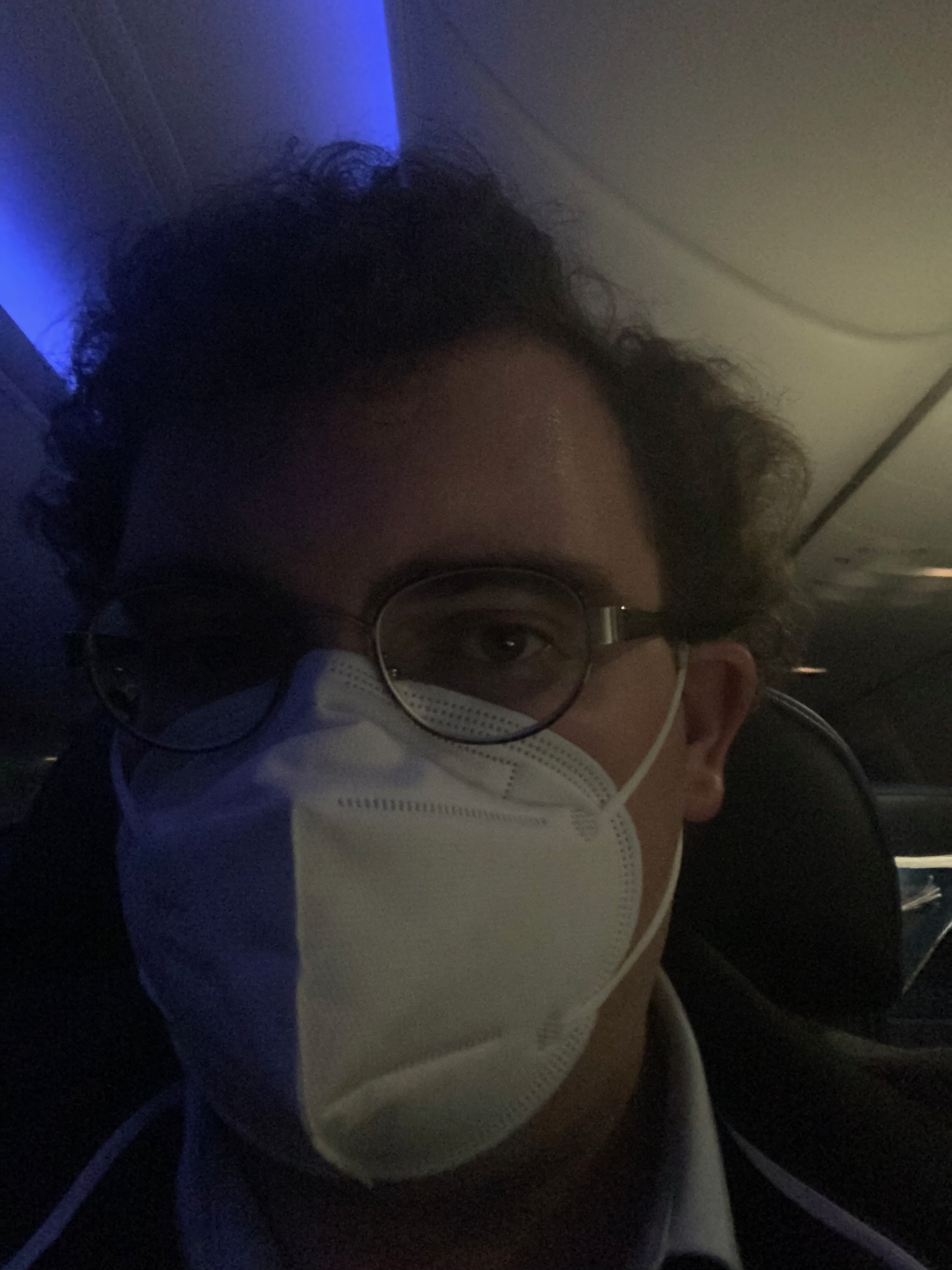
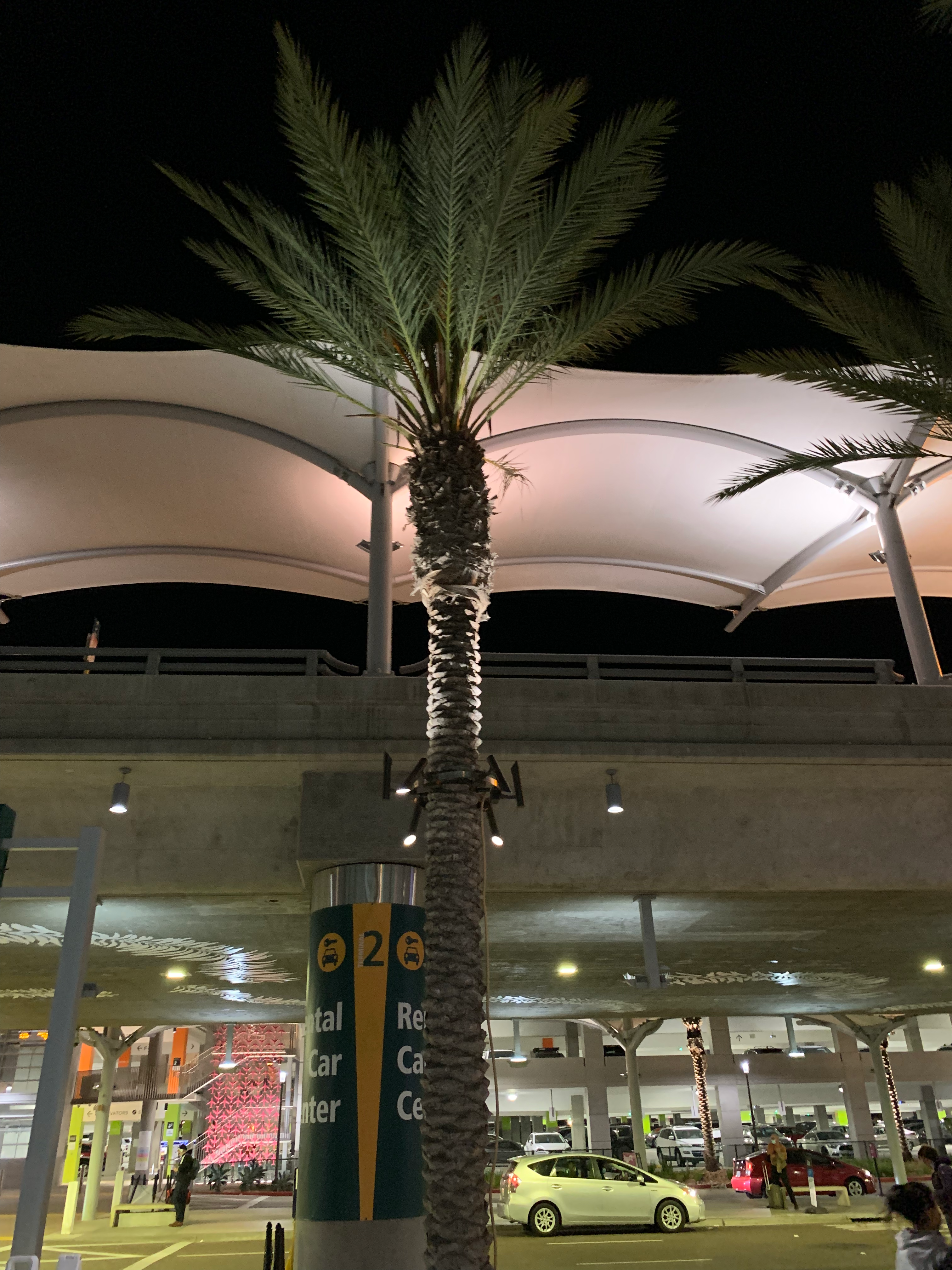
This evening I had the opportunity to travel from my usual place of business in Binghamton, NY to the sunny port city of San Diego on the far side of the country and this continent. It was my first time flying on a full transcontinental route; coming from the Midwest I’ve benefitted from living almost halfway between Atlantic and Pacific until now. The experience was largely uneventful, though I’m humbled by the fact that this continent across most of which I’ve now driven (as far to the east as Boston, as far to the west as the Great Salt Lake) could be crossed in the same amount of time it would normally take me to drive west from Kansas City to that place in western Kansas where I’ve found myself within sight of the tallest clouds rising off the Rockies just west of Denver. I spent the flight reading a compelling story, checking my preferred flight tracking app, and listening to Planetary Radio. 

But the greatest physical reminder of this flight and this entire day will be the pain in my ears and the sides of my head from wearing this KN95 face mask for so long. I dearly hope we climb out of this hole of a pandemic we’ve dug ourselves into, and that my fleeting escapes from mask wearing as I took a drink of water would be signs of a future when we won’t have to wear these masks to travel. And yet, I worry that our relatives and neighbors who cry wolf about these masks so forcefully that events meant to be dull, like school board meetings, become events rife with danger, that these our fellow Americans are the ones whose actions will only keep these mask mandates in place longer. After all, we’d be further out of this continuing crisis if we were as a country more fully vaccinated. Being triple-vaccinated against COVID-19 myself, I know I’m probably safe, but the best way to ensure that is the case both for myself and for all the people around me on this plane from the oldest passenger to the youngest infant are safe as well.

I worry that in the fear-mongering of the last decades we’ve lost a sense of communal spirit. We’ve become suspicious of our neighbors who once we could trust. Any statement deserves to be questioned, so I ask you now: what went wrong? When did we choose to fear others before learning to appreciate them? And why don’t we lower our pride for even a minute and let ourselves lower our guard?

We have a lot of problems facing us today. Step one clearly will mean that we’ll have to at least start by looking each other in the eye and at the very least saying hello. It’s a start.

I don’t think I’m in New York anymore.

Visions and Dreams in 2020

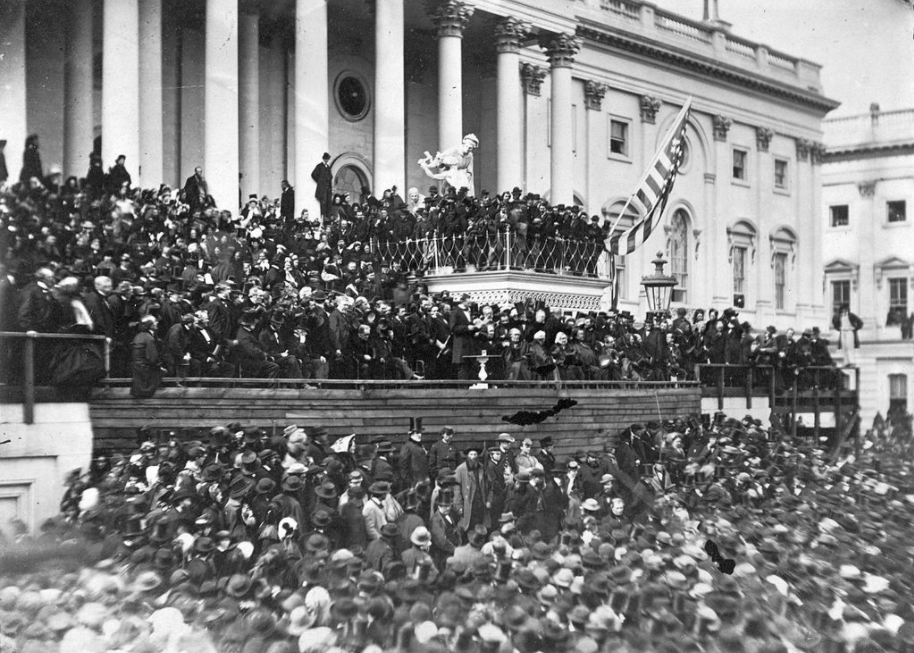
I’ve been thinking a lot lately about Lincoln’s Second Inaugural Address. I first heard perhaps the most famous and impactful line in any of his speeches as a child during the final episode of Ken Burns’s magnificent The Civil War documentary series. Spoken on 4 March 1865, a month before the end of the Civil War and a few days further removed from Lincoln’s assassination, the lawyer from Springfield, Illinois concluded his address calling on all Americans to feel “malice toward none,” and “charity for all.” After all the pain caused by the war, many of Lincoln’s goals still seeming far too distant from reality, he called on our forebearers to: 

“strive on to finish the work we are in, to bind up the nation’s wounds, to care for him   who shall have borne the battle and for his widow and his orphan, to do all which may achieve and cherish a just and lasting peace among ourselves and with all nations.”

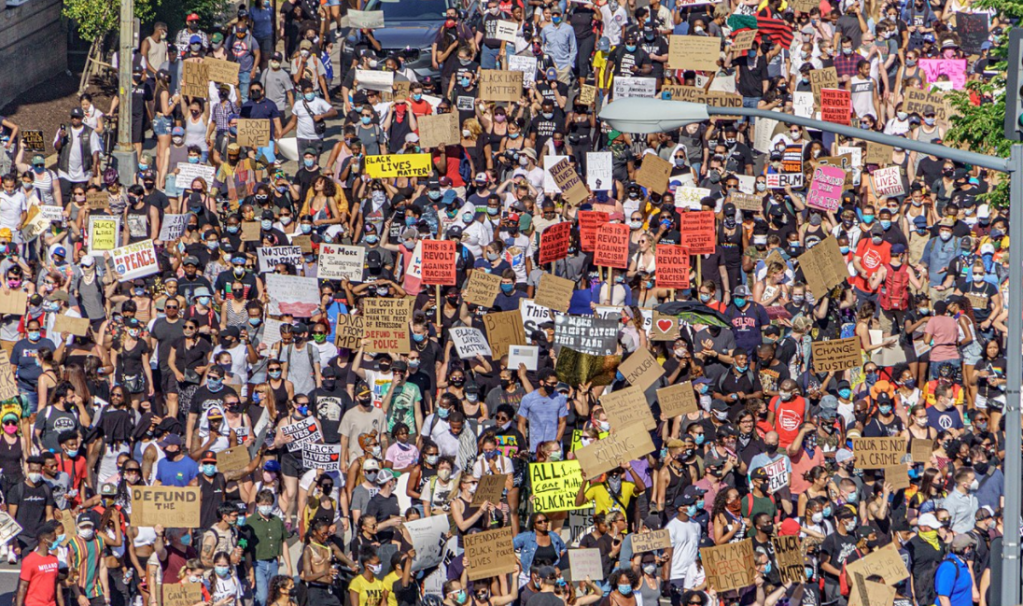
Lately, I’ve wondered how best to categorize the year we’ve been living in. Could the upheaval of 2020, a combination of general public dissatisfaction with government, a global pandemic, and social and economic tensions boiling over after generations of bubbling, could all these combined be called a revolution of sorts? Could we be living through so consequential a time that in fifty or a hundred years, school children will place 2020 in the same column with the most recent global revolutionary years of 1989, 1968, 1918, 1848, 1789, and perhaps even 1776? I’ve also wondered, if we are living through a time which rhymes with Lincoln’s, are we in 1861, at the start of our national nightmare, or in 1865 at the moment of waking from that horror?

Yet when I think about Lincoln’s words again, one thing in particular strikes me. We are at our weakest as a country when we are divided. Today, when each side sees the other with such contempt, it’s hard to see how we could heal these divisions and sow back together these wounds that have cursed our country from its very inception with the conquest and colonization of this continent. Yet heal these divides we must. Someone is going to have to take the first step at reconciling the many factions and camps in this country, someone is going to have to reach across the chasm and offer a hand of friendship to someone on the other side. We need to learn to recognize the innate humanity in those we disagree with before we see their faults. We need to learn to grow past our hate.

Even a person who has committed the worst acts imaginable, people whose names live on in the darkest infamy, were still people like you and me. There are people out there who seek to divide us even further, to sow distrust among us until we are unable to bear the mere thought of one another anymore. Their power is fueled by our hatred, their lies take on the sense of truth only when so smelted by the fire of our hate. As long as we let our hate guide our actions and principles, as long as we make choices great and small based on that darkest emotion, they will win. 

Listen to the voices that offer us a message of unity and hope, to the ones who offer us a future that doesn’t seem bleak, to the ones who offer solutions instead of just spewing bile and denouncing their rivals as the enemy. I fundamentally believe that all things are created good, if I know anything for certain, it’s that. Look at it this way, why would a God who wished for evil to be the only option give us free will? It is up to us to choose how we act and react, think and feel. Another thing that I fundamentally believe in is that it’s up to us to make our world as we want it. God made this reality, it’s up to us as citizens of this reality to decide its future. 

True love, what many would say is the anthesis of hate, depends on free choices for survival. It’s up to us to decide which emotion our future will be shaped by: hate and its offspring distrust, fear, and bigotry, or love and its offspring hope, kindness, justice, and mercy. Let’s finish Mr. Lincoln’s work, and make 2020 the year when we began to at long last heal our nations wounds, care for each other as equals, and do what we must to earn that “just and lasting peace” for all of us, the oppressed and their erstwhile oppressor too. After all, if we leave even a single person behind, hate’s cold song will still be there for yet another generation to hear.

It’s up to us to live up to our forebearers’ visions and to build the foundations for our descendants’ dreams. Hope and pray for those visions and dreams all you want, but if you want them to come true, you and I, each and every one of us, must act on them. 

I’ve had my say, now it’s your turn.