Tag Archives: Irish American

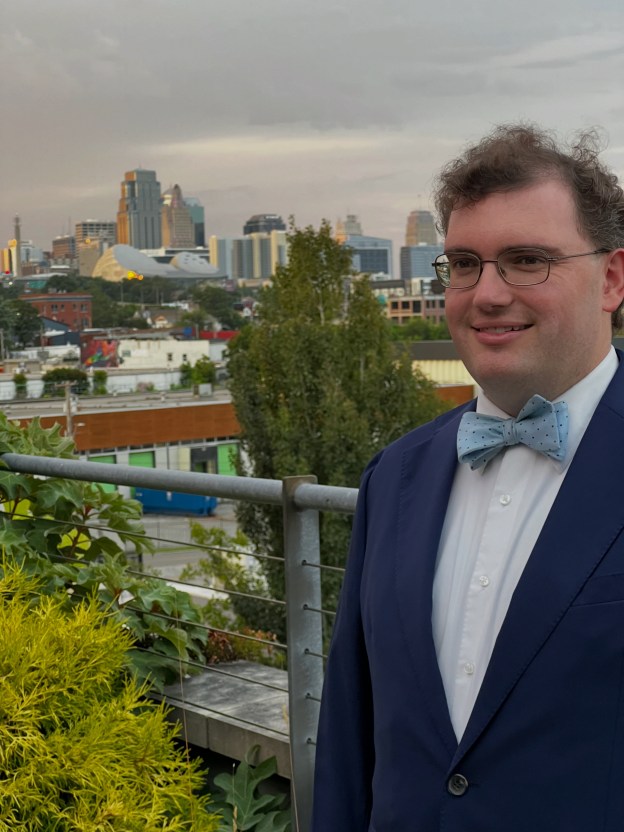
The author posing in front of the Kansas City skyline in July 2025.

The Wednesday Blog

This week, to conclude what I’ve been saying.—Click here to support the Wednesday Blog: https://www.patreon.com/sthosdkane—Sources:%5B1%5D “Signs,” Wednesday Blog 1.10.[2] “On Servant Leadership,” Wednesday Blog 6.15.[3] Percy Bysshe Shelley, “Ozymandias,” Poetry Foundation.


This week, to conclude what I’ve been saying.


I’ve said over the four years that I’ve been writing the Wednesday Blog weekly that I would stop writing this when it ceased to be fun. That’s a good rule for life overall that I’ve found: devote your life to things you love doing and keep them fun in the process. I tend to put on a very dry public face; a friend recently commented that I didn’t seem like one to scream or cheer at a concert, I affirmed that statement and demonstrated my own gentle “hurray!” to great amusement. This blog has changed with the times. It began as a project for me to write about things I enjoy outside of my research. I like to point to an early blog post all about my favorite state highway signs as a good example of this.[1] Yet I’ve found the topics I write about are changing, they’re becoming more academic, outlets where I can introduce some of the ideas I’m working on in my professional life and workshop them in a public forum. It’s a bald faced way of getting more readers to the Blog, I admit, yet so far, it’s worked.

I continue to cover politics here when I feel there’s a need to say something. Yet I’ve tried to balance what I’m writing to keep it positive, or at least to ensure that what I end up publishing suggests ways we can move forward out of the current crises we face. After all, there are enough writers out there pointing out the crises of the moment, some of us should be looking to the future to offer a light ahead that we all can reach for. This Spring, I was inspired by the commemorations in Boston of the 250th anniversary of the start of the American Revolution and the rallies for democracy here in Kansas City to focus that positive attention on popular action, the root of any good political system. I believe that government must act with the consent and full participation of the governed, and that through our elected representatives at all levels we ought to consider ourselves both governed and government. It sounds paradoxical, I know, and to an extent I believe that paradoxes are often a good thing. I devised one of my favorite phrases, “the extraordinary acts of ordinary people” to express this sentiment, that it is people acting out of the ordinary, out of what is considered ordered, which propels political change and keeps our politics fresh.[2] In 2023 one of the fads of the year on the internet was women asking men how often they think of the Roman Empire. I was asked this by one of my colleagues over lunch at the Nativity Parish School and remarked that because I was teaching the Romans at the time they were front of mind. Beyond this however, as much as I am familiar with the remains of the Empire, I am more drawn to the Republic and its ideals of popular government, even if they were never realized. The founders of the United States sought to model this federal republic on Roman models, yet they kept the Constitution they framed fresh for its day, an American constitution living in its ability to be amended to fit the changing times and passage of each generation rather than a Roman one deemed sacred through association with the old Republic’s gods and ancient institutions. Our republic is secular because for it to be sacred is to make it inviolate and unchanging, a monolith which will grow ever more distant from the people it was meant to govern, until like Shelley’s Ozymandias it is left as a mere pedestal of itself adrift in the sands of time.[3]

I want to stay a while longer with this phrase because I am so proud of it. To trumpet the extraordinary acts of ordinary people is to say that everyone has a voice and an impact upon the rest of us. In the first few years of the Wednesday Blog, my political essays tended to get lower readership across the board. I started writing the Blog in March 2021, a year after the January 6th insurrection showed how much the Republic was corrupted by the refusal to concede the 2020 election which caused that attack on the Capitol. I’ve seen a steady decline in political readership for my writing since the 2016 election, yet after 2020 that readership dropped off a cliff. American politics today is not a happy thing to write about, and at the moment it only seems to be getting worse. Yet by focusing less on the people in power and more on the people engaged for the common good I saw my readership grow on these political essays until they tended to be level with my other non-academic writing. A great inspiration for me here lies in the revolutionary era anthem Chester, sung by the New Englanders in the Continental Army and one of the older tunes in this country’s patriotic songbook. I’d been listening to it here and there without realizing for months, yet once I figured out what it actually was, when I was in Boston in March no less, I found that it spoke to my sentiment in a far greater way than I anticipated. I’m listening to William Schuman’s arrangement in his New England Triptych (1956) as I write this now, a New Deal era work intended to celebrate the democratic spirit of the cradle of the revolution.

There is a great deal of history behind my politics, naturally I notice that being a trained historian, and having taught American and British history on several occasions and having read a great deal in Irish history I can point out the various threads which I’ve coalesced into a logical genealogy of my political philosophy. Suffice to say, I believe it is better to look to the future and enact political policy which will build a future that we can all be proud of. At the core of this is listening to the people around us, hearing what they have to say, and listening to our own logic and empathy, two things which should always work together in our decisions. In writing about the extraordinary acts of ordinary people I look to those who will appear from the crowd as the leaders from my millennial generation and those coming up behind us in Generations Z and Alpha. We have inherited a great mess, and we have a lot of work to do. There are plenty of people arguing and advocating on what needs to be reformed, I feel better suited to provide an optimistic voice of what we could look forward to. By putting ordinary people front and center, I hope to make clear that policy should address problems from the bottom up, help reinforce and support the poorest in society that the whole structure grows stronger in kind. You might call this trickle-up economics, to speak to the Reaganites. We could build a future where everyone has good work, they can be proud of, enough to eat, a roof over their heads, and where every child learns how to read. We could have this future where people feel that law is meant to support them rather than push them down. I see this every day when I’m out around town: I suspect that the general sentiment behind people who run stop signs, red lights, or drive in transit only lanes is that the law has never worked in their favor, always rather beaten them down and stripped them of their humanity, so why should they follow the law? We must find our humanity in each other if we are ever going to grow out of this time of crises and begin to build a better future.

I enjoy thinking about the future in other languages, not just in the sense of the future tense but in the mentality of the language. How do they express things which haven’t happened but will come? In English we have the word future as a monolith on its own, derived from French and originally from the Latin futūrus, an irregular future active participle of the to be verb sum. In English, the future is as much a place as it is a time, it’s the destination we’re going to. Yet is it not better to think of the future as the scenery about to pass by as we go down the line like the trees and fields that we pass on a train? The present is momentary, here and gone in the blink of an eye, each millisecond the present, and the past a great gulf of memory whence we came. Yet the future is something both unknown and recognizable. It is both what we can see ahead of us along the way and what is just over the next horizon. It is an irregular version of being which will come someday. French expresses the concept of the future like this, whereas futur refers to the tense, l’avenir is instead the noun I’ve heard used most to describe the concept of the future. Yet l’avenir instead merely is the crafting of a phrase, temps à venir (time to come) into a noun, avenir, or that which is coming. We don’t know in truth what it is, what it will feel like when it comes, yet we know that someday we will see it and live in it. The future is inevitable, yet it is not singular by nature. Rather, if there is one past and present those are merely the choices made by actors in those moments which were chosen from the multitude that is possible from what could come. 

Irish expresses this sense of the future well because Irish really has no specific word for future. There is a future tense, which in some ways is more regular in its formation than the Irish present tense. Instead, Irish uses a phrase which breaks down the future into its core concepts:  An rud atá le teacht, or the thing which is coming. Therein lies the future in its baldest form: it is merely the thing that is coming next out of all the possibilities. Another topic which I seemed to write about a fair deal for a while was faith, self-help, and religion. My Catholicism is influential to my cosmovision and political philosophy in my core belief of the paradoxical nature of God, that God can exist yet also be omnipotent and omniscient. Because of this, I like to say, “anything is possible in the Eyes of God,” or for short, “anything is possible.” As I think about the end of my doctoral writing and needing a dedication to affix on my dissertation, I’ve found myself thinking about this phrase, and about who my audience is. After all, you now reading this sentence in my future, just as I wrote it in your past. It is possible that just about anyone could be reading this now, and so rather than dedicate my work to one person in particular in the moment in which I am writing it, perhaps I ought to instead dedicate it to the possible, or rudaí indéanta in Irish. That second word indéanta is a neat one because it comes from the verb déan, meaning to do, thus the possible is something that might be done. In English and French, I say, “I am studying” or « J’étudie, » yet in Irish, I say, “Déanaim ag staidéar,” or “I am doing study,” which makes the study more of an act than a state of being. The future has and always will be something acted, something done by individuals in our own small ways that creates great change in the collective form.

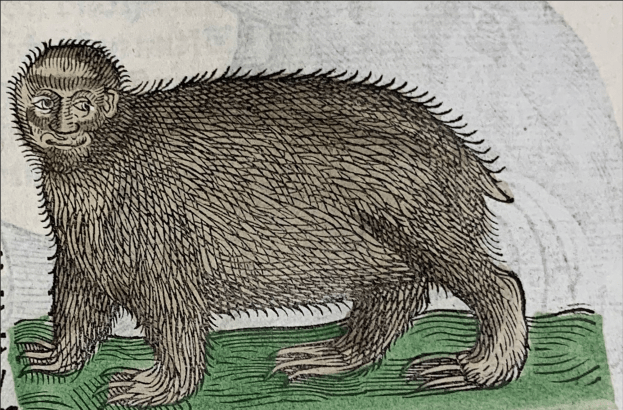
I study history because of all the things I am interested in it is history which brings them together. So far, history is a human creation made in our image and likeness which seeks to tell our story as best as we can recall it. We’ve devised historical methods of a similar manner to understand other histories, salvation history, church history, and natural history to name three. I returned to natural history as an adult yearning for the halcyon days of curiosity and wonder from my early childhood and built my career on my study of André Thevet’s (1516–1590) sloth. It’s become my gateway into the history of natural history, and through it I’m beginning to make my name as a sloth historian. I do not believe in prescriptivism, the notion that history in inexorably leading to some great moment in the future when the final form of human nature will announce itself. I think this is limiting, claustrophobic in fact. It’s far too simplistic to say that we will all wake up someday and find the morning sunlight is just a little bit brighter, the grass and trees greener, and the sky a prettier shade of blue because there’ll be somebody among us who will find something contrary about the experience. I for one an enjoying the gray skies outside my window today, it’s finally cool enough in mid-October for me to open the blinds in my room and let some sunlight in without making it too hot. Rather, history teaches us that the future is what we will make of it. I chose to not study the twentieth century because I felt this dolorous pain in my heart that there were so many things which happened in the last century which could have been avoided, choices which could have been different. In studying recent history, I worried I would be faced with the ghosts of the world wars, Great Depression, and all the troubles faced by humanity in general and my fellow Irish Americans in particular throughout my working life. 

Instead, I looked deeper into the past, first to the Roman Republic with an interest in studying the expansion of Roman citizenship in the late Republic after the Social War of the 90s and 80s BCE and later to the Renaissance, a period that seemed similar enough, Latinate to be sure, yet full of people and stories who I felt I could relate to better than the ancients. I found Thevet almost accidentally, and through his sloth I feel that I’ve found balance in my life that sustains me today, makes me feel more fulfilled in my efforts than I was before. My history is fundamentally interdisciplinary, historical zoology adopts zoological methods and theories to determine the true nature of historical animals, layering their scientific taxa upon their far older human memory and legendaria. In Thevet I am able to work with the ancients, looking especially Aristotle and Pliny, yet soon after I can turn around and look ahead to Buffon and Linnaeus and see how they interpreted what Thevet wrote in order to establish a clear lineage through the historical record for the animal in question. There is nothing sure about this history, often the historical sources are lacking with detail about a given animal, or the zoological data may not have enough detail about an extinct species to offer a clear picture of what it is I am describing. Both are limited by the foggy memory of the human past, yet together they can offer a light with which to move ahead and keep exploring those parts of our cosmos which are still strange and unfamiliar to us today.

I write because it is the greatest way I’ve yet found to express myself. I can say far more in an essay such as this than I could in a conversation. The Wednesday Blog remains less formal than my academic writing, here I use the first person. Yet with the passage of time, I’ve found the Blog has become more academic to the point that friends have told me they got an education about Thevet that they never expected. The Blog has several antecedents, including earlier less regular blog posts which you can find on this same website from before 2021 that all form the roots of this project. I’m proud of the writing I’ve done here, the Wednesday Blog now is comprised of 238 essays and 200 podcast episodes, I’ve written 521 pages, and the total word count is over 300,000. The future is defined as much by its potential as the fact that once it comes to be what was present will then be past. To see an end gives all things meaning. It is for this reason, at the end of the sixth book of the Wednesday Blog, and fifth season of the podcast, that I’ve decided to end this particular publication. This remains a fun thing to write, yet I have so much more to do today, and I only see that workload growing as I try my hand at more peer-reviewed articles, books, and translations in the coming decades. I hope the Wednesday Blog will be a testament to who I was at this point in my life in the years after the COVID-19 Pandemic and during my long years of doctoral study. Let these essays remain a monument of the first half of the 2020s, a sign of where we’ve been and where I hope we will be going.


[1] “Signs,” Wednesday Blog 1.10.

[2] “On Servant Leadership,” Wednesday Blog 6.15.

[3] Percy Bysshe Shelley, “Ozymandias,” Poetry Foundation.


On Translation

This week, how I take nuance and particularity into account in my efforts as a translator.—Click here to support the Wednesday Blog: https://www.patreon.com/sthosdkane


This week, how I take nuance and particularity into account in my efforts as a translator.


When I chose to study André Thevet (1516–1590) and the three-toed sloth in August 2019 I did so because I already knew French and the need to learn a new language was less pressing than if I’d chosen to study another source in the history of natural history. I chose Thevet because it was practical, and I chose the sloth because the thought of being a sloth historian made me laugh. From the first day working on Thevet, I found that my understanding of his books was heightened when I took the time to type out my own translations of his text. Thevet wrote in Middle French that is native to the middle decades of the sixteenth century. I arrived at this project very familiar with Early Modern English, the contemporary form of this language to Thevet’s time, as my history master’s thesis delt with sources in that chronological variety of English from Thevet’s generation and the one just before. I’ve never had much trouble understanding the most prolific author of Early Modern English literature, Shakespeare, but I think I’ve had a tolerance for varieties in speech that’s allowed for me to try to think beyond my own millennial Midwestern metropolitan American English and be willing to understand the likes of Shakespeare from a young age.

So, when I began translating passages from Thevet’s Singularitez de la France Antarctique for my own professional use in my dissertation, I decided that as long as I was translating that book I might as well translate it with the intention of sharing Thevet’s words beyond the scholarly analysis and critique which lie at the heart of my work as a historian. This first draft is built around the 1558 French edition published by Christophe Plantin (c. 1520–1589) in Antwerp and contains footnotes drawn from the 1878 French edition by Paul Gaffarel published in Paris, two Brazilian Portuguese translations by Sergio Amado (1978) and Estêvão Pinto (1944, using the 2018 reprint), and the partial 1986 English translation by Arthur Stabler and Roger Schlesinger which contains only Thevet’s North American chapters.

I finished the first draft of this translation in Summer 2023 and am now looking ahead toward the second draft which is the next stage of the project, and I hope the last one before I feel confident in formally writing to the publishing editors whose press sales agents I’ve spoken with about this project at conferences over the last two years. The second draft will consist of two main stages. First, I will cross-reference my translation and the 1558 Antwerp edition on which it is primarily based with the 1557 first and 1558 second editions published in Paris by Maurice de la Porte, two Venetian editions translated into Italian by Giuseppe Horologgi and published by Gabriel Giolito de’ Ferrari (c. 1508–1578) in 1561 and 1584, and the 1568 full English translation by Thomas Hacket published in London by Henry Bynneman. Second, I will seek to make my translation more understandable for a 21st century English-speaking reader while endeavoring to preserve Thevet’s particular mannerisms and voice, a writing style with which I’ve become quite familiar in the last 6 years to the point that I can now confirm at least two French translated manuscripts in the Bibliothèque nationale’s collections in Paris are verifiably written by Thevet. He had a way of writing that’s unmistakable.

These two competing axes create a binary star system around which my translation revolves. On the one hand, I want to be true to the original text, to preserve the author’s voice and something of their spirit which remains in those words. On the other hand, I need to make my efforts readable for my own contemporaries. Thevet and his contemporaries are notorious for long run-on sentences that would make Hemingway shake his head in earnest frustration. Where do I break up a long sentence while preserving its overall integrity? Furthermore, at what point should I decided to remove the bracketed notations of page breaks in the original text? There the 1558 Antwerp edition is most fully evident as its pagination has several quirks that make it stand out from the 1557 & 1558 Paris editions. At this point, Plantin published books with folio numbers rather than page numbers, so the first two pages were in fact folios 1 recto (1r) and 1 verso (1v). These names refer to the custom that scribes traditionally started writing on the back side of the vellum (recto in Latin) and then flipped the skin over once ready to continue writing on the verso, or opposite side. In several instances the folio numbers actually decrease in the book, notably in Thevet’s chapter on the sloth, which makes the footnotes on that core element of my research particularly confusing if you’re paying close enough attention. So, in summation the inclusion of the page breaks with the folio numbers keeps my translation grounded in Plantin’s edition, however that may break up the text in an uncomfortable way for some readers.

Ultimately, I am not the author of this book, merely a herald relaying it on for our time. My voice is there in the handful of introductory chapters I’ve written to go along with this book. These chapters describe Thevet as a reader of travel literature and place his accounts of the Americas beyond what he himself saw in Brazil in the context of their French and Spanish sources. I see my efforts in this as a means of introducing the reader to Thevet, a man who today exists on the furthest margins of the popular imagination of the First Age of Exploration in the English-speaking world. Thevet remains present in academic circles, there were at least four papers presented at this weekend’s annual meeting of the Renaissance Society of America in Boston which discussed Thevet, mine included. I hope this book will be useful to fellow academics and perhaps will entice curious readers to learn more about this man who I’ve spent the last 6 years of my life getting to know.I find myself drawn as much to the effort of a translator as I do to the work of a historian these days. We live in such a fractious time when reasoned debate and earnest discourse is riddled with dangers and seemingly improbable to undertake. I feel as though I’m constantly translating my thoughts and character for others to understand me. It’s why I enjoyed my time in Boston because that city has a large enough Irish American population that when I’d tell my name to a cashier to put on a carry-out order they’d actually spell it in the proper Irish manner; this never happens in Kansas City. That said, I felt that I had to translate my expectations and personal limits to be able to live even for just a few days in a city as expensive as Boston where I was often paying double what I’d normally pay at home in restaurants. In translating I recognize that each of us think in slightly different ways and see the world in which we all live in just as unfamiliar terms to one another. Difference enhances our common humanity and elevates our manner to something greater than ourselves.


We, Irish Americans

This week, to conclude what I’ve been saying.—Click here to support the Wednesday Blog: https://www.patreon.com/sthosdkane—Sources:%5B1%5D “Signs,” Wednesday Blog 1.10.[2] “On Servant Leadership,” Wednesday Blog 6.15.[3] Percy Bysshe Shelley, “Ozymandias,” Poetry Foundation.


This week, what does it mean for my community to call ourselves Irish Americans?


When I was applying for universities for my undergraduate studies, I was thrilled that one university allowed me to write in my own answer for “race or ethnicity.” I took out my pen and wrote down “Irish.” That university, Rockhurst, is the one which I chose and attended throughout my undergraduate years, and it remains the one that I list today before the others. Rockhurst holds a special place in my heart because it is so intrinsically linked with the Irish American community here in Kansas City, and it is one of those anchors that’s tethered me to this community where I’ve been able to make my own impact and presence.

That adjective I chose to write however is perhaps more complicated. I am not Irish by birth but by descent, though one generation too far removed to qualify for Irish citizenship in that manner. Still, Irish is a better descriptor of me than the generic American white, a category which my people were only accepted into for the sake of preserving the flimsy-footed tableau that is racism in America. When I moved to London, I was surprised to be confronted with three categories of white to choose from rather than the monolith I was used to. I technically qualified for all three: I have both Irish and British ancestry, yet I am from a country other than those two. I marked the box for White Irish as long as I was living and studying there because it felt the truest to my nature. Yet again, I am not Irish per se; rather I am Irish American, a member of one of the larger camps within the diaspora created out of the centuries of trouble caused by English and later British colonialism in Ireland. In this perspective, my people are victims of colonization, yet here in America we are the colonizers. So, amid all these tangled webs of identity and nature what are we, Irish Americans?

It is notable to me that in France there is no particular legal sense of identifying oneself as anything other than French. Trevor Noah put this well when he spoke about an immigrant who was granted French citizenship by President Macron after a tremendous act of heroic bravery in saving the life of a child. Yet when I’m in France, I find that if people are confused about my name I go toward my heritage to explain why it’s not your typical Anglo-American name, that my family comes from Ireland instead. I hear a similar tone from the varied generations of nativists in this country, even in the writings of President Theodore Roosevelt, a man who I overall admire a great deal, who wrote in opposition to us persisting as “hyphenated Americans.” This country ought to be a melting pot where all of the immigrants and their descendants shed away their own national and ethnic trappings in favor of becoming one people with one common identity. Yet again, I find this perspective runs contrary to my own lived experience.

To be an Irish American means to remember the place where our ancestors came from, and to remember their struggles as they sought to live their lives first at home and later in this place their newly adopted home. To be an Irish American is to remember that we too were the immigrants not that long ago and to offer a warmer welcome to the newcomers than our ancestors often received. For me, to be an Irish American is to have roots in two countries, better reflecting the interconnected and global nature of our world. Yet at the end of the day, we are Americans. In Ireland, I refer to myself as “an American cousin,” with a slight nod to that infamous play of 1865. The Ireland that many of us know is the Ireland of our grandparents and great-grandparents, the Ireland of the revolutionary generation and the twentieth century when our families left to come to this country. The Ireland of 2025 is still the same country, yet it has grown with the last generations into something that many of us find incongruent with our expectations. It is less an island than ever before with more outposts of the global world on its shores.

Our experiences greeting this global world are different because we encountered it here in America rather than in Ireland. We relate to all the peoples of the Earth through our friendships, rivalries, and mutual circumstances with the other diasporic immigrant groups in this country. I’ve wondered for a long while, including in this outlet if we are slowly with each new generation becoming less Irish Americans and more deeply rooted in other tribes in this country. We tend to be more religious than our cousins in Ireland, and as there are less Catholic schools and parishes that are explicitly Irish are we then becoming Catholic Americans more than Irish Americans? Or are we contributing to a general secularization of that larger white American demographic resulting in both our ethnicity and our religion fading into the background of our identities as ordinary Americans trying to survive in an ever more chaotic world? The key here is that our community is diversifying between political persuasions and regional identities and an overall willingness to remain connected to the lives and histories and passions of our ancestors.

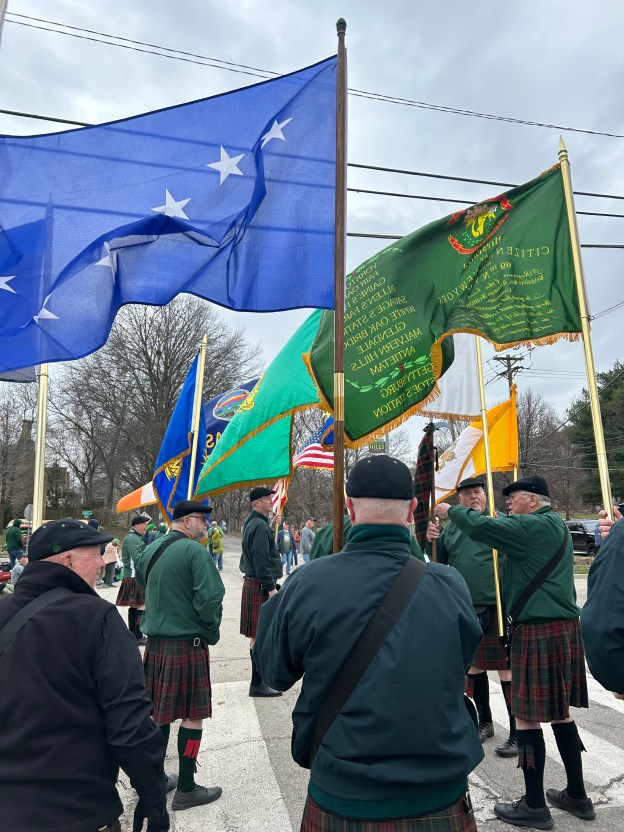
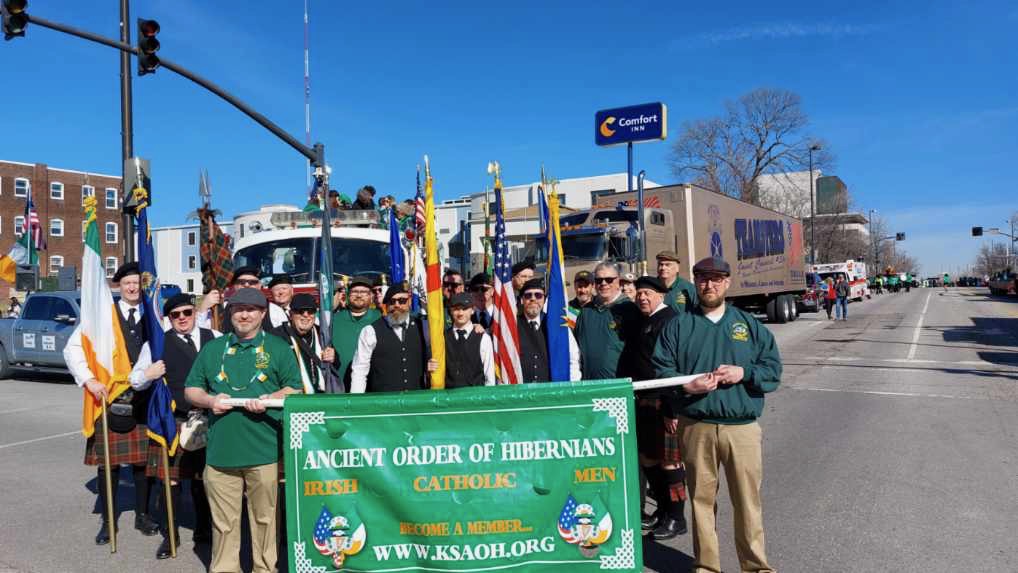
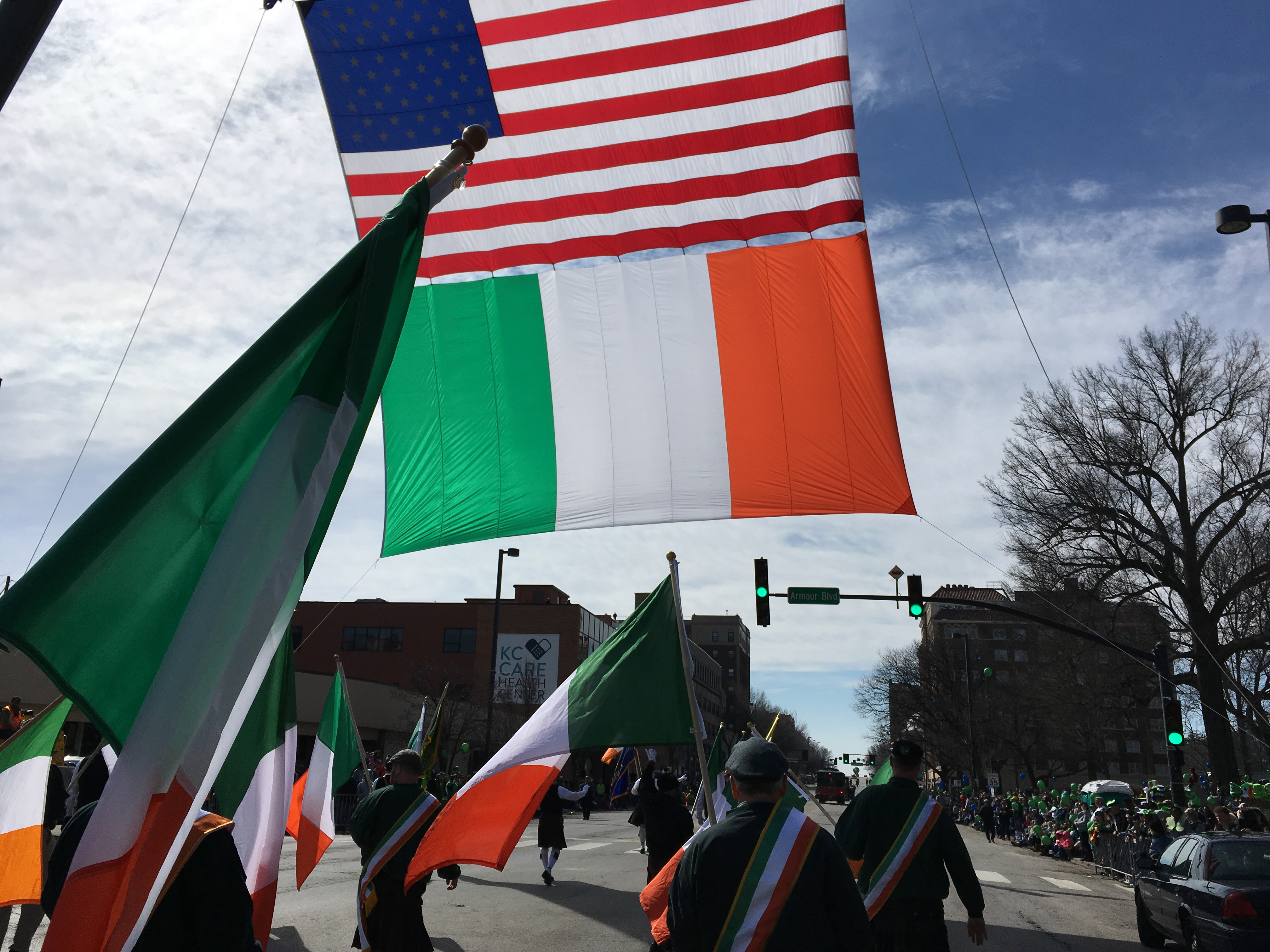
I for one have kept in touch with all of that because I believe it is intrinsic to understanding who I am. My Dad grew up under the same roof as his grandmother who came to this country from Mayo in 1920, and the fact that my parents chose to name me Sean demonstrated to me that this history was an important part of who I am even before I really began to understand what it all meant. For the record, I decided to add the fada to my name (Seán) when a little before my 10th birthday I learned that’s how it is spelled in Irish. I’ve devoted a great deal of time to learn the Irish language even though it’s not all that useful here in America because I know that it’s what my family once spoke, and in order to better understand them and by extension myself as well, I decided I ought to use one of my talents and learn it.This week we celebrated St. Patrick’s Day with our usual parades here in Kansas City. I marched in two this year, the warm-up parade on the Saturday before here in my neighborhood of Brookside and the big parade down Broadway in Midtown Kansas City on the holy day itself. Normally, I end the big parade and the holy day itself rather annoyed at how the old caricatures of Irishness and Irish Americanness persist along the route both in the parade and among the spectators. And while I did see some of that, I was more focused on marching with my brothers in the Fr. Bernard Donnelly Division of the Ancient Order of Hibernians (AOH). Many of us continued the celebration of our brotherhood and our common heritage later that day and it proved to be one of the better, and sunnier, St. Patrick’s Days that I’ve experienced in a long time. We, Irish Americans persist in our stubborn identity because we’ve built our communities in this country around our roots. It defines us distinctly from our fellow Americans, and with all good intentions demonstrates to our cousins across the water that we haven’t forgotten about them.


Carruthers Smith’s Museum

Carruthers Smith's Museum Wednesday Blog by Seán Thomas Kane

This week, a story about excess and secrets all in a museum built by an old reclusive Gilded Age tycoon named Carruthers Smith. — Click here to support the Wednesday Blog: https://www.patreon.com/sthosdkane The episode artwork this week was generated by Dreamstudio. I really need to get back to sketching.


This week, we join a team of federal agents as they investigate a strange museum owned by a reclusive Captain of Industry that has never opened its doors to the public.


Part I.

            I arrived at Carruthers Smith’s Museum just after 4:15 in the afternoon after nearly a three hour drive out from D.C. and across the Chesapeake Bridge and most of Delmarva to Lewes, Delaware where the reclusive tycoon had taken up residence nearly fifty years before. My office began tracking his investments five years ago, when my colleague Bill Hardy was on the case, but just last week when he came out here to this beach town he never returned. My partner, Penny Wilson, joked when we were leaving the Hoover Building’s garage that Bill must’ve gotten distracted by the beach and stuck around for an unannounced vacation. Whatever the case, Smith’s file was dropped on my desk, and I was sent out to the Delaware Shore to see what became of Bill, and then to pick up where he left off investigating Smith’s Museum. There was something that didn’t make sense about a museum that had never opened to the public.

            Carruthers Smith was one of the titans of the rubber industry, his tires and tank treads had helped us win the War in Europe, for one, and he was lauded by every administration since Franklin D. Roosevelt for his service to our country as one of the good, charitable captains of industry. His father was a strong supporter of the Taft Administration, having had his wings clipped by Theodore Roosevelt’s trust busting, and his grandfather one of the great Wall Street investors that supported Republican nominees from Grant through McKinley. The Smith Company hadn’t started with rubber tires, first they were a shipping company that cornered the market for trade between Rio de Janeiro and New York. They even helped keep an eye on ex-Confederates who’d escaped to Brazil in 1865, reporting on their whereabouts to Union authorities. Thanks to their deep connections in Rio as well as New York, they were well placed to corner the developing rubber market when it appeared almost forty years before Carruthers Smith was born. All this is to say it took a lot for any federal agency to be willing to investigate a good tycoon when there were plenty of rotten ones out there who ignored their workers’ safety or were notorious union-busters or preferred to outsource their factories overseas and flood the American market with cheap goods that were easily breakable and commonly known among the public as generally worthless. Smith Tires were different, they were sturdy and dependable, far more so than any competitor. They were especially good traveling over sand, so much so that the Army still kept a contract with Smith for tires for any future desert operations.

            Still, Penny and I were there in front of Carruthers Smith Museum, our car parallel parked with the handbrake on Franklin Avenue. It was a very modern building, white walls that showed some of the characteristic curves of the Art Deco, yet it seemed less brutalist than the Hirshhorn and more akin in color to the Guggenheim in New York. There seemed to be no front door where you could queue to enter, but there was a smaller service door off Franklin Ave. that I could see from the driver’s seat. “Do you think that’s it, Pat?” Penny asked.

            “Yeah, that seems to be it. Let’s go ring the bell.”

            We got out of the car and walked into this small service driveway and up the five concrete steps that led to the service door. There was an industrial-type doorbell affixed to the wall at the top of the steps next to a door that on closer inspection turned out to be steel painted white to match the rest of the building, yet it had no window through which the respondent could see their visitors or vice versa. I rang the bell, holding down the button for a good two seconds. “Mr. Smith, this is Agents Patrick O’Malley and Penelope Wilson of the FBI, may we come in and talk to you?” We waited for another thirty before a buzzing announced to us that the metallic lock on the door was released, and we were allowed entry.

            We found ourselves in a sort of room that could be a back office, it had denim blue carpet, and high wooden walls around which were photographs of the museum under construction beginning from the laying of the cornerstone in 1942. An old wooden desk stood to my left; it reminded me of a smaller version of the Resolute Desk that sits in the Oval Office. Before us was a set of stairs that led three steps up to another door. This one had a window, yet it was high up in the door, and thus too high for either of us to see through it. Yet there was light beyond it that seemed to dance off the high white ceilings of the room beyond. I nodded at Penny, and she walked up the steps and opened the door. The room beyond seemed minimalist in nature, yet it was still quite large. “This must be the museum,” Penny said.

            “It looks that way,” I replied, scanning left and right as we entered the room beyond. There was a high angled white wall to our left in front of us, blocking our view beyond to whatever was to the south in that room. To our right the room continued for some uncertain distance, its white tile floors fading into the darkness at the far edge of the room. There didn’t seem to be any art on the walls of the museum, nothing here displayed. What could Carruthers Smith have been collecting these last 50 years? Beyond the angled wall in front of us light danced on the ceiling from something metallic. I proceeded cautiously, my gun still holstered, as was Penny’s, yet we both knew we could draw in 3 seconds at least and be on guard. The heavy sounds of our shoes clicked across the floor as we rounded the corner and found a small metallic box on a table in front of a large glass display case standing erect that housed a large rubber object, rectangular in shape, and standing at least 6 feet tall. It seemed taller being up on a podium. I looked up at it, confused what I was seeing, “maybe it’s the largest single piece of rubber the Smith Company has ever produced,” I quipped to Penny.

            “It is in fact,” came a voice from behind us. We turned to see Carruthers Smith standing there, a tall man who once might have been the eye of many a high society debutante. He was slim in frame, wearing a gray double-breasted suit of the kind not often seen since the early 1960s. “This is the largest single piece of rubber that my family’s firm ever acquired and sought to study. How do you find it, Agent Wilson?”

            Penny looked back at it, “it’s a little unsettling, how is it held up in the case?”

            “You are welcome to walk around the back and discover that fact for yourself,” Carruthers replied in a slow, tenor voice that betrayed hints of the Transatlantic accent he and his class used decades ago.

            Penny looked at me and I nodded approval, sending her around the case to its right to ascertain the supports for this piece of rubber. “How is it standing on its own?” she asked with incredulity seeping through their voice.

            I walked left around the case and found her behind it looking for where some sort of supports ought to be yet instead there was nothing. The rubber artifact instead stood erect inside the case, not leaning on it or putting any pressure on the glass that could shatter it. Carruthers appeared behind Penny, “it truly is a wonderous specimen, one that was brought to our office in Rio from deep in the Amazon in 1941, on the same day that the Japanese attacked our fleet at Pearl Harbor. My agent who ran the Rio Office then, a Senhor Dos Santos, said that anyone who touched it felt as though they were touching something that seemed alive.”

            “Alive?” I asked, quizzically raising an eyebrow.

            “Yes, Agent O’Malley, this artifact was alive when it arrived here in early Spring 1942. I had it shipped into our wharves in Jersey City where it was loaded onto a train and brought to Lewes where I could study it myself.”

            “Mr. Carruthers, I know your family’s connection to this town doesn’t go back very far, didn’t your father have a summer cottage here?”

            “No, most of the family would summer in Newport, Rhode Island with our friends, yet I was the one who enjoyed the waters further south here in Delaware and found Lewes a fine enough little town to build my summer cottage here,” Carruthers replied, never dropping his hint of a smile.

            “When did you first come here then?” Penny asked.

            “In 1932, an 18 year old looking for something profound and reclusive in life. I’d read Thoreau you see; Walden inspired me to seek new things beyond the family firm or society life in New York. The Depression brought land prices low here, and I thought I might be able to help the local people. I provided tires at a 33% discount to all residents of Lewes, which ingratiated myself to their company.”

            “Is that why you built this museum?” I asked.

            Carruthers looked around him at the cavernous space, its white walls and white tile floors made the space feel monochromatic and minimalist. “I built this museum to house the treasures I’ve collected in my years, things old and new, mundane and,” he gestured to the rubber artifact before us, “wonderous.”

            “But why haven’t you opened it to the public?” I asked, “Surely this would be a testament to your life and work like the Carnegie Museums in Pittsburgh or the Freer Gallery in Washington?”

            “I never felt that it was complete and ready for the public. There was always something missing, something which I couldn’t quite place. I’ve been collecting for this museum now for 58 years ever since I first arrived in Lewes, and still the museum is not yet finished. But you, dear agents, have come a long way, surely you have business to attend to?”

            I looked at Penny who nodded and walked back around the display case. We followed behind her to the metal table that stood beyond. “Mr. Smith,” she began, “we are here to ask two questions. An agent of ours, Bill Hardy, came here a week ago to inquire into the contents of this museum that has never opened and ensure they are all legally in the country, and he has yet to report back to the office since. So, we are here both to see if you know what might have happened to Agent Hardy and to complete his assignment.”

            “I met with Agent Hardy when he arrived here on the 10th, he seemed to be in a hurry to return to Washington, so I didn’t want to detain him too long. As to his investigation into this museum, you can find the effects of that effort on the table here,” Carruthers motioned downwards toward the metal table between them where a single silver box was placed in the middle.

            “Sir, are you here alone?” I asked.

            “In fact, I have one assistant here with me,” Carruthers motioned to a man who only just seemed to appear from the corner of my eye. He wore a dark green museum guard’s uniform, with a black necktie on a white shirt. “Have you met Peter Dougherty? He’s one of your tribe, a fellow Irish American born in Brooklyn.”

            I turned to see Peter more clearly and saw a wizened old man, at least 80, who looked back at me with tired eyes. “How long as Mr. Dougherty been working for you?” I asked.

            “Peter was hired by my father as a warden to keep watch over me in my youth, in 1929 I believe.”

            “That’s correct, Mr. Smith,” Peter replied in a low baritone voice.

            “And you’ve been with Mr. Smith ever since?” Penny asked.

            “That’s correct, Agent Wilson.”

            “Peter served in the first war in the trenches under my Uncle George’s command, and after the war when lost his job after Black Tuesday, my dear uncle asked my father to bring him on.”

            “So, this Peter has been working for the Smith Family for over 60 years,” I thought, “he’s loyal then, very loyal.” “Where did you serve, Mr. Dougherty?”

            “At St. Mihiel and in the Meuse-Argonne Offensive with the Fighting 69th,” he replied proudly.

            “We appreciate your service,” Penny smiled at him. Peter returned the smile, yet he seemed tired by the process.

            “So, you say that this box is what remains of Agent Hardy’s investigation?” I asked.

            “Yes, Peter collected the things he left here.”

            “And when did he leave?”

            “He left his investigation on the 10th,” Carruthers replied, his expression unchanging.

            “On the same day he arrived?” Penny confirmed aloud.

            “Indeed,” Carruthers affirmed.

            “Then you haven’t seen him since the 10th?” I asked, pulling a notepad and pen out of my jacket’s right pocket and opening it to a page titled “Carruthers Smith Museum.”

            “That is correct, he had a sudden change of mind and chose to end his investigation right here while he was looking over the financial records of my museum.”

            “May we see those records?” I asked, trying to understand why Bill would give up an investigation like that.

            “Certainly, Agent Wilson, will you follow Peter, he’s not as strong as he once was and could use the help lifting these boxes, unless you’d rather attend to it, Agent O’Malley.”

            I looked at Penny who gave me a glance, I knew she could do this well enough, “Go with him, you’ve got this.”

            “Understood,” she replied, before turning and following the aged soldier to the northeast across the large gallery in which we stood until they passed beyond the light and into a portion enveloped in darkness. I could still hear their footsteps as a door beyond sight opened and they passed through that portal to the collections’ storage beyond.

            “How long have you and Agent Wilson been together?” Carruthers asked.

            “She was assigned to be my partner fresh out of the academy two years ago.”

            “So young,” he pined, “but keen eyed still. Would you care to sit and inspect the effects of Agent Hardy’s investigation,” Carruthers motioned toward the box on the table.

            I sat, feeling as though the invitation was unavoidable and slid open the metal lid with my hands. Inside were several metal artifacts, a slide-rule, Hardy’s notepad, and a paper sheath for the instrument. I took the notepad out first, noting that it was closed and flipped open the cover. The first few pages were notes from other cases he’d worked recently, followed by a page with directions to Lewes from Washington. Yet after that the pages were just filled with what seemed like random numbers, ten full pages of random numbers. “Can you explain these numbers, Mr. Smith?”

            Carruthers looked down at the paper in my hand, “they refer to specific indices in my records, you can find everything you need in the documents that Agent Wilson and Peter will shortly be bringing to this table.”

            I looked back down at them, and began to mutter the numbers aloud, for no apparent reason, yet still to mutter them aloud all the same. “Seven, nine, six, five, three, one, nine, eight, two, five, three, one, eight, three, seven, six, nine, zero, seven, five, three, nine, zero, seven, two, one, six, five, three,” until I found my eyes drooping, an air of drowsiness coming over me. It seemed like a good long while since Penny and Peter had left my sight and gone into that distant room off in the dark, what could be taking them so long? “Seven, nine, six, five, three, one, nine, eight, two, five, three, one, eight, three, seven, six, nine,” I tried to stand from the table yet felt my body heavier than expected; it was a weight which felt less physical and more emotional. I could swear I saw the display case to my left open, how could that be opening?! The large rubber artifact was there before me, what a strange thing it was. I began to see the darkness consume the distant edges of my vision until all that remained was that artifact, which seemed to yawn before me. I thought I could hear Bill’s voice, “Pat! What are you doing?” but soon all was silent.

Part II.

Penny found the collections room to be far less impressive than the gallery beyond. It’s linoleum floors and light green walls seemed to be caught in a time loop going back to the late 1940s when this part of the museum was built. She followed Peter further and further back into the collections until they came to a locked metal cabinet on a nondescript back wall. Peter took a key from his coat and unlocked it, revealing nearly a century’s worth of documents behind the door. “This is everything,” he said, “everything from Mr. Smith and his father’s time leading the firm.”

            “Mr. Smith’s father retired in 1936, yes?” Penny asked.

            “Yes, he left the firm to Mr. Smith in that year.”

            “And how long has Mr. Smith been collecting for this museum?”

            “For as long as I’ve known him,” Peter replied.

            “You know, my grandfather served in World War I,” Penny said, trying to make small talk as she began to finger through the files.

            “Did he,” Peter seemed uninterested in the topic.

            “Yes, he was an ambulance driver from Kansas City, most of the guys on his crew became animators.”

            “We all have our own paths to take, Agent Wilson.”

            Penny kept looking through the files, moving fast between folders with handwritten dates and names on them. “Are you looking for anything in particular, Agent Wilson?” Peter asked.

            “Not yet just trying to get an idea of what’s in here,” she replied as she kept quickly flipping through the folders. “So then, if you won’t talk about the war, what did you do between then and when you started working for the Smith Family?”

            “I was an interpreter for a while at Ellis Island until the government closed that facility in 1922.”

            “Which languages do you speak?”

            “English, French, Spanish, and Portuguese.”

            “Oh wow, you’ve got a knack for language, then.”

            “I ran away from home when I was fourteen and took a job on the Smith Company’s ships going to Rio, learned Portuguese there and Spanish on their stopovers in San Juan and Havana. I learned my French during the war. Captain Smith put me on interpreting duty with our French allies when he heard about my work.”

            “That’s Mr. Smith’s Uncle George, right?”

            “Right.”

            “So, what’d you do after 1922, Mr. Dougherty?”

            “I tried going back to the Smith Company, but they weren’t taking as many sailors for the Brazil Route anymore, so I became a policeman.”

            “You were a cop?” Penny turned to look at Peter who stood behind her still looking as tired as before.

            “I served with the New York Police Department for five years until 1927.”

            “What happened then?”

            “My sergeant had us raid the wrong alderman’s office and we were all out of a job.”

            “That’s tough,” Penny paused a moment, “I’m glad you were a good cop. My dad is a cop in Kansas City, it runs in our family.”

            Peter was silent, he still seemed reluctant to share much more than was necessary, even if it was just to pass the time.

            Penny ignored this, “What about your personal life, did you ever marry?” she asked, trying to unlock the man behind her as she pried open the files before her.

            Peter was silent for a moment before she heard a sigh, the first sound he’d made other than the odd monotone words she’d heard from him before. “I did, a long time ago.”

            Penny smiled, “what was her name?”

            “Delia McGinty.”

            “I see you stayed in the community,” Peter made no response to that attempted joke. “How did you meet?”

            “At a party in 1924 at the Hotel Commodore on 42nd Street in Manhattan hosted by one of the big Irish organizations in the city. She was there with a friend, Mary Mulroney. They were both famous for standing up for themselves.”

            “What did they do?”

            “They were suffragettes during the war, and afterwards Delia worked as a schoolteacher on the Lower East Side. She wanted to give these new kids who’d just arrived the welcome that our parents’ generation didn’t get.”

            “She sounds like an amazing woman. So, what happened?”

            Penny could feel a darkness shift over Peter’s face even though her back was turned to the older man, “We were married for nearly twenty years, but she disappeared around the time we went to war with Germany the second time in 1942.”

            Penny turned and offered a compassionate look, “I’m sorry, Peter, that must have devastated you.”

            Peter returned her gaze with a weary look, “It was a long time ago. My cop friends couldn’t find her, there was no sign of her anywhere. Mr. Smith took me in and invited me to move here to Lewes with him. I left the city and the memories and started anew.”

            Penny had reached the bottom third of the files when she found one that caught her eye, she read the label, “1941,” and turned to Peter again, “Isn’t this the year that that rubber artifact came into the Smith Family’s possession?”

            Peter’s face seemed weary, yet sharp with a renewed purpose. He reached into his coat pocket and drew a pistol, pointing it at Penny who stood from her squatted position. “Peter, what’re you doing?” Penny asked, alarm in her voice as she reached for her sidearm.

            “Don’t move, Mr. Smith said no one is to inquire about the origins of the artifact.”

            “Peter, you need to lower your weapon and put it on the floor,” Penny commanded.

            “I work for Mr. Smith, not you,” Peter said with a cold steel in his voice.

            “Mr. Smith is hiding something, Peter, why else would he order you to put your life and freedom in jeopardy by threatening a federal agent to protect it?”

            Peter gave no answer, but his hand had begun to shake. Penny stepped forward, gingerly, eyes on Peter’s. “Peter, I’m not going to hurt you, just give me the gun. There’s a reasonable explanation for all this.”

            Peter’s hand lost its steadiness, and Penny closed the gap between them, taking the gun from his hand and resetting the safety. She looked it over, “whose gun is this, Peter?”

            “It’s my old service pistol, from my cop days.”

            Penny looked at the gun, it had to be at least 63 years old, before returning her gaze to Peter, “let’s start over again,” she held the 1941 file up to him, “why is this file so important, Peter?” Peter was silent, “You were a good cop, remember, going after corrupt officials, protecting your community. Is it worth going to prison in your nineties to stay silent about this?”

            “I’ve lived a long life,” Peter said slowly, “Mr. Smith is the only person I have left. You’ll get there someday, Agent Wilson, when everyone you’ve ever known is gone.”

            “Yeah, you’re right, but for now Peter I’m with you, and I want you to understand I’m not going anywhere until you explain why you pulled your gun on me.”

            “Mr. Smith said no one should ever know what that thing really is, what it does. It caused a big ruckus in Rio when they first brought it into the warehouse. He never said what happened, just that they had to handle a police investigation over it and that some workers died.”

            “Some workers died because of that thing?” Penny was alarmed at the thought. “Pat’s in there, right next to it.”

            She ran for the door, leaving Peter behind her, pulled it open and charged back toward the table where Carruthers stood. “Where’s Pat!” she shouted.

            Carruthers turned to meet Penny’s fierce eyes, “Agent O’Malley left his investigation,” he said in the same soft, dry voice he’d used when they met him.

            Penny looked at the display case, it wasn’t quite as she’d left it, instead the front plate of glass seemed to reflect the light just a bit differently. “Mr. Smith, when I collected this file from your cabinet, your man Peter pulled his gun on me. Would you care to explain?”

            Carruthers looked to the file in her hand, “1941” he read on the label. “That file is confidential, and without a warrant I see no reason why you must be aware of its contents. Please return it to me,” he held out his hand.

            “No.”

            Carruthers’ face lost the soft glow of friendliness it’d had since they arrived, “I believe the law is clear on this matter, you have a piece of my personal property which if I’m correct in assuming you have no specific warrant to search.”

            Penny opened the file, as the papers caught the light from above, yet at that moment Carruthers moved to slam it shut, “you will not read anything in that file, it is not yours to read!” he commanded.

            “If you don’t want me reading that file then you can tell me where Pat is. When I left you, he was sitting at that table. You were the last person to see him and now he’s not here.”

            “He needed a rest from his troubles.”

            “What do you mean, rest?” Penny gave Carruthers an interrogatory look, her eyes locked on his. She caught the smallest of a micro expression, his eyes glanced slightly to the left toward the display case behind him. Penny dropped the file, revealing Peter’s service pistol in her hand beneath it, pulled the safety back and fired a shot into the display case. A second shot shattered the glass. A third pierced the rubber artifact within. An oil began to ooze out of the artifact as the air entered a newly formed chasm in the bullet’s path. Penny drew her own service weapon from the holster at her hip and pointed it at Carruthers. “Explain,” her one word command.

            “You have no right,” he whispered in a seething, quiet, and deadly voice.

            Footsteps came from behind as Peter appeared from the darkened far end of the gallery, a shocked look on his face. “Mr. Smith, I tried to stop her,” his voice faltered as he looked to the shattered display case and the fast liquifying rubber artifact. A hand appeared from within, followed by the arm to which it was attached, and soon Pat’s face and body were restored to light and air. Penny ran forward, her gun still drawn toward Carruthers. She pocketed Peter’s service weapon and caught Pat at his shoulder.

            “Are you okay?” she asked.

            Pat looked around, and caught Carruthers in his sight, “what was that thing?”

            Yet before he could respond another body appeared from the case, someone who was placed below Pat, it was Bill Hardy. He hadn’t taken that unannounced beach vacation after all. Penny got Pat onto his feet and went to help Bill who’d been immobile for a week now. “That thing ate me!” Bill shouted; his eyes blurred by the sudden shock of the gallery’s artificial light.

            There was still a good half of the artifact left, yet it kept draining out of the case, a white liquid oozing down onto the white tile floor below. Another figure began to appear, someone crouched down, kept still by the weight of the prison in which they’d been enthralled. Penny heard a sob come from across the room, and unsteady feet run forward as Peter approached the milky pool, “Delia?!” he shouted.

            Peter saw as a frail woman appeared from within, she didn’t seem to have aged as much as would be expected. She was crouched over, in almost a fetal position, wearing the same blue dress she’d worn the last day he saw her. Her eyes were glazed over, surely, she hadn’t seen daylight in almost fifty years. Yet her hair still had mere whisps of gray. Peter helped her up, though unsteady he lifted her from what remained to the artifact and set her in a chair at the metal table. Ensuring she was safe, and wouldn’t fall from her chair, where she’d begun to rub her eyes, Peter turned to his employer. “What happened?”

            Carruthers looked at the man who’d stood by his side for the last half century and laughed, a cruel, heartless laugh. “She came to me to ask about the workers who’d died in Rio. She said that she wouldn’t let it slide, and that if I was a true patriot, I would be better to my workers. Yet while we spoke, she saw the artifact, and slipped in.”

            “I didn’t slip,” Delia spoke with a defiant voice. “You gave me a piece of paper with notes about the workers to read, you told me this would have all the information I needed. You said I should read it aloud to prove to me that what you read was the truth. I read it and was drawn into that monstrous thing of yours.”

            “That’s what happened to me!” Pat shouted.

            “You had me write those numbers in my notebook, I figured they were accounting figures,” Bill said groggily. “What do those numbers do?”

            Carruthers remained defiant, keeping his silence in spite of his situation.

            “Give it up, Carruthers, you’re done for,” Peter said, standing up to the man who’d commanded his loyalty.

            “How dare you speak to me that way,” Carruthers seethed.

            Peter raised himself before the man, “You’re no better than the rest of us, you and your captains of industry. You were born into riches, but do you really know what I had to do just to survive? I’ve been watching you for sixty-one years, I know who you really are you two-faced miser. You’d happily put on the red, white, and blue in support of the war effort and to make people feel proud to buy Smith, but any chance you got to denigrate Mr. Roosevelt or Mr. Truman you took. You’re one of the good bosses, that’s what you told everyone, but I know you for the weasel that you are, the wolf in sheep’s clothing. You don’t care for any of us, not a one. We could all be starving and dying of plague and all you’d do is pack up and leave us to die.”

            Carruthers was seething with rage now, “How dare you speak to your betters like that, you worthless Irish scoundrel! All of you should’ve been sent back on your ships with your agitators and your freedom fighters! And you, Delia McGinty, we had a name for you and your kind who upset the natural order of things in 1920. Insufferables you all were!”

            Penny stepped forward, “that’s enough of this,” she took a pair of handcuffs from her jacket pocket, “Carruthers Smith, you’re under arrest for kidnapping, and attempted murder.” She grabbed his wrists and placed them behind his back, cuffing him there. “Bill, do you want to help me get him to our car? This was your case first.”

            “Gladly,” Bill said.

            Pat turned to Peter, “do you have a phone? I should call the office for backup.”

            Peter pointed toward the darkened portion of the gallery where he and Penny had disappeared before Pat began to read Bill’s notepad. Pat nodded and walked to the collections room to place his call.

            Peter turned and looked back at Delia. He took the other chair at the table and brought it around to her side, sitting in it next to her. “Delia, do you remember me?”

            “How long has it been, my love?”

            “Forty-eight years, forty-eight long years,” he sobbed as he hugged her.

            She looked at his face, “you must be at least ninety by now.”

            “Yes, but you don’t look a day older than the last time I saw your face.”

            “I don’t understand it,” she said, “if it’s been forty-eight years then I must be at least ninety-five. Do you have a mirror?”

            Peter looked around and cautiously took a shard of glass from the floor and held it up for Delia to see her reflection. “How is this possible?”

            They looked down at the floor, at the milky white liquid that oozed from the fallen artifact, gobsmacked at this new lease on their life together.

Part III.

The following morning a story appeared on the newswires in papers nationwide, “Carruthers Smith Arrested on Kidnapping Charges,” the headline read. 

Carruthers Smith, of the Smith Import Company family, was arrested by federal agents at his home in Lewes, Delaware on kidnapping charges on Saturday. Among his victims were 95 year old Delia McGinty Dougherty of Brooklyn, New York, and Agents William Hardy and Patrick O’Malley of Washington, D.C. who were in Lewes investigating possible charges of art theft lodged against the accused. Mr. Smith began building the Smith Museum of Contemporary Art in Lewes a town of just over 2,000 inhabitants on the shores of Delaware Bay in 1941, yet the museum famous in Lewes for its Streamline Moderne architecture never opened to the public. 

Dr. Ronald Yancey, M.D. of Lewes inspected Agents Hardy and O’Malley, and the miraculously young suffragette Delia McGinty Dougherty, and concluded all were in good health despite the unusual circumstances of their captivity. Carruthers himself was taken by federal agents from Washington, D.C. for questioning and is being held in a detention facility in Wilmington pending trial before the United States District Court for the District of Delaware. No other arrests were made in the raid. Mr. Smith, age 76, was famous in his youth as the captain of industry who singlehandedly supplied the Allied forces in World War II with rubber tires that could traverse the deserts of the North African Campaign and the muddy fields of Northern France and Germany. For his service, he was awarded the Congressional Gold Medal in 1947 by Speaker of the House Joseph W. Martin, Jr. (R-MA).

One curiosity of the case is the vitality of Mrs. Dougherty, age 95, who Dr. Yancey wrote appears to be physically fifty years younger than her age. Dr. Yancey offered no comment when asked further about her condition. Mrs. Dougherty’s husband, Mr. Peter Dougherty, age 91, of Brooklyn, has lived in Lewes with Mr. Smith since 1942. When asked for comment on his wife’s health, Mr. Dougherty said “I am fortunate indeed to have these next few years to spend with my beloved.” No charges have been filed against Mr. Dougherty. Agent Penelope Wilson, one of the three federal agents who were investigating Mr. Smith told Sophie Fleming of the Daily Whale, the Lewes local newspaper, that Mr. Dougherty was unaware his employer had been imprisoning Mrs. Dougherty in the museum. Mr. Dougherty agreed to stand as a witness against Mr. Smith in the tycoon’s impending federal trial.

This is not the first missing persons case connected to Mr. Smith. In 1941 several workers from the Brazilian branch of the Smith Company disappeared on the job Rio de Janeiro. Brazilian authorities have said they are interested in questioning Mr. Smith.

A spokesman for the federal agency responsible for the raid said no objects were found in the museum’s galleries.

The Essence of Being

This week, to begin Season 4 of the Wednesday Blog podcast, I want to talk about what it means to exist. I know, small topic for a Wednesday. — Click here to support the Wednesday Blog: https://www.patreon.com/sthosdkane


This week, to begin Season 4 of the Wednesday Blog podcast, I want to talk about what it means to exist. I know, small topic for a Wednesday.


Two weeks ago, I started teaching a new class that I’m calling Bunrang Ghaeilge, Beginner Irish. The students come from my fellow members of the Fr. Bernard Donnelly Division of the Ancient Order of Hibernians and their relatives, and in the first two weeks we’ve progressed slower than I initially expected yet we’re still progressing through the materials. The first verb which I taught my current students in English translates as to be, yet in Irish as two forms: is for a more permanent being and  in a more impermanent circumstance. In the moment I explained this difference by noting how I say is as Chicago mé (I am from Chicago), as in I was born in the Chicago area, but I say tá mé i mo chónaí in Kansas City (I live in Kansas City). We don’t have this distinction in English, either between the permanent and impermanent versions of the to be verb or in the clear distinction between where you’re from at birth and where you currently live; that distinction is far more subtle in English.

At the same time, I am learning Italian for a trip this summer, my own version of the Grand Tour, and on the Busuu app where I’m learning Italian they taught that I should say sono di Chicago però abito a Kansas City,as in I was born in Chicago, but I inhabit today in Kansas City. This distinction between a place that is central to our essence, the place where we were born, and the place where we now live seem important, yet it flies in the face of the American sense of reinvention that we can make ourselves into whomever we want to be. It’s struck me when I’ve met people who would rather see themselves as from the place where they currently live than the place where they were born. That is a different view from my own, born out of different lived experiences and different aspirations.

This word essence developed from the Latin word essentia, which the 1st century CE Stoic philosopher Seneca wrote was coined by the great orator Cicero as a translation of the Greek word οὐσία (ousia), a noun form of the Ancient Greek verb εἰμί (eimi), meaning “to be.” (Sen., Ep. 58.6) It refers to an innate idea that the ultimate goal of philosophy and learning in general is to better understand the self; the most famous inscription in the ancient Temple of Apollo at Delphi read γνῶθι σαυτόν (gnōthi sauton), or “know thyself.” I add to that goal the aspiration that one can improve oneself. 

This time of year, I find myself thinking more and more about what it means for me to be an Irish American. This past weekend we celebrated St. Patrick’s Day, a day of great celebration for the global Irish diaspora and our cousins back in Ireland as well. I’ve written before here about how my communities’ immigrant connections to Ireland often predate the current century, if not the twentieth century as well and how we are in many respects far more American than Irish. In recent years, I began to refer to myself in this subject as an American cousin, after all as much as I have Irish roots and I come from an Irish family, I’m an American and have lived an American life to date. I’m not as far removed from Ireland as many I know, yet this year marks the 110th anniversary of my great-grandfather Thomas Kane’s arrival in America.

There’s something about being Irish American which doesn’t quite fit neatly into any of the official boxes. In Ireland, to be Irish is to be from Ireland or to be a close enough descendant that you qualify for Irish citizenship, like my father does. In America, there’s a sense that the old stereotypes of Irish immigrants are fair caricatures to still uphold, especially on our communities’ holiday in much the same way that the sombreros are donned on Cinco de Mayo. Yet there’s a lot more to it. On both sides of the Atlantic, our communities have the same deeply intertwined connections between families near and far, friends in common, and a sense of nostalgia that I see especially strong among those of us born in America.

Perhaps the Irish language can offer the best answer here. In Irish, I’ll say to Irish people, as I wrote a few paragraphs ago, “Is col ceathrair Meiriceánach mé.” Yet the official Irish name for us Irish Americans is “na Gael-Meiriceánigh”, or Gaelic Americans. I think this speaks to something far older and deeper than any geographic or political connections. We come from common ancestors, share common histories and stories that wind their way back generations and centuries even. We are who we are because of whom we’ve come from. I hope to pass this rich legacy in all its joys and struggles onto the next generation in my family; perhaps I dream of those not yet born hoping they’ll be better versions of my own generation. I hope they’ll still feel this connection to our diaspora like I do even as we continue on our way along the long winding road of time further and further from Ireland.

I am the child of my parents, the grandchild of my grandparents, and great-grandchild of my great-grandparents. In so many ways, I am who I am today because of those who’ve come before me. The geography of my life was written by them, by a choice among other immigrants from County Mayo my ancestors found their way to Chicago instead of Boston, New York, or Philadelphia. My politics reflect my ancestors’ views as well, in the Irish context the legacies of the Home Rule Crisis of 1912-1916, the Easter Rising of 1916, the War of Independence of 1919-1921, and the Civil War of 1922-1924 all have as much of a presence in my political philosophy as does their American contemporaries: the Progressive Era and its successor in the New Deal coalition. Yet I am my own person, and from these foundations I’ve built my own house in as much of an image of the past as it is a hope for the future.

What does it mean then to be ourselves? We hear a great deal today about how people identify, in a way which seems to be a radical departure from older norms and expectations both in the English language and in how we live. We constantly seek answers to all of our questions because we anticipate that all of our questions can be answered, yet the mystery of being is one of my great joys. I love that there are always things which I do not know, things with which I’m unfamiliar and uncertain. This is where belief extends my horizons beyond what my knowledge can hold, a belief born from the optimistic twins of aspiration and imagination. I know that the essence of my being, the very fundamental elements of who I am, draw far more from these twins than any other emotion. I am what my dreams make of me, I see my world with eyes colored by what my mind imagines might be possible; and in that possibility I find the courage to hope for a better tomorrow.


How Irish Understands the World

After I released my previous episode “Summer School in Irish” back at the beginning of August, I had a good conversation with one of my best friends and one of my most frequent listeners, past Wednesday Blog guest Alex Brisson, about the utility of keeping smaller languages like Irish alive. How do these languages benefit humanity when we’re moving toward a time of greater linguistic conformity, when there are a handful of global human linguae francae, such as English, Mandarin, Russian, Arabic, Spanish, and French (the official languages of the United Nations)?

I responded by lauding the beauty of Irish, by the fact that Irish helps the speaker understand the nature and world around them differently. Take the phrase Tá mé i ngrá leat for example. This means “I love you,” though not quite in the same sense as the English. In English, there’s the subject “I” who’s doing an action “love” to the object “you.” This is the same way that this sentiment is expressed in many other languages from German “Ich liebe dich” to French “Je t’aime” to Spanish’s “Yo te amo” or more simply “Te amo.” 

Irish, on the other hand takes a less forceful approach, instead having the subject “mé” being in a state of love ” i ngrá” with the object “leat.” Thus, in Irish the expression Tá mé i ngrá leat says less that one person is expressing love toward another and more that both people are in a state of love with each other, a model of relationship that I personally prefer far more. Losing a language like Irish loses this elegant worldview, it takes away one particular means of understanding how one group of humans has long perceived the world around them.

Another way that Irish does things differently from English is in the use of a habitual copular verb. In plain English this means there’s a version of “to be” that expresses an action that’s done on a regular basis, so Bím ag scríobh colún gach seachtain a The Wednesday Blog atá air. | I write a column every week which is called The Wednesday Blog. This particular verbal construction of Bím rather than the present active tense Tá mé as seen in the last example helps express the regularity of the action, the writing of the blog and podcast itself. It demonstrates that I, Seán, am on a weekly basis writing this string of ideas which you, dear reader or listener, then choose to read or listen to. It also offers a sense of much needed hope that yes, I’ll actually keep writing The Wednesday Blog, something which I’m always not sure about. Today though, looking back at the 40 episodes already written and the 38 blog posts that came before the launch of the podcast, I’d like to think I’ve gotten myself into a good rhythm.

If there’s any other chief argument I’ve made in the past for why Irish ought to be kept alive, even taken off life support one day and spoken as another one of Europe’s vibrant languages, it’s that so many echoes of its once and future vitality still exist on the face of our world today. Take my name, Seán Thomas Kane, which though not intentional is a highly traditional Irish name. In Irish, my name is Seán mac Tomás Ó Catháin, or Seán, son of Thomas, descendant of Cathán. Cathán was a King of Ulster who ruled in the late 9th century CE about the same time as Alfred the Great was on the throne of Wessex. Thomas is my Dad, Tom Kane, meaning that my name actually works quite well seeing as I am actually Seán mac Tomás, or in the more clunky English Seán, son of Thomas. You can often tell when a family over here in the U.S. are Irish Americans by the fact that the parents and kids tend to have similar Irish names like Brigid, Patrick, Maureen, Brendan, or Molly, among others. While we’ve generally lost our ancestral language through the generations spent living in English-speaking countries, we’ve still kept aspects of that culture alive.

One thing I would love to see someday is a vibrant, if spread out, Irish-speaking community here in North America. It would be neat to have that sort of communal connection through our ancestral language preserved and even slightly transformed by our own distinct experiences living in North America from the Irish that’s spoken today in Ireland. Perhaps this would be seen in the gradual creation of a North American dialect of Irish alongside the three modern dialects of Connacht, Munster, and Ulster Irish. I for one am finding it easiest to speak a bit of a mix of Connacht Irish (the dialect spoken by my family) and Ulster Irish, though I’ve also learned many a Munster mannerism and mode of doing things as well.

Here in the United States our monolingualism has so greatly influenced our way of thinking that it is strange to consider a life where one might speak one language at home and one out in society. This is something done by people everywhere, even here in the US. In that future, even if we do come up with some sort of universal translator that just renders all linguistic barriers largely null and void, there would still be room for people to speak their own languages in their own way among themselves.

Go raibh maith agaibh go héisteacht! Thanks for listening!

Culture

This week, some thoughts on what keeps a culture alive.

I really enjoy going to concerts and hearing all sorts of musicians from all around the globe perform. I’ve been lucky enough to attend some historic concerts, such as the 2012 performance of the Cuban National Symphony Orchestra at the Kauffman Center in Kansas City. It was their first performance in the United States since the beginning of the embargo on Cuba in the 1960s. In that moment I could feel echoes of a vibrant and lively culture living alongside my own in the same moment in time. The way the musicians put their own spin, their own rhythm on Gershwin’s Rhapsody in Blue to make it sound Cuban was wonderful to hear. Still, the setting of the concert hall where there is a clear physical barrier between the performers who stand or sit on a stage frozen in place with an audience watching all around does sometimes give me chills. 

There have been many other concerts that I’ve attended where music or stories from particular cultures are played or told, relayed to us an audience foreign to those artists’ culture. Yet the way they’re transmitted, removed from the physical surroundings of those artists’ home, placed on a sterile stage where we can hear and see everything in perfect clarity, takes something out of the performance. It worries me that in America we’ve come to expect that particularly “cultural” things, especially if they’re foreign or “ethnic” ought to be neatly packaged in an expected format and set up. That way they can be interpreted through our own cultural lens in such a way that if I see a bottle of Italian seasonings in the grocery store, I’ll be able to tell first and foremost that those are seasonings. Yet in that standardization of culture to fit a set mold into which all its many and contradictory elements can be poured and melted down, we lose a great deal of the memories and the life that those cultural artifacts embodied.

My own people, the Irish Americans, have an interesting relationship with this. We still maintain some elements of a distinct culture from other European-descended ethnic groups in the United States, though I know some reading or listening to this might object to my use of the word “ethnic” to describe a community so assimilated into mainstream American society. The problem for me arises in trying to answer how our culture is still even partially Irish. Here in Kansas City, we have plenty of people who play Irish music, myself included, as well as a couple of local Irish dance schools. We even have a local Irish Center where classes in the Irish language are taught. Yet when most of those cultural milestones are performed, they are often more so in delineated places and situations where they are expected, say at the Kansas City Irish Fest, rather than more organically on a regular basis as a daily part of life. 

One of the great exceptions to this rule is with music, after all some of my favorite concert memories have been sitting in on the jam sessions at the Irish Center and at other venues around town, even in the homes of friends. There, an element of our Irish American culture is still being performed organically, like a group of friends getting together one evening for a party. It just so happens that instead of playing the Top 40 Hits at that party they might pull out their own instruments and play their own top 40 for themselves.

Culture is fundamentally performative, and to survive it must flourish organically in the setting where it exists. This past weekend I had the honor of serving as a groomsman for one of my best friends who is Greek Orthodox. The wedding took place in his church, and clearly seemed to be an unfamiliar ceremony to many of those present who weren’t themselves Greek (myself included). Still, I found the chanted prayers and hymns––most of which were performed in English––to be fairly easy to learn, and after the first one I was able to add my own voice to the congregation. Later that evening the typical wedding reception DJ hits were freely interspersed with Greek dances, which likewise for the average participant were far easier to pick up on than any of the Irish dances I’ve done over the years. There’s a culture that’s still vibrant in how ordinary its performances tend to be for the people who live it every day.

It struck me that the idea of having Irish music played at an Irish American wedding reception would probably be met with shock, after all most of us don’t know the steps for the jigs and reels that make up Irish dance today. Furthermore, someone is bound to be annoyed by some inconsistency with what is properly Irish American, meaning that trying to toe the line of ensuring that one’s Irish American cultural practices are so highly regulated that they become harder than necessary to follow. I for one would love to try and introduce some elements of jazz into the jigs, reels, and airs that I’ve learned to play on the tin whistle, and if I do ever get around to joining in a specifically Irish dance again you can bet that I’ll let my arms move more freely than is expected.

I worry that a culture which isn’t performed as a daily routine will gradually become fossilized. Such a culture, if confined only to special events that aren’t expected or normal for the everyday, will surely die, leaving its participants poorer as a result. Perhaps one of the greatest differences between Greek American culture and Irish American culture is that our ethnic church, Roman Catholicism, did not preserve our Irish language as the language of liturgy and spirituality. Rather, Catholic priests continued to say the Mass in Latin until the 1960s, by which point so few Irish Americans still spoke Irish that there are hardly any Irish Masses performed here in the United States today. I’ve only ever been to one such Mass that was done entirely in Irish. It was said on a stage at the Dublin Irish Festival outside Columbus, Ohio where we the congregation watched on as if gazing at some exotic ceremony stuck out of place and out of time. That most essential element of any culture, the way in which it speaks and sings and laughs and cries, its language, is vital to that culture’s survival. And in a country where we make up a good portion of English-speaking Catholics, our Church has assimilated faster than our hopes for a distinct Irish American culture may have wanted.

The Voice of American Music

Growing up there always seemed to be a few specific genres of hymns that’d be sung at Mass: the really traditional Latin hymns that go back into the Middle Ages, the eighteenth and nineteenth century hymns, often of Lutheran or Methodist origin that we Catholics had adopted, without necessarily acknowledging their sources, and the newer hymns written by the likes of the St. Louis Jesuits or those that came out of the spiritual and Gospel tradition native to this country. Often, my experiences performing music, whether singing or playing, was pretty well focused on church music and on the other hand on traditional Irish music, which I started learning when I was 13.

It strikes me how much our common musical language here in the United States can bridge gaps that we ourselves aren’t yet quite ready to leap across ourselves. My own experiences coming from a Midwestern Irish American Catholic family are entirely different from many of the people I work with today on so many different levels, but at the core of it all there seems to be this same common musical language that subconsciously unites us.

One of my favorite YouTube videos lately is of the great cellist Yo-Yo Ma performing “Going Home” from Dvorak’s 9th Symphony for the New American Arts Festival. Ma begins his contribution by telling the story of Dvorak’s time teaching music to his American students before his own return to Europe, and how the Czech master told them not to copy his style but to go out and listen to all the different music around them and create their own style from that. Out of those students and their students came Duke Ellington, George Gershwin, and Aaron Copeland, three of the great American composers of their day.

I often find myself thinking of how I could embody this country in a particular sound, or in a sonic landscape that could immediately transport me as I listen to one part of this country or another. When I wrote my trio sonata for flute, violin, and cello, I set the first three movements in a very Irish tone. The first movement was an entirely original jig, with the flute taking the part that I’d normally play with my tin whistle. The second movement ended up being my version of Dvorak’s “Going Home”, this time a setting of the Irish air “An Gaoth Aneas,” known in English as “The South Wind,” the third movement ended up being a setting of the jig “Merrily Kiss the Quaker’s Wife,” which has a really fun second part to it.

The fourth movement though was again something new. But unlike the first three movements, which told their story with an Irish voice, the fourth movement was set in America, and to tell that story I tried to emulate the voice that Aaron Copeland composed in, built off the sound of American folk tunes, their very particular twang that certainly has some Irish roots but has changed with all the other influences on music in this country. I wrote that fourth movement with the spirituals and originally Methodist hymns I’ve sung at Mass all my life in mind, and compared to the rest of the piece it has a very different sound.

There’s a related but still different sound in the musical landscape of the American West, something born out of both old cowboy songs from the nineteenth century as well as both twentieth century Hollywood soundtracks to the great Westerns, including my personal favorites, the contributions of Ennio Morricone’s to the genre through his scores for Sergio Leone’s spaghetti westerns A Fistful of Dollars, For a Few Dollars More, The Good, The Bad, and the Ugly, and of course Once Upon a Time in the West. Still more interesting to me is that this western soundscape has been picked up in recent decades by the continued popularity of Country music, though admittedly it’s a genre I’m personally not nearly as fond of as many of my fellow Americans.

When I think of one particularly American instrument, it’s honestly the trumpet. Sure, this is something that was invented in Europe and is used in all sorts of contexts outside American music, but the trumpet nevertheless plays a central role in two particular musical genres that speak volumes to me personally. The first is the frequent use of the trumpet to represent the solemn dignity of the republic, as a calling card for our country as the first modern representative government. It’s something I hear particularly in the film music of John Williams, especially in his scores for Lincoln and Amistad.

This particular sound blends into the use of the trumpet as a stand in for the military as well, seen especially well in Williams’s score to Saving Private Ryan or in Jerry Goldsmith’s score for the film Patton and Elmer Bernstein’s mix of military motifs with Keystone Cops silliness in his score for Stripes. The trumpet, it’s simple yet pronounced call, seems to me to symbolize the idealized nature of this republic, and its classical legacy with the same instrument often being used in sword and sandal films to stand in for Republican Rome.

The other great genre that uses the trumpet to tremendous effect is my favorite genre created in this country: jazz. When I was first really learning about jazz as an adolescent I specifically remember thinking that I was less interested in what I saw as that boring piano jazz that my Dad liked to listen to on NPR. Instead, I wanted to hear the exciting stuff written for trumpets and trombones and horns.

I’ve since grown to love piano jazz, as my students can tell you from listening to Duke Ellington, Count Baisie, and Jon Batiste before the start of my classes every Friday (when I can get the sound in the classroom to work), but I still have a knack for wanting to hear trumpet. I’ve gotten to see Wynton Marsalis play live twice now, the first time with the Abyssinian Gospel Choir when they played his Abyssinian Mass at the Kauffman Center in Kansas City about 7 years ago, the second time when he played with Jazz at Lincoln Center in a Christmas concert at the Midland Theatre in 2015 or 2016. Jazz trumpet especially lends itself to Latin Jazz, another part of this country’s and more broadly these continents’ musical landscape that speaks directly to the soul of what it means to be American.

One of these days, I’d like to try to blend the traditional Irish music that I play with jazz, to see what sorts of neat sounds come out of it. What sort of language will be sung by those instruments when they come together. Maybe if I try my hand at composing again I’ll make an effort at it. Oh, and if you’re looking for recordings of my sonata I’m afraid you’re out of luck, it’s yet to be performed, though I’m open to offers there.