Tag Archives: Joy

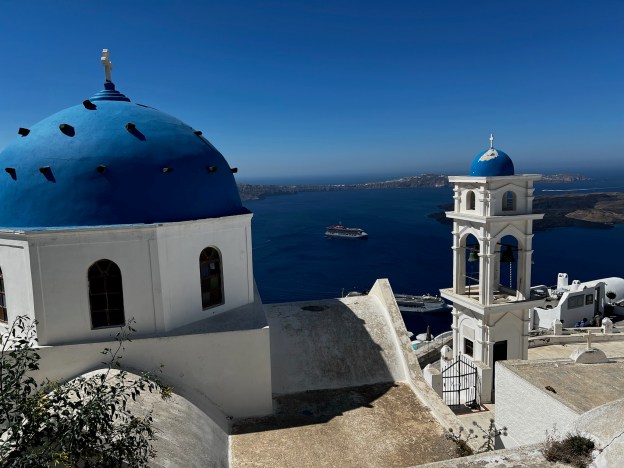
A view from behind a church on the Greek island of Santorini.

On Simplicity

This week, how the greatest wisdom is simple in nature.—Click here to support the Wednesday Blog: https://www.patreon.com/sthosdkane—Sources:Photo by Elizabeth Duke.[1] Nikos Kazantzakis, Zorba the Greek: The Saint’s Life of Alexis Zorba, trans. Peter Bien, (Simon and Schuster, 1946, 2014), 81.[2] “Elephant Tails,” Wednesday Blog 5.24.[3] “Asking the Computer,” Wednesday Blog 5.26.[4] “On Political Violence,” Wednesday Blog 5.17.


This week, how the greatest wisdom is simple in nature.


Over the last several weeks I’ve written about forms of knowledge and knowledge collecting. Knowledge is easier to identify, as it is empirical in its core. Yet on a scale even beyond knowledge lies wisdom, the cumulative sum of humanity’s understanding of the underlying character of human nature. It’s very easy for me to get bogged down in words, words, words and tie myself in knots which I find nigh unbreakable and even more undecipherable. Yet amid all those layers of paint there are often gems which merely need good editing to illuminate. This is what fills my days today, a big edit which I hope will signal the beginning of the end of my years of doctoral study.

In these years, while I’ve devoted my days to reading histories of the Renaissance intersections between the Americas and France, I’ve made a point of reading for fun all the same. I need to read things not related to my research for the escape they provide. At times these fun readings have been more thoroughly connected to my research, as in my recent choice of Jason Roberts’s Every Living Thing, yet in Binghamton I spent many happy evening hours reading Star Trek anthologies and novels while returning to my vocation each day. Of the stories that I’m drawn to, I enjoy reading books and watching films with characters that embody a certain lived experience that begats wisdom. Recently, this desire for such a character led me to read Peter Bien’s new translation of Nikos Kazantzakis’s Zorba the Greek: The Saint’s Life of Alexis Zorba. This is phronesis. Zorba’s wisdom is one that’s been gathered over the sixty years of his life and funneled toward living a good life as he sees fit. His is a simple wisdom which recognizes the physical limitations of the body in opposition to the limitless potential of the soul. I loved the first dance scene in Zorba the Greek in which the old miner erupted upward from his dinner and began to leap about. Kazantzakis describes it as though his soul could not be contained by his body and that it was that spiritual essence which spoke so fervently and wordlessly of its own joy. Kazantzakis can make even the simplest of scenes appear elegant and luminous. His description of the passage of time on the Mediterranean reaching up from Africa to the southern shore of Crete is one of my favorites. Here, I quote from Bien’s translation with the affection that beautiful prose deserves:

“The immense sea reached African shores. Every so often a warm southwest wind blew from distant red-hot deserts. In the morning the sea smelled like watermelons; at midday it vented haze, surged upward discharging miniature unripe breasts; in the evening, rose pink, wine red, eggplant mauve, dark blue, it kept continuously sighing.”[1]

The wisdom inherent in Kazantzakis’s prose lies in his ability to evoke the variable texture of nature, the changing face of it with the passage of the day. I remember once in Binghamton I have the idea to take a selfie once an hour throughout the day to see how my face, hair, stubble, and what not changed as the hours passed. I know for instance that if I want to have a lower register in my recordings of this Wednesday Blog that I need to record first thing in the morning when my tenor is closer to a baritone. This week, owing to a general sense of exhaustion, I haven’t gotten around to writing this essay until nearly 90 minutes before when the podcast normally publishes. Rather than force myself to write something earlier in the day I waited and gave myself the time to think of something good.

Wisdom is knowing that worrying won’t get you anywhere; it lies in the peace of mind and heart that keeps us happy and healthy. This evening, while I was having dinner with one of my best friends and his wife and young son, I brought up my particular conundrum of the day. Jokingly, the suggestion that I write about simplicity was made. I shrugged, thinking of William of Ockham, one of Bill Nye’s favorite history of science examples to use, and decided to run with it. After all, often the wisest people that I’ve met are the ones who embrace the simplicity of living a life embracing their own nature. The wise know that they are going to grow old and die and don’t worry about it. I find myself thinking of this as I watch without much resource as my hair recedes. I’ve joked that my particularly follicly impaired genes may require an eventual investment in a variety of hairpieces for different degrees of formality. I’ve grown in my own comfort with taking care of myself, applying sunscreen before going out on walks around the neighborhood now to mitigate the inevitable that comes from having largely Irish genes and living in the far sunnier Midwestern climate than my ancestors’ rain soaked home soil in Mayo. In his Saint’s Life, Alexis Zorba often doesn’t worry about these things and expresses frustration and even anger when the narrator, his boss, frets about the things he cannot control. I’m better at this than I have been, which is reassuring in some ways of looking at things, yet I still have room to grow.

Wisdom is trusting the people around you to do what they feel is best. If the simplest solution is often the best, then why aim to make things overly complex? Complexity requires forethought, or sometimes is the result of a lack of forethought. Last summer I delighted in writing several essays for the Wednesday Blog attempting to adapt chaos theory to explain human behavior.[2] We need both complexity and simplicity to understand ourselves and the world in which we live. Think about it: we cannot narrow things down to binary options. More often, the binary is one of a series of binaries which together form a logical thought or series. I marvel at the fact that computers most fundamentally work in the binary language of 1s and 0s, and that in this manner language and thought are boiled down to so rudimentary an interpretation. It’s for this reason that while I’m concerned by the rise and development of artificial intelligence and its misuse, I feel a sense of assurance that it is still limited by its basic functions and limited by the abilities of its artifice.[3] The human brain is a wonderous and ever complicated organ which evolved to fulfill its own very particular needs. On the simplest level the brain thinks, it sends directions to the rest of the body to keep the body operating. In a theological framework, I’ve argued that the brain may be the seat of the soul, the consciousness that is at the core of our thought. My earliest memory that I’ve written about here was the first time I recognized that particular voice of my own consciousness, which occurred sometime when I was 3 years old.[4]

Wisdom is intangible, it’s something that you have to learn to recognize. This is perhaps the most complex tenant that represents something simple. In order to truly become wise, one must understand that wisdom isn’t something you can buy off the shelf or write your way into. For all the words which Zorba’s boss writes, allowing them to consume him, he remains feeling unfulfilled in life. It’s why the narrator of the novel struck out from his books and sought to live among ordinary people, buying a stake in a lignite mine on the southern shore of Crete. On his way there in the Piraeus he met Zorba, the man who within a few pages became his foreman and the one who’d realize his idea of finding wisdom in the living world. The simplest explanations are often best. Zorba lives to enjoy the life he has, and when things go wrong––as they often do––he finds something to build upon and start over again.

A couple of months from now I’m going to be contributing my own experiences to a tacit knowledge panel at the History of Science Society’s conference in New Orleans about how I’ve been able to maintain a full research load and writing all year round with hardly any funding at all. I recognize that the circumstances of these past few years have been marked by my own poor decisions and mistakes that I’ve made along the way. Yet in spite of those, and bad luck in many respects, I’ve been able to continue with my work and to produce historical studies that are beginning to make a decent contribution to the history of science in the Renaissance and specifically to the history of animals in that same period. I’m looking forward to that panel, and to the two papers I’m presenting during the same weekend. Maybe, like Zorba, when things feel like they are about to go well I’ll feel the need to rise to my feet and leap into the air as though my soul were attempting to escape from my body. Simply put, for all the trouble that life has brought, joy is overpowering when pure.


[1] Nikos Kazantzakis, Zorba the Greek: The Saint’s Life of Alexis Zorba, trans. Peter Bien, (Simon and Schuster, 1946, 2014), 81.

[2] “Elephant Tails,” Wednesday Blog 5.24.

[3] “Asking the Computer,” Wednesday Blog 5.26.

[4] “On Political Violence,” Wednesday Blog 5.17.

On Universals

This week, I discuss some of the things which are common to all of us, problems we all share, and why I think we ought to look at solving those problems.—Click here to support the Wednesday Blog: https://www.patreon.com/sthosdkane


This week, I discuss some of the things which are common to all of us, problems we all share, and why I think we ought to look at solving those problems.


I don’t rest much these days, there’s so much I have on my mind from my work to my hopes for my life to the state of our world boiling in tumult around us. I sleep, yet I rarely feel rested when I awaken. I suspect it’s worse on those mornings when I’m pulled awake from the middle of a dream, that is from REM sleep into my waking reality. Perhaps this is the same for you if you’ve noticed it. This morning was one such occurrence and I’ve been tired throughout the day, even drifting off to sleep midday while watching the Cubs game and later riding in the backseat of my family’s car to an event. These days, I have a lot on my plate, and as one of my best friends pointed out to me recently, I’m probably due for a vacation of at least a week in length. When I have the time and the money to do so I’ll probably slip away somewhere as suggested.

I’ve always thought that the more technologically advanced our society becomes the better life will be for we humans who crafted these machines and machine intelligences which are the hallmarks of our civilization today. I suspect many, if not all, of you would both agree and disagree on some level with this statement. Life is easier on some counts, yet we still haven’t found a way to relieve the burden of human labor through invention. This is one of many universals we all have in common, one of many things we can look to and nod at as signs of our humanity. We all struggle in our own way, and we all have things we love and fear. I think at the core of our problems today is the desire to divide us into camps armed to the teeth to defend their own circle from the other circles out there in the fog of doubt. How often I’ve worried about nothing when someone doesn’t respond to a message, email, or letter when the person on the other end was simply busy! We all dream, don’t we? In our waking moments as well as in our sleep we dream about the life we want to have in our future. There does lie a difference between those who see those dreams as blueprints for what they can create and those who merely see these dreams as figments of an overactive imagination. Yet that difference can be overcome with enough courage and determination to see a better tomorrow.

I do believe that we all want to be happy, the question lies in what we each believe on our own terms will make us happy. In America, a country with capitalism so deeply baked into our collective consciousness, happiness is often quantifiable in dollars and cents. I went to college with a lot of people who chose their majors out of a conviction that their happiness would come if they became rich. I also know other people who are happy with quiet, unassuming lives. In my case I know I am capable of doing great things, of making an impact on our society, and I want to do all that. Yet as I’ve grown, I’ve found that what makes me happiest is being comfortable in my living, having choice in what I do and who I live my days with, and always seeking new knowledge and even wisdom from time to time. I know I need to earn my keep to do these things, something I’m presently not doing, yet as I often say when I’m feeling especially dour about the current state of my life at 32: I have many long years ahead of me, let’s take one step after another to get to that point of comfort that I seek.

Another universal emotion for humanity is fear; in fact, it’s one of the most powerful emotions we can feel. I know fear well, as Captain Kathryn Janeway of the Starship Voyager said to an embodiment of Fear in one of the finest episodes of Star Trek: Voyager, “I’ve known fear, it’s a very healthy thing most of the time. You warn us of danger, remind us of our limits, protect us from carelessness. I’ve learned to trust fear.” Fear is a seed of knowledge, yet hope is the fertilizer needed for wisdom to flower. We’ve been fed so much fear by one camp of  all others that it is nearly all we hear today. Yet that fear lacks the depth which is needed for true societal growth to occur. The power of the fearmongers will remain brittle and fragile until at long last it crumbles again as it always does.

So, let me ask you this: what would it be like if we let our guard down even for a few moments and talked with one another about the things we have in common? What if we lowered our banners proudly proclaiming our camps and sought out the universal ground upon which we all stand? At the end of this time of change, whenever whatever is coming next is settled, we’re going to have to do just this. We will need to talk with one another and recognize our common humanity. What’s more, we will have to learn not only to talk with one another but listen to one another again. I’ve been in meetings in the last few months where I certainly could’ve contributed my own thoughts about the state of things, yet I’ve found it far better to be attentive to the people there with me and hear what they have to say. Often, we have similar concerns and similar hopes in kind. To do any of this takes a tremendous amount of courage but not anymore than we’ve mustered in the past. I’ve seen it after big storms when people help dig each other out of the damage. You may ask, “Why would we care about our neighbors if we don’t even know them well?” That question is simple: you do it because it’s the right thing to do.

There was a series of television commercials several years ago which purported to show a potentiality where it was normal to prefer pain or trouble over pleasure and comfort. I wonder if we aren’t in fact living in that world where we accept the pain and trouble because we can’t work up the courage to face that pain and trouble and find solutions to remedy it? Take for instance the trouble we go to in the United States to travel between our cities: we put up with uncomfortable day or multiday long road trips or quick yet rickety short-haul regional flights because we’ve dismissed the potential of trains to connect our smaller and larger cities together. Last month, I drove up to Chicago in the backseat of my Dad’s small pickup truck and returned home in a sleeper class roomette on Amtrak’s Southwest Chief. I appreciate the ride back to the city of my birth, yet the benefits of having more legroom, being able to walk about the train, lounge access in Chicago, and complimentary service in the dining car can only be outweighed by the convenience of being able to choose when I want to leave my origin and arrive at my destination by car, especially when as of now there’s only one direct train per day in each direction between Chicago and Kansas City.

We can use particular answers to solve universal problems, if only we have the courage to consider those particularities. I worry today that we may be short on the courage to solve our most universal of problems, the rot at the heart of our civilization that we’ve too long ignored until it’s oozing there right before our eyes. A house with rot in its foundation will eventually fall and crumble into ruin. Can we face our own rotting foundations before we lose what is most universal, what we most love and appreciate about our lives? Or can we do what we know to be right, what we know we must, and begin the process of rebuilding to craft a better version of the old edifice of our civilization, a more equitable edifice indeed, for our posterity to enjoy?I’ll leave you with those questions, because often the best conclusion to any essay ought to be the provocation of more queries rather than definitive answers.


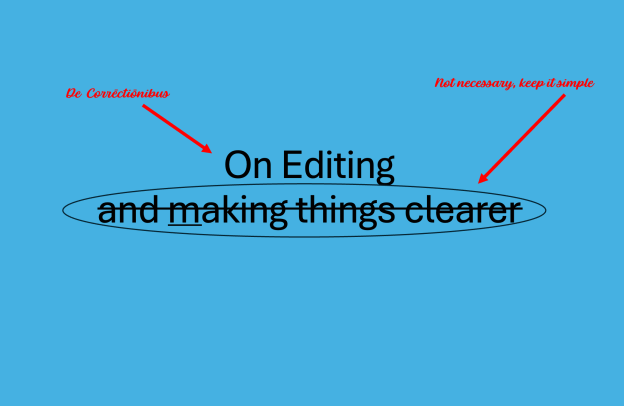
On Editing

This week, I want to write to you about the revealed joys found in the experience of editing. — Click here to support the Wednesday Blog: https://www.patreon.com/sthosdkane


This week, I want to write to you about the revealed joys found in the experience of editing.


I spent most of last Thursday editing a chapter I’m contributing to a new book about Shakespeare’s play The Tempest. My contribution argues that the bard was inspired in his descriptions of Caliban and the play’s island setting by André Thevet’s accounts of Tupinambá beliefs and the role of magic in their society, and the sense of Brazil as the archetype of the insular natural world across the sea at the turn of the seventeenth century. There’s a lot in its 32 pages, and it’s been a good effort on my part since I first saw the call for papers for this book two years ago. I wrote the first draft between March and June of this year both here at home in Kansas City, and while I was on my European trip this June; I spent most of my time in the San Francisco International Airport G Concourse United Club writing paragraphs for this chapter. 

Until last Thursday, I’d only edited it on my computer. This is a far faster way to edit text, it allows me to work as I’m reading through the draft. This method is still relatively new to me, I feel fortunate that I was taught to write by hand first and to edit with pen and paper. That’s been more challenging with my dissertation, in Binghamton I didn’t own a printer and because I could never figure out how to use the university printers, I relied heavily on the local print shop across the road from the University to print anything I needed. That meant then that up until the sixth or seventh draft I never saw it on paper, always on the computer screen for both economical and environmental reasons.

The week before last Thursday, when I returned to my Tempest chapter after finishing several other major projects, I found myself thinking that it could benefit my editing if I printed this document out at least for my last full read through before sending it off to the editor. So, returning to it just before noon on Thursday, I decided to print draft 4 of the full document, all 34 pages of it. As it turned out, there was something heartwarming about editing this chapter with pen and paper. Sure, I knew I’d save myself time by editing it while I was reading it on my computer, but I’ve found more and more that if I really need to work on a sentence, I’ll have to copy it out of the draft and into a separate document where I can look at it on its own separate from the rest of the text. This works, and this is what I often end up doing, but it’s not a problem I have reading lines on a printed page. I find I can read faster when reading something printed rather than something digitized, and now that I’m doing so many more things than just writing and editing my dissertation, moving towards these postdoctoral projects, I’m finding that I’m returning to how I read and wrote before I fully adopted all this technology.

Even though I now edit using more review bubble comments and review tracking on Microsoft Word or Google Docs than the old shorthand symbols that I learned in my elementary school English classes, I could still return to them with an ease that felt native to my sensibilities and origins as a writer and a reader. I even left the odd marginal note on draft 4 of my Tempest chapter should anyone else ever find this printed copy to see some of the things I was referencing in the additions and changes I made to this draft.

One of the greatest lessons I’ve yet learned about writing came from a policy writer who at the time worked for the offices of the European Union in Brussels. He came to the University of Westminster for a couple of days in March 2016 to run a policy writing workshop for all of us who were interested. I joined in and wrote a brief about a hypothetical crisis along the Danube between Hungary, Croatia, and Serbia (I think). While I’m less likely to become a professional political policy writer anytime soon, the most impactful thing he taught us was to leave whatever it is we’re writing aside once we’re done with a draft and return to it later. Like a good dough, our writing needs to rise for a while before we return to it and work on it some more. I took a week between finishing draft 4 and returning to it to complete the edits that make up draft 5 of this Tempest chapter, and I’m certain the finished draft benefits from that gap. It’s something I do here with the Wednesday Blog on those weeks when I’m able to write things in advance. The words you’re reading, or hearing, now were written on Thursday afternoon about an hour after I sent draft 5 off to the editor. I’ll return to them sometime on Tuesday, October 15th, and read through them again when I record them for the podcast.

The Wednesday Blog podcast actually grew out of my editing sessions for the blog. You see, I traditionally edit by reading my writing aloud; if it doesn’t make sense to my ear then it needs to be rewritten. Nearly three years ago then, at the end of November 2021, I decided one night after dinner to start recording those read-throughs and release them as a podcast version of my blog. Of course, the version you get in your podcast player each week is more polished than the first draft, but with these essays I usually don’t need to do as many edits. This is a different style of writing than my academic work, less formal, and more personal.

Editing also reminds me to express what I’m thinking in a clearer way. An early lesson in teaching that I received, and nearly all of my lessons in teaching have been on the job while I’m teaching, was to speak to my audience in their own language. This is a no-brainer when it comes to speaking French in Paris, or German in Vienna, yet what I mean here is speaking to your audience in a way that they’ll understand. I like to use the words they’ve just used in my answers. This is a grammatical thing in Irish where instead of having words for yes or no we instead say the positive or negative of the verb in question. I’ve begun doing this in my English too: responding not only with a yes or a no but with a yes, I do or yes, I can, or no, I don’t understand. Clarity is the best friend of writing and good communication. A common comment I get from editors is that what I’m trying to say is just under the surface or not quite clear yet. This is a symptom of how I developed my writing voice first in poetry and plays and later in short stories and now factual and highly researched non-fiction blog posts and academic essays. It’s been a weakness in my writing up until now that I’ve had a hard time getting over, but I think I may have figured it out by closely reading what I’ve already done with those comments up on a screen where I can clearly see them as I read.

Sometimes the thesis or plot of what I’m writing will change significantly in the edit. There are times where my original argument simply doesn’t work, and I need to adjust drastically to save the essay or story. This happened early on with this Tempest chapter, and I’m glad I saw the flaws in my original approach as early as I did because it made the chapter I’ve written in the five drafts since all the stronger. While that may be frustrating at first, I love the way that things work when all the pieces of the story or all the sources behind the thesis line up. I love how a good edit can inspire me to keep writing and get closer to my record average of writing 1000 words per hour. This is more possible outside of my academic writing where I often stop to consult a source to make sure I’m getting it right, but even there when I can write with a great fluidity, and I know what I’m trying to say it reminds me why I do what I do.


Correction: in my initial publication of this blog post I miswrote my average writing speed as “1000 words per minute,” when I meant to say “1000 words per hour.” I’m not Lt. Cmdr. Data.

Olympic Optimism

In celebration of the last few weeks of the Summer Olympics in Paris, I want to write to you about the optimism that the Olympics embody. — Click here to support the Wednesday Blog: https://www.patreon.com/sthosdkane


In celebration of the last few weeks of the Summer Olympics in Paris, I want to write to you about the optimism that the Olympics embody.


I’m an optimist at heart. I think that’s what has gotten me through these last 10 years of graduate school, and what keeps me going through the hard times we find ourselves in. Every two years, my optimism is renewed by the staging of the Olympic Games, summer and winter. Each Olympiad resides in my memory in its own different way, the character of the host city and the joy of the individual athletes shining through the broadcast of the games. Here in the U.S., the Olympics are actually the one big thing that I think of when I watch NBC, while Rio 2016 was a rare Olympiad that I missed most of being in London at the time with the events at odd hours for Europe. The Olympics reinforce that optimism that we humans can truly work together for our mutual betterment. We have the potential to grow beyond what Carl Sagan called “our adolescence as a species” dominated in the last two centuries by nationalism, division, war, and genocide toward a better future where societies work for the betterment of all.

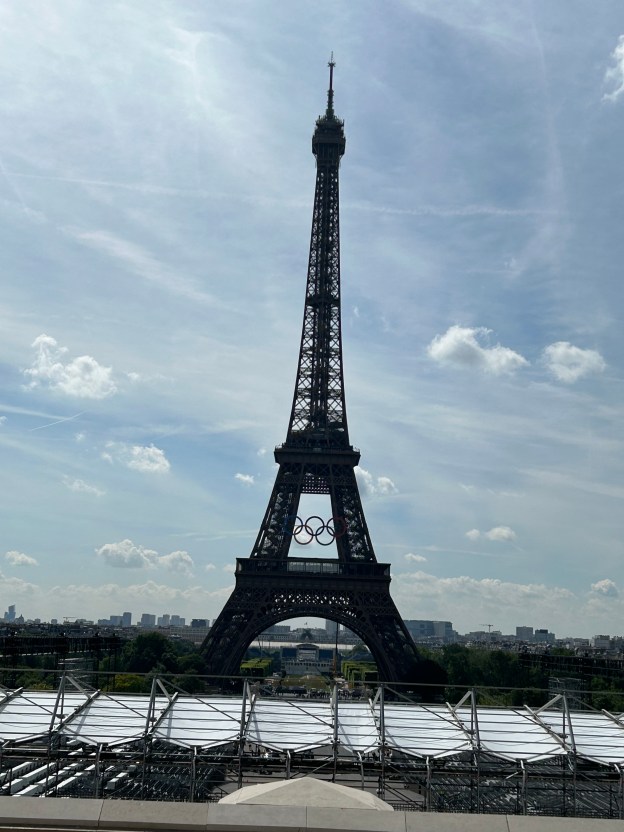
This year, I was in Paris a short while before the games began and got to see aspects of the Olympiad in preparation. The rings were mounted on the north face of the Eiffel Tower in early June when I visited the Musée national de la marine at Trocadéro, and all around the city the lavender-colored placards advertising directions to Olympic venues were hung in the metro. It gave me a sense of what it might be like to be in this city a few weeks later when the games began. Paris is a city which has such a long history of both oppression and liberation that it speaks better than many others to the collective human experience. It truly was a wonderful city for this Olympiad to be held at a time of tremendous pessimism and conflict around our globe.

I set up alerts on the Paris Olympics app on my phone for Team USA and Team Ireland, and for several specific events which I wanted to follow, especially the Fencing, I was a saber fencer in my pre-teen years for a while. While I wanted to support my own national team and the national team of my ancestral homeland, I still cheered on whoever was competing at a given moment. I like to say often that it’s better to have a wide margin of victory when I have a team in the competition: I’d rather see my Cubs win by 5 or 6 runs than by 1 run in a late season or playoff game. Yet, when I’m happy to see the competition itself and see these athletes perform their best on a stage watched by billions, I love seeing a tight race. For me then, as much as I love seeing Team USA march into the Opening Ceremony, or in this year’s case float down the Seine on their boat as the second-to-last to launch from Pont d’Austerlitz, I love even more the moment when the national flags join together and march toward the podium following the Olympic flag. All nations united in a common cause empowered by their hope and joy.There’s a song that was composed for the Rugby World Cup, which is just as pertinent here, World in Union, set to Holst’s Jupiter theme from The Planets which ought to be sung here too. The idea that every two years we all can join together, for several weeks, and form that very same world in union is what fuels my optimism that our days of division and strife are impermanent. I recognize the realists who say that we need to focus solely and whole-heartedly on the trials of our time, the wars and oppression happening in our midst; yet we should also keep this hope in mind that we might one day grow beyond war and beyond feeling the need to oppress each other. There should be as many diplomats and negotiators offering a chance at peace as there are soldiers carrying on the fight because at the end of any war there will be peace again, and the form that that peace takes will determine if any other wars will follow on.


The Art of Joy

This past weekend, the Nelson-Atkins Museum of Art debuted a new retrospective exhibit on the life and work of Franco-American artist Niki de Saint Phalle. One of her great initiatives was to express rebellious joy in her art, especially later in her career. — Click here to support the Wednesday Blog: https://www.patreon.com/sthosdkane


This past weekend, the Nelson-Atkins Museum of Art debuted a new retrospective exhibit on the life and work of Franco-American artist Niki de Saint Phalle. One of her great initiatives was to express rebellious joy in her art, especially later in her career.


I wasn’t familiar with the name Niki de Saint Phalle (1930-2002) before the Nelson-Atkins Museum of Art announced they would be hosting the first American retrospective exhibition of her work, yet having seen aspects of it, particularly her Nanas, I find that I do remember seeing these around here and there. The exhibit begins with her early work, highlighting her tirs paintings (1961–63) which involved her shooting paint-filled collages of popular material objects each with their own cultural meanings, until they bled their paint out. I found these hard to appreciate, the violence at the core of these pieces and the claustrophobic nature of their assemblages filled me with a sense of dread.

Yet, it was the latter two thirds of the Saint Phalle exhibit which I returned to, the section radiating and erupting in light and color in a manner that felt welcoming and brilliant as though it were made to bathe in the warm rays of the Sun. These portions of the gallery were filled with her Nanas (1964–73) and other works in the same style. Saint Phalle created her Nanas as an evocation of the power of women, often drawing from ancient fertility figurines like the Venus of Willendorf, today housed at the Museum of Natural History in Vienna. Even the serpentine figures which I would normally be wary of felt warm and cheering.

So, what then is it about Saint Phalle’s work and this dramatic change between her early creations in the 1960s and 1970s to her later works in the 1980s, 1990s, and early 2000s that the latter ones feel so different? In my two visits thus far I’ve gotten a sense that early on she was fighting back against oppressive forces and that her resolve was to take hold of the ancient model of fighting violence with violence, while later once she felt liberated from these old shadows, as much as she could’ve been, she began to create in a spirit of wonderous joy.

I’ve had a hard time with joy lately, and I’m usually the eternal optimist. In many respects, I feel my emotions have had a softening in the last year and a half out of fatigue more than anything else. After I finished my teaching job in the Fall, I could not feel much for a good two weeks; I was so tired that Christmas came and went with only a passing acknowledgement from me. I gave every last drop of my enthusiasm and optimism in that job, knowing that I would have to do no less if I wanted to do that job justice. Joy then, the emotion that I felt even in the darkest and most terrifying days of the pandemic as I dreamed of better tomorrows, is something distant from me even now.

Yet I prefer to be optimistic, to live joyfully, rather than to be consumed by the trends of pessimism and destruction that are well in vogue now. There are horrific things happening in our world every single day, and I applaud those who are fighting to stop those horrors from spreading. The great fight of our time is one to defend democracy in a year when it is very well and truly under threat. It might seem naïve to some, yet I feel it is my vocation to try to keep a positive outlook and remind the people around me of all the good things we’re fighting for. What good is war if we give up any hope of finding peace again? Like Saint Phalle, I see joy in color and light. Where years ago, I would want to keep the shutters closed on my windows today I love having the sunlight dance between their opened gates and radiate an exuberance that reminds me of St. Francis wandering the fields around Assisi 800 years ago. There are great horrors in our world, and we need heroes who will face them and restore them to their box, yet we also need people to remind us of the good times so that we have a reason to envelop that darkness in light.

In the arts, the greatest periods in recent American history of optimism and joy are the New Deal and the Great Society, two moments when the political will to make life better for all Americans translated into an artistic awakening which sings the spirit of the times. The New Deal policies of President Franklin Delano Roosevelt responded to a time of great pessimism and trouble for America and the globe, when at the heart of the Great Depression he and his brain trust found ways to invigorate society through economic and financial reforms as well as new funds for the arts that had not been known at any time before. Here in Kansas City, we look to the paintings of our local artist Thomas Hart Benton (1889–1975) to evoke the regionalist style of the day, or nationally to the works of Georgia O’Keefe, Edward Hopper, and Grant Wood. I often associate O’Keefe’s art with the bright colors and lights of the desert Southwest, a region that was conquered by the United States from Mexico in 1848 yet not fully realized into our national mentality until after World War II.

For me, the great voice of this optimism is Aaron Copland, whose music evokes the same regional influences of the painters just mentioned. A long standing question in American classical music is how best do we define our national voice? I say we here because the compositions created in this country live or die by the audience’s appreciation. I found it fitting then when I read that the Kansas City Symphony’s first European tour, happening this August, will include performances of Copland’s Third Symphony in Berlin and Hamburg alongside performances of the works of three other great American composers: Bernstein, Gershwin, and Ives. In Copland’s music there’s a sense of the enduring youth of this country, the optimism of a new society building itself from these foundations.[1]

I love how the third symphony uses his famed Fanfare for the Common Man as a central theme, this idea that while in other countries fanfares would be reserved for only the great and the good descending down to our common level on their golden escalators, in our country that fanfare is open to anyone who is willing to live their best life. We are all capable of greatness as long as we live within that brilliant sunlight that so dominates the most optimistic periods in our art.

The greatest challenge that we humans have ever received is to love one another, to be kind and generous with our compassion, and to work for the betterment of all of us. I see that message fading somewhat today, its brilliance drowned in the neon glow of our own individualism and aspirations for fame and riches. It runs contrary to our culture as it has developed that we ought to prefer charity over transactionalism, that we ought to be kind to each other for no other reason than because it’s the right thing to do. I worry that this is lost amid all the revolving cycles of fads and trends that catch our attention for but a moment only to be overshadowed by the next.

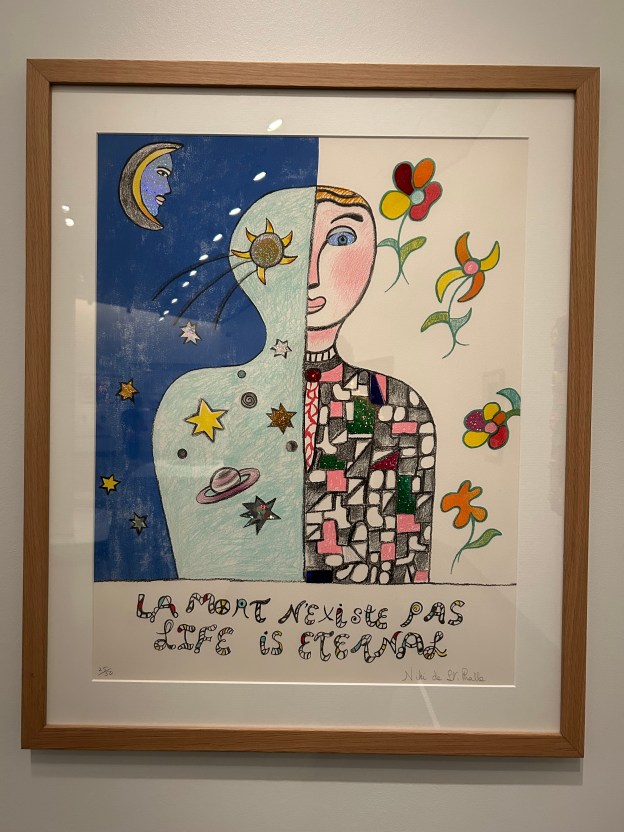
So then, perhaps what I appreciated the most about Niki de Saint Phalle’s later works was as much the longevity of their creation as it was their brilliant colors and joyous expressions. These are works which are meant to last so that generations of people will see them and perhaps in their forms feel a sense of their creator’s joy. I certainly felt that, even now 22 years after Saint Phalle’s death. I took one photo in the exhibit, of a color lithograph she made with a dualistic figure, on the one side with a human face and body and on the other the human frame surrounded by planets, moons, and stars. Beneath the dual figure Saint Phalle wrote in French and English, “La mort n’existe pas / Life is eternal.” I believe through our joy, no matter how childlike it may be, we can live on even after death. As St. Paul wrote, “Rejoice! Your kindness should be known to all.” (Phil. 4:4–9)


[1] Yes, there’s a great deal of problems with that new society’s foundations in the conquest and colonization of this continent.


Niki de Saint Phalle: Rebellion and Joy is on view in the Bloch Building at the Nelson-Atkins Museum of Art from 27 April through 21 July 2024. More information can be found here.