Tag Archives: Kansas City Zoo & Aquarium

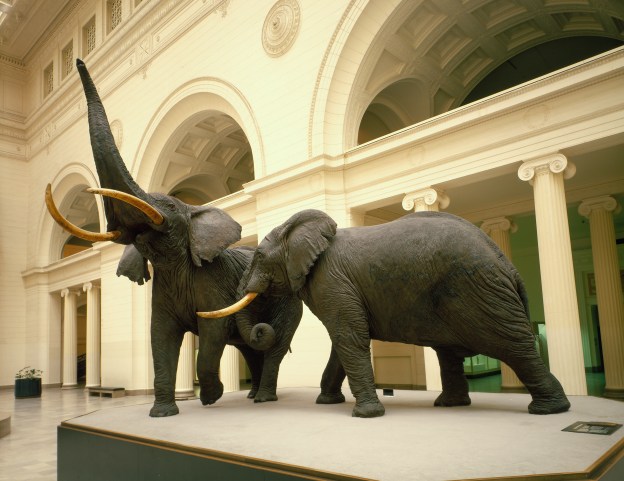
Fighting African Elephants in Stanley Field Hall. Taxidermy by Carl Akeley . 41411 is on the left with two tusks and its trunk is raised. 41410 is on the right, with one tusk. Photo credit: (c) Field Museum of Natural History - CC BY-NC 4.0.

Elephant Tails

Photo Credit: Fighting African Elephants in Stanley Field Hall. Taxidermy by Carl Akeley. 41411 is on the left with two tusks and its trunk is raised. 41410 is on the right, with one tusk. © Field Museum of Natural History – CC BY-NC 4.0.

This week, some animalistic thoughts. Photo credit: Fighting African Elephants in Stanley Field Hall. Taxidermy by Carl Akeley . 41411 is on the left with two tusks and its trunk is raised. 41410 is on the right, with one tusk. (c) Field Museum of Natural History – CC BY-NC 4.0 — Click here to support the Wednesday Blog: https://www.patreon.com/sthosdkane


This week, some animalistic thoughts.


I wonder if the reason why we take our children to zoos and natural history museums to see the animals is because there’s a deep sense where we recognize our own animality? I still go to these places today, to revel in the same sense of wonder I felt at spying the animals, living and dead, that grace the halls and paths of these scientific institutions. For me and many others these are places where we were first introduced to wild things when we too were wild in our own way.

On Tuesday morning I made one of my regular visits to the Kansas City Zoo, to enjoy a cool late summer morning, and yes to see the animals who live there. I’ve come to appreciate more elements of these zoo visits the older I’ve gotten, where before I might love to see the lions and imagine them in the hunt; today, I admire the power, strength, and grace of their forms, and their wisdom at sleeping for nearly 20 hours per day. On this visit the African elephants were out on a morning buffet run through their long enclosure, while families and zookeepers gazed on from the footpaths that line the west side of the elephant enclosure. We didn’t stay long at the elephants on this visit, instead watching them as we passed by. These animals are intelligent and powerful and reflect some of the noblest values we cherish in our fellow humans in their own way.

Perhaps that is why we seek after collecting other animals and housing them in zoos while living or in museums after they are dead. Jay Kirk’s biography of Carl Akeley (1864–1926), the father of American taxidermy, described how on 24 June 1910, while on a collecting expedition for the American Museum of Natural History in Kenya and Uganda, Akeley was taken by surprise by a great bull elephant.[1] Akeley had the distinct impression that he “was being hunted as well, and was now engaged in a mortal contest with this bull.”[2] In the furor of the moment the safety of his rifle caught, after which he threw it aside and grabbed hold of one of the elephant’s tusks “as it lanced past him with the force of a sharpened swinging log.” Akeley held on between the two tusks as the elephant “plowed him into the ground,” and gored off part of his face, breaking enough of his body to convince the Kikuyu porters who joined his expedition 14,000 feet up Mount Kenya that he was dead.[3] Thankfully, Akeley wasn’t dead, and by the end of the expedition had gathered enough mammals to begin building his African Hall of Mammals at the American Museum of Natural History in New York where many generations of visitors have learned about these species in the century since.

I see an educational purpose to zoos and museums; they allow us to view these animals up close where otherwise we would have to travel to their native habitats or watch nature documentaries of their lives. These are places where the city dweller can explore the natural world in a controlled and comfortable manner. We demarcate ourselves from the rest of nature by our inventions and our buildings and our tool-use, yet other animals have been seen to do all these things in their own way. What sets us apart perhaps is that we build worlds meant only for ourselves in which we expect other species to exist on our terms. My parents didn’t buy new rugs for their house until after our last two pets, Noel the shih-poo and Kitty the American shorthair cat both died of old age, knowing that those two and our other dogs, cats, horses, goats, ponies, and even a turtle were going to do what they needed to when and where they needed to.

The same goes for these animals living in zoos: today they have enclosures that seek to mimic their native habitats, and to keep them busy and engaged in the thrill of life even while in captivity. Where once they were kept in cages, now they are housed in enclosures. The good people of Kansas City therefore are able to see Sumatran tiger, Red pandas, and Orangutans all in the same general vicinity of each other in the Asian zone of the Kansas City Zoo with minimal risk to life or limb. I say minimal because for all the efforts to contain the natural ways of these animals, we still have the human factor to consider.

In the last week I’ve read a fair bit on chaos theory, first devised by meteorologist Edward Lorenz in the 1960s to describe seeming anomalous elements in weather patterns. Lorenz defines chaos as having a “sensible dependence” which is inherently deterministic by its sensibility.[4] Chaos “appears to involve chance,” which can be statistically estimated, yet those results are mere estimates.[5] One might say that the size of the human species alone, all 8.2 billion of us, would be enough data points to fulfill the conditions for chaos. Yet even then, there is a finite number which can be calculated, so even the uncertainty of the human factor in building environments for safe encounters between the rest of nature and ourselves for the mutual benefit of all is not uncertain enough to fulfill the need for an infinitely large sample size required for chaos to exist.[6]

Perhaps then, the best way to try to quantify the roots of chaos in the human factor would be to attempt to quantify the countless thoughts of we 8.2 billion humans? I imagine it like filling Stanley Field Hall at the Field Museum in Chicago and the balcony galleries above it to just beyond the fire code maximum capacity and then trying to count the number of thoughts each individual there might have in a given moment. In order to safely move those people out of the building to avoid overcrowding you not only would need to coax each individual to move in such an unsafely large crowd, but you’d need to keep all of those individuals calm and compliant to avoid a panic and stampede. At the end of the day, we are all humans, and humanity is inherently animalistic. A chaotic system is one dependent less on external factors, the fire marshal on a bullhorn directing the crowd out the north and south doors, and more on interior changes in initial conditions.[7] External changes then are predictable, while the human consciousness remains a wonder and a liability in situations when too many of us are in the same place at the same time. It’s a real wonder that the 2016 Cubs World Series Parade, which saw 5 million of us humans gather along the route from Wrigley Field down to Grant Park, didn’t result in any casualties or fights. I’ve argued before that this event is a sign of the inherent benevolence of the human spirit, and that we evolved with good intentions first and foremost.

Here though we’re moving from my philosophical interpretation of a branch of mathematics into matters of theology; and that doesn’t feel like an appropriate direction to take this, so I am avoiding matters of faith this week. When done right our museums and zoos allow us to learn about the rest of nature at a distance, a safe distance for both ourselves and everyone else. With all I’ve read in the last few weeks about polar bears, I’d rather just view them at the zoo, or the standing bears frozen in taxidermic eternity behind glass at the Field Museum. They might appreciate meeting me in life during their summer fast, though that’s entirely irr-elephant.


[1] “Akeley Expedition to British East Africa (1909-1911),” American Museum of Natural History Archives, https://data.library.amnh.org/archives-authorities/id/amnhc_2000084.

[2] Jay Kirk, Kingdom Under Glass: A Tale of Obsession, Adventure, and One Man’s Quest to Preserve the World’s Great Animals(New York: Picador, 2010), 220.

[3] Kirk, 221-222.

[4] Edward N. Lorenz, The Essence of Chaos(Seattle: University of Washington Press, 1993), 8.

[5] Lorenz, 9.

[6] Lorenz, 10-12.

[7] Lorenz, 24.


The Museum

This week, to round out Season 3 of the Wednesday Blog podcast, a few words about my love for museums. — Click here to support the Wednesday Blog: https://www.patreon.com/sthosdkane


This week, to round out Season 3 of the Wednesday Blog podcast, a few words about my love for museums.


I learned about our cosmos from visiting museums and reading books as a child. Where my books could thrill my imagination into creating whisps of wonders that would dance about my mind and keep me enchanted during the quieter moments, museums offered me the physical embodiments of many of those same wonders. The older Irish word for a museum is iarsmalann, or “reliquary.” Museums, the seat of the muses of the Ancient Greek cosmos, are where we house our greatest treasures today. They are places which the public can visit and learn about our human world and the natural cosmos it inhabits. Museums are seats of knowledge where we can wonder about a great many things that otherwise would not be accessible to us.

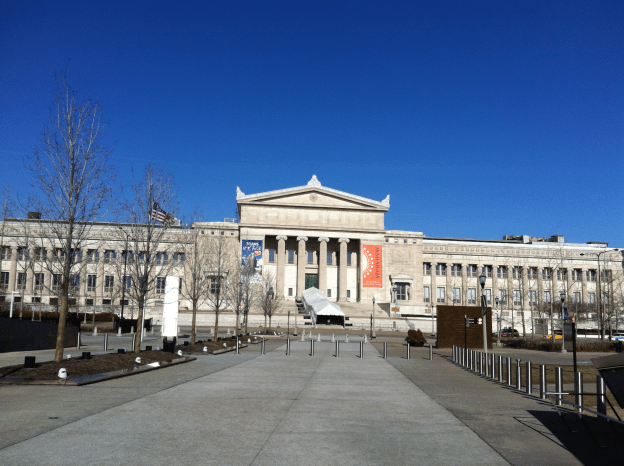
My favorite museums to visit are the ones I return to the most. From my youth, I loved wandering the halls of Chicago’s Field Museum and Art Institute most. In the acknowledgements of my dissertation, I will note that it was in the Field Museum as a small child that I first experienced wonder, and that that is where the passion, beauty, and joy that drives my career and my life today began. One of my last truly awe inspiring visits to the Art Institute was in January 2019 on the last day of the American Historical Association’s meeting at the Hilton on South Michigan Avenue. That afternoon as I wandered around the labyrinthine halls of the Art Institute, I was struck at how endearing I found the Early Republican galleries, rooms which previously I’d been frustrated by because I still have trouble finding my way out of them. I’ve returned to the Field Museum more in the following years both to wander the halls and to remember all the joyous times I’ve had in that building as a child, a teenager, and now an adult.

Here in Kansas City, my favorite museum by far is the Nelson-Atkins Museum of Art. When we first moved to Kansas City, 25 years ago this summer, my Dad took me to the Nelson in hopes of filling that role that the Field Museum had for me back in Chicago. As I grew and matured, I found myself returning to the Nelson more and more, seeing the same art each time sure, but more so appreciating the constancy of that art than anything else. In the last six years I’ve grown to love the Kansas City Zoo & Aquarium as well; perhaps the Zoo is a better equivalent locally to the Field Museum with its dominant focus on the natural world over anything else. I think of the Zoo like another sort of museum, a living and breathing museum situated in the expansive wooded grounds of Swope Park. One of my dreams is to contribute a museum to Kansas City, ideally a natural history museum where my own particular contribution would be in a History of Science gallery.

Elsewhere, during my year in London I fell in love with many of that city’s great museums. I became a member of the British Museum and would often walk there from class and spend my afternoons wandering and loving how much I could learn there. It was on these visits to the British Museum that I decided to do my doctorate in History or Classics; I settled on History as you know, though I ended up in the Renaissance in part because of my love for the Banqueting House on Whitehall and Hampton Court Palace, two expansive palaces now turned into museums by Historic Royal Palaces. Initially, I wanted to study Roman history and focus on how the concept of Roman citizenship expanded as the Republic’s and later Empire’s borders expanded outward from the City of Rome. Yet, I instead decided to settle in the Renaissance, a period that seemed to me to evoke some aspects of the idealized Rome that I thought of while still feeling closer to home. In London too I loved my visits to the Natural History Museum and Victoria & Albert Museum in South Kensington, two that I returned to on several occasions on this most recent, if brief, visit to the British capital in October.

The more I’ve traveled, the more museums I’ve visited. In many respects they fill certain roles which I set in my mind from early on depending on their focus. In Upstate New York, if I wanted to visit a natural history museum I would go to the Museum of the Earth in Ithaca or if I wanted to wander around an art museum for an afternoon, I’d go to the Rockwell Museum in Corning or the Everson Museum in Syracuse.

I’ve been fortunate to see so many of these places and experience the life we give them amid all the relics of our past. In more ways than I probably even recognize, these museums have inspired my career, and I hope that I may contribute a verse to their songs one day.


Supplementing Human Nature

Supplementing Human Nature Wednesday Blog by Seán Thomas Kane

This week, how technology enhances and supplements human nature. — Click here to support the Wednesday Blog: https://www.patreon.com/sthosdkane

This week, how technology enhances and supplements human nature.


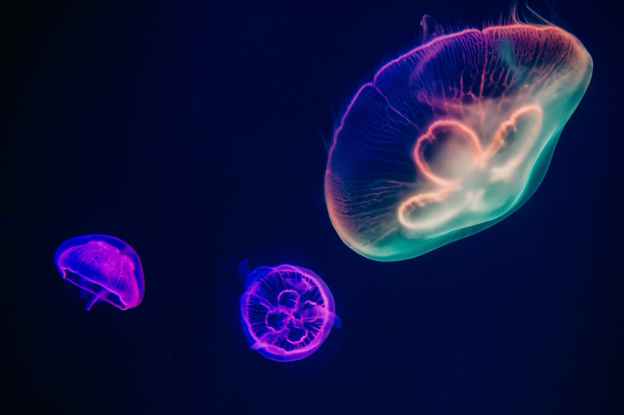
Just before the New Year began, I paid a visit to the new aquarium at the Kansas City Zoo, a new favorite haunt of mine. Because the high holiday week between Christmas and New Year’s Day was in full force, we were joined by a sizable crowd curious at what this new aquatic construction might contain. This was my third visit to the new Sobela Ocean Aquarium, so while some of the wonder had faded, I was still fascinated to see some of these creatures up close and in person.

Amid all the fish though I paused in front of a shark, caught in thought about its method of propulsion. How is it that this animal is able to glide so smoothly through its space with so few motions of its fins when we need to move our legs for each step? Our language for motion itself is biased towards human propulsion, we move forward step-by-step, pace by pace. There is little sensible movement that the human body can make without moving our arms or legs. Other life forms––floral and faunal––have other means of moving about their world, yet for us and most life that we find sensible there’s an inherent reliance on feet, legs, and even arms to move.

As I stood there, I thought about Prometheus, the titan in Greek mythology who formed all mortal life out of clay saving humans for last. Yet when he came to creating humans, he found he had used all the claws, fangs, furs, scales, feathers, and fins that he had, leaving humanity more naked and exposed than any other species. To rectify this the cunning Prometheus guided humanity towards wisdom and stole fire from Zeus “which, unknown to Zeus, he had hidden in a stalk of fennel,” wrote Pseudo-Apollodorus in the Bibliotheca (1.7.1). In the Abrahamic traditions, humanity’s original sin was to eat from the tree of knowledge of good and evil and to question God. Zeus punished Prometheus for his theft by chaining him up onto the side of Mount Elbrus where each day an eagle was sent by Zeus to eat out his liver, which would grow back only to be eaten again the following day.

Plato wrote in his book the Protagoras that humanity supplemented our standing and raised ourselves above other life by adopting the creative power demonstrated by Prometheus, whose name means “forethought” in Greek. Our use of techne (τέχνη), our skill and inventiveness, drove us to create not only with our hands like other animals do but with our minds as well. Mel Brooks’s 2000 Year Old Man joked that as soon as one of his pet cave chickens walked through a fire and cooked itself, he and his companions realized that cooked meat tasted good. So too with most things, we can discover wonders with the things we’ve made for ourselves. Today the human eye extends far beyond that of any other known life. 

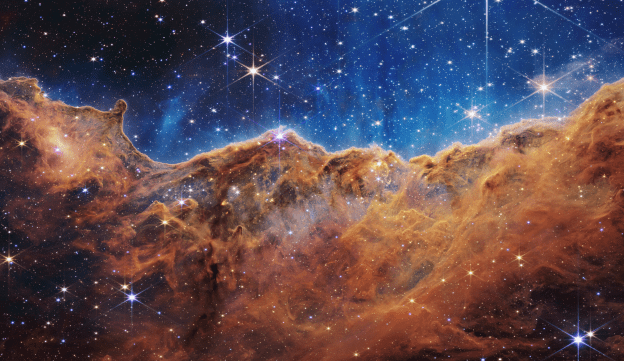
This weekend I went to see an IMAX film called Deep Sky about the James Webb Space Telescope (JWST) which launched from the European Space Agency’s spaceport in French Guiana on Christmas Day 2021 and six months later began transmitting images back to Earth of the earliest moments in the Universe’s long story. There are glimpses of light, whisps of dust, and clouds of matter that were unknown to humanity until just now yet predate our evolution by billions of years. We can now see that, well beyond what our own evolved eyes can see. Yet is our nature evolved only to perceive certain things with our senses, only those things we can immediately touch, smell, taste, hear, and see? Knowledge could be a sense of its own, one which perceives further using supplements from technology and reliance on other people alike. Yet knowledge is what sorts through all the signals coming from our senses and, well, makes sense of them.

Yesterday afternoon on our drive back to Kansas City from seeing that film at the St. Louis Science Center I awoke in the front passenger seat of the family car to see a snowplow in the lane next to us. I watched as it drove past us and was at first startled by what I thought I saw, a man hanging onto the back of the plow moving at 70 mph (112.6 km/h) only to blink again and see that what I thought was a man hanging on for dear life was actually an assortment of things hanging down from over the rim of the back of the plow that holds the road salt, with a large box in the back near the middle that my sleepy brain mistook collectively for a person.

Knowledge could be a sense of its own yet unlike the others I can’t say if it contributes its own information to the assortment that is our understanding of the world around us. Everything enters our mind through our senses, I saw those images captured by the Webb Telescope just as I’ve heard, read, and seen retellings of the ancient myths of Prometheus and stories of Genesis time and again. In some ways then, the reflective pause that I experienced watching that shark two weeks ago was less a reaction to the shark itself and more a realization of my own human nature in contrast to the shark’s. I may be able to dream, and often do, of flying or floating distances without moving my arms or legs yet those visions remain encased in my mind, thoughts to return to in my sleep or in those quiet moments fit for daydreaming.

And yet those same thoughts are what propel us as a species forward. We supplement our human nature with those thoughts, and work through the questions they raise until we have solutions which can make our lives better. I have always lived with this understanding that human history is one of overall general progress, that our finest minds are always finding ways to improve the human experience, to raise humanity’s stars so that we can hold onto that dream, that belief which is fundamental to human nature that we can better ourselves and the lives of future generations.

We offer these thoughts and all their creations as our inheritance to posterity, that they may make of what we left unfinished something even more wondrous than what we and our forbearers aspired to.


Community

This week on the Wednesday Blog, recollections of this past holiday weekend's activities at the Kansas City Irish Fest and beyond. — Click here to support the Wednesday Blog: https://www.patreon.com/sthosdkane

I had a realization this weekend when I was talking to some people who were friends of friends in the Kansas City Irish community: I don’t need to try to be someone else or to accentuate one part of my personality over any other part to fit in, I am who I am and the people around me accept me for it. Growing up I would see my friends and classmates make their name as the big baseball player or the dancer or as the Polish guy who could tell you everything you ever wanted to know about the thing, they were passionate in. For me, I filled several different roles from the history and geography nerd to the Irish guy in the room, to the Chicago kid living away here in Kansas City. Yet throughout all of it, I always felt the need to highlight one part of who I was over all the others in a given moment.

I often get annoyed when I see other people do this, when they talk about the same thing over and over again to no end and will catch myself doing the same thing. So, it is a relief and a moment of joy to realize that I don’t need to be that person, that I never needed to be that person. I’ve always been complicated and multifaceted in my interests, roots, and personality and I am the combination of all those things. 

This weekend saw my return to the Kansas City Irish Fest after five years away thanks to my time in Binghamton. I remembered the Fest being larger in the mid-2010s during my most recent visits, and this year my own participation was somewhat muted by outside circumstances of a new job and a general need to use the Labor Day weekend to rest after months at work on my latest dissertation draft. So, I found myself relieved to be surrounded by my own community, the Kansas City Irish community which is made up of long-time locals like my maternal family, recently arrived Irish immigrants, and transplants from other Irish communities across North America like my Dad and I. It was a moment when I felt like I was returning to something of the normal that I once knew before the pandemic and before I left for Binghamton that I had forgotten I missed.Still, the holiday weekend also saw another momentous occasion in the history of this city beyond the regular annual festivities in our community. On Friday, 1 September, the new aquarium at the Kansas City Zoo opened. I got to tour it with my parents on Labor Day, this Monday, and was awed at the achievement of all the people who conceived of the idea of building an aquarium at the Kansas City Zoo, and of all the people who built it including one of my uncles. This aquarium, while small compared to the Shedd in Chicago still offers a complete picture of life in the world’s oceans and seas from the deepest depths to the coastlines. I want to go back on a cold, snowy winter day when no one is at the Zoo and just wander the halls of the aquarium without all the people around and admire what was achieved in that building’s construction. Surely there will be scientists who will be inspired by that building to pursue careers in marine biology and oceanography. That alone makes me radiant with joy at the future that this our metropolitan community has as we continue to improve ourselves and open ourselves up to new worlds and ideas, and with each passing day to a great many more future possibilities.