
This July, while I was preparing for the Longest Commute, I made my usual pre-trip browse of the audiobooks available on Audible that I might be interested in listening to during the long hours in the car. On this particular trip I had even more driving time than usual to listen to books, podcasts, and music as I made my way through the varied scenery of the Midwest, South, and Northeast. I already had a biography of the German naturalist Alexander von Humboldt on my listening list, and there were other books I’d downloaded for previous long drives that I had yet to touch such as a memoir by actor Cary Elwes about his time making The Princess Bride. But I wanted something that related to the trip itself, something to get me even more excited about the things I’d be seeing along the way.
I settled on an Audible original called The Space Race which tells the history of NASA and Roscosmos from the launch of Sputnik 1 in 1957 up into our current generation of public and private spaceflight agencies and companies competing and cooperating in our continued reach for the stars. The whole story was narrated by Kate Mulgrew, an actress I know best from her role as Captain Kathryn Janeway on Star Trek: Voyager and seeing her name on the billing was among the reasons why I chose this particular thing to listen to. I won’t call it a book, it was more of a series of radio shows with a combination of narration, talking heads, and scenes set in the next century.
Those scenes, the ones set in the future are the ones I want to talk to you about today. They posit that the only way humans can ever hope to reach a habitable planet orbiting our closest neighboring star, Alpha Centauri, would be by a generational ship, one where the original passengers’ grandchildren would be the ones to set foot on that planet, and would only be possible through genetic engineering to ensure that those humans who made it there would be well suited to the environment they found and would soon call home, after all any trip that takes three generations to complete would have no path of return.
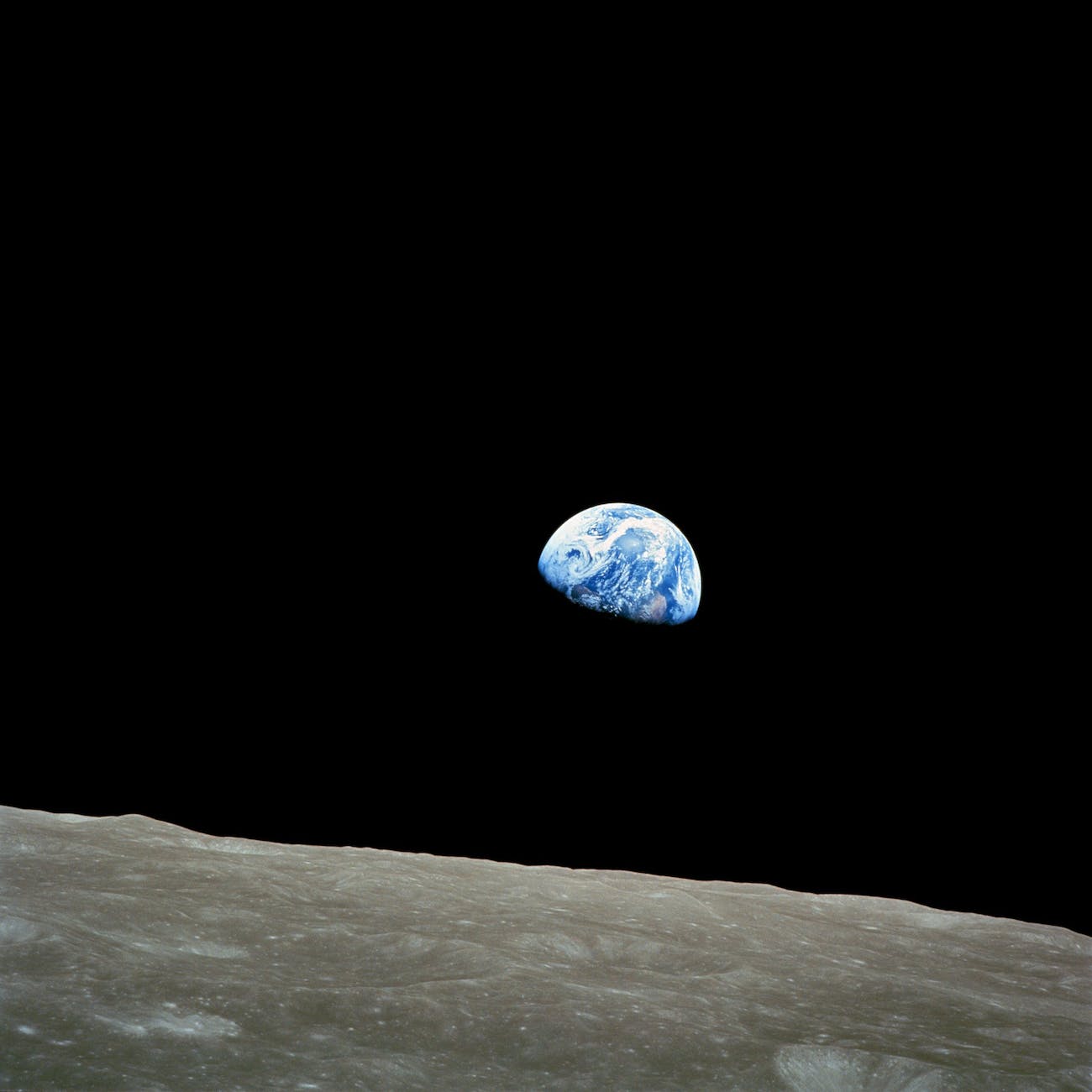
I for one am eager to see humanity reach beyond Earth and our Moon towards Mars and beyond. We have the potential to do really tremendous things, to learn so much from those experiences about our universe and about ourselves. Why else would TV series and films like the ones from Star Trek be so intriguing to me? They offer us a vision of a future where our introduction to our cosmic neighborhood makes us better people and ushers in a veritable golden age here on Earth. Why would that not be a thrilling prospect?
I listened to the last few scenes of The Space Race while I was driving east along I-10 in the Florida Panhandle, and the moment when they acknowledged that in the world of their story that genetic engineering would be necessary for such a voyage, I felt chills. So, let me ask you this question: if the purpose of exploration at any scale is both extroverted and by equal measures introspective, if the curiosity at the heart of any exploration is a part of what makes us human, then to what lengths should we go to satisfy that curiosity? Should we go as far as to transform our very genetic code, the most essential biological parts of who we are?
This is a question I really worry about. I’m as much an everyday explorer as anyone else, yet there are limits for me as to how far I’m willing to go to satisfy my curiosity; I don’t know that I would want to push myself to such a point that I’d be willing to change who I am just to see over the next horizon. We are who we are because of so many complex and intricate pieces to our identities. Untangle any of those threads and are we still the same person? It makes logical sense that future explorers would consider adapting themselves to the environment of the planet they’re seeking to visit, yet among the things that make us human are our roots to this our home planet. What would the humans who first set foot on that alien world be like if they have no memory of their own world?
If we are to engineer ourselves in any way to adapt to life as a spacefaring or interplanetary species, then let it be technological rather than biological engineering. Let’s create the habitats we would need to survive on Mars so that we can travel to other worlds as ourselves and not as some engineered offshoot of humanity growing ever distant from the source. Let’s take with us our collective memory of all our triumphs and our faults. Let’s bring our stories & music, our proclivities & our imperfections with us for they are what make us human.
And if our explorers should meet anyone out there who is just as curious about the unknown as we are then let them meet us as we are. Let them see us for who we are. Let them see both our problems and our possibilities.
 Wednesday Blog by Seán Thomas Kane