Tag Archives: Language

The Essence of Being

This week, to begin Season 4 of the Wednesday Blog podcast, I want to talk about what it means to exist. I know, small topic for a Wednesday. — Click here to support the Wednesday Blog: https://www.patreon.com/sthosdkane


This week, to begin Season 4 of the Wednesday Blog podcast, I want to talk about what it means to exist. I know, small topic for a Wednesday.


Two weeks ago, I started teaching a new class that I’m calling Bunrang Ghaeilge, Beginner Irish. The students come from my fellow members of the Fr. Bernard Donnelly Division of the Ancient Order of Hibernians and their relatives, and in the first two weeks we’ve progressed slower than I initially expected yet we’re still progressing through the materials. The first verb which I taught my current students in English translates as to be, yet in Irish as two forms: is for a more permanent being and  in a more impermanent circumstance. In the moment I explained this difference by noting how I say is as Chicago mé (I am from Chicago), as in I was born in the Chicago area, but I say tá mé i mo chónaí in Kansas City (I live in Kansas City). We don’t have this distinction in English, either between the permanent and impermanent versions of the to be verb or in the clear distinction between where you’re from at birth and where you currently live; that distinction is far more subtle in English.

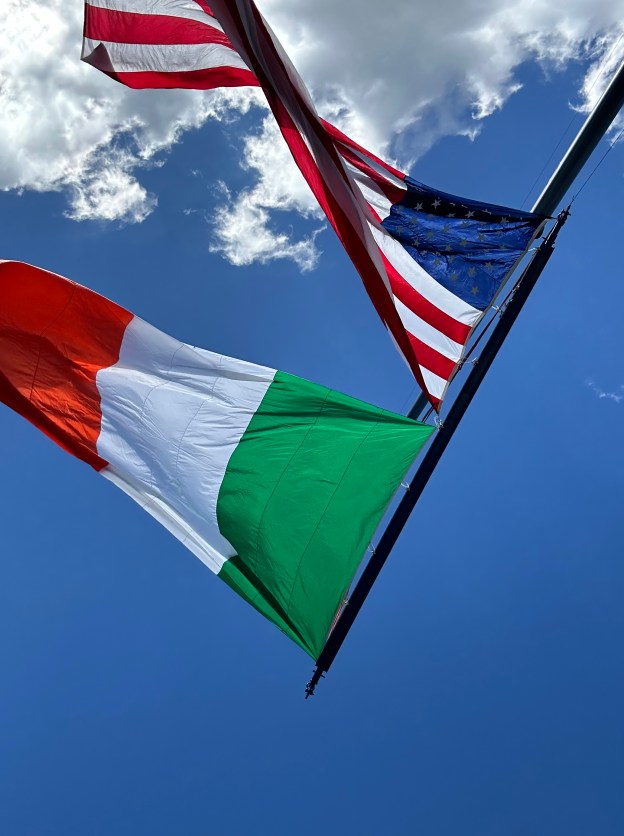
At the same time, I am learning Italian for a trip this summer, my own version of the Grand Tour, and on the Busuu app where I’m learning Italian they taught that I should say sono di Chicago però abito a Kansas City,as in I was born in Chicago, but I inhabit today in Kansas City. This distinction between a place that is central to our essence, the place where we were born, and the place where we now live seem important, yet it flies in the face of the American sense of reinvention that we can make ourselves into whomever we want to be. It’s struck me when I’ve met people who would rather see themselves as from the place where they currently live than the place where they were born. That is a different view from my own, born out of different lived experiences and different aspirations.

This word essence developed from the Latin word essentia, which the 1st century CE Stoic philosopher Seneca wrote was coined by the great orator Cicero as a translation of the Greek word οὐσία (ousia), a noun form of the Ancient Greek verb εἰμί (eimi), meaning “to be.” (Sen., Ep. 58.6) It refers to an innate idea that the ultimate goal of philosophy and learning in general is to better understand the self; the most famous inscription in the ancient Temple of Apollo at Delphi read γνῶθι σαυτόν (gnōthi sauton), or “know thyself.” I add to that goal the aspiration that one can improve oneself. 

This time of year, I find myself thinking more and more about what it means for me to be an Irish American. This past weekend we celebrated St. Patrick’s Day, a day of great celebration for the global Irish diaspora and our cousins back in Ireland as well. I’ve written before here about how my communities’ immigrant connections to Ireland often predate the current century, if not the twentieth century as well and how we are in many respects far more American than Irish. In recent years, I began to refer to myself in this subject as an American cousin, after all as much as I have Irish roots and I come from an Irish family, I’m an American and have lived an American life to date. I’m not as far removed from Ireland as many I know, yet this year marks the 110th anniversary of my great-grandfather Thomas Kane’s arrival in America.

There’s something about being Irish American which doesn’t quite fit neatly into any of the official boxes. In Ireland, to be Irish is to be from Ireland or to be a close enough descendant that you qualify for Irish citizenship, like my father does. In America, there’s a sense that the old stereotypes of Irish immigrants are fair caricatures to still uphold, especially on our communities’ holiday in much the same way that the sombreros are donned on Cinco de Mayo. Yet there’s a lot more to it. On both sides of the Atlantic, our communities have the same deeply intertwined connections between families near and far, friends in common, and a sense of nostalgia that I see especially strong among those of us born in America.

Perhaps the Irish language can offer the best answer here. In Irish, I’ll say to Irish people, as I wrote a few paragraphs ago, “Is col ceathrair Meiriceánach mé.” Yet the official Irish name for us Irish Americans is “na Gael-Meiriceánigh”, or Gaelic Americans. I think this speaks to something far older and deeper than any geographic or political connections. We come from common ancestors, share common histories and stories that wind their way back generations and centuries even. We are who we are because of whom we’ve come from. I hope to pass this rich legacy in all its joys and struggles onto the next generation in my family; perhaps I dream of those not yet born hoping they’ll be better versions of my own generation. I hope they’ll still feel this connection to our diaspora like I do even as we continue on our way along the long winding road of time further and further from Ireland.

I am the child of my parents, the grandchild of my grandparents, and great-grandchild of my great-grandparents. In so many ways, I am who I am today because of those who’ve come before me. The geography of my life was written by them, by a choice among other immigrants from County Mayo my ancestors found their way to Chicago instead of Boston, New York, or Philadelphia. My politics reflect my ancestors’ views as well, in the Irish context the legacies of the Home Rule Crisis of 1912-1916, the Easter Rising of 1916, the War of Independence of 1919-1921, and the Civil War of 1922-1924 all have as much of a presence in my political philosophy as does their American contemporaries: the Progressive Era and its successor in the New Deal coalition. Yet I am my own person, and from these foundations I’ve built my own house in as much of an image of the past as it is a hope for the future.

What does it mean then to be ourselves? We hear a great deal today about how people identify, in a way which seems to be a radical departure from older norms and expectations both in the English language and in how we live. We constantly seek answers to all of our questions because we anticipate that all of our questions can be answered, yet the mystery of being is one of my great joys. I love that there are always things which I do not know, things with which I’m unfamiliar and uncertain. This is where belief extends my horizons beyond what my knowledge can hold, a belief born from the optimistic twins of aspiration and imagination. I know that the essence of my being, the very fundamental elements of who I am, draw far more from these twins than any other emotion. I am what my dreams make of me, I see my world with eyes colored by what my mind imagines might be possible; and in that possibility I find the courage to hope for a better tomorrow.



Personalizing Language

Personalizing Language Wednesday Blog by Seán Thomas Kane

This week, adding onto last week's release about my work as a translator, I'm discussing my view on how language ought to be personalized. — Click here to support the Wednesday Blog: https://www.patreon.com/sthosdkane

This week, adding onto last week’s release about my work as a translator, I’m discussing my view on how language ought to be personalized.

About this time every year I’ve been releasing a blog post about my interest in and continued study of the Irish language. In past years I’ve talked about how I came into this period of studying Irish knowing bits and pieces of it, but without the comfort of speaking or reading it regularly, and later how I appreciate the meaning of how the structure of Irish gets its ideas across. This year, I want to talk about how I feel my own personal use of the Irish language has taken on its own form, or idiolect, and why that’s the case.

A few weeks ago, I found several books on the regional variations in Irish through my university’s e-book catalog. It struck me that these linguists had found such common generalizations of Irish sounds when spoken, or rather attempted, by native English speakers who don’t have much experience with Irish itself. The frequent “ch” sound as in leathanach, or page, gets hardened from a ch to a k, while the slightly less frequent “dh” in dha, or two things, gets turned from a dh into a g. The best way I can describe this dh sound is it sounds to me like a French r that’s rolled further back in the throat.

I read these examples of Anglicizations of Irish phonetics and could see, or rather hear, where they were coming from. Yet in my own case I’ve always tended to either make these sounds as we’re taught in class, or to soften them, with the ch becoming a h and the dh joining the other sound spelled “dh” as something along the lines of a ya. I suppose the authors of that book were using native speakers of Hiberno-English as their test subjects, something that I am not. I speak American English, more specifically a blending of the western end of Inland Northern American English (aka Great Lakes English) and Midland American English. Plus, when it comes to other languages I’m most often exposed to, French and Spanish, I’ve found a good deal of the phonetics of those languages to be rather easy to adopt. So, my own idiolect, my own way of speaking Irish would be a tad different from the norm because I don’t speak the expected standard of English.

Going forward, I wonder if it would be more helpful, should I ever get the opportunity to teach Irish here in the United States, if I adopted some of these slightly easier to pronounce sounds and taught those, alongside the traditional Irish ones, would that change the ways my students spoke the language? It’s certainly possible, yet on the other hand like how I adapted Irish to fit the comforts of my own speech perhaps they would find ways to make the language their own as well.

At the end of the day, these ch and dh sounds are two of many that make Irish its own, that give it the spirit and the character that keeps it true to its origins and history. I for one love that I’ve figured out how to make these sounds, and how to speak this language to an intermediate level now as an adult. It means a lot to me to speak the language of so many of my ancestors, to keep that vehicle for thoughts, ideas, and stories alive.

Artificial Intelligence

Artificial Intelligence Wednesday Blog by Seán Thomas Kane

Concerns have been raised lately over the risk that the increasing artificial intelligence of our computers poses to humanity. I think the risk truly lies in who teaches these computers and what they are taught. — Click here to support the Wednesday Blog: https://www.patreon.com/sthosdkane

Concerns have been raised lately over the risk that the increasing artificial intelligence of our computers poses to humanity. I think the risk truly lies in who teaches these computers and what they are taught.

There have been stories of humans striving for divine heights for millennia, whether it be Icarus flying too high as the wax of his wings melted in the Sun’s rays, or Dr. Frankenstein creating life from the remains of the dead only to find his creation a terror because it couldn’t find a home in human society. In more recent generations stories of cyborgs like Darth Vader, the Borg, and the Cybermen have shown the horrors that augmenting the human body with mechanical parts could bring, especially if those augmentations overwhelm the human.

Many of these risks bear resemblance to the countless stories in our history of people who were raised to fear rather than to love. Darth Vader is merely a tragic figure in a mask lacking most of his limbs without all the anger, hate, and rage that boiled inside that suit sinking the man deep within the façade of Vader so that his climb out, his redemption took the greatest of effort and over two decades to achieve. A central fear over artificial intelligence is in how narrow-minded computers traditionally tend to be. They are machines that run on binary code, 0s and 1s, which allow every one of their decisions to be narrowed down to an up or down choice. There’s little nuance in that, nuance that distinguishes the human from the machine.

In the last few years our machines have gotten far better at interpretation and understanding hints of nuance. What started as humorous easter eggs embedded into virtual assistants created by Apple, Amazon, Google, and Microsoft like answers to riddles or references to the Hitchhiker’s Guide to the Galaxy have become the minute personalization of service provided by the newest generation of artificial intelligences, notably those developed by Microsoft’s Open AI, the creators of Chat GPT. I was unsurprised to see that Chat GPT could devise information for me regarding very particular subjects like André Thevet (1516–1590), the focus of my dissertation, or about the Ancient Order of Hibernians, the largest Irish Catholic fraternal order in the United States of which I am a member. Yet what struck me was the speed at which Chat GPT learned how to communicate and relay ideas. No longer was there a bias towards English and several other languages as has been the case with the other AI text generator Google Translate; Chat GPT was able to answer questions I asked it in Irish, and when I pressed on further in the Connacht dialect that I speak it replied in the same.

I am cautious about using artificial intelligence without due process or consideration of the ramifications. I want the things I write to be my own, without much bias from a computer beyond the fact that nearly everything I write today is typed on a computer rather than written by hand. This reminds me of how our very understanding of language is technologically influenced from the start. Without the technologies we and our ancestors developed over thousands of years our languages would exist orally, spoken and sung, heard, yet not read. The very word language comes from the Latin lingua, which has a very close sibling word dinguameaning tongue, not unlike how in English an older synonym for language is tongue itself. This distinction is pressing for me because much of the ancient history of my Irish Gaelic ancestors was only written down centuries after the fact, rendering those stories from the ancient epics prehistoric in the eyes of the historical method. I recognize their view: after all many of the characters in epics like the Táin Bó Cuailnge are thought to be personifications of ancient gods and goddesses, Queen Medb in particular. I still bristle a bit in frustration at hearing that, especially when an explanation I wrote of the anglicization of my family name from Ó Catháin to Kane was referred to as a “prehistory” by one fellow academic. Without the technology of the written word there is little precedent that we would find acceptable to distinguish one people’s history from another people waiving it off as mere prehistoric myth.

Still, artificial intelligence remains central to my life and work today from my ability to interface with the computer in my car vocally to the spell check that doesn’t care for the handful of Irish names in the previous paragraph telling me to rework those. Over the last three weeks readers of the Wednesday Blog will have seen a series of images that I created using Open AI’s image generator DALL-E 2. I once had more skill as a sketch artist, but have long since fallen out of practice, in part due to the discouragement of an art teacher years ago. So, rather than try to create all these images myself with paper, pencil, and watercolors I instead decided to see what an artificial intelligence could do. I asked DALL-E 2 to create images in the style of Claude Monet (1840–1926), the French impressionist painter whose works I deeply admire that depicted all of the main characters as well as several of the settings on Mars. Those images came to embody “Ghosts in the Wind” in a way that I’m quite pleased with.

The fears that many of the leaders in artificial intelligence have been speaking of lately reflect as much the potential that their creations hold as in the worry that our own long history poses. We have seen time and again as technologies are created and twisted for destructive purposes. This call for caution is very much warranted in that long lens, yet I think behind it is a concern that there are enough people or powers out there who would want to use artificial intelligence to further their own ends to the detriment of everyone else. Many of the beta canon explanations for the Borg lie in genetic experimentation with nanotechnology injected into organic tissue that overwhelms the organic and through a collective hive mind dreams up a desire to assimilate all other organic life. Whether we’re looking at that emerald tinted nightmare or at the vision of a computer that will only stop its program once it’s played all the way through, we need more safeguards against both the human inclination towards chaos that will continue to influence A.I., and against the resolute binary inclination towards order of the machines. As the moral of Fritz Lang’s 1927 film Metropolis––the first great science fiction film to ask about artificial intelligence––says: the mediator between the head and the hands must be the heart.

Terminologies

Today, I'm going to talk for a bit about how the meanings of words change. Click here to support the Wednesday Blog: https://www.patreon.com/sthosdkane

Normally, I’ll have something written for the Wednesday Blog by Monday and recorded at the latest by Tuesday morning. Yet this week I’m sitting here on Tuesday at 2:30 pm with nothing written, and thus nothing recorded. Some weeks I’m abuzz with ideas and others, like this week, the hive remains silent. So, while I was talking this morning with my friend Rebecca Legill, I was in the background searching for something to write about this week.

Our conversation turned, as many conversations in Kansas City do these days, to the new terminal at Kansas City International Airport. The big shiny new building opened to the public a month ago on February 28th and has seen around 300,000 travelers pass through its doors in the weeks since. What struck me while I was talking about the new terminal with Rebecca was that the word terminal itself is a bit of an odd word. Terminal comes from the Latin terminus, a word for a boundary or a limit. The modern context of a terminal as a transportation hub came from the railways whose end stations are called terminals. Think of Grand Central Terminal in New York or the London Terminals that you used to see on old British Rail tickets. Here in Kansas City, it’s a bit of a weird idea because our Union Station was built as a through station. Sure, trains once terminated and still terminate here, the Missouri River Runner’s western end is in K.C., but elsewhere the idea of a terminal station makes sense.

So, when the languages of railways and ocean liners were being adopted for airports a century ago the idea of the airport terminal as one building among others where people board and disembark from planes was born. In many cases a terminal isn’t necessarily where a trip ends, especially on a point-to-point carrier like Southwest Airlines here in the United States, yet for hub airlines like our big three––American, Delta, and United––to say that the new building at KCI is the terminal works pretty well. In a similar way, saying that O’Hare Airport in Chicago has Terminals 1, 2, 3, and 5 or that London Heathrow has Terminals 2, 3, 4, and 5 also makes sense in this logic of aviation naming considering that a flight is most often the equivalent of an express train, they rarely make stops along the way anymore to unload some passengers and bring aboard others.Language evolves with its speakers; my English today is different from my English twenty years ago when I was a spry 10 year old. The complexity of any language becomes more noticeable with time and experience speaking that language. Language is the vehicle that carries us from one terminal in our lives to the next, it’s how we interpret the experiences that our senses describe to us. Language is our mechanism for crafting new worlds and ideas, whether fantastical or ordinary. Language is how we think, so it strikes me as curious to consider which philosophers speak to which people. Some appreciate the Stoics for their straightforwardness, others like me the Existentialists who see patterns and subtext in every interpretation. In the study of history perhaps the most influential thinker is Karl Marx, whose economic philosophy has defined a great deal of historians especially in Europe following the Second World War. All of us have read Marx to varying degrees. I get his ideas though I don’t entirely buy them. Of all the Marxist philosophers the one who speaks the most to me has to be Harpo Marx for all the life and joy that can be found in his chaotic wisdom. Language can be more than just words, and Harpo lived and breathed that kind of expression.

In Praise of my Favorite Latin Verb

In Praise of my Favorite Latin Verb Wednesday Blog by Seán Thomas Kane

Today, I'm talking about a particularly versatile Latin verb that I'll admit I'm rather fond of: mittō. Click here to support the Wednesday Blog: https://www.patreon.com/sthosdkane

I first started studying Latin when I was fourteen, a high school freshman at St. James Academy. Over the next four years I studied Latin with Bob Weinstein, then the St. James Latin teacher, and even took a year of Ancient Greek with him as well. In those years I got a good foundation in Latin, though I’ll admit I didn’t learn as much as I wanted, in part thanks to my own immaturity at the time. In the years since I’ve been able to connect more of these concepts in my thinking about the language, now on my third round of studying it. I often like to say that there are certain languages which I feel I can inhabit, that are so familiar and comfortable to me that I feel empowered to read, speak, write, and even think in them on a regular basis. These four are English, my native language, Irish my ancestral language, French, the language I fell in love with in college, and Latin, my original language of study in school.

Honestly, it took me until my third round studying Latin to really get the hang of today’s verb of note: mittō. Its full dictionary entry, laying out its principal parts are mittō, mittere, mīsī, missum. Looking at these four we can see the utility of this verb, which in its most basic meaning I’d translate mittō as “I send.” It means to send, but it also includes other types of sending like dispatching, releasing, or extending a hand, yielding, bringing out, attending, and dedicating a book, among many others. To say that one verb has so many meanings, so many actions it represents seems a bit of a stretch to me, but if you only think of a language by taking its parts out of place and analyzing them individually of the rest of the language, you’ll find you’re getting a different picture than you would if you considered the whole thing in one go.

Mittō has a great many descendants in English. Just looking at that 1st person present active form (mittō) we can see emit, intermittent, omit, permit, remit, submit, transmit, and everyone’s favorite cat name mittens. Frommīsī and missum we get all of the mission words, words like intermission, missile, omission, permission, promise, remission, and transmission. 

Even the word Mass as in the Catholic liturgy comes from mittō. It originated in the phrase Īte, missa est, which I’ve always heard as “Go, the assembly is dismissed” though I think of it more in line with the phrase “the Mass has ended” that you hear at the end of every liturgy. Missa in that phrase comes from missiō, a 3rd declension Latin noun meaning sending or dismissal, which itself has roots in our old friend mittō. One thing of interest regarding the name of the Mass is that the Latin word Missa is the origin of a great many names for the liturgy in the Romance and Germanic languages as well as the Polish msza. Yet in Irish the Mass is called Aifreann, which comes instead from the Latin verb participle offerendus, essentially translating as offering. The same Latin word is the origin of the name for the Mass in all of the other Celtic languages, though Welsh and Breton today call it an offeren and an oferenn respectively.

I decided to write about mittō this week because it keeps coming up in stuff as I find myself going about my work. I like versatility, the idea that we can look to something as particular as a verb like mittō to find the source for so many concepts and ideas. Language is the way we understand the world around us. It’s one of the first things in most creation myths that the humans do, they look about and start naming things. Those names transmit information about the object to people whether in earshot or in other worlds through writing. In our own day we are pushing the limits of mittō and its descendants by sending data back and forth to our furthest out exploratory spacecraft, from the Voyagers on the edge of the Solar System to the Perseverance Rover on Mars to the International Space Station in orbit. All of that data gets submitted back to each craft’s mission control here on Earth for further analysis.So, here’s to mittō, one of my favorite Latin verbs.

How Irish Understands the World

After I released my previous episode “Summer School in Irish” back at the beginning of August, I had a good conversation with one of my best friends and one of my most frequent listeners, past Wednesday Blog guest Alex Brisson, about the utility of keeping smaller languages like Irish alive. How do these languages benefit humanity when we’re moving toward a time of greater linguistic conformity, when there are a handful of global human linguae francae, such as English, Mandarin, Russian, Arabic, Spanish, and French (the official languages of the United Nations)?

I responded by lauding the beauty of Irish, by the fact that Irish helps the speaker understand the nature and world around them differently. Take the phrase Tá mé i ngrá leat for example. This means “I love you,” though not quite in the same sense as the English. In English, there’s the subject “I” who’s doing an action “love” to the object “you.” This is the same way that this sentiment is expressed in many other languages from German “Ich liebe dich” to French “Je t’aime” to Spanish’s “Yo te amo” or more simply “Te amo.” 

Irish, on the other hand takes a less forceful approach, instead having the subject “mé” being in a state of love ” i ngrá” with the object “leat.” Thus, in Irish the expression Tá mé i ngrá leat says less that one person is expressing love toward another and more that both people are in a state of love with each other, a model of relationship that I personally prefer far more. Losing a language like Irish loses this elegant worldview, it takes away one particular means of understanding how one group of humans has long perceived the world around them.

Another way that Irish does things differently from English is in the use of a habitual copular verb. In plain English this means there’s a version of “to be” that expresses an action that’s done on a regular basis, so Bím ag scríobh colún gach seachtain a The Wednesday Blog atá air. | I write a column every week which is called The Wednesday Blog. This particular verbal construction of Bím rather than the present active tense Tá mé as seen in the last example helps express the regularity of the action, the writing of the blog and podcast itself. It demonstrates that I, Seán, am on a weekly basis writing this string of ideas which you, dear reader or listener, then choose to read or listen to. It also offers a sense of much needed hope that yes, I’ll actually keep writing The Wednesday Blog, something which I’m always not sure about. Today though, looking back at the 40 episodes already written and the 38 blog posts that came before the launch of the podcast, I’d like to think I’ve gotten myself into a good rhythm.

If there’s any other chief argument I’ve made in the past for why Irish ought to be kept alive, even taken off life support one day and spoken as another one of Europe’s vibrant languages, it’s that so many echoes of its once and future vitality still exist on the face of our world today. Take my name, Seán Thomas Kane, which though not intentional is a highly traditional Irish name. In Irish, my name is Seán mac Tomás Ó Catháin, or Seán, son of Thomas, descendant of Cathán. Cathán was a King of Ulster who ruled in the late 9th century CE about the same time as Alfred the Great was on the throne of Wessex. Thomas is my Dad, Tom Kane, meaning that my name actually works quite well seeing as I am actually Seán mac Tomás, or in the more clunky English Seán, son of Thomas. You can often tell when a family over here in the U.S. are Irish Americans by the fact that the parents and kids tend to have similar Irish names like Brigid, Patrick, Maureen, Brendan, or Molly, among others. While we’ve generally lost our ancestral language through the generations spent living in English-speaking countries, we’ve still kept aspects of that culture alive.

One thing I would love to see someday is a vibrant, if spread out, Irish-speaking community here in North America. It would be neat to have that sort of communal connection through our ancestral language preserved and even slightly transformed by our own distinct experiences living in North America from the Irish that’s spoken today in Ireland. Perhaps this would be seen in the gradual creation of a North American dialect of Irish alongside the three modern dialects of Connacht, Munster, and Ulster Irish. I for one am finding it easiest to speak a bit of a mix of Connacht Irish (the dialect spoken by my family) and Ulster Irish, though I’ve also learned many a Munster mannerism and mode of doing things as well.

Here in the United States our monolingualism has so greatly influenced our way of thinking that it is strange to consider a life where one might speak one language at home and one out in society. This is something done by people everywhere, even here in the US. In that future, even if we do come up with some sort of universal translator that just renders all linguistic barriers largely null and void, there would still be room for people to speak their own languages in their own way among themselves.

Go raibh maith agaibh go héisteacht! Thanks for listening!

Human or Man?

In English should we say that Jesus "became human" or "became man"? Join me as I work through the history of the Nicene Creed and how this most pivotal of beliefs was interpreted first by the Greek speaking Church Fathers who wrote the Creed, later by the Latin speaking Catholic Church, and today by us English speakers. You can read a transcript of the full episode here. Written, read, and produced by Seán Thomas Kane. © Seán Thomas Kane, 2021.

On Saturday I took the opportunity to go to 4:00 pm Mass at my home parish here in Kansas City, MO while I was in town for Thanksgiving. It was wonderful getting to see the place again, and even though it’s only been 3 months since I left town for the semester a part of me doubted I’d actually see these places that are so dear to me anytime soon.

During the Nicene Creed as I recited the words I’ve known at least since freshman year of high school, the proclamation of the Faith, kind of a Pledge of Allegiance that we Catholics still have mostly in common with our Orthodox and Protestant cousins, I noticed something that made perfectly good sense but I hadn’t thought of yet. A friend who was standing near me said that Jesus “became human” instead of “became man.” It caught me off guard for a number of reasons. Firstly, the official English translation that we use in the US does use the older word “man” rather than the newer “human” but secondly, I had a feeling from what I could remember of the Latin translation that our English one is more closely based on that “human”, “homō” in Latin, might actually be the noun used.

That evening I made a point of going to the source. I looked up the Creed in Latin and sure enough the line there is “et homō factus est,” which I’d translate in my schoolroom Latin as “and he was made human.”1

The one catch here is that the Creed wasn’t originally written in Latin but in Greek. So, in order to get to the original meaning and intent of the Church Fathers at the Council of Nicaea (325) that wrote the Creed we still say nearly 17 centuries later, I’d need to call up my admittedly elementary and rusty knowledge of Greek. Unlike Latin, which I studied all through my high school years, have picked up again twice since, and use professionally on a regular basis as a historian of Renaissance natural history, I haven’t been lucky enough to use much of my Greek. I took Classical Greek in my senior year of high school after finishing my last required math credit the summer before, and then took a semester of Koine Greek (aka New Testament Greek) in my sophomore year of undergrad at Rockhurst. So yeah, my Greek is rusty. I can still read the alphabet pretty well and I know enough about etymologies that I can get by, but I never really got it the way I got Latin or French.

Still, I was determined to spend at least a few minutes of my Saturday evening at home working through this question: what was the original Greek line that the Latin translator rendered as “et homō factus est“?2 I went to a pretty reliable source that has both the Latin and Greek versions and started scouring the Greek, figuring I was either looking for one of two words: ἄνθρωπος (anthropos) meaning human or ᾰ̓νήρ (anḗr) meaning man.3

One of the big tricks that I’ve learned after now a few years of working with sixteenth-century printed books that are often not in English is the quickest way to find a particular word you’re looking for is basically to just focus on finding that word, don’t pay too much attention to the rest of the text. Once you’ve found the word you’re looking for then go and read the rest of it to put that word into context.

One example of a 16th century printed book that I’ve worked with.

Anyway, back to the story.

So, I scanned through the Greek original version of the Nicene Creed and was left stumped. I couldn’t find either ἄνθρωπος or ᾰ̓νήρ anywhere. I began to wonder if there was some third Greek word for human or man that I didn’t know about, and knowing what I do know about Greek there being three words for the same concept isn’t at all out of the question. Looking for clues, I turned then to the previous line, “and by the Holy Spirit was incarnate of the Virgin Mary”. In the Latin this appears as “Et incarnātus est, ex Spirītū Sānctō ex Marīā Virgine“. A great trick for any researcher working in a second or third language, or better yet one that they have a passing familiarity with is to always keep an eye out for personal names or other proper nouns: those will usually be more prominent, and when it comes to the BVM (Māter Deī, Θεοτόκος [Theotókos]) you can bet her name will be prominent. Sure enough, I quickly found mention of a Μαρίας τῆς Παρθένου (Marias tés Parthenou) meaning the Virgin Mary and kept looking along that line for something that resembled either ἄνθρωπος or ᾰ̓νήρ. Two words over came my answer: a fittingly long Greek verb ἐνανθρωπήσαντα (enanthrōpōpésanta).

I quickly returned to my favorite English-Greek dictionary and found the root form of the verb in question, ἐνᾰνθρωπέω (enanthrōpéō), meaning “to put on human/man’s nature,” or more essentially “to become human/man.” The only job left to do was to take out that clunky slash and acknowledge which noun, ἄνθρωπος or ᾰ̓νήρ was at the heart of that verb. As it turned out, and as you can see, it’s ἄνθρωπος.

Thus, to the best of my efforts as a scholar and translator, and as you can see, I’d argue that in English saying that Jesus “became human” works, perhaps even better than “became man”. Why? Well, remember that English has changed a lot as a language in the past century. We have so many more people and ideas using this language than ever before, and to be honest while the English noun man began as both a word meaning males in both gender and sex (ever a complicated series of terms) and our entire species in general, it has steadily come to lose that second, neuter meaning in favor of solely being a masculine noun. Neil Armstrong’s first words when he stepped onto the Moon’s surface in 1969 were “it’s one small step for man, one giant leap for mankind.” For a guy in 1969 that worked. But for the astronauts that will be setting foot on the lunar surface again in the next few years with the Artemis program, I firmly believe that man won’t cut it anymore.

A few years ago, I wrote a blog post that was a predecessor to this now weekly Wednesday Blog about why I prefer to say “you guys” rather than “y’all”. Long story short: I’m not a Southerner, and I’ll fully admit when I hear “y’all” I don’t tend to think of much besides the people who drug our country into a Civil War 160 years ago because they couldn’t accept the fact that it was morally corrupt to own other human beings. The fact that their heirs are still fighting against racial equity in this country makes my case for me. In that same blog post I also argued that we should move away from the word mankind, and towards something that more closely reflects a more gender neutral word for our species: humanity. On a small side note here (in a paragraph begun with a side note) I don’t like humankind because it combines the very Germanic -kind with the very Latin human. Instead, Latin gives us the word humanity, derived from the Latin hūmānitās. Let’s use that instead. It works, and frankly as we do become far more globally interconnected (which, guys, really isn’t a bad thing at all), it translates far better than humankind ever will.

All this said, getting back to the main point after a brief stop in the politics and history of American English, I think it’s actually a lot better and more profound to refer to Jesus as God becoming human instead of God becoming man. It means that Jesus came to be among all of us, to be one of all of us. I’ve written before in an academic setting about why I believe it’s flawed to refer to God in gendered terms: gender is cultural, it’s fundamentally human, and it keeps the blinders on us to the extent that we can’t make a true effort at seeing, and by seeing hopefully we can get closer to understanding the fullness of God. From there, I’ll leave the writing about how to understand the fullness of God to the theologians and clergy.


Footnotes

  1. Why the difference between the official “became” and “was made” in my translation of the Latin passive verb factus est? Factus est is the passive perfect 3rd person singular form of the verb faciō, which my old stalwart dictionary William Whitaker’s Words translates into the English verbs “do, make, create; acquire; cause, bring about, fashion; compose; accomplish.” So, while “became” is more poetic, “was made” is more accurate to the verb in question. But, theologically was Jesus the passive recipient of the blessing of being made human? After a significant amount of time for what I thought would be a short search I found an entry in the Liddell, Scott, and Jones Ancient Greek Lexicon (LSJ) on the Perseus database that listed the original Greek verb that was translated into Latin as factus est, namely ἐνανθρωπήσαντα, as an aorist participle singular active masculine verb in the accusative case. So basically, while the Latin factus est is in the perfect passive voice (meaning it’s describing an event that fully happened to the subject in the past), the Greek verb is an event that happened in the past without any time specified as to when it happened (kinda like a French passé simple?) This alone shows the complexity of trying to translate from Greek into Latin and then by extension into English. One final note here: while the Greek verb grammatically has a masculine gender (see above in this oversized footnote) I’d stress that that gender designation is referring to Jesus who it’s generally accepted was biologically male. In the process of trying to figure out how the Greek verb in question (ἐνανθρωπήσαντα, in case you forgot) was conjugated, I found an interesting article from the Orthodox Christian Studies Center at Fordham University discussing how best to translate this very verb in the Nicene Creed from the Greek original into English. So, to return to the original question that led me to write this footnote that would outrun the Gettysburg Address in length: the fact that Jesus in the Latin was apparently the passive recipient of his humanity, given to Him by the Holy Spirit is more or less a “it’s the best we can do” translation from the original Greek where Jesus actively “became human”. So, in English while the best translation from the Latin is “was made” human, when taking the Greek into account the official Catholic “became” human works a lot better, because it recognizes that at the end of the day Jesus and the Holy Spirit are consubstantial with the Father, meaning they all share the same Substance, i.e. they are all One. “Three Persons in One God” as my notes from my undergrad freshman Honors Christianity I notes say.
  2. For my fellow grammar constables out there, yes I put the quotation mark outside the quotes. There’s a reason for that, it’s not a part of the quote so I don’t see why it should be included in the quotes. I’m going to write another blog post about this eventually.
  3. For my Greek friends and all Greek scholars out there: to my understanding ᾰ̓νήρ is the Ancient Greek word for “man.” To my understanding the more familiar and modern word άνδρας is descended from the accusative singular (direct object form) of ᾰ̓νήρ.

Languages

Of any one of my talents, the one that I tend to pride myself in the most is my ability to pick up languages fairly easily. I listen for the patterns, for words that may sound familiar, and gradually piece together what the speaker or author is trying to say. I have a number of stories involving me fumbling through having to speak languages foreign to me, whether it be the time I accidentally said “no” in Finnish when I mean to say “eh?” as in asking the flight attendant to repeat her question, or the time when I tried to tell a pair of Flemish men I didn’t need to see a doctor after falling down a flight of stairs at the train station in Welkenraedt in eastern Belgium. My solution there, by the way, was to merge the German “Ich bin gut” with what little I knew of Dutch, coming up with “Ik bin gut.” Regardless of how accurate it was to the situation, the fumbled line in my attempted Flemish worked, and kept the medical attention at bay.

The first language I learned to speak was English, American English, centered on the Midwestern cities that I’ve called home, Chicago and Kansas City. I’ve often yearned for small signs here or there of linguistic peculiarities in my own speech, and in the ways my family and friends speak. While many of the most evident signs I’d hope would appear haven’t shown, we aren’t terribly distinctive in how we speak, pretty standard American to be honest, the potential that we could have some regionality in our speech certainly makes the foundations for a good story.

I wouldn’t really begin to learn other languages until I was 14, when I began taking classes in Irish, the language of the majority of my ancestors. I’ve always wanted to be fluent in Irish, to speak the language which I feel is the closest to the beating heart and origins of my community. Based on Census data, my great-grandparents’ generation among my Kane ancestors, the ones who came over from Mayo a century ago, were the last ones who likely had some Irish. That multigenerational gap in our ability to read, write, speak, and think in our ancestral language reflects the degree to which we’ve become American with each generation, to which we’ve given up the cóta of the coasts of Clew Bay and embraced our new urban Midwestern American nature to its fullest.

Today, I can do somethings in Irish; rather fittingly I can conjugate verbs in the present and past tense, but the future remains elusive. I use my limited Irish in some contexts, when she was still alive I’d talk to Noel in Irish, saving that language so dear to my heart for my dearest of friends. In the meantime, I’ve focused on other languages: I’m now on my third attempt to properly learn Latin, thankfully as I hope my previous post made clear, third time’s a charm. I’ve also spent a great deal of effort and time learning French, with enough comfort to the extent that I built my PhD dissertation’s source material around the availability of French sources that I could. I’ve spent time studying German and Italian, Ancient Greek, and Egyptian Hieroglyphs. I’ve studied my other ancestral languages, Welsh, Finnish, and Swedish, as well as a little more Flemish after my railway station tumble.

I once wrote a sentence in Irish that I thought expressed how I think about the language, how many of us the descendants of European immigrants spread across this continent may well equally think of their ancestral languages. Is ár dteanga an glór ár n-anama í. “Our language is the voice of our soul.” As best I can tell, it’s grammatically correct, and to me it has deep meaning. As long as we understand and remember our ancestral languages, the deep and intricate contexts of so many aspects of our familial manners and ways of life will stay alive. Even in the whisper of an ethnic memory that comes in preserving our names, the many Irish Americans named Patrick, Molly, Colleen, Brendan, Aidan, or Seán, we can see a hint of the Irish language alive today.

If I am able to truly become fluent in Irish, and I hope I’ll be able to dedicate the time and energy to do so in the long run, I hope my contribution to the language will reflect our times, that as truly it will recognize the efforts of generations past, my Irish will be the language as it is spoken in the twenty-first century, with recognition of the international nature of the language deeply rooted in the native soil from whence all Irish Americans’ ancestors came. I hope deeply, as an American cousin, that my efforts to continue my studies will reflect the respect and admiration I feel for the modern, progressive people my Irish cousins have become.

Understanding Others and Communicating Well, Pt. 2: English

Introduction

In the week since I published my last little mumbling about why Latin scholars today should use the macron, see here, I’ve had more conversations than normal with those of you who’ve been reading this about ways we can improve communication and education in and for English. Ours is a very complicated language, one that has effectively assimilated aspects from other languages, grafting them onto its strong oaken Germanic trunk, and created new ways of explaining things both familiar and foreign. English’s complexity is due to all of this adopting and assimilating, to the fact that we have two words for many things, especially if it’s something that we both live with on a regular basis, like a cow, and something that we eat, like beef.

English has also tended to play somewhat loosey-goosey with how to spell these assimilated words. Take my name for example, Seán Kane. Over the 28 years I’ve been around, I’ve seen people spell my first name four different ways, and my last name in even more variations. There’s Seán/Sean, Shawn, Shaun, and even Shon. With my last name, itself an English version of the Irish Ó Catháin, there’s the two spellings used in my family, Keane and Kane, as well as Cane, Caine, Cain, Kayne, Cayne, and Keene. When it comes to my first name, my given name, it’s easy, it’s Seán. Yeah, it’s not an English name, it’s still very Irish. Often, a name will tend to be one thing that’s assimilated that stays truest to its native form. But over time, as a name gains popularity, it’ll adapt to fit how an individual speaker figures it ought to be spelled.

English spelling on its own is a tricky topic, as anyone who’s studied English as a second language can affirm. Why is it that the words through and pew rhyme, but not trough and new? Simply put, English spelling began to be standardized with the introduction of the printing press in England in the late fifteenth century. The first English presses largely came from Dutch and Flemish-speaking printers in the Low Countries (modern Belgium, Luxembourg, & the Netherlands), who essentially began to use their own preferred spellings of English words in their books and pamphlets. Thus, we got an extra “h” in ghost where one was not present before. English spelling has generally stayed the same in the intervening 500 years, even while the language itself has changed.

So, today, I thought I might discuss a few changes I think could be helpful for us Anglophones, and for everyone else stuck learning this language. These are generally based off of things I’ve appreciated from other languages, you can guess which ones.

Possessives

When I was taught how to write the English possessive in elementary school, I was told that all you have to do is add an ‘s to the end of a word. So, if I wanted to write about the wings of a bird outside the window, all I had to write was the bird’s wings. But what if I wanted to write about something that a guy named James owned? Would I write James’ or James’s? At the time, my teacher told my class, “You choose which one you want to use, they both mean the same thing.” And for about fifteen years, I wrote James’. But when I was living in London, going through St. James’s Park tube station one day, I started wondering is there a difference between James’ and James’s?

The issue here is that saying it’s alright for people to write about a singular noun ending in an s possessing something as s’ only confuses that noun with any other plural noun. Why should the singular possessive James’ and the plural possessive birds’ have the same ending? I realized then why that station is called St. James’s Park, because it’s a park dedicated to only one of the two St. Jameses, not to both of them (which one remains to be seen). So, really the rule should be that the possessive ending of a noun ending in s should be s’s, and that the plural possessive in all cases in English should be s’. Why wasn’t I taught this? Probably because of custom, habit, or because that particular question hadn’t been thought about by that teacher or anyone else they had discussed it with.

If we clear up how to write a possessive ‘s ending on a noun, we’ll save a lot of people a lot of trouble. More often than not one this is one of my most frequent grammatical corrections on assignments that I grade. Explaining to students that the possessive of Athens is not Athen’s but Athens’s. If we explained the rule this way, there’s a better chance people would make sense of it and we’d clear up one big confusion.

And, or &

The conjunction and is a very solid word. It’s clear what it’s used for, and it’s usually hard to mess it up. But what it I told you there was a way to make its use even clearer? In Latin, the main word for and is et, but there is another way of expressing this particular conjunction. Latin has the capacity of adding a suffix, -que to a word to express a version of and that’s closer in proximity than the usual and. Take the classic name of the old Roman state: Senatus Populusque Romanus (SPQR). Usually, traditionally, this is translated as the Senate and People of Rome, but I personally prefer the Roman Senate and People because Romanus is an adjective.

But notice here the use of -que to mean and. Latin’s -que is not the same as English’s and in its purest form. Rather, -que refers to a close proximity between the two nouns being connected by it. In this case, it implies that the Roman Senate and the Roman People are arm in arm united in government. (Note, implies; political names are always ideals). Our and as it’s written can be interpreted to mean that same idea as -que a closer, more intimate sort of and, but not without context and interpretation. That said, we do have a symbol which means and, the ampersand (&), which itself is a stylized form of the Latin word et. So, why not adopt the very informal & into formal written English as our very own intimate conjunction?

Jack and Jill went up the hill together right? So, they went to fetch that proverbial pail of water as Jack & Jill. And what about a couple of newlyweds, surely they deserve to be represented in print as one grammatical phrase, united by a neat and tidy &. Instead of translating Senatus Populusque Romanus (SPQR) as the Roman Senate and People, a better translation, noting the ideal of the Roman state, would be the Roman Senate & People.

Spelling

Let’s go back to English spelling for a minute. When it comes to spelling, English is a lot like Spanish, by and large the language is spelled the same way anywhere English is spoken, with two main versions: UK & Commonwealth English, and US English. The differences here largely come from the work of one Noah Webster (1758-1843), who in his 1806 Compendious Dictionary of the English Language decided the new American republic ought to have its own version of English, distinct from the King’s English, so he decided to adopt some spellings over others as he saw fit. For example, we in the US spell honor closer to how it’s spelled in Latin, rather than as honour, which derives its spelling from Norman French. All this would be firmly established 22 years later in Webster’s more famous work the American Dictionary of the English Language, the first edition of the modern Webster’s Dictionary.

Today, though English doesn’t have an official academy or institution dictating the rules of the language or how it should be spelled, like French’s Académie Française, or Spanish’s Real Academia Española. English does have two main dictionary editorial boards that effectively do the same job. For UK & Commonwealth English there’s the Oxford English Dictionary (OED), and for US English there’s Merriam-Webster’s Dictionary (MW). (Naturally, in true American fashion the double name is due to a corporate acquisition). These two dictionaries set the rules and standards within each of the varieties of written English, and provide standards for style and citation guides, like the friend of many a US-based historian, the Chicago Manual of Style (CMOS).

As a result of this, English spelling reflects written conventions far more than it does the spoken language. As I noted in my post about Latin, each of the five, sometimes six, written vowels represent at least three sounds each in my own idiolect. This is thanks to the many layers of speech introduced to the language by waves of immigration to the Midwestern United States, which included all of my ancestors. There are hints of my ancestral languages in there: Irish, as well as some odd echoes of Welsh, Finnish, Swedish, and Flemish included. There’s also a sizable chunk of German phonology in the varieties of Midwestern American English, thanks to the predominance of German Americans in our part of the country.

It would then, quite possibly, be better for learners if we spelled English phonetically rather than per centuries-old written conventions. But if we do that, then each local variety of English would be spelled differently from the next. And how would we determine how to spell words? The only really good option would be to switch to spelling everything using IPA, the International Phonetic Alphabet. bʌt ɪf wi spɛl θɪŋz fəˈnɛtɪkli ˈjuzɪŋ aɪ-pi-eɪwoʊnt ɪt luz sʌm ʌv ɪts ˌlɛʤəˈbɪləti?1

Conclusion

English, it’s a tricky language to figure out. I only started with a couple things that I’d like to see changed with it, things that could well be improved upon. What are some things you’d like to see done with English? Please leave your comments below.


1 But if we spell things phonetically using IPA, won’t it loose some of its legibility?


Corrections

24 March 2021: Added the Real Academia Española into the section about spelling in reference to the role that language academies play in French and Spanish.

Deacrachtái na Teanga – Problems of Langauge – Des problèmes de langue

Kansas City – Ba shcríobh mé as Gaeilge aréir sa mo dialann in ionad as Béarla. Is labhaim Gaeilge ach tá trioblóid scríoim Gaeilge agam. Tá sé mo Gaeilge neamhliteartha murab ioann agus mo Laidin, mo Fraincis, agus mo Béarla. Ní suim ar mo trioblóid sin! Bhí mé shcríobh as Gaeilge!

So, as I was saying as Gaeilge, in Irish, I decided last night to write my daily journal entry (so whoever takes my place as family archivist can have fun seeing what I did everyday). As it turned out, and as I knew when undertaking this daunting task, my written Irish is about as good as the whereabouts of Mohamed Morsi are known to the Western media (or the general public for that matter. So, I decided enough was enough, I was going to tackle this rather major issue, considering I tend to be known as a Gaeilgeóir, an Irish speaker, in the community at large. My plan is simple, write every one of my daily journal entries as Gaeilge from here on out, unless I’m somewhere like France or Belgium, in which case I’d probably go en français

Alors, je disais en anglais ce mon écrit irlandais n’est pas très bien, comme mon parlant français. J’ai appris les langues romantiques, ma latin et mon français avec leurs formes écrites. C’est au contraire avec mon irlandais, qu’est orale.

The point of this entry, rather than having a more useful function, is rather to show that multiple languages can flow together, somewhat. I admit, this might come out sounding nicer and flowing better if I were writing this say in mid afternoon rather than almost at 23.00, but I’m writing it now because it’s coming to mind now. And in any case, it’s almost time to go and write down today’s goings on as Gaeilge. Wish me luck on Day No. 2!