Tag Archives: Latin

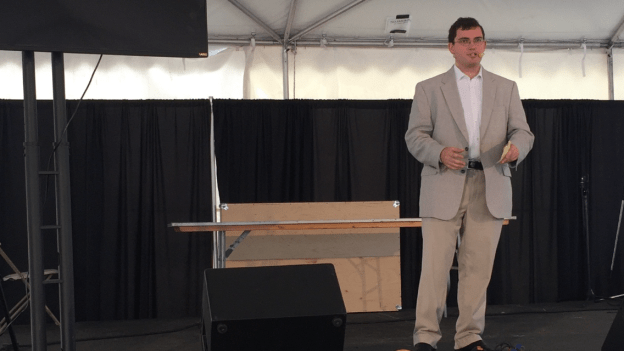
The author on a blue background wearing Apple AirPods.

On Machinery

This week, for the penultimate post of the Wednesday Blog, how machinery needs constant maintenance to keep functioning.—Click here to support the Wednesday Blog: https://www.patreon.com/sthosdkane—Sources:%5B1%5D Surekha Davies, “Walter Raleigh’s headless monsters and annotation as thinking,” in Strange and Wonderous: Notes from a Science Historian, (6 October 2025).[2] “Asking the Computer,” Wednesday Blog 5.26.


This week, for the penultimate post of the Wednesday Blog, how machinery needs constant maintenance to keep functioning.


I am just old enough to remember life before the ubiquity of computers. I had access to our family computer as long as I can remember, and to my grandparents’ computer at their condo when we stayed with them in the Northwest Suburbs of Chicago. Yet even then my computer usage was limited often to idle fascination. I did most of my schoolwork by hand through eighth grade, only switching from writing to typing most of my work when I started high school and was issued a MacBook by my school. I do think that a certain degree of whimsy and humanity has faded from daily life as we’ve so fully adopted our ever newly invented technologies. Those machines can do things that in my early childhood would’ve seemed wonderous. Recently, I thought how without knowing how powerful and far-reaching my computer is as a vehicle for my research and general curiosity, I would be happy, delighted in fact, if my computer could conduct one function, say if it had the ability to look up any street address in the United States as a device connected to the US Postal Service’s database. That alone would delight me. Yet that is the function of not just one application on my computer but merely one of many functions of several such programs I can load on this device, and not only can I look up addresses in the United States but I can look up addresses in any country on this planet.

With the right software downloaded onto this computer I can read any document printed or handwritten in all of human history and leave annotations and highlights without worrying about damaging the original source. Surekha Davies wrote warmly in favor of annotating in her newsletter this week, and I appreciated her take on the matter.[1] In high school, I was a bit of a prude when it came to annotating; I found that summer reading assignment in my freshman and sophomore English classes to be almost repulsive because I see a book as a work of art crafted by its author, editor, and publisher to be a very specific way. To annotate, I argued, was like drawing a curly-cue mustache on the Mona Lisa, a crude act at best. Because of this I process knowledge from books differently. I now often take photos of individual pages and organize them into albums on my computer which I can then consult if I’m writing about a particular book, in much the same fashion that I use when I’m in the archive or special collections room looking at a historical text.

All of these images can now not only be sorted into my computer’s photo library, now stored in the cloud and accessible on my computer and phone alike, but they can also be merged together into one common PDF file, the main file type I use for storing primary and secondary sources for my research. With advances in artificial intelligence, I can now use the common top-level search feature on my computer to look within files for specific characters, words, or phrases to varying levels of accuracy. This is something that was barely getting off the ground when I started working on my doctorate six years ago, and today it makes my job a lot easier; just my file folder containing all of the peer-reviewed articles I’ve used in my research since 2019 contains 349 files and is 887.1 MB in size.

Our computers are merely the latest iterations of machines. The first computer, Charles Babbage’s (1791–1871) counting machine worked in a fairly similar fashion to our own albeit built of mechanical levers and gears where ours have intricate electronics in their hard drives. I, like many others, was introduced to Babbage and his difference engine by seeing the original in the Science Museum in London. This difference engine was a mechanical calculator intended to compute mathematical functions. Blaise Pascal (1623–1662) and Gottfried Wilhelm Leibniz (1646–1716) both developed similar mechanisms in the seventeenth century and still older the Ancient Greek 2nd century BCE Antikythera mechanism can complete some of the same functions. Yet between all of these the basic idea that a computer works in mathematical terms remains the same even today. For all the linguistic foundations of computer code, the functions of any machine burn down to the binary operations of ones and zeros. I wrote last year in this blog about my befuddlement that artificial intelligence has largely been created on verbal linguistic models and was only in 2024 being trained on mathematical ones.[2] Yet even then those mathematical models were understood by the A.I. in English, making their computations fluent only in one specific dialect of the universal language of mathematics making their functionality mostly useless for the vast majority of humanity.

Yet I wonder how true that last statement really is? After all, I a native English speaker with recent roots in Irish learned grammar like many generations of my ancestors through learning to read and write in Latin. English grammar generally made no sense to me in elementary school, it is after all very irregular in a lot of ways, and so it was only after my introduction to a very orderly language, the one for which our Roman alphabet was first adapted, that I began to understand how English works. The ways in which we understand language in a Western European and American context rely on the classical roots of our pedagogy influenced in their own time by medieval scholasticism, Renaissance humanism, and Enlightenment notions of the interconnectedness of the individual and society alike. I do not know how many students today in countries around the globe are learning their mathematics through English in order to compete in one of the largest linguistic job markets of our time. All of this may well be rendered moot by the latest technological leap announced by Apple several weeks ago that their new AirPods will include a live translation feature acting as a sort of Babel Fish or universal translator depending on which science fiction reference you prefer.

Yet those AirPods will break down eventually. They are physical objects, and nothing which exists in physical space is eternal. Shakespeare wrote it well in The Temepst that 

“The solemn temples, the great globe itself,

Yea, all which it inherit, shall dissolve,

And, like this insubstantial pageant faded,

Leave not a rack behind. We are such stuff

As dreams are made on, and our little life

Is rounded with a sleep.” (4.1.170-175)

For our machines to last, they must be maintained, cleaned, given breaks just like the workers who operate them lest they lose all stamina and face exhaustion most grave. Nothing lasts forever, and the more those things are allowed to rest and recuperate the more they are then able to work to their fullest. So much of our literature from the last few centuries has been about fearing the machines and the threat they pose. If we are made in the Image of God then machines, our creation, are made in the image of us. They are the products of human invention and reflect back to us ourselves yet without the emotion that makes us human. Can a machine ever feel emotion? Could HAL-9000 feel fear or sorrow, could Data feel joy or curiosity? And what of the living beings who in our science fiction retrofitted their bodies with machinery in some cases to the extent that they became more machine than human? What emotion could they then feel? One of the most tragic reveals for me in Doctor Who was that the Daleks (the Doctor’s main adversaries) are living beings who felt so afraid and threatened that they decided to encase the most vital parts of their physical bodies in wheelchair tanks, shaped like pepper shakers no less, rendering them resilient adversaries for anyone who crossed them. Yet what remained of the being inside? I urge caution with suggestions of the metaverse or other technological advances that draw us further from our lived experiences and more into the computer. These allow us to communicate yet real human emotion is difficult to express beyond living, breathing, face-to-face interactions.

After a while these machines which have our attention distract us from our lives and render us blind to the world around us. I liked to bring this up when I taught Plato’s allegory of the cave to college freshmen in my Western Civilization class. I conclude the lesson by remarking that in the twenty-first century we don’t need a cave to isolate ourselves from the real world, all we need is a smartphone and a set of headphones and nothing else will exist. I tried to make this humorous, in an admittedly dark fashion, by reminding them to at least keep the headphones on a lighter mode so they can hear their surroundings and to look up from their phone screen when crossing streets lest they find themselves flattened like the proverbial cartoon coyote on the front of a city bus. 

If we focus too much on our machines, we lose ourselves in the mechanism, we forget to care for ourselves and attend to our needs. The human body is the blueprint for all human inventions whether physical ones like the machine or abstract like society itself. As I think further about the problems our society faces, I conclude that at the core there is a deep neglect of the human at the heart of everything. I see this in the way that disasters are reported on in the press: often the financial toll is covered before the human cost, clearly demonstrating that the value of the dollar outweighs the value of the human. In abdicating ourselves to our own abstractions and social ideals we lose the potential to change our course, repair the machinery, or update the software to a better version with new security patches and fixes for glitches old and new. In spite of our immense societal wealth, ever advancing scientific threshold, and technological achievement we still haven’t gotten around to solving hunger, illiteracy, or poverty. In spite of our best intentions our worst instincts keep drawing us into wars that only a few of us want.The Mazda Rua, my car, is getting older and I expect if I keep driving it for a few years or more it’ll eventually need more and more replacement parts until it becomes a Ship of Theseus, yet is not the idea of a machine the same even if its parts are replaced? That idea is the closest I can come to imagining a machine having a soul as natural things like us have. The Mazda Rua remained the Mazda Rua even after its brakes were replaced in January and its slow leaking tire was patched in May. Yet as it moves into its second decade, that old friend of mine continues to work in spite of the long drives and all the adventures I’ve put it through. Our machinery is in desperate need of repair, yet a few of us see greater profit from disfunction than they figure they would get if they actually put in the effort, money, and time to fix things. If problems are left unattended to for long periods of time they will eventually lead to mechanical failure. The same is true for the machinery of the body and of the state. Sometimes a good repair is called for, reform to the mechanisms of power which will make the machine work better for its constituent parts. In this moment that need for reform is being met with the advice of a bad mechanic looking more at his bottom line than at the need of the mechanism he’s agreed to repair. Only on this level the consequences of mechanical failure are dire.


[1] Surekha Davies, “Walter Raleigh’s headless monsters and annotation as thinking,” in Strange and Wonderous: Notes from a Science Historian, (6 October 2025).

[2] “Asking the Computer,” Wednesday Blog 5.26.
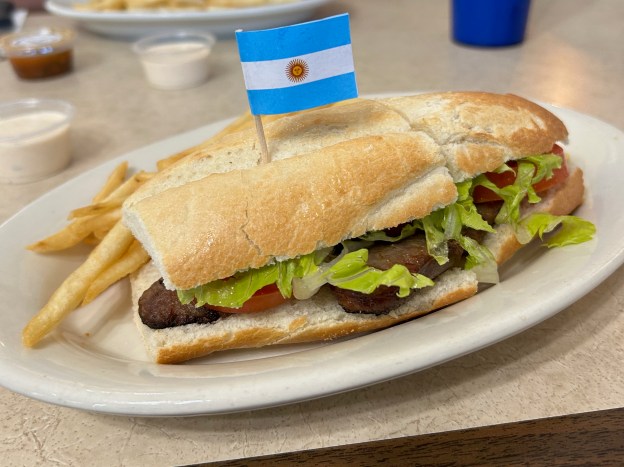

A choripán sandwich from Los Hornos Argentinian Flavors in Kansas City, Missouri photographed by the author just before it was eaten by the same.

On Language Acquisition

On Language Acquisition Wednesday Blog by Seán Thomas Kane

This week, how living in a culture is required to speak a language in depth.—Click here to support the Wednesday Blog: https://www.patreon.com/sthosdkane—Sources: [1] “A Letter from San Juan,” Wednesday Blog 3.29.[2] “The North American Tour,” Wednesday Blog 5.34.


This week, how living in a culture is required to speak a language in depth.


The languages which I speak are directly responsible for the ways my life has turned, its winding path a result of the words I use and the ideas they represent. Language is the voice of culture; it evokes the rich harmony of thought that comes from seeing things from certain points of view. At the University of Westminster, I was regularly in classes where there were maybe 10 or 20 languages spoken between each of the students, if not more. English remained our common language and the language of instruction, yet how many of us must have been switching between English and their own native language as they thought about the readings and topics in political philosophy and science which we discussed on a given day? Even then, my English is not the same as the King’s English, nor is it the same as the English I heard spoken when I drove through Alabama in July 2022. Language then reflects our individual circumstances of experience. Knowledge is gained through experience first and foremost, whether that experience be theoretical through books or practical through lived experience. I make this distinction because I often feel that when I’m reading a particularly well written book that I can actually imagine the characters as real people who I might meet in my life. The best TV shows and films are like that, their casts that we see regularly begin to seem like old friends who we look forward to visiting again and again.

Language acquisition is a lot like this for me. Today, I speak three languages: English, Irish, and French, and I can read Latin, Italian, Catalan, Spanish, and Portuguese and some Ancient Greek. I break my languages down into these two categories by their utility in my life. The handful which I can read are those which I’ve worked with in my historical capacity. I’ve spoken Italian and Spanish from time to time, yet those moments of elocution are few and far between. The same could be said for my German, though it’s now been five years since I last spoke that language in Munich, and at time of writing I can’t say that I’d be much use in remembering it today. This is even more true for my Mandarin, a language which I studied for a semester in between my two master’s degrees out of pure curiosity. I can remember the pronouns, a couple of verbs, and a noun or two but that’s about it. All this to say that I may know something about German and Mandarin yet it’s little more than a foundation for the future when I might be faced with a desire or need to learn the language properly.

I’ve been thinking lately that of any of these I need to work most on my Spanish, the most useful of these languages for me to speak here in the United States. I can understand Spanish fine yet speaking it remains a challenge. On Sunday evening after my shift I decided to reopen the Spanish course on the app Busuu––one which I used for Spanish before my March 2023 trip to the Renaissance Society of America’s annual meeting in San Juan, Puerto Rico––and try it out again.[1] That time I got through the A1 level before life got in the way, and I gave it up feeling frustrated with the process. I did not resume any online Spanish courses before my trip to Mexico last November for the History of Science Society meeting in Mérida, instead choosing the less preparatory method of winging it.[2] That worked with fits and spurts, my best Spanish conversations were in taxis with locals, though I was mostly thinking about how I would say things in French and then Hispanifying them based on my minimal knowledge of Spanish grammar. On Sunday, after I retired for the evening from my Spanish lessons on the app I realized what it was I missed so much in these apps: the human connection. Busuu prides itself on its crowd-sourced learning method; throughout the course learners are asked to submit spoken or written answers to the computer’s prompts which learners of other languages who speak the target language then correct. I like this system overall, and it does give this sense of community, yet I feel that it could go further.

After English, the second language I learned was Irish, my ancestral language. I started studying the Irish language when I was fourteen and have been focused on it to varying degrees for the last eighteen years. It really took until 2022 for me to connect with the language though, in spite of the fitful starts and stops because in that year I began to build a community around the Irish language. First on Zoom through Gaelchultúr, an Irish language school in Dublin, I met other speakers from across North America and beyond who like me were descendants of Irish immigrants old and new. I looked forward to seeing some of the same people term after term. Yet after returning to Kansas City, I began to look locally for Irish classes and came across the community that my friend Erin Hartnett has built at the Kansas City Irish Center. Through Erin I’ve met some really good friends and from our mutual appreciation for our ancestral language we’ve found a lot more in common from mutual histories to mutual appreciations for rugby. Without this community I would speak Irish but not terribly well. Now, not only do I speak Irish daily, but I also write in Irish every day. It has truly surpassed French as my second language, something I’m proud of yet not too concerned about when it comes to my Francophonic abilities.

French exists in a different sort of place for me than Irish. It’s not an ancestral language with deep family ties. Rather, it’s a language that I gravitated toward out of a fascination with French culture and history. I may have written here in the Wednesday Blog before that my first exposure to French came at sunset on a Sunday in February 2001 when my Mom put a “Learn French” cassette tape into the tape player in our family car when we were driving through the hills of northwestern Illinois toward Dubuque, Iowa. She and I were preparing for a trip to London and Paris that summer, the first European trip that I could remember, and she wanted to put in the effort for us to have some French before we arrived on the Eurostar from Waterloo Station at Paris-Gare du Nord. I didn’t like Paris much on that first visit, I found the language barrier to be too great for me to really feel a sense of connection with the place. On my next visit to France in March 2016 with three years of undergraduate French under my belt I found that I not only got the place more, but I appreciated the nuances of French culture more than I had as a child.

I owe a great deal to my undergraduate French professors M. Kathleen Madigan and Claudine Evans. It’s through their classes that I gravitated toward my career studying the French Renaissance. When I get asked why I chose to study the French I keep it simple and say it was a matter of pure convenience: I already spoke French, so I wouldn’t need to learn a new language (Spanish or Portuguese) to read my primary sources. That’s how I ended up studying André Thevet (1516–1590). I chose him because he happened to write about a sloth and for me the idea of being a sloth historian made me laugh. It’s as simple as that. I loved studying French in college, and even more teaching it with the online Beginner French course I built for the Barstow School in 2023 and 2024. I found that going through the same textbook I used a decade before I was not only teaching the students who in the future would go through my course, I was also renewing my own French education and learning things that I’d missed on my first go around. This is a critical point in language acquisition: few people are going to get a language on their first try, it’ll take multiple goes to understand what’s being said and to make oneself heard as well. It took me three tries to get Irish down, and the same is the case for Latin. Failure in the moment is merely a setback which can, and ought to be overcome in future endeavors. After all, remember that if we’re paying attention to our lives we’ll learn from our experiences.

I grew to really embrace a lot about the Francophonie to the point of paying Sling TV for access to TV5 Monde, France’s global TV channel which now broadcasts several different channels. I personally enjoy TV5 Monde Style, which tends to broadcast documentaries and cooking shows, though I don’t watch it as much as I might like. I read a lot of French books for my research, after all I work with source material that has largely only been written about in French and to a lesser extent in Portuguese. I am able to do what I do with those sources because I can read them and the secondary literature about them in French. All this made it all the easier for me to go to France and Belgium in the last several years and be able to switch from English to French as soon as I walked off the plane. I found when I was flying back to the United States in June 2024 after spending about a week speaking mostly French in Paris that I was consistently responding with the quick phrases “please, thank you, you’re welcome,” and the like bilingually with the French followed by the English as I’d heard so many people do in shops and the museums during that visit. It took me a while to get past doing this and just say things in English again after I returned.This then is why I think I’ve had so much trouble with learning Spanish. It’s the first language that I’ve given a big effort to learning outside of a classroom on my own. At least in the classroom you have fellow students around you to practice with. When you’re on your own you’re on your own, a wise-sounding craic which is to say that when alone you have no one else to talk with. I have friends here in Kansas City who speak Spanish, and I know all I have to do is ask, yet it’s finding the free time to sit down with them and work on it that I need to figure out. To truly gain a footing in a language one needs to immerse oneself in the culture. Apps and online learning will only take you so far. A classroom learner will blend into their own classroom idiolect of the language in that particular space where it exists in their life. Only if they move beyond classroom and begin to converse and live with people in places where that language is spoken will they begin to speak it in a manner which is more recognizable to native speakers.


[1] “A Letter from San Juan,” Wednesday Blog 3.29.

[2] “The North American Tour,” Wednesday Blog 5.34.


Dúlra

This week, how it’s good to pause and notice the ways we supersede older things with the new while benefiting from the old all the same. — Click here to support the Wednesday Blog: https://www.patreon.com/sthosdkane

This week, how it’s good to pause and notice the ways we supersede older things with the new while benefiting from the old all the same.


One thing I seek to understand the most about the Irish language is how different external influences have changed the language. I first learned the word nádúr before learning dúlra. Both words mean the same thing on a broad level: they both refer to the concept of nature. Yet nádúr comes from the Latin nātūra with the early medieval monks. It was an import to Ireland that arrived with Christianity and the Latin alphabet, a Roman concept of nature that perhaps fits better in the classical sense of civilization than the Gaelic model which was highly developed around forts and homesteads rather than cities or towns. I’ve often challenged my students to consider that while civilization at its core refers to cities, the ways in which it has developed around the globe differ in their own methods.

Take, if you will, the different origins of writing. Whereas our own Latin alphabet derives from a Mediterranean sphere of the written word whose roots trace back to Egyptian hieroglyphs, the history of writing in East Asia goes back to the earliest forms of writing in ancient China on the oracle bones. In the countries whose writing systems derive from this Chinese source, they still largely use logographic or syllabic forms of writing while there is a greater diversity of form among the descendants of these old Egyptian hieroglyphs. We, the Greeks, and Cyrillic writers, have devised alphabets in which both consonants and vowels are written out. Other cultures that have adopted this Mediterranean tradition of writing only write the consonants, as in Arabic and Hebrew. Still others have syllabic systems in which individual written characters represent a syllabic sound: a consonant and vowel combination.

Each system is equal in its utility, and each represent the diversity of human experiences with their own worlds. They are each their own response to a common question. So it is with nātūra and dúlra, one is a Latin way while the other a Gaelic one. Nature, in this Latin perception is quite monolithic and abstract in my view; I’m thinking of Lucretius’s book De rērum nātūra, or On the Nature of Things, whose title I’ve surely ripped off a good many times in the last fifteen years. We can talk about nature this and nature that, yet we need further context to properly understand what is meant by nature. It could be a reference to the non-human world, places untouched by civilization. That certainly fits the Renaissance perception of nature which I study. Or it could stand in for instinct and feeling. My Instagram feed was filled earlier this week with videos of people who have pet panthers and tigers for some reason. Sure, they may seem like big, cute kittens but unlike domesticated cats (Felius cattus) these animals don’t have generations of domestication and breeding to be willing to live around humans like their smaller distant cousins do. So, pets they may be, but they are still pets that could, and quite likely will, rip your face off if given the chance.

What I like about dúlra is that it comes from another Irish word, dúil, which is a very abstract concept in English yet specific in that it refers to the most fundamental aspects of one’s nature. Dúil can be used to refer to the elements of one’s existence, or to a creature as something created. In English we have several words that all generally refer to other fauna: there’s animal, the most common one which has the Latin anima meaning “spirit” at its core, creature, which sounds slightly more menacing yet at the same time speaks to the thing’s nature as a created being, and finally beast which comes into English through French from the Latin bēstiawhich implies a strong sense of danger in its name. These three words offer a gradient of distinction from humanity, and even a scale by which we humans have judged each other. Dúil then fits closer to the English word creature in the sense that a creature is created and is constituted of elements which allow it to exist.

Are these elements then immutable, or can they change with their experiences? There is a story in the March/April 2024 issue of Smithsonian Magazine by conservation journalist Ben Goldfarb about the negative impacts that roads are having on the forests of the American West. In many places roads were the forward guard of civilization, along those roads came the hunters and loggers, the miners and sightseers all of whom transformed these forests to better fit that classical view of a civilized and maintained wilderness that isn’t truly wild. Today, Goldfarb writes, in the contiguous United States “it is impossible to travel further than 22 miles (35 km) from the nearest road.” Think about that for a moment: in the Lower 48 states, which occupy an area of 3,119,884.69 mi2 (8,080,464.3 km2), you can’t go very far from running into a road. I’ve often noticed how if you look at a road map of the 48 states you’ll see how tightly packed the roads are in the eastern half of the country, and once you go out further west they are still there but often more in a clear grid pattern. Goldfarb describes how Idaho’s Nez Perce-Clearwater National Forests have a road density which exceeds that of New York City even.

These roads then are not natural to the landscape, and those which were built on older Native American footpaths and trade routes are now so widened and imprinted upon the landscape as to make them less thoroughfares through the woods and more barriers for the denizens of the woods going straight through their home turf. Think of Arthur Dent’s exasperation at waking up in his comfortable English house to find a bulldozer outside his front door ready to pull the house down to build a bypass. The same goes for the bears and birds and deer and all the other wild things that live in this continent’s forests.

Roads often stand for a level of sophistication and civility which hearkens back to the Romans, whose roads famously all led to Rome. Like the Roman coloniae which reshaped the great forests of Northern and Western Europe two millennia ago, our own settlements changed this continent in a way which better reflects the aspirations of one society seeking to assert their sense of civility and right upon all others they encounter. Roads are tangible symbols of empire which aid the movement of goods and people from one place to another. They tie this continent together in its most fundamental way, before the railways or airways brought us even closer together. Yet Goldfarb makes a good point: at what cost have we strung these ribbons of highway across the North American continent?

The suggestion which Goldfarb describes is pulling out less used roads, old timber roads no longer operated by the companies who built them, and letting the wilderness restore itself. At first, I was hesitant to support this cause, after all how else would I, a city guy, be able to venture out west into the woods to see nature and admire the wonders of the Rockies? Yet as I read his article which features conservationists in Idaho and Montana, I began to see his point. These roads are destructive, and perhaps the better way to see nature, to experience dúlra in its fullness on this continent is to pull out some of these more remote roads, let the brush take over again, and force any would-be visitors to hike in and out. Let it be a reminder that whenever we are in that world that we are guests in someone else’s house.

In the coming weeks, I hope to write more about this question of mine of what exactly makes us human? What is the dúil at the core of our existence? And how can we understand our own dúil, our own essence, in a way which coexists with all other life rather than living above all others as some sort of self-appointed superior? Perhaps that famous line in the Book of Genesis where God commissions Adam and Eve as stewards of the Earth ought to be understood not as “having dominion over nature” but “tending to the balance of nature.” As humanity becomes more urbanized, as civilization becomes more city-orientated, perhaps we will see the land around our cities return to the wild. The Australian mammalogist, paleontologist, environmentalist, conservationist, explorer, and science communicator Tim Flannery argues this could be the case. To conclude his book Europe: A Natural History, Flannery describes a future around 2100 where most of Europe’s human population live in cities and the open land between them has been turned into wildlife reserves, national parks, and restored to its primeval forests. As long as we can assure that our food supplies, fresh drinking water, and sanitation persist if not improve, and that overcrowding doesn’t become too much of a problem in these cities then I have little issue with this idea.

It is interesting to me that even in the context of the word dúlra there is a clear distinction between that and humanity, that dúlra represents the essence of the non-human world, something far less orderly than what we’ve created. It doesn’t necessarily follow laws in the same manner as nātūra, laws whose order can be discerned with careful examination. There is something pure to the chaotic origins of life in this word dúlra, and that’s something I appreciate.


Our First Languages

Last week, I listened to an essay from the New York Times Magazine about the possibility that one might lose their first language if they use another too much. Today then, I write to my own experience in this matter. — Click here to support the Wednesday Blog: https://www.patreon.com/sthosdkane

Last week, I listened to an essay from the New York Times Magazine about the possibility that one might lose their first language if they use another too much. Today then, I write to my own experience in this matter.


We choose how we sound to the extent that our physical bodies can allow. This means that our voices and body language can change as we move between environments and groups. I’ve seen this, and even noticed it in myself. My jokes change depending on the setting for one, yet also my tone and accent will deviate to the slightest degree when I move from one group to the next. This change is all the more dramatic when I’m speaking a different language to any significant degree. Last October, when I was in Brussels and Paris, I was speaking French far more than English. On two occasions when I met with friends who I normally speak with in English, I noticed something strange was happening to my voice: my accent was dulled. 

I like to compare the human voice to a pen, in the right hands and with the right training it can move with fluid precision. When at my best moments I can glide in and out of a series of registers with ease and use those different registers to accentuate the point I’m making. You’ve heard some of this here on the Wednesday Blog, those who listen to the podcast that is. The range of sounds I can make is far broader than the mere 26 letters of the English alphabet; this is thanks to my experience speaking other languages, French and Irish in conversation, and to the years of singing Latin hymns at Mass and practicing reciting Ovid and Virgil in my high school Latin classes. I can make myself understood in German, Italian, and Spanish as well if needs be, thanks to the other four I’ve spoken most frequently.

So, at those two dinners, one in Paris and the other a few days later in Brussels, I found that the usual fluidity of my speech was lacking, that I couldn’t quite make all the sounds I usually can. It occurred to me then that speaking French so much had made it harder to switch back into English after all the exercise that my vocal muscles had parler français produced different results to my usual practice speaking English. The author of the essay in the Times Magazine, Madeleine Schwartz, writes about losing recall of one language as much as the physical difficulty of making the sounds not made in the language, she uses the most. For her, the American English r sound was especially challenging after saying the French r so often. For me, my version of the French /ʁ/ is in fact an approximation that I make based on the Irish /ɣ/ sound as in the word dhá, a variation of the number two. These two sounds are approximates of each other, the French /ʁ/ is an uvular fricative while the Irish ɣ is a velar fricative. This means that the French /ʁ/ is produced further back in the mouth than the Irish /ɣ/. Still, my American English /r/ becomes a challenging sound to make when I’ve been saying /ɣ/ or /ʁ/ all day.

On top of this, I’ve steadily worked on mastering another r sound, the trilled r sounds. I say sounds because there are a variety of these that an individual speaker can make depending on where on the tongue you produce the sound. I can make three of these sounds, one which is more of a clipped r that I picked up from Peter Cushing’s performance as Grand Moff Tarkin in the original Star Wars that I think of as more high-brow stage English, the second is a fuller trill, scientifically called a velar fricative, not quite at the tip of the tongue that I use at the beginnings and middles of Irish words, and in Latin and when I’ve spoken Italian and Spanish, and the third is a wisping of air just beyond the tip of the tongue that I use to make the r sound at the ends of Irish words. This last r is called a palatized fricative. These have all taken practice to learn and even more practice to begin doing on a regular basis. Again, I chose to speak the way that I do, and to change registers when I am speaking to a public audience, what you hear here, compared to when I’m speaking with family and friends.

I find that the letter r is important for getting down any accent, because it is so particular to each. It’s a sort of in-between sound that is a consonant yet can act like a vowel in some ways. It’s perhaps fitting then that this same Irish velar fricative ɣ is spelled dh, a digraph which is also pronounced in my Irish as the schwa vowel, /ə/. In my speech, I want to be understandable to my audience, yet also express an aspect of myself in a way that will appeal to that person. While my first language is English, my own urban Midwestern variety of it, my experiences and travels have transformed my idiolect into something that transcends regional boundaries now with bits of London and the Northeastern American English accents that I’ve been exposed to filtering in alongside the ways that my family and community here at home talk amongst ourselves.

One question I still have, one which I’ve pondered for years, is does our modern code switching reflect the abilities of our prehistoric ancestors and perhaps the early evolutionary history of language and human speech? Are other animals able to change how they communicate to reach the widest possible audience? It’s notable to me that a great deal of evidence shows that adult domesticated cats only meow to humans, a vocalization they normally only make as kittens to their mothers. So, in the cat’s meow we hear a conscious change in vocal expression intended to get whatever they’re feeling or thinking across to us. Had I not become a historian, I would have probably chosen to pursue anthropology, focusing on the evolution of human communication and human language.

What do you think about this? Do you intentionally change how you speak to be understood by specific audiences? Let me know in the comments on this blog post at wednesdayblog.org, or on the social media platforms where I share this: Facebook, Instagram, LinkedIn, and X (formerly Twitter). You can also share your comments on the Wednesday Blog Patreon feed where I share these blog posts with more of an introduction from me and a bit before they go onto the social media channels.


In Praise of my Favorite Latin Verb

In Praise of my Favorite Latin Verb Wednesday Blog by Seán Thomas Kane

Today, I'm talking about a particularly versatile Latin verb that I'll admit I'm rather fond of: mittō. Click here to support the Wednesday Blog: https://www.patreon.com/sthosdkane

I first started studying Latin when I was fourteen, a high school freshman at St. James Academy. Over the next four years I studied Latin with Bob Weinstein, then the St. James Latin teacher, and even took a year of Ancient Greek with him as well. In those years I got a good foundation in Latin, though I’ll admit I didn’t learn as much as I wanted, in part thanks to my own immaturity at the time. In the years since I’ve been able to connect more of these concepts in my thinking about the language, now on my third round of studying it. I often like to say that there are certain languages which I feel I can inhabit, that are so familiar and comfortable to me that I feel empowered to read, speak, write, and even think in them on a regular basis. These four are English, my native language, Irish my ancestral language, French, the language I fell in love with in college, and Latin, my original language of study in school.

Honestly, it took me until my third round studying Latin to really get the hang of today’s verb of note: mittō. Its full dictionary entry, laying out its principal parts are mittō, mittere, mīsī, missum. Looking at these four we can see the utility of this verb, which in its most basic meaning I’d translate mittō as “I send.” It means to send, but it also includes other types of sending like dispatching, releasing, or extending a hand, yielding, bringing out, attending, and dedicating a book, among many others. To say that one verb has so many meanings, so many actions it represents seems a bit of a stretch to me, but if you only think of a language by taking its parts out of place and analyzing them individually of the rest of the language, you’ll find you’re getting a different picture than you would if you considered the whole thing in one go.

Mittō has a great many descendants in English. Just looking at that 1st person present active form (mittō) we can see emit, intermittent, omit, permit, remit, submit, transmit, and everyone’s favorite cat name mittens. Frommīsī and missum we get all of the mission words, words like intermission, missile, omission, permission, promise, remission, and transmission. 

Even the word Mass as in the Catholic liturgy comes from mittō. It originated in the phrase Īte, missa est, which I’ve always heard as “Go, the assembly is dismissed” though I think of it more in line with the phrase “the Mass has ended” that you hear at the end of every liturgy. Missa in that phrase comes from missiō, a 3rd declension Latin noun meaning sending or dismissal, which itself has roots in our old friend mittō. One thing of interest regarding the name of the Mass is that the Latin word Missa is the origin of a great many names for the liturgy in the Romance and Germanic languages as well as the Polish msza. Yet in Irish the Mass is called Aifreann, which comes instead from the Latin verb participle offerendus, essentially translating as offering. The same Latin word is the origin of the name for the Mass in all of the other Celtic languages, though Welsh and Breton today call it an offeren and an oferenn respectively.

I decided to write about mittō this week because it keeps coming up in stuff as I find myself going about my work. I like versatility, the idea that we can look to something as particular as a verb like mittō to find the source for so many concepts and ideas. Language is the way we understand the world around us. It’s one of the first things in most creation myths that the humans do, they look about and start naming things. Those names transmit information about the object to people whether in earshot or in other worlds through writing. In our own day we are pushing the limits of mittō and its descendants by sending data back and forth to our furthest out exploratory spacecraft, from the Voyagers on the edge of the Solar System to the Perseverance Rover on Mars to the International Space Station in orbit. All of that data gets submitted back to each craft’s mission control here on Earth for further analysis.So, here’s to mittō, one of my favorite Latin verbs.

Human or Man?

In English should we say that Jesus "became human" or "became man"? Join me as I work through the history of the Nicene Creed and how this most pivotal of beliefs was interpreted first by the Greek speaking Church Fathers who wrote the Creed, later by the Latin speaking Catholic Church, and today by us English speakers. You can read a transcript of the full episode here. Written, read, and produced by Seán Thomas Kane. © Seán Thomas Kane, 2021.

On Saturday I took the opportunity to go to 4:00 pm Mass at my home parish here in Kansas City, MO while I was in town for Thanksgiving. It was wonderful getting to see the place again, and even though it’s only been 3 months since I left town for the semester a part of me doubted I’d actually see these places that are so dear to me anytime soon.

During the Nicene Creed as I recited the words I’ve known at least since freshman year of high school, the proclamation of the Faith, kind of a Pledge of Allegiance that we Catholics still have mostly in common with our Orthodox and Protestant cousins, I noticed something that made perfectly good sense but I hadn’t thought of yet. A friend who was standing near me said that Jesus “became human” instead of “became man.” It caught me off guard for a number of reasons. Firstly, the official English translation that we use in the US does use the older word “man” rather than the newer “human” but secondly, I had a feeling from what I could remember of the Latin translation that our English one is more closely based on that “human”, “homō” in Latin, might actually be the noun used.

That evening I made a point of going to the source. I looked up the Creed in Latin and sure enough the line there is “et homō factus est,” which I’d translate in my schoolroom Latin as “and he was made human.”1

The one catch here is that the Creed wasn’t originally written in Latin but in Greek. So, in order to get to the original meaning and intent of the Church Fathers at the Council of Nicaea (325) that wrote the Creed we still say nearly 17 centuries later, I’d need to call up my admittedly elementary and rusty knowledge of Greek. Unlike Latin, which I studied all through my high school years, have picked up again twice since, and use professionally on a regular basis as a historian of Renaissance natural history, I haven’t been lucky enough to use much of my Greek. I took Classical Greek in my senior year of high school after finishing my last required math credit the summer before, and then took a semester of Koine Greek (aka New Testament Greek) in my sophomore year of undergrad at Rockhurst. So yeah, my Greek is rusty. I can still read the alphabet pretty well and I know enough about etymologies that I can get by, but I never really got it the way I got Latin or French.

Still, I was determined to spend at least a few minutes of my Saturday evening at home working through this question: what was the original Greek line that the Latin translator rendered as “et homō factus est“?2 I went to a pretty reliable source that has both the Latin and Greek versions and started scouring the Greek, figuring I was either looking for one of two words: ἄνθρωπος (anthropos) meaning human or ᾰ̓νήρ (anḗr) meaning man.3

One of the big tricks that I’ve learned after now a few years of working with sixteenth-century printed books that are often not in English is the quickest way to find a particular word you’re looking for is basically to just focus on finding that word, don’t pay too much attention to the rest of the text. Once you’ve found the word you’re looking for then go and read the rest of it to put that word into context.

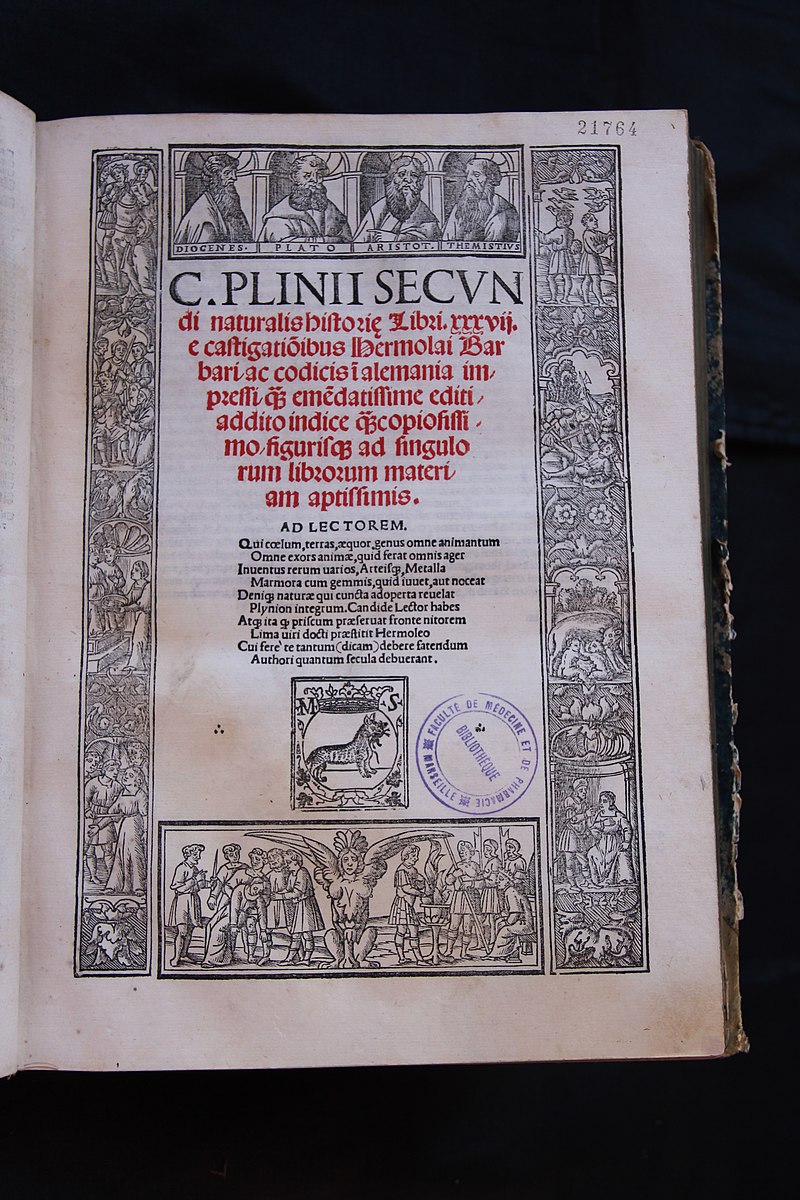
One example of a 16th century printed book that I’ve worked with.

Anyway, back to the story.

So, I scanned through the Greek original version of the Nicene Creed and was left stumped. I couldn’t find either ἄνθρωπος or ᾰ̓νήρ anywhere. I began to wonder if there was some third Greek word for human or man that I didn’t know about, and knowing what I do know about Greek there being three words for the same concept isn’t at all out of the question. Looking for clues, I turned then to the previous line, “and by the Holy Spirit was incarnate of the Virgin Mary”. In the Latin this appears as “Et incarnātus est, ex Spirītū Sānctō ex Marīā Virgine“. A great trick for any researcher working in a second or third language, or better yet one that they have a passing familiarity with is to always keep an eye out for personal names or other proper nouns: those will usually be more prominent, and when it comes to the BVM (Māter Deī, Θεοτόκος [Theotókos]) you can bet her name will be prominent. Sure enough, I quickly found mention of a Μαρίας τῆς Παρθένου (Marias tés Parthenou) meaning the Virgin Mary and kept looking along that line for something that resembled either ἄνθρωπος or ᾰ̓νήρ. Two words over came my answer: a fittingly long Greek verb ἐνανθρωπήσαντα (enanthrōpōpésanta).

I quickly returned to my favorite English-Greek dictionary and found the root form of the verb in question, ἐνᾰνθρωπέω (enanthrōpéō), meaning “to put on human/man’s nature,” or more essentially “to become human/man.” The only job left to do was to take out that clunky slash and acknowledge which noun, ἄνθρωπος or ᾰ̓νήρ was at the heart of that verb. As it turned out, and as you can see, it’s ἄνθρωπος.

Thus, to the best of my efforts as a scholar and translator, and as you can see, I’d argue that in English saying that Jesus “became human” works, perhaps even better than “became man”. Why? Well, remember that English has changed a lot as a language in the past century. We have so many more people and ideas using this language than ever before, and to be honest while the English noun man began as both a word meaning males in both gender and sex (ever a complicated series of terms) and our entire species in general, it has steadily come to lose that second, neuter meaning in favor of solely being a masculine noun. Neil Armstrong’s first words when he stepped onto the Moon’s surface in 1969 were “it’s one small step for man, one giant leap for mankind.” For a guy in 1969 that worked. But for the astronauts that will be setting foot on the lunar surface again in the next few years with the Artemis program, I firmly believe that man won’t cut it anymore.

A few years ago, I wrote a blog post that was a predecessor to this now weekly Wednesday Blog about why I prefer to say “you guys” rather than “y’all”. Long story short: I’m not a Southerner, and I’ll fully admit when I hear “y’all” I don’t tend to think of much besides the people who drug our country into a Civil War 160 years ago because they couldn’t accept the fact that it was morally corrupt to own other human beings. The fact that their heirs are still fighting against racial equity in this country makes my case for me. In that same blog post I also argued that we should move away from the word mankind, and towards something that more closely reflects a more gender neutral word for our species: humanity. On a small side note here (in a paragraph begun with a side note) I don’t like humankind because it combines the very Germanic -kind with the very Latin human. Instead, Latin gives us the word humanity, derived from the Latin hūmānitās. Let’s use that instead. It works, and frankly as we do become far more globally interconnected (which, guys, really isn’t a bad thing at all), it translates far better than humankind ever will.

All this said, getting back to the main point after a brief stop in the politics and history of American English, I think it’s actually a lot better and more profound to refer to Jesus as God becoming human instead of God becoming man. It means that Jesus came to be among all of us, to be one of all of us. I’ve written before in an academic setting about why I believe it’s flawed to refer to God in gendered terms: gender is cultural, it’s fundamentally human, and it keeps the blinders on us to the extent that we can’t make a true effort at seeing, and by seeing hopefully we can get closer to understanding the fullness of God. From there, I’ll leave the writing about how to understand the fullness of God to the theologians and clergy.


Footnotes

  1. Why the difference between the official “became” and “was made” in my translation of the Latin passive verb factus est? Factus est is the passive perfect 3rd person singular form of the verb faciō, which my old stalwart dictionary William Whitaker’s Words translates into the English verbs “do, make, create; acquire; cause, bring about, fashion; compose; accomplish.” So, while “became” is more poetic, “was made” is more accurate to the verb in question. But, theologically was Jesus the passive recipient of the blessing of being made human? After a significant amount of time for what I thought would be a short search I found an entry in the Liddell, Scott, and Jones Ancient Greek Lexicon (LSJ) on the Perseus database that listed the original Greek verb that was translated into Latin as factus est, namely ἐνανθρωπήσαντα, as an aorist participle singular active masculine verb in the accusative case. So basically, while the Latin factus est is in the perfect passive voice (meaning it’s describing an event that fully happened to the subject in the past), the Greek verb is an event that happened in the past without any time specified as to when it happened (kinda like a French passé simple?) This alone shows the complexity of trying to translate from Greek into Latin and then by extension into English. One final note here: while the Greek verb grammatically has a masculine gender (see above in this oversized footnote) I’d stress that that gender designation is referring to Jesus who it’s generally accepted was biologically male. In the process of trying to figure out how the Greek verb in question (ἐνανθρωπήσαντα, in case you forgot) was conjugated, I found an interesting article from the Orthodox Christian Studies Center at Fordham University discussing how best to translate this very verb in the Nicene Creed from the Greek original into English. So, to return to the original question that led me to write this footnote that would outrun the Gettysburg Address in length: the fact that Jesus in the Latin was apparently the passive recipient of his humanity, given to Him by the Holy Spirit is more or less a “it’s the best we can do” translation from the original Greek where Jesus actively “became human”. So, in English while the best translation from the Latin is “was made” human, when taking the Greek into account the official Catholic “became” human works a lot better, because it recognizes that at the end of the day Jesus and the Holy Spirit are consubstantial with the Father, meaning they all share the same Substance, i.e. they are all One. “Three Persons in One God” as my notes from my undergrad freshman Honors Christianity I notes say.
  2. For my fellow grammar constables out there, yes I put the quotation mark outside the quotes. There’s a reason for that, it’s not a part of the quote so I don’t see why it should be included in the quotes. I’m going to write another blog post about this eventually.
  3. For my Greek friends and all Greek scholars out there: to my understanding ᾰ̓νήρ is the Ancient Greek word for “man.” To my understanding the more familiar and modern word άνδρας is descended from the accusative singular (direct object form) of ᾰ̓νήρ.

Understanding the Classics to Understand Ourselves

I’m writing this having just read a stirring article in Commonweal by Cathleen Kaveny, a professor of law and theology at Boston College, on the merits of reading St. Augustine’s Confessions in the original Latin. Professor Kaveny’s article was in response to Princeton’s Classics department’s much noted decision to cut the requirement for its undergraduate majors to prove proficiency in Latin and/or Ancient Greek in order to earn their degrees. I’ve had a number of discussions with friends and colleagues about that particular decision, being a current student of Latin myself, and an off-again-on-again student of Classical and Koine Greek. While I personally haven’t yet read Augustine in the original Latin, in part from a personal dislike for what I perceive as the grumpiness of St. Augustine’s writings (of the early Church Fathers I prefer St. Gregory of Nyssa), I can relate to the thrill and benefit of reading these texts in their original languages.

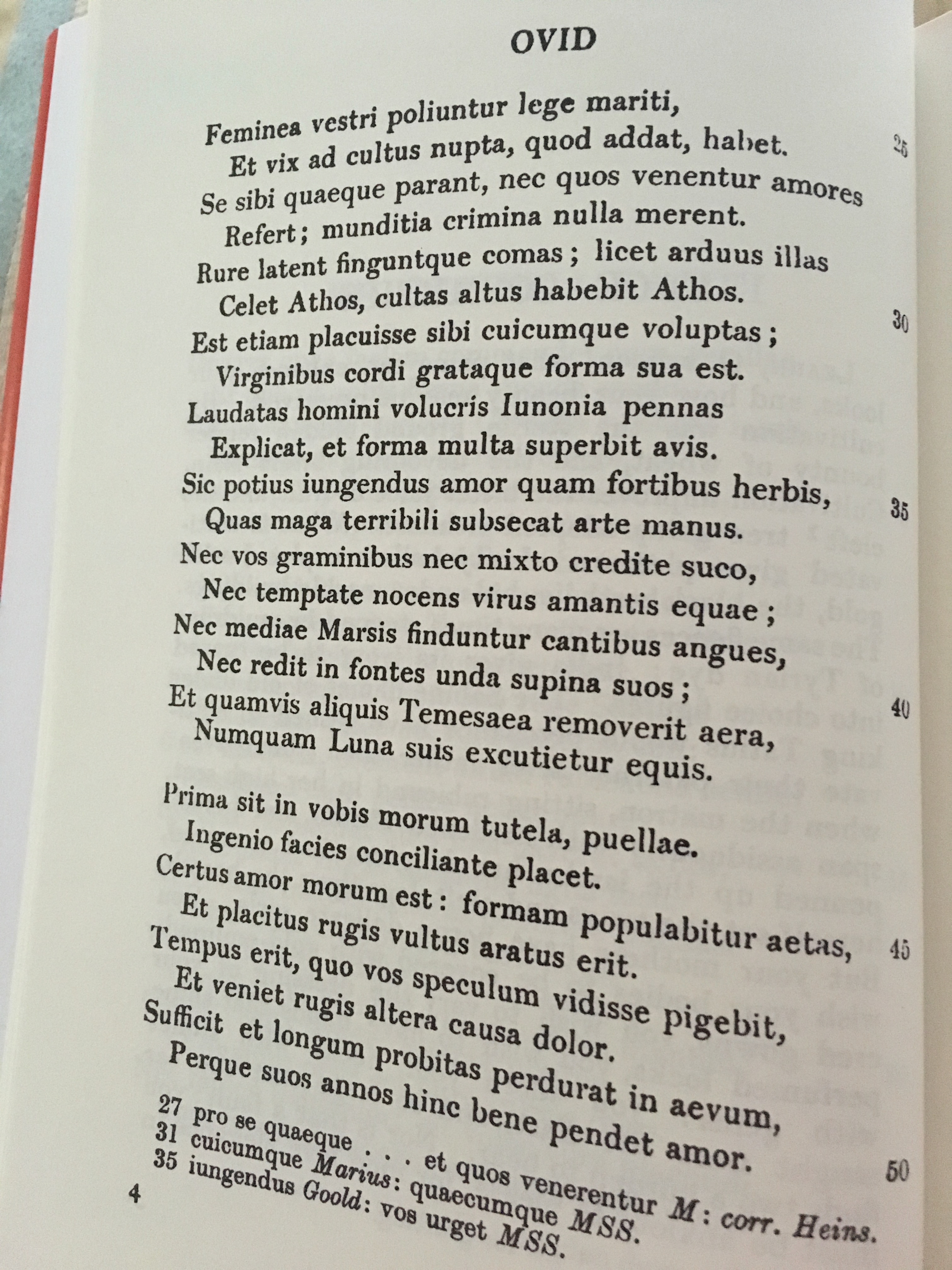
A page from my copy of Ovid’s Ars Amorita

There’s something lost in the translation of any text. English, for all its excessive complexity, lacks the imperfect tense for verbs, meaning that when I am trying to express an idea in any of the languages my sources are written in that uses imperfect verbs, I’m often left struggling to find a really good clear way of expressing that the action is in the past but not quite completed. Think about particular words or phrases in English that sound like other words; the planet Uranus has a funny name depending on how you pronounce it, but that relation between the seventh planet and your posterior anatomy is lost if you try to translate it into practically any other language.

Beyond just understanding literature as its authors intended, the study of Latin and Ancient Greek is critically important to understanding the origins of our civilization, however problematic that word may well have become. The civilization of the peoples whose cultural origins are drawn from Europe, both eastern and western, derive in their origins from the ancient civilizations of the Greeks and the Romans. Those cultures, those powers, those memories have had such a profound and lasting influence on our world today that it would be profoundly shortsighted to stop teaching about them to such a detailed level as many programs do. Our political systems have their origins at least in part in the Classical World, modern representative governments can draw some of their lineage from the democracy of Athens as well as from the Roman Republic.

Generation after generation following the fall of the Western Roman Empire tried in their own way to set themselves up as the heirs of Rome, from Theodoric and the Ostrogoths based at Ravenna in the fifth century CE through Charlemagne and his successors the Holy Roman Emperors in the German-speaking lands north of the Alps, to the Tsars of Russia, the revolutionaries of France, and the founders of the United States. I once wrote in my book Travels in Time Across Europe that to me, Paris today feels as close to what I’d imagine an idealized vision of Rome during the height of the Republic would’ve been like two thousand years ago. The symbols of those governments, particularly of the Roman Republic and the later Roman Empire, remain so present in so many aspects of our world today.

I study the history of French natural history texts written in the second-half of the sixteenth century right at the tail end of the Renaissance that began in Florence in the late fourteenth and early fifteenth centuries. The whole idea of a renaissance is that it was a period when classical culture, literature, architecture, politics, and philosophy saw a revival, a rebirth as is the etymology of the word “renaissance” itself. Advocates of this “renaissance” at the time saw themselves as rekindling the light of the classical world, of restoring the course of what at that time was beginning to be understood as European (aka Western) civilization.

The accidental realization that the Americas existed in 1492 thanks to Columbus resulted in one of the greatest changes in the history of humanity, the opening of the Atlantic and the beginning of permanent contact between the peoples of the Americas and those of Eurasia and Africa. It’s because of this that I prefer not to refer to our civilization as “Western” or “European,” but rather as an Atlantic civilization. It is still the descendant of the civilization of Christian Europe, itself a descendant of the older Mediterranean civilizations of Greece and Rome, but since 1500 our civilization has been profoundly altered by its encounters with civilizations beyond Europe’s waters.

I concede that many of the worst aspects of our Atlantic civilization, from colonialism to slavery can trace some of their origins back to the Greeks and Romans, and that ideas like Manifest Destiny here in the United States have been argued to have drawn influence from older ideas like Rome’s right to rule the world, but even in the historical periods when these claims were being made they were incredibly flimsy. That said, of any problem today, one cannot tie modern ideas of race back to the classical world, as our ideas about race didn’t really begin to develop until 1500; it’s development in the Americas is a central theme to my research.

All this said, we need to understand our history to understand who we are and how we got here, and to do that we need to understand the classical foundations upon which our civilization has been built. The best way to understand those foundations is to be able to read the books they left behind in their original languages. Since the Renaissance we’ve remained generally in the same steady period of knowledge about the classical past; in fact one could argue that the beginnings of all modern fields of research can draw their origins back to the humanists of the Renaissance who sought to revive the sciences of the classical past. Language barriers speak more so to the problems with our education system in general than to anything else. Language education isn’t prioritized in this country, where assimilation and Americanization have been the standards for generations; we come to expect schoolchildren to only know American English because anything else would be unpatriotic. Even if a student comes into a Classics program with a foundational knowledge of one of the Romance languages, in this country likely Spanish, they’ll have a way into beginning to understand Latin. There are strong connections between languages as much as there are between cultures of different ages, we just have to know where to look.

Languages

Of any one of my talents, the one that I tend to pride myself in the most is my ability to pick up languages fairly easily. I listen for the patterns, for words that may sound familiar, and gradually piece together what the speaker or author is trying to say. I have a number of stories involving me fumbling through having to speak languages foreign to me, whether it be the time I accidentally said “no” in Finnish when I mean to say “eh?” as in asking the flight attendant to repeat her question, or the time when I tried to tell a pair of Flemish men I didn’t need to see a doctor after falling down a flight of stairs at the train station in Welkenraedt in eastern Belgium. My solution there, by the way, was to merge the German “Ich bin gut” with what little I knew of Dutch, coming up with “Ik bin gut.” Regardless of how accurate it was to the situation, the fumbled line in my attempted Flemish worked, and kept the medical attention at bay.

The first language I learned to speak was English, American English, centered on the Midwestern cities that I’ve called home, Chicago and Kansas City. I’ve often yearned for small signs here or there of linguistic peculiarities in my own speech, and in the ways my family and friends speak. While many of the most evident signs I’d hope would appear haven’t shown, we aren’t terribly distinctive in how we speak, pretty standard American to be honest, the potential that we could have some regionality in our speech certainly makes the foundations for a good story.

I wouldn’t really begin to learn other languages until I was 14, when I began taking classes in Irish, the language of the majority of my ancestors. I’ve always wanted to be fluent in Irish, to speak the language which I feel is the closest to the beating heart and origins of my community. Based on Census data, my great-grandparents’ generation among my Kane ancestors, the ones who came over from Mayo a century ago, were the last ones who likely had some Irish. That multigenerational gap in our ability to read, write, speak, and think in our ancestral language reflects the degree to which we’ve become American with each generation, to which we’ve given up the cóta of the coasts of Clew Bay and embraced our new urban Midwestern American nature to its fullest.

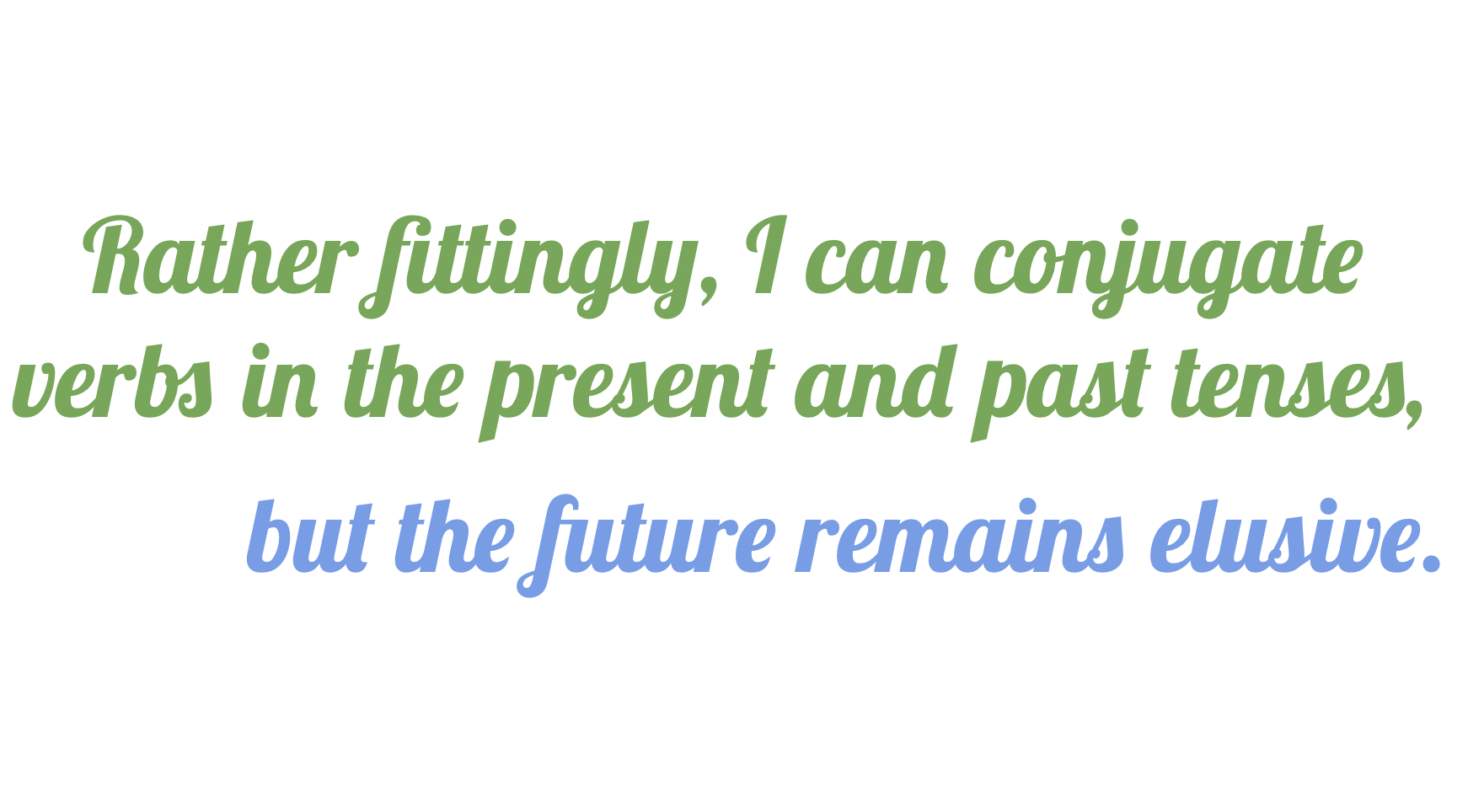
Today, I can do somethings in Irish; rather fittingly I can conjugate verbs in the present and past tense, but the future remains elusive. I use my limited Irish in some contexts, when she was still alive I’d talk to Noel in Irish, saving that language so dear to my heart for my dearest of friends. In the meantime, I’ve focused on other languages: I’m now on my third attempt to properly learn Latin, thankfully as I hope my previous post made clear, third time’s a charm. I’ve also spent a great deal of effort and time learning French, with enough comfort to the extent that I built my PhD dissertation’s source material around the availability of French sources that I could. I’ve spent time studying German and Italian, Ancient Greek, and Egyptian Hieroglyphs. I’ve studied my other ancestral languages, Welsh, Finnish, and Swedish, as well as a little more Flemish after my railway station tumble.

I once wrote a sentence in Irish that I thought expressed how I think about the language, how many of us the descendants of European immigrants spread across this continent may well equally think of their ancestral languages. Is ár dteanga an glór ár n-anama í. “Our language is the voice of our soul.” As best I can tell, it’s grammatically correct, and to me it has deep meaning. As long as we understand and remember our ancestral languages, the deep and intricate contexts of so many aspects of our familial manners and ways of life will stay alive. Even in the whisper of an ethnic memory that comes in preserving our names, the many Irish Americans named Patrick, Molly, Colleen, Brendan, Aidan, or Seán, we can see a hint of the Irish language alive today.

If I am able to truly become fluent in Irish, and I hope I’ll be able to dedicate the time and energy to do so in the long run, I hope my contribution to the language will reflect our times, that as truly it will recognize the efforts of generations past, my Irish will be the language as it is spoken in the twenty-first century, with recognition of the international nature of the language deeply rooted in the native soil from whence all Irish Americans’ ancestors came. I hope deeply, as an American cousin, that my efforts to continue my studies will reflect the respect and admiration I feel for the modern, progressive people my Irish cousins have become.

Understanding Others and Communicating Well

This may not necessarily be a post that will be on a topic that’s familiar to most of you, the 30 or so people who occasionally read these posts, but it’s something that’s important to me. The ability to communicate well, and efficiently, is paramount. It’s ultimately going to be key to solving all of our problems, to making life better for everyone. I truly believe if we could, or rather would, actually sit down and talk with someone we have a disagreement with, chances are we’d find enough common ground to begin sorting our problems out.

But this post isn’t about solving humanity’s big problems, and I’m going to try to refrain from my usual upbeat optimistic conclusions that I’ve noticed I tend to write. Because this evening I want to write about a topic I’ve been interested in for nearly 20 years, one that I’ve struggled with and studied, and am only now really feeling like I’ve confidently mastered: Latin.

Latin is a language that I’ve been fascinated by for a very long time. In part, I’ll admit it’s an attraction to the prestige it embodies: the language of the Romans, and of my Church. It’s been a constant piece of the intellectual and cultural fabric of European and now Atlantic civilization (that’s another idea I’m working on) for millennia. It’s also a highly logical language, a systematic language governed by a set of rules that, once explained, make pretty good sense. Moreover, it’s the ancestor of a number of humanity’s most widely spoken languages, and has directly influenced many, many others, including English. It’s taken three tries now, but I’ve made sense of the language well enough now to feel confident not just repeating the declensions and conjugations that I’ve memorized, but understanding the intricacies of their meaning, and in so doing, to have a better idea at understanding how Latin works.

Latin has also come to reflect the people who have written in it and spoken it over the generations, particularly in their preferences in word order and writing. I’ve often thought, considering that word order isn’t as important in Latin, after all the word endings provide the meaning, couldn’t a native Irish speaker go ahead and speak Latin using a verb, subject, object order and be decently-well understood just as much as a speaker using the classical Ciceronian order of subject, object, verb? Yet there’s one thing that does survive from the ancient world in faint traces that was revived later than other customs in written Latin, something that is still not universally adopted: the macron.

Macrons: the flat line over a vowel sometimes seen in Latin writing, as well as the first family of France, is something that I believe to be fundamental in properly understanding Latin. Sure, my medievalist friends will say, it wasn’t used in Medieval Latin, so we (Medieval and Renaissance historians & scholars, myself included) don’t need to memorize the macrons. But for me, it’s the macrons that have been one of the best tools to help me make sense of Latin. It’s answered the question for me of how a Latin speaker might differentiate between līber, “a child” (pronounced like Lee) and liber, “a book” (li pronounced like literature). It helps me make sense of the difference between a 1st declension nominative singular noun (the subject form) and a 1st declension ablative singular noun (a slightly more complicated form).1 The macron makes everything clear.

This is a good explanation from a far better Latin scholar than me about the use of macrons (the apex).

Without the macron, the meaning of a sentence can be understood, but with much more difficulty. This particular idea makes perfect sense to me because of my work with my primary ancestral language, Irish. In Irish, there are two types of vowels, long and short. The long vowels are represented by a fada over the vowel, essentially an acute accent (accent aigu en français). This is how an Irish speaker knows when reading my name that they’re in fact reading about a guy named Seán and not something that’s old (sean). The presence of the fada isn’t just to make the language look cool (which it also does), but it has a very real impact on the pronunciation and meaning of the word as a whole.

I think it’s best not to think of Irish vowels with fada or Latin vowels with macrons as just variant forms of those vowels but instead as entirely different vowels all together. The á in Seán is an entirely different sound, and thus ought to be seen as an entirely different letter to the a in sean. In the same way, that ī in līber is a different character, and a different sound from the i in liber.

We don’t have these same written variations of our vowels in English. We just have the 5 vowels, occasionally 6, which are supposed to represent all of the vowel sounds that English uses, in all national and regional Englishes around the globe, and in all of their local varieties. In my own accent, I can count at least 3 different sounds that each of the vowels represent. Granted, English wasn’t always like this, macrons were also used in Old English, and through generations of linguistic change, immigration, and English’s constant adoption of foreign words the language has become the exceedingly complicated, often irregular form of communication it is today. Not only is my English influenced by the most basic form of the language studied and spoken here in North America, but there’s also hints of Irish in there as well as the strong British, German, and Nordic influences in my English from all those immigrants who settled in my home region, the American Midwest, in the 19th and 20th centuries, including some of my other ancestors from England, Finland, Flanders, Sweden, and Wales.2

In English, we’ve chosen complexity in spelling as it relates to the spoken language over a 1-to-1 matching of the written language with the spoken language. Why? My best guess is it’s to preserve the unity of English. This keeps it so that all English speakers are generally spelling their words in the same way, between the two main written forms of English (UK & Commonwealth, and US English). For the most part, it’s worked for English, and I wouldn’t recommend moving away from the current model for the exact reasons why it exists; more on that at a later date.

But returning to Latin, if students trying to learn this language, famous for its now generally unspoken nature, really want to give themselves a good chance of succeeding in learning it, then those of us familiar with Latin, whether as students or as teachers, should embrace the macron even more than it already is, and use it throughout all our written Latin. Up until recently, it was challenging especially on computers with English keyboards to type any sort of accented vowels or consonants, but the technology has advanced enough that it’s readily possible today for most keyboards to make things work. On my Mac, I can hold down any of the vowel keys until a box pops up on the screen indicating each accent that can be put on that vowel. I then just have to choose them by number. So, for līber, when it comes to the ī, all I have to do is hold down the i key and press 4, et voilà, I’ve got myself an ī. We should do ourselves, and Latin itself, a favor, after all the easier we make learning this language, the more likely people are going to want to keep learning it.

I like Latin, it’s orderly, and when it’s explained well it can make a lot of sense. All of my Latin teachers to date have done a wonderful job explaining it, sometimes though it takes a bit more maturity to make sense of things. In general, I think we tend to have trouble in the English-speaking world understanding grammar. Let’s face it, our own language has so many contradictions that often English speakers don’t even really understand the rules of English grammar all that well. One of these days, I want to write a little book, a libellus in Latin, that can provide at least what I see as some of the more important rules in English, that’ll allow English to make more sense for the average speaker.

Today though, in my Latin studies (Wheelock, Ch. 20), I learned to my delight that the word frūctus means both fruit and profit. Frankly, those two make sense together, after all what are profits but the fruits of our labors. For the rare admirer of Star Trek out there who might be reading this, it came to mind that if I ever get the chance to write for them on a future Trek TV show involving the Ferengi of DS9 fame, I’d want to have a particularly smart-ass human academic offer a Ferengi a bowl of fruit (frūctus), after all the sole goal in the life of a Ferengi is the acquisition of profit (frūctus). A Latin pun set in an imagined version of the 24th or 25th century CE somewhere out in Space. I wonder what Cicero would make of it?


1 For the sake of the narrative flow, the ablative basically is the form that distinguishes a myriad of ways a noun relates to the rest of the sentence not covered by the nominative (subject), genitive (possessive), dative (indirect object), and accusative (direct object). I’m going to let the Latin teacher who runs the Latin Tutorial channel on YouTube explain it in this playlist:

2 What can I say, I’m an American.

CORRECTION: 18 March 2021, added pronunciations of līber and liber.