Tag Archives: Literature

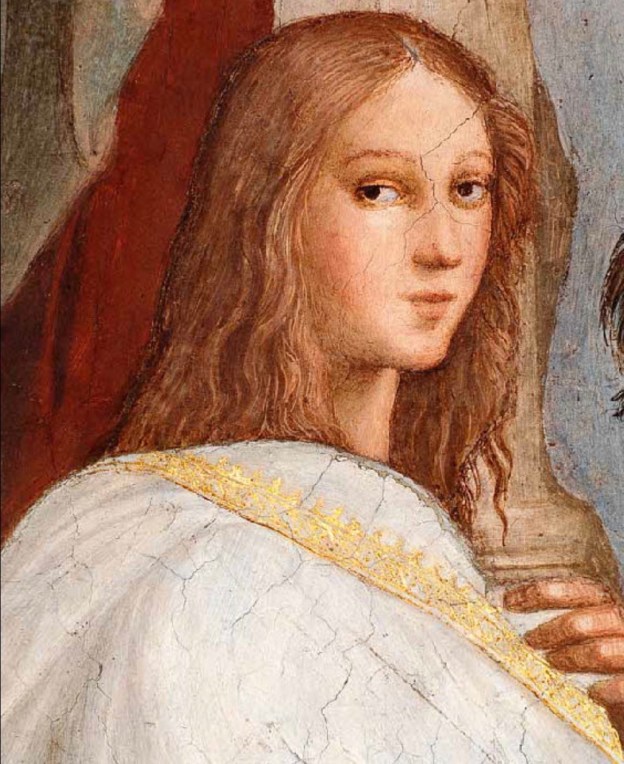
A figure from Raphael's "The School of Athens" variously identified as Francesco Maria della Rovere, Pico della Mirandola, or Hypatia of Alexandria.

On Knowledge

This week, I want to address how we recognize knowledge in comparison to the various fields of inquiry through which we refine our understanding of things.—Click here to support the Wednesday Blog: https://www.patreon.com/sthosdkaneArtRaphael, The School of Athens (1509–1511), Apostolic Palace, Vatican Museums, Vatican City. Public Domain.Sources“On Writing,” Wednesday Blog 6.27.Surekha Davies, Humans: A Monstrous History, (University of California Press, 2025).Marcy Norton, The Tame and the Wild: People and Animals After 1492, (Harvard University Press, 2024), 307.Dead Poets Society, (1989) "What will your verse be?" Video on YouTube.


This week, I want to address how we recognize knowledge in comparison to the various fields of inquiry through which we refine our understanding of things.


Lately my work has been dedicated to a thorough review of the historiography within which I’m grounding my dissertation. I wrote about this two weeks ago in an essay titled “On Writing.”[1] My research is historical, yet it touches on secondary literature which operates within various fields within the discipline of history. These include Renaissance history, and its larger sibling early modern history, the history of cartography, the history of animals, the history of botany, and more broadly the history of early modern science. Methodologically, I owe a great deal to two great twentieth-century Francophone anthropologists, Alfred Métraux (1902–1963) and Claude Lévi-Strauss (1908–2009). While Métraux and Lévi-Strauss aren’t considered directly in the historiographic section of the new introduction that I’m writing for my dissertation, which is limited to sources published since the millennium, they nevertheless stand tall in the background of my history.

Today we often talk within academia about a desire for interdisciplinarity in our work and our research. We’ve found ourselves too narrowed by our ever shrinking fields and seek greener common pastures for grazing as our intellectual and pastoral ancestors alike once knew. In my case, this interdisciplinarity lies more in my efforts to incorporate historical zoology into my work, a methodology which seeks to use zoological methodology and theory to explain historical animals. I have friends who study many things. Among them is one whose passion for history, classics, and mathematics has come together to craft a dissertation which seeks to demonstrate the intersections between those three to better understand the great transitions in human inquiry. Another seeks to follow the medical connections across oceans between disparate regions in the Americas and Europe that nevertheless existed even if they seem remarkable today. Still more, I have a friend who applies basic economic need to explain a complex diplomatic situation that once existed between the Venetian Republic and the Ottoman Empire in the Adriatic Sea. All of these historians of whom I write are applying a degree of interdisciplinarity to their work that reflects their own disparate interests and curiosities. In early modern history we talk about curiosities as objects which were collected from disparate and exotic lands into cabinets to display the erudite collector’s prestige and wealth. I say our curiosity is something to be collected by those worthy archives, libraries, museums, or universities that will employ us in the near future and for us to feed with new ideas and avenues of investigation that we will never be bored with life.

In all of these things, there is an underlying genre of knowledge which I am addressing. I’ve written thus far about history alone, yet it is the same for the anthropologists, astronomers, planetary scientists, and physicists who I know. Likewise for the literature scholars and the linguists. Our fields of inquiry all grow on the same planet that comprises of our collected knowledge. In English, this word knowledge is somewhat nebulous. To me, it says that we know things broad or specific. In London, for instance, the Knowledge is the series of tests which new cabbies must complete in order to learn every street within a certain radius of Charing Cross. The Latin translation of this word, scientia, makes things even more complicated as that is the root of the English word science. Thus, when we refer to Renaissance science, there is always a caveat in the following sentence explaining that “this is not science as we know it but a sort of protoscience.” I was advised, similarly, after a particularly poorly received presentation at a workshop at the Museum of Natural Sciences in Brussels in October 2023 that I shouldn’t refer to “sixteenth-century conservation” because no such concept existed at the time; instead, it would be better to discuss a “genealogy of conservation.” This sense that modern terms, in use since the Enlightenment of the eighteenth century, ought not to be pulled further back into the past I think loses some of the provenance of those terms and how the Enlightenment philosophes first came across them. 

I find it telling that the Ancient Greek translation of knowledge, γνῶσις (gnôsis), is a word with which I’m more familiar from theology and the concept of Gnosticism whereas scientia reminds me of philosophy and the other fields of inquiry which grew from that particular branch of the tree of human curiosity. One might even say that philosophy and theology are a pair, siblings perhaps? They seek to understand similar things: on the one hand an inquiry into thought, and ideally wisdom, and on the other a search for the nature of the Divine, which at least in my Catholicism we can know because we are made in the Image of God. The division here between the Ancient Greek term being affiliated with faith and the Latin one with reason I think speaks to the Latin roots of my own education in Catholic schools and at a Jesuit university, where I learned about Plato and Aristotle, yet I recognized Aristotle’s Historia animalium (History of Animals) by its Latin name by which it was generally known in Western Europe for centuries before the rise of vernacular scholarship rather than by its Greek original Τῶν περὶ τὰ ζα ἰστοριῶν (Ton peri ta zoia historion). Note that the English translation of this title, History of Animals reflects better the Latin cognate of ἰστοριῶν rather than the better English translation of that Greek word, Inquiry.

Added onto these classical etymologies, in my first semester Historiography class at Binghamton University I was introduced to the German translation of scientiaγνῶσις, and knowledge. Wissenschaft struck me immediately because I saw the German cognate for the English word wizard in its prefix, and because I knew that the -schaft suffix tends to translate into English as -ship. Thus, my rough Anglicization of Wissenschaft renders Wizardship, which is rather nifty. Yet this word Wissenschaft instead was seen in the nineteenth century as a general word which could be translated into English as science. This is important for us historians trained in the United States because our own historiographic tradition, that is our national school of historians traces our roots back to German universities in the early and middle decades of the nineteenth century. I remember long sessions of my historiography class at UMKC discussing the works of Leopold von Ranke (1795–1886), the father of research-based history. I felt a sense that this concept of Wissenschaft seemed relatable, and as it turned out that was because Irish has a similar concept. 

Whereas in English we tack on the suffix -ology onto any word to make it the study of that word, in Irish you add the suffix -ocht. So, geology is geolaíocht and biology is bitheolaíocht. Yet note with the second example that the suffix is not just -ocht but an entire word, eolaíocht. This is the Irish word for science, added onto the end of bitheolaíocht to demonstrate that this word refers to the study of bith- a prefix combining form of the word beatha, meaning life. So, biology then is the science of life itself. Powerful stuff. I appreciate that Irish linguists and scholars have sought overall to preserve our language’s own consistency with its scientific terminology. It means that these fields of study, these areas of knowledge, can exist purely within the purview of the Irish language without any extra need to recognize that their prefixes or suffixes come from Latin, Greek, or English. There are some exceptions of course: take zó-eolaíocht, the Irish word for zoology, which effectively adopts the Greek word ζῷον perhaps through the English zoo into Irish. Would it not have been just as easy for whoever devised this hyphenated word to instead write ainmhíeolaíocht, translated into English as the science of animals? Here though I see more influence from English because this language adopts as much as it can from other languages out of prestige and a desire for translingual communicability. As an English speaker, I find scholarly works often easier to read because we share common etymologies for our words relating to knowledge. English’s sciencegeology, biology, and zoology are French’s sciencegéologie,biologie, and zoologie. In English, we drop any pretense of Englishness to clothe ourselves in a common mantle familiar to colleagues from related cultures around the globe. In academia this is to our mutual benefit, after all so much of our work is international. I’m regularly on webinars and Zoom calls with colleagues in Europe for instance. I believe this is the lingering spirit of the old scholarly preference for Latin as a lingua franca which at least to me seems close enough in the past that it’s tangible yet realistically it’s surely been a very long time since any serious scholarly work beyond classics was published in Latin for the benefit of a broad translingual readership?

I for one admire the Irish word eolaíocht and its root eolas, which translates into English as knowledge, that is an awareness of things because eolaíocht represents a universal concept while retaining its own native nature. So often in my research I am discussing the early assimilation of indigenous cosmovisions, to borrow a Spanish word put to good use by Surekha Davies in her latest book, into the nascent global world centered on Europe.[2] I see how these cosmic conceptions faded until they were rendered in Gothic or Latin letters on the voluminous pages of encyclopedic Renaissance general and natural histories which remain among the most often cited primary sources for these indigenous cultures who Marcy Norton argued in her 2024 book The Tame and the Wild: People and Animals After 1492 had their own classical past made remote from their colonial present by European contact, conquest, and colonization.[3] Seeing these indigenous perspectives fade into their categorized and classified statuses within the cosmos defined by Europe’s natural philosophers I feel fortunate that my own diaspora (which was also colonized) has retained this element of our individual perspective. I first came across the -ocht suffix in the word poblacht, the Irish word for republic. A famous story from the birth of the Irish Free State during the Anglo-Irish Treaty negotiations in 1921 tells of British Prime Minister David Lloyd-George, a Welsh speaker, remarking to Michael Collins, an Irish speaker, that their choice of a republic was unusual because none of the Celtic languages naturally have a word for republic. That word evokes its Roman roots in the ancient Res publica Romana, the Roman Republic, whose northward expansion across the Alps led to the gradual death of the Continental Celtic languages, whose speakers’ descendants today are largely the Western Romance speakers of French, Romansh, Occitan, Catalan, Spanish, Galician, and Portuguese, among others. Romance languages are noted for their common descent from Latin, whence they all derive variations on the Latin word scientia; English gets science through Old French. “How are you going to name your new government in the Irish language?” Lloyd-George asked. Collins replied something along the lines of “a kingdom is called a ríocht, so this government of the people (pobal) will be called a poblacht. Thus, the Republic of Ireland is named in Irish Poblacht na hÉireann. Naturally, this word pobal derives from the Latin populus, so the shadow of Rome hovers even over unconquered Hibernia. Yet that is another topic for a different essay.

Let me conclude with a comment on the difference between knowledge and wisdom, as I see it. The former is far more tangible. We can know things through learning embodied best in living and in reading. I know for instance to look both ways before crossing a street because plenty of people in the last 140 years have been hit by cars, buses, and trucks, and you can never be too careful. Likewise, I know everything I do about the things I study through reading what others have written about these topics. It’s my job then to say what I will. In Whitman’s words made immortal by our recitation, the answer to the eternal question, “that the powerful play goes on, and you may contribute a verse.” That’s history, people! Reading the powerful play of what others have written and summoning up the courage to take the podium and have your say. I first heard this particular poem, as did many in my generation, recited by Robin Williams in the 1989 film Dead Poets Society. Knowledge is the recitation of these facts we’ve learned. Wisdom is understanding how these facts fit together and speak to our common humanity. What makes us human? I believe it’s as much what we know as what we remain ignorant of. Our ignorance isn’t always a curse, rather it’s another foggy field we’ve yet to inquire about, a place where someone’s curiosity will surely thrive someday. It is another evocation of eolas still to come in our long human story. How wonderous is that?


[1] “On Writing,” Wednesday Blog 6.27.

[2] Surekha Davies, Humans: A Monstrous History(University of California Press, 2025).

[3] Marcy Norton, The Tame and the Wild: People and Animals After 1492, (Harvard University Press, 2024), 307.

On Translation

This week, how I take nuance and particularity into account in my efforts as a translator.—Click here to support the Wednesday Blog: https://www.patreon.com/sthosdkane


This week, how I take nuance and particularity into account in my efforts as a translator.


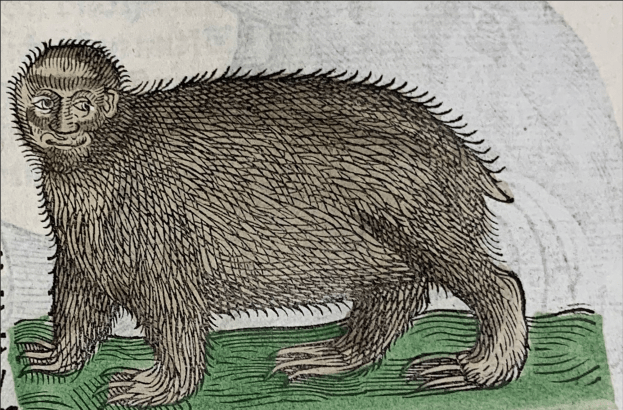
When I chose to study André Thevet (1516–1590) and the three-toed sloth in August 2019 I did so because I already knew French and the need to learn a new language was less pressing than if I’d chosen to study another source in the history of natural history. I chose Thevet because it was practical, and I chose the sloth because the thought of being a sloth historian made me laugh. From the first day working on Thevet, I found that my understanding of his books was heightened when I took the time to type out my own translations of his text. Thevet wrote in Middle French that is native to the middle decades of the sixteenth century. I arrived at this project very familiar with Early Modern English, the contemporary form of this language to Thevet’s time, as my history master’s thesis delt with sources in that chronological variety of English from Thevet’s generation and the one just before. I’ve never had much trouble understanding the most prolific author of Early Modern English literature, Shakespeare, but I think I’ve had a tolerance for varieties in speech that’s allowed for me to try to think beyond my own millennial Midwestern metropolitan American English and be willing to understand the likes of Shakespeare from a young age.

So, when I began translating passages from Thevet’s Singularitez de la France Antarctique for my own professional use in my dissertation, I decided that as long as I was translating that book I might as well translate it with the intention of sharing Thevet’s words beyond the scholarly analysis and critique which lie at the heart of my work as a historian. This first draft is built around the 1558 French edition published by Christophe Plantin (c. 1520–1589) in Antwerp and contains footnotes drawn from the 1878 French edition by Paul Gaffarel published in Paris, two Brazilian Portuguese translations by Sergio Amado (1978) and Estêvão Pinto (1944, using the 2018 reprint), and the partial 1986 English translation by Arthur Stabler and Roger Schlesinger which contains only Thevet’s North American chapters.

I finished the first draft of this translation in Summer 2023 and am now looking ahead toward the second draft which is the next stage of the project, and I hope the last one before I feel confident in formally writing to the publishing editors whose press sales agents I’ve spoken with about this project at conferences over the last two years. The second draft will consist of two main stages. First, I will cross-reference my translation and the 1558 Antwerp edition on which it is primarily based with the 1557 first and 1558 second editions published in Paris by Maurice de la Porte, two Venetian editions translated into Italian by Giuseppe Horologgi and published by Gabriel Giolito de’ Ferrari (c. 1508–1578) in 1561 and 1584, and the 1568 full English translation by Thomas Hacket published in London by Henry Bynneman. Second, I will seek to make my translation more understandable for a 21st century English-speaking reader while endeavoring to preserve Thevet’s particular mannerisms and voice, a writing style with which I’ve become quite familiar in the last 6 years to the point that I can now confirm at least two French translated manuscripts in the Bibliothèque nationale’s collections in Paris are verifiably written by Thevet. He had a way of writing that’s unmistakable.

These two competing axes create a binary star system around which my translation revolves. On the one hand, I want to be true to the original text, to preserve the author’s voice and something of their spirit which remains in those words. On the other hand, I need to make my efforts readable for my own contemporaries. Thevet and his contemporaries are notorious for long run-on sentences that would make Hemingway shake his head in earnest frustration. Where do I break up a long sentence while preserving its overall integrity? Furthermore, at what point should I decided to remove the bracketed notations of page breaks in the original text? There the 1558 Antwerp edition is most fully evident as its pagination has several quirks that make it stand out from the 1557 & 1558 Paris editions. At this point, Plantin published books with folio numbers rather than page numbers, so the first two pages were in fact folios 1 recto (1r) and 1 verso (1v). These names refer to the custom that scribes traditionally started writing on the back side of the vellum (recto in Latin) and then flipped the skin over once ready to continue writing on the verso, or opposite side. In several instances the folio numbers actually decrease in the book, notably in Thevet’s chapter on the sloth, which makes the footnotes on that core element of my research particularly confusing if you’re paying close enough attention. So, in summation the inclusion of the page breaks with the folio numbers keeps my translation grounded in Plantin’s edition, however that may break up the text in an uncomfortable way for some readers.

Ultimately, I am not the author of this book, merely a herald relaying it on for our time. My voice is there in the handful of introductory chapters I’ve written to go along with this book. These chapters describe Thevet as a reader of travel literature and place his accounts of the Americas beyond what he himself saw in Brazil in the context of their French and Spanish sources. I see my efforts in this as a means of introducing the reader to Thevet, a man who today exists on the furthest margins of the popular imagination of the First Age of Exploration in the English-speaking world. Thevet remains present in academic circles, there were at least four papers presented at this weekend’s annual meeting of the Renaissance Society of America in Boston which discussed Thevet, mine included. I hope this book will be useful to fellow academics and perhaps will entice curious readers to learn more about this man who I’ve spent the last 6 years of my life getting to know.I find myself drawn as much to the effort of a translator as I do to the work of a historian these days. We live in such a fractious time when reasoned debate and earnest discourse is riddled with dangers and seemingly improbable to undertake. I feel as though I’m constantly translating my thoughts and character for others to understand me. It’s why I enjoyed my time in Boston because that city has a large enough Irish American population that when I’d tell my name to a cashier to put on a carry-out order they’d actually spell it in the proper Irish manner; this never happens in Kansas City. That said, I felt that I had to translate my expectations and personal limits to be able to live even for just a few days in a city as expensive as Boston where I was often paying double what I’d normally pay at home in restaurants. In translating I recognize that each of us think in slightly different ways and see the world in which we all live in just as unfamiliar terms to one another. Difference enhances our common humanity and elevates our manner to something greater than ourselves.


Notes on Carruthers Smith’s Museum

Notes on "Carruthers Smith's Museum" Wednesday Blog by Seán Thomas Kane

This week, some notes on the story I released here last week, more about Carruthers Smith and the other stories who populate that tale. — Click here to support the Wednesday Blog: https://www.patreon.com/sthosdkane


This week, some notes on the subtext and background of my story “Carruthers Smith’s Museum” which I released in this blog last week.


            This story about Carruthers Smith was born out of a dream I had at some point between 5:00 am and 9:00 am on Saturday, November 23rd, 2024, after a late night working at the Kauffman Center for the Performing Arts. I often have quite thematic dreams like this one, and so when I woke from this particular dream, I knew I had a story to write. The dream itself only lasted as far as Part I of the story you will have just read, or perhaps heard if you prefer the podcast version. I began writing it shortly after waking and finished it close to 3:00 pm on that same Saturday. It proved therefore to be one of the quicker ones that I’ve written in quite some time, though one of the stranger ones at that. I wanted to write out several notes about the story, its characters, and its setting so you might better understand the subtext behind the story, and to preclude any other interpretations of what I’ve written.

            In my original dream none of the characters had names. I observed the action from the perspective of Agent Pat O’Malley, which is why in the first part of the story he is the narrator. In my original dream he was filing some sort of metallic slide rule for the character that became Carruthers Smith, a reversal of roles as in the dream I was initially there to interrogate Smith for some uncertain cause. The setting of the story, Carruthers Smith’s Museum, was there in the original, though now writing this nearly 18 hours after waking today I remember it looking more like an art gallery built on a platform above the sanctuary of some old Upstate New York church with a big square base to the bell tower and a more Victorian looking wooden exterior that I often saw in the small villages in Broome, Tioga, and Tompkins Counties on my drives between Binghamton and Ithaca when I lived in Binghamton between 2019 and 2022. Agent Penny Wilson’s character was in the dream yet taken off-stage by Smith’s accomplice, trapped somewhere, yet my character couldn’t prove they were so entangled and thus I had no reason to properly accuse Smith’s character. At that point of desperation, I awoke and began writing.

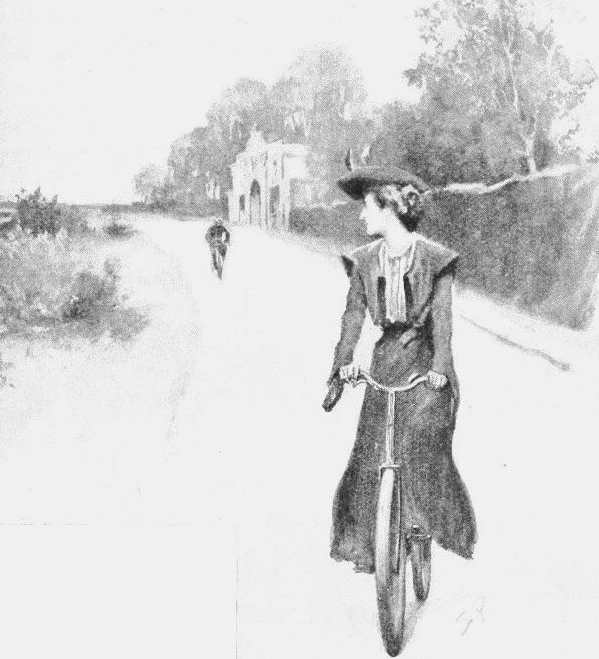
            My characters’ names are always quite intentional and tell more about the characters than their actions or dialogue in the story might convey. Carruthers Smith was the first character who I named in this story. I wanted the villain to be a looming WASPish figure, the last scion of the Gilded Age living a recluse in this vast museum he built for himself somewhere far from the great cities of the Northeast yet still within a day’s drive of any of them. I settled on Southeastern Delaware as the setting simply because it seemed most practical for the federal agents to drive there from Washington than if they were in New Jersey, on Long Island, or on Cape Cod. Lewes became the setting for the story because I’ve always liked that name and its connections to the county town of East Sussex in the south of England. I went back and forth for a minute between the names Smith and Jones; several weeks ago, I’d gotten the idea for a story about a man who is always wrong about everything named Erroneous Smith, which I haven’t written yet though I took aspects of his sketched character and took them into the less comical Carruthers Smith. As for his first name, I drew that from an old Sherlock Holmes story, “The Adventure of the Solitary Cyclist” published at the beginning of 1904 in The Strand Magazine in London and a month earlier in Collier’s in New York. The 1984 Granada TV adaptation of the story featuring Jeremy Brett as Mr. Holmes was my introduction to the story and remains etched into my memory from watching that series in the early mornings on PBS during my high school days. Carruthers is one of the two suspects in Conan Doyle’s story, and it’s a British-enough name that it felt fitting for the old colonial New York type of person I was looking for.

Sidney Paget’s art in The Strand edition of Sir Arthur Conan Doyle’s “The Adventure of the Solitary Cyclist” (1904). Public Domain.

            The federal agents were all named in quick succession. Bill Hardy is named to make him appear as non-descript and American as I could with a nod to the Hardy Boys. I know a lot of Bills, though none from Buffalo, and so it seemed a fitting name to use here without nodding to one in particular. Pat O’Malley drew from the idea that I can best write from the perspective of someone like me, that is a fellow Irish American. My family comes from the townlands around Newport, County Mayo a part of the country which before colonization was ruled by the O’Malleys and Burkes. Everyone around Clew Bay is related to some degree or another if you go far enough back, and I have a handful of O’Malley ancestors myself. Patrick was an easy choice, it’s the most accepted Irish name in the English-speaking world, with my own Seán in all its phonetically spelled variations reflecting each country’s version of English coming in second, though Liam, the Irish version of William, is quite popular now too probably thanks to the recently buried Liam Payne of One Direction. Penelope Wilson was a harder one to name. I’ve used the name Penelope in my long awaited second novel in my romantic comedy series which I dramatically call the Plumwoodiad and was hesitant to use it again. It’s in part a nod to Penny Hofstadter in The Big Bang Theory, one of my favorite TV shows, yet more so a nod to the original Penelope in Homer’s Odyssey. At one point when I stepped away from my desk yet was still engrossed in this story while making breakfast, I considered putting a line in there about her having to wait a long time to find a man who can string her husband’s bow. The name Penny was intended to give her a deep well of resilience and strength that she would call on to save everyone else from Carruthers Smith. Wilson was another choice of trying to make her sound as American as possible, and while I did have President Woodrow Wilson in mind a bit here, I also thought about Robert Sean Leonard’s character Dr. James Wilson in the Fox series House in mind with this name.

            I didn’t initially plan on making everyone else in this story Irish Americans. This is something which makes me laugh now thinking about it. I’ll make a small digression here, if you’ll permit me. When I was in elementary school, I remember one day my teacher brought out a stack of books for us to all read together as a class that was about a character who she said, “was from an ethnic group that aren’t often talked about in books.” I remember thinking then how the only book about Irish people or Irish Americans I could remember reading in my school was Tomie de Paola’s picture book about the life of St. Patrick, the namesake and patron saint of my elementary school, St. Patrick’s in Kansas City, Kansas. That’s nagged at me since, and I do think we Irish Americans tend to get forgotten because the Carruthers Smiths of this country have largely accepted us as white in the last sixty years since the first of our kind was elected President. It’s often forgotten today how we Irish Americans were reviled by the old English colonial population in this country for a long time. I heard some stories about this, and in the older histories of my alma mater Rockhurst University, there are stories of Rockhurst students in the 1920s and 1930s sneaking into Klu Klux Klan rallies to try and fight back against their banality. And yet, all that fit neatly into the background of Carruthers’s assistant, who I decided would be a first-generation Irish American, whose parents crossed the Atlantic during the big wave of migration among our people to this country in the 1890s. That character developed into Peter Dougherty. I had to be careful here, the first couple of names I gave him ended up being changed because I realized they were the names of actual people I know either in the Kansas City Irish community at large or nationally among my brothers in the Ancient Order of Hibernians. I imagined Peter was a sort of Bob Newhart type character who spent his early life trying to get by amid the shifting tides of the world around him, and once he found Carruthers Smith he was eventually willing and able to give up on trying to just survive and instead enjoy something more comfortable even if it meant sacrificing the woman he loved. That woman became the penultimate character I named in this story. At first her named was Bridie McGinty, Bridie being a pet form of the Irish name Brigid, yet that changed near the end of the story when I decided instead to name her after my great-great aunt Delia McDonnell who came to America from Ireland in the 1940s or 1950s. yet I had a mental image of her from the start. She was going to be a cross between Mamie O’Rourke in the 1894 classic song The Sidewalks of New York, Dorothy Day, and many of the women who I’ve known in my life who day in, and day out work in the schools and hospitals and for nonprofits trying to make life better for others. There’s a subtle yet profound truth in this: if you make life better for other people who’re worse off than you are, it’ll eventually make your own life better too. Call it trickle-up economics if you will. Lastly, there was the town doctor, who got the name Ronald out of a desire to find something that felt like it’d fit a character born in the 1940s or 1950s, and Yancey because it was the end of the story, and I was looking for something at the end of the alphabet.

From Ric Burns’s New York: A Documentary Film, sung by Robert Sean Leonard who already got a mention in this blog post.

            Let me say something briefly about the time in which this story is set. From the first moment I thought of this story taking place in 1990, thirty-four years ago. I felt this was far enough removed from the turn of the twentieth century to have much of the off-stage action feel removed yet still before the millennium which feels like a profound break in time in my own life. I did have aspects of the lived environment of the 1979 Peter Sellers film Being There in mind when I thought of the décor and technology that Carruthers Smith would have in his museum, where the building itself was largely designed forty years earlier in the first few years just after World War II, yet the technology kept getting updated to a certain point at which Carruthers no longer felt comfortable replacing things. I’ve seen this in people who prefer to stick with certain technology that they’re most familiar with even if many years or decades have passed since that technology has been commonly sold or can be repaired with replacement parts on hand with the manufacturer. Doing the math here, this places Carruthers Smith’s birth in 1914, Peter Dougherty’s in 1899, and Delia McGinty Dougherty’s in 1898. The agents meanwhile are largely children of the 1950s and 1960s, with Penny Wilson the youngest at around 25 years old. It seemed less important for me to settle their ages than it did the characters in Carruthers’s orbit. There is something of the nostalgic for me writing about characters in the seventies, eighties, and nineties who were born in the decades just around the turn of the twentieth century. These birthdates were the norm for the oldest generations when I was born in 1992, and today I do miss something of the expectation that my great-grandparents’ generation born between 1890 and 1918 would still be living in our world with us today. I in fact only met one of my eight great-grandparents, the last of them to be born, who died when I was three years old.

The Walter Parks Thatcher Archive in Citizen Kane

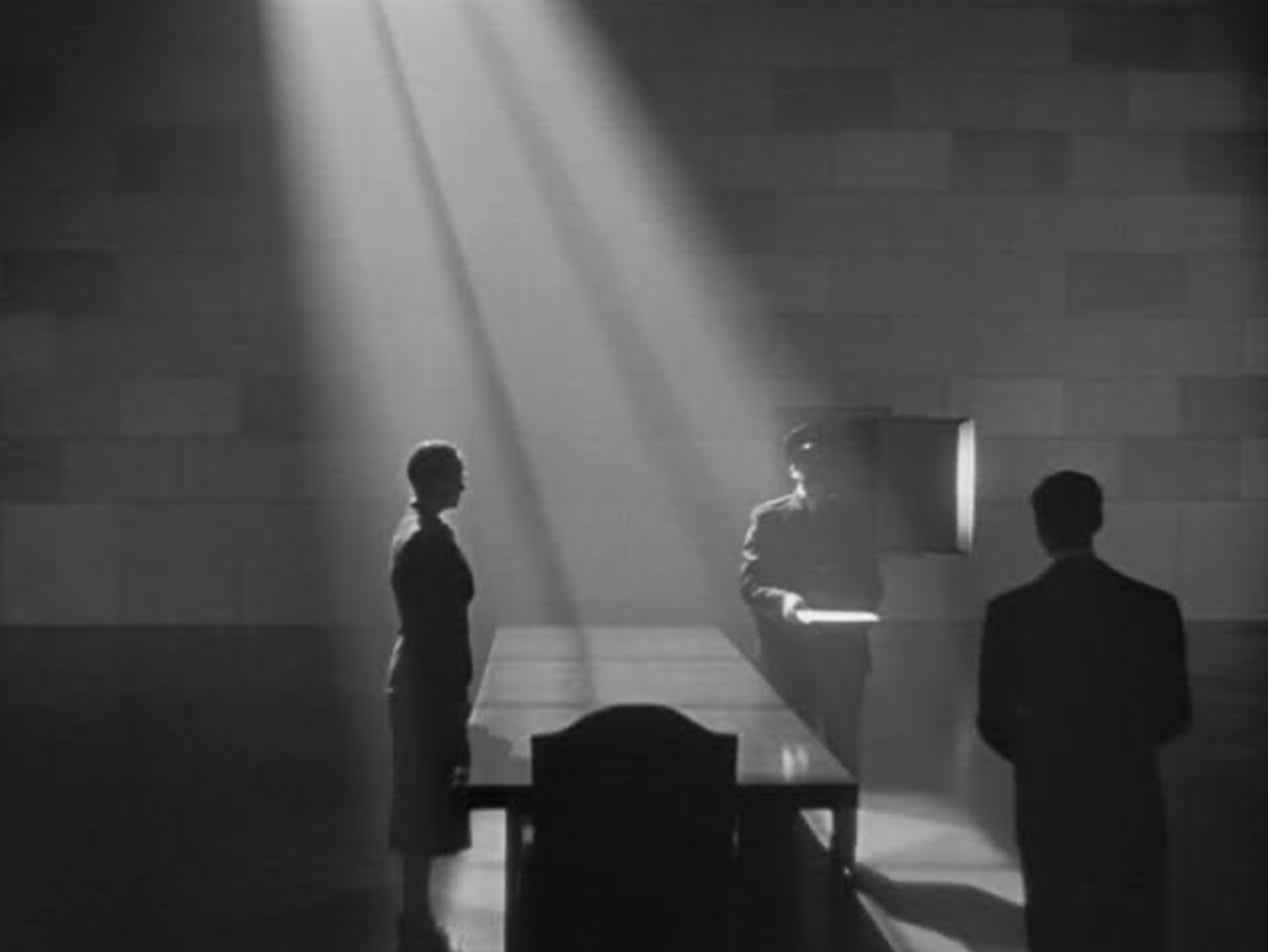
            Finally, I want to end by addressing the museum itself. I love museums, or musea as Carruthers would surely use the Latinate plural of that word, and so Carruthers Smith’s Museum was intended to be a twist on that happy place of mine as it was in my dream. The museum is made of one long gallery whose white walls and white marble floors match the place where I work yet whose shape is more akin to some of the galleries at the Corning Museum of Glass in Corning, New York, yet I often thought of how it appeared with its own internal lighting in a manner similar to the private archive of Walter Parks Thatcher in Citizen Kane with its long shadows and stark surfaces. That warm and welcoming space is twisted however when you remove all of the art from its confines except for something that seems eerily out of place. The great rubber artifact is a phrase that made me laugh the first time I wrote it, and yet what’s essentially a giant eraser-shaped blob of milky white goo became the unintended means of Carruthers Smith’s fall into depravity. Was he ever afraid of it? I think so at first, yet by the time we met Carruthers he’d lost any real desire to live and was happy to have something that could take his life at any moment be a constant presence in his life. He may have once loved another, he may have once been happy with his success, he may have once believed in being the patriotic good boss whose tires helped drive the Allied advances across North Africa and Europe, yet by the time we meet him he is so jaded about life itself that he sees no reason to cherish it. I imagined this rectangular piece of rubber standing atop a foot-tall podium, with the object itself reaching up to about six or seven feet in height, so it would tower over anyone who approached it, yet not by too much. Was the rubber alive? Perhaps in a sort of imagined monstrous way, yet only as much as a Venus fly trap is alive.

            The giant rubber monolith in the center of the room stands for the corruption at the heart of Carruthers, his willingness to sacrifice others for his own success. His two-faced approach to people like Peter who keeps the keys to his house, yet he still sees as little more than a servant speaks to just how morally bankrupt Carruthers is. Here is a man who was once on good terms with presidents for his wartime industrial service. In one line which I cut he admitted for the first time how on the morning of the 1948 election he voted for Dewey and then put a call to President Truman to wish him good luck because if Truman thought Carruthers Smith was a friend then maybe he’d sign another contract for more tires and tank treads for the impending war in Korea. Money for the sake of money alone is the corruption at the heart of this man, a heart that’s been hollowed out so he can hide away even more of his gains. He is the true face of an oligarch who puts on a nice mask for the sake of selling his wares in a democracy yet would rather all the nice people who buy those goods stay out of his way and leave the governing of society to the captains of industry and their cronies in government.

            Carruthers Smith then is a warning, a vision of the last echoes of the First Gilded Age at the dawn of its successor. All the successes for expanding suffrage, workers’ rights, and improving our education, healthcare, and overall quality of life are at risk if we allow the oligarchs of today try to return us to a limited regulation small government policy of the late nineteenth century. If we let the wolves into the henhouse the chances are good that they’ll turn it into a buffet for themselves to feast upon while everyone else is left out in the cold to fight over scraps or starve. Of all the federal agents who seek to bring Carruthers to justice, it’s Penny Wilson who is successful. Without her tenacity or her compassion for Peter Dougherty that reinvigorates his soul after decades of uneasy slumber in his boss’s shadow, Carruthers would have remained at large, a glowering menace on the far horizon of the seat of our democracy. The youngest of all the characters in this story is the one who saves them all.


How Reading James Joyce Prepared Me for my Doctorate

How Reading James Joyce Helped Prepare me for my Doctorate Wednesday Blog by Seán Thomas Kane

This week, in honor of Bloomsday, how reading Joyce helped prepare me for my doctorate. — Click here to support the Wednesday Blog: https://www.patreon.com/sthosdkane

Last Friday was the annual commemoration of Bloomsday. 16 June 1904 was the date when all of the action in James Joyce’s 1922 episodic novel Ulysses takes place. Bloomsday is named for the main character, the sometimes hapless Leopold Bloom who fits perfectly into the wider scope of Irish main characters who may want things to go one way but often find their life taking ever weirder and sometimes darker turns. It reminds me of An Béal Bocht.

I’ll fully admit, I’ve never read Ulysses through the entire way before. I’ve seen the stage adaptation that they used to put on that the Irish Center of Kansas City a handful of times and have participated here and there in the day-long reading of Ulysses at the same cultural center, but to date I’ve never actually sat down and tried to read this work from cover to cover. For one thing, Ulysses evades expectations of literary formalities and standards. For another, a fair bit of the text really only makes sense when read aloud. And finally, because of several scenes it was banned here in the United States for a while, a nod to the puritan roots of our American culture.

So, on Friday I went over to Rainy Day Books, the finest local bookstore I’ve stepped foot in, located just across the border in Fairway, Kansas, to buy a copy of Ulysses for myself. My goal on Friday was to record an Instagram reel of me reading my favorite passage from the novel, a scene with an ever increasingly ridiculous list of foreign dignitaries attending the Ascot Gold Cup, which took place on the same day as the story at large. Yet, the eccentricity of Ulysses befuddled me enough that I ended up choosing a different passage from Part II’s Episode 12, “Cyclops” in which an ancient hero wearing a leather belt adorned with the portraits of a series of Irish heroes is described. Again, this series of Irish heroes steadily becomes more ridiculous as it goes on. As a matter of fact, I’ll read this passage for you now:

Joyce’s Ulysses makes far more sense when read aloud than if read silently, a style of reading that was pioneered in the 5th century CE by none other than St. Augustine of Hippo no less. It’s a far older style of literature that way, something which gives it an air of antiquity that I for one appreciate a great deal. This is also something that I find regular among my primary sources for my dissertation, books which were written for a very different audience who lived 450 years ago in France. In my case, I often find reading those aloud gives me the greatest clarity of what they’re actually trying to say. My translation of André Thevet’s 1557 book The Singularities of France Antarctique is one such book that is best read in full voice, and I have a feeling when I go through and edit my translation that I’ll have to soften some of the eccentricities of my initial interpretation of Thevet’s text, or at least that’s what I’ve been finding as I incorporate it into my dissertation.I find Joyce’s writing daunting, a proper challenge, yet still something that is immensely relatable to my own way of thinking about writing. I love his fluid use of adjectives to describe his characters, they bring even the most marginal of figures to life in a way that echoes down the last century to the present moment. Now, 119 years after Leopold Bloom’s eventful day in Dublin, and 101 years after Joyce’s first edition was published in one volume under the title of Ulysses, there’s a connection to that story which continues to live on for me.