

Terminologies – Wednesday Blog by Seán Thomas Kane
Normally, I’ll have something written for the Wednesday Blog by Monday and recorded at the latest by Tuesday morning. Yet this week I’m sitting here on Tuesday at 2:30 pm with nothing written, and thus nothing recorded. Some weeks I’m abuzz with ideas and others, like this week, the hive remains silent. So, while I was talking this morning with my friend Rebecca Legill, I was in the background searching for something to write about this week.
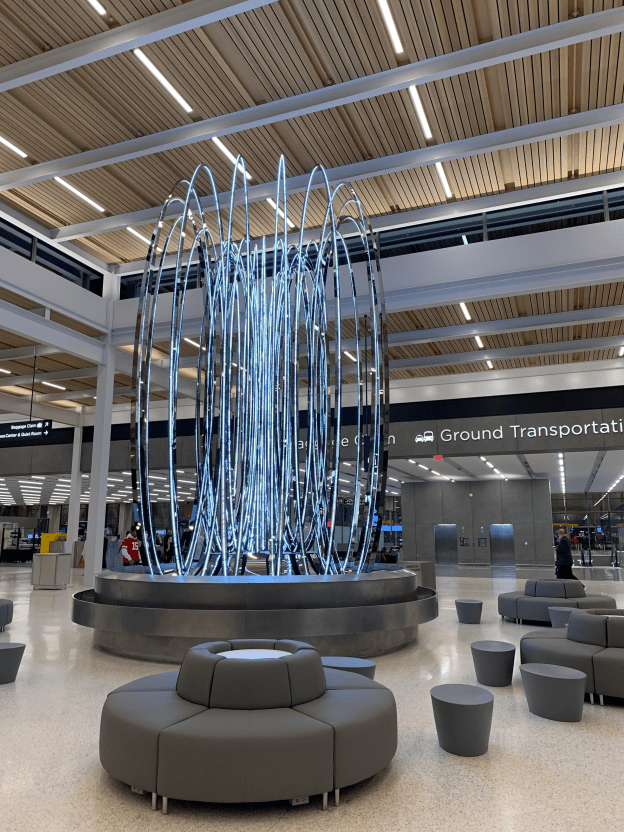
Our conversation turned, as many conversations in Kansas City do these days, to the new terminal at Kansas City International Airport. The big shiny new building opened to the public a month ago on February 28th and has seen around 300,000 travelers pass through its doors in the weeks since. What struck me while I was talking about the new terminal with Rebecca was that the word terminal itself is a bit of an odd word. Terminal comes from the Latin terminus, a word for a boundary or a limit. The modern context of a terminal as a transportation hub came from the railways whose end stations are called terminals. Think of Grand Central Terminal in New York or the London Terminals that you used to see on old British Rail tickets. Here in Kansas City, it’s a bit of a weird idea because our Union Station was built as a through station. Sure, trains once terminated and still terminate here, the Missouri River Runner’s western end is in K.C., but elsewhere the idea of a terminal station makes sense.
So, when the languages of railways and ocean liners were being adopted for airports a century ago the idea of the airport terminal as one building among others where people board and disembark from planes was born. In many cases a terminal isn’t necessarily where a trip ends, especially on a point-to-point carrier like Southwest Airlines here in the United States, yet for hub airlines like our big three––American, Delta, and United––to say that the new building at KCI is the terminal works pretty well. In a similar way, saying that O’Hare Airport in Chicago has Terminals 1, 2, 3, and 5 or that London Heathrow has Terminals 2, 3, 4, and 5 also makes sense in this logic of aviation naming considering that a flight is most often the equivalent of an express train, they rarely make stops along the way anymore to unload some passengers and bring aboard others.Language evolves with its speakers; my English today is different from my English twenty years ago when I was a spry 10 year old. The complexity of any language becomes more noticeable with time and experience speaking that language. Language is the vehicle that carries us from one terminal in our lives to the next, it’s how we interpret the experiences that our senses describe to us. Language is our mechanism for crafting new worlds and ideas, whether fantastical or ordinary. Language is how we think, so it strikes me as curious to consider which philosophers speak to which people. Some appreciate the Stoics for their straightforwardness, others like me the Existentialists who see patterns and subtext in every interpretation. In the study of history perhaps the most influential thinker is Karl Marx, whose economic philosophy has defined a great deal of historians especially in Europe following the Second World War. All of us have read Marx to varying degrees. I get his ideas though I don’t entirely buy them. Of all the Marxist philosophers the one who speaks the most to me has to be Harpo Marx for all the life and joy that can be found in his chaotic wisdom. Language can be more than just words, and Harpo lived and breathed that kind of expression.
 Wednesday Blog by Seán Thomas Kane