Tag Archives: metropolis

On Sources

This week, the fourth in several scribblings about my research: borrowing from Oscar Wilde, the importance of being earnest with one’s sources.—Click here to support the Wednesday Blog: https://www.patreon.com/sthosdkane—Sources:Ologies Podcast: https://www.alieward.com/ologies"Metropolis," Wednesday Blog 3.20: https://wednesdayblog.org/2023/01/11/metropolis/.Marie V. Alessandro, "The Workers of Metropolis" in Cinema at UMass Boston, (6 November 2020), https://blogs.umb.edu/cinemastudies/2020/11/06/workers-of-metropolis/Surekha Davies, “Here be black holes: Like sea monsters on premodern maps, deep-space images are science’s fanciful means to chart the edges of the known world,” Aeon (13 July 2020), https://aeon.co/essays/how-black-holes-are-like-sea-monsters-at-the-edge-of-our-vision.Chicago Manual of Style, 18th Ed., Notes-Bibliography System Quick Guide, https://www.chicagomanualofstyle.org/tools_citationguide/citation-guide-1.html.Jacob Burckhardt, The Civilization of the Renaissance in Italy, trans. S.G.C. Middlemore, (London, 1878): https://www.gutenberg.org/ebooks/2074.


This week, the fourth in several scribblings about my research: borrowing from Oscar Wilde, the importance of being earnest with one’s sources.


Over the weekend when I was chatting with some friends in my parish choir about the rallies and political protests ongoing in our city and around this country, I made a joke that I went about making my own protest sign, something I’ve been slower to do. I said the sign fit my temperament and was useful for a wide range of protests. This sign, conceived for the sake of a joke, reads “I am rather miffed.” One of my friends retorted that she expected any protest sign of mine would include citations. I laughed and retold one of my favorite stories from my History Master’s program when I wrote a footnote that traced the historiography of a particular concept back through at least four generations of the scholarship to the early nineteenth century; I described this particular citation as a footnote within a footnote within a footnote within a footnote, much to the bemusement of my friends.

This got me thinking more about citations, something I often tend to think about anyway with my work. I do honestly love writing footnotes, it’s one of the more technical aspects of my work that gives me a great sense of pride at accomplishing manually, that is to say without the help of any extra software built to keep track of citations. One of our professors at UMKC introduced my cohort to Zotero, for example, and I flatly refused to consider using it saying, “I memorized the basic formulae in the Chicago Manual of Style in my undergraduate, I don’t need a computer to help me with this.” That’s been my take on this kind of software since. I see the benefit of it, yet I don’t feel the need to adopt it in my own work. I’ve seen so many student essays that copied & pasted text into their footnotes where something went wrong with the formatting that I’d rather just type the text out character by character. There’s something delightfully personal about taking this slower approach because it means I’ve considered every character in the document, and by and large I can avoid typos and errors as a result.

The format of my citations will vary slightly depending on the publication. A proper peer-reviewed article or book chapter will get the full treatment, sort of like the top of the line all-inclusive package they offer at a high price at my local car wash. In contrast, my book reviews rarely include citations beyond those to the book being reviewed, and in that instance, they are mere in-text citations with the page number listed alone. That could be seen as the quick and cheap package at my car wash. Here on the Wednesday Blog, I endeavor to include hyperlinks in all of my citations and in the text of the blog where I first reference a given source. I’ve begun to see more hyperlinks included in peer-reviewed journals as I suspect the vast majority of us who read Isis or Renaissance Quarterly do so on their computers as I do, and thus can click on those links, rather than reading the journal in print when it’s mailed out with each issue. I make an effort to include any citations in the text description box on each of the Wednesday Blog podcast episodes as well, for the benefit of listeners who access this publication through any of the podcast platforms where it is found. I’ve seen the likes of Ologies do this as well, in fact I was inspired by Alie Ward’s thorough efforts at citing her sources on Ologies to do the same on the Wednesday Blog. In my case, it was a question of whether I needed to have the same rigor in this publication as I do in my scholarly writing. I concluded that it was not only needed but that it would be something that could set my work apart from my peers.

My footnotes are the hard workers of my writing, the double-checked cross-references that populate the bottom of my work yet add such vitality to it all the same. Without the footnotes the rest of the essay would lack the depth of meaning that they provide. They root my sentences in a rich soil of past scholarship which can enlighten even the densest lineage. Yet the footnotes require clarity in the text which they elaborate. For them to work I need to ensure that my own text makes sense and is readable, something which often needs a bit more thought after the first draft. I think of the relationship between the text and footnotes in a manner similar to the stratified society in Fritz Lang’s 1927 science fiction masterpiece Metropolis; the footnotes are the hands to the text’s head, the evocation of thought that elaborates on the essay’s thesis.[1] Yet without the footnotes’ deeper connection to the human experience the world above soaring high into the heavens with the foolhardiness of the biblical Babel would awaken to find its words meaningless.
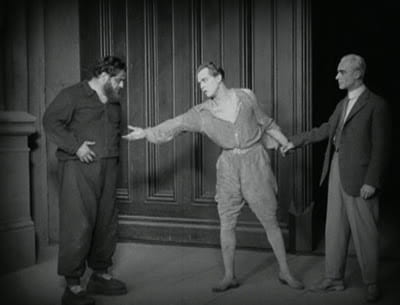
“The Mediator Between the Head and the Hands Must Be the Heart.” Photo source (and a good blog on the workers of Metropolis).

Citations are a form of cross-referencing that was engrained into me from even my elementary school years. I remember seeing footnotes in some of my favorite childhood books, in particular in Watership Down and I believe in The Lord of the Rings trilogy. I wanted to use them on my stories from as early as elementary school but didn’t have a proper need for them until I was an undergraduate writing essays that needed full and clear sources for their work. It’s funny to me now because I do often read peer-reviewed articles that don’t have the same rigorous citation systems in place as the one that I committed myself to over a decade ago now. My rule is that if I make a fact-based claim then I cite it, regardless of how important it is to the argument. I know from my own experience scouring academic databases for secondary sources on André Thevet (1516–1590) and his contemporaries that even the smallest off-hand mention of the man in a source that may have very little to do with him could nonetheless lead me to another source that has a great deal more to offer the Thevet scholar. It made me laugh earlier this week reading one such book that made a fairly large claim about its subject without providing sources for all of the historical figures mentioned in a given sentence, just the ones the author clearly thought were more important.

The way I think of citations resembles how Surekha Davies, one of the leading experts in the field of Renaissance monster studies, described the category of the diagram in a 2020 essay for Aeon. Like Davies’s diagrams, citations “are devised by interpretative communities made up of readers, makers, and practitioners. Each interpretative community has its own distinct pictorial language.”[2] In this context, that language is the style guide for citations in use. Access to the information contained in my citations is eased by using an accepted and standard style, in this case the notes-bibliography system set by the Chicago Manual of Style, which just published its 18th edition last NovemberThere lies the rub of this: citations embed a strong sense of subjective importance in their nature. I try to cite anything and everything that goes into my work, while others will only cite those things which they deem to be the most valuable to their reader. I’ve always looked toward a wider readership, maybe hoping to catch the eye of my colleagues, graduate students, and the odd bookshop aisle walker alike who happens to see my work on the shelf. My more liberal use of footnotes reflects this preference for a wider readership; I try to have enough information in my citations to go around for anyone who may be curious about the connections between my work and its peers and ancestors. I understand the argument that older secondary literature often has less to contribute to contemporary conversations, my dissertation committee for instance asked me to write a new historiography document that only focused on the literature that I’ve used which was published since the millennium. Yet in the twin magnetic poles between which lies my field, Renaissance Studies and the History of Natural History, my historiography begins in the former with Jacob Burckhardt’s 1860 The Civilization of the Renaissance in Italy and in the latter with the likes of Linnaeus adapting new understandings of the natural world from the sixteenth and seventeenth-century perceptions of it which include Thevet’s own cosmography. This is to say that my historiographic timeline begins far earlier than many, and I have to take the full scale as well as the particular scope of it into account.

The earnestness with which I approach my sources is reflected in the quality of my work. I’ve long heard words of warning about particular institutions as places that promote competition between graduate students and between faculty in order to keep the flow of a high level of research and writing. I for one initially heard this and felt a sense of trepidation, why not if I couldn’t keep up with the best of my colleagues. And yet, when I’m in the flow of my writing, things are magnificent. I wrote the first draft of an article of mine that’ll be coming out in the December special issue of Terrae Incognitae in the period of about a week last summer; it uses sources that I’m very familiar with, in fact an expert on, and it makes an argument I’d been thinking about for some time when I sat down to write it. That article’s gone through several rounds of revision since, yet from the beginning one area that needed minimal rewriting were my citations. Today I have another paper I plan on writing in the next few weeks that I initially conceived of in a proposal to another journal special issue, yet I decided to go ahead and write anyway; after all, if that first journal rejects my proposal, I can always send the finished manuscript to somewhere else.

The rub of all of this is that by getting my citations down early, I’ve started my work in a strong place that’s only grown stronger and more resolute with each essay that I write.


[1] S.T. Kane, “Metropolis,” in Wednesday Blog 3.20, (11 January 2023).

[2] Surekha Davies, “Here be black holes: Like sea monsters on premodern maps, deep-space images are science’s fanciful means to chart the edges of the known world,” Aeon (13 July 2020), https://aeon.co/essays/how-black-holes-are-like-sea-monsters-at-the-edge-of-our-vision.

Classics

This week I'm discussing what the word "classical" means to me in musical as well as historical and political terms. — Click here to support the Wednesday Blog: https://www.patreon.com/sthosdkane

During my high school years in Kansas City, I would often listen to either NPR or 1660 AM, the local classical music station, on my 30 minute drive south to St. James Academy. In those years I continued to embrace Classical Music, especially opera, as an art form that remains a particular passion of mine, even to the point of several ill-fated attempts at composing.

Still, it strikes me that our term classical has a rather complicated set of meanings and uses. In the musical sense, it’s used to refer to the most highbrow of our genres, the rare musical tradition that still sees performances of music composed within the last 400 years rather than the decade-based music that usually makes the Pop and Rock charts. Classical Music tends to embrace the trappings of old European and American elite while also providing a gateway for the rest of us to enter that refined space and hear the radiant melodies and harmonies that have been the soundtrack for generations.

I began to explore Classical Music in my middle school years, like many Americans my introduction to this wide scope of music was through jazz and Gershwin’s blending of the classical and jazz orchestras. I’ve been wanting to write a blog post all about my appreciation for Gershwin’s music, though my continuing uncertainty regarding copyright law has kept me from ever publishing it or trying to record a podcast version of it. From Gershwin I jumped backwards to Mozart, Beethoven, and the other big names before settling both in the Baroque world with Lully and in the realm of the Romantics with the likes of Johann Strauss II, Verdi, Wagner, and Mahler. Today, I still love the music from all of those composers, yet I’m also drawn to more recent works written by the likes of Debussy, film music that fits in the 20th Century late Romantic tradition embodied by Prokofiev and the German film composer Gottfried Huppertz, who longtime Wednesday Blog readers and listeners will remember is the composer of the score for Fritz Lang’s 1926 science fiction film Metropolis

In the last couple of years, I’ve returned to my first unwitting introduction to classical music through the film music of the likes of John Williams and Elmer Bernstein and found myself drawn to electronic-classical compositions of Vangelis, which inspired the theme for the Wednesday Blog, and the choral classical-crossover albums of Christopher Tin and 2022’s The Moons Symphony written by Amanda Lee Falkenberg. I’ll gladly spend an afternoon listening to Jerry Goldsmith’s themes for the various Star Trek series and Mr. Williams’s compositions for Star Wars as much as I’ll choose to hear a Mozart piano concerto or Bernard Lallement’s Missa Gallica.

I’ve long thought that classical music saw its greatest innovation in the last century when its venue diversified from the concert hall alone to include the sweeping compositions that breathe life into films. Film music to me fits in the long tradition of ballet music. This comes out of the great silent film tradition of a century ago which reached its zenith in the late 1920s with epics like the original Ben-Hur and Phantom of the Opera films as well as with Metropolis and the other great German expressionist films. Sound film took some of the storytelling need off of the music as now the characters on screen could too be heard, yet the power of music in film was already clear. I relish the chance to hear the Kansas City Symphony perform a concert of film music, because even when it’s disassociated from the pictures that score was originally created to accompany that score often holds up on its own as a concert piece.

It is interesting then to consider that within the world of Classical Music the term “classical” generally only refers to a short span of musical composition within the long history of the wider “classical” genre. The Classical Period in music matches up with the Neo-Classical Period in art, architecture, and literature that ran from around 1750 to 1820. This period includes great composers like Gluck, Haydn, Mozart, Beethoven, and Schubert, all of whom worked in Vienna the beating heart of Europe’s music industry in this period. Yet by this definition the word classical implies a separation from the present, clear limits to its scale and span, and an air of antiquity.

In many other contexts the term classical refers to the far older Classical Antiquity of European History, the centuries during the height of Greek and later Roman civilization from around the 8th century BCE to the 5th century CE. When I write about the classics in my work, I am most often referring to people and ideas conceived during this 13-century long span of time. The classical fathers of Western philosophy––Socrates, Plato, and Aristotle––continue to be required reading in modern philosophy studies, while Aristotle and Pliny the Elder have a foundational role in my own discipline in the History of Natural History. Those two, Aristotle and Pliny, were central influences for the naturalists who defined the Americas in the sixteenth century, people like the focus of my dissertation André Thevet, as well as Gonzalo Fernández de Oviedo and José de Acosta who both wrote natural histories of the Spanish Americas, and Conrad Gessner & Carolus Clusius whose works were written about distant worlds from the comfort of their own homes back in Europe.

Classical is a tricky word because it can be interpreted as something which is removed from common life. It stands apart from popular things because of its high status. I’m often struck by the adoption of mannerisms and norms from the classical music world in popular music, there was one concert I attended nearly a decade ago where the musicians on stage went from dancing in circles playing their violins to suddenly, briskly, taking chairs and sitting in a neat orchestral row in them as though playing the part yet ever with a wink and a nod about it. There has been a general loosening of expectations and normalities in our culture, a sort of reaction to the manners of past generations. I tend to see our present moment as responding to the norms of the 1980s and 1990s, politically we are in a period of unstable transition from the Reagan Conservativism and Clinton centrism of the 80s and 90s, though that needle continues to move forward in time and it does feel now that American conservativism and liberalism now seems to be working in response to the policies of the Bush and Obama Administrations as our youngest generation of voters now were born after the Millennium. I’m happy to see more classical musicians on social media releasing short videos of their performances, rehearsals, and daily practice for all to see. That’s one way for the classical to remain vibrant in the present moment. Still, it worries me that today in 2023 classical and jazz tend to be the exception in popular performance compared to pop, rock, and country.

Artificial Intelligence

Artificial Intelligence Wednesday Blog by Seán Thomas Kane

Concerns have been raised lately over the risk that the increasing artificial intelligence of our computers poses to humanity. I think the risk truly lies in who teaches these computers and what they are taught. — Click here to support the Wednesday Blog: https://www.patreon.com/sthosdkane

Concerns have been raised lately over the risk that the increasing artificial intelligence of our computers poses to humanity. I think the risk truly lies in who teaches these computers and what they are taught.

There have been stories of humans striving for divine heights for millennia, whether it be Icarus flying too high as the wax of his wings melted in the Sun’s rays, or Dr. Frankenstein creating life from the remains of the dead only to find his creation a terror because it couldn’t find a home in human society. In more recent generations stories of cyborgs like Darth Vader, the Borg, and the Cybermen have shown the horrors that augmenting the human body with mechanical parts could bring, especially if those augmentations overwhelm the human.

Many of these risks bear resemblance to the countless stories in our history of people who were raised to fear rather than to love. Darth Vader is merely a tragic figure in a mask lacking most of his limbs without all the anger, hate, and rage that boiled inside that suit sinking the man deep within the façade of Vader so that his climb out, his redemption took the greatest of effort and over two decades to achieve. A central fear over artificial intelligence is in how narrow-minded computers traditionally tend to be. They are machines that run on binary code, 0s and 1s, which allow every one of their decisions to be narrowed down to an up or down choice. There’s little nuance in that, nuance that distinguishes the human from the machine.

In the last few years our machines have gotten far better at interpretation and understanding hints of nuance. What started as humorous easter eggs embedded into virtual assistants created by Apple, Amazon, Google, and Microsoft like answers to riddles or references to the Hitchhiker’s Guide to the Galaxy have become the minute personalization of service provided by the newest generation of artificial intelligences, notably those developed by Microsoft’s Open AI, the creators of Chat GPT. I was unsurprised to see that Chat GPT could devise information for me regarding very particular subjects like André Thevet (1516–1590), the focus of my dissertation, or about the Ancient Order of Hibernians, the largest Irish Catholic fraternal order in the United States of which I am a member. Yet what struck me was the speed at which Chat GPT learned how to communicate and relay ideas. No longer was there a bias towards English and several other languages as has been the case with the other AI text generator Google Translate; Chat GPT was able to answer questions I asked it in Irish, and when I pressed on further in the Connacht dialect that I speak it replied in the same.

I am cautious about using artificial intelligence without due process or consideration of the ramifications. I want the things I write to be my own, without much bias from a computer beyond the fact that nearly everything I write today is typed on a computer rather than written by hand. This reminds me of how our very understanding of language is technologically influenced from the start. Without the technologies we and our ancestors developed over thousands of years our languages would exist orally, spoken and sung, heard, yet not read. The very word language comes from the Latin lingua, which has a very close sibling word dinguameaning tongue, not unlike how in English an older synonym for language is tongue itself. This distinction is pressing for me because much of the ancient history of my Irish Gaelic ancestors was only written down centuries after the fact, rendering those stories from the ancient epics prehistoric in the eyes of the historical method. I recognize their view: after all many of the characters in epics like the Táin Bó Cuailnge are thought to be personifications of ancient gods and goddesses, Queen Medb in particular. I still bristle a bit in frustration at hearing that, especially when an explanation I wrote of the anglicization of my family name from Ó Catháin to Kane was referred to as a “prehistory” by one fellow academic. Without the technology of the written word there is little precedent that we would find acceptable to distinguish one people’s history from another people waiving it off as mere prehistoric myth.

Still, artificial intelligence remains central to my life and work today from my ability to interface with the computer in my car vocally to the spell check that doesn’t care for the handful of Irish names in the previous paragraph telling me to rework those. Over the last three weeks readers of the Wednesday Blog will have seen a series of images that I created using Open AI’s image generator DALL-E 2. I once had more skill as a sketch artist, but have long since fallen out of practice, in part due to the discouragement of an art teacher years ago. So, rather than try to create all these images myself with paper, pencil, and watercolors I instead decided to see what an artificial intelligence could do. I asked DALL-E 2 to create images in the style of Claude Monet (1840–1926), the French impressionist painter whose works I deeply admire that depicted all of the main characters as well as several of the settings on Mars. Those images came to embody “Ghosts in the Wind” in a way that I’m quite pleased with.

The fears that many of the leaders in artificial intelligence have been speaking of lately reflect as much the potential that their creations hold as in the worry that our own long history poses. We have seen time and again as technologies are created and twisted for destructive purposes. This call for caution is very much warranted in that long lens, yet I think behind it is a concern that there are enough people or powers out there who would want to use artificial intelligence to further their own ends to the detriment of everyone else. Many of the beta canon explanations for the Borg lie in genetic experimentation with nanotechnology injected into organic tissue that overwhelms the organic and through a collective hive mind dreams up a desire to assimilate all other organic life. Whether we’re looking at that emerald tinted nightmare or at the vision of a computer that will only stop its program once it’s played all the way through, we need more safeguards against both the human inclination towards chaos that will continue to influence A.I., and against the resolute binary inclination towards order of the machines. As the moral of Fritz Lang’s 1927 film Metropolis––the first great science fiction film to ask about artificial intelligence––says: the mediator between the head and the hands must be the heart.

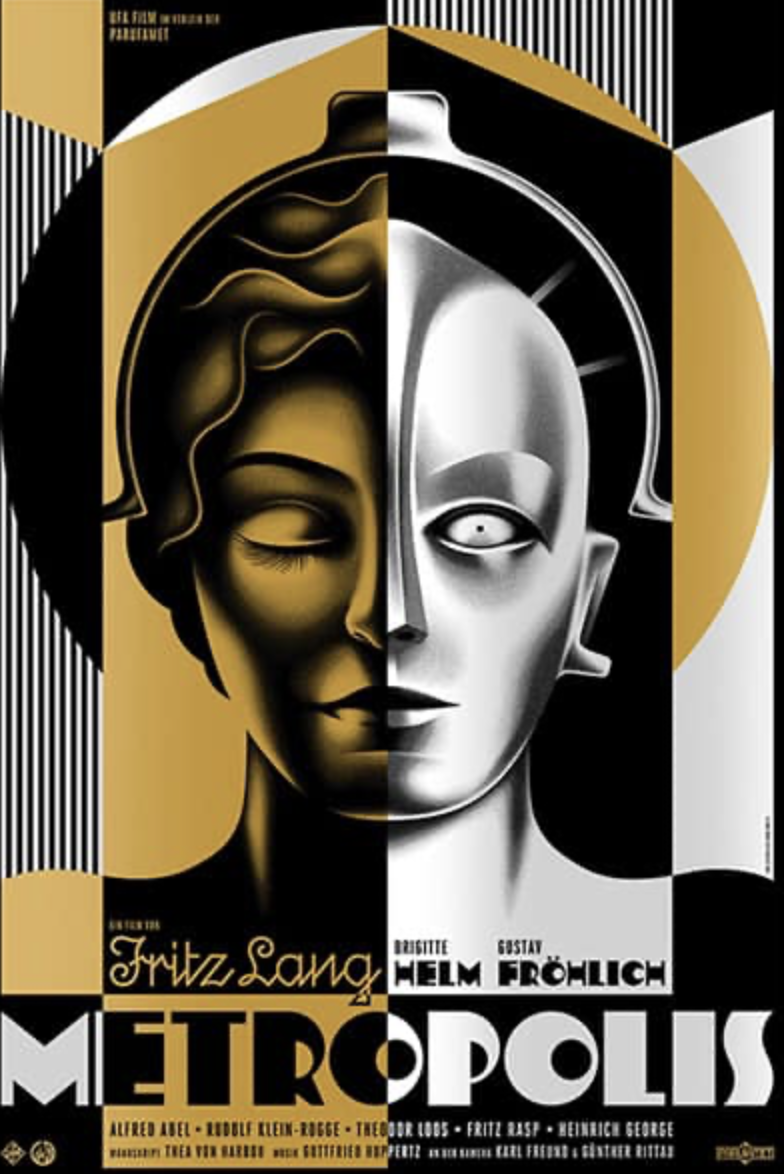
Metropolis

When I returned home to Kansas City about a month ago, I saw an email from the Nelson-Atkins Museum of Art that the Tivoli Cinema, which since 2020 has been housed in the Nelson’s auditorium, would be holding two showings of Fritz Lang’s 1927 silent masterpiece Metropolis. I jumped at the opportunity and immediately bought a ticket for the opportunity to watch this film on a big screen with an audience around me. So, this past Sunday afternoon I showed up for the matinee screening and was even more dazzled by the experience than I’d expected.

I had seen Metropolis once before when it was on Netflix about a decade ago. I remember feeling a bit wary of the film and its story when I first watched it that time. Now I know that watching a movie as monumental as this one on a screen as small as my laptop does a disservice to the whole experience. Metropolis was made to be seen on the big screen with a live orchestra, or at least a live organist, adding a whole extra dimension of music to this already vivid story. In the case of this weekend’s showings, Metropolis was accompanied by a 2010 recording of the original Gottfried Huppertz score performed by Berlin Radio Symphony Orchestra conducted by Frank Strobel. I’ve since played that recording again on iTunes while grading essays this week and have felt just as profoundly moved by it as I was in the theatre on Sunday.

It occurred to me while listening to that album again this week that as much as this score is a film score, listening to it on its own it feels far more like ballet music. In the past I’ve written about how I feel that ballet and silent film share similar characteristics born out of their mutual need for wordless expression to tell their stories. As I listened to Huppertz’s score without seeing the images in front of me I found myself thinking back to each particular scene in Metropolis as I’d seen them the day before. Yet in the moment as I sat in the third row of the Atkins Auditorium watching this spectacle unfold before me, I felt that Metropolis was more operatic than balletic in its very character. These were actors performing at a time when the quantity of film influences were far fewer on their lives thanks to the relatively recent invention of motion pictures, film at that point was only about 40 years old. 

In Metropolis I saw echoes of Wagner and Strauss as well as hints of the future, all the films and television shows that would follow it. There is a scene near the beginning of the film’s first act, the 45-minute prelude, where a shift change of the underground workers occurs that seemed strikingly similar to several scenes from the new Star Wars: Andor series released on Disney+ this Fall. Don’t worry, no spoilers here. There are many elements of Metropolis that certainly have been influential, look no further than the Machine-Man, the poster child of Metropolis that wreaks havoc on the city and nearly destroys it and all who live within it. There perhaps we see the ancestor of Doctor Who‘s cybermen, Star Trek‘s Borg, or Alicia Vikander’s character in Ex Machina.

In the last few days, I read in Variety that there’s a TV series remake of Metropolis in the works for Apple TV+. While I’m normally hesitant about remakes of classic films or shows, the new Star Trek: Strange New Worlds which sees the adventures of the original 23rd century USS Enterprise before it was captained by James T. Kirk, has made the idea more amenable to me, though that’s likely because Strange New Worlds does the whole reboot idea perfectly. I’m most curious to see how Apple TV+’s new Metropolis will depict the city of tomorrow. In 1927 Fritz Lang’s original film used the great art deco skyscrapers of New York built of brick and steel as his model. Will this new series seek to depict the sort of futuristic architecture that I’ve collected on my architecture Pintrest board, filled with gentle curves, evocative colors, and dramatic lines? That remains to be seen.

Metropolis was a gripping film to see, and while long, with some aspects perhaps a bit old fashioned to our tastes, notably the over-the-top heart-gripping that happens throughout that made the crowd around me laugh from time to time, it still has my attention caught even now a few days later. Silent films speak to us in a way that their talking counterparts created after 1927 simply don’t. They tell stories in different ways, adjusting their style to fit the technical limitations of their time. I’ve always been drawn to silent films for this reason, and perhaps I’m drawn to ballet for much the same reason. After all, Chaplin was as much a dancer as he was a slapstick comic. Metropolis is a testament to the time and place in which it was made, Weimar Germany in the 1920s. In Joh Fredersen, the master of Metropolis I see Henry Ford, both in his character and in his physical appearance. I see fears about extremism on all fronts, and a call for unity and dialogue in the face of anger. I wonder what the new Metropolis will be like?

Defining Ourselves Regionally

In the last couple weeks since the UN released their new and ominous climate report I’ve been reading quite a bit about how climate change is going to impact my own home region and city. More often than not I tend to feel let down by the data available as for the United States it tends to be organized by state. So, instead of reading about how climate change is going to impact the Kansas City Metro I usually am left reading reports about its potential impacts on the States of Kansas and Missouri as a whole. While this is somewhat helpful as it narrows down the data from a national level to at least focusing on my local region, it becomes increasingly unhelpful the closer into the details I try and investigate as the climate is hardly uniform across both Kansas and Missouri.

I think this complication in how we think about ourselves and our regional identities is in large part due to how we so thoroughly organize our societies here in the United States into our 50 states, the District of Columbia, and the overseas commonwealths and territories. Metropolises like Kansas City don’t fit comfortably into these state-based regions as they straddle interstate borders. Think through a list of the major metropolitan cities in the United States, how many of them straddle interstate borders like Kansas City? This tends to be a factor more in the East and Midwest than the West where the borders tends to reflect the regional geography better than in the West where they are based on abstract lines of latitude and longitude (see the rectangularity of Colorado and Wyoming).

At the time when the United States was first formed as a federal republic in the late 1780s these borders effectively reflected what had been the borders between neighboring colonies and later effectively semi-autonomous republics and commonwealths. The idea of urban sprawl, let alone suburban development, was in its infancy. Cities could only be as large as a person could cross them by foot or carriage. Yet thanks to industrialization and a booming population the great cities of this country have spread far and wide from their original boundaries. There is a good argument to be made that the westernmost suburbs of New York today are located in Northeastern Pennsylvania.

We should really begin to think of our country not as a collection of states defined solely by their geographical boundaries but instead as a collection of metropolises defined by their sprawl and common culture. I believe the best maps to describe the population of the United States today are those that depict either regional media markets, such as the counties where the local TV and radio broadcasts come from a specific city, or those that show general spheres of cultural influence.

A map of the US media markets

All of this is fully impacted by each metropolis’s local climate. Kansas City is Kansas City in part because of its varied weather and four seasons, and by the fact that unlike much of Kansas to the west that Kansas City actually gets a decent amount of rain. So when I read that the climate “in Kansas” or “in Missouri” is going to do X or Y I’m left frustrated because our climate in Kansas City is vastly different from the climate of Goodland or Dodge City as it equally is from that of St. Louis or Ste. Genevieve. I suggest we begin to really start thinking of our country in this manner that’s more accurate to the population and density.

For me, having lived on both the Kansas and Missouri sides of the metro, I see myself as a Kansas Citian well before I’ve ever thought of myself as a Kansan or a Missourian. The same can be said in regards to my original hometown in the Chicago suburbs: I always felt more a part of the greater Chicago Metro than I ever did feel any connection to the rural parts of Illinois beyond the suburban sprawl. The continuing pandemic has only increased my sense of a metropolitan identity with how profoundly the state government in Missouri let its citizens down in not fighting but actually aiding and abetting the spread of the pandemic throughout the state.

Yesterday I did find a Kansas City-specific climate change report published by the Mid-America Regional Council. In it the evidence points to a likely conclusion that Kansas City will move by the end of this century from its current situation of being on the borderline between a humid continental climate and a humid subtropical climate to being fully within the bounds of the latter. As a humid subtropical city, we will have more rainfall per year, with hotter summers and milder winters. Less snow, sure, but more summer days when it will be too hot and humid to be outside.

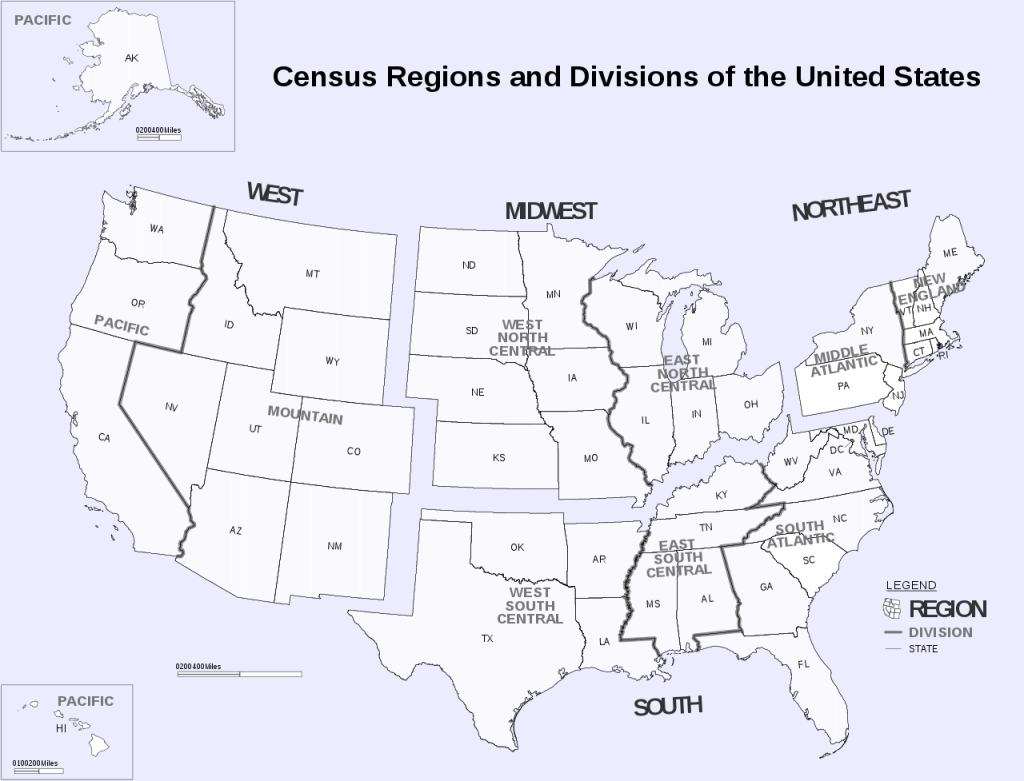
One aspect of this report that wasn’t stated that I think needs to be considered: if Kansas City is going to have a hotter and more humid climate, then surely the cities and states further to the south (Arkansas, Louisiana, Oklahoma, Texas) will see their climates transition to a point that they will be unbearable for many people. To me this seems to indicate that Kansas City will become a destination for many climate refugees from the West South Central census region, meaning our current metropolitan population of 2.34 million is only a shadow of what we might end up happening.