Tag Archives: Middle French

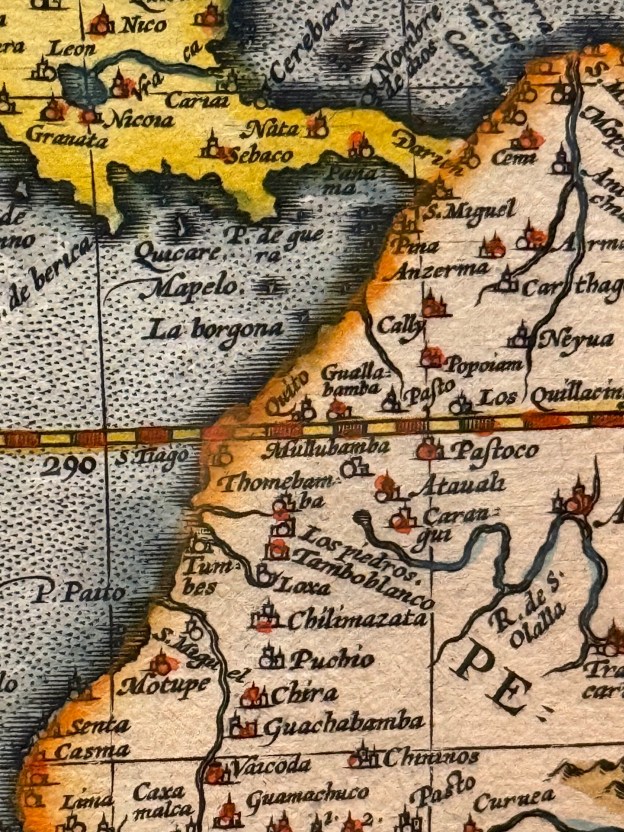
A frame from Abraham Ortellius's map of the Americas, 1587.

On Toponymy

This week, the first in several scribblings about my research: how I connect historic places in my sources with their modern names.—Click here to support the Wednesday Blog: https://www.patreon.com/sthosdkane


This week, the first in several scribblings about my research: how I connect historic places in my sources with their modern names.


When I started working on my dissertation and began downloading copies of André Thevet’s 1557 book Les Singularitez de la France Antarctique, I was struck by a curious question regarding the identity of some of the places which Thevet described along the disparate shores of the Atlantic Ocean in the middle of the sixteenth century. Some of these were readily accessible, the Portuguese fortress of Elmina for one remained an infamous outpost of the slave trade for centuries after Thevet’s 1555-1556 voyage. Likewise, Thevet made early references to regions like Florida, Mexico, Peru, and Brazil which are still known by those names today. I especially admire how he demonstrated the assimilative power of colonialization in the renaming of the Taíno island of Haiti into a newly christened European island literally called Little Spain, that is Hispaniola. Today, we know Haiti as the name of the western republic on the island of Hispaniola, and the Haitians as a people predominately of African descent, yet that term on its own originated with the indigenous inhabitants of that island and its neighbors.
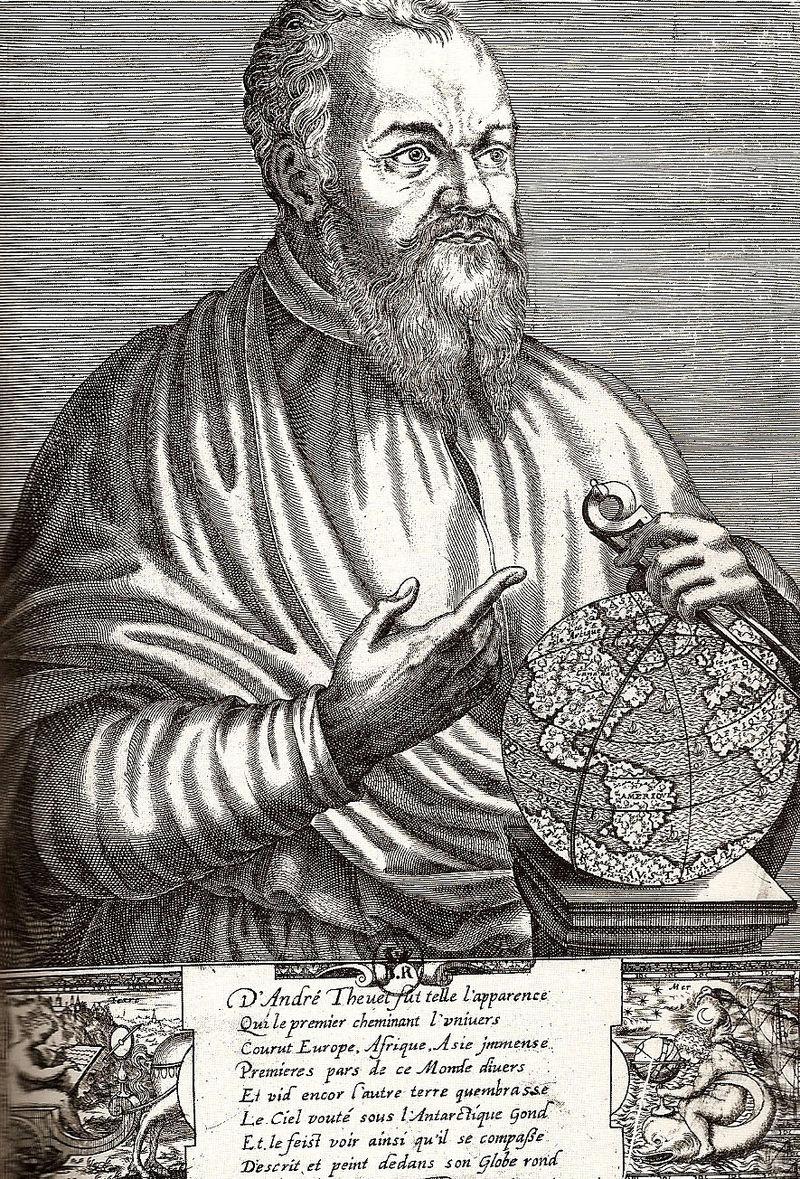
André Thevet (1516-1590) from his Grande Insulaire.

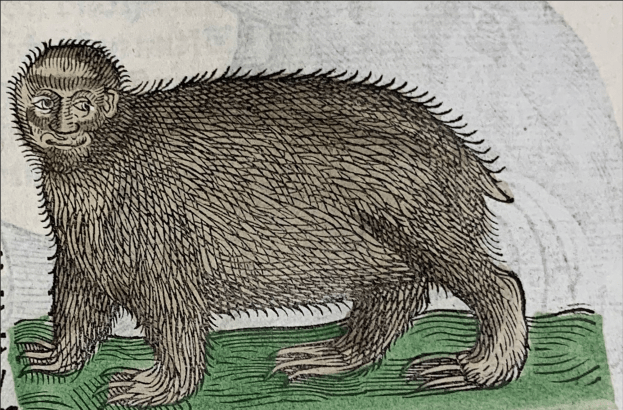
This new world of names which Thevet hoisted upon the places he sought to describe in his Singularitez place that book in its historical context at the dawn of the European colonization of the broader Atlantic World and also in some cases provides a perspective on precolonial and early contact societies that have otherwise been diminished by the deluge of colonial toponyms which in many places replaced them. Thevet, like his fellow Frenchman Jacques Cartier, tended to use indigenous names for places, flora, and fauna. I’ve written in great detail about this concerning Thevet’s use of a French rendering of the Tupi name for the sloth, Haüt, and my dissertation includes similar analyses of the preservation of indigenous names for toucans, parrots, and macaws from Tupi for Thevet’s own French audience in his work. While his preference for indigenous names certainly added a lure of the exotic to his work, it is clear that he saw the utility of keeping these names and promulgating them to his readers.

When I am approaching a location in Thevet’s work I begin by seeing what the other editors and translators of Thevet down the last 468 years have done to familiarize what Thevet wrote for their audience. Thomas Hacket’s 1568 translation is beneficial to see how an Elizabethan reader might interpret distant Brazil and is useful for connecting Thevet’s Atlantic to Ralegh’s. Likewise, Giuseppe Horologgi’s 1562 translation is beneficial for understanding how Thevet was read by Italian humanists curious about the wider world; these readers were most likely thinking about Thevet’s stories in the context of the wider genre of travel literature typified in Italy by Giovanni Battista Ramusio’s (1485–1557) I Navigationi et Viaggi and for his natural history the collected works of Ulisse Aldrovandi (1522–1605). Moving from Thevet’s contemporaries, I then turn to a nineteenth century French reprint of the Singularites (as they were rendered in Modern French) edited by Paul Gaffarel. This edition was published in 1878 at a time when interest in Thevet and sixteenth-century French Brazil had a resurgence during the Third Republic which lasted into the early career of Claude Lévi-Strauss and Alfred Métraux, the two most prominent French anthropologists to consider the value of Thevet and his rival Jean de Léry as primary sources on early contact Tupinambá culture. Finally, I will turn to the two modern Brazilian translations of Thevet, Estêvão Pinto’s from 1944 and Eugenio Amado’s from 1978. Together these two sources are often my first choice when tracking down taxa of Brazilian flora and fauna and confirming Brazilian demonyms and toponyms. I figure these translators tended to have better access to Brazilian archives and scientific studies concerning their own country than their European counterparts considering the great distance between these continents. Lastly, several partial modern English translations of Thevet exist which provide their own regional analyses, most notable of these is Roger Schlesinger and Arthur Stabler’s 1986 translation of Thevet’s North American chapters which does particular justice to Thevet’s account of Canada. 

The best sort of contributions any of us can make to collective human knowledge is built upon the conclusions and efforts of our colleagues past and present. The academy is a collaborative effort that only survives as long as we believe in the value of our work and of each other. I was reminded of this when I was in Boston during the Renaissance Society of America’s annual conference in March and felt such a potent sense of jubilation at that experience of camaraderie, I felt spending those four days among friends and colleagues. I especially see this among my fellow grad students and early career scholars who are the future of higher education and who are engaged in their work to a degree that in the span of a doctorate we readily become experts in our own disparate fields yet find solace and support in that common experience.

Returning to the task at hand, once I have consulted each of these various editions and translations of Thevet’s Singularitez, I then turn to his Cosmographie Universelle, a two volume magnum opus which was published in 1575. Volume 1 contains his accounts of Asia and Africa, and Volume 2 collected knowledge about Europe and the Americas. Thankfully, the Cosmographie Universelle has a good set of indices crafted by Thevet himself, which make navigating this gargantuan work easier. At this point, six years into my study of the man my PDF files of this book have enough of my own highlights & notes that I’ve added my own layer of internal navigation atop the cosmographer’s original efforts. Often, the Cosmographie Universelle supplements the Singularitez and adds greater depth and detail to it. For one, I first recognized Thevet’s claim that the sloth was an animal which could “live only on air” in the Cosmographie Universelle, only later noting the same claim in Chapter 52 of his Singularitez. In the Cosmographie Universelle it’s actually pulled out as a section heading in the margins of the book.

If again, Thevet either uses the same name for the geographical feature in question without any further context or the feature all together isn’t mentioned I will then turn to his 1586 Grande Insulaire, an unpublished manuscript of his which was edited by the preeminent French Thevet scholar Frank Lestringant and released in book form in 2016 by the Genevan publisher Droz. Lestringant has a long career studying Thevet, and his footnotes on the cosmographer remain among the best around. Often, he’ll be able to identify the places I’m looking for, but again his specialty is the history of French Protestantism in the sixteenth century, so toponymy isn’t necessarily his focus in reading Thevet.

This then leaves the last resort: a quick internet search to see what comes up when I type in Thevet’s sixteenth-century name for a given location. Often, I have better luck searching French or Portuguese Google than English Google (google.fr or google.pt) or even the French or Portuguese editions of Wikipedia, though all results from both the search engine and online encyclopedia need to be taken with a grain of salt and tremendous care. Anything I find online needs to be double-checked with other sixteenth-century sources, often Spanish in origin, to determine where Thevet got his name for the place from.

With my method in place, I want to put it to use explaining how I identified one particularly confusing toponym which Thevet used to describe a city on the coast of Peru. First, let me say that Thevet had a very broad understanding of Peru which included the entire side of South America west of the Andes, Panama, most of Central America, and the Caribbean archipelago beyond. Knowing this, I began by ignoring the word Peru and focusing instead on the coordinates Thevet ascribed to this city. He wrote in Volume 2, Book 22, Chapter 8 of his Cosmographie Universelle that this city was located “22 degrees from the Equator.”[1] Thevet used a Ptolemaic system for determining degrees of latitude, writing in the Singularitez that the Earth was divided into “360 degrees, and each degree is divided into 70 miles, which equals 16.5 leagues (96.48 km).”[2] By this calculation, the Earth’s circumference should be 34,732.8 km, which is 5,342.217 km short of the actual circumference at the Equator. This is a fitting comparison to make because the region where this city of “Saint Iacques” was located because it was certainly Equatorial in latitude considering he placed it among the cities of Quito & Ingapirca, which are located in modern Ecuador and Cusco & Cajamarca, which are located in modern Peru. 

A frame from Abraham Ortellius's map of the Americas, 1587.
A frame from Abraham Ortellius’s map of the Americas, 1587, showing Thevet’s Sainct Iacques as S. Tiago.

Generally, I found that Thevet’s degrees of latitude tend to be about double their modern equivalents, though this is a rough and often incorrect assessment. In this instance, that theory led me to search maps of the Peruvian coast around 11ºS looking for towns called Santiago, the Spanish translation of the Middle French Sainct Jacques. After spending a day searching, I gave up on this particular effort for the first time. Weeks later though, I returned to it after a conversation with frequent Wednesday Blog reader and one of my best friends Carmelita Bahamonde, who pointed out to me that her Ecuadorean hometown’s official, long name is Santiago de Guayaquil. I looked into it, and found several pages later hidden amid the text that Thevet had clarified further about this particular city of Sainct Jacques, writing that it was “the old port formerly named Guayaquil.”[3] I put this oversight at not finding this information where it was in that same source to my own poor eyesight, yet I remain grateful to my friend for confirming her hometown’s presence in Thevet’s Atlantic cosmography. He went into further detail about Guayaquil’s Spanish founder, the conquistador Francisco de Orellana (1511–1546) who led the first successful European expedition down the Amazon from the Andes to the Atlantic, losing almost all of his men along the way to desertion, disease, and attacks by the locals who knew to not welcome the Spaniards. In fact, when I began hearing about the lost Amazonian civilization first on PBS’s NOVA and later in one of my magazines, I believe it was in Smithsonian, I nearly leapt from my chair shouting “Thevet wrote about them!”

An engraving from a 16th century book of indigenous Brazilians cutting down trees for their timber.
The Franco-Tupinambá trade partnership in action from Thevet’s Cosmographie Universelle, vol. 2, 21.16, f. 950v. BNF, Public Domain.

The value of André Thevet’s books lie in their character as sources for understanding the Americas just at the moment of these continents’ invention as the fourth part of a larger global world. The Singularitez and Cosmographie Universelle offer stories and perspectives of peoples and places that had not yet been subsumed into the colonial deluge that would submerge so much of the indigenous cultures of these continents in the coming centuries. This week, my colleague (and newly minted Ph.D.) Mary Katherine Newman at Oxford published a blog post with the History Workshop on restoring indigenous historical practices to equal prominence with the written European archive that we historians are trained to use. In many respects, Thevet did this, albeit through the perspective of a sense of civilizational hierarchy which was the accepted norm of his day. Métraux wrote that Thevet was the better of the sixteenth-century travelers to visit Brazil when it came to finding the precolonial and early contact Tupinambá in that same written archive. In my work, I’ve made a strong effort at acknowledging Tupinambá agency in their colonial encounters with the French, who were interested in trading with the locals rather than conquering, colonizing, or converting them. This allowed for a vibrant trading partnership  to develop between the French and the Tupinambá which lasted through the mid 1560s. French colonial efforts might have taken off in Brazil had the colony, named France Antarctique, survived its first decade. Through a mix of sectarian infighting and increasing Portuguese dominance along the Brazilian coast, the French were expelled from France Antarctique by 1567. Still, one French toponym survives; the island where the French built their fort, which they named Fort Coligny, is today still known in Portuguese as Ilha da Villegagnon, after France Antarctique’s governor, Admiral Nicolas Durand de Villegaignon (1510–1571), the man who brought Thevet to Brazil to serve as the colony’s chaplain.


[1] Thevet, Cosmographie Universelle, vol. 2, 22.8, f. 970a.

[2] Thevet, Singularitez, f. 132v.

[3] Thevet, Cosmographie Universelle, vol. 2, 22.8, f. 972a.
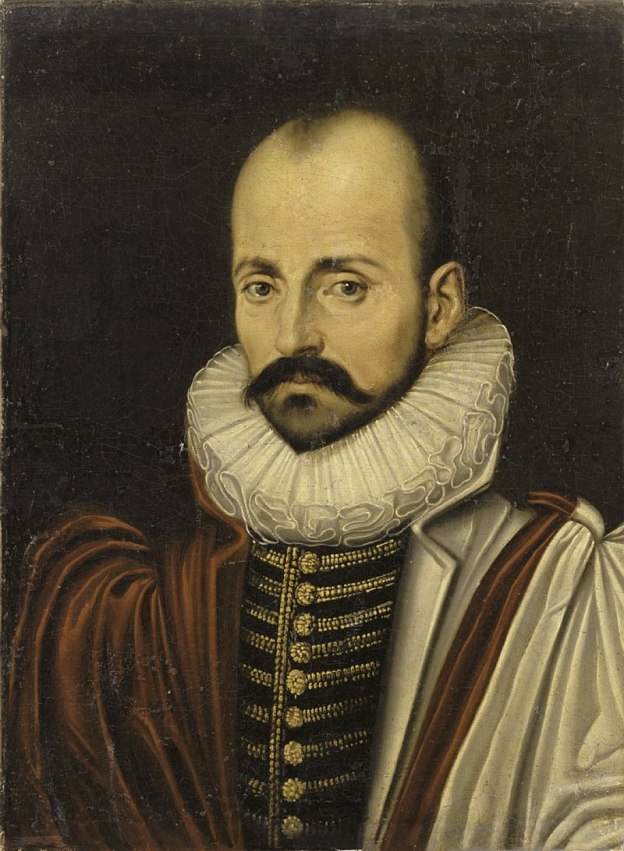

Montaigne and the Ages of Life

Montaigne and the Ages of Life Wednesday Blog by Seán Thomas Kane

This week, reflections on Michel de Montaigne’s perception of his changing character throughout his life.—Click here to support the Wednesday Blog: https://www.patreon.com/sthosdkane


This week, reflections on Michel de Montaigne’s perception of his changing character throughout his life.


I’m currently reading Philippe Desan’s biography of Michel de Montaigne, the French philosopher and statesman and the father of the essay. Montaigne is an influence for me in how the Wednesday Blog has developed over the last four years that I’ve been writing this weekly. He is also one of the figures on the orbit of my dissertation, and one of the most important sources for critical analysis of the events which I describe in that doctoral work. Philippe Desan in turn is one of, if not the most prolific Montaigne scholar of our time. So, it’s been a delight to read his biography of this man who I’ve gotten to know however faintly through the frame of his Essays in my research.

Most of my work deals with his famous essay “On the Cannibals” found in Volume 1 of that three volume collection. “Des cannibales,” as it’s known in its original French, was published in the first collection of Montaigne’s essays in 1580, and it’s this collection with which I’ve been the most invested in my work. The cannibals of Montaigne’s focus speak to questions of humanity and human dignity which I pose in my dissertation, which is titled “Understanding the Sauvage in André Thevet’s Brazil: 1555-1590.” 

Yet it is in the third volume of Essays where Desan established a crucial connection between Montaigne the man and Montaigne the humanist of the late Renaissance preserved in the amber of his words. In the essay titled “On Vanity” Montaigne poses a fascinating self-reflection looking back at his life as he remembered it and who he was at the time he wrote that particular essay near the end of his days. Quoting here from Donald Frame’s 1965 translation, Montaigne wrote that in the years since he published his first edition of essays in 1580 “I have grown older by a long stretch of time; but certainly I have not grown an inch wiser.” Here whether out of humility or in refutation of Aristotle’s maxim that age and experience begats wisdom, Montaigne sees himself as the same light as before. Despite this, Montaigne continued to observe that “myself now and myself a while ago are indeed two; but when better, I simply cannot say.”[1] This struck me that the essayist could see such a simple yet profound difference between himself as he was when first he wrote and published his magnum opus and the man he later was publishing his third and final volume of essays nearly a decade later.

From my earliest days of extensive writing in my high school years I found myself looking ahead to a time late in my life when I would return to the places of my teenage youth and reflect on what once was and who I’d become. I suppose there’s some vanity of my own in having this profound sense of legacy even from what was then quite an early point in my life. Still, in recent weeks I’ve been reintroduced to younger versions of myself as my family carries out a Spring cleaning and we’ve found decades old boxes of photographs and postcards that I still remember taking and sending yet which haven’t seen the light of day since their capture. I was humbled and heartened to see in particular how loved was the boy I once was, and how inventive and imaginative he could be. Looking at these photos, especially from around my family’s great move from Chicago to Kansas City in 1999, I remember each and every one of them being taken. I remember the sights and sounds, the smells, the prairie winds and the things I was thinking in those first days of my life in Kansas City. These memories have always been there in my mind, yet the subsequent quarter-century has piled many more atop them so that they are now rendered foundations for the memories that comprise me today.

I suspect these days spent pouring over decades-old photos removed some sort of mental block I’d put up out of stress that’s kept my imagination in check in recent months. I longed to have the same expansive dreams and wandering thoughts that’ve populated so much of my consciousness, and now again I find it easy to tap into that deep reservoir which too is built into my memories yet also grows out from them into things which are wonderous and extend beyond the limits of reality toward the possible. Am I then wiser than I was when first I began writing essays in my adolescent and early teenage years? I’d like to think so, at least in some respects. I have a sense of calm today which was lacking in earlier years, and while the stresses of my life are great, as they are for all of us, I know how to accept them and tamper down some of their effects.

Yet in so many ways I do feel that I too am a different person from the kid who moved west all those years ago. Likewise, I see a clear distinction between the student starting high school in the years after the turn of the millennium and imagining his future in the last decades of this century. I’ve learned to live more in the moment in which I find myself, to influence that moment to fit what I aspire it to be. A complex turn of this answer is to consider all the potential lives I might have led, a thought experiment which I’ve considered developing into a short story with some sort of science fiction shenanigans. In one version of this, a broken-down elevator occurring simultaneously across parallel realities as a sort of mirror image resulted in contemporary alternative versions of myself ending up stuck in the same elevator all at once. I could see it either being a bit of a laugh-fest as one version of myself attempted to out-wit the others, or a simmering cauldron of irritation. 

What all this speaks to is the complexity of our personalities. We are all multifaceted with so many different competing thoughts and desires and inclinations and perceptions. I’ve thought more recently that perhaps my academic career would be further along if I limited myself to only focusing on my research, yet then again, I’ve always had multiple hats in the ring so why would I stop doing all these different things now? The Wednesday Blog for one remains a sort of release-valve for me to write about things which I’m curious about yet don’t directly relate to my research. I look to my colleagues, and I see people with similar interests and in some cases similar paths they’ve taken to get to where they are today. Several days ago, when I was dwelling in a particular bout of melancholy thinking about the long winter that has grayed the skies over my own doctoral candidacy when compared to my peers, I felt a sense of pride at noticing just how I’ve persisted in my efforts and my work in spite of all the challenges which the last six years have brought. Perhaps it is this combination of trial and hope which forms a person; it’s what formed me into the historian I am today.

When I started writing the Wednesday Blog in March 2021 I did so because I felt such a profound sense of nostalgic hope at one particular memory that surfaced after a sleepless night amid my comprehensive exam studying that I felt compelled to share it with the world. I know for a fact that I am a different person today than I was four years ago when I wrote that blog post about an Air France commercial I remembered seeing on ITV and Channel 4 five years before when I lived in London. The difference lies in the added layers of experience laid by all the trials which I’ve endured and the hopes which’ve kept me going. When I had such tremendous trouble unlocking my imagination and letting myself daydream in the latter months of 2024, I recognized that I am happier when I allow my mind to wander and craft stories that no one else will ever know. These are often stories of the future I hope I might live and the wonders I might come to know and explore. That imagination, that connection with my own consciousness, is the thread that runs all throughout my life and connects these different versions of myself that I’ve grown into and out of with the passing of time.

When Montaigne picked up a copy of the 1588 edition of his Essais, containing all three volumes of musings, he took a pen to it and steadily began correcting things he found beneath the standards he’d developed at that late moment in his life. I don’t often read my own writing after I’ve finished editing a document. I’ll occasionally return to an old blog post when I’m referencing it in a newer one, and even more occasionally if I’ve cited a source before in a previous paper, I’ll open that paper to aid me in citing the same source again in the research project of the moment. Yet, I rarely sit down just to read my own writing. The last time I did I ended up switching from a PDF file back to the Word document version so I could edit as I read. In fact, when I was moving into my apartment in Binghamton in August 2019, I found an essay I wrote in my sophomore year of high school when I was 15 years old. It was a near 20 page essay that attempted to summarize the history of religion in Britain and Ireland from the Stone Age to St. Patrick. Reading it then at the start of my doctorate and thinking about it as an essay that I might grade, I would’ve given it a low B- or maybe a C+.

I need to remember that my old writing fits into a particular time and place in my life and ought to remain in that setting for as long as I can muster the strength to not try to refine it further. These ages in my life mirror those in everyone else’s, and I hope that as I dream about the ages to come, I will be able to share them and live them to their fullest potential. Montaigne died in September 1592, almost 400 years before my own birth. At that point, he’d made his name in politics and in philosophy. The Wednesday Blog is essentially my collection of essays of varying length and quality. I hope that when I wander off in my own time that my life in all its ages will have been as fulfilled and prolific as the great essayist.


[1] Montaigne, Essais (EB) 3.9.433r, Frame, 736.


On Translation

This week, how I take nuance and particularity into account in my efforts as a translator.—Click here to support the Wednesday Blog: https://www.patreon.com/sthosdkane


This week, how I take nuance and particularity into account in my efforts as a translator.


When I chose to study André Thevet (1516–1590) and the three-toed sloth in August 2019 I did so because I already knew French and the need to learn a new language was less pressing than if I’d chosen to study another source in the history of natural history. I chose Thevet because it was practical, and I chose the sloth because the thought of being a sloth historian made me laugh. From the first day working on Thevet, I found that my understanding of his books was heightened when I took the time to type out my own translations of his text. Thevet wrote in Middle French that is native to the middle decades of the sixteenth century. I arrived at this project very familiar with Early Modern English, the contemporary form of this language to Thevet’s time, as my history master’s thesis delt with sources in that chronological variety of English from Thevet’s generation and the one just before. I’ve never had much trouble understanding the most prolific author of Early Modern English literature, Shakespeare, but I think I’ve had a tolerance for varieties in speech that’s allowed for me to try to think beyond my own millennial Midwestern metropolitan American English and be willing to understand the likes of Shakespeare from a young age.

So, when I began translating passages from Thevet’s Singularitez de la France Antarctique for my own professional use in my dissertation, I decided that as long as I was translating that book I might as well translate it with the intention of sharing Thevet’s words beyond the scholarly analysis and critique which lie at the heart of my work as a historian. This first draft is built around the 1558 French edition published by Christophe Plantin (c. 1520–1589) in Antwerp and contains footnotes drawn from the 1878 French edition by Paul Gaffarel published in Paris, two Brazilian Portuguese translations by Sergio Amado (1978) and Estêvão Pinto (1944, using the 2018 reprint), and the partial 1986 English translation by Arthur Stabler and Roger Schlesinger which contains only Thevet’s North American chapters.

I finished the first draft of this translation in Summer 2023 and am now looking ahead toward the second draft which is the next stage of the project, and I hope the last one before I feel confident in formally writing to the publishing editors whose press sales agents I’ve spoken with about this project at conferences over the last two years. The second draft will consist of two main stages. First, I will cross-reference my translation and the 1558 Antwerp edition on which it is primarily based with the 1557 first and 1558 second editions published in Paris by Maurice de la Porte, two Venetian editions translated into Italian by Giuseppe Horologgi and published by Gabriel Giolito de’ Ferrari (c. 1508–1578) in 1561 and 1584, and the 1568 full English translation by Thomas Hacket published in London by Henry Bynneman. Second, I will seek to make my translation more understandable for a 21st century English-speaking reader while endeavoring to preserve Thevet’s particular mannerisms and voice, a writing style with which I’ve become quite familiar in the last 6 years to the point that I can now confirm at least two French translated manuscripts in the Bibliothèque nationale’s collections in Paris are verifiably written by Thevet. He had a way of writing that’s unmistakable.

These two competing axes create a binary star system around which my translation revolves. On the one hand, I want to be true to the original text, to preserve the author’s voice and something of their spirit which remains in those words. On the other hand, I need to make my efforts readable for my own contemporaries. Thevet and his contemporaries are notorious for long run-on sentences that would make Hemingway shake his head in earnest frustration. Where do I break up a long sentence while preserving its overall integrity? Furthermore, at what point should I decided to remove the bracketed notations of page breaks in the original text? There the 1558 Antwerp edition is most fully evident as its pagination has several quirks that make it stand out from the 1557 & 1558 Paris editions. At this point, Plantin published books with folio numbers rather than page numbers, so the first two pages were in fact folios 1 recto (1r) and 1 verso (1v). These names refer to the custom that scribes traditionally started writing on the back side of the vellum (recto in Latin) and then flipped the skin over once ready to continue writing on the verso, or opposite side. In several instances the folio numbers actually decrease in the book, notably in Thevet’s chapter on the sloth, which makes the footnotes on that core element of my research particularly confusing if you’re paying close enough attention. So, in summation the inclusion of the page breaks with the folio numbers keeps my translation grounded in Plantin’s edition, however that may break up the text in an uncomfortable way for some readers.

Ultimately, I am not the author of this book, merely a herald relaying it on for our time. My voice is there in the handful of introductory chapters I’ve written to go along with this book. These chapters describe Thevet as a reader of travel literature and place his accounts of the Americas beyond what he himself saw in Brazil in the context of their French and Spanish sources. I see my efforts in this as a means of introducing the reader to Thevet, a man who today exists on the furthest margins of the popular imagination of the First Age of Exploration in the English-speaking world. Thevet remains present in academic circles, there were at least four papers presented at this weekend’s annual meeting of the Renaissance Society of America in Boston which discussed Thevet, mine included. I hope this book will be useful to fellow academics and perhaps will entice curious readers to learn more about this man who I’ve spent the last 6 years of my life getting to know.I find myself drawn as much to the effort of a translator as I do to the work of a historian these days. We live in such a fractious time when reasoned debate and earnest discourse is riddled with dangers and seemingly improbable to undertake. I feel as though I’m constantly translating my thoughts and character for others to understand me. It’s why I enjoyed my time in Boston because that city has a large enough Irish American population that when I’d tell my name to a cashier to put on a carry-out order they’d actually spell it in the proper Irish manner; this never happens in Kansas City. That said, I felt that I had to translate my expectations and personal limits to be able to live even for just a few days in a city as expensive as Boston where I was often paying double what I’d normally pay at home in restaurants. In translating I recognize that each of us think in slightly different ways and see the world in which we all live in just as unfamiliar terms to one another. Difference enhances our common humanity and elevates our manner to something greater than ourselves.