
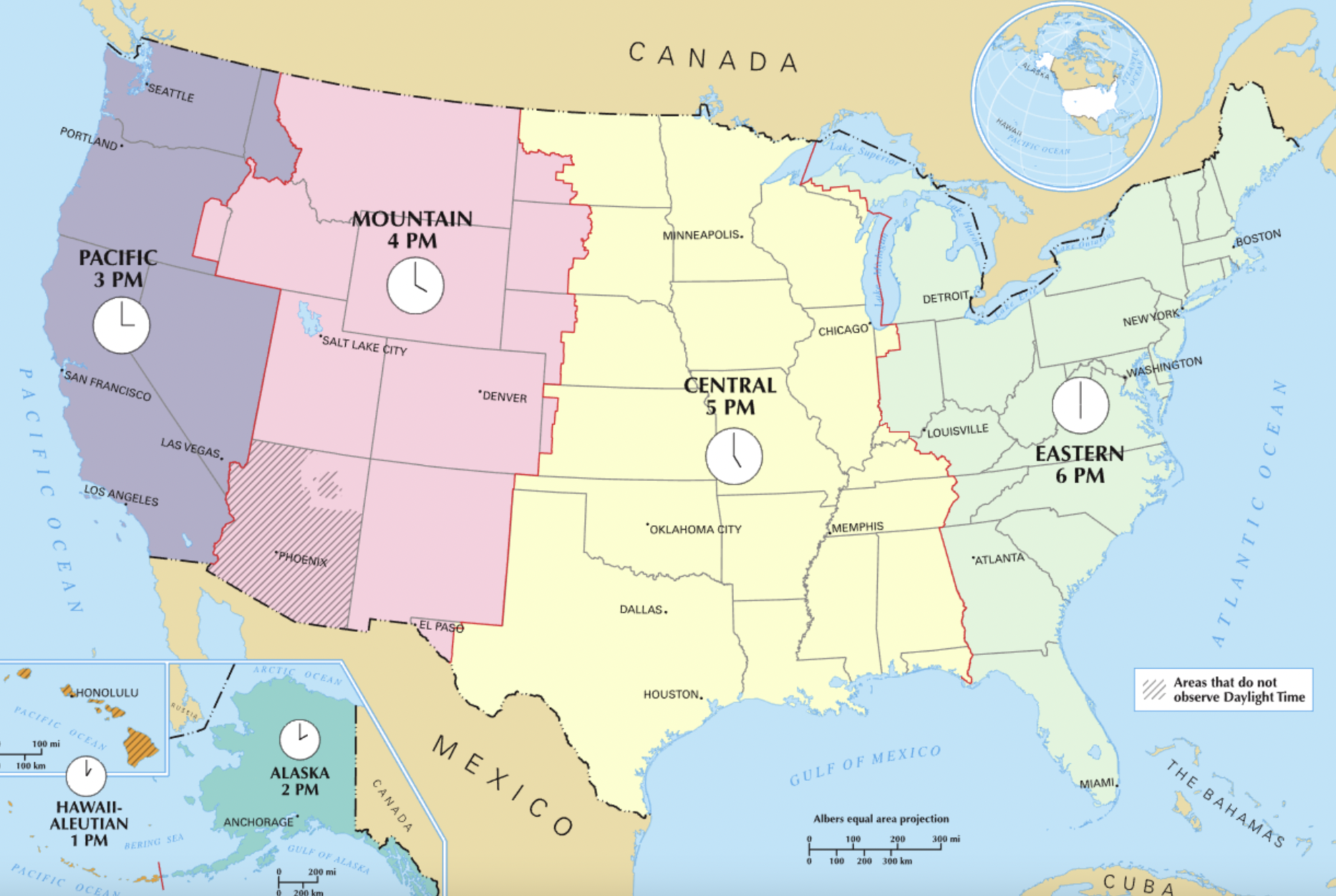
I’ve always been fascinated by how we understand the passage of time, from the older ideas of local solar time, to the nineteenth century adoption of standardized regional time zones, to now how most people I know seem to have at least one aspect of their life guided by the reality that they have to work with multiple time zones in a given day. Take my case: I work at a university located in New York, which is in North America’s Eastern Time Zone, but at the moment I’m staying with my parents in Kansas City, a city located in the Central Time Zone. This means that I have to keep an eye on the clock with a mind not only for the local time where I am, but the time as it is one hour ahead of me in New York.
As any Midwesterner from west of most of Indiana will tell you, any national TV or radio broadcast will always be announced in Eastern Time and Pacific Time, meaning that those of us in the Central Time Zone just have to subtract an hour from the listed broadcast time in the East to get our own broadcast time. And our friends out in the Mountain West just have to look at the Pacific broadcast time and add an hour to get their’s. What this means is that the listed broadcast times on any TV or radio show in the Continental United States relies on 35.8% of the population rarely ever sees national broadcasts listed in their own local time. Granted, the largest population centers in the country are on the coasts, but coming from the middle of the country, this has always been a bit of a sticking point for me.
Driving across the US, you’ll often come across the usual Welcome signs when entering new states, new counties, or new cities. In some places, particularly in the Rockies, each city’s welcome sign will include that city’s elevation where in the prairies it might include the population or the date that settlement was founded. Meanwhile, each state has its own at times unique welcome sign. I always enjoy seeing those, because it marks a real milestone on each of my long drives. My favorite welcome sign to date remains Colorado’s, though normally where I see it on I-70 at the Kansas/Colorado border the dominant colors in colorful Colorado are the golden brown of the Great Plains stretching off to an endless blue, though sometimes gray, sky.

Yet alongside all these welcome signs, and the signs advertising this country’s wonderful and often weird roadside tourist attractions, are the occasional signs you’ll pass by that announce that you’ve entered a new time zone. It baffles me that neither the Illinois nor the Indiana Departments of Transportation have put such signs on I-70 on their shared border just west of Terre Haute, where I usually will gain or lose an hour depending on the direction I’m driving between Binghamton and Kansas City. Still, these signs are always an even bigger marker of progress on a trip, a sign (pun intended) that you’ve moved not from one of the 50 states to another, but from one of the 6 continental North American time zones to another.1 It’s a rarer thing to do.
There is one thing about how this country is divided by time zone that does bug me, and that’s the eastern edge of my own native time zone in Indiana and up the middle of Lake Michigan. You see, back in the nineteenth century when these time zones were first being set up, the merchants and city leaders in Detroit wanted to be on the same time zone as the markets in New York and Toronto, so they got Michigan as a whole to be put in Eastern Time. Later, in the twentieth century, Indiana’s state government decided the majority of their state should also be on Eastern Time, probably because of Michigan’s decision, leaving the option of being on Central Time up to only the westernmost Hoosier counties. As a result, cities like Gary in Northwestern Indiana that are a part of Chicagoland are in Central Time, while the rest of the state is an hour ahead.
But geographically, that border between Eastern and Central Time should be further to the east. Geographically, Indiana and Michigan should be on Central Time, not Eastern. This would allow both states to be on the same time as the Midwest’s biggest markets in Chicago, while at the same time causing some problems for Detroiters driving across the border to Windsor, Ontario, or people commuting into Toledo, Ohio from Michigan. All that said, I do use the time change on the Illinois/Indiana border to my benefit when I’m driving in either direction across it. Going east, if I leave Kansas City at 07:00 CT, it means I can stop for dinner around 17:00 ET in Indianapolis, which if it were in Central Time would usually be an hour too far west (16:00 CT) for my usual dinner time. Going west, if I leave Binghamton at 07:00 ET, I can use the extra hour to get a little further along the drive, even making it as far as St. Louis, which is only 3.5 hours from Kansas City before 22:00 CT (23:00 ET).
Then there’s the issue of the seasonal time changes. In North America we call it Daylight Savings Time, while in Europe it’s called Summer Time. This means that over here the official time zone abbreviations change from CST in the cold months to CDT in the warm ones, while the UK’s time zone remains BST (British Standard Time/British Summer Time) all year round. I personally tend to agree with the people calling for us to just adopt Daylight Savings, i.e. Summer, Time all year round. It makes more sense, and even though it can be a pain to get up before dawn in the mornings in the Winter, that’s just a part of Winter. I always thought it was kinda neat, though I admit I never really have been a morning person, so my appreciation for any wake-ups before 08:00 are limited at best.
That said, even if one US state here in the Midwest or in the East did vote to switch permanently to Daylight Savings Time, as Missouri is currently considering, it would require every other state in that region to do so as well. Unlike Arizona, the most notable state to make this change, there are too many cities in the Midwest that are close, or cross to state borders. Some notable ones among these are Chicago, St. Louis, Kansas City, Cincinnati, Louisville2 Milwaukee, the Twin Cities, Omaha, the Quad Cities, Duluth-Superior, and Detroit.
Even today, the furthest eastern reach of Chicago’s suburban train network extends from the Central into the Eastern Time Zone with the South Shore Line in South Bend and Hudson Lake, Indiana. Imagine if Missouri’s bill was signed into law without the provision that Kansas agreeing to it as well. Every time someone crossed State Line Road here in Kansas City between the first Sunday in November and the second Sunday in March, they’d have to adjust their clocks by an hour. Because of this, if one Midwestern state decides to adopt Daylight Savings Time permanently, everyone else will have to follow along, or else it won’t work.
As you can see, just from the intricacies of it, I enjoy thinking about time zones. In a couple of months when I drive west from Kansas City on a vacation out to the Rockies, I’ll look forward to seeing that rare sign on I-70 in Western Kansas announcing my entry into Mountain Time. I know, it’s nerdy, but it’s something I enjoy thinking about.
Notes
1 The six continental North American time zones are: Atlantic, Eastern, Central, Mountain, Pacific, and Alaskan. You could also include Hawaiian-Aleutian because part of it does reach sections of the Alaskan mainland (I think), but that seems a bit of a stretch.
2 Yeah, Louisville is in Kentucky, but it’s borderline Midwestern.
 Wednesday Blog by Seán Thomas Kane