

Author vs Writer – Wednesday Blog by Seán Thomas Kane
Recently I noticed when someone referred to a guy as “the author of x”, in my mind I thought about what it means that they were called “the author” and not “the writer.” This whole question came to me considering that in Irish, I’d introduce myself with “Is staraí agus scríbhneoir mé,” or rather “I’m a historian and a writer,” and the same goes in French « Je suis historien et écrivain, » yet in neither context would I introduce myself at a party as “I’m an author.” Both words have their origins and similar yet separate meanings in every language, and that distinction is worth noting.
Author comes to us from the Latin auctor via Old French autor, it’s a cognate of the modern French auteur. The Irish version of this, údar also comes from the Latin auctor, demonstrating that the core idea of an author may well have spread northwards with the Romans. On the other hand, writer is an inherently English word, a writer is most fundamentally someone who writes. I like words that make their function this clear, words that are built off of the verb that they accomplish. When I’ve thought about trying to emulate Tolkien’s work it’s been less to create my own massive legendarium of fantasy literature and more to devise new ways of understanding the world through constructed languages like his own Quenya and Sindarin. In those thought experiments one of the key principles, I’ve wanted to address is crafting a language where there is a relatively small vocabulary because every word is a stem upon which one adds grammatical endings to make it a noun, adjective, verb, or adverb, or to include prepositional elements to it. This is something you see in older languages like Latin with its declensions and conjugations or in Finnish with its 14 noun cases. So, these simplest of English words like writer that demonstrate what they do as efficiently as possible are among my favorites.
Author too in its Latin origins was a word like writer. An auctor is someone who increases or nourishes their object (augeō in Latin). In classical literature the story comes from the muses, In the Loeb translation Ovid began his Metamorphoses acknowledging “my mind is bent to tell” the stories that will follow, for “ye gods, for you yourselves have wrought the changes, breathe on these my undertakings, and bring down my song in unbroken strains from the world’s very beginning even unto the present time.” (Met. 1.1.1–4) Shakespeare picked up on this in his reading and began Henry V with the chorus uttering the line
“O, for a muse of fire that would ascend
The brightest heaven of invention!” (Henry V, 1.0.1–2.)
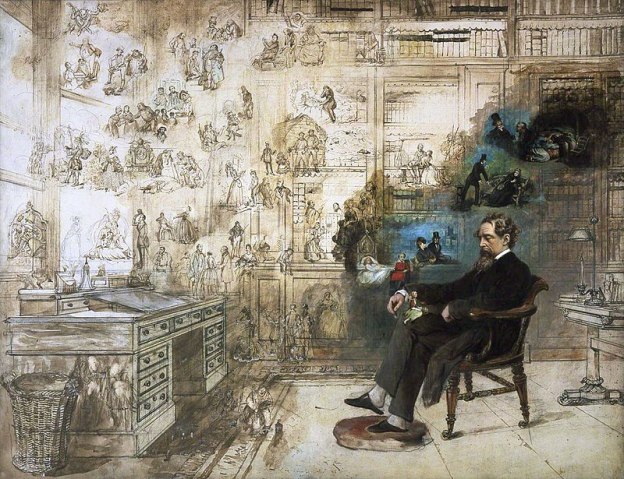
In my mind an author is both someone who has received inspiration for their work and an active participant in the creation of those works. There is a wonderful print of Dickens dreaming at his desk with all his myriad of characters he nourished into existence in his stories floating about him. I sometimes wish that this is the way that I’ll be remembered, as a storyteller who crafted so many lives that while they only exist in my writings therein is encapsulated a little world, an imagined reality all its own. In this act of creation, I am an author, but I am also a writer, for it’s my job to translate these worlds from my imagination onto paper where others can experience these characters’ lives.
A writer is a craftsman busy in their workshop devising new ways of getting information across. They could be writing serious factual information, reports of the events of the modern world, or setting the scene of stories more fantastical than anyone before could’ve imagined. I think of Dr. Franklin in his printing shop as the archetypal writer his sleeves rolled up hard at work, a stark contrast to the image of Dickens asleep in his chair dreaming of his many creations. Yet we rarely have authors without writers anymore, they are of course more often than not the same person, still in older times there were stories that existed without the written word. The Gaelic file tradition which I hope my own stories can be worthy heirs to is one such form of authorship beyond the boundaries of the written word.
So perhaps I don’t like to introduce myself as an author because of the world-building implications of authorship. Day-to-day I am a writer, a craftsman of words, scrawled onto paper, typed into a computer, and printed onto the page. I am an author of some stories, there are characters you’ve met here on the Wednesday Blog like Dr. Noël Felix and Captain Amelia Daedalus from a few weeks ago. I hope to get back into writing more fiction again in the coming months and years, to telling those kinds of stories. Yet perhaps because my authorship is so much more personal than my craftsmanship as a writer, I am left preferring to keep my creations closer to my chest and instead hold my craft out for all the world to see.
 Wednesday Blog by Seán Thomas Kane