Tag Archives: Museums

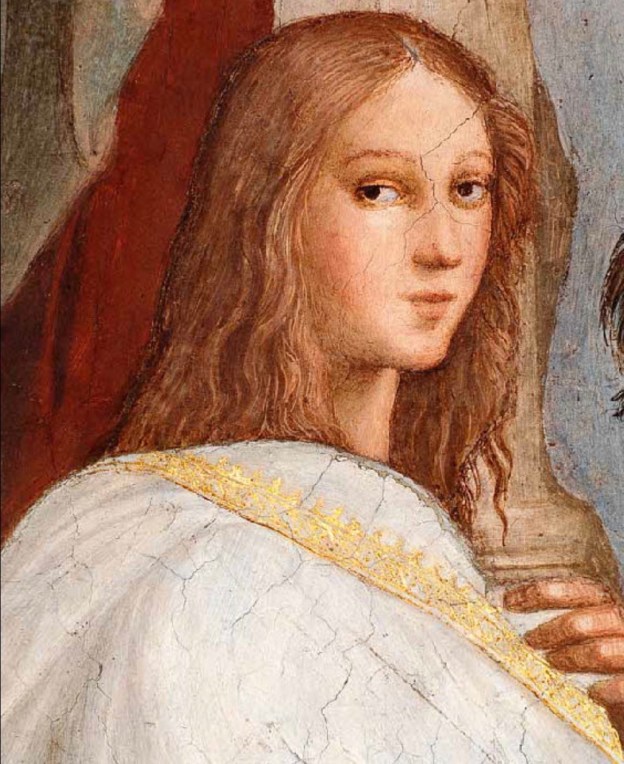
A figure from Raphael's "The School of Athens" variously identified as Francesco Maria della Rovere, Pico della Mirandola, or Hypatia of Alexandria.

On Knowledge

This week, I want to address how we recognize knowledge in comparison to the various fields of inquiry through which we refine our understanding of things.—Click here to support the Wednesday Blog: https://www.patreon.com/sthosdkaneArtRaphael, The School of Athens (1509–1511), Apostolic Palace, Vatican Museums, Vatican City. Public Domain.Sources“On Writing,” Wednesday Blog 6.27.Surekha Davies, Humans: A Monstrous History, (University of California Press, 2025).Marcy Norton, The Tame and the Wild: People and Animals After 1492, (Harvard University Press, 2024), 307.Dead Poets Society, (1989) "What will your verse be?" Video on YouTube.


This week, I want to address how we recognize knowledge in comparison to the various fields of inquiry through which we refine our understanding of things.


Lately my work has been dedicated to a thorough review of the historiography within which I’m grounding my dissertation. I wrote about this two weeks ago in an essay titled “On Writing.”[1] My research is historical, yet it touches on secondary literature which operates within various fields within the discipline of history. These include Renaissance history, and its larger sibling early modern history, the history of cartography, the history of animals, the history of botany, and more broadly the history of early modern science. Methodologically, I owe a great deal to two great twentieth-century Francophone anthropologists, Alfred Métraux (1902–1963) and Claude Lévi-Strauss (1908–2009). While Métraux and Lévi-Strauss aren’t considered directly in the historiographic section of the new introduction that I’m writing for my dissertation, which is limited to sources published since the millennium, they nevertheless stand tall in the background of my history.

Today we often talk within academia about a desire for interdisciplinarity in our work and our research. We’ve found ourselves too narrowed by our ever shrinking fields and seek greener common pastures for grazing as our intellectual and pastoral ancestors alike once knew. In my case, this interdisciplinarity lies more in my efforts to incorporate historical zoology into my work, a methodology which seeks to use zoological methodology and theory to explain historical animals. I have friends who study many things. Among them is one whose passion for history, classics, and mathematics has come together to craft a dissertation which seeks to demonstrate the intersections between those three to better understand the great transitions in human inquiry. Another seeks to follow the medical connections across oceans between disparate regions in the Americas and Europe that nevertheless existed even if they seem remarkable today. Still more, I have a friend who applies basic economic need to explain a complex diplomatic situation that once existed between the Venetian Republic and the Ottoman Empire in the Adriatic Sea. All of these historians of whom I write are applying a degree of interdisciplinarity to their work that reflects their own disparate interests and curiosities. In early modern history we talk about curiosities as objects which were collected from disparate and exotic lands into cabinets to display the erudite collector’s prestige and wealth. I say our curiosity is something to be collected by those worthy archives, libraries, museums, or universities that will employ us in the near future and for us to feed with new ideas and avenues of investigation that we will never be bored with life.

In all of these things, there is an underlying genre of knowledge which I am addressing. I’ve written thus far about history alone, yet it is the same for the anthropologists, astronomers, planetary scientists, and physicists who I know. Likewise for the literature scholars and the linguists. Our fields of inquiry all grow on the same planet that comprises of our collected knowledge. In English, this word knowledge is somewhat nebulous. To me, it says that we know things broad or specific. In London, for instance, the Knowledge is the series of tests which new cabbies must complete in order to learn every street within a certain radius of Charing Cross. The Latin translation of this word, scientia, makes things even more complicated as that is the root of the English word science. Thus, when we refer to Renaissance science, there is always a caveat in the following sentence explaining that “this is not science as we know it but a sort of protoscience.” I was advised, similarly, after a particularly poorly received presentation at a workshop at the Museum of Natural Sciences in Brussels in October 2023 that I shouldn’t refer to “sixteenth-century conservation” because no such concept existed at the time; instead, it would be better to discuss a “genealogy of conservation.” This sense that modern terms, in use since the Enlightenment of the eighteenth century, ought not to be pulled further back into the past I think loses some of the provenance of those terms and how the Enlightenment philosophes first came across them. 

I find it telling that the Ancient Greek translation of knowledge, γνῶσις (gnôsis), is a word with which I’m more familiar from theology and the concept of Gnosticism whereas scientia reminds me of philosophy and the other fields of inquiry which grew from that particular branch of the tree of human curiosity. One might even say that philosophy and theology are a pair, siblings perhaps? They seek to understand similar things: on the one hand an inquiry into thought, and ideally wisdom, and on the other a search for the nature of the Divine, which at least in my Catholicism we can know because we are made in the Image of God. The division here between the Ancient Greek term being affiliated with faith and the Latin one with reason I think speaks to the Latin roots of my own education in Catholic schools and at a Jesuit university, where I learned about Plato and Aristotle, yet I recognized Aristotle’s Historia animalium (History of Animals) by its Latin name by which it was generally known in Western Europe for centuries before the rise of vernacular scholarship rather than by its Greek original Τῶν περὶ τὰ ζα ἰστοριῶν (Ton peri ta zoia historion). Note that the English translation of this title, History of Animals reflects better the Latin cognate of ἰστοριῶν rather than the better English translation of that Greek word, Inquiry.

Added onto these classical etymologies, in my first semester Historiography class at Binghamton University I was introduced to the German translation of scientiaγνῶσις, and knowledge. Wissenschaft struck me immediately because I saw the German cognate for the English word wizard in its prefix, and because I knew that the -schaft suffix tends to translate into English as -ship. Thus, my rough Anglicization of Wissenschaft renders Wizardship, which is rather nifty. Yet this word Wissenschaft instead was seen in the nineteenth century as a general word which could be translated into English as science. This is important for us historians trained in the United States because our own historiographic tradition, that is our national school of historians traces our roots back to German universities in the early and middle decades of the nineteenth century. I remember long sessions of my historiography class at UMKC discussing the works of Leopold von Ranke (1795–1886), the father of research-based history. I felt a sense that this concept of Wissenschaft seemed relatable, and as it turned out that was because Irish has a similar concept. 

Whereas in English we tack on the suffix -ology onto any word to make it the study of that word, in Irish you add the suffix -ocht. So, geology is geolaíocht and biology is bitheolaíocht. Yet note with the second example that the suffix is not just -ocht but an entire word, eolaíocht. This is the Irish word for science, added onto the end of bitheolaíocht to demonstrate that this word refers to the study of bith- a prefix combining form of the word beatha, meaning life. So, biology then is the science of life itself. Powerful stuff. I appreciate that Irish linguists and scholars have sought overall to preserve our language’s own consistency with its scientific terminology. It means that these fields of study, these areas of knowledge, can exist purely within the purview of the Irish language without any extra need to recognize that their prefixes or suffixes come from Latin, Greek, or English. There are some exceptions of course: take zó-eolaíocht, the Irish word for zoology, which effectively adopts the Greek word ζῷον perhaps through the English zoo into Irish. Would it not have been just as easy for whoever devised this hyphenated word to instead write ainmhíeolaíocht, translated into English as the science of animals? Here though I see more influence from English because this language adopts as much as it can from other languages out of prestige and a desire for translingual communicability. As an English speaker, I find scholarly works often easier to read because we share common etymologies for our words relating to knowledge. English’s sciencegeology, biology, and zoology are French’s sciencegéologie,biologie, and zoologie. In English, we drop any pretense of Englishness to clothe ourselves in a common mantle familiar to colleagues from related cultures around the globe. In academia this is to our mutual benefit, after all so much of our work is international. I’m regularly on webinars and Zoom calls with colleagues in Europe for instance. I believe this is the lingering spirit of the old scholarly preference for Latin as a lingua franca which at least to me seems close enough in the past that it’s tangible yet realistically it’s surely been a very long time since any serious scholarly work beyond classics was published in Latin for the benefit of a broad translingual readership?

I for one admire the Irish word eolaíocht and its root eolas, which translates into English as knowledge, that is an awareness of things because eolaíocht represents a universal concept while retaining its own native nature. So often in my research I am discussing the early assimilation of indigenous cosmovisions, to borrow a Spanish word put to good use by Surekha Davies in her latest book, into the nascent global world centered on Europe.[2] I see how these cosmic conceptions faded until they were rendered in Gothic or Latin letters on the voluminous pages of encyclopedic Renaissance general and natural histories which remain among the most often cited primary sources for these indigenous cultures who Marcy Norton argued in her 2024 book The Tame and the Wild: People and Animals After 1492 had their own classical past made remote from their colonial present by European contact, conquest, and colonization.[3] Seeing these indigenous perspectives fade into their categorized and classified statuses within the cosmos defined by Europe’s natural philosophers I feel fortunate that my own diaspora (which was also colonized) has retained this element of our individual perspective. I first came across the -ocht suffix in the word poblacht, the Irish word for republic. A famous story from the birth of the Irish Free State during the Anglo-Irish Treaty negotiations in 1921 tells of British Prime Minister David Lloyd-George, a Welsh speaker, remarking to Michael Collins, an Irish speaker, that their choice of a republic was unusual because none of the Celtic languages naturally have a word for republic. That word evokes its Roman roots in the ancient Res publica Romana, the Roman Republic, whose northward expansion across the Alps led to the gradual death of the Continental Celtic languages, whose speakers’ descendants today are largely the Western Romance speakers of French, Romansh, Occitan, Catalan, Spanish, Galician, and Portuguese, among others. Romance languages are noted for their common descent from Latin, whence they all derive variations on the Latin word scientia; English gets science through Old French. “How are you going to name your new government in the Irish language?” Lloyd-George asked. Collins replied something along the lines of “a kingdom is called a ríocht, so this government of the people (pobal) will be called a poblacht. Thus, the Republic of Ireland is named in Irish Poblacht na hÉireann. Naturally, this word pobal derives from the Latin populus, so the shadow of Rome hovers even over unconquered Hibernia. Yet that is another topic for a different essay.

Let me conclude with a comment on the difference between knowledge and wisdom, as I see it. The former is far more tangible. We can know things through learning embodied best in living and in reading. I know for instance to look both ways before crossing a street because plenty of people in the last 140 years have been hit by cars, buses, and trucks, and you can never be too careful. Likewise, I know everything I do about the things I study through reading what others have written about these topics. It’s my job then to say what I will. In Whitman’s words made immortal by our recitation, the answer to the eternal question, “that the powerful play goes on, and you may contribute a verse.” That’s history, people! Reading the powerful play of what others have written and summoning up the courage to take the podium and have your say. I first heard this particular poem, as did many in my generation, recited by Robin Williams in the 1989 film Dead Poets Society. Knowledge is the recitation of these facts we’ve learned. Wisdom is understanding how these facts fit together and speak to our common humanity. What makes us human? I believe it’s as much what we know as what we remain ignorant of. Our ignorance isn’t always a curse, rather it’s another foggy field we’ve yet to inquire about, a place where someone’s curiosity will surely thrive someday. It is another evocation of eolas still to come in our long human story. How wonderous is that?


[1] “On Writing,” Wednesday Blog 6.27.

[2] Surekha Davies, Humans: A Monstrous History(University of California Press, 2025).

[3] Marcy Norton, The Tame and the Wild: People and Animals After 1492, (Harvard University Press, 2024), 307.

The Art of Joy

This past weekend, the Nelson-Atkins Museum of Art debuted a new retrospective exhibit on the life and work of Franco-American artist Niki de Saint Phalle. One of her great initiatives was to express rebellious joy in her art, especially later in her career. — Click here to support the Wednesday Blog: https://www.patreon.com/sthosdkane


This past weekend, the Nelson-Atkins Museum of Art debuted a new retrospective exhibit on the life and work of Franco-American artist Niki de Saint Phalle. One of her great initiatives was to express rebellious joy in her art, especially later in her career.


I wasn’t familiar with the name Niki de Saint Phalle (1930-2002) before the Nelson-Atkins Museum of Art announced they would be hosting the first American retrospective exhibition of her work, yet having seen aspects of it, particularly her Nanas, I find that I do remember seeing these around here and there. The exhibit begins with her early work, highlighting her tirs paintings (1961–63) which involved her shooting paint-filled collages of popular material objects each with their own cultural meanings, until they bled their paint out. I found these hard to appreciate, the violence at the core of these pieces and the claustrophobic nature of their assemblages filled me with a sense of dread.

Yet, it was the latter two thirds of the Saint Phalle exhibit which I returned to, the section radiating and erupting in light and color in a manner that felt welcoming and brilliant as though it were made to bathe in the warm rays of the Sun. These portions of the gallery were filled with her Nanas (1964–73) and other works in the same style. Saint Phalle created her Nanas as an evocation of the power of women, often drawing from ancient fertility figurines like the Venus of Willendorf, today housed at the Museum of Natural History in Vienna. Even the serpentine figures which I would normally be wary of felt warm and cheering.

So, what then is it about Saint Phalle’s work and this dramatic change between her early creations in the 1960s and 1970s to her later works in the 1980s, 1990s, and early 2000s that the latter ones feel so different? In my two visits thus far I’ve gotten a sense that early on she was fighting back against oppressive forces and that her resolve was to take hold of the ancient model of fighting violence with violence, while later once she felt liberated from these old shadows, as much as she could’ve been, she began to create in a spirit of wonderous joy.

I’ve had a hard time with joy lately, and I’m usually the eternal optimist. In many respects, I feel my emotions have had a softening in the last year and a half out of fatigue more than anything else. After I finished my teaching job in the Fall, I could not feel much for a good two weeks; I was so tired that Christmas came and went with only a passing acknowledgement from me. I gave every last drop of my enthusiasm and optimism in that job, knowing that I would have to do no less if I wanted to do that job justice. Joy then, the emotion that I felt even in the darkest and most terrifying days of the pandemic as I dreamed of better tomorrows, is something distant from me even now.

Yet I prefer to be optimistic, to live joyfully, rather than to be consumed by the trends of pessimism and destruction that are well in vogue now. There are horrific things happening in our world every single day, and I applaud those who are fighting to stop those horrors from spreading. The great fight of our time is one to defend democracy in a year when it is very well and truly under threat. It might seem naïve to some, yet I feel it is my vocation to try to keep a positive outlook and remind the people around me of all the good things we’re fighting for. What good is war if we give up any hope of finding peace again? Like Saint Phalle, I see joy in color and light. Where years ago, I would want to keep the shutters closed on my windows today I love having the sunlight dance between their opened gates and radiate an exuberance that reminds me of St. Francis wandering the fields around Assisi 800 years ago. There are great horrors in our world, and we need heroes who will face them and restore them to their box, yet we also need people to remind us of the good times so that we have a reason to envelop that darkness in light.

In the arts, the greatest periods in recent American history of optimism and joy are the New Deal and the Great Society, two moments when the political will to make life better for all Americans translated into an artistic awakening which sings the spirit of the times. The New Deal policies of President Franklin Delano Roosevelt responded to a time of great pessimism and trouble for America and the globe, when at the heart of the Great Depression he and his brain trust found ways to invigorate society through economic and financial reforms as well as new funds for the arts that had not been known at any time before. Here in Kansas City, we look to the paintings of our local artist Thomas Hart Benton (1889–1975) to evoke the regionalist style of the day, or nationally to the works of Georgia O’Keefe, Edward Hopper, and Grant Wood. I often associate O’Keefe’s art with the bright colors and lights of the desert Southwest, a region that was conquered by the United States from Mexico in 1848 yet not fully realized into our national mentality until after World War II.

For me, the great voice of this optimism is Aaron Copland, whose music evokes the same regional influences of the painters just mentioned. A long standing question in American classical music is how best do we define our national voice? I say we here because the compositions created in this country live or die by the audience’s appreciation. I found it fitting then when I read that the Kansas City Symphony’s first European tour, happening this August, will include performances of Copland’s Third Symphony in Berlin and Hamburg alongside performances of the works of three other great American composers: Bernstein, Gershwin, and Ives. In Copland’s music there’s a sense of the enduring youth of this country, the optimism of a new society building itself from these foundations.[1]

I love how the third symphony uses his famed Fanfare for the Common Man as a central theme, this idea that while in other countries fanfares would be reserved for only the great and the good descending down to our common level on their golden escalators, in our country that fanfare is open to anyone who is willing to live their best life. We are all capable of greatness as long as we live within that brilliant sunlight that so dominates the most optimistic periods in our art.

The greatest challenge that we humans have ever received is to love one another, to be kind and generous with our compassion, and to work for the betterment of all of us. I see that message fading somewhat today, its brilliance drowned in the neon glow of our own individualism and aspirations for fame and riches. It runs contrary to our culture as it has developed that we ought to prefer charity over transactionalism, that we ought to be kind to each other for no other reason than because it’s the right thing to do. I worry that this is lost amid all the revolving cycles of fads and trends that catch our attention for but a moment only to be overshadowed by the next.

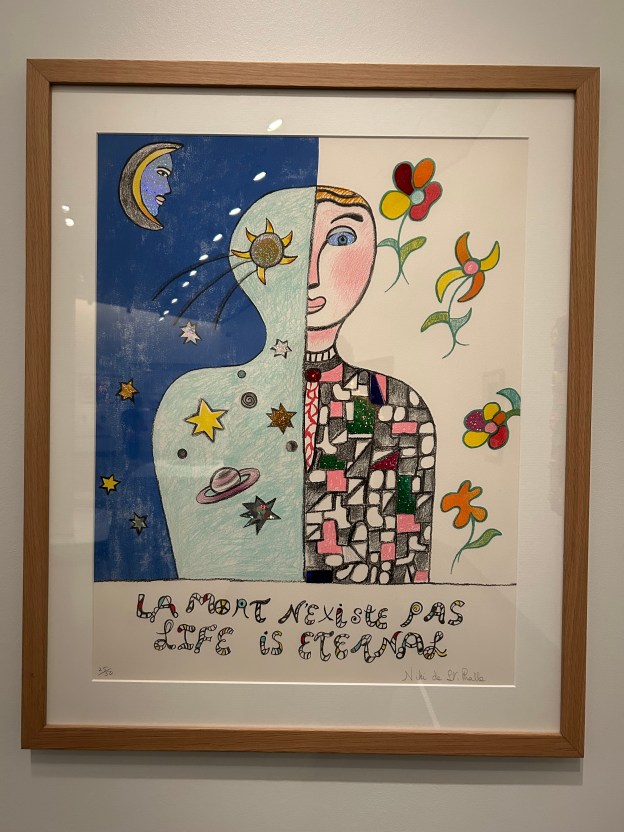
So then, perhaps what I appreciated the most about Niki de Saint Phalle’s later works was as much the longevity of their creation as it was their brilliant colors and joyous expressions. These are works which are meant to last so that generations of people will see them and perhaps in their forms feel a sense of their creator’s joy. I certainly felt that, even now 22 years after Saint Phalle’s death. I took one photo in the exhibit, of a color lithograph she made with a dualistic figure, on the one side with a human face and body and on the other the human frame surrounded by planets, moons, and stars. Beneath the dual figure Saint Phalle wrote in French and English, “La mort n’existe pas / Life is eternal.” I believe through our joy, no matter how childlike it may be, we can live on even after death. As St. Paul wrote, “Rejoice! Your kindness should be known to all.” (Phil. 4:4–9)


[1] Yes, there’s a great deal of problems with that new society’s foundations in the conquest and colonization of this continent.


Niki de Saint Phalle: Rebellion and Joy is on view in the Bloch Building at the Nelson-Atkins Museum of Art from 27 April through 21 July 2024. More information can be found here.

The Museum

This week, to round out Season 3 of the Wednesday Blog podcast, a few words about my love for museums. — Click here to support the Wednesday Blog: https://www.patreon.com/sthosdkane


This week, to round out Season 3 of the Wednesday Blog podcast, a few words about my love for museums.


I learned about our cosmos from visiting museums and reading books as a child. Where my books could thrill my imagination into creating whisps of wonders that would dance about my mind and keep me enchanted during the quieter moments, museums offered me the physical embodiments of many of those same wonders. The older Irish word for a museum is iarsmalann, or “reliquary.” Museums, the seat of the muses of the Ancient Greek cosmos, are where we house our greatest treasures today. They are places which the public can visit and learn about our human world and the natural cosmos it inhabits. Museums are seats of knowledge where we can wonder about a great many things that otherwise would not be accessible to us.

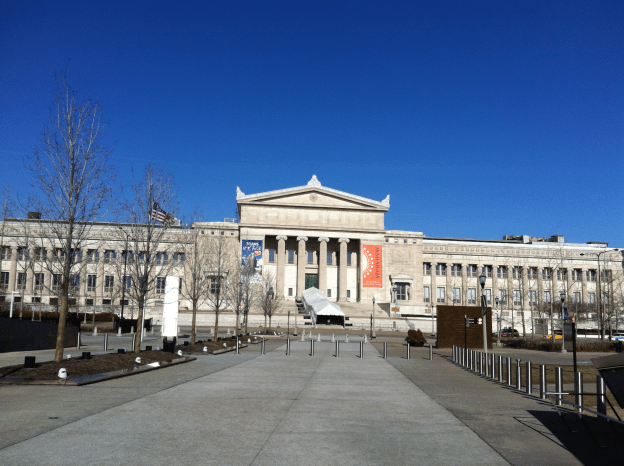
My favorite museums to visit are the ones I return to the most. From my youth, I loved wandering the halls of Chicago’s Field Museum and Art Institute most. In the acknowledgements of my dissertation, I will note that it was in the Field Museum as a small child that I first experienced wonder, and that that is where the passion, beauty, and joy that drives my career and my life today began. One of my last truly awe inspiring visits to the Art Institute was in January 2019 on the last day of the American Historical Association’s meeting at the Hilton on South Michigan Avenue. That afternoon as I wandered around the labyrinthine halls of the Art Institute, I was struck at how endearing I found the Early Republican galleries, rooms which previously I’d been frustrated by because I still have trouble finding my way out of them. I’ve returned to the Field Museum more in the following years both to wander the halls and to remember all the joyous times I’ve had in that building as a child, a teenager, and now an adult.

Here in Kansas City, my favorite museum by far is the Nelson-Atkins Museum of Art. When we first moved to Kansas City, 25 years ago this summer, my Dad took me to the Nelson in hopes of filling that role that the Field Museum had for me back in Chicago. As I grew and matured, I found myself returning to the Nelson more and more, seeing the same art each time sure, but more so appreciating the constancy of that art than anything else. In the last six years I’ve grown to love the Kansas City Zoo & Aquarium as well; perhaps the Zoo is a better equivalent locally to the Field Museum with its dominant focus on the natural world over anything else. I think of the Zoo like another sort of museum, a living and breathing museum situated in the expansive wooded grounds of Swope Park. One of my dreams is to contribute a museum to Kansas City, ideally a natural history museum where my own particular contribution would be in a History of Science gallery.

Elsewhere, during my year in London I fell in love with many of that city’s great museums. I became a member of the British Museum and would often walk there from class and spend my afternoons wandering and loving how much I could learn there. It was on these visits to the British Museum that I decided to do my doctorate in History or Classics; I settled on History as you know, though I ended up in the Renaissance in part because of my love for the Banqueting House on Whitehall and Hampton Court Palace, two expansive palaces now turned into museums by Historic Royal Palaces. Initially, I wanted to study Roman history and focus on how the concept of Roman citizenship expanded as the Republic’s and later Empire’s borders expanded outward from the City of Rome. Yet, I instead decided to settle in the Renaissance, a period that seemed to me to evoke some aspects of the idealized Rome that I thought of while still feeling closer to home. In London too I loved my visits to the Natural History Museum and Victoria & Albert Museum in South Kensington, two that I returned to on several occasions on this most recent, if brief, visit to the British capital in October.

The more I’ve traveled, the more museums I’ve visited. In many respects they fill certain roles which I set in my mind from early on depending on their focus. In Upstate New York, if I wanted to visit a natural history museum I would go to the Museum of the Earth in Ithaca or if I wanted to wander around an art museum for an afternoon, I’d go to the Rockwell Museum in Corning or the Everson Museum in Syracuse.

I’ve been fortunate to see so many of these places and experience the life we give them amid all the relics of our past. In more ways than I probably even recognize, these museums have inspired my career, and I hope that I may contribute a verse to their songs one day.