
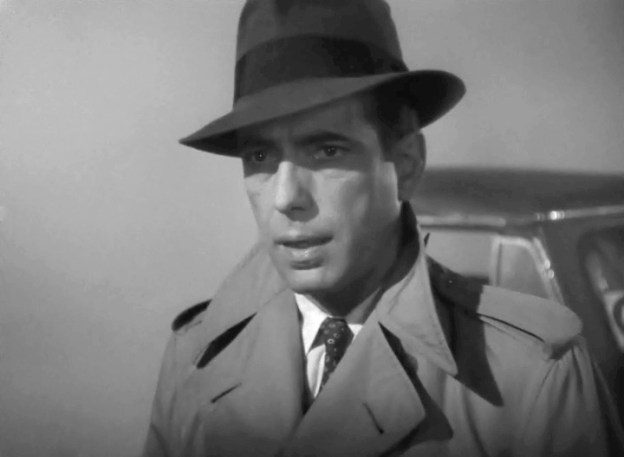

"Casablanca" at 80 – Wednesday Blog by Seán Thomas Kane
Listen to this week’s podcast for a conversation about Casablanca with Alex Brisson
Few films have held our attention for as long as Casablanca, a romantic drama filmed at the height of the Second World War telling a story yearning for America to remember it’s passion and enter the fray against the forces of evil. The story, now well known, is about an American café owner, Rick Blaine, in the Moroccan city of Casablanca, then a French protectorate under the control of the Vichy government. Into his purely neutral life walks an old love interest, Ilsa Lund with her husband the resistance leader Victor Laszlo.
Everything that could be said about Casablanca has likely already been said. So, what I’m going to say here isn’t anything new, there really isn’t any intervention that I can make into this particular discussion as my fellow academics would insist every bit of writing make. So, I’m going to point out a few things that I thought of watching the film, subtextual themes that I hadn’t noticed the first time I watched it a few years ago. That time, I paired Casablanca with a delightful French film titled Que la lumière soit ! (Let There Be Light!) starring Hélène de Fougerolles. They were an odd pairing I’ll admit.
Casablanca is set in December 1941 on the eve of the Japanese attack on Pearl Harbor and America’s entry into the war. It’s the last hour in the limelight of an isolationist America, an America that still around but has been forced into the shadows by our country’s leading role in the postwar world. I nevertheless found it interesting that the opening credits placed Casablanca the city less as a Mediterranean, or rather Mediterranean-adjacent port, but rather as a city on the map behind the opening titles on the far northwestern corner of Africa. Casablanca is a gateway for those seeking to leave Europe either to the west across the water to America or south across the Sahara to the remaining Free French and British colonies in Africa. This makes it clear that Casablanca is distinct from Europe, it’s exotic when compared to the port of origin and the destination of the travelers waylaid in Casablanca.
Amid all of them one such traveler who’s made a slightly more stable living than most, accepting the circumstances of his complicated situation in isolation amid many others of the displaced appears Rick Blaine, who’s found stability in his café after losing stability in his life at the German invasion of Paris and Ilsa’s disappearance all on the same day. The film’s central conflict is Rick’s internal struggle between the isolationism he’s adopted since Ilsa left him and he ended up a saloon keeper in Casablanca and the passion he once felt for Ilsa in the last summer of the age of optimism in 1939. Now that Ilsa appears with Laszlo, the embodiment of the resistance to Nazi rule in Europe, Rick is confronted by his lost passion for that cause. Ilsa is a reminder of the passion for liberty he once felt that left him on the run from the Nazis in Paris where they met in the first place.As with the first time that I watched this film in 2021, I now find myself pondering the message of isolation vs. passionately standing up for the causes one believes in. I know people who are leaving this country to escape all the troubles we inflict on ourselves. I’ve thought of it myself, but there’s that stubborn passion in me that won’t give up on America. Rick’s isolationism shows us how we can let bullies march into our lives and dictate orders to us if we let them if we try to simply survive. That’s a fair way to live, I dealt with bullies in school and life by not reacting to them. But at some point, a person can only take so much pushing around, and I worry that today in America we’ve forgotten that fact. Rick’s turning point comes when the Nazi officers bully their way into controlling the voice of his café, Sam’s piano, to play a march of their own, Die Wacht am Rheinwhich was written in response to French efforts to annex the western banks of the Rhine in the 1840s, a moment a century before when France was the great power and Germany still divided among its princes. Laszlo tells the band to respond to this insult by playing La Marseillaise, not only the French anthem but an anthem for the struggle of the people against oppression everywhere. At that point, Rick is no longer an isolationist, America is no longer on the sidelines, but is tacitly helping the Allies, readying to cross the Atlantic in the words of French philosopher Bernard-Henri Lévy like an Aeneas returning to the aid of old Troy.
 Wednesday Blog by Seán Thomas Kane