Tag Archives: PBS

On October Baseball

This week, a great celebration commences in our national pastime. — Click here to support the Wednesday Blog: https://www.patreon.com/sthosdkane


This week, a great celebration commences in our national pastime.


Several years ago, near the start of the podcast version of my Wednesday Blog, I wrote two of my favorite stories in this continuing publication of mine about my love for baseball at the beginning of the 2022 season. I seem to remember even playing a poor rendition of Take Me Out to the Ballgame on the digital keyboard provided on GarageBand, where I do all my recording and editing. Don’t worry, I’m not planning on doing that again.

Today, I want to write instead about my joy at how this postseason is beginning. The 2024 season had plenty of potential for my beloved Chicago Cubs and my adopted second-favorite team the Kansas City Royals, and while the Cubs didn’t quite make it far enough to earn a wild card spot, the Royals did in spite of themselves. This is being released on the morning of Game 2 of the Wild Card series, following a 1-0 Royals win in Baltimore against the Orioles. So, should the Royals win again today they will advance to face the Yankees, a matchup that brings to mind the stories my Mom likes to tell of watching the Royals teams of the ‘80s face up against the Bronx Bombers in the American League playoffs.

Meanwhile in the National League the team that excites me the most in these Wild Card series is the San Diego Padres, a perennial favorite of the last four years to win the World Series. Their resounding 4-0 win at home over the Atlanta Braves last night in Game 1 proved to be a good alternative to the Vice Presidential Debate that was occurring at the same time from CBS News’s headquarters in New York. You might think it odd that someone as politically engaged as me would choose to watch a ballgame over a debate, and yes, I started the 8 pm hour watching Governor Walz of Minnesota and Senator Vance of Ohio face off on CBS, but as soon as the first question concerning the increasing odds of war between Israel and Iran occurred, I decided to seek some escapism.

There are a lot of things that we all are worried about today, and with good reason. Whereas for most of my life I’ve looked to the future with eagerness, today I’m scared about the future and what we are doing to ourselves. Over the weekend, I watched an episode of the PBS documentary series In Their Own Words about Jim Henson in which he said his inspiration for creating his 1980s children’s television show Fraggle Rock was to make something that could inspire world peace. To paraphrase the visionary creator of the Muppets, Henson believed the best chance we have at solving our problems is to speak to the youth who aren’t already jaded by the weariness of life and are more willing to imagine a good future. He spoke to the inner child in all of us, a part of me that I’ve found slinking back from the foreground as the world seems evermore scary and dangerous.

Even when I don’t have a team in the playoffs, and let’s face it as a Cub and Royal fan that’s most years, I still religiously watch the baseball playoffs because I love this sport. It’s the sport my parents introduced me to as a kid watching Sammy Sosa, Kerry Wood, and the great Cubs of the late ‘90s and early 2000s skirt so close to the glory of winning the World Series in 1998 and 2003. It’s the one sport that I played with even the remotest success. It’s a sport that I shared with generations of my family that I understood, and today it’s a nice antidote to the weekends of American football, which let’s face it I get but still don’t really understand. Baseball is one of those core things that makes me feel more American, and one of the parts of American life that I missed the most when I lived in England.

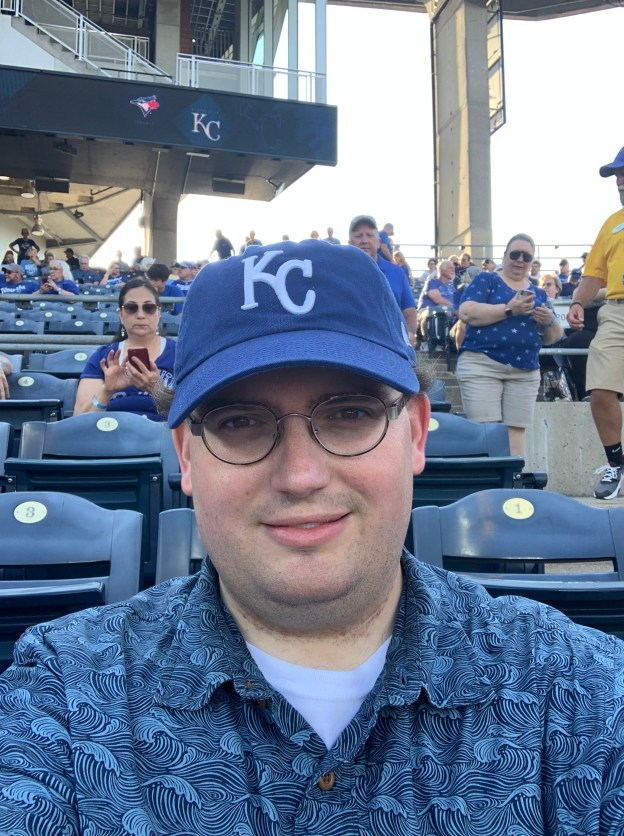
Locally here in Kansas City I feel that the Royals have lost some of their connection with the community in the wake of their failed bid to get a renewal on the stadium sales tax here in Jackson County, which would help them to fund a new stadium along Truman Road in the Crossroads neighborhood. I was one of those voters on the fence who wanted to support a downtown stadium but were really unhappy with the plan they laid out and repeatedly changed in the days and weeks leading up to the vote. Since the playoffs began, I found it harder to put on my Royals hat when going out. I’m having a hard time putting my faith in an organization that doesn’t seem to want to trust the city it represents. I hope this Royals playoff run, 10 years after their monumental and near triumphant 2014 run will revive some of that jubilation that I felt in Kansas City that year. I remember during the World Series that year driving down 47th Street in the Plaza and nearly everyone out walking down the sidewalks was wearing Royal blue jerseys and hats, and I even saw Commissioner of Baseball Bud Selig’s motorcade parked outside the Classic Cup Café at 47th and Central. I want to feel that kind of community spirit again in Kansas City, where the team and the city are open with each other and working together in a productive manner.

So, who am I picking to win the World Series this year? Well, even though we’re down to the last handful of teams, and even though I have a horse in the race this time around, it’s still too hard for me to say. I want the Royals to win again, that’s for sure, though were they not playing against the Orioles I’d be excited for Baltimore’s chances this year. In the National League though it’s a two horse race for me between the Dodgers and the Padres. While Los Angeles has one of the greatest baseball players of our time – Shohei Ohtani – on their team, the Padres have been red hot in the second half of the season, and I stand by my long held claim that the weekend I spent in San Diego in 2021 was one of the best I’ve had in the last few years. What I want to see most is amazing baseball that makes me want to watch the guys on the field play more and more and more; and by the end of this month to long for March and Spring Training.

Writing this tells me one thing for certain: even when I’m trying to celebrate something I love as much as baseball, the muddied waters of the world still appear, yet even then I remain hopeful of better tomorrows.
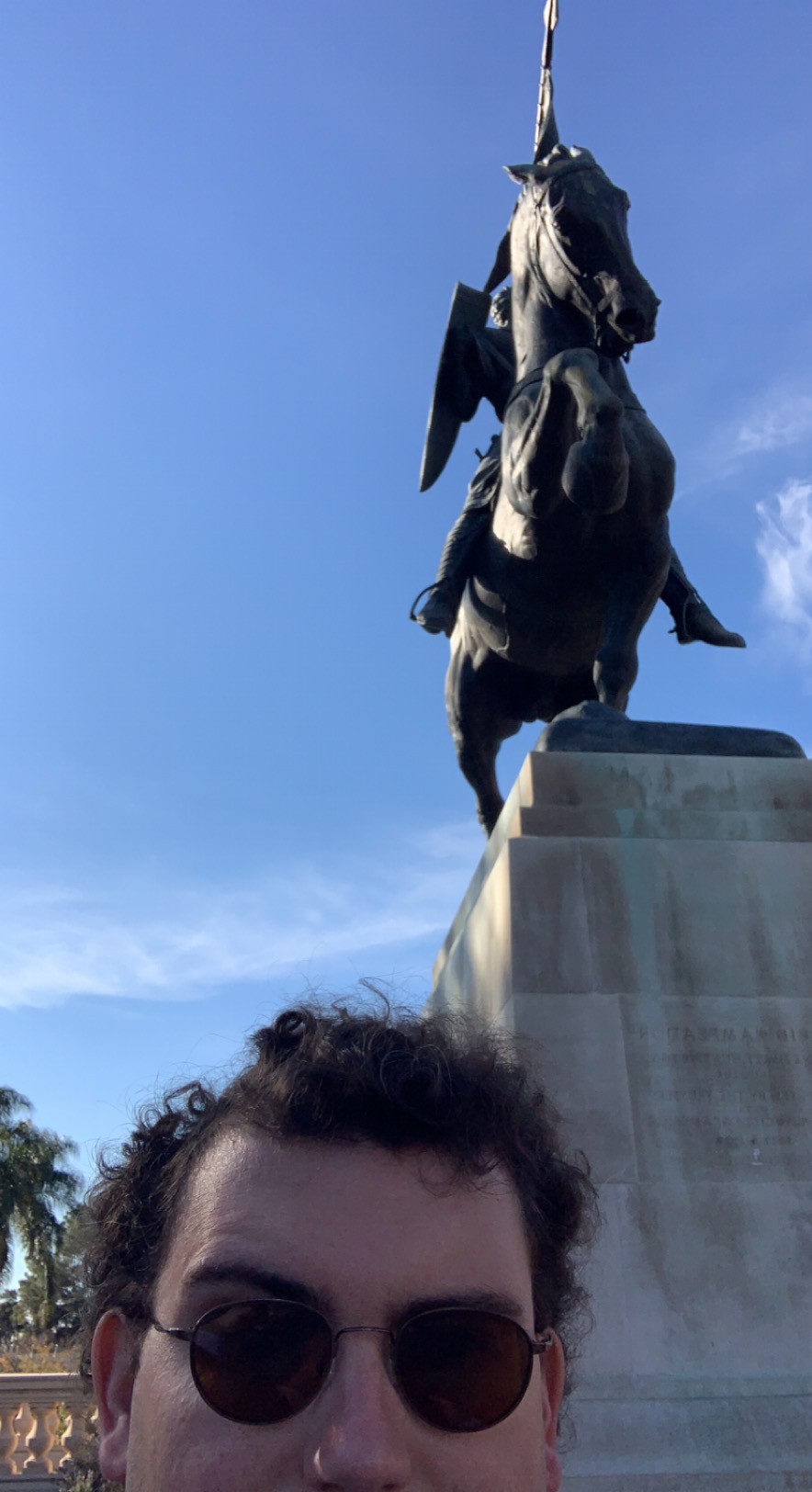
A selfie I took beneath the statue of El Cid in Balboa Park’s Plaza de Panama in San Diego on Halloween 2021.

Inferno

A while ago, I began reading Dante's Divine Comedy. So, over the next three weeks I will be writing my own reflections on each of its three parts. This week then, I begin with the Inferno. — Click here to support the Wednesday Blog: https://www.patreon.com/sthosdkane — Dante: Inferno to Paradise, https://dantedocumentary.com The Blues Brothers, "Everybody Needs Somebody to Love and Sweet Home Chicago," https://youtu.be/FrLZoQUl2mQ?si=g9rLDM6ZPM7tXJ97 Molly Fischer, "The Tyranny of Terrazzo: Will the millennial aesthetic ever end?", The Cut: New York Magazine, (3 March 2020), https://www.thecut.com/2020/03/will-the-millennial-aesthetic-ever-end.html Ian McKellen's performance in Macbeth "Tomorrow, tomorrow, and tomorrow" speech (5.5.17–28): https://youtu.be/4LDdyafsR7g?si=3qgAmsaKW6oKJKXq


A while ago, I began reading Dante’s Divine Comedy. So, over the next three weeks I will be writing my own reflections on each of its three parts. This week then, I begin with the Inferno.


Three years ago marked the 700th anniversary of the death of the great Italian poet Dante Alighieri, the author of the Divine Comedy, whose Tuscan dialect is widely regarded as foundational for the modern standardized Italian language taught today. I will write at length about language standardization in the future, if I haven’t already, yet today, dear Reader, I wish to address his Commedià itself. Around the time of his great anniversary, the Center for Medieval and Renaissance Studies (CEMERS) at my university held a variety of lectures concerning Dante. In one such instance, I became critically self-aware of the fact that I was likely one of the few people in the room who had not read the work.

I finally got around to reading the Commedià in the last month when a new two-part documentary on the life of Dante aired on PBS. I realized then that even though I hadn’t read his magnum opus, I still knew a great deal about it because of how closely tied it is to my Catholic culture. The concepts of Hell, Purgatory, and Heaven as I grew up understanding them have clear support from Dante’s vision of these three realms. Yet like Dante, my own vision of these three is just as drawn from far older classical and biblical sources. He recognized the importance of connecting the beliefs of his own age with those that they replaced.

This is a point I made in conversation with a friend and fellow historian: Dante was a man of his own time. In his moment, it is fitting to see the great classical heroes, philosophers, and poets resting on the outer most layers of the Inferno because they had no introduction to God during their lives. Even more unsettling is his placement of the Prophet Muhammad within the eighth circle’s ninth bolgia as one of the “Sowers of discord.” Again, this fits in Dante’s own time and place, living at the same time as the Crusaders lost Acre in 1291, nine years before when the Commedià is set.

The Inferno is proof of four great truths which I wish to discuss in the remainder of this week’s post. The first of these is that faith often requires trust in more tangible things that one can see and touch and most importantly imagine. This past weekend on Trinity Sunday, I was moved by how my pastor––Fr. Jim Caime, SJ––described his relationship with the Trinity in his own prayer life. I believe in the Trinity, though what draws me towards that belief at this moment in my life is an appreciation for the mystery of the Trinity. It’s funny there, I appreciate the mystery of the most important doctrines of the faith yet when it comes to things that are more tradition than anything else, my faith is still built on a foundation that is strikingly tangible in its nature. At times I’ve thought that superstition might stick with me more because it’s something that is more tangible and everyday than some of the more metaphysical elements of my Catholic faith. Faith needs to be lived in “to live, thrive, and survive” in the words of the great Elwood Blues.

Second, I’m not a fan of iconoclasm. Culture is built by individuals yet adopted by communities. We live in a present moment which is layered upon the past. In those layers we can see bygone moments, years, decades, generations, centuries, millennia, and ages when our past thought something they made was worth cherishing even for a moment. Everything from the eternal grace of the great monuments of human endeavor, and our striving for greater truths is just as central to these ringed layers that form our culture as are the passing fads that come and go year by year. An article I read over the weekend in New York Magazine‘s style outlet The Cut about the millennial aesthetic that has defined the tastes of my generation in the last decade asked if “the tyranny of terrazzo” will ever end. The article concludes with a foreboding of the dominance of bright yellow among the style choices of our successors, Generation Z. I for one felt a similar sense of dread the last time I went clothes shopping at Target only to discover everything in the menswear section was geared to younger generations than my own. I continue to shop at Macy’s when I’ve gotten a nice paycheck and Costco when my parents are around with their membership.

If you’ll pardon that digression, the iconoclastic spirit would burn down the terrazzo of my generation’s invention and inspiration and would replace the soft hues with new and reactive bright colors. It would respond to decades of slow burning negotiation and working within the status quo with a fierce clamor to fight and resist even if the odds aren’t in your favor that your resistance will do you any good in the long run. I’ve been there and found that sort of thinking didn’t accomplish much and so settled for Dr. Franklin’s approach to change, make friends with as many people as possible and nudge them to do things you think important. In this light, my vote tends to be cast for more moderate candidates than my own views, and I’ll freely admit my own views on issues have changed with my own changing sense of frustration and irritation towards others whose voices are perhaps projected louder than necessary through social media.

So, I appreciate how Dante kept the voices and spirit of the pre-Christian past alive in his Inferno, that he was guided by the great poet Virgil, whose Aeneid I became quite familiar with in my senior year Latin IV class (Grātiās tibi agō, Bob Weinstein). It never seemed strange to my faith that the old faiths of Europe or any other religions could also exist within our understanding of Heaven, Hell, and all the rest. Again, Dante was a man of his time and his place, so to fit in the great heroes of Ancient Greece and Rome into his vision of the afterlife is only natural. Iconoclasm only harms us and our posterity by robbing all of us of the riches of our past and the finest parts of the great human inheritance. The iconoclast’s tradition to destroy what came before will only lead to their own destruction in turn by their posterity. Third, as powerful some may be in life it is the writers who will preserve their memories for eternity. Chaucer and Dante both preserved the memories of their enemies in a way that has led to the survival of those men’s names. Yet their names are not spoken kindly, so the world would do well to heed the power of the pen. They can live long beyond their memory ought to have otherwise. While more ancient stories began and lived for generations told orally and remembered from that recitation, we now in our learned state require things be written if they are to be remembered. In Shakespeare’s words, written for the Scottish King to utter upon news of his wife’s death:

She should have died hereafter;

There would have been a time for such a word.

— To-morrow, and to-morrow, and to-morrow,

Creeps in this petty pace from day to day,

To the last syllable of recorded time;

And all our yesterdays have lighted fools

The way to dusty death. Out, out, brief candle!

Life’s but a walking shadow, a poor player

That struts and frets his hour upon the stage

And then is heard no more. It is a tale

Told by an idiot, full of sound and fury

Signifying nothing. (Macbeth 5.5.17–28)

The writer helps human memory survive long after each generation is gone. Before our carbon dating or genetic coding of the remains of beings now dead, writing remains the original technology by which we recorded our nature and taught our learning, and dare I say our wisdom, to those who come after us.

Fourth, I admired how Dante cast himself as both observer and listener to the plight of the damned. In every circle he chose to stop and ask the souls he encountered their names and to tell him about their lives and why they were where they ended up. This more than anything else is a model we ought to emulate, as I’ve written before here, we ought to listen to each other more. I believe this would solve a fair number of the problems we face in our lives. Pope Francis’s message from the balcony after his election eleven years ago echoed this sentiment when he simply asked that we pray for him as he began this new ministry in his life. This is something that I want to get better at; I am so used to my own solitary company that I often have to consciously remind myself to make smaller gestures of gratitude toward the people around me.

Dante often offered to speak to the loved ones of those who he recognized on his journey through Hell or to pray for their souls. Yet where I saw the greatest pity was at the bottom circle when he beheld the three great traitors of his world being devoured by the heads of the Devil: Judas Iscariot, Brutus, and Cassius. After reading this Canto, I wondered if the Inferno were to be written by an American who might be our three great traitors? Yet here my own beliefs divert from Dante’s, as I find it distasteful to say with any authority what the spirituality of anyone else might be.

I recently finished listening to the most recent Star Was anthology book From a Certain Point of View: Return of the Jedi which is a collection of stories told from the perspectives of minor characters who appear in the film in question. One of the last stories was the main one I was looking forward to the most. It was from the eyes of Anakin Skywalker after his redemption from 23 years living under his evil alter ego as Darth Vader. What struck me here was that despite everything Anakin did in his life, the Force and his best friend Obi-Wan Kenobi, whose force ghost beckoned him into the next life, forgave him. I don’t claim to have any authority over whether one person or another ended their life in one state or another because of the power of forgiveness. Forgiveness is a deep expression of love that we ought to express and inhabit more. Forgiveness it isn’t something that necessarily came naturally. Most of the bullies I faced in my childhood got a silent response from me later in life. I’m not proud of how I’ve reacted to certain people and situations in a way that echoes my own fear and anger, because I know I can do better. Fear isolates us from love, after all.

As I continue reading, I’m eager to see how Dante grapples with forgiveness and with the love that fuels it. I for one am eager to climb from the depths of Hell alongside Dante and Virgil onto the slopes of Mount Purgatory, a cantica which I expect I might allow myself to read in my usual pre-bedtime hour. I chose to spare my dreams of the Inferno, figuring I give myself enough nightmares of my own invention as it is.

Next week then, I will write to you about the Purgatorio and Dante’s climb towards the climax of his literary life.


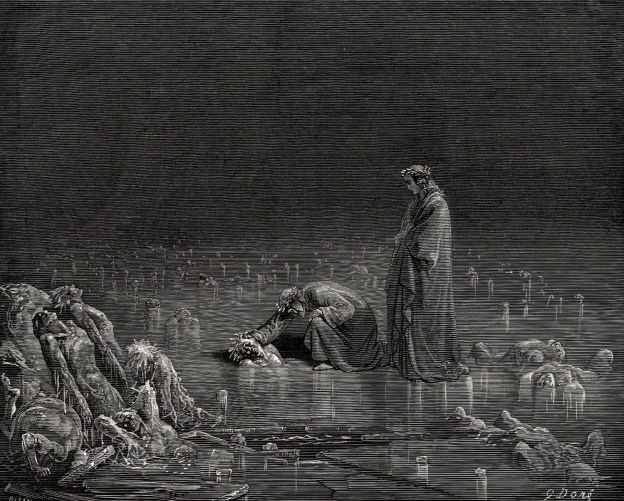
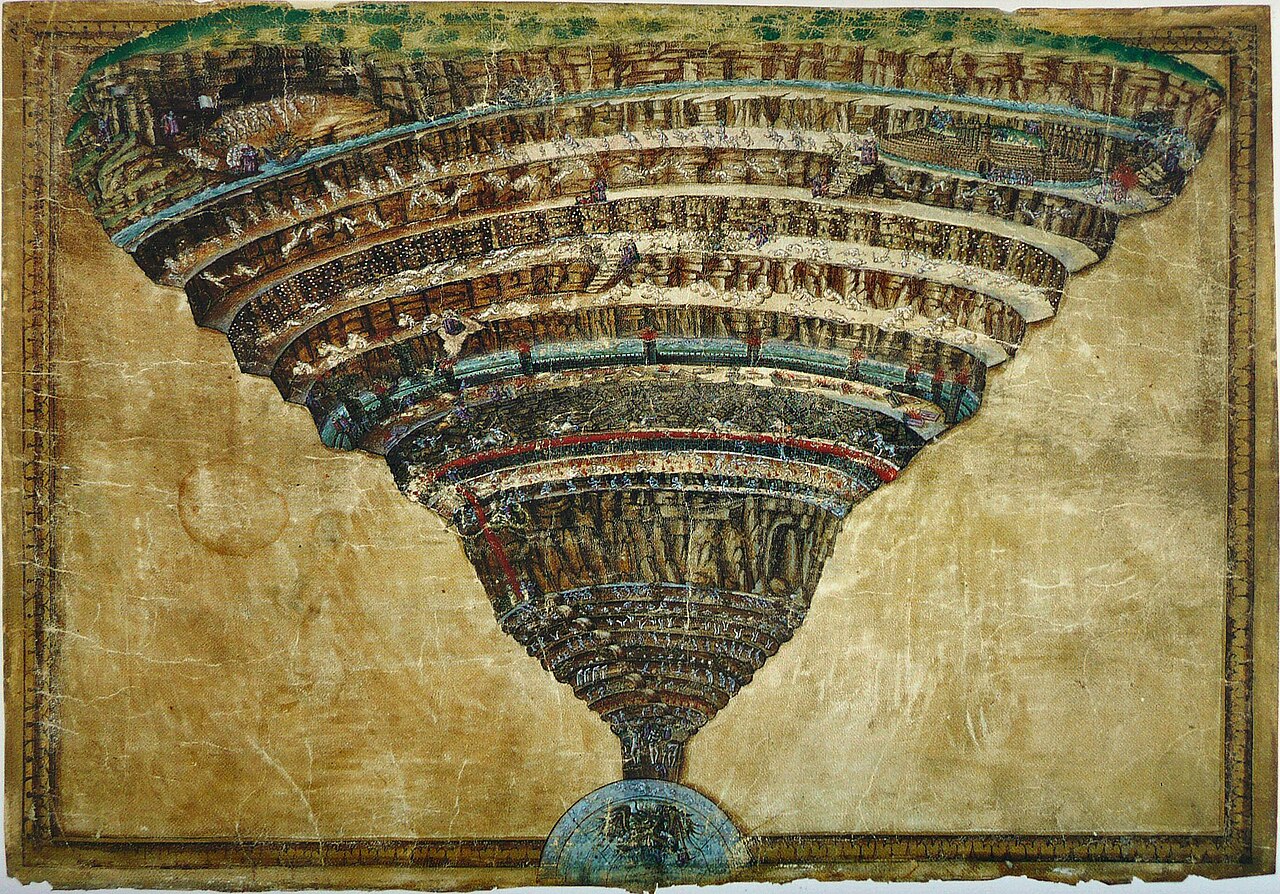
Dante’s vision of the circles of Hell.

Teaching as a Performance

This morning, in an effort to get out of a funk born out of a mix of exhaustion and burn out after a long semester preparing for my comprehensive exams, I decided to watch the Mozart episode of Scott Yoo’s series Now Hear This, which has been airing as a part of Great Performances on PBS. In the episode, Yoo worked with pianist Stewart Goodyear to learn how to not only play the solo part in Mozart’s Piano Concerto No. 20, but to do so while conducting the orchestra as Mozart himself did when he performed that concerto in 1785. Watching Yoo and Goodyear work together on this performance got me thinking about my own work as a performer, which nowadays is usually through my work as a teacher.

At its core, the reason why I love teaching is because it’s purely a performance. Like actors and musicians, teachers have as much need to keep their audience entertained and connected to the topic of their performance as they do to transmit the content they’re teaching. All of the best teachers I’ve studied under in my 24-25 years as a student have gotten this fact down in some way or another.

To put this into context, when I teach on Friday afternoons, I have to put together an hour long performance that covers the content while making that information engaging. This means less reliance on notes and more extemporaneous dialogue with my audience, in this case my students.

I’ve found the best thing I can do at the beginning of any performance I’ve given, whether it be as a teacher, a musician, or an actor, is to try and connect with my audience, make it clear to them that I’m on their side, and that I can understand what they’re going through. This means, among other things, incorporating humor into my teaching, and acknowledging that they have other responsibilities than my class and my requirements for them should bear that fact in mind. For example, normally I have my students answer a set of weekly discussion questions. It’s a good way to make sure they come to class prepared to talk. That said, on weeks when they have a bigger assignment like an essay due, I’ll make sure to waive the regular discussion questions so I’m not giving them too much work.

Currently at Binghamton for the Spring 2021 semester, I’m teaching 2 classes of about 25 students each. It’s a decent number to handle, especially when it comes to grading, but considering at my last university I was teaching 2 classes of 35 students each, it’s not nearly as taxing. What is a bit more hard on me as a performer is that at Binghamton both of my classes are always back-to-back on Friday afternoons, meaning I have to turn around after the first performance and do the entire thing over again. It’s a huge challenge, and normally by the end of the second class I’m physically and mentally exhausted.

All that said, the challenge of creating a new show every week, and doing everything live is something I love. Having done pre-recorded shows like The Awesome Alliance, as much as I enjoy the security of playing my part ahead of time and not being around when my audience sees it, the thrill of performing isn’t as strong in that sort of a setting. That said, where a live performance differs from a pre-recorded one in my experience is in my own ability to really live in the performance. In a live class, I have to be present in the moment with my students, paying attention to their answers as well as their body language, making sure what I’m trying to teach is coming across. In a pre-recorded performance, like on Awesome Alliance, I’m more able to let myself live fully in my performance, in that case to become my character, something that is less readily feasible in teaching than in acting or music.

Improvisation is equally hugely important in my experience. I always have a lesson plan, usually revolving around my discussion questions which I provide ahead of time to my students. But beyond that, in the context of actually answering those questions, everything hinges on the unknown factor of what the students will say, how they’ll answer the questions, and then how I’ll respond to their answers. These are supposed to be discussions, focused around a particular topic but dependent as well on the individuals involved and what’s most present in their thoughts.

All of this relies on a great degree of being comfortable in your own skin. I know I’m going to make a fool of myself from time to time while teaching, it’s just a fact of life. But if I can explain a historical concept in a way that’s going to meet my students where they’re at, then I’ll find a way to do it. Last Spring, when I was TAing for a US History class, I was given a version of the Battle Hymn of the Republic written by Mark Twain to discuss with my classes. Not finding a good recording of it with the exact words of the version the professor had given me, I decided to go on a very big limb and sing it myself, after all I know the melody line pretty well.

I could’ve never begun to perform without being able to laugh at myself, and accept that in performing I am inherently putting myself out in front of people. The confidence that has allowed me to do this as an adult really began when I was in high school, when in my Junior Year English class, I decided to tell a couple jokes in what was otherwise a somewhat awkward presentation where I had to show a baby picture of myself to the class. I ended up bringing a picture of a very large and old tree on the grounds of Canterbury Cathedral with myself at age 9 just barely in the bottom of the frame, shrugging and saying “it was the best I could find.” Like Julie Andrews’s Maria in the Sound of Music, it’s great having “confidence in me.”

The Luxury of Stress, or the Adrenaline Rush of Fear

2020 began for me with a long drive east: Kansas City to Pittsburgh to New York. I drove the first leg in 15 hours, arriving just before midnight on a Friday, and spent the next day wandering through the Carnegie Museums of Art and Natural History in Downtown Pittsburgh, which was the main reason for that particular stopover. That Sunday however was characteristic of how the year that this would become. I woke up around 4 am on Sunday, early enough that I hoped I could be in Manhattan for lunch. As I made a quick donut stop near Pittsburgh Airport, I checked the travel updates for the Pennsylvania Turnpike, and was shocked to discover that it was blocked in both directions just east of Pittsburgh due to a fatal multi-vehicle accident that had happened about an hour before. So, realizing that I’d have to take an alternate route, I plugged one into the navigation system in my car and made my way into one of the most eventful days of driving in my lifetime.

The route on that snowy Sunday morning in January

For the first 3 hours of the 6 that I’d have to drive that day, I was largely on US-22, a smaller rural highway, which heads east out of Pittsburgh across Pennsylvania toward the Jersey Shore. Normally I prefer to stick to the interstates for the lack of stoplights, and at that hour of the night for the lack of traffic. In this instance though I quickly found myself crawling my way across the Appalachians in a blizzard with next to no visibility. I passed semitrucks that were sliding backwards down the inclines on this normally reasonable, yet now snow-packed, highway. I’m pretty sure I passed a plow or two even, continuing onward, only really able to see where I was going thanks to the car’s navigation. Only after 7:30 am or so did the snow clear and I was able to enjoy an otherwise uneventful drive to the long-term parking garage that I frequent near Newark Airport when I drive to New York City.

Like the rest of 2020, thus far, I was nearly stressed to my limit in the early hours of that morning. This year has been one for the record books, a right old annus horibilis to borrow a term from the Queen. At the same time that I was dodging stuck semis in the Pennsylvania mountains, this country’s leaders were saber-rattling and threatening war with Iran. We were lucky to have missed that cataclysmic fiasco of a war, though I doubt we’ll know the full details of how we missed it for a few years to come. Since then we’ve seen the rise of the greatest pandemic in a century, a near economic depression, irate armed citizens occupying government buildings over their economic and social fears, the murders of many other citizens of this country by authorities, and the largest protests this country has seen in a long time. Throughout all of this, the response of those in charge hasn’t helped to ease tensions one bit, both publicly and privately for a great many of us.

Yet unlike that early morning in January, I now feel like I have the luxury to think about it, and to stress about it. That morning, I did not have that luxury, or perhaps I had too strong of a fear-driven adrenaline rush to stress about it. After all, if I thought too hard about how terrifying of a situation I was in, I would’ve made a mistake and gone off the side of the road, not knowing what that’d bring: a field, a hill, a house, the edge of one of the mountains? If I’d let my stress take over then, I can’t be sure I’d be able to write this today. Yet in the months since I’ve been largely secluded from the world, first in my apartment in Binghamton, NY, and for the last two months in my parents’ house in Kansas City, MO. Like all of us, I’ve had a lot of extra time on my hands to think, to consider how I want my life to go forward, and to stress and worry about our world, and how it’ll either improve or wreck our future.

The stress has certainly got to me, and there have been more occasions than usual of late where I’ve had real trouble working through it. It’s left me irritable, quick to anger, and generally in a sour temper. I could probably take all this sour stress and make one of those sourdough starters that so many people started doing this Spring. I’ve always found it hard to hear the memories and feel the emotions of the best days of my life over the obnoxious clamoring of the worst memories. Lately it’s been harder than ever, but I’ve tried my best to cherish the best moments of my life and my time at home. 

This past weekend in particular had so many wonderful moments. On Friday, the executives at my Mom’s company decided to give all of their employees Juneteenth off. So, that morning for the first time in at least 21 years my parents and I together went to the Zoo. When I was little, I loved going to the Brookfield Zoo near our home in suburban Chicagoland with them and have cherished those memories ever since. Now, after living in Kansas City for 21 years, we finally went as a family to the Kansas City Zoo, a place that I usually visit at least once a week on my own when I’m home. We didn’t see everything we wanted to see, but we left truly happy. 

The Kansas City Zoo’s new Elephant Expedition Enclosure. The photo is my own.

Later that evening after dinner we drove up to my alma mater Rockhurst University at 52nd & Troost and took part in the Juneteenth Prayer Service that stretched for 10 miles all along Troost. This was a prayer service like no other, less silent meditation, or communal rosary, and more a celebration of the hope that our community on both sides of the dividing line feels that change is in the air. I sat there on a stone wall for an hour and watched as countless cars drove by, their drivers honking their horns, people waving, children singing from the back windows.

On Saturday we went to one of my aunt’s houses for a small backyard gathering. I always treasure the times that I have with my family, the whole crowd. Just sitting there with people whose company I enjoy, people who I’ve known my whole life, and experiencing the madness of our current world from the perspectives of their stories, jokes, and worries made everything seem better for a little bit. Sunday was similar, Father’s Day, a quiet celebration this year at home with my parents. My Mom and I made brunch for the three of us, brioche French toast and eggs, before spending the afternoon watching soccer and reading June’s National Geographic. This was followed by a quiet small gathering in Roanoke Park.

I was reminded of all of this, and in particular of that terrifying snowy morning on US-22 east of Pittsburgh on Sunday evening when we watched last year’s release A Beautiful Day in the Neighborhood, starring Tom Hanks as Mr. Rogers. In part, the film’s Pittsburgh setting triggered those memories, and my thoughts on that January Saturday evening that I’d live in Pittsburgh if I got a job there, and how much fun I had at the Carnegie Museums. Yet more than that, the kindness which Mr. Rogers exuded in his life and work reminded me that this stress doesn’t have to be permanent, and that the best of memories should be the ones I treasure. I can still vaguely remember seeing him on WTTW in Chicago in the ’90s, and even a little bit on KCPT after we moved here to KC at the turn of the millennium. At the time I don’t really remember knowing what to make of the guy. Yet today, as an adult with far more responsibility to my community, our future, and to myself, I feel like if I were to try to learn from anyone in my own work as an educator, it’d be him.

“The Story of the Jews”, Simon Schama’s Masterwork

Kansas City – When I first read that PBS would be broadcasting a new Simon Schama documentary, happy memories came to mind of his only pervious work that I have had the pleasure of seeing, The Power of Art. His latest documentary, which Andrew Anthony of The Observer also called “his greatest” was simply sublime storytelling. The series, which runs in 5 parts, covers Jewish history from the earliest instances in the archaeological record of there being a Jewish people in the Near East to the modern struggle of identity for those residing in Israel and Palestine, though where Israel ends and Palestine begins has been a matter of some confusion for a few generations now.

Image

Courtesy of the BBC.

As a historian-in-training I found Schama’s style of telling the story of his own people to be inspiring for my own goal of eventually telling the story of my own people, the Irish diaspora. Schama’s reasons for studying history as a profession, because “We are our story,” we are the source of the history that we, as historians, study. This is almost word for word my own chief reason for studying history. That is something that Schama seems to connect to with his latest documentary that many other historians fail to see, that history is nothing without being an inheritance from the past to the present. Schama’s way of telling the story of his faith made me, an Irish Catholic American, feel as though not only could I understand some elements of the Jews troubled history, with both of our peoples often being at the receiving end of some bigger power’s brutality, and with his frequent remarks on the Jewish sense of humour developed through centuries of oppression and exile. Yet, despite these, and many other, commonalities, the story that Schama tells is very much a Jewish one. The very fact that the Jews have made it through all they have is testament not only to the existence of God but also to the tenacity of the human will to survive.

Schama is at times whimsical bringing the viewer into his personal life at the synagogue and at the annual Seder, whilst at other points he brings the viewer into the darker, dolorous parts of what it means to be a European Jew in a community that is now a mere shadow of its former self. His visit to Lithuania, his family’s homeland, is one such moment. A particularly poignant point came when Schama proceeded to explain just how the Lithuanian Jews in a particular shtetl were rounded up, tortured, and killed en masse by the Nazis during the Holocaust. Likewise in its poignancy for me was the intense description that Schama used to conclude his telling of the story of the expulsion of the Jews from Spain by Queen Isabella, more famous today for sending Columbus to the Americas. He recounts how the Spanish king ordered his Christian subjects, “Not to harass or disturb the Jews in the process of packing up and selling off synagogues, and lands, and possessions. Get them out of here in peace and as quickly as possible, to which you want to say ‘How very considerate.'”

What sets Schama’s documentaries and books apart from many other historians is how dedicated to his work he has become. Especially in the case of The Story of the Jews, where Simon Schama invites us, the viewer, to join him on a journey into his own family history. It’s an invitation that I would highly recommend be accepted.

To watch Simon Schama’s The Story of the Jews online in the United States, please click on the following link.