
Tag Archives: Phaëton

Author vs Writer

Today, on Chiefs Parade Day, I thought it'd be interesting to consider the distinctions between an author and a writer. Click here to support the Wednesday Blog: https://www.patreon.com/sthosdkane

Recently I noticed when someone referred to a guy as “the author of x”, in my mind I thought about what it means that they were called “the author” and not “the writer.” This whole question came to me considering that in Irish, I’d introduce myself with “Is staraí agus scríbhneoir mé,” or rather “I’m a historian and a writer,” and the same goes in French « Je suis historien et écrivain, » yet in neither context would I introduce myself at a party as “I’m an author.” Both words have their origins and similar yet separate meanings in every language, and that distinction is worth noting.

Author comes to us from the Latin auctor via Old French autor, it’s a cognate of the modern French auteur. The Irish version of this, údar also comes from the Latin auctor, demonstrating that the core idea of an author may well have spread northwards with the Romans. On the other hand, writer is an inherently English word, a writer is most fundamentally someone who writes. I like words that make their function this clear, words that are built off of the verb that they accomplish. When I’ve thought about trying to emulate Tolkien’s work it’s been less to create my own massive legendarium of fantasy literature and more to devise new ways of understanding the world through constructed languages like his own Quenya and Sindarin. In those thought experiments one of the key principles, I’ve wanted to address is crafting a language where there is a relatively small vocabulary because every word is a stem upon which one adds grammatical endings to make it a noun, adjective, verb, or adverb, or to include prepositional elements to it. This is something you see in older languages like Latin with its declensions and conjugations or in Finnish with its 14 noun cases. So, these simplest of English words like writer that demonstrate what they do as efficiently as possible are among my favorites.

Author too in its Latin origins was a word like writer. An auctor is someone who increases or nourishes their object (augeō in Latin). In classical literature the story comes from the muses, In the Loeb translation Ovid began his Metamorphoses acknowledging “my mind is bent to tell” the stories that will follow, for “ye gods, for you yourselves have wrought the changes, breathe on these my undertakings, and bring down my song in unbroken strains from the world’s very beginning even unto the present time.” (Met. 1.1.1–4) Shakespeare picked up on this in his reading and began Henry V with the chorus uttering the line 

            “O, for a muse of fire that would ascend

            The brightest heaven of invention!” (Henry V, 1.0.1–2.)

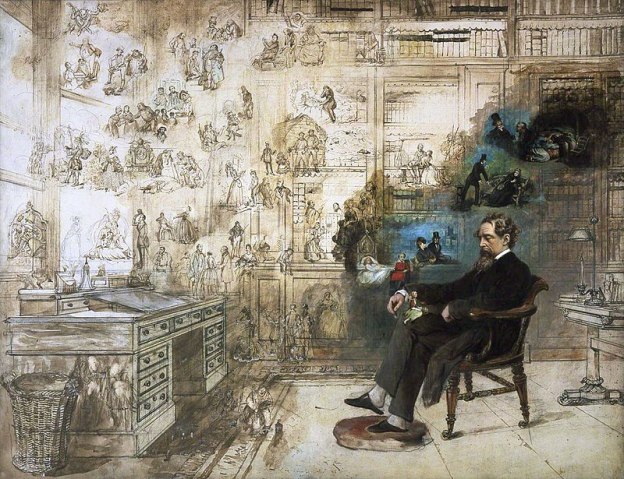
In my mind an author is both someone who has received inspiration for their work and an active participant in the creation of those works. There is a wonderful print of Dickens dreaming at his desk with all his myriad of characters he nourished into existence in his stories floating about him. I sometimes wish that this is the way that I’ll be remembered, as a storyteller who crafted so many lives that while they only exist in my writings therein is encapsulated a little world, an imagined reality all its own. In this act of creation, I am an author, but I am also a writer, for it’s my job to translate these worlds from my imagination onto paper where others can experience these characters’ lives.

A writer is a craftsman busy in their workshop devising new ways of getting information across. They could be writing serious factual information, reports of the events of the modern world, or setting the scene of stories more fantastical than anyone before could’ve imagined. I think of Dr. Franklin in his printing shop as the archetypal writer his sleeves rolled up hard at work, a stark contrast to the image of Dickens asleep in his chair dreaming of his many creations. Yet we rarely have authors without writers anymore, they are of course more often than not the same person, still in older times there were stories that existed without the written word. The Gaelic file tradition which I hope my own stories can be worthy heirs to is one such form of authorship beyond the boundaries of the written word.

So perhaps I don’t like to introduce myself as an author because of the world-building implications of authorship. Day-to-day I am a writer, a craftsman of words, scrawled onto paper, typed into a computer, and printed onto the page. I am an author of some stories, there are characters you’ve met here on the Wednesday Blog like Dr. Noël Felix and Captain Amelia Daedalus from a few weeks ago. I hope to get back into writing more fiction again in the coming months and years, to telling those kinds of stories. Yet perhaps because my authorship is so much more personal than my craftsmanship as a writer, I am left preferring to keep my creations closer to my chest and instead hold my craft out for all the world to see.


Phaëton: A Short Story

It hung over the streets and steeples of Kansas City like a great dark cloud, the many neighborhoods and suburbs looking up at it in awe. It had been said by some that the airship Phaeton was over a mile from bow to stern, but many could not believe such a craft could ever take to flight. And yet here it was, towering over nearly half a million pairs of eager eyes, who looked up at her underside with a mix of fear and wonder. All were running out into the streets to behold the sight, businessmen and artists, cabbies peering from within their charges and clergy praying to their God at such a magnificent sight. There were scholars and vagabonds, sportsmen and aviators, soldiers, sailors, and marines on leave, politicians and pensioners, inmates and the invalid all looking upward at the great edifice in the sky. From 33rd to 54th, the city was clouded by the shadow of Phaeton, the greatest wonder ever built by human hands.

         Out of his home on 55th near Main, still in his slippers ran Noël Felix, a lecturer on transportation and public efficacy at the University of Kansas City. He was in awe of the sight that rose high above his home, the great sign of humanity’s technological achievements, which only a decade prior had been considered too fantastical to even be allocated probability within the modern imagination. “He’s done it!” cried Noël, “Captain Daedalus’ ship flies!” It was certainly an amazing start to a quiet Lenten Friday.

         Alongside the lecturer, out in 55th Street, the many residents of the neighborhood clamoured and shouted praises to the world-renowned Captain Daedalus. It was said that he was the first person to land on both poles without stopping to refuel, the first to bring much needed humanitarian aid to the people of North Korea, the first to arrive on the summit of Mount Everest from above rather than below. Daedalus was by far the most renowned figure of his time.

~

There was a certain air about him, he did seem both kind and boastful, but not to much more than a degree expected of a man who was the conqueror of the last great terrestrial trials facing an adventurer. He had been welcomed with fabulous balls and galas in every city he visited. No less of a welcome would he receive upon arriving in the Paris of the Plains, whose artistry and musicianship were renowned throughout the world. In the great hall of the Performing Arts Centre, a great ball was held in Daedalus’ honor in the evening of 31 March 2012, the Saturday following his arrival. All the great figures of the Metro were invited, the rich and famous along with those of high moral and social regard as well.

Nöel had spent the greater part of the day allocating a good evening suit for the occasion, for he was not often accustomed to wearing black tie. He arrived in the Arts Centre to hear some light chamber music being played by the house orchestra; largely at this point it was Mozart and Haydn. Upon arrival he was presented to the mayor, Edward Johnson, who had personally invited all of the guests. “Welcome, Mr. Felix,” he said, shaking the lecturer’s hand, “I trust your father is well?”

“He is,” replied Noël with a polite smile, “he sends his regards to you and your wife.”

“That’s very good of him,” said Mayor Johnson as he turned to converse with Walter Gregson, the famed industrialist and philanthropist. Noël gave a slight bow to the mayor and then turned and walked about the great hall. He was dazzled by the beautiful brilliance of the hall, its amazing use of glass, steel, and marble to allow for light to flood through its great open chasm that stood between the theatre that was home to the opera and ballet, and the concert hall that was home to the orchestra.

He began to walk up the stair that led to the mezzanine level of the concert hall, observing the beautiful blue shades that surrounded him. It felt as though he were walking on an aquatic azure cloud, which rang with the beauty of the music from the hall below. The swirling sounds of the strings and woodwinds mesmerized Noël, and he leaned against the wall, his breath becoming the chief function of his body, as he let the music consume his senses. The very nature of the sounds that flooded into his metaphysical soul through the all-too physical existence of the ear were enough to make even the hardest of hearts relish in the exuberance and beauty of this nearly angelic artistry.

Noël had always loved Mozart, but his life had taken him far from his youthful aspirations of soaring high above the mundane in a realm of celestial beauty, far down to laboring over improving the roads and railways of America, forming what he hoped would be a better infrastructure for posterity. And yet, despite his career bearing him amongst those who are all too fond of cynical pessimism, he retained some degree of his youthful optimistic imagination, a trait which had earned great accolades for the once time pianist turned civil engineer.

Suddenly, the music picked up, a trumpet sounded in one of the higher galleries that led to the highest levels of the theatre. All eyes turned towards the grand staircase that led up to the hall from the foyer below. Noël rushed to the edge of the balcony on which he stood, peering down as a figure robed in finery processed up the stair to Mayor Johnson, whose smile beamed all the way up to where Noël watched.

His heart pounded with excitement, as he rushed down the stair to the hall, pushing his way through the mob, to the head of the stair where the adventurer stood. Though he recognized the sounds of many voices about him, he understood not any verbal expression that erupted from his fellow Kansas Citians. His eyes were on the place where stood the subject of an entire world’s admiration.

The Mayor caught sight of Noël, and called to him, allowing for many members of society to steadily push the little lecturer forward, many out of a deep desire to be in his position, others simply euphoric at that historic moment in their city’s history. All seemed like a daze to Noël, like a lifetime of impressionistic fog covering his eyes, the sounds of the applause and personalities about him muffled, the music slowed, yet his own heartbeat taking center stage in this symphony of the present moment. The light about him seemed to dim as well, as he moved ever forward, to the one whom he admired most. His every thought bent on little more than his plausible reactions to the introduction that was certainly coming closer with every step.

Suddenly he was at the top of the stair, standing next to the Mayor looking headlong into his idol’s eyes. “Noël Felix, may I present Captain Amelia Daedelus.”

Noël was amazed: before him stood Daedelus, not the wizened man that he had long thought, but a beautiful woman, with the steely determination of any great name from the history of humanity. He bowed low, “Captain,” being the only word his tongue could emit.

“Mr. Felix,” she replied, with a fine mezzo-soprano voice, “it is an honor to meet you.” As she walked forward into the throng, she turned to look once more at Noël, whose face by this point was a fine shade of red. She winked, then turned and walked on.

To read more stories like this, please consider purchasing a copy of my book The Adventures of Horatio Woosencraft and Other Short Stories

Introducing “The Adventures of Horatio Woosencraft and Other Short Stories”

Horatio Woosencraft front cover

After a decade of writing, I have decided to release a collection of my short stories, composed between 2008 and 2017. I am happy to announce it will be available for purchase on Amazon starting in late August 2017 in paperback form to readers in Europe, and in the United States as well as to a global audience digitally on Kindle.

From the fictional Welsh immigrant detective Horatio Woosencraft who solves mysteries in an alternate-reality Kansas City to the glamour and adventure of the massive airship Phaëton and bewildering confusion of the characters in Abducted and Abandoned, this volume is sure to please. I have included my epic poem Caffydd, a tale of love and the daily struggle against evil with deep theological undertones in this volume as well. While it does not reflect my current theology quite as closely as it did when I wrote it in 2010, Caffydd still serves as a fascinating read, a vision of what might be.

Beyond the stories, this book includes many, many of the stories and ideas, the metaphors and hyperboles that I thought of through out my high school and undergraduate years. It reflects my interests in history, theology, linguistics, and the great Classical, Victorian, and Edwardian works of fiction that fill out my library.

The Adventures of Horatio Woosencraft and Other Stories will be available for sale in both paperback and Kindle formats on Amazon later this month, just in time for Halloween, any Autumn birthdays, and Christmas. Keep an eye on my website, Twitter, and the Adventures of Horatio Woosencraft and Other Stories Facebook page for further updates on the book.