This week, on the patriotism we live in our ordinary lives.
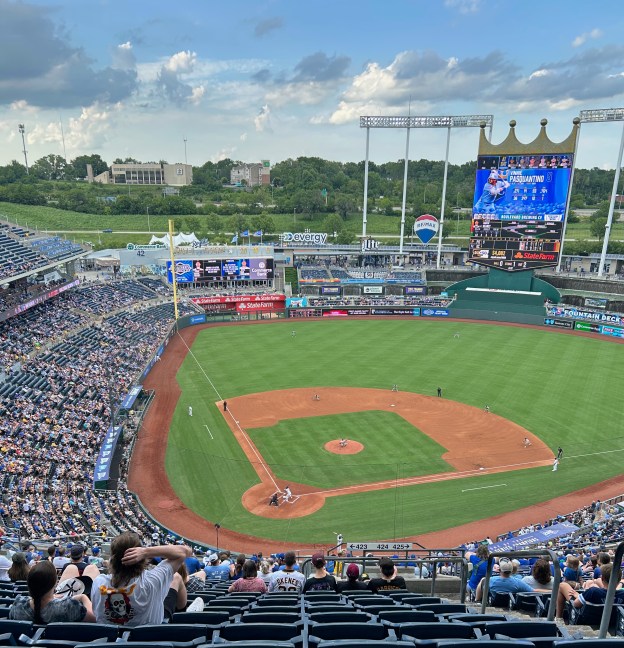
This Monday, after a long day working on my dissertation I went with my parents to Kauffman Stadium to see the Kansas City Royals play the first game in this week’s series against the Pittsburgh Pirates. Of the many things that I think of when I see the Pirates, memories of the weekend I spent in Pittsburgh in January 2020, or memories of watching them with my grandmother play the Cubs on WGN in my youth, I have a slight soft spot for the Pirates as a fellow legacy nineteenth-century team (1887) in the National League Central alongside my Cubs (1876), the Reds (1890), and the Cardinals (1892). The great Irish American artist Gene Kelly often said that he took up dancing to meet girls and to be agile and athletic so he could play outfield for the Pirates, his hometown team.
On this particular Monday, once we finished our walk into the stadium, bought our dinners and bottles of water, we made our way up to the top level of the stadium, the View Level to watch the game. I broke off from the rest of my family for a few minutes when we made it up to the 400s level to buy myself a brat. I didn’t realize though that the pregame ceremonies were reaching their conclusion with the march of the color guard and the performance of the national anthem. I consider myself patriotic in my own way; I hope you’ve seen in the last six months on this blog that I strive to elevate my fellow countrymen, my fellow humans in fact, through evocations of all the tremendous things we are capable of doing, of the extraordinary acts of ordinary people.[1] So, as the singer began her tune, I looked around at the people around me to see what I should do. At that moment I was at the register paying for my brat (everything is self-checkout now), yet as I saw no one else at the registers beside me were stopping to make our salute it occurred to me that nothing could be more American, dare I say more patriotic, than engaging in commerce with overpriced foods and drink that’s probably not good for any of us. I quickly finished my purchase and stepped back from the register and took a place beside a group of fellow millennials who held their right hands over their hearts, as we’re taught to do.
Throughout the game, a strong showing by the Royals who hit in 9 runs over the Pirates 3, I thought about this brat purchase during the national anthem and felt resolute in my decision. There are people who I know who take the anthem very seriously to the point of zealotry. In my many years of attending baseball games and soccer matches I’ve often wondered what would happen if someone chose to keep their hands at their sides or even remain seated during the anthem? We saw the harsh reaction of the clamorous cacophony when Colin Kaepernick kneeled during the anthem a decade ago. At the time I was ambivalent yet now having heard more stories of oppression and promises unkept I appreciate what he did. I believe this question of how free we are to patriotically express discontent in civic rituals is essential to the vitality of a democracy. I’ve often found the crafted rituals which the Royals put between innings to be at times bordering the ludicrous. This is especially true in 2025 after the Royals ruined their relationship with so many of us Kansas Citians with how they misled us and took advantage of us in this year’s stadium sales tax vote. My distrust of the team is why I effectively retired the Royals cap that I bought only two years ago at another visit to Kauffman Stadium.
We embody our rituals by wearing American flags on our clothes and demanding unquestioning patriotism in this American life. Here I’m adopting Céline Carayon’s notion of embodied language in her 2019 book Eloquence Embodied about early colonial French communications and relations with Indigenous Americans through gestures and visual language.[2] Today in the United States our patriotism is just as often meant to be blood-red flowing within our bodies as it is worn on our chests and loudly proclaimed with often poorly sung renditions of the national anthem, a hymn requiring professional training to perform. It is meant to be shouted in unquestioning proclamations of American freedom even as that liberty seems ever more fleeting under the combined weight of a cruel-minded governing majority and an even crueler corporate elite that has created so much of the embodied rituals which define American culture in the 21st century. These rituals, always sponsored by some robber baron and crafted by their public relations department, sing proudly of American freedom all while ensuring their own profits at the expense of the American people’s own freedom from want and fear. We embody our patriotism in what we purchase and where. Earlier that day, looking for a late afternoon pastry, I ended up at my local Whole Foods. Their bakery is good; the chocolate croissants are about what you’d expect for a gargantuan corporation’s attempt at mimicry of a Parisian classic. Yet as I bought a slice of pizza that caught my eye thinking how I might stop here for pizza by the slice more often I felt a pang of guilt after all there’s a good local pizzeria, Pizza 51, just across the street and several more within walking distance. Even as bakeries go as fair as Whole Foods is during the morning rush I would much rather go to McLain’s, the Roasterie, or Heirloom, all local bakeries within walking distance of my family home and along the route I was driving yesterday afternoon. Yet where Whole Foods won was that they forego the usual bakery hours and keep baking pastries in the afternoons whereas the others are usually low on their morning batches or already closed for the day. I’ve known for most of my life that these big corporate chains put tremendous stress on small local businesses; in fact I’ve flatly refused to shop at Walmart for this very reason, only buying a couple of bottles of water at one in the Kansas City suburbs once in 2020 when my Dad’s old truck broke down outside of it during the evening rush hour under a hot summer sun.
The America that I love seems more and more fraught the further from walkable neighborhoods and into the suburbs and exurbs you go. This is where most Americans have built their lives in common isolation living in mansions of rest surrounded by moats of artificially green grass regardless of how dry the local climate may be. It’s a life spent driving individually in vehicles increasingly resembling The Princess Bride’s rodents of unusual size in their environmental dangers. Several months ago, I had a bad argument with an attendant at a car wash in a nearby suburb because I ended up in the members’ lane on accident. I told the teenager working there that I made the mistake because there wasn’t a sign that I could see in my Mazda where the two lanes split (the big overhead sign is blocked by a dumpster from my lower line of sight) while the guy kept telling me that I can’t pay in the lane I was in. I was angry because the way that place was built favored the minivans, SUVs, and trucks that most people drive at the expense of those of us who still drive sedans. Yet I lost my temper because when the management got involved in our deteriorating conversation they shrugged off my suggestion that the row of ground-level signs standing outside their toll booth ought to be placed where the lanes split saying “that’s something for corporate to decide.” This is where that America of neighbors seems to be at least dormant to me; rather than making decisions that will benefit all of us together we instead more often choose inaction rather than risk our own individually precarious position. I grew up admiring the likes of Daniel Burnham and was proud as a young kid to say I was from Carl Sandburg’s City of Big Shoulders with big ideas and big ambitions. I’m just as proud to have witnessed firsthand the renaissance that Kansas City has experienced since the millennium. Those sorts of dreams and ambitions are what make me proud to embody our shared patriotism when I feel we’ve warranted it. I prefer the embodied patriotism my parents and grandparents taught me which as I’ve gotten older, I’ve found grew out of the progressive and city beautiful movements of a century ago and felt their greatest expression during FDR’s New Deal in the 1930s. That is my America, the America of neighbors standing up for each other. I see that America every day in my neighborhood where people say hello to each other when walking down the sidewalks or on the Trolley Trail. It’s for that America that I feel pride is warranted, that America which we should be working to rebuild by reconnecting our car-dependent suburbs and neighborhoods, by forcing us to spend time with each other again, to be social again.
[1] That’s one of my favorite lines I’ve ever written.
This week, looking ahead to the next 25 years here are three things that I hope we see become ordinary things by 2050.
—
Click here to support the Wednesday Blog: https://wwww.patreon.com/sthosdkane
This week, looking ahead to the next 25 years here are three things that I hope we see become ordinary things by 2050.
Last week I started the New Year off in this publication with a reflection on the technologies that I remember looking forward to in the first quarter of the twenty-first century. Today then, I want to look ahead to the next quarter, to the years leading up to 2050. On New Year’s Day of that year, I will be 57 years old, well into my career with hopefully a good wind in my sails from successes and contributions to society in the decades previously built upon the work that I am doing now. Perhaps by then I will watch the New Year’s ball drop in Times Square with my wife and children to be, though that’s one dream that remains more elusive to imagine than any professional triumph. 2050 feels like a strange milestone to me, in part because 1950 feels far more tangible to me growing up surrounded by people who were beginning their own lives in that middle decade of the twentieth century. Yet as much as I feel a bond to the century of my birth, my own legacy will likely be numbered among the figures of the current century rather than the last.
Our century has tremendous potential to be one of the most consequential in the long history of humanity. We’ve already seen dramatic changes in the first 25 years which have defined the break in our current moment from the century we left at the millennium from new wars and economic recessions to the COVID-19 pandemic and dramatic advances in technology and global interconnectedness. A significant cause for discomfort in this century is the rift between those who see globalization as a threat to individual, local, regional, and national identity and the increasing interconnectedness of our world. At the beginning of this century the easiest and most affordable way for us in the United States to be in touch with relatives in Britain and Ireland was by letter, whether handwritten or typed, and sent by air mail to arrive within the next two weeks at its destination. We could place international phone calls, I remember doing this in early 2001 when my Mom was in London on a business trip, but those were far more expensive. The expense of international calling over regular phone networks remains an annoyance, yet today we have other options of placing voice and video calls over the internet that have existed since near the beginning of the century which fill this role.
The increasing ease of global communication is one clear sign of the advances of this century that I applaud. Just before writing this, I spent a delightful hour watching a live public lecture from the Linnean Society of London over Zoom in which I was able to pose a question in the Q&A box that was read by the moderator at her desk nearly 7,000 km across the Atlantic and answered soon after by the speaker. Throughout my undergraduate I often heard the maxim that I should earn my doctorate in the country in which I wish to teach, yet the little islands of national academies that we’ve built in the last two centuries are fast growing into each other’s back gardens to the extent that in my experience there isn’t so much an American and a Canadian academy but a North American academy which also has close links with the republics of letters in Britain, Ireland, and across Europe with more disparate connections in East Asia, Australia, and New Zealand or even South Africa. I’ve yet to present at any conferences on the far side of the Pacific though I have attended conferences held at the Universities of Auckland and Sydney over Zoom that were held the following day, or thanks to the disparity of time zones late in the evening here in North America.
The lecture in question
Yet again, these are technologies which already exist and even if they have room for improvement, they fit better into that first of these two entries about the technological innovations of the twenty-first century that I am most excited by. This week then, I intend to discuss three technologies which I hope will see fruition in the next 25 years that would have a noticeable influence on all our lives for the better. All three of these technologies are already being developed, and in some cases merely need implementation here on this continent as they already are elsewhere. We seem to be in a moment of reaction when the parking brake is firmly grasped in the hands of those who fear any further forward motion on the part of our society whether for their own portended loss of power or their general fear of the unknown. Both are understandable, yet as Indiana Jones learned in his last great challenge in The Last Crusade there comes a point in life where each of us needs to take a leap of faith and trust in ourselves and our future.
The first of these three technologies which I’ve read a great deal about in the last several years and which is proven in a laboratory setting is the use of nuclear fusion to create a new source of energy and ideally power to keep our lights on. One great worry I have among many others about the incoming administration which will take office next week in this country is that they will slow or even stop the construction of new renewable energy facilities: solar and wind farms in particular without any significant scientific foundation for that decision. We ought to be developing ways that solar panels can be integrated into the shingles and tiles atop our roofs so that they aren’t an extra addition to any edifice. Likewise, wind farms in places like the deserts, the Great Plains, and off our coasts (ideally still out of sight of the beachgoers) where the wind is strongest and most usable would help to eliminate our use of fossil fuels including natural gas and coal which are still in use in parts of this country.
A drawing of the ITER Tokamak and integrated plant systems now under construction in France. CC by 2.0 Oak Ridge National Laboratory.
The prospect of nuclear fusion to be downsized from its current necessary laboratory dimensions to something that can be implemented on a local level in cities and towns around the globe is what I look forward to most. The effects of human influenced climate change are well and visible around us. Look no further than the extreme shifts in weather year round, or the prolonged droughts across much of this continent. Look at the winter wildfires that burned around Boulder, Colorado and west of Kansas City in Central and Western Kansas in December 2021. Look at the wildfires burning down neighborhoods in the Los Angeles area today! We need renewable and clean energy sources that will continue to power our civilization if we’re going to survive in this brave new world that we’ve created for ourselves. We’ve already reached the threshold of a 1.5ºC increase in mean global temperatures, and we only seem to be letting things get worse. I’m reminded of the beginning of the story of the Flood in Genesis and how “the wickedness of human beings was on the earth” and “[corrupted] the earth” itself. Are we not doing the same thing by not wedding our continued innovation and progress with a heart for preserving the Earth that has nurtured us to which we too contribute? If we can develop technologies from our own invention which will cultivate a stronger relationship with the rest of nature on this planet in whose cradle we evolved as every other living thing we today know did then what are we doing?
Secondly, one of my great passions outside of academia is the promotion of high speed rail here in the United States. The YouTuber Alan Fisher recently released a video which spells out the utility of high speed rail as a realized technology in contrast to the fantasized options like the Hyperloop that caught our national attention several years ago and even resulted in a thorough study by the State of Missouri to build a hyperloop line between Kansas City, Columbia, and St. Louis. I’ve had my fair share of experiences on high speed rail in Europe and having that option alongside air travel would go a long way to building a far more equitable society in this country. Today, unless you choose to drive the 3.5-4 hours it takes to get between Kansas City and St. Louis, you have the choice of 2 daily flights on Southwest, 2 daily trains on the Missouri River Runner, or 8 daily bus services provided by Greyhound and Flix Bus. While the flight itself is quite short, rarely more than 45-50 minutes from takeoff to landing though including travel to & from each airport and waiting time this option grows closer to 4-5 hours in length. Meanwhile, the train takes 5.5-6 hours and the bus usually 4.5 hours to cross the state. With high speed rail we could certainly cut the travel time either along the Missouri River Runner or a new route along the I-70 corridor with one intermediate stop in Columbia for a service that could well be faster and more convenient than driving. The Missouri state high speed rail proposal from the High Speed Rail Alliance, of which I am a member, calls for 10 daily roundtrip services between KC and St. Louis at least making it possible for residents of either city to make day trips to the other, something that is very difficult to do by any option today.
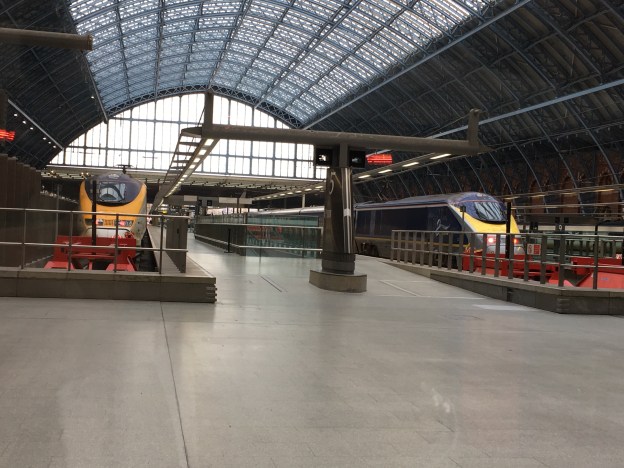
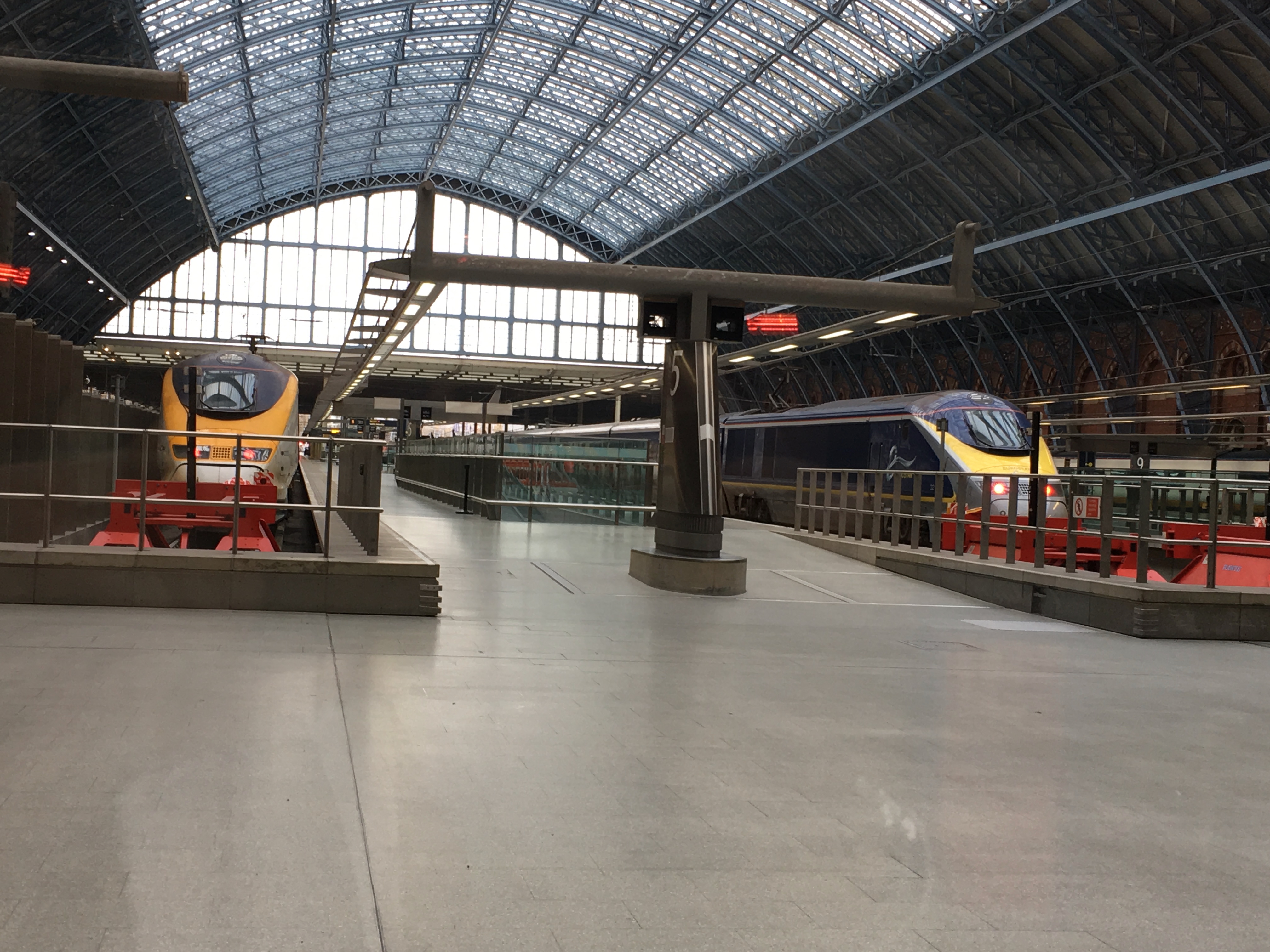
The Eurostar hall at St Pancras International in London. Photo by the author, 2016.
In Kansas we have a more tangible possibility for high speed rail thanks to the work of a YouTuber who goes by the channel name Lucid Stew. He released a video this summer theorizing what a High Plains HSR line between Denver and Kansas City would look like. The total travel time largely following I-70 would take 3.5 hours compared to the 4 hours it takes to fly between the two cities with airport transfer times included. There are currently on average 7 flights per day between these two cities offered by Frontier, Southwest, and United and there is at least 1 daily bus between the two cities. The drive across Kansas is a dull one, the Great Plains really do get to seem flat once you get west of Salina until essentially the Denver Airport exit. I remember falling asleep in the passenger seat on my last drive from Denver back to Kansas City in June 2021 in a trip featured in the Wednesday Blog two-parter “Sneezing Across the West” and dreaming that there was a high speed train running between the two cities that ran frequently enough (a minimum of 10 trips per day each way) that allowed your average Kansas Citian the opportunity to get off work on a Friday afternoon and go spend the weekend in Denver or up in the Rockies with enough time to come back on Sunday evening to make the start of business on Monday. It was one of those dreams that really sat with me, and made me wonder whether it could be possible to build this line in the future? I think the key feature that would make this happen would be if it were the primary transcontinental link between a Midwestern high speed rail network centered around Chicago and the easternmost node in a Western network that included lines reaching as far as the Pacific Ocean. While it’s far less likely that most travelers would take high speed rail from Kansas City to Los Angeles, San Francisco, Portland, Seattle, or Vancouver, we should still think on a continental scale because there could be travelers leaving from Denver who might want to make that trip, putting the High Plains HSR line into the broader North American network.
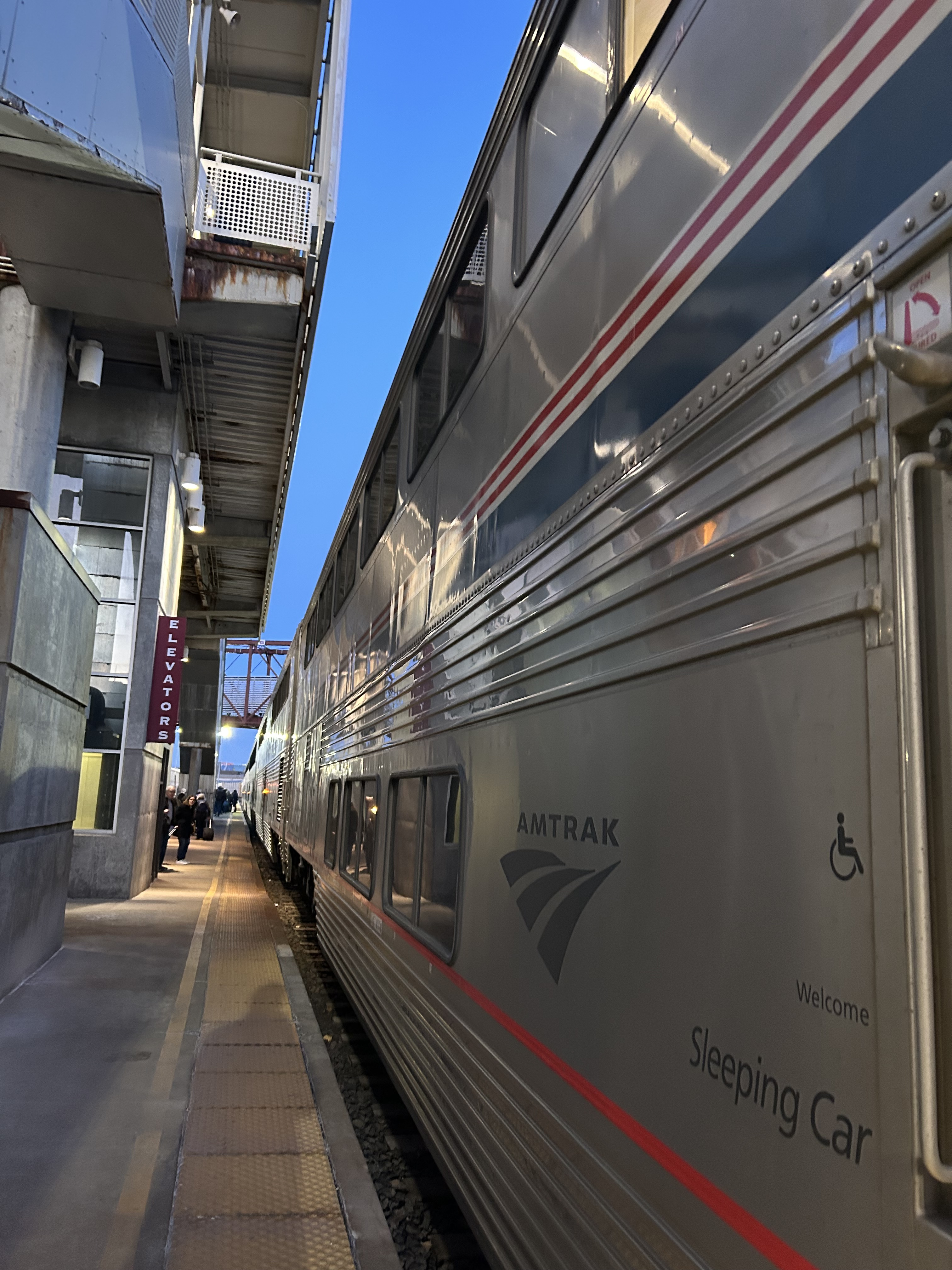
The Southwest Chief in Kansas City, photo by the author 2023.
I for one would gladly take a high speed train to Chicago over flying or driving. I already enjoy taking the Southwest Chief, though I was lucky the last time I took it that we arrived on time. Our current passenger rail network is hampered by the lack of enforcement of the federal law which says that Amtrak should have the right of way over freight, yet the host freight railroads now run trains so long that it’s much harder to manage Amtrak schedules in the face of mile-long freight trains that take up much more of the space along these lines. This is a problem for both the long distance routes like the Chief, which runs on BNSF tracks between Chicago and Los Angeles, as it is for the state-sponsored routes like the River Runner which runs on the old Missouri Pacific line now owned by Union Pacific. With the same sorts of amenities as the current trains, the option for private compartments (roomettes, rooms, and bedrooms), sleeper capabilities, a fully stocked dining car, and the observation & café car, I’d happily spend a couple hours more traveling by train on a high speed line between Kansas City and Chicago via St. Louis rather than take the more direct, if slower, route on the Chief. It seems more likely that the Missouri River Runner will get the high speed upgrade than the Southwest Chief because it’ll serve more people: the Southwest Chief’s primary metropolitan areas east of the Great Plains are Kansas City and Chicago alone. If we had an express train that ran just between those two cities along the Chief route that could be another good option that’d cut the journey down from 7 to closer to 5 hours.
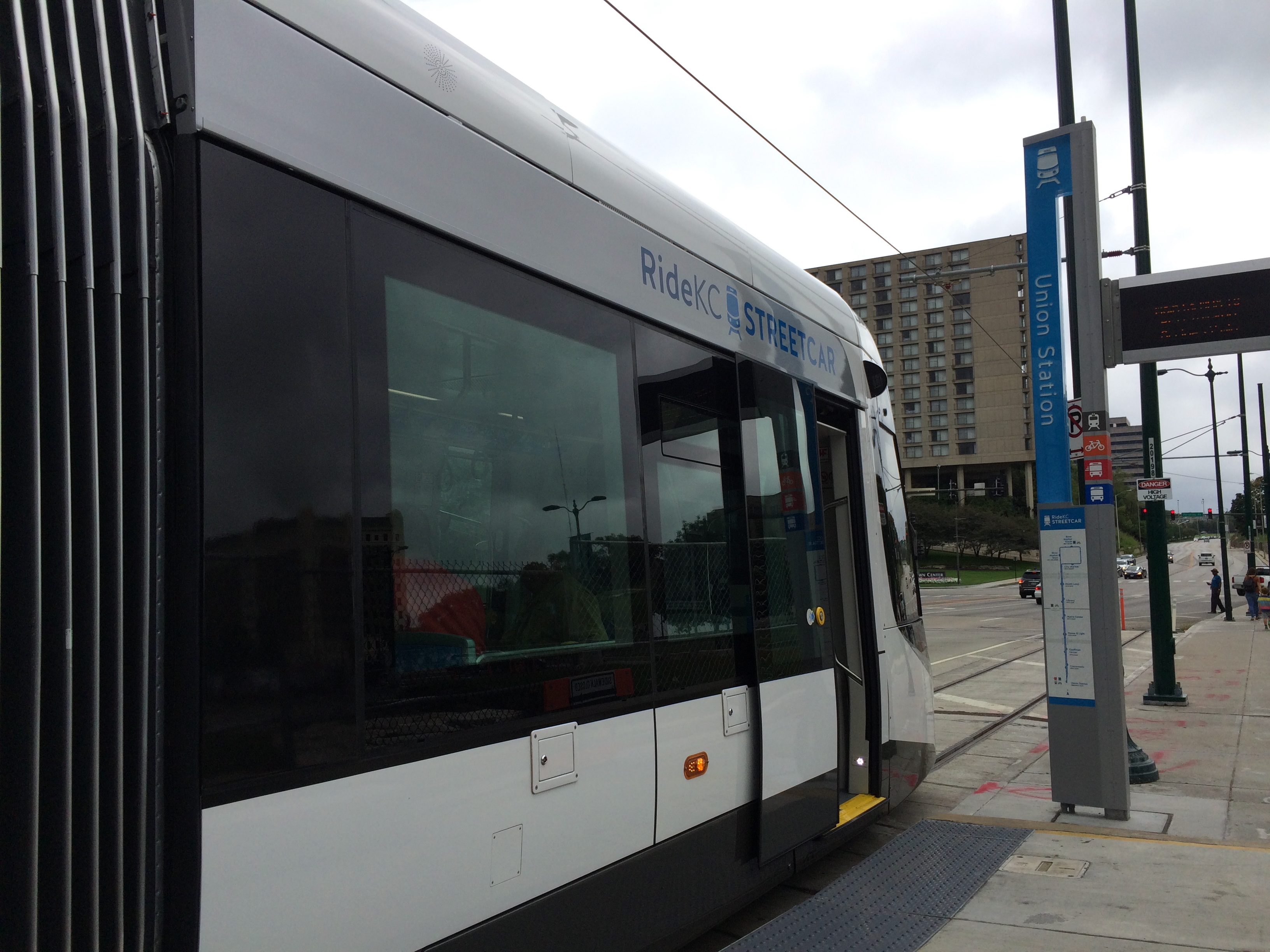
RideKC’s Streetcar service at Union Station, photo by the author 2016.
All of this would need to be complimented by better public transportation on the regional, metropolitan, and local levels. We will soon see the opening of the southern extension of the Kansas City Streetcar down Main Street from Union Station (23rd Street-ish) to UMKC (51st Street). This will get the Streetcar right to the top of my neighborhood, Brookside, and just within reach that I will probably begin to take it when I’m going downtown for work or a day out. Yet our local transit agency, RideKC, needs to expand bus service south of 51st Street now to feed people onto the extended streetcar line. Currently we have 20 minute frequencies on the Main Street Max line south of the Country Club Plaza (47th Street), which have been the case since the Max line opened in 2005. I for one want to see at least 10 minute frequencies all the way to Waldo (75thStreet) if not even further south to 85th Street or even to the I-435 loop around 103rd Street. This is a problem that needs to be addressed nationwide. I firmly believe that no one in an urban or suburban area should live further than a half a mile from a transit line, whether that be a bus, streetcar, light rail, metro, or regional rail. When I worked at the Nativity Parish School at 119th Street and Mission Road in Leawood, Kansas the closest bus line to the school was the 57 bus stop at the intersection of Minor and Wornall Roads just north of Avila University (Minor Road becomes 119th Street at State Line Road, aka the Kansas-Missouri border). The walk from there to the school is 2.1 miles (3.38 km) in length and according to Google would take about 45 minutes to complete and while there’s a sidewalk for most of the way on the north side it does end at the property of the Church of the Nazarene just 528 feet shy of the border. Here the pedestrian can cross the street and continue on the south side of the street, but that’s not always the safest prospect on what is a fairly major street on both sides of the border.
In Kansas City we need more streetcar lines and a robust regional rail network that can connect the disparate suburbs together as a supplement for our existing highway network. Thinking about this over the weekend I came to the thought that perhaps if we had a strong enough passenger rail network it could leave more space on the highways for freight traffic which already makes up a fair share of the interstate network’s users. Here if we had a system of through services connecting at Union Station on the tracks of the Kansas City Terminal Railway (KCTR) we could have north-south routes running from St. Joseph to Gardner or Lee’s Summit that would connect points in between including KCI Airport, suburbs in the Northland, Downtown, and neighborhoods and suburbs on the southwest and southeast sides of the urban core. Likewise, an east-west line ought to run as far west as Topeka and as far east as Grain Valley or beyond along the I-70 corridor would do a great deal to connect this region.
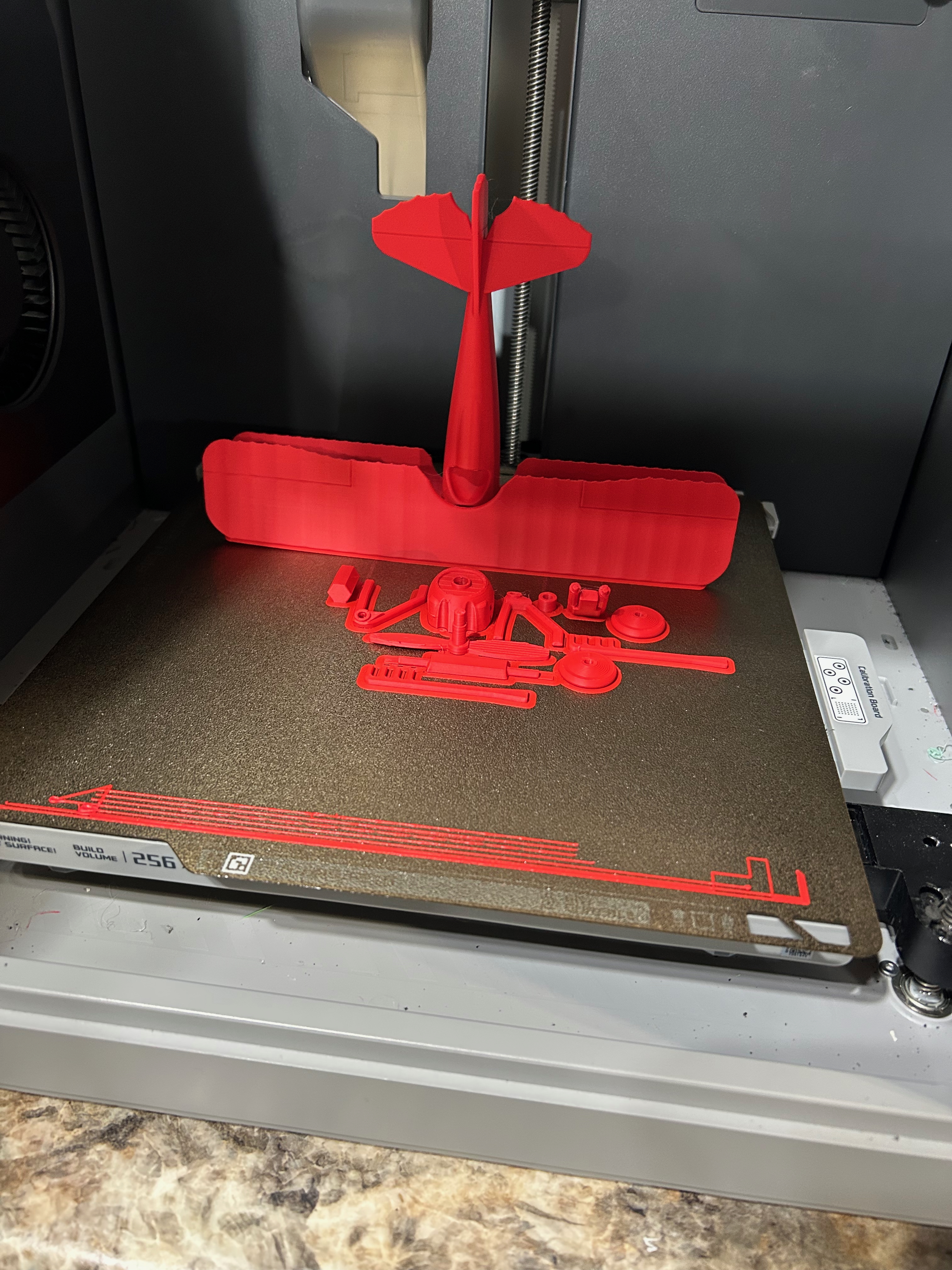
I’ve digressed a great deal here about transportation, and rail in particular. So, let me finish with something that’s on a smaller scale yet seems to be growing into something far more robust. In the last decade 3D printing has really developed into a new art form that has a great deal of utility to offer. My parents have developed a hobby of 3D printing with both uses. I’m quite proud of the one print that I’ve completed with my Mom’s help. Just before Christmas we made an old World War I biplane with red filament leading to my declaration that this year the Red Baron would be visiting the Baby Jesus in our manger scene. I’ve seen newer models of cars and trucks, the Ford Maverick in particular, which have interior parts that are 3D printed.
The Red Baron biplane as it appeared when it finished printing. Some assembly required. Photo by the author, 2024.
In October 2016, NASA launched Phase 2 of its 3D printed habitat challenge to see what could be designed as homes “where future space explorers can live and work.” One of the problems to be solved here is that for every kilogram of mass which is carried into Space whether for a Lunar or Martian destination the spacecraft will need to carry more fuel. So, why not bring lighter materials that can be assembled on arrival? The advent of 3D printing technology will allow this to happen with the understanding that the technology will continue to advance in the coming years as the Artemis program brings humanity back to the Moon in the 2020s and 2030s and a future program takes astronauts to Mars for the first time. I don’t know if we’ll see humans on Mars by New Year’s 2050. It’s possible, but with all the delays that the Artemis II launch has faced it seems like the days of rapid-fire launches from the Apollo era are more a distant memory than a part of the present moment.
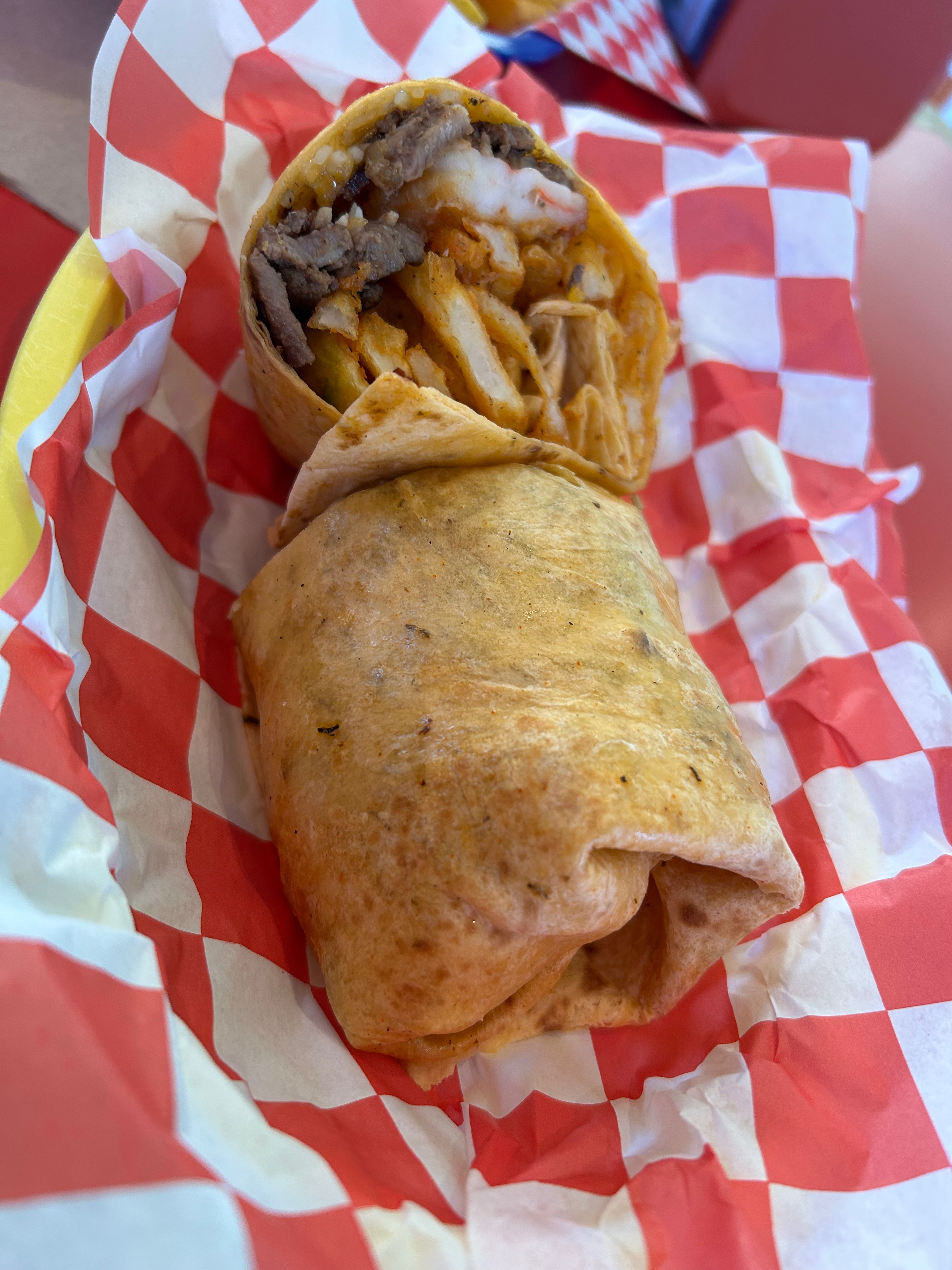
The Tiki Taco Surf & Turf Burrito, not 3D printed. Photo by the author, 2024
Other innovations in 3D printing stand as challenges to be faced: ghost guns made from 3D printed parts are a new threat to public safety, and the fact that these filaments are largely plastic concerns me from an environmental standpoint. I’m curious however about the prospect of 3D printed food. A long term vision I have for this technology is that it may lead to some sort of device like the replicator we see on Star Trek, and should my preference for beef over other meats become unsustainable and too expensive for me to continue in the next 25 years then I’d be open to considering an artificial alternative that is less taxing on the Earth and its environment alongside eating other meats: bison, chicken, lamb, and pork as well as the varieties of seafood. Yet with this last one there’s the problem of over-fishing. By any natural measure we in Kansas City shouldn’t have as easy access as we do to saltwater fish, shrimp, and the like. I’ve recently discovered the surf & turf burrito at Tiki Taco, a Kansas City Cali-Mex chain with 3 locations. This burrito’s main ingredients are shrimp, steak, with either rice or fries and several other fillings, and yes, I do love it. Yet again, if cattle produce more methane than is safe for our climate and if industrial shrimping is bad for the long term viability of shrimp populations and the oceans in general, shouldn’t we look for alternatives, even ones that have their origins in laboratory experiments?
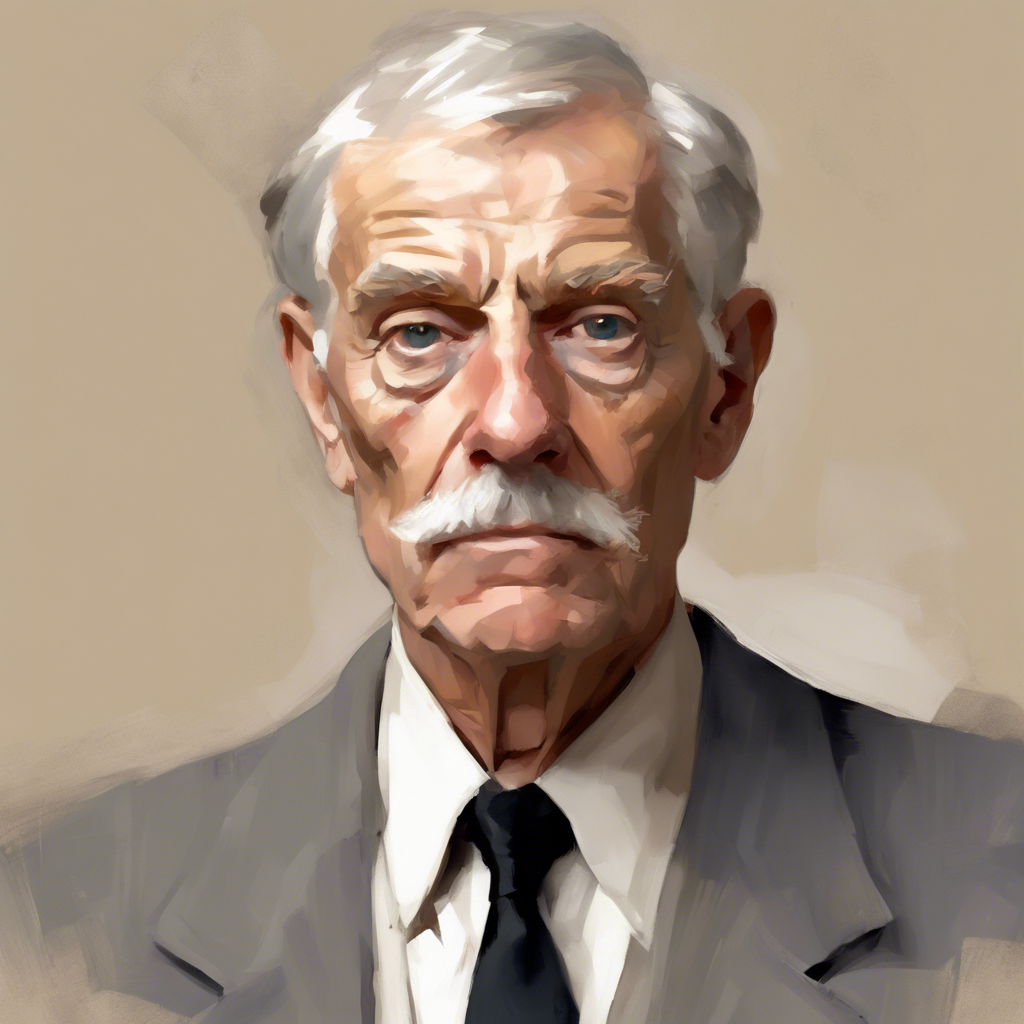
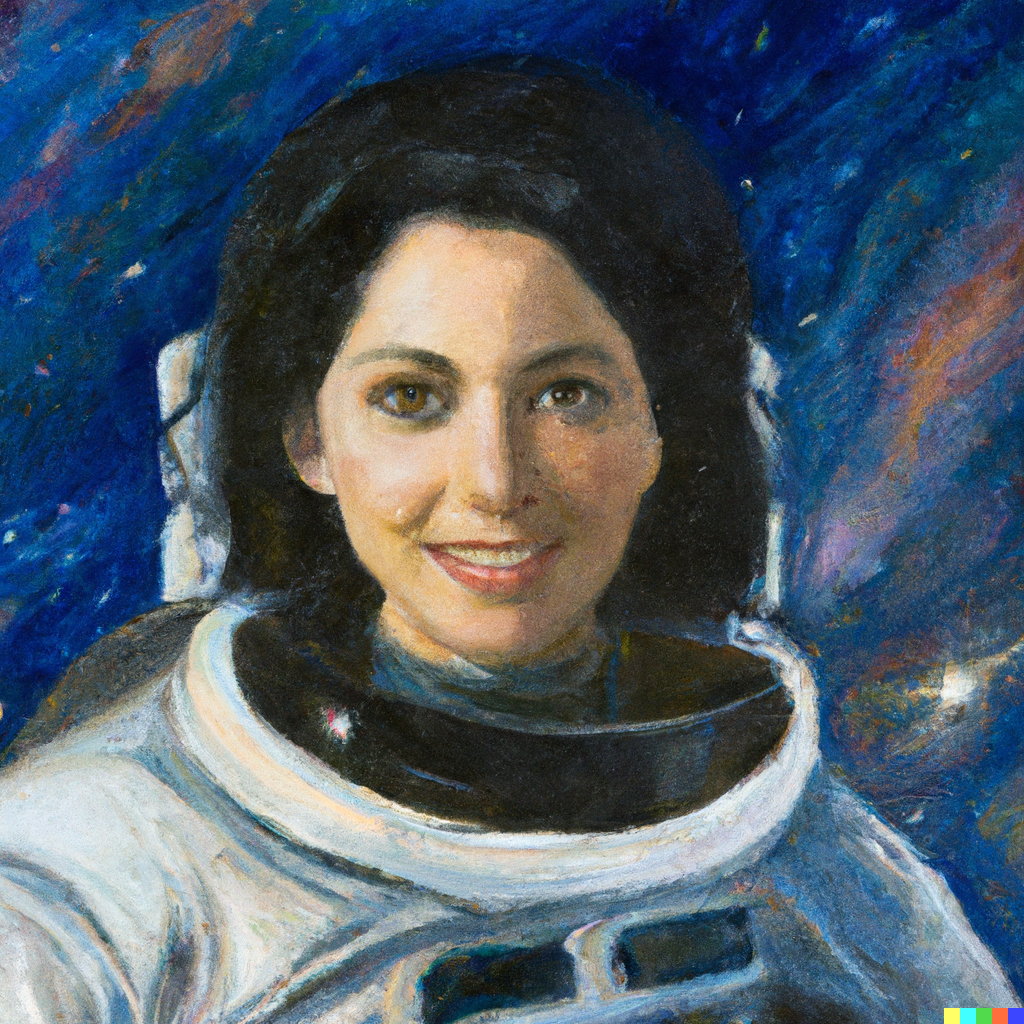
Finally, I don’t quite know what to make of advances in artificial intelligence quite yet. The means in which it’s become most visible in our lives is through crafted sentences and generated images. I’ve seen some examples of good AI and many of AI that is obviously computer generated. I freely admit to using an AI program, DALL-E 2, to create the images I used in my story “Ghosts in the Wind” from the Season 2 finale, and again I used a separate AI program to create the portrait of Carruthers Smith which appears at the top of my story “Carruthers Smith’s Museum” and its follow-up appendix. I’ve taken advantage of the vast database behind Chat GPT to confirm it’s not aware of more secondary sources in projects where I’m less familiar with the scholarship, a sort of streamlined version of the databases I’ve used throughout my career to find peer-reviewed articles and books. Yet I have too much pride in my own scribblings to use an AI program to write for me. If I want to find a fancier way of saying something, I’ll turn to my trusty thesaurus instead and decide for myself which of the synonyms I like best.
I do think we can find examples of computerized systems that work well to enhance the lived human experience of all three of these technologies. Computers with human supervision will be one of the better ways of monitoring nuclear fusion reactors to ensure their safe operation. Driverless trains already operate in cities like London and Paris, and while it’s disconcerting when you first board the front carriage of a DLR train or a Line 1 train in their respective cities you get used to it. On a less labor-pinching model using automatic train signaling systems and AI driven algorithms to determine schedules and monitor bus & train maintenance will help streamline things. Meanwhile in the world of 3D printing the flaws in current printers certainly can be ironed out with assistance from artificial intelligence to build things in regular patterns and to warn the operators if the machinery involved needs to be fine-tuned or replaced. As a comparison: Teslas have sensors in each wheel which keep track of individual tire pressures. These sensors are accessible on the central display screen. My own Mazda Rua has similar sensors, but they don’t differentiate between each of the four tires and so there’s the one light that will illuminate when there’s a problem. To find which tire has the low pressure I need to leave my car and check each one manually, which really isn’t a problem, yet it’s become an annoyance on my long drives when I’ve had to stop repeatedly to check tire pressures because of the poor quality of road surfaces on our older highways in this country.
As I’m writing this, I’ve been watching the notifications pop up on my computer from new emails coming in. A recent software update from Apple introduced Apple Intelligence to my computer, and now I get brief summaries of each email as they arrive. This means that the pop ups appear a second or two slower than before, and so if I’m not busy as I often check the email before the pop up appears. However, one that did appear while I was finishing the last paragraph announced several new books for sale at a local bookshop. One category of these was “Dystopian fiction.” I for one don’t care for dystopias, I’d rather spend my days thinking of utopias. Sure, the word utopia is St. Thomas More’s way of saying “nowhere is perfect,” but isn’t the human ideal that we’re foolhardy enough to strive for things that seem impossible only to find we actually got close to making those things happen?
Today, high speed rail is slowly being developed in this country. The Central Valley leg of the California High Speed Rail line between Los Angeles and San Francisco continues its slow march, even as its detractors try to see it shut down. At the same time, Brightline West’s efforts to build a separate high speed line between the eastern LA suburb of Rancho Cucamonga and Las Vegas seems more likely to open in this decade. Once we see those lines open in California, will the rest of the country begin to take notice and start planning their own high speed lines? By the time we reach the middle of the century it’s possible our energy sources will come from nuclear fusion generators as well as solar and wind farms, hydroelectric dams like the ones around Niagara Falls, and some as yet unknown or unfamiliar technologies that will help our civilization to progress further in communion with nature rather than in contrast to it. This could well be done using the descendants and successors of our current 3D printers. This technology will likely be instrumental in the establishment of the first permanent human settlements on the Moon and Mars and could prove just as useful here at home. Maybe the interiors of those trains will largely be made from 3D printed materials and parts not unlike the prefabricated houses that’ve been built now for generations. I remember seeing a news story in 2019 or 2020 about a company building prefabricated homes that didn’t require air conditioning because of strategic window placement near the roofline which allowed for the wind to naturally cool the space.
There are a great many prospects to look forward to in the next 25 years, and I hope come New Year’s 2050 that we will be living on a far healthier planet and will have worked through the gridlock that keeps us held back today. I hope that 2050 will beckon in a happier time in a way that 2025 doesn’t seem to be.




 Wednesday Blog by Seán Thomas Kane