Tag Archives: San Diego

On October Baseball

This week, a great celebration commences in our national pastime. — Click here to support the Wednesday Blog: https://www.patreon.com/sthosdkane


This week, a great celebration commences in our national pastime.


Several years ago, near the start of the podcast version of my Wednesday Blog, I wrote two of my favorite stories in this continuing publication of mine about my love for baseball at the beginning of the 2022 season. I seem to remember even playing a poor rendition of Take Me Out to the Ballgame on the digital keyboard provided on GarageBand, where I do all my recording and editing. Don’t worry, I’m not planning on doing that again.

Today, I want to write instead about my joy at how this postseason is beginning. The 2024 season had plenty of potential for my beloved Chicago Cubs and my adopted second-favorite team the Kansas City Royals, and while the Cubs didn’t quite make it far enough to earn a wild card spot, the Royals did in spite of themselves. This is being released on the morning of Game 2 of the Wild Card series, following a 1-0 Royals win in Baltimore against the Orioles. So, should the Royals win again today they will advance to face the Yankees, a matchup that brings to mind the stories my Mom likes to tell of watching the Royals teams of the ‘80s face up against the Bronx Bombers in the American League playoffs.

Meanwhile in the National League the team that excites me the most in these Wild Card series is the San Diego Padres, a perennial favorite of the last four years to win the World Series. Their resounding 4-0 win at home over the Atlanta Braves last night in Game 1 proved to be a good alternative to the Vice Presidential Debate that was occurring at the same time from CBS News’s headquarters in New York. You might think it odd that someone as politically engaged as me would choose to watch a ballgame over a debate, and yes, I started the 8 pm hour watching Governor Walz of Minnesota and Senator Vance of Ohio face off on CBS, but as soon as the first question concerning the increasing odds of war between Israel and Iran occurred, I decided to seek some escapism.

There are a lot of things that we all are worried about today, and with good reason. Whereas for most of my life I’ve looked to the future with eagerness, today I’m scared about the future and what we are doing to ourselves. Over the weekend, I watched an episode of the PBS documentary series In Their Own Words about Jim Henson in which he said his inspiration for creating his 1980s children’s television show Fraggle Rock was to make something that could inspire world peace. To paraphrase the visionary creator of the Muppets, Henson believed the best chance we have at solving our problems is to speak to the youth who aren’t already jaded by the weariness of life and are more willing to imagine a good future. He spoke to the inner child in all of us, a part of me that I’ve found slinking back from the foreground as the world seems evermore scary and dangerous.

Even when I don’t have a team in the playoffs, and let’s face it as a Cub and Royal fan that’s most years, I still religiously watch the baseball playoffs because I love this sport. It’s the sport my parents introduced me to as a kid watching Sammy Sosa, Kerry Wood, and the great Cubs of the late ‘90s and early 2000s skirt so close to the glory of winning the World Series in 1998 and 2003. It’s the one sport that I played with even the remotest success. It’s a sport that I shared with generations of my family that I understood, and today it’s a nice antidote to the weekends of American football, which let’s face it I get but still don’t really understand. Baseball is one of those core things that makes me feel more American, and one of the parts of American life that I missed the most when I lived in England.

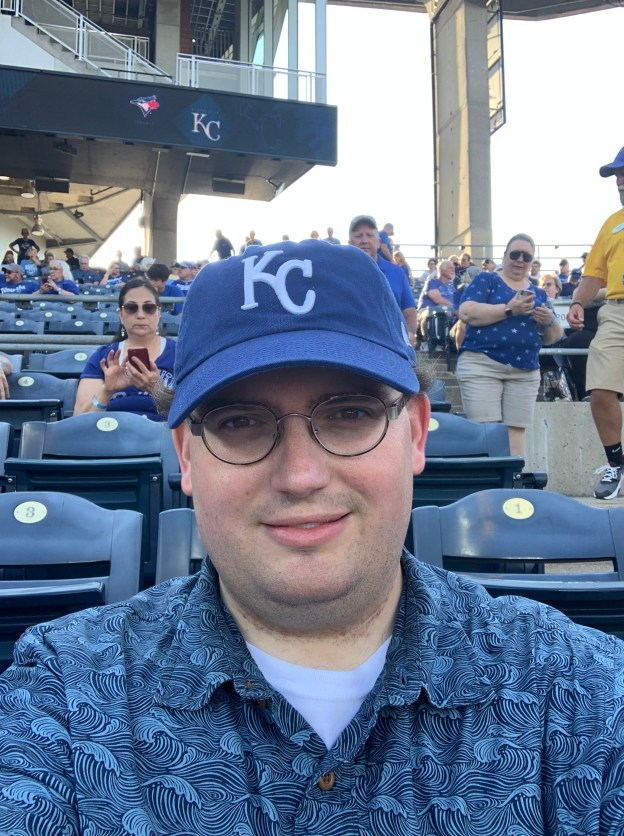
Locally here in Kansas City I feel that the Royals have lost some of their connection with the community in the wake of their failed bid to get a renewal on the stadium sales tax here in Jackson County, which would help them to fund a new stadium along Truman Road in the Crossroads neighborhood. I was one of those voters on the fence who wanted to support a downtown stadium but were really unhappy with the plan they laid out and repeatedly changed in the days and weeks leading up to the vote. Since the playoffs began, I found it harder to put on my Royals hat when going out. I’m having a hard time putting my faith in an organization that doesn’t seem to want to trust the city it represents. I hope this Royals playoff run, 10 years after their monumental and near triumphant 2014 run will revive some of that jubilation that I felt in Kansas City that year. I remember during the World Series that year driving down 47th Street in the Plaza and nearly everyone out walking down the sidewalks was wearing Royal blue jerseys and hats, and I even saw Commissioner of Baseball Bud Selig’s motorcade parked outside the Classic Cup Café at 47th and Central. I want to feel that kind of community spirit again in Kansas City, where the team and the city are open with each other and working together in a productive manner.

So, who am I picking to win the World Series this year? Well, even though we’re down to the last handful of teams, and even though I have a horse in the race this time around, it’s still too hard for me to say. I want the Royals to win again, that’s for sure, though were they not playing against the Orioles I’d be excited for Baltimore’s chances this year. In the National League though it’s a two horse race for me between the Dodgers and the Padres. While Los Angeles has one of the greatest baseball players of our time – Shohei Ohtani – on their team, the Padres have been red hot in the second half of the season, and I stand by my long held claim that the weekend I spent in San Diego in 2021 was one of the best I’ve had in the last few years. What I want to see most is amazing baseball that makes me want to watch the guys on the field play more and more and more; and by the end of this month to long for March and Spring Training.

Writing this tells me one thing for certain: even when I’m trying to celebrate something I love as much as baseball, the muddied waters of the world still appear, yet even then I remain hopeful of better tomorrows.
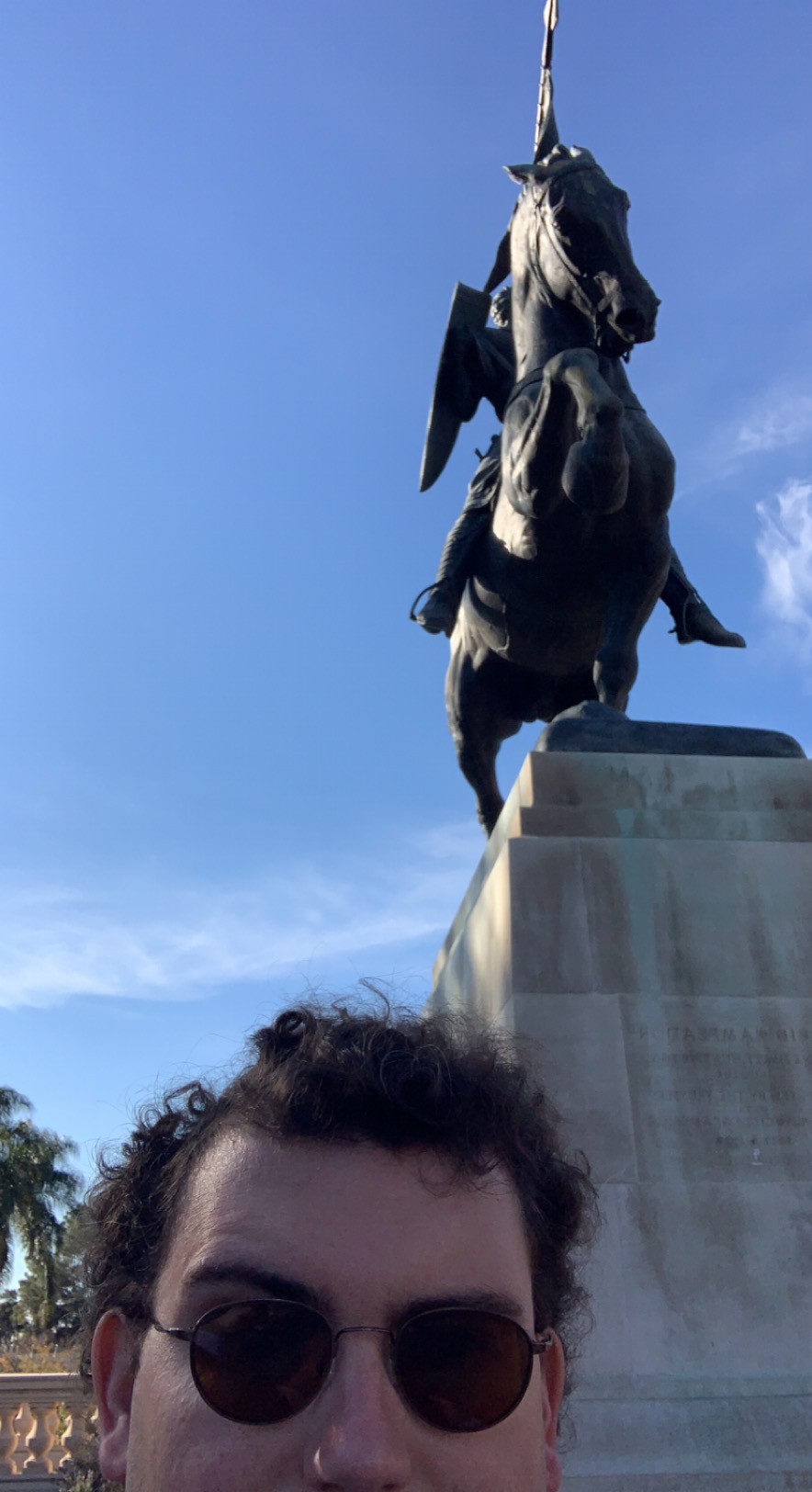

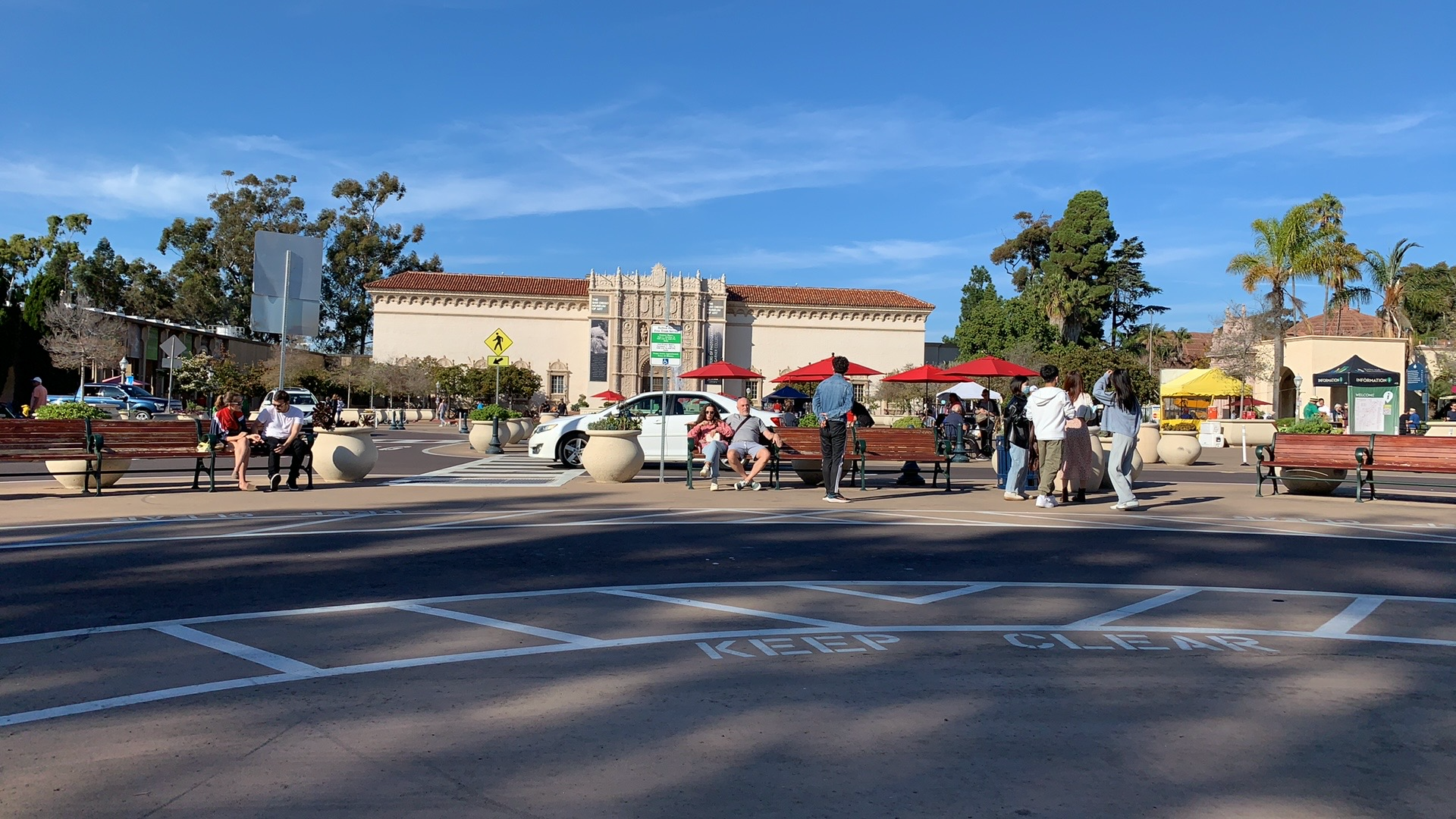
A selfie I took beneath the statue of El Cid in Balboa Park’s Plaza de Panama in San Diego on Halloween 2021.

To Gaze into the Past

“Cosmic Cliffs” on the Carina Nebula, NASA JWST, Public Domain.
This week, some inspiration from the first images taken by the James Webb Space Telescope. You can view all of these images at: https://webbtelescope.org/news/first-images/gallery

Historians like me spend our working days trying to understand past generations, to see their worlds through their eyes and to interpret that world in a way that’s understandable to our modern audiences. I for one would love to see the sloths that my dissertation focuses on as they lived in their own time and place 467 years ago. Better yet, I would love the opportunity to sit down and chat with such greats as Abraham Lincoln, Benjamin Franklin, Eleanor Roosevelt, or Hypatia of Alexandria just to hear these great minds of their own times speak as regular people without all the pretenses, titles, and theories that we frame their lives within our histories.

Unfortunately, as far as I know the time machine hasn’t been successfully built yet, and time travel even by slingshoting an object around a sun hasn’t been attempted yet. Give it a few centuries, maybe. My conversation with Mr. Lincoln will have to wait. Yet there are ways we can gaze back into the past that are possible today. If you’re reading or listening to this at night go outside and look up at the stars and see what you can find up there. Maybe even use a star chart app on your phone to figure out which stars you’re looking at. Once you’ve done that see how many light years distant they are from us on Earth. That light took quite some time to reach us, meaning that that light left those distant stars years, decades, or even centuries or millennia ago.

Last summer I wrote about my profound sense of awe at gazing up towards the light radiating out from the star Vega while sitting on the rim of the Split Mountain Canyon in the Utah side of Dinosaur National Monument. What struck me most was that Vega is 25 light-years away from Earth, meaning that that light left that star when I was still a small child in a moment of my life I look back on quite fondly. What’s more, I knew I could return to the same spot 25 years later in 2046 with my children, if I’m so lucky in the future, and show them the light that left that star on the night when I went up there with my Dad back in 2021.

The same idea is central to how we ought to understand the immensity of space. Einstein is responsible for the development of the idea of spacetime, that time itself is a dimension alongside the others we might already recognize. I often think about this when I’m daydreaming, imagining observing the passage of time in a very small scale by watching the light move across the walls of a room however slowly as the day goes by. This past Halloween evening I sat with a fellow sixteenth-century historian in San Diego’s Waterfront Park and looking out towards San Diego Harbor to the west stared at the sunset as it seemed to almost faintly radiate up and down as it slowly set below the horizon. In that moment I knew I could begin to understand the passage of time just as I learned at a young age to comprehend the passage of space in the form of physical objects moving across the landscape, like cars driving along an open highway.

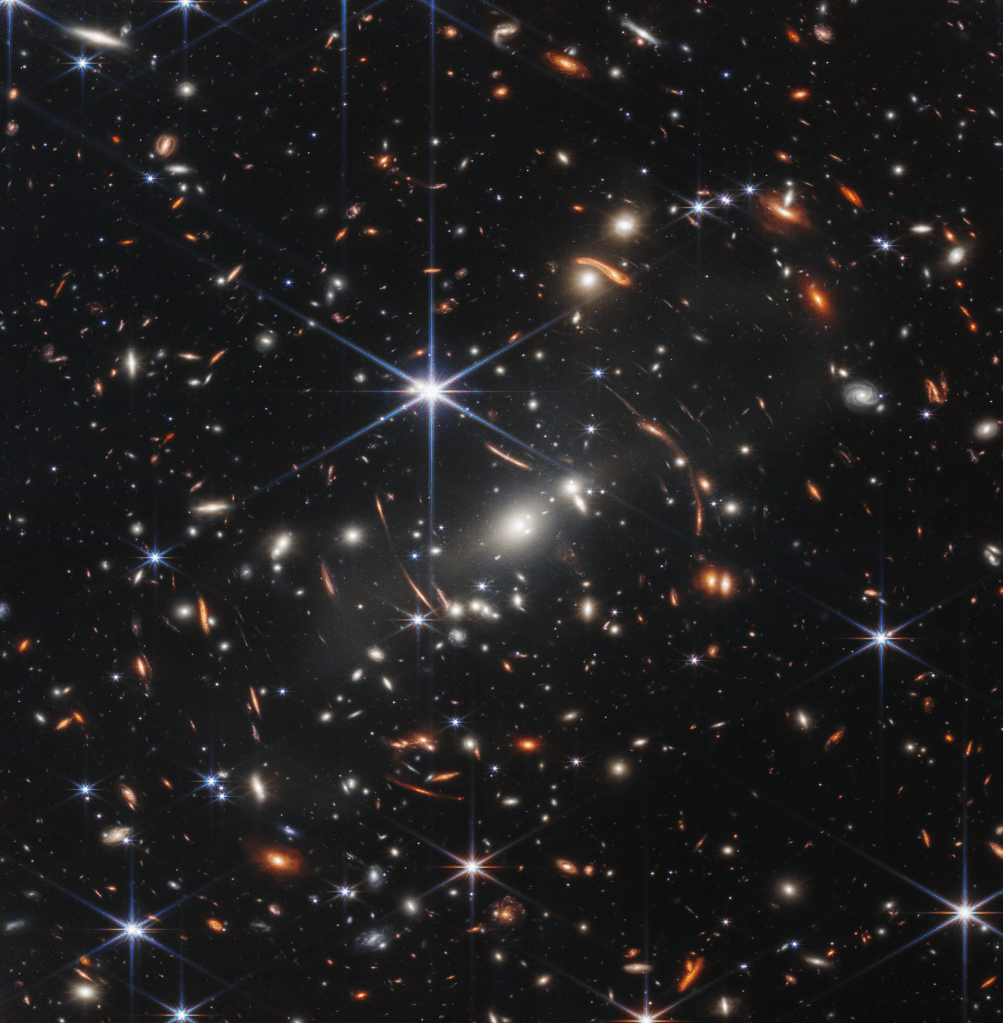
So, this week’s breaking news from NASA Goddard of the reveal of the first five images taken by the James Webb Space Telescope out in orbit of the Earth was a profoundly beautiful moment for me. Webb captured our first images of galaxies as they existed a mere 4.6 billion years ago. Those same galaxies could look very different today, yet their light has only just reached us across the vastness of Space. That image, Webb’s First Deep Field, was released on Monday evening by the White House after NASA offered a preview of the five images to the President and Vice President. Lucky them!

Webb’s First Deep Field, NASA JWST, Public Domain.

As profound as that deep field is, I was struck more by the potential offered by another one of Webb’s images, the second image released to the public which shows the atmospheric composition of an exoplanet called WASP-96 b, which is about 1,120 light-years from Earth. WASP-96b’s atmosphere confirms the presence of water on that planet’s surface, a sign of potential life on that planet’s surface. This is the part of Webb’s mission I’m the most excited about, its potential to help us in our endeavors to find out whether we’re alone in this vast Universe of ours, or if we’re one planet among many populated and teeming with intelligent, thinking, and innovative people.

I can’t help but mention the picture, which is probably my favorite on an aesthetic level, that being the image of the “Cosmic Cliffs” of the Carina Nebula, a stellar nursery located roughly 7,600 light-years distant from Earth. The vibrant colors of the Carina Nebula even unseated Thomas Wilmer Dewing’s 1904 painting The Lute from the coveted role of my computer’s background, at least for now.  A closer nebula to Earth, the Southern Ring Nebula, was also photographed. This time though instead of a stellar nursery this nebula surrounds a dying star in its cloudy sphere. Even more profound are the quintet of galaxies captured by Webb from some 290 million light-years away, old enough that its light was contemporaneous with the end of the Carboniferous Period and beginning of the Permian Period here on Earth, well before even the evolution of the first dinosaurs.

On a side note: the Carboniferous room in the Evolving Planet exhibit at the Field Museum remains my favorite room in that collection; I’ve always loved those trees.

The images released by the Webb team and broadcast Tuesday from NASA Goddard represent 25 years of combined efforts from a whole host of scientists and engineers at space agencies around the globe working together to achieve a common goal. By expanding our knowledge of the universe around us we are also demonstrating to ourselves and our descendants that it is possible to work across national divides, to achieve common goals. When we do pull ourselves out of our current string of interrelated crises and societal problems it will be because we’ve finally decided to work together as one humanity for the betterment of all of us.

We have an opportunity now to gaze into the past, to see light coming from stars that may well have died long ago. Yet with their light memories of their existence remains. With that light we’re reminded not only of what once was both out there and here on our home planet, but also of what could be in our future, of a time when maybe we will explore further afield, spread out from our home not as conquerors but as explorers. Stay curious.

Natural History

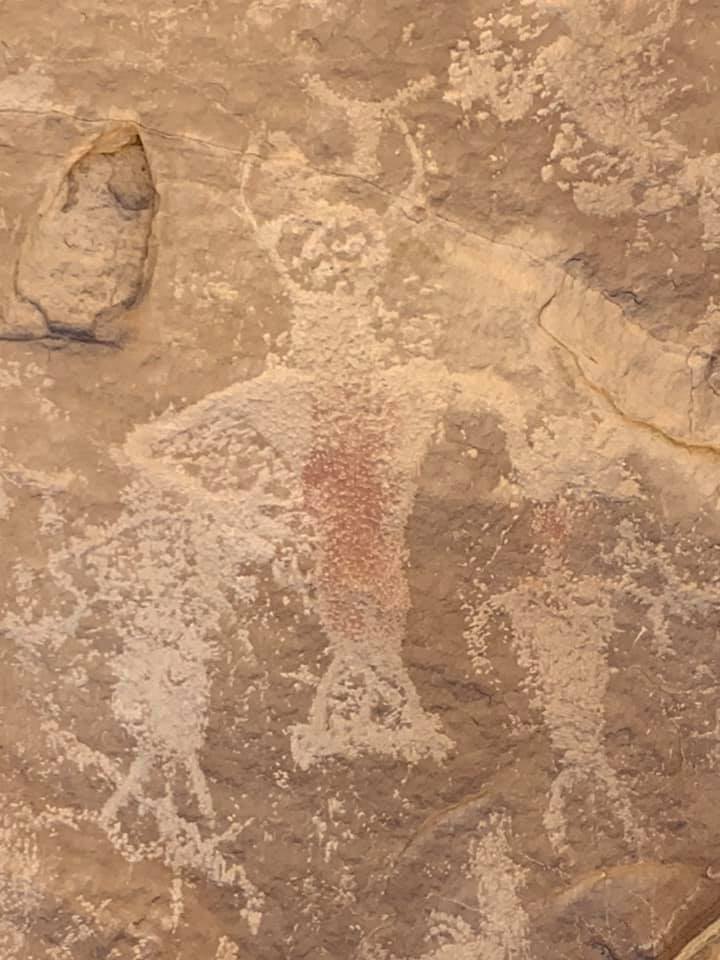
Fremont culture petroglyphs, Dinosaur National Monument. Photo by the author.
This week, I'm thinking about how we humans fit into the structures of natural history.

There’s a big problem with a lot of older anthropology exhibits in natural history museums around the globe, namely that they were built in the last two centuries often using either old and out of date information about the peoples they seek to describe, or like the old bronzes depicting the variety of humanity in the Musée de l’Homme in Paris, they were inherently racist to begin with.

Museums like San Diego’s anthropology museum have sought to rectify this with rebrandings and reorganizations. The museum in question, located in the California Tower building in Balboa Park, has recently renamed itself from the Museum of Man to the Museum of Us. Others like the Musée de l’Homme in Paris have worked to reassess how they display older historic anthropological exhibits like those old bronzes, so that today their primary message is one of “this is how people used to think, but not how we think anymore.” They’ve gone from being scientific teaching tools to historical artifacts.

There needs to be a very fine balance between lumping individual ethnicities with the rest of the natural world and actually considering humanity as a whole as part of nature. We are, after all natural beings, no matter how far we try to remove ourselves from nature with the edifices of civilization we’ve built up around ourselves. In case you’re wondering, this is a pretty central theme to the dissertation that I’m writing. In older generations, the idea of “natural humanity” was inherently understood to mean different peoples who were less civilized than others. It was used in the idea of the savage as a means of demeaning and describing the native peoples of the Americas following the beginning of the Columbian Exchange in 1492 (borrowing a term from one of my favorite historians, Alfred Crosby, here).

I’ve often thought of the world natural as being something good. Natural, or organic, food often tastes far better than the processed stuff. Natural soaps and such are less likely to harm our bodies. There’s even a style of music that I’ve called “natural” before, but only to myself. The liturgical music written by the St. Louis Jesuits, or the album Adiemus by Karl Jenkins would fall into this category.

So, if we’re natural beings, why then shouldn’t we be included in the kaleidoscope of life studied under the big tent of natural history? I for one have developed my own professional career from being an intellectual historian of the Renaissance to being a historian of late Renaissance natural history. That means I study natural history texts written between 1550 and 1600, in particular those which introduced new species from the Americas to audiences in Europe. At the time, natural history was closely related to another field called Cosmography, which while originally a theological study of the Cosmos had by the Renaissance become essentially the study of everything natural and human under the Sun. The first great proto-encyclopedias of our own modern age were descendants of the cosmographies of people like Sebastian Münster and my own focus of study, André Thevet (1516-1590), whose Cosmographie Universelle (1575) basically sought to describe everything, and yes I mean everything, that he knew about.

Today, we live at a turning point in human history. It seems like the last vestiges of the post-World War II order are finally beginning to break off, letting whatever the current century will bring be hatched from that shell born of the last century. Every century’s generations live in the shadows of their forebearers and have to figure out how to deal both with the benefits and the problems those generations left them. So, for us today talking about natural history we have the terrible realities of racism and bigotry which cloud this field and all its constituent studies. I do think humanity ought to be considered a part of natural history, ought to be studied like any other animal, but if we are going to speak of ourselves in those sorts of terms then it ought to do it in the same language across the board for all humanity, recognizing that we are all equal.

Today though, even more than any other time in our past, humanity has a critical role in the future of nature, and the stories that will be told someday in natural history. We’ve entered the beginnings of a new geological epoch, the Anthropocene, when we are the greatest influencers on the natural order of things. I’m seeing this in how many natural history and science museums have extensive exhibits on climate change, and even the handful of older ones on human biology, like my personal favorite at the Natural History Museum in London. We can try to ignore our part in shaping life on Earth, but at the end of the day as much as we’ll ignore it, we’ll end up like the proverbial unicorns who missed the boat. At that point, we will fall victim to our own pride, to our own endless thirst for more raw materials until the nature we need to survive has been stripped away. Human history has always been a part of natural history. Perhaps that’s a key to solving our current crises and all potential crises in the future: we must reckon with nature and our place within it.

Federalism vs. Regionalism

Federalism & Regionalism Wednesday Blog by Seán Thomas Kane

This week, I want to talk about some reasons that I see for why we Americans are so deeply divided. You can find the editorial by Charles M. Blow that inspired this episode here.

A few evenings ago, I read an editorial by the frequent New York Times contributor Charles M. Blow about what he called the first signs of the next civil war looming on the horizon. Blow’s argument boils down to the idea that today’s political actors on the right who accept our most recent former President’s Big Lie that the 2020 Election was somehow stolen are themselves inheriting rhetoric from former Vice President, and Senator from South Carolina John C. Calhoun. Calhoun has often been called the father of secession, the one who laid the rhetorical and political groundwork for eleven southern states to leave the Union in open rebellion, launching a Civil War in 1861, 11 years after Calhoun’s death, that would lead to around 720,000 American deaths. Just as today the Trumpist faction feeds on this Big Lie of their own creation, so too the secessionists of the nineteenth century made their fateful decision to embark on the conflict that my friend and fellow historian of Midwestern extraction Josh Kluever recently termed the “Treasonous Southern Enslavers’ Rebellion” on the basis of an even bigger lie, one that contends that there are varying degrees of humanity, some better than others, and that those degrees are understood on an arbitrary designation based on phenotype: distinctions in skin color.

If the Trumpist argument has any merit it’s that it’s a reaction to a sense that some Americans feel left behind by the dominant forces in our culture and society today. As much as being American implies that we are all one people, one culture, in the same way that old caesaropapist rhetoric would cry that under the banner of the emperor of the day there was “One God, One Emperor,” so too the idea that the United States is “one nation indivisible” makes it entirely evident that we are expected to be unified not only politically but culturally and socially as well. The great façade of this line from our Pledge of Allegiance is that we have never truly been “one nation” in any more of a sense than we share some common cultural and social bonds brought about in part through the spread of American dominance on this continent through westward expansion, phantom dreams of manifest destiny, and frequent generational rallying calls of “America First,” embodied in the idea of the melting pot that boils down all of us ethnic descendants of immigrants and makes us one common people: Americans. The South, in its misguided attempt at going it alone in the 1860s, has long recognized that it has a distinct culture from the rest of the country. We in the Midwest too are different from our cousins in the Northeast, even if we generally come from the same immigrant roots as our fellow Americans in New England or the Mid-Atlantic states. Then there’s the great gulf between the east and West, which falls somewhere in the Great Plains. During my recent visit to San Diego I mentioned to my family back in Kansas City that if any part of this country could even remotely think about successfully seceding from the Union it would be California, which is geographically so remote from the still largely eastern center of power and wealth in this country that as American as it does feel, it still seems foreign enough to my Midwestern senses as to be mistaken for a foreign country.

The greatest fault that our collective popular history has perpetuated is by smoothing out the surfaces of our past to make an easy to digest collective etiological story, a creation myth of this most artificial of countries born out of a series of settler colonies founded by the English in the seventeenth and eighteenth centuries on the Atlantic coast. Unlike the majority of countries around the globe, the United States is not a nation, it is a political collection of peoples living together in the same region of the globe. A nation is something far more ancient, its members share not only a common political leadership but common heritage going back centuries if not millennia. The purest examples of nationhood are countries like Iceland that have had little immigration to its shores, and thus a fairly stable population for generations. 

Considering this, by my estimation there are few nations today, instead many countries, states which represent the interests of the peoples who live in those places. Those peoples are often either native to those areas or varying degrees of newcomers. Yet the degree to which people are either native or newcomer is itself vague, after all would the old Bay Staters be considered at this point after 400 years of settlement on the shores of Massachusetts Bay native to that part of the world? Or are they, like the descendants of the Ulster Scots who were brought to Ulster in the same century still relative newcomers to the places that they have called home for generations?

Here in the United States, we often highlight the English and Dutch colonial heritage of our country while demoting the French, Spanish, and Russian colonial heritages of other regions beyond the old Thirteen Colonies. Our holidays commemorating the colonial period, notably Thanksgiving, commemorate the founding of one English colony on Cape Cod, and even the history behind that commemoration is flimsy at best. It struck me when I was walking through the Museum of Us, San Diego’s renamed anthropology museum in Balboa Park, that the most basic understanding of “us” as the intended audience of the museum’s exhibits are Anglo-Americans. I feel a sort of secondary connection to this idea of “us” as Anglo-Americans, after all I have old colonial ancestry on my Mother’s side going back to seventeenth-century Connecticut, and eighteenth-century Maryland and Pennsylvania, but I see myself far more in light of my more recent and familiar status as a third-generation Irish American. What was especially profound about this particular definition of “us” in San Diego’s anthropology museum was that it was being used in a city that was founded not by the English or later American settlers but by the Spanish in 1769. Sure, there were exhibits that included the stories of the local indigenous peoples, notably the Kumeyaay, but they were always the object of focus not the subject describing the object. In the process of conquest by the United States during the Mexican-American War of the 1840s, not only were the Amerindians living in the West and Southwest subjugated and demoted to second-class citizens in their own home, so too were the Californios, Nuevomexicanos, and Tejanos, the descendants of the Spanish colonists who settled in their northernmost American colonies and would later become regional identities in a newly independent Mexico after 1821. 

Similar patterns can be seen among the French of the Mississippi Basin; it’s noteworthy that Homer Plessy of Plessy vs. Ferguson fame was seen as a free person of color within the French and Spanish racial contexts, while to the Americans any hint of African ancestry deemed him to be legally black. If you want to understand why the fight for racial justice is so complex consider that firstly race is an artificial concept that was created to promote a colonial order of hierarchy, and secondly that out of these ideas of race entire notions of identity and community have developed that are very real, very powerful, and frankly beautiful. Just because I don’t feel any affinity for my legal identification as white doesn’t mean that my relatives, friends, and neighbors who identify as black aren’t in any way unjustified in being proud of being black.

Secessionist rhetoric had power in the nineteenth century because of how new the Union was. Remember how Lincoln introduced his Gettysburg Address, noting that he spoke “four score and seven years” after the Declaration of Independence from the British Empire was made in 1776. Speaking only 87 years after the conception of this idea of a country called America, populated by a people called Americans, it makes sense that some in the South would feel far closer to their identities as South Carolinians, Georgians, and Virginians among others. Yet it is interesting to me that the President of the Confederacy, Jefferson Davis, was born in Kentucky but served from Mississippi, both states that were created by the United States out of territories controlled by the Federal Government after the signing of the Federal Constitution in 1787. In short, Davis’s claim to some innate loyalty to his state before any loyalty to the Union was far less well founded than that of the father of secession, John C. Calhoun of South Carolina. I’ve written before about how I argue that the moment that the United States became more important than the individual states themselves was when the United States Congress began admitting new states to the Union west of the Appalachians that hadn’t existed before the Revolution. The first thirteen states created the Union, yet the Union created nearly every state that would follow its own founding, save a few holdouts with preexisting governments that elected to join the Union, whether by popular demand like Texas or by coup and minority rule like Hawaii.

Today though, secessionist rhetoric is less well founded on the idea that the states have some precedence over the Union and more on the idea that the power of the Union relies on the states’ and by extension the voters’ full faith in the credit and authority of the Union itself. No institution exists without that most fundamental level of trust that it can do what it sets out to do. Historically, governments have been able to hold power through a combination of force of arms and public support. This is at the heart of what Machiavelli argued about how a good prince ought to govern in the sixteenth century. The definition of what it means to be American is inherently exclusive, it relies on this identity created out of the twin foundation myths of Jamestown and Plymouth. Because of this we have seen a continual multigenerational struggle to expand that definition to become inherently inclusive, that it might embrace not only the English heritage of the oldest colonies that eventually contributed to the foundation of the United States but all the other identities, whether indigenous, colonial, or immigrant that best express the intricate mosaic of what it means to be an American.

If we do have a second civil war, whether on the battlefield or in the destabilization of the authority of the ballot box, it will be because we don’t recognize the interests and needs of our myriad of different Americans. I agree with Mr. Blow that the efforts of activists and politicians on the right in the last year to take control of government at the local level, whether on school boards or in local election boards, better reflects the true battleground of this second civil war. Yet I’d take that argument one step further and say that the fact that this focus has been so intent on assuming authority over the most local of political offices reflects more than anything else how at the local level we are still divided into our own nations, whether they be as Southerners, Northeasterners, Midwesterners, or Westerners, or whether it’s even more particular that we truly define ourselves by our towns and cities, or even by our neighborhoods and blocks. The homogenization inherent in the narratives constructed around being American over the last 245 years brews conflict with this hyperlocal level of identity that is inherent not only in we the American people, but in all humanity no matter who we are.

Being Nice and the Metaverse

In the Star Trek series set during the 24th century one of the greatest inventions known to humanity is the holodeck, a room in a building or on a starship where one can recreate anyone, anything, or any setting in a virtual reality using holographic projectors. The technology itself is very optimistic in whether we’ll ever get quite that far along with virtual reality, but it’s a neat idea. If anything today, the holodeck reminds me most of Mark Zuckerberg’s idea for the metaverse. It’s a proposed virtual reality where people can escape from their everyday lives even for just a few minutes and be someone else. Software like this has been around for a long time, I remember a few years ago trying out the program Second Life, without much success. That said, as unsuccessful as my foray into that virtual world was, I nevertheless stayed up all night trying to make it work.

Charles M. Blow wrote an opinion piece in the New York Times last weekend criticizing the idea of the metaverse for denying us some basic elements of our own humanity, in particular our abilities to socially interact and on a more fundamental level to live in the moment. Yesterday evening, a full fourteen hours ago, I sat on a park bench beneath the statue of El Cid in the Plaza de Panama in San Diego’s Balboa Park. I could’ve spent that time checking my social media accounts on my phone, the most widely available version today of what could become Zuck’s metaverse. Instead though I took that forty minutes spent on that bench enjoying the sights around me, listening to the other visitors, to the intoxicating rhythms of the music being played live in the plaza, the sounds of the classic cars parading by on a beautiful Sunday evening in one of the most beautiful cities in this country.

The metaverse can offer solitary people like me a chance to live another life from the comfort of our own homes. And as much as another life is always an alluring prospect, why else daydream, I have the life I’ve been lucky enough to lead. My story is yet to be fully written, so why would I open a new virtual blank slate and start writing all over again?