Tag Archives: Second Gilded Age

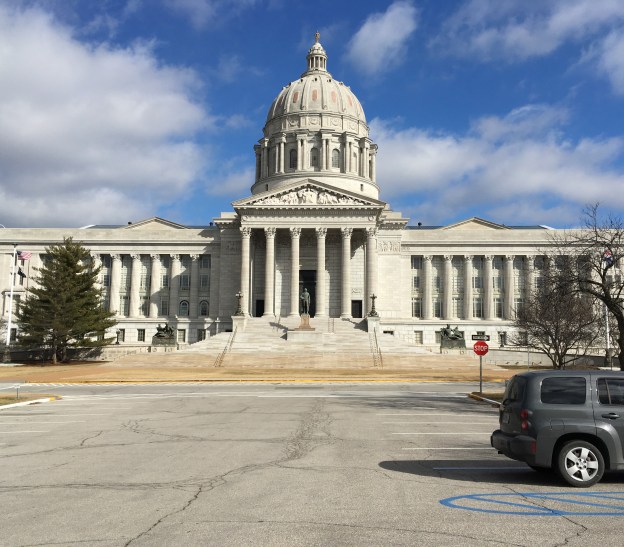
A photograph of the Missouri State Capitol building taken by the author in January 2017.

On Democracy, Part II

This week, on the current round of redistricting sweeping through Missouri.—Click here to support the Wednesday Blog: https://www.patreon.com/sthosdkane—Sources%5B1%5D “On Democracy,” Wednesday Blog 5.39.[2] “We, Irish Americans,” Wednesday Blog 6.10.[3] “On Servant Leadership,” Wednesday Blog 6.15.[4] “Freedom from Fear,” Wednesday Blog 2.6; “Embodied Patriotism,” Wednesday Blog 6.26.[5] “Governor Kehoe announces special session on congressional redistricting and initiative petition reform,” Office of the Governor of the State of Missouri, 29 August 2025.[6] “A Scary Time For Chicago | Trump Gets FOMO Over China's Military Parade | Donald's Life Lessons,” The Late Show with Stephen Colbert (3 September 2025), YouTube.[7] “A Defense of Humanism in a Time of War,” Wednesday Blog 6.24.


This week, on the current round of redistricting sweeping through Missouri.


When I wrote my essay “On Democracy” last December, I anticipated that it would be the only thing I wrote concerning the most recent Presidential election.[1] I wanted to say more, in fact I went back and forth on saying something stronger and more forceful, yet what I ended up with turned out to be just right for the moment. It remains one of the essays I’m most proud of from the Wednesday Blog. The first half of 2025 was marked by a series of essays which followed up on “On Democracy” and commented on the growing number of political crises blowing across this country and here in Missouri and Kansas especially.[2] I even found that the usual low readership numbers on my political essays was mitigated somewhat with these essays; I attribute that in part to my choice to stay positive and focus on the extraordinary acts of ordinary people that have proven essential to the course of American democracy in the last 250 years and remain vital to the continued survival of our Republic today.[3]

All that said, and as much as I am a political animal, I would much rather write about my research and about my English translation of André Thevet’s 1557 book Les Singularitez de la France Antarctique which I’m currently editing. Those are the things which make me happy today because when I’m engaged in my historical work, I feel connected to my friends and colleagues who I’ve met in academia over the years. I want to be known a historian first and a writer second. I’m learning things everyday about Thevet and his worldview that I only barely noticed when I was deep in the effort of translating his book in the first place.

Yet current affairs in Jefferson City are pressing enough that I feel it is my duty to speak up. I know there are very real risks to publishing, saying, or writing anything political today. I’m in a precarious place now as a Ph.D. candidate approaching my dissertation defense and looking at a job market that feels smaller and more threatened than it did a year ago. I know that saying anything political could make me a harder sell for many hiring committees to accept. I take this risk because it is the right thing to do.

Today, 10 September, the Missouri Senate is set to vote on a new congressional map drawn by an uncertain cartographer, possibly in Jefferson City, possibly in Washington, with the intention of ensuring that the Republican Party secures a clear electoral victory in the 2026 congressional midterm elections in spite of learned expectations that the president’s party always loses seats in the midterms after they assume office, and the living reality of our moment in which the majority party is acting to preserve its own power and the wealth of a few at the expense in the political rights of everyone else. I’ve written time and again here that my America in its purest form is embodied in the New Deal and Great Society, and in FDR’s Four Freedoms speech.[4] Sure, we haven’t gotten there yet, all that means is we should keep working for it. America is a shining beacon of democracy for all the world to see, even if that beacon’s shadow often also shows our flaws played out before it like hand-puppets on a screen. Democracy requires participation; it’s the greatest form of government we’ve yet invented because it requires the most of the governed to understand how government works and to participate in their own government for the common good.

This new congressional map is not democratic. In fact, it is the anthesis of democracy. In his statement announcing the Republican supermajority’s push to force this map through the Missouri General Assembly, Governor Mike Kehoe openly stated that this map is intended to protect “Missouri’s conservative, common-sense values should be truly represented at all levels of government, and the Missouri First Map delivers just that.”[5] This was expected, yet still bold by a sitting governor to be so openly one-sided. On Thursday, 4 September, the window to submit written testimony on the redistricting bill opened on the Missouri House of Representatives’ website. I sent in the following statement:

In his statement announcing this new mid-decadal redistricting effort, Governor Kehoe explicitly said this was to preserve “conservative values.” With that out in the open, I want it to be known that if this map is intended to support conservative party politics in Missouri, then it impedes on the rights of all of us moderate, liberal, and progressive Missourians. It is a blatant abuse of power that targets us Kansas Citians in particular. I want to see Missouri create a nonpartisan independent board which draws the electoral maps, so they are fair for all Missourians. I ask the committee to reject this redistricting map for its blatant partisanship and the fact that this redistricting process is costing the taxpayers’ money that could and should be spent elsewhere.

This is the sum of it. I do not think it is hyperbole to say that my own political rights are under threat by this bill. Rather, what was once extreme is today expected because any rules we had for electoral fairness have been thrown out the window. It’s true that both parties gerrymander their congressional maps, but the Republicans do it far more. It’s also true that the Democrats are gerrymandering congressional maps in the states that my party controls. I want independent redistricting maps in all 50 states, the District of Columbia, Puerto Rico, and every territory. That should be our goal. Yet in this moment we need to fight for democracy to save it. This is a struggle here in the United States, yet it is being felt around the globe. Who else is as influential in world geopolitics today who could take up the mantle of democracy if we discard it? What keeps striking me about what the Republicans are doing is that it is all for short-term goals that masquerade as solutions to the country’s problems. What I and many like me want are long term solutions that will actually resolve many of those problems.

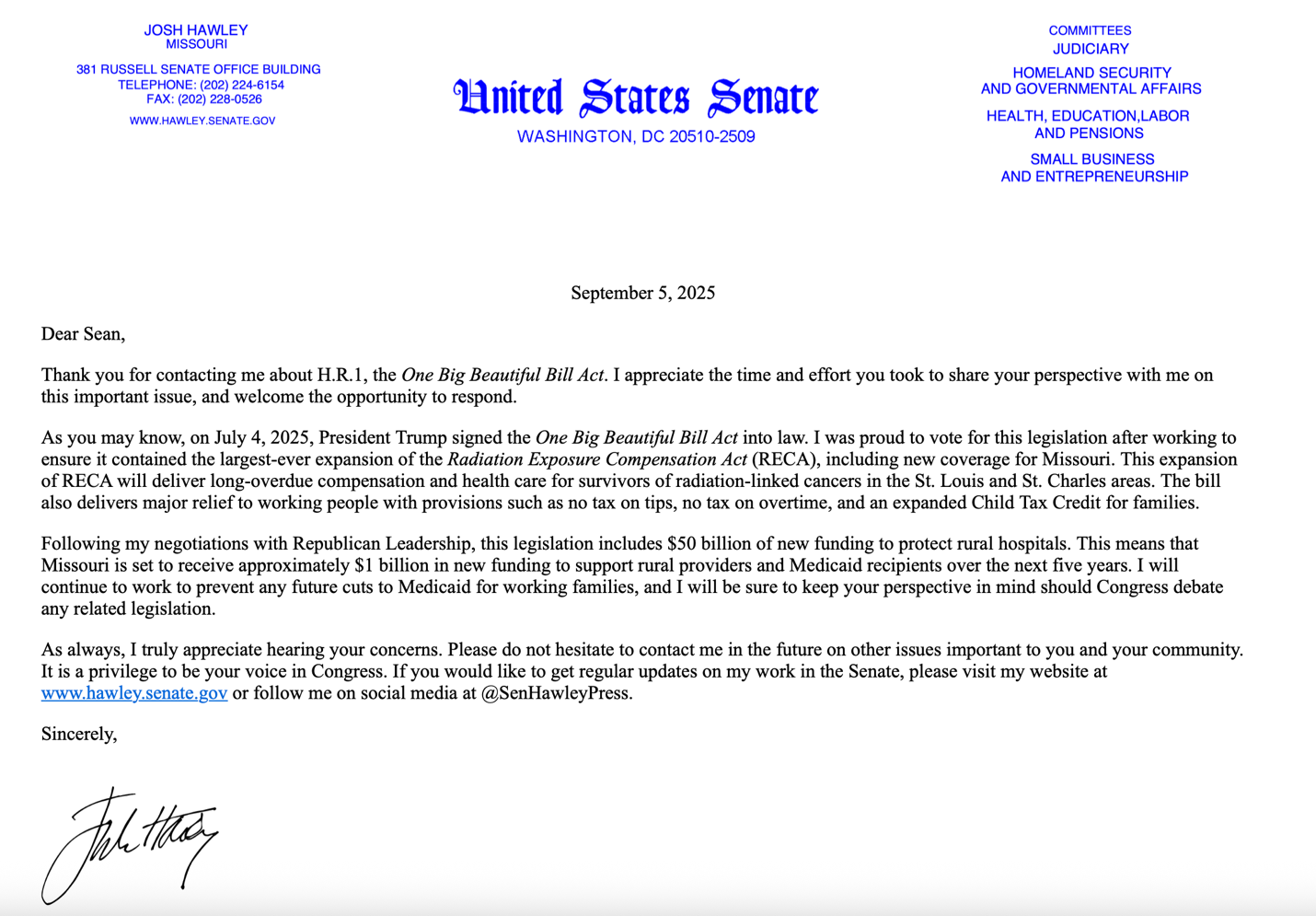
With this new congressional map, I and every other moderate, liberal, and progressive on the Missouri side of Greater Kansas City will lose all federal representation. We currently are represented in Congress solely by Congressman Emmanuel Cleaver II, who has served this city for many decades. I regularly send emails to our senators, Josh Hawley and Eric Schmitt about a variety of issues that I care about from restoring funding to the National Endowments for the Arts and Humanities (NEA, NEH) and the National Science Foundation (NSF), to my fears of presidential overreach with so many executive orders which seek policy changes that by law can only be made through acts of Congress. In every instance, the response I receive has nothing to do with what I wrote. In the case of an email I sent to Senator Hawley concerning my fears over my profession’s long-term viability in this country as federal funding to universities and research institutions is threatened for political reasons, I received an email back lauding the Big Beautiful Bill and all the good it will do for America. A screenshot of that email is included below.

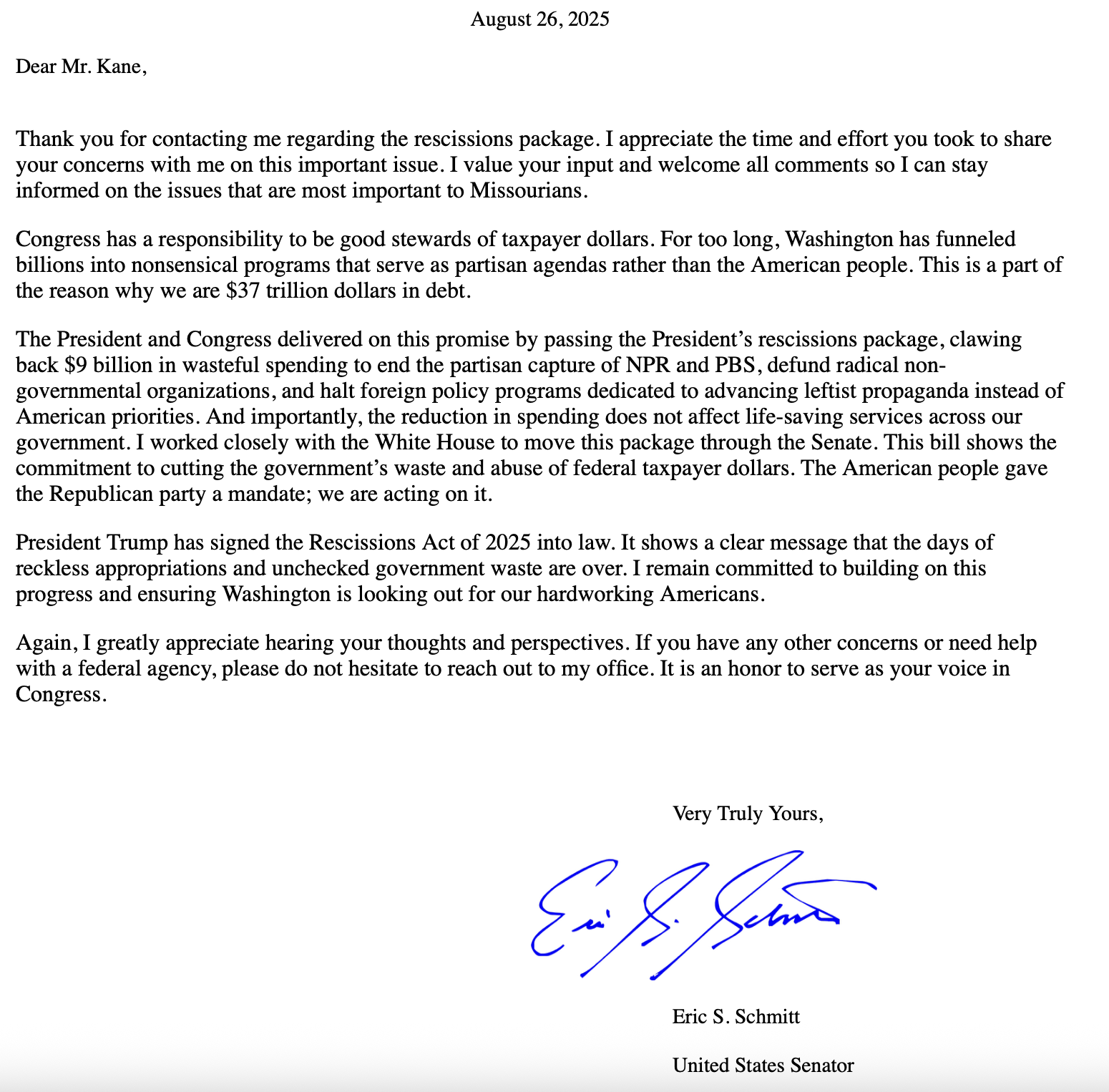
Meanwhile, Senator Schmitt’s office only responds with campaign emails pretending to be official senatorial correspondence. This ought to be illegal in my opinion, and a version of the Hatch Act of 1939 should be passed for the Legislative Branch to keep Members of Congress from using their official correspondence to actively campaign for their offices. I have a folder filled with all of the emails I’ve received from his office since April 2024 and normally they will go directly into that folder. Yet there was one email his office sent me in response to my concerns over cutting funding to the Corporation for Public Broadcasting which was such a blatant example of his dismissive approach to his constituents who disagree with his views that I became pretty angry. 

So, I called his Washington office, realizing as the phone was ringing that it was after business hours in the East, and left a voicemail. In summation, I challenged him to actually address his constituents’ concerns. I borrowed what I imagine is the lingo of the manosphere, a foreign corner of the Internet to me and challenged him “man to man to stop being a coward and do his job for all Missourians, not just those in his own party.” I haven’t gotten a response to that one, whether by email, phone, or letter. This is not how I like to talk to people, let alone write to them. I would rather find ways to speak to people in their own language to lift them up. I’m my worst when I lose that sense that I can say or do something that will make the lives of the people around me better.

It’s in this spirit that I decided to write again this week about democracy. Any form of representative government requires that we trust in each other for it to function. This is one of the central tactics of the current majority party. The President recently called the city of my birth a “hellhole,” something that I take personal offence to. I appreciated Stephen Colbert’s response, especially the heartfelt final two words of it.[6] In my essay “A Defense of Humanism in a Time of War” I wrote that I don’t want to be known as a pacifist because there will always be schoolyard bullies to contend with.[7] The people in power today here in Missouri and the slim governing majority in Washington are the biggest bullies this country has seen in a long time. They evoke the worst aspects of America, the greed that embodied both the First Gilded Age and the garishness of this Second Gilded Age in which we live. Not content with letting the democratic process that brought them into office work as it has for over two centuries, they insist on doing what they’ve accused their opponents of doing: rigging the electoral process in their favor. They clearly do not trust us, so why should we trust them?

Democracy is nourished by a love of neighbor. American democracy in particular is built upon a bedrock of idealism that we are still trying to achieve. That is what we need to work on. Robert Reich, the former Secretary of Labor, argues that we are on the verge of a second Progressive Era, a time of tremendous political reform. We who oppose the Missouri supermajority and the thin ruling majority in Washington need to remember that end goal. We need to sustain the democratic spirit through this time of trouble so that we can have a better tomorrow. I’m writing this knowing the risks because I feel it’s my duty as an American. I will always stand up for my neighbor regardless of if we agree or disagree on a given topic just as I will stand up for my colleagues, students, friends, and family because it’s the right thing to do.


[1] “On Democracy,” Wednesday Blog 5.39.

[2] “We, Irish Americans,” Wednesday Blog 6.10.

[3] “On Servant Leadership,” Wednesday Blog 6.15.

[4] “Freedom from Fear,” Wednesday Blog 2.6; “Embodied Patriotism,” Wednesday Blog 6.26.

[5] “Governor Kehoe announces special session on congressional redistricting and initiative petition reform,” Office of the Governor of the State of Missouri, 29 August 2025.

[6] “A Scary Time For Chicago | Trump Gets FOMO Over China’s Military Parade | Donald’s Life Lessons,” The Late Show with Stephen Colbert (3 September 2025), YouTube.

[7] “A Defense of Humanism in a Time of War,” Wednesday Blog 6.24.


Notes on Carruthers Smith’s Museum

Notes on "Carruthers Smith's Museum" Wednesday Blog by Seán Thomas Kane

This week, some notes on the story I released here last week, more about Carruthers Smith and the other stories who populate that tale. — Click here to support the Wednesday Blog: https://www.patreon.com/sthosdkane


This week, some notes on the subtext and background of my story “Carruthers Smith’s Museum” which I released in this blog last week.


            This story about Carruthers Smith was born out of a dream I had at some point between 5:00 am and 9:00 am on Saturday, November 23rd, 2024, after a late night working at the Kauffman Center for the Performing Arts. I often have quite thematic dreams like this one, and so when I woke from this particular dream, I knew I had a story to write. The dream itself only lasted as far as Part I of the story you will have just read, or perhaps heard if you prefer the podcast version. I began writing it shortly after waking and finished it close to 3:00 pm on that same Saturday. It proved therefore to be one of the quicker ones that I’ve written in quite some time, though one of the stranger ones at that. I wanted to write out several notes about the story, its characters, and its setting so you might better understand the subtext behind the story, and to preclude any other interpretations of what I’ve written.

            In my original dream none of the characters had names. I observed the action from the perspective of Agent Pat O’Malley, which is why in the first part of the story he is the narrator. In my original dream he was filing some sort of metallic slide rule for the character that became Carruthers Smith, a reversal of roles as in the dream I was initially there to interrogate Smith for some uncertain cause. The setting of the story, Carruthers Smith’s Museum, was there in the original, though now writing this nearly 18 hours after waking today I remember it looking more like an art gallery built on a platform above the sanctuary of some old Upstate New York church with a big square base to the bell tower and a more Victorian looking wooden exterior that I often saw in the small villages in Broome, Tioga, and Tompkins Counties on my drives between Binghamton and Ithaca when I lived in Binghamton between 2019 and 2022. Agent Penny Wilson’s character was in the dream yet taken off-stage by Smith’s accomplice, trapped somewhere, yet my character couldn’t prove they were so entangled and thus I had no reason to properly accuse Smith’s character. At that point of desperation, I awoke and began writing.

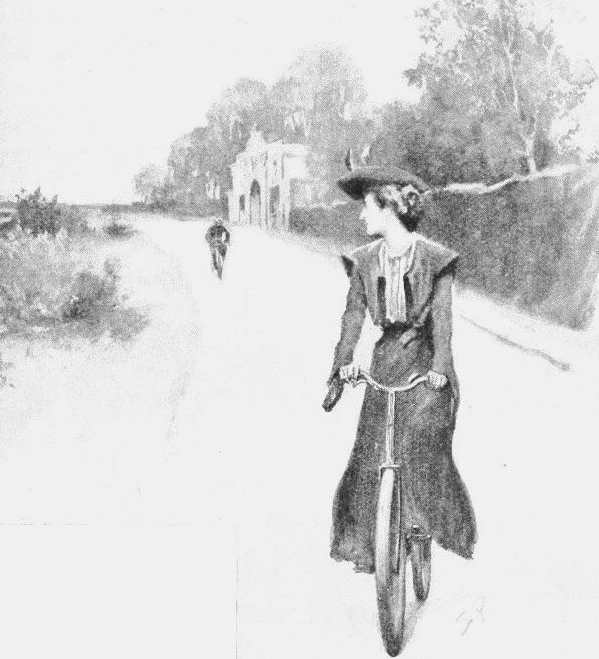
            My characters’ names are always quite intentional and tell more about the characters than their actions or dialogue in the story might convey. Carruthers Smith was the first character who I named in this story. I wanted the villain to be a looming WASPish figure, the last scion of the Gilded Age living a recluse in this vast museum he built for himself somewhere far from the great cities of the Northeast yet still within a day’s drive of any of them. I settled on Southeastern Delaware as the setting simply because it seemed most practical for the federal agents to drive there from Washington than if they were in New Jersey, on Long Island, or on Cape Cod. Lewes became the setting for the story because I’ve always liked that name and its connections to the county town of East Sussex in the south of England. I went back and forth for a minute between the names Smith and Jones; several weeks ago, I’d gotten the idea for a story about a man who is always wrong about everything named Erroneous Smith, which I haven’t written yet though I took aspects of his sketched character and took them into the less comical Carruthers Smith. As for his first name, I drew that from an old Sherlock Holmes story, “The Adventure of the Solitary Cyclist” published at the beginning of 1904 in The Strand Magazine in London and a month earlier in Collier’s in New York. The 1984 Granada TV adaptation of the story featuring Jeremy Brett as Mr. Holmes was my introduction to the story and remains etched into my memory from watching that series in the early mornings on PBS during my high school days. Carruthers is one of the two suspects in Conan Doyle’s story, and it’s a British-enough name that it felt fitting for the old colonial New York type of person I was looking for.

Sidney Paget’s art in The Strand edition of Sir Arthur Conan Doyle’s “The Adventure of the Solitary Cyclist” (1904). Public Domain.

            The federal agents were all named in quick succession. Bill Hardy is named to make him appear as non-descript and American as I could with a nod to the Hardy Boys. I know a lot of Bills, though none from Buffalo, and so it seemed a fitting name to use here without nodding to one in particular. Pat O’Malley drew from the idea that I can best write from the perspective of someone like me, that is a fellow Irish American. My family comes from the townlands around Newport, County Mayo a part of the country which before colonization was ruled by the O’Malleys and Burkes. Everyone around Clew Bay is related to some degree or another if you go far enough back, and I have a handful of O’Malley ancestors myself. Patrick was an easy choice, it’s the most accepted Irish name in the English-speaking world, with my own Seán in all its phonetically spelled variations reflecting each country’s version of English coming in second, though Liam, the Irish version of William, is quite popular now too probably thanks to the recently buried Liam Payne of One Direction. Penelope Wilson was a harder one to name. I’ve used the name Penelope in my long awaited second novel in my romantic comedy series which I dramatically call the Plumwoodiad and was hesitant to use it again. It’s in part a nod to Penny Hofstadter in The Big Bang Theory, one of my favorite TV shows, yet more so a nod to the original Penelope in Homer’s Odyssey. At one point when I stepped away from my desk yet was still engrossed in this story while making breakfast, I considered putting a line in there about her having to wait a long time to find a man who can string her husband’s bow. The name Penny was intended to give her a deep well of resilience and strength that she would call on to save everyone else from Carruthers Smith. Wilson was another choice of trying to make her sound as American as possible, and while I did have President Woodrow Wilson in mind a bit here, I also thought about Robert Sean Leonard’s character Dr. James Wilson in the Fox series House in mind with this name.

            I didn’t initially plan on making everyone else in this story Irish Americans. This is something which makes me laugh now thinking about it. I’ll make a small digression here, if you’ll permit me. When I was in elementary school, I remember one day my teacher brought out a stack of books for us to all read together as a class that was about a character who she said, “was from an ethnic group that aren’t often talked about in books.” I remember thinking then how the only book about Irish people or Irish Americans I could remember reading in my school was Tomie de Paola’s picture book about the life of St. Patrick, the namesake and patron saint of my elementary school, St. Patrick’s in Kansas City, Kansas. That’s nagged at me since, and I do think we Irish Americans tend to get forgotten because the Carruthers Smiths of this country have largely accepted us as white in the last sixty years since the first of our kind was elected President. It’s often forgotten today how we Irish Americans were reviled by the old English colonial population in this country for a long time. I heard some stories about this, and in the older histories of my alma mater Rockhurst University, there are stories of Rockhurst students in the 1920s and 1930s sneaking into Klu Klux Klan rallies to try and fight back against their banality. And yet, all that fit neatly into the background of Carruthers’s assistant, who I decided would be a first-generation Irish American, whose parents crossed the Atlantic during the big wave of migration among our people to this country in the 1890s. That character developed into Peter Dougherty. I had to be careful here, the first couple of names I gave him ended up being changed because I realized they were the names of actual people I know either in the Kansas City Irish community at large or nationally among my brothers in the Ancient Order of Hibernians. I imagined Peter was a sort of Bob Newhart type character who spent his early life trying to get by amid the shifting tides of the world around him, and once he found Carruthers Smith he was eventually willing and able to give up on trying to just survive and instead enjoy something more comfortable even if it meant sacrificing the woman he loved. That woman became the penultimate character I named in this story. At first her named was Bridie McGinty, Bridie being a pet form of the Irish name Brigid, yet that changed near the end of the story when I decided instead to name her after my great-great aunt Delia McDonnell who came to America from Ireland in the 1940s or 1950s. yet I had a mental image of her from the start. She was going to be a cross between Mamie O’Rourke in the 1894 classic song The Sidewalks of New York, Dorothy Day, and many of the women who I’ve known in my life who day in, and day out work in the schools and hospitals and for nonprofits trying to make life better for others. There’s a subtle yet profound truth in this: if you make life better for other people who’re worse off than you are, it’ll eventually make your own life better too. Call it trickle-up economics if you will. Lastly, there was the town doctor, who got the name Ronald out of a desire to find something that felt like it’d fit a character born in the 1940s or 1950s, and Yancey because it was the end of the story, and I was looking for something at the end of the alphabet.

From Ric Burns’s New York: A Documentary Film, sung by Robert Sean Leonard who already got a mention in this blog post.

            Let me say something briefly about the time in which this story is set. From the first moment I thought of this story taking place in 1990, thirty-four years ago. I felt this was far enough removed from the turn of the twentieth century to have much of the off-stage action feel removed yet still before the millennium which feels like a profound break in time in my own life. I did have aspects of the lived environment of the 1979 Peter Sellers film Being There in mind when I thought of the décor and technology that Carruthers Smith would have in his museum, where the building itself was largely designed forty years earlier in the first few years just after World War II, yet the technology kept getting updated to a certain point at which Carruthers no longer felt comfortable replacing things. I’ve seen this in people who prefer to stick with certain technology that they’re most familiar with even if many years or decades have passed since that technology has been commonly sold or can be repaired with replacement parts on hand with the manufacturer. Doing the math here, this places Carruthers Smith’s birth in 1914, Peter Dougherty’s in 1899, and Delia McGinty Dougherty’s in 1898. The agents meanwhile are largely children of the 1950s and 1960s, with Penny Wilson the youngest at around 25 years old. It seemed less important for me to settle their ages than it did the characters in Carruthers’s orbit. There is something of the nostalgic for me writing about characters in the seventies, eighties, and nineties who were born in the decades just around the turn of the twentieth century. These birthdates were the norm for the oldest generations when I was born in 1992, and today I do miss something of the expectation that my great-grandparents’ generation born between 1890 and 1918 would still be living in our world with us today. I in fact only met one of my eight great-grandparents, the last of them to be born, who died when I was three years old.

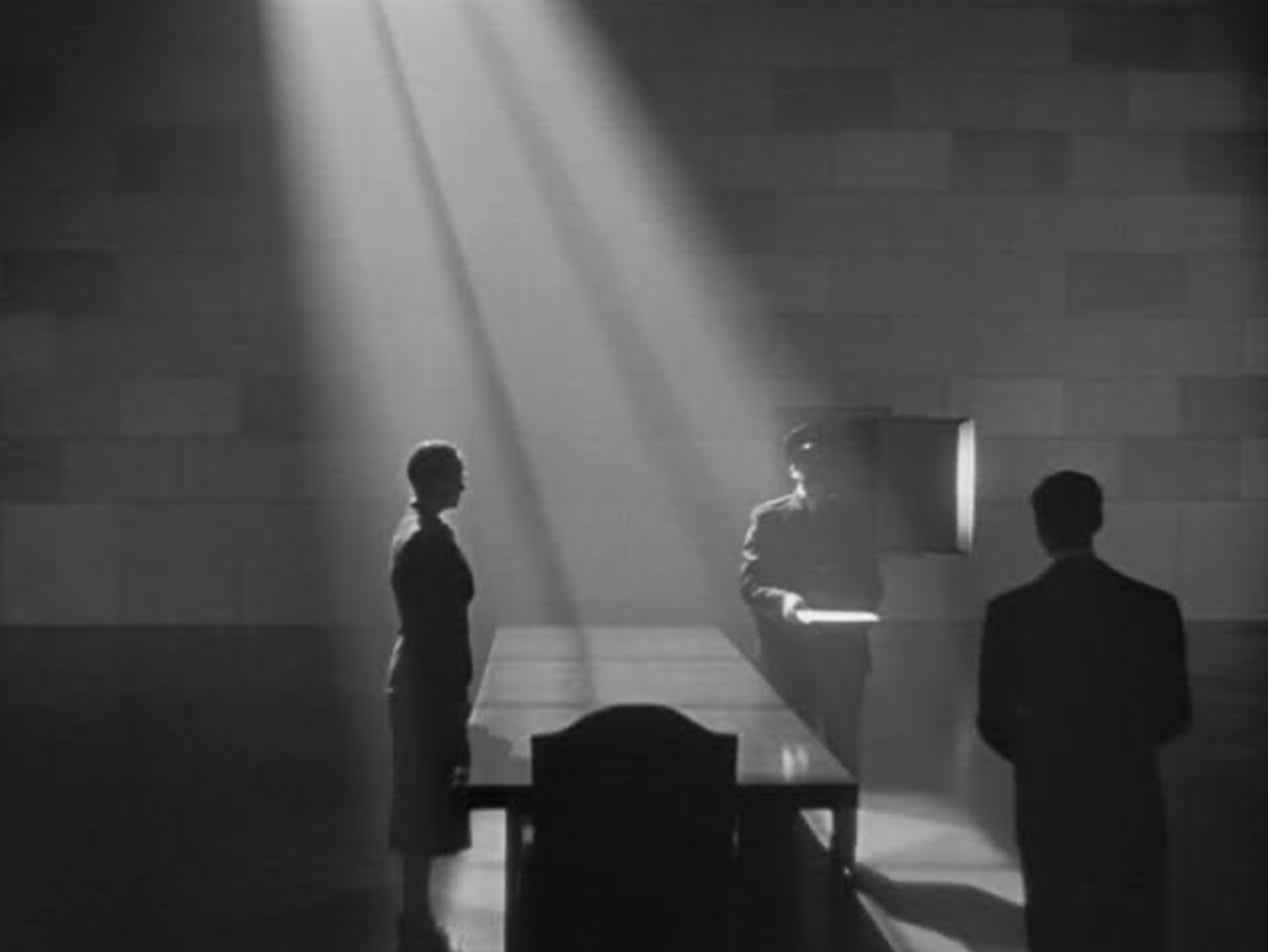
The Walter Parks Thatcher Archive in Citizen Kane

            Finally, I want to end by addressing the museum itself. I love museums, or musea as Carruthers would surely use the Latinate plural of that word, and so Carruthers Smith’s Museum was intended to be a twist on that happy place of mine as it was in my dream. The museum is made of one long gallery whose white walls and white marble floors match the place where I work yet whose shape is more akin to some of the galleries at the Corning Museum of Glass in Corning, New York, yet I often thought of how it appeared with its own internal lighting in a manner similar to the private archive of Walter Parks Thatcher in Citizen Kane with its long shadows and stark surfaces. That warm and welcoming space is twisted however when you remove all of the art from its confines except for something that seems eerily out of place. The great rubber artifact is a phrase that made me laugh the first time I wrote it, and yet what’s essentially a giant eraser-shaped blob of milky white goo became the unintended means of Carruthers Smith’s fall into depravity. Was he ever afraid of it? I think so at first, yet by the time we met Carruthers he’d lost any real desire to live and was happy to have something that could take his life at any moment be a constant presence in his life. He may have once loved another, he may have once been happy with his success, he may have once believed in being the patriotic good boss whose tires helped drive the Allied advances across North Africa and Europe, yet by the time we meet him he is so jaded about life itself that he sees no reason to cherish it. I imagined this rectangular piece of rubber standing atop a foot-tall podium, with the object itself reaching up to about six or seven feet in height, so it would tower over anyone who approached it, yet not by too much. Was the rubber alive? Perhaps in a sort of imagined monstrous way, yet only as much as a Venus fly trap is alive.

            The giant rubber monolith in the center of the room stands for the corruption at the heart of Carruthers, his willingness to sacrifice others for his own success. His two-faced approach to people like Peter who keeps the keys to his house, yet he still sees as little more than a servant speaks to just how morally bankrupt Carruthers is. Here is a man who was once on good terms with presidents for his wartime industrial service. In one line which I cut he admitted for the first time how on the morning of the 1948 election he voted for Dewey and then put a call to President Truman to wish him good luck because if Truman thought Carruthers Smith was a friend then maybe he’d sign another contract for more tires and tank treads for the impending war in Korea. Money for the sake of money alone is the corruption at the heart of this man, a heart that’s been hollowed out so he can hide away even more of his gains. He is the true face of an oligarch who puts on a nice mask for the sake of selling his wares in a democracy yet would rather all the nice people who buy those goods stay out of his way and leave the governing of society to the captains of industry and their cronies in government.

            Carruthers Smith then is a warning, a vision of the last echoes of the First Gilded Age at the dawn of its successor. All the successes for expanding suffrage, workers’ rights, and improving our education, healthcare, and overall quality of life are at risk if we allow the oligarchs of today try to return us to a limited regulation small government policy of the late nineteenth century. If we let the wolves into the henhouse the chances are good that they’ll turn it into a buffet for themselves to feast upon while everyone else is left out in the cold to fight over scraps or starve. Of all the federal agents who seek to bring Carruthers to justice, it’s Penny Wilson who is successful. Without her tenacity or her compassion for Peter Dougherty that reinvigorates his soul after decades of uneasy slumber in his boss’s shadow, Carruthers would have remained at large, a glowering menace on the far horizon of the seat of our democracy. The youngest of all the characters in this story is the one who saves them all.


Carruthers Smith’s Museum

Carruthers Smith's Museum Wednesday Blog by Seán Thomas Kane

This week, a story about excess and secrets all in a museum built by an old reclusive Gilded Age tycoon named Carruthers Smith. — Click here to support the Wednesday Blog: https://www.patreon.com/sthosdkane The episode artwork this week was generated by Dreamstudio. I really need to get back to sketching.


This week, we join a team of federal agents as they investigate a strange museum owned by a reclusive Captain of Industry that has never opened its doors to the public.


Part I.

            I arrived at Carruthers Smith’s Museum just after 4:15 in the afternoon after nearly a three hour drive out from D.C. and across the Chesapeake Bridge and most of Delmarva to Lewes, Delaware where the reclusive tycoon had taken up residence nearly fifty years before. My office began tracking his investments five years ago, when my colleague Bill Hardy was on the case, but just last week when he came out here to this beach town he never returned. My partner, Penny Wilson, joked when we were leaving the Hoover Building’s garage that Bill must’ve gotten distracted by the beach and stuck around for an unannounced vacation. Whatever the case, Smith’s file was dropped on my desk, and I was sent out to the Delaware Shore to see what became of Bill, and then to pick up where he left off investigating Smith’s Museum. There was something that didn’t make sense about a museum that had never opened to the public.

            Carruthers Smith was one of the titans of the rubber industry, his tires and tank treads had helped us win the War in Europe, for one, and he was lauded by every administration since Franklin D. Roosevelt for his service to our country as one of the good, charitable captains of industry. His father was a strong supporter of the Taft Administration, having had his wings clipped by Theodore Roosevelt’s trust busting, and his grandfather one of the great Wall Street investors that supported Republican nominees from Grant through McKinley. The Smith Company hadn’t started with rubber tires, first they were a shipping company that cornered the market for trade between Rio de Janeiro and New York. They even helped keep an eye on ex-Confederates who’d escaped to Brazil in 1865, reporting on their whereabouts to Union authorities. Thanks to their deep connections in Rio as well as New York, they were well placed to corner the developing rubber market when it appeared almost forty years before Carruthers Smith was born. All this is to say it took a lot for any federal agency to be willing to investigate a good tycoon when there were plenty of rotten ones out there who ignored their workers’ safety or were notorious union-busters or preferred to outsource their factories overseas and flood the American market with cheap goods that were easily breakable and commonly known among the public as generally worthless. Smith Tires were different, they were sturdy and dependable, far more so than any competitor. They were especially good traveling over sand, so much so that the Army still kept a contract with Smith for tires for any future desert operations.

            Still, Penny and I were there in front of Carruthers Smith Museum, our car parallel parked with the handbrake on Franklin Avenue. It was a very modern building, white walls that showed some of the characteristic curves of the Art Deco, yet it seemed less brutalist than the Hirshhorn and more akin in color to the Guggenheim in New York. There seemed to be no front door where you could queue to enter, but there was a smaller service door off Franklin Ave. that I could see from the driver’s seat. “Do you think that’s it, Pat?” Penny asked.

            “Yeah, that seems to be it. Let’s go ring the bell.”

            We got out of the car and walked into this small service driveway and up the five concrete steps that led to the service door. There was an industrial-type doorbell affixed to the wall at the top of the steps next to a door that on closer inspection turned out to be steel painted white to match the rest of the building, yet it had no window through which the respondent could see their visitors or vice versa. I rang the bell, holding down the button for a good two seconds. “Mr. Smith, this is Agents Patrick O’Malley and Penelope Wilson of the FBI, may we come in and talk to you?” We waited for another thirty before a buzzing announced to us that the metallic lock on the door was released, and we were allowed entry.

            We found ourselves in a sort of room that could be a back office, it had denim blue carpet, and high wooden walls around which were photographs of the museum under construction beginning from the laying of the cornerstone in 1942. An old wooden desk stood to my left; it reminded me of a smaller version of the Resolute Desk that sits in the Oval Office. Before us was a set of stairs that led three steps up to another door. This one had a window, yet it was high up in the door, and thus too high for either of us to see through it. Yet there was light beyond it that seemed to dance off the high white ceilings of the room beyond. I nodded at Penny, and she walked up the steps and opened the door. The room beyond seemed minimalist in nature, yet it was still quite large. “This must be the museum,” Penny said.

            “It looks that way,” I replied, scanning left and right as we entered the room beyond. There was a high angled white wall to our left in front of us, blocking our view beyond to whatever was to the south in that room. To our right the room continued for some uncertain distance, its white tile floors fading into the darkness at the far edge of the room. There didn’t seem to be any art on the walls of the museum, nothing here displayed. What could Carruthers Smith have been collecting these last 50 years? Beyond the angled wall in front of us light danced on the ceiling from something metallic. I proceeded cautiously, my gun still holstered, as was Penny’s, yet we both knew we could draw in 3 seconds at least and be on guard. The heavy sounds of our shoes clicked across the floor as we rounded the corner and found a small metallic box on a table in front of a large glass display case standing erect that housed a large rubber object, rectangular in shape, and standing at least 6 feet tall. It seemed taller being up on a podium. I looked up at it, confused what I was seeing, “maybe it’s the largest single piece of rubber the Smith Company has ever produced,” I quipped to Penny.

            “It is in fact,” came a voice from behind us. We turned to see Carruthers Smith standing there, a tall man who once might have been the eye of many a high society debutante. He was slim in frame, wearing a gray double-breasted suit of the kind not often seen since the early 1960s. “This is the largest single piece of rubber that my family’s firm ever acquired and sought to study. How do you find it, Agent Wilson?”

            Penny looked back at it, “it’s a little unsettling, how is it held up in the case?”

            “You are welcome to walk around the back and discover that fact for yourself,” Carruthers replied in a slow, tenor voice that betrayed hints of the Transatlantic accent he and his class used decades ago.

            Penny looked at me and I nodded approval, sending her around the case to its right to ascertain the supports for this piece of rubber. “How is it standing on its own?” she asked with incredulity seeping through their voice.

            I walked left around the case and found her behind it looking for where some sort of supports ought to be yet instead there was nothing. The rubber artifact instead stood erect inside the case, not leaning on it or putting any pressure on the glass that could shatter it. Carruthers appeared behind Penny, “it truly is a wonderous specimen, one that was brought to our office in Rio from deep in the Amazon in 1941, on the same day that the Japanese attacked our fleet at Pearl Harbor. My agent who ran the Rio Office then, a Senhor Dos Santos, said that anyone who touched it felt as though they were touching something that seemed alive.”

            “Alive?” I asked, quizzically raising an eyebrow.

            “Yes, Agent O’Malley, this artifact was alive when it arrived here in early Spring 1942. I had it shipped into our wharves in Jersey City where it was loaded onto a train and brought to Lewes where I could study it myself.”

            “Mr. Carruthers, I know your family’s connection to this town doesn’t go back very far, didn’t your father have a summer cottage here?”

            “No, most of the family would summer in Newport, Rhode Island with our friends, yet I was the one who enjoyed the waters further south here in Delaware and found Lewes a fine enough little town to build my summer cottage here,” Carruthers replied, never dropping his hint of a smile.

            “When did you first come here then?” Penny asked.

            “In 1932, an 18 year old looking for something profound and reclusive in life. I’d read Thoreau you see; Walden inspired me to seek new things beyond the family firm or society life in New York. The Depression brought land prices low here, and I thought I might be able to help the local people. I provided tires at a 33% discount to all residents of Lewes, which ingratiated myself to their company.”

            “Is that why you built this museum?” I asked.

            Carruthers looked around him at the cavernous space, its white walls and white tile floors made the space feel monochromatic and minimalist. “I built this museum to house the treasures I’ve collected in my years, things old and new, mundane and,” he gestured to the rubber artifact before us, “wonderous.”

            “But why haven’t you opened it to the public?” I asked, “Surely this would be a testament to your life and work like the Carnegie Museums in Pittsburgh or the Freer Gallery in Washington?”

            “I never felt that it was complete and ready for the public. There was always something missing, something which I couldn’t quite place. I’ve been collecting for this museum now for 58 years ever since I first arrived in Lewes, and still the museum is not yet finished. But you, dear agents, have come a long way, surely you have business to attend to?”

            I looked at Penny who nodded and walked back around the display case. We followed behind her to the metal table that stood beyond. “Mr. Smith,” she began, “we are here to ask two questions. An agent of ours, Bill Hardy, came here a week ago to inquire into the contents of this museum that has never opened and ensure they are all legally in the country, and he has yet to report back to the office since. So, we are here both to see if you know what might have happened to Agent Hardy and to complete his assignment.”

            “I met with Agent Hardy when he arrived here on the 10th, he seemed to be in a hurry to return to Washington, so I didn’t want to detain him too long. As to his investigation into this museum, you can find the effects of that effort on the table here,” Carruthers motioned downwards toward the metal table between them where a single silver box was placed in the middle.

            “Sir, are you here alone?” I asked.

            “In fact, I have one assistant here with me,” Carruthers motioned to a man who only just seemed to appear from the corner of my eye. He wore a dark green museum guard’s uniform, with a black necktie on a white shirt. “Have you met Peter Dougherty? He’s one of your tribe, a fellow Irish American born in Brooklyn.”

            I turned to see Peter more clearly and saw a wizened old man, at least 80, who looked back at me with tired eyes. “How long as Mr. Dougherty been working for you?” I asked.

            “Peter was hired by my father as a warden to keep watch over me in my youth, in 1929 I believe.”

            “That’s correct, Mr. Smith,” Peter replied in a low baritone voice.

            “And you’ve been with Mr. Smith ever since?” Penny asked.

            “That’s correct, Agent Wilson.”

            “Peter served in the first war in the trenches under my Uncle George’s command, and after the war when lost his job after Black Tuesday, my dear uncle asked my father to bring him on.”

            “So, this Peter has been working for the Smith Family for over 60 years,” I thought, “he’s loyal then, very loyal.” “Where did you serve, Mr. Dougherty?”

            “At St. Mihiel and in the Meuse-Argonne Offensive with the Fighting 69th,” he replied proudly.

            “We appreciate your service,” Penny smiled at him. Peter returned the smile, yet he seemed tired by the process.

            “So, you say that this box is what remains of Agent Hardy’s investigation?” I asked.

            “Yes, Peter collected the things he left here.”

            “And when did he leave?”

            “He left his investigation on the 10th,” Carruthers replied, his expression unchanging.

            “On the same day he arrived?” Penny confirmed aloud.

            “Indeed,” Carruthers affirmed.

            “Then you haven’t seen him since the 10th?” I asked, pulling a notepad and pen out of my jacket’s right pocket and opening it to a page titled “Carruthers Smith Museum.”

            “That is correct, he had a sudden change of mind and chose to end his investigation right here while he was looking over the financial records of my museum.”

            “May we see those records?” I asked, trying to understand why Bill would give up an investigation like that.

            “Certainly, Agent Wilson, will you follow Peter, he’s not as strong as he once was and could use the help lifting these boxes, unless you’d rather attend to it, Agent O’Malley.”

            I looked at Penny who gave me a glance, I knew she could do this well enough, “Go with him, you’ve got this.”

            “Understood,” she replied, before turning and following the aged soldier to the northeast across the large gallery in which we stood until they passed beyond the light and into a portion enveloped in darkness. I could still hear their footsteps as a door beyond sight opened and they passed through that portal to the collections’ storage beyond.

            “How long have you and Agent Wilson been together?” Carruthers asked.

            “She was assigned to be my partner fresh out of the academy two years ago.”

            “So young,” he pined, “but keen eyed still. Would you care to sit and inspect the effects of Agent Hardy’s investigation,” Carruthers motioned toward the box on the table.

            I sat, feeling as though the invitation was unavoidable and slid open the metal lid with my hands. Inside were several metal artifacts, a slide-rule, Hardy’s notepad, and a paper sheath for the instrument. I took the notepad out first, noting that it was closed and flipped open the cover. The first few pages were notes from other cases he’d worked recently, followed by a page with directions to Lewes from Washington. Yet after that the pages were just filled with what seemed like random numbers, ten full pages of random numbers. “Can you explain these numbers, Mr. Smith?”

            Carruthers looked down at the paper in my hand, “they refer to specific indices in my records, you can find everything you need in the documents that Agent Wilson and Peter will shortly be bringing to this table.”

            I looked back down at them, and began to mutter the numbers aloud, for no apparent reason, yet still to mutter them aloud all the same. “Seven, nine, six, five, three, one, nine, eight, two, five, three, one, eight, three, seven, six, nine, zero, seven, five, three, nine, zero, seven, two, one, six, five, three,” until I found my eyes drooping, an air of drowsiness coming over me. It seemed like a good long while since Penny and Peter had left my sight and gone into that distant room off in the dark, what could be taking them so long? “Seven, nine, six, five, three, one, nine, eight, two, five, three, one, eight, three, seven, six, nine,” I tried to stand from the table yet felt my body heavier than expected; it was a weight which felt less physical and more emotional. I could swear I saw the display case to my left open, how could that be opening?! The large rubber artifact was there before me, what a strange thing it was. I began to see the darkness consume the distant edges of my vision until all that remained was that artifact, which seemed to yawn before me. I thought I could hear Bill’s voice, “Pat! What are you doing?” but soon all was silent.

Part II.

Penny found the collections room to be far less impressive than the gallery beyond. It’s linoleum floors and light green walls seemed to be caught in a time loop going back to the late 1940s when this part of the museum was built. She followed Peter further and further back into the collections until they came to a locked metal cabinet on a nondescript back wall. Peter took a key from his coat and unlocked it, revealing nearly a century’s worth of documents behind the door. “This is everything,” he said, “everything from Mr. Smith and his father’s time leading the firm.”

            “Mr. Smith’s father retired in 1936, yes?” Penny asked.

            “Yes, he left the firm to Mr. Smith in that year.”

            “And how long has Mr. Smith been collecting for this museum?”

            “For as long as I’ve known him,” Peter replied.

            “You know, my grandfather served in World War I,” Penny said, trying to make small talk as she began to finger through the files.

            “Did he,” Peter seemed uninterested in the topic.

            “Yes, he was an ambulance driver from Kansas City, most of the guys on his crew became animators.”

            “We all have our own paths to take, Agent Wilson.”

            Penny kept looking through the files, moving fast between folders with handwritten dates and names on them. “Are you looking for anything in particular, Agent Wilson?” Peter asked.

            “Not yet just trying to get an idea of what’s in here,” she replied as she kept quickly flipping through the folders. “So then, if you won’t talk about the war, what did you do between then and when you started working for the Smith Family?”

            “I was an interpreter for a while at Ellis Island until the government closed that facility in 1922.”

            “Which languages do you speak?”

            “English, French, Spanish, and Portuguese.”

            “Oh wow, you’ve got a knack for language, then.”

            “I ran away from home when I was fourteen and took a job on the Smith Company’s ships going to Rio, learned Portuguese there and Spanish on their stopovers in San Juan and Havana. I learned my French during the war. Captain Smith put me on interpreting duty with our French allies when he heard about my work.”

            “That’s Mr. Smith’s Uncle George, right?”

            “Right.”

            “So, what’d you do after 1922, Mr. Dougherty?”

            “I tried going back to the Smith Company, but they weren’t taking as many sailors for the Brazil Route anymore, so I became a policeman.”

            “You were a cop?” Penny turned to look at Peter who stood behind her still looking as tired as before.

            “I served with the New York Police Department for five years until 1927.”

            “What happened then?”

            “My sergeant had us raid the wrong alderman’s office and we were all out of a job.”

            “That’s tough,” Penny paused a moment, “I’m glad you were a good cop. My dad is a cop in Kansas City, it runs in our family.”

            Peter was silent, he still seemed reluctant to share much more than was necessary, even if it was just to pass the time.

            Penny ignored this, “What about your personal life, did you ever marry?” she asked, trying to unlock the man behind her as she pried open the files before her.

            Peter was silent for a moment before she heard a sigh, the first sound he’d made other than the odd monotone words she’d heard from him before. “I did, a long time ago.”

            Penny smiled, “what was her name?”

            “Delia McGinty.”

            “I see you stayed in the community,” Peter made no response to that attempted joke. “How did you meet?”

            “At a party in 1924 at the Hotel Commodore on 42nd Street in Manhattan hosted by one of the big Irish organizations in the city. She was there with a friend, Mary Mulroney. They were both famous for standing up for themselves.”

            “What did they do?”

            “They were suffragettes during the war, and afterwards Delia worked as a schoolteacher on the Lower East Side. She wanted to give these new kids who’d just arrived the welcome that our parents’ generation didn’t get.”

            “She sounds like an amazing woman. So, what happened?”

            Penny could feel a darkness shift over Peter’s face even though her back was turned to the older man, “We were married for nearly twenty years, but she disappeared around the time we went to war with Germany the second time in 1942.”

            Penny turned and offered a compassionate look, “I’m sorry, Peter, that must have devastated you.”

            Peter returned her gaze with a weary look, “It was a long time ago. My cop friends couldn’t find her, there was no sign of her anywhere. Mr. Smith took me in and invited me to move here to Lewes with him. I left the city and the memories and started anew.”

            Penny had reached the bottom third of the files when she found one that caught her eye, she read the label, “1941,” and turned to Peter again, “Isn’t this the year that that rubber artifact came into the Smith Family’s possession?”

            Peter’s face seemed weary, yet sharp with a renewed purpose. He reached into his coat pocket and drew a pistol, pointing it at Penny who stood from her squatted position. “Peter, what’re you doing?” Penny asked, alarm in her voice as she reached for her sidearm.

            “Don’t move, Mr. Smith said no one is to inquire about the origins of the artifact.”

            “Peter, you need to lower your weapon and put it on the floor,” Penny commanded.

            “I work for Mr. Smith, not you,” Peter said with a cold steel in his voice.

            “Mr. Smith is hiding something, Peter, why else would he order you to put your life and freedom in jeopardy by threatening a federal agent to protect it?”

            Peter gave no answer, but his hand had begun to shake. Penny stepped forward, gingerly, eyes on Peter’s. “Peter, I’m not going to hurt you, just give me the gun. There’s a reasonable explanation for all this.”

            Peter’s hand lost its steadiness, and Penny closed the gap between them, taking the gun from his hand and resetting the safety. She looked it over, “whose gun is this, Peter?”

            “It’s my old service pistol, from my cop days.”

            Penny looked at the gun, it had to be at least 63 years old, before returning her gaze to Peter, “let’s start over again,” she held the 1941 file up to him, “why is this file so important, Peter?” Peter was silent, “You were a good cop, remember, going after corrupt officials, protecting your community. Is it worth going to prison in your nineties to stay silent about this?”

            “I’ve lived a long life,” Peter said slowly, “Mr. Smith is the only person I have left. You’ll get there someday, Agent Wilson, when everyone you’ve ever known is gone.”

            “Yeah, you’re right, but for now Peter I’m with you, and I want you to understand I’m not going anywhere until you explain why you pulled your gun on me.”

            “Mr. Smith said no one should ever know what that thing really is, what it does. It caused a big ruckus in Rio when they first brought it into the warehouse. He never said what happened, just that they had to handle a police investigation over it and that some workers died.”

            “Some workers died because of that thing?” Penny was alarmed at the thought. “Pat’s in there, right next to it.”

            She ran for the door, leaving Peter behind her, pulled it open and charged back toward the table where Carruthers stood. “Where’s Pat!” she shouted.

            Carruthers turned to meet Penny’s fierce eyes, “Agent O’Malley left his investigation,” he said in the same soft, dry voice he’d used when they met him.

            Penny looked at the display case, it wasn’t quite as she’d left it, instead the front plate of glass seemed to reflect the light just a bit differently. “Mr. Smith, when I collected this file from your cabinet, your man Peter pulled his gun on me. Would you care to explain?”

            Carruthers looked to the file in her hand, “1941” he read on the label. “That file is confidential, and without a warrant I see no reason why you must be aware of its contents. Please return it to me,” he held out his hand.

            “No.”

            Carruthers’ face lost the soft glow of friendliness it’d had since they arrived, “I believe the law is clear on this matter, you have a piece of my personal property which if I’m correct in assuming you have no specific warrant to search.”

            Penny opened the file, as the papers caught the light from above, yet at that moment Carruthers moved to slam it shut, “you will not read anything in that file, it is not yours to read!” he commanded.

            “If you don’t want me reading that file then you can tell me where Pat is. When I left you, he was sitting at that table. You were the last person to see him and now he’s not here.”

            “He needed a rest from his troubles.”

            “What do you mean, rest?” Penny gave Carruthers an interrogatory look, her eyes locked on his. She caught the smallest of a micro expression, his eyes glanced slightly to the left toward the display case behind him. Penny dropped the file, revealing Peter’s service pistol in her hand beneath it, pulled the safety back and fired a shot into the display case. A second shot shattered the glass. A third pierced the rubber artifact within. An oil began to ooze out of the artifact as the air entered a newly formed chasm in the bullet’s path. Penny drew her own service weapon from the holster at her hip and pointed it at Carruthers. “Explain,” her one word command.

            “You have no right,” he whispered in a seething, quiet, and deadly voice.

            Footsteps came from behind as Peter appeared from the darkened far end of the gallery, a shocked look on his face. “Mr. Smith, I tried to stop her,” his voice faltered as he looked to the shattered display case and the fast liquifying rubber artifact. A hand appeared from within, followed by the arm to which it was attached, and soon Pat’s face and body were restored to light and air. Penny ran forward, her gun still drawn toward Carruthers. She pocketed Peter’s service weapon and caught Pat at his shoulder.

            “Are you okay?” she asked.

            Pat looked around, and caught Carruthers in his sight, “what was that thing?”

            Yet before he could respond another body appeared from the case, someone who was placed below Pat, it was Bill Hardy. He hadn’t taken that unannounced beach vacation after all. Penny got Pat onto his feet and went to help Bill who’d been immobile for a week now. “That thing ate me!” Bill shouted; his eyes blurred by the sudden shock of the gallery’s artificial light.

            There was still a good half of the artifact left, yet it kept draining out of the case, a white liquid oozing down onto the white tile floor below. Another figure began to appear, someone crouched down, kept still by the weight of the prison in which they’d been enthralled. Penny heard a sob come from across the room, and unsteady feet run forward as Peter approached the milky pool, “Delia?!” he shouted.

            Peter saw as a frail woman appeared from within, she didn’t seem to have aged as much as would be expected. She was crouched over, in almost a fetal position, wearing the same blue dress she’d worn the last day he saw her. Her eyes were glazed over, surely, she hadn’t seen daylight in almost fifty years. Yet her hair still had mere whisps of gray. Peter helped her up, though unsteady he lifted her from what remained to the artifact and set her in a chair at the metal table. Ensuring she was safe, and wouldn’t fall from her chair, where she’d begun to rub her eyes, Peter turned to his employer. “What happened?”

            Carruthers looked at the man who’d stood by his side for the last half century and laughed, a cruel, heartless laugh. “She came to me to ask about the workers who’d died in Rio. She said that she wouldn’t let it slide, and that if I was a true patriot, I would be better to my workers. Yet while we spoke, she saw the artifact, and slipped in.”

            “I didn’t slip,” Delia spoke with a defiant voice. “You gave me a piece of paper with notes about the workers to read, you told me this would have all the information I needed. You said I should read it aloud to prove to me that what you read was the truth. I read it and was drawn into that monstrous thing of yours.”

            “That’s what happened to me!” Pat shouted.

            “You had me write those numbers in my notebook, I figured they were accounting figures,” Bill said groggily. “What do those numbers do?”

            Carruthers remained defiant, keeping his silence in spite of his situation.

            “Give it up, Carruthers, you’re done for,” Peter said, standing up to the man who’d commanded his loyalty.

            “How dare you speak to me that way,” Carruthers seethed.

            Peter raised himself before the man, “You’re no better than the rest of us, you and your captains of industry. You were born into riches, but do you really know what I had to do just to survive? I’ve been watching you for sixty-one years, I know who you really are you two-faced miser. You’d happily put on the red, white, and blue in support of the war effort and to make people feel proud to buy Smith, but any chance you got to denigrate Mr. Roosevelt or Mr. Truman you took. You’re one of the good bosses, that’s what you told everyone, but I know you for the weasel that you are, the wolf in sheep’s clothing. You don’t care for any of us, not a one. We could all be starving and dying of plague and all you’d do is pack up and leave us to die.”

            Carruthers was seething with rage now, “How dare you speak to your betters like that, you worthless Irish scoundrel! All of you should’ve been sent back on your ships with your agitators and your freedom fighters! And you, Delia McGinty, we had a name for you and your kind who upset the natural order of things in 1920. Insufferables you all were!”

            Penny stepped forward, “that’s enough of this,” she took a pair of handcuffs from her jacket pocket, “Carruthers Smith, you’re under arrest for kidnapping, and attempted murder.” She grabbed his wrists and placed them behind his back, cuffing him there. “Bill, do you want to help me get him to our car? This was your case first.”

            “Gladly,” Bill said.

            Pat turned to Peter, “do you have a phone? I should call the office for backup.”

            Peter pointed toward the darkened portion of the gallery where he and Penny had disappeared before Pat began to read Bill’s notepad. Pat nodded and walked to the collections room to place his call.

            Peter turned and looked back at Delia. He took the other chair at the table and brought it around to her side, sitting in it next to her. “Delia, do you remember me?”

            “How long has it been, my love?”

            “Forty-eight years, forty-eight long years,” he sobbed as he hugged her.

            She looked at his face, “you must be at least ninety by now.”

            “Yes, but you don’t look a day older than the last time I saw your face.”

            “I don’t understand it,” she said, “if it’s been forty-eight years then I must be at least ninety-five. Do you have a mirror?”

            Peter looked around and cautiously took a shard of glass from the floor and held it up for Delia to see her reflection. “How is this possible?”

            They looked down at the floor, at the milky white liquid that oozed from the fallen artifact, gobsmacked at this new lease on their life together.

Part III.

The following morning a story appeared on the newswires in papers nationwide, “Carruthers Smith Arrested on Kidnapping Charges,” the headline read. 

Carruthers Smith, of the Smith Import Company family, was arrested by federal agents at his home in Lewes, Delaware on kidnapping charges on Saturday. Among his victims were 95 year old Delia McGinty Dougherty of Brooklyn, New York, and Agents William Hardy and Patrick O’Malley of Washington, D.C. who were in Lewes investigating possible charges of art theft lodged against the accused. Mr. Smith began building the Smith Museum of Contemporary Art in Lewes a town of just over 2,000 inhabitants on the shores of Delaware Bay in 1941, yet the museum famous in Lewes for its Streamline Moderne architecture never opened to the public. 

Dr. Ronald Yancey, M.D. of Lewes inspected Agents Hardy and O’Malley, and the miraculously young suffragette Delia McGinty Dougherty, and concluded all were in good health despite the unusual circumstances of their captivity. Carruthers himself was taken by federal agents from Washington, D.C. for questioning and is being held in a detention facility in Wilmington pending trial before the United States District Court for the District of Delaware. No other arrests were made in the raid. Mr. Smith, age 76, was famous in his youth as the captain of industry who singlehandedly supplied the Allied forces in World War II with rubber tires that could traverse the deserts of the North African Campaign and the muddy fields of Northern France and Germany. For his service, he was awarded the Congressional Gold Medal in 1947 by Speaker of the House Joseph W. Martin, Jr. (R-MA).

One curiosity of the case is the vitality of Mrs. Dougherty, age 95, who Dr. Yancey wrote appears to be physically fifty years younger than her age. Dr. Yancey offered no comment when asked further about her condition. Mrs. Dougherty’s husband, Mr. Peter Dougherty, age 91, of Brooklyn, has lived in Lewes with Mr. Smith since 1942. When asked for comment on his wife’s health, Mr. Dougherty said “I am fortunate indeed to have these next few years to spend with my beloved.” No charges have been filed against Mr. Dougherty. Agent Penelope Wilson, one of the three federal agents who were investigating Mr. Smith told Sophie Fleming of the Daily Whale, the Lewes local newspaper, that Mr. Dougherty was unaware his employer had been imprisoning Mrs. Dougherty in the museum. Mr. Dougherty agreed to stand as a witness against Mr. Smith in the tycoon’s impending federal trial.

This is not the first missing persons case connected to Mr. Smith. In 1941 several workers from the Brazilian branch of the Smith Company disappeared on the job Rio de Janeiro. Brazilian authorities have said they are interested in questioning Mr. Smith.

A spokesman for the federal agency responsible for the raid said no objects were found in the museum’s galleries.

How Space Exploration Can Unite Us

How Space Exploration Can Unite Us Wednesday Blog by Seán Thomas Kane

In this episode I argue that we should consider Space exploration as a way of uniting humanity around a common cause in what otherwise is a time when we seem far more divided.

My Dad woke me up just before 6 am on Christmas morning to watch the long-anticipated launch of the James Webb Space Telescope (JWST) from the European Space Agency’s spaceport in French Guiana. Over the past few months, I’d heard and read a great deal about Webb, the engineering behind it, and the mission it has been sent on to travel to the Lagrange 2 point about 1 million miles, or 1.5 million kilometers, from Earth. Once there, Webb will serve as our newest set of eyes on the stars and planets far removed from our own. It will even be able to detect the chemical composition of the atmospheres of distant exoplanets, which could provide us with far better leads than ever before to finding life on distant worlds.

In this last week of 2021, during the Christmas season, a generally happy time of the year, I’ve got to admit there are a lot of problems facing us that are sure to dominate the year to come. The COVID pandemic continues and has recently flooded humanity with a new wave powered by the omicron variant, leaving us scared and worried during the holiday season. The tensions that have boiled over in the last few years in this country, social unrest born out of decades of dissatisfaction, disenchantment, and the pressures of our lives in this Second Gilded Age have brought we Americans closer to the brink than we’ve been in quite some time. Globally, we can’t bring ourselves to do enough to combat climate change, the greatest existential threat humanity has yet faced. Still, the familiar tempo of the drumbeats rises quicker and quicker as the Ukrainians prepare for a potential invasion from Russia, and tensions continue to simmer in the waters between China and Taiwan. Both of these regional wars could well draw my country, the United States, and our allies in, cycling further and further until that simmering pot comes to a boil in the form of another world war.

Meanwhile civil wars, famines, and the other children of fear torment people around the globe in nearly every country, some worse than others. The 2020s have thus far proven to be one of the darkest decades in recent memory, with many of its woes being fruits born from the troubles of the 2010s, 2000s, and the century prior.

Yet alongside all of this, I still have hope that we, humanity, will see ourselves through these threats, that somehow, someway we’ll survive as we have now for so long. It’s interesting to me how the same story, human history, can be told in so many different ways. I was brought up learning the story of human progress, of ingenuity and invention from the Promethean discovery of fire to the digital age in which we now live. It’s a story that has a happy ending, that believes we will eventually overcome our sins and the ghosts that have haunted our waking days as much as our dreams of a better tomorrow. The question I’m left with now, as an adult prone to daydreaming rather than a child without a responsibility to make something of myself, is how do we achieve that future? How do we make tomorrow better than today or all the yesterdays in our collective memory ever have been?

I suggest we look to the potential of what Webb can tell us about the Universe around us. We are after all made of stardust, as Carl Sagan was famous for saying, and at the end of the day it is to that stardust that we will return. The exploration of Space has the potential to be truly revolutionary to our story. If done right, it could be the catalyst that pushes our boulder over the hill, letting us the eternal Sisypheans we are, out of the Hadean turmoil we’ve been in for as long as we can remember. By realizing we are not alone in the Universe, that there are others out there who like us have struggled and fallen time and time again yet still found the strength within them to rise up and build civilizations in their own images, to leave legacies for others to remember them by. We have the potential to overcome our troubles: war, hunger, poverty, ignorance. Let’s set those drums aside and sit down and talk to one another, get to know one another, and learn from each other. Let’s realize that we’re more alike than different, no matter who we are, where we’re from. We may speak different languages, and by extension think in slightly different ways, we may have different incentives for our actions, but at the end of the day we’re all still human.

On the Sunday of Christmas weekend, a date I know as St. Stephen’s Day, I read a thoughtful editorial in the Washington Post by the conservative columnist George Will called “National conservatives and racial identitarians have a common enemy: Individualism”. While I didn’t agree entirely with his argument, and while in general Mr. Will and I only agree on a small number of things (in particular our mutual love of baseball) the main thesis of this column made good sense to me, that here in the United States individuality and the ability of the individual to express their self has fallen by the wayside in many circles in favor of a degree of collective identity on both sides of the political spectrum. The focus has fallen so much on what divides us that we’ve lost sight of how we are really so alike. 

We are all Scrooges as long as we stay in our camps and refuse to venture out into the no man’s land between them. There are past wrongs that need to be delt with, crimes that have yet to be punished, I would be naïve to deny that. At the same time, we need something to bring us together, to break these circles of violence that have been carried out since the time immemorial, embodied in stories like the primordial Fall from Paradise described in the Abrahamic religions. At this point, it’s fair to say we’re in a time when revolutions and counterrevolutions born out of a spirit of vengeance are far more in vogue than any belief in a common humanity. Yet through the fog of war that we allow the dragons of our imagination to breathe out into our world, there are still those among us who send missions beyond Earth with hopes that knowledge will broaden our horizons and increase our knowledge of not only the Universe around us but of ourselves as well. This Second Age of Exploration offers us the chance to unite around a common purpose of bettering ourselves, of elevating humanity above that fog and into a new age in our history when we can achieve all those lofty ideals we continue to set ourselves from each generation to the next.