
Tag Archives: Silmarillion

Holy Week

It's Holy Week in Western Christianity (Catholicism and Protestantism), so some words about that. Click here to support the Wednesday Blog: https://www.patreon.com/sthosdkane

Some years I find Lent and the arrival of Easter just kind of happens without much ceremony or pomp. In our culture Christmas is the more notable holiday, the one that we travel for and take time off work for. Christmas is what defines our academic calendar, our Winter Break is essentially just the time we get off for Christmas and New Year’s. Yet theologically Easter is the more important of the two holidays.

This past Sunday during the Palm Sunday Mass at my local parish, I found myself deeply moved by the traditional recitation of the Passion Story from St. Matthew’s Gospel. From where I sat in the back row of the choir I could feel the trio of voices, two of our parishioners and our pastor, echoing off the walls of the church and moving about the packed congregation. I’ve been preparing for Holy Week a bit longer than usual this year because I’ve got a small part in the Masses on Palm Sunday, Holy Thursday, and during the Easter Vigil with the choir, so perhaps that contributed as well. Still, at a time when I’m unsure about my own faith in a way that would seem strange to my younger self a decade ago, Holy Week this year really does have a great deal of deeper meaning to me than I expected five weeks ago.

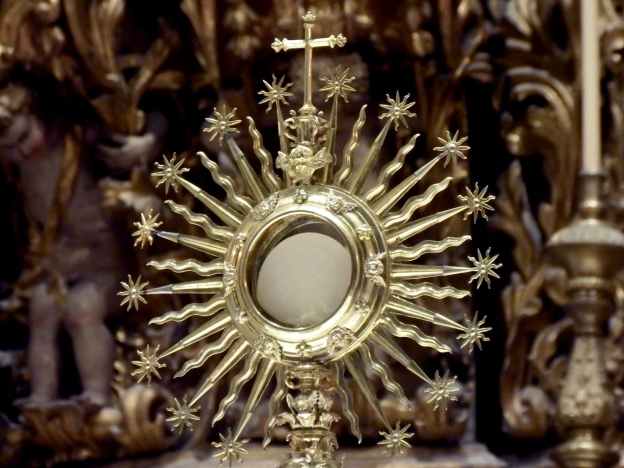
This week culminates in the Easter Triduum, three days of interconnected liturgies beginning on Holy Thursday with the commemoration of Jesus’s Last Supper, continuing on Good Friday with the Passion Service, and concluding at sunset on Holy Saturday with the Easter Vigil Mass. I’ve long found the Holy Thursday Mass to be my favorite, not just of the Triduum but of the entire year. For me, the mystery of the Eucharist is perhaps the most inspiring and compelling part of my faith that has continued regardless of the doubt and skepticism with which I’ve approached so many other aspects of reconsidering what I believe. One of the greatest lessons I ever heard in all my now 27 years of schooling was from Dr. Daniel Stramara, Professor of Theology at Rockhurst University, who explained that in the old Nicene Church of the Roman Empire, while in the Latin Rite the old Roman legalistic tradition persists in seeking answers to every question under the Sun, in the Greek Rite the prevailing opinion was open to mystery, to not having all the answers. I know I won’t really understand how “the biscuit turns into Jesus” to quote Craig Ferguson, one of my favorite comedians and all-time favorite late night host, yet that’s okay with me. It remains a mystery, and I trust in the long Tradition of our sacraments that there is deeper meaning in the Eucharist.

Good Friday was once described to me by my high school theology teacher Sebastian D’Amico as the one day of the year when we Catholics don’t celebrate, after all the Mass is a celebration of our faith. Good Friday is a somber day. Traditionally I’ve tended to attend the 3 pm Stations of the Cross service rather than the Passion Service later in the evening. The Stations of the Cross is a series of prayers which follow the path of Jesus from the Last Supper to the Crucifixion and eventually to the Resurrection that you’re taught very early on in Catholic school. Still, in the last decade I’ve probably returned for the Passion Service that evening on more occasions than not. Some years that service is so deeply moving, while in others I leave it feeling frustrated or downtrodden. I think of Good Friday as a sort of wild card in that way, it’s a day that has huge significance. It reminds me of other days in the year that mark the anniversaries of the deaths of relatives and loved ones, and historical figures who I have a great fondness for, curiously including President Lincoln who was shot on Good Friday 1865 of all days and died on the following morning on Holy Saturday.

With that segue Holy Saturday is a newer commemoration for me. I didn’t start going to the Easter Vigil Mass on an annual basis until just 2018 but have since found it a tremendously rewarding experience. The same mystery involved in the humble awe of Holy Thursday and the mournful remembrance of Good Friday trumpets itself on Holy Saturday in all the splendor of 2,000 years of liturgical tradition and precedent. I’m excited to serve my parish in this year’s Vigil Mass as one voice in the choir. 

The first of the nine readings said at that Mass always comes from Genesis 1, the Creation stories, which I will likely write about here in the Wednesday Blog at some point. I think of the Biblical Creation in the context of the opening verse of St. John’s Gospel, “in the beginning was the Word,” which with all its original Greek meaning also speaks to me of the idea that this vision of Creation first occurred through the voice, perhaps even as Tolkien wrote in his Silmarillion through song. Now of course, I don’t believe that the Universe was created in six days, I accept the idea of the Big Bang and cosmic evolution. There was a recent awe-inspiring episode of NOVA that talked about the raw energy that came before and propelled the Big Bang, which to me seems like a profound reflection of our own older traditional beliefs of the beginning, of Creation, though I’m not saying we can prove the existence of God, that again is best left to a whole separate week.

I’m looking forward to the rest of Holy Week this year, and I hope it will be a time of reflection and inspiration.

Suspending Disbelief

I’ve always been someone who has a hard time focusing on the world around me in the immediate aftermath of leaving a cinema. The story played out before my eyes in rich and large visual colors and resounding about my ears in the surround sound systems used in modern cinemas is entrapping and beguiling to say the least. Every film I have ever gone to see, that I can remember, has been met by this same internal thought process as soon as the picture ends and I wander back out into the lobby. I imagine myself in the story, in its settings, walking and talking with its characters. I guess I’ve always been a bit of a day dreamer.

I’ve also been a storyteller for much of my life. Much of those energies that were once spent inventing fabulous fables of remote realities and fantasies in my youth are now often spent trying to think through my professional writing, both here at The Wednesday Blog and in my research. Still, I do like to daydream from time to time. I find it helps me focus on the good things in life. Those dreams are less extraordinary than they used to be, they are populated less by characters from the books and films I enjoy than by my own hopes for the future, however domestic and ordinary those hopes may be.

In recent months as I’ve allowed more of the dolor of our times creep into my thoughts, I’ve found my ability to daydream has become less and less pronounced. Maybe that’s what C. S. Lewis meant in The Last Battle when he said that of all the Pevensie children, the only one not to return to Narnia in its last days was Susan because she had grown up and didn’t believe in those stories anymore. Yet this fading ability to daydream has left me somewhat bereft. I find I’m less able to write when I can’t imagine a happy future. I’m less able to tell the stories I know both recent and quite ancient when I can’t imagine my own near and distant future. So, I hold onto that need for dreams, and do my best to keep that fire of my imagination alive despite the troubles of our time and the worries seemingly inherent in adulthood.

Over the last few weeks since I returned to Binghamton, I decided to watch a series of films that I loved as a child but hadn’t seen in full for at least a decade. Yet now with the extended editions of The Lord of the Ringson HBO Max I figured it’d be fun to see them again, and not only to remember them as I knew them years ago, but to relive those stories as an adult with everything that I know now guiding my eyes and ears through that modern epic. I often like to think of these sorts of stories that I enjoy, whether they be Tolkien’s legendarium or the near future of Star Trek, along the same general continuum of time and thought. Yet I quickly found myself asking the question, “how can these stories of a far distant past fit into what I know of the world and its origins?” The rational thinker in me posed a fundamental question about suspending disbelief.

So, how do I rationalize these stories of some ancient primordial past just before the dawn of human memory when we weren’t the only such people to walk this Earth? That after all is the setting of The Lord of the Rings, a time long lost when the Earth was young. There are plenty of old stories that tell of an age when humans lived alongside more supernatural creatures, whether they be the monsters and demigods of Greek mythology or the Tuatha Dé Dannán of the distant Irish mythic past. Tolkien set his stories in this same vein, they are a modern recreation of those old myths, those old epics & sagas that he loved so much. And those stories come from a different world than our own, one where the long history of the Earth cannot be explained by evolution or science, but where all things are created through divine music, described in the opening of Tolkien’s Silmarillion.

I for one do feel that there’s still a way to balance the old stories with the new. Our modern narrative for the creation of the Universe, of which the creation of the Earth and all life upon it is but a small verse, is yet another one of these stories. Yet among all the stories our modern one, our new one, is grounded in an understanding of the rational roots of Creation; it sings less of God and angels, supernatural spirits guiding the world into being, and more of Creation urging itself into existence through the very energy that burns at the heart of all things. I still think there’s room for these old stories in our new one, there’s room for us to acknowledge and embrace ancient interpretations of how we came to be in that we are richer for knowing what our ancestors thought and believed.

Tolkien’s stories are beautiful in their own way. They echo the great myths and sagas of the myriad cultures of Europe. They remind me of the Penguin translations of the old Irish myths that I read as a boy and could recite from memory today. Suspending disbelief allows us to let ourselves go from our lives, even for a few moments, and experience something incredible that we otherwise would not. 

As The Return of the King finished on the evening of Labor Day, I found myself wondering what different characters from the Star Trek series would think of The Lord of the Rings and its characters. What would Spock make of the elves and their similar anatomy to his own Vulcans? What would Worf make of the fierce warriors of Rohan steeped in their honor charging to certain death before the walls of Minis Tirith? What can I learn from these two different yet similar stories of people trying to make their world a better place? I think the answer lies in the question. I’m drawn to stories such as The Lord of the Rings and Star Trek because they offer hope even in the darkest of times. The Hobbits prove that even the smallest among us can save the world, and Star Trek offers us today a vision of a better tomorrow that may still come. And if I need to suspend disbelief, if I need to shake the scales of my worldly cynicism from my eyes in order to see those two hopeful lights in the darkest night, then it’s worth doing.