Tag Archives: Space

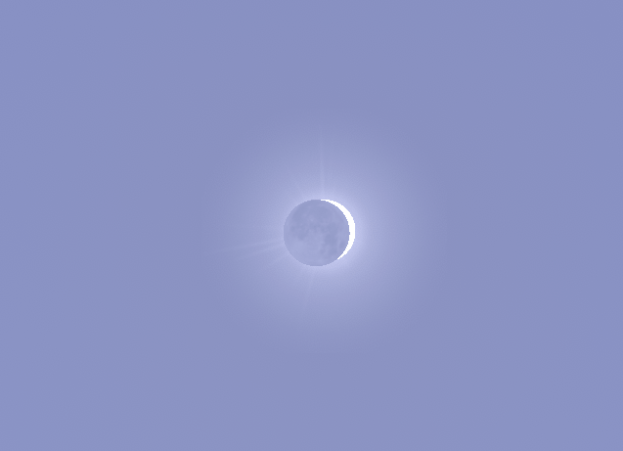
Eclipse simulation using Stellarium

The Eclipse

This Monday, North America experienced its second total solar eclipse in the last decade. — Click here to support the Wednesday Blog: https://www.patreon.com/sthosdkane


This Monday, North America experienced its second total solar eclipse in the last decade.


I remember being over-the-moon excited when we began preparing for the Total Solar Eclipse in August 2017. Several weekends before the eclipse, my parents and I drove north from Kansas City into the path of totality to scout out possible places where we might travel on Eclipse Day to see the phenomenon for ourselves. Eclipse Day 2017 also happened to be my first day as a history graduate student at the University of Missouri-Kansas City. That morning a sudden summer thunderstorm rolled through Kansas City and as the day continued the clouds persisted in our skies. When the moment of totality arrived around 12:55 pm on 21 August, we watched it through darkened clouds and heard the birds and insects around us revert to their nocturnal states and songs.

I was excited to have experienced a total solar eclipse yet disappointed that I wasn’t able to see it. So, when the prospect of traveling for this week’s total solar eclipse appeared, I seriously considered going afield to Texas to observe it. That trip didn’t end up working out because of a series of scheduling conflicts, and so instead seeing that the cloud forecast across North America called for most places along the path of totality to be obscured, I decided to stay here in Kansas City and observe our partial solar eclipse. At its greatest extent, the April 2024 solar eclipse reached about 90.5% totality. I was able to see that extent, yet the feel of it was quite different than 100% totality from seven years ago. We were watching Everyday Astronaut and the Planetary Society’s live broadcast from the Society’s Eclipse-o-rama event in Fredericksburg, Texas while observing the eclipse here at home, and what they experienced was far more dramatic than what we observed. I do regret not travelling for this eclipse, yet at the same time in the circumstances as they fell, I’m glad I chose to stay home all the same.

This concept of an eclipse is one that speaks to me both astronomically, as a big space nerd, historically, and linguistically. Eclipses are phenomena that have made their mark on the psyche of more than just us humans, note how the birds began singing their twilight songs when the Moon passed in front of the Sun. I have never put much theological potency into eclipses because we have been able to predict their occurrences with increasing accuracy for generations now. Religion, in many ways, relies on our perceptions of things. Some see in an eclipse a threat to divine order in the Cosmos. This view reminds me of Mozart’s final opera, near to my favorite of his works, Die Zauberflöte (The Magic Flute) in which the Queen of the Night is defeated by Sarastro, the high priest of the Temple of the Sun. Sarastro proclaims victory for the good and right, singing: 

Die Strahlen der Sonne

Vertreiben die Nacht.

Zernichtet der Heuchler

Erschlichende Macht.

The rays of the sun

Drive away the night.

Destroyed  is the hypocrites’  

Surreptitious power.

(Source: Aria-Database.com, trans. Lea Frey)

Sarastro’s triumphant finale in Die Zauberflöte sung by Josef Greindl with the RIAS Symphonie-Orchester Berlin.

The divine hand is better seen in the wisdom of devising a manner to mathematically ascertain the revolutions of these celestial orbs, to borrow the title of Copernicus’s magnum opus, De revolutionibus orbium coelestium. In our ability to ascertain our surroundings, and to make sense of nature we see a loving design.

Still, knowledge of the movements of the Sun, planets, moons, and stars across our night skies have had their impact in our history. During his fourth voyage, on 1 March 1504, after 9 months stranded in Jamaica, Christopher Columbus (1451–1506) used his knowledge of eclipses from an almanac he brought with him written by the Castilian Jewish astronomer Abraham Zacuto (1452 – c. 1515) to inspire the Taíno caique of that part of Jamaica to give Columbus’s men food and provisions. Columbus wrote in his journals that he pointed at the Moon and told the Taíno that “God caused that appearance, to signify his anger against them for not bringing the food” to Columbus and his men.[1] Several years ago then, when discussing this story with a friend and fellow Renaissance historian, I decided to use the Stellarium astronomy program to simulate this lunar eclipse as Columbus and those with him in Jamaica saw it. Our ability to track the movements of these celestial orbs is good enough that our computers can show exactly what was visible in the night sky (baring any atmospheric data) at any moment in the past or future.

My simulation of the March 1504 Lunar Eclipse as seen from St. Ann’s Bay, Jamaica using Stellarium.

This ability to calculate the dates and locations of eclipses came in handy when researchers look at mentions of eclipses in ancient literature to seek to date the events of the stories. Plutarch and Heraclitus both argued that the Odyssey contains “a poetic description of a total solar eclipse,” which astronomers Carl Schoch and P.V. Neugebauer proposed matched an eclipse which occurred over the Ionian Sea on 16 April 1178 BCE, though a more recent article in the Proceedings of the National Academy of Sciences by Constantino Baikouzis and Marcelo O. Magnasco offer doubts concerning this proposition owing to the difficulty of finding exact matches in spite of centuries of the Odyssey‘s transmission through the oral tradition before it was written.[2] Still, that eclipses are so readily discernible and measurable with our mathematics speaks to the potential that they could be used to date moments long remembered only in heroic literature like Odysseus’s return to Ithaca in Book 20 of the Odyssey (20.356-57). In this effort, where others divine gods, we make tools out of the Sun and Moon to better understand ourselves.

The way we describe an eclipse speaks to our culture’s relationship with the phenomenon. Our Modern English word derives from the same word in Old French, which developed from the Latin eclīpsis, which in turn was borrowed from the Ancient Greek ἔκλειψις (ékleipsis), which comes from the verb ἐκλείπω (ekleípō)meaning to abandon, go out, or vanish.” Eclipse eclipsed the Old English word āsprungennes, which derives from the past participle of the verb āspringan, meaning “to spring up, to spread out, to run out, to cease or fail.” As an adjective, āsprungen meant that something was defunct or deficient, so perhaps this sense of an eclipse meant that it seemed for a moment as though the Sun had run out of energy and ceased to burn? Again, this speaks to the idea that nature had limits as humanity does, to an older understanding of nature from the perspective of a limited human lifespan. 

In Irish, there is the Hellenic word éiclips, yet there’s an older Gaelic word which means the same thing, urú. Now, usually students of the Irish language will learn of urú in the context of Irish grammar, an urú or eclipsis is one way that Irish handles both consonant clusters and situations when one word ends in a vowel and the following word begins with another vowel. So, in that sense the word gets eclipsed by this urú which preserves some of the integrity of the language. Yesterday’s eclipse then was less an urú focail (word eclipse) and more a urú gréine (solar eclipse). That both the Sun and the words we speak in Irish can be eclipsed makes this astronomical phenomenon all the more ordinary and measurable. 

We use this word eclipse beyond astronomy in many cases; it seems to me today that the old guard of the Republican Party has been eclipsed by an orange political pulsar whose violent rhetoric and chaotic behavior have eaten away at their party’s support in these last 8 years, not unlike a pulsar discovered by NASA’s Swift and Rossi X-Ray Timing Explorer satellites in 2007. An eclipse is something wonderous to behold yet ordinary in how readily we can predict when they will appear. They have given us a great deal of cultural qualifications that continue to influence how we see our world.

On Monday then, when the sky began to darken as the Moon passed in front of the Sun, I noticed that the color spectrum that I’ve always known began to change. Before my eyes the colors seemed to take on a sort of metallic glow, as if the light which illuminated them was shifting into a spectrum that seemed unnatural to the natural world I’ve known. The Sun is fundamental to how we understand the world around us. Its light is what illuminates our senses, and without it, or even with partial changes to its glow, we would find ourselves observing a very different world.


[1] Christopher Columbus, “The Fourth Voyage,” Select Letters of Christopher Columbus: With Other Original Documents Relating to the Four Voyages to the New World, trans. and ed. R. H. Major, (London: Haklyut Society, 1847), 226.

[2] Constanino Baikouzis and Marcelo O. Magnasco, “Is an eclipse described in the Odyssey?” Proceedings of the National Academy of Sciences 105, no. 26 (2008): 8823–8828, nn. 1, 12–14.


How to Know the Unknown

How to Know the Unknown Wednesday Blog by Seán Thomas Kane

This week I want to talk about how we can recognize the existence of unknown things. — Click here to support the Wednesday Blog: https://www.patreon.com/sthosdkane

This week I want to talk about how we can recognize the existence of unknown things.


At the beginning of the month when I was preparing for my copyright post, I looked into an old interest of mine that had always been there, yet wasn’t quite active in the last few years, the effort by an organization called Thank You Walt Disney to restore the building that his first studio, Laugh-O-Gram, occupied at 31st & Forest here in Kansas City called the McConahay Building. To this end, I made a detour by the old building one afternoon on the way back from the central post office at Union Station and saw a good deal of work underway on that block, and after some back and forth I found a book written by some members of that organization called Walt Disney’s Missouri that I requested from the Kansas City Public Library.

I found Disney’s early years in Marceline, Chicago, and Kansas City quite familiar; his passion and drive to create art and tell stories in a new and inventive way using the skills and talents he developed over those early years remind me deeply of many of the ideas and projects I’ve worked on since my high school days. The sky truly is the limit in this mindset. I find the young Walt Disney to be a familiar face, someone who is quite relatable to all of us who have adopted Kansas City as our canvas for the many things we create.

Yet Kansas City is not like many other great American cities, for unlike New York, Los Angeles, or even Chicago we aren’t on a shoreline, we don’t look out onto an endless expanse of water far out to the horizon. Instead, we have the vast sightlines of the prairies and Great Plains extending out from our city in every direction. The astounding sunsets that glowed across the prairies out to the west of our old family farm are some of the great images of my childhood that will forever be burned into my memory.

When I was reading about Disney returning to Marceline, Missouri as an older man, I felt intensely familiar with the setting having grown up in the Midwest; familiar with the vast scale of the prairie that overwhelms me in how small it makes me, and the few built-up edifices of our civilization feel amid the tall grass Prairie. Our interventions only emptied this landscape and rebuilt it anew with the farms & ranches that have largely replaced the native roots. We have changed this landscape to suit ourselves, and yet this landscape remains its own because its fundamental character is too distinct for us to fully comprehend in our vision of a normal inspired by the great woodlands and old colonies of the East Coast and even older cultivated and measured forests and farmland growing around the ancient generational villages and towns of Europe.

My research focuses on the unknown entities that were too far-fetched to be imagined on the edge of the European imagination, particularly animals whose proportions were exaggerated to a degree that set them and the world they inhabited apart from the well-known and measured Mediterranean World at the heart of the European cosmos. This question of how we can begin to describe the unknown has stood out to me for a while and it’s something that both thrills and scares me at the same time. I feel a profound sense of humility thinking of all the things that we don’t know that exist beyond our world, whether they be lifeforms deep in the still largely unexplored oceans or entities deep in the void of Space. Yet I love stopping to think of these things and the endless horizon they represent as it gives me a sense of things still to accomplish.

Imagine, dear reader if you will, what it would be like to witness something you never before knew appear before your own eyes, or even those things which you do know about but only in stories and fables happening in real life. Shakespeare asked his audience to use their imaginations to fill in the breadth and depth of his world. In the prologue of Henry V, the Chorus asks the audience to imagine that the actors on the stage might

“on this unworthy scaffold bring forth 

so great an object. Can this cockpit hold 

the vasty fields of France? Or may we cram

within this wooden O the very casques

that did affright the air at Agincourt?

O pardon, since a crooked figure may

attest in little place a million,

and let us, ciphers to this great account,

on your imaginary forces work.

Suppose within the girdle of these walls

Are now confined two mighty monarchies,

Whose high upreared and abutting fronts         

the perilous narrow ocean parts asunder.”

Henry V, Prologue 11–23

Our imaginations are perhaps our greatest assets, after all we call ourselves Homo sapiens, wise humans. We pride ourselves on our capacity for thought, on our ability to imagine possibilities for ourselves and our posterity. We need the unknown to give us hope that there will be something new to discover tomorrow, for even if that new thing is familiar to others, it will still invoke wonder in us. Hope is what the greatest human endeavors are built upon, the hope that even if a cause seems doomed in the short term that someday it will succeed.

I feel this sense of potential success is central to my nature. I grew up with this hopeful maxim from three sources, my Catholic faith in things inexplicable, my Irish heritage informed by the experiences of generations who hoped for home rule and justice under a colonial government, and more light-heartedly from my lifelong passion for the erstwhile lovable losers, the Chicago Cubs. Robert Emmet perhaps put it best in his speech from the dock that he knew someday his epitaph would be written, someday someone yet unknown to him in 1803 would be able to judge his efforts towards Irish independence. “Let my character and my motives repose in obscurity and peace, till other times and other men can do them justice. Then shall my character be vindicated; then may my epitaph be written.” 

We cannot truly know what our future will hold, though we can predict what variable futures might come to exist. I wonder if a young Walt Disney would have imagined the man he would become, and how his name would be known by what surely is a majority of humanity alive today, 123 years after his birth. All of that was unknown in his childhood, just as all the things that will happen tomorrow and every day after that are still to a certain degree unknown to us today. That might be the closest we come to touch the unknown, to recognize its ambiguous feel, yet while that fine cloth of silk might seem somewhat familiar in its unfamiliarity, we ought to always remember that it extends far enough from our view and beyond all our horizons into infinity. There is, and likely will always be, more unknowns than knowns in the Cosmos.

A historian restores things forgotten from the vast silk threads of the unknown and weaves those fibers back into the great tapestry of human knowledge. I just started reading a book yesterday which does this with the understanding that religion and science have always been at odds when it comes to the age of the Earth. Perhaps I will write about that book, Ivano Del Prete’s On the Edge of Eternity: The Antiquity of the Earth in Medieval & Early Modern Europe in this publication later this year. That, good people, remains well and truly among those strands of the great yet smooth silky unknown sea which lies behind us, beyond our vision as the Greeks understood the future to be. The future is perhaps more unknown to us than the past because we at least have means and methods to uncover the past we’ve long forgotten and left behind, whereas the future remains unwritten and daunting to behold.

Perhaps that is why I chose to become a historian, because I find a comfort in imagining and reading about the past that is absent when I imagine the future. There is some truth there that the future I behold is colored in the same hues as my present, which I know will not be realized as the future will certainly be its own creation, inspired by our current moment yet distinct from it all the same. The characters who grace this “kingdom for a stage” will have taken their last bow by the time many of these events I imagine in the future occur; and at the culmination of the future lies the greatest unknown of all, one about which we tell many stories and ascribe many tenants, all to humanize it and make it more familiar.Our memories keep past ideas, people, places, and things alive in our knowledge. I hope the people at Thank You Walt Disney are successful in restoring the McConahay Building which housed Disney’s Laugh-O-Gram Studio so that the memory of that time when so many creative minds, so many animators, lived in this city is preserved; so that Kansas Citians in the present and unknown future remember that art can be created here, and dreams first imagined here can grow into wonders for all humanity to behold.


The New Frontier

This week on the Wednesday Blog, I try to remember a story for this week that I came up with on Saturday while lost in a parking garage. — Click here to support the Wednesday Blog: https://www.patreon.com/sthosdkane

This week on the Wednesday Blog, I try to remember a story for this week that I came up with on Saturday while lost in a parking garage.

I will usually have a few ideas for the Wednesday Blog lying around in one of several repositories, including my memory of incidents that’ve happened within the last few days or weeks that might make for curious anecdotes for this weekly publication. This Saturday, while I was getting dinner on the Plaza on my way up to my evening shift at the Kauffman Center, I thought of one such idea that at the time seemed golden for this week. For some reason, walking back down the stairs from street level to where my car was parked underground, I found myself thinking about the first line of Captain Jean-Luc Picard’s opening monologue from Star Trek: The Next Generation, identical to the same line in Captain James Kirk’s monologue from the Original Series, “Space, the Final Frontier.” This idea of the frontier sticks with me because my own world here in the Midwest is so very new; where now there are tree-lined streets, parks, and fountains little more than a century ago was open prairie.

At the 1893 Columbian Exposition World’s Fair in Chicago, the American historian William Jackson Turner presented his famed Frontier Thesis, which argued that as of that moment the American frontier was well and truly closed; all land from Atlantic to Pacific was taken, bought, or occupied by some one or another. Turner, a historian at the University of Wisconsin-Madison, made this point to mark 1893 as a major turning point in American history from the age when our culture was defined by the endless frontier extending far out beyond the horizon to a distant and nigh mythic Pacific Ocean and towards a new world where the United States was an island unto itself, with travel from New York to San Francisco possible in a matter of days by rail. Today, of course, the same journey can be made in about 6 hours by plane, and for much of my life I’ve heard of Alaska as the new frontier and, like the two Captains of my favorite science fiction series, Space as the final frontier.

Yet I think there’s another frontier that bears consideration, one which is far more personal to each of us. I stand today looking at my own life and childhood with a great degree of nostalgia, and especially now that I am spending my days with students who are going through those same moments, I often want to connect with them by remarking about how I was doing this or that when I was their age. Yet, it is hard for me to reconcile that these people are living out their adolescent years in the early 2010s and not the early 2000s as I did. Their world is a new frontier for me, one that is far more digital, one that is far more interconnected, and one that is in many ways far more dangerous than my own.

I’ve long thought about how different things would be if I had children for them compared to my own life. If I were to have children this year in 2023, they would be in middle school in the early 2030s and graduate high school in 2041, a full 30 years after I did. This is almost equal to the same gap that I have with my parents, yet to me the cultural and technological differences between even today in 2023 with what I knew in 2011 are in some ways far greater than what I remember being around when I was little in the mid and late 1990s that my parents lived with in their teenage and young adult years in the 1980s. It is harder for me to understand some of this generation because my experiences are far more framed in the world that existed when I was born, and as much as I look forward to the futures that this century could hold, I still feel a close connection to the century that formed my own existence.

This is all a very linear way of thinking about time and even space. It could be that echoes of moments from my own past keep appearing in my present as I experience this new period in my life. The frontier of full-time employment has been reached, and I’ve chosen for the moment to cross its threshold into whatever its potentials may hold. I look back at my life from just a few months ago with some wistful longing for the days before I was constantly needing to be my best self, the days when I had plenty of time to get all of the things I need to complete done. There are always echoes in my memory which announce themselves in the present, from the way the sunlight shines nebulously in the sky on a morning after an overnight rain to the new takes on old hymns we sang in my elementary school Masses each week. I find myself remembering the people I knew and loved in my past and see a great deal of them in those I surround myself with now.

I hope that as I move further into this new frontier I will be glad to see what it has to offer, what ideas it will inspire in me, and how I can continue to grow, hopefully, to become the person who people will remember in centuries long after I and all those around me are gone when perhaps humans will have begun venturing out from our home planet to seek their own new frontiers deep in the void of Space.

Artemis

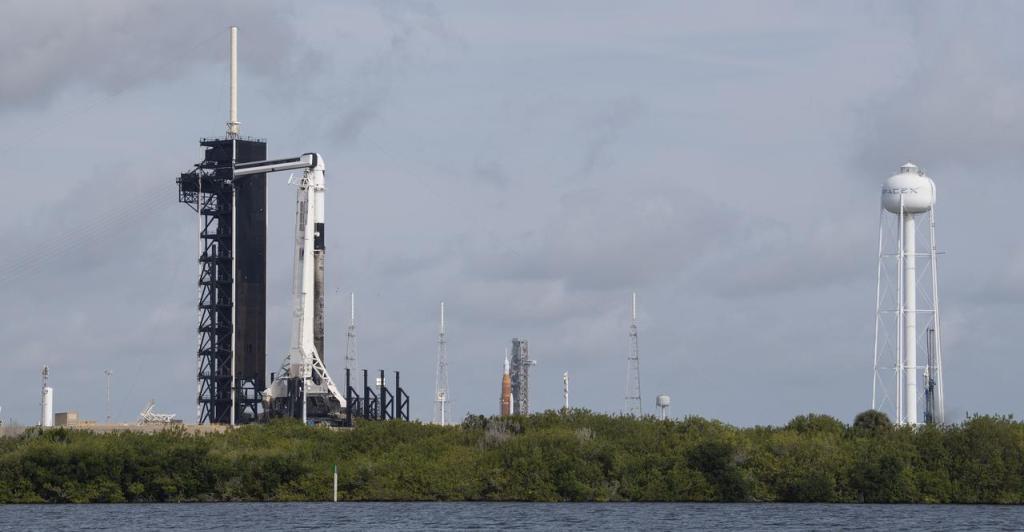
NASA’s SLS and SpaceX’s Falcon 9 at Launch Complex 39A & 39B. NASA Images Library.
This week, some exciting news about the upcoming launch of Artemis 1. The audio clips used today come from the NASA Audio and Ringtones Library. You can learn more at http://www.nasa.gov/connect/sounds.

As long as I can remember I’ve known Neil Armstrong’s now immortal words “It’s one small step for Man, one giant leap for Mankind.” They were spoken a couple decades before I was born at a time when my parents were themselves children. I think I may have recognized Armstrong’s voice earlier than many other public figures. Then again, Space exploration has always been a big deal in my life, from the endless sci-fi novels that lined the shelves of our basement library in our suburban Chicago home to the Hubble pictures that adorned the walls of many of my classrooms through the years.

Looking back at a lot of those novels and hopeful calls for future Space exploration and settlement, like Gerard K. O’Neill’s The High Frontier or Stanley Kubrick’s classic film 2001: A Space Odyssey it’s striking how far we are now today in 2022 from where we hoped we’d be over the last 60 years. Our last lunar mission ended 20 years to the day before my own birth in December 1972, and besides the odd Chinese robotic mission we humans haven’t been back to our largest satellite since.

So, in December 2017 when NASA announced the beginning of the Artemis program I was thrilled. Artemis, like its twin Apollo, will take humans back to the Moon at some point later this decade or in the early 2030s. Not only that, but Artemis is supposed to be the beginning of the first permanent human outpost on the lunar surface, the beginning of a new stage of human settlement. Since that announcement I’ve enjoyed the thought that in future when I look up at the Moon, I’ll be able to see from a very great distance places where other humans will be living.

The troubles of the last few years, the great crises we’ve been living in with the pandemic and all its associated problems, have certainly contributed to delays in the launch of Artemis 1, an uncrewed mission that will orbit the Moon and lay the groundwork for future crewed missions in the Artemis program. There were even moments when I admit I worried that Artemis 1 would never leave the ground, like the Constellation program that Artemis replaced.

Many of those worries were relieved a few weeks ago when Artemis 1 was moved onto its launchpad at the Kennedy Space Center in Florida. The rocket, the first launch of the Space Launch System (SLS), a 365 ft (111.25 m) tall super-heavy lift expendable launch vehicle, now waits for its date on the same Pad 39B where the Apollo missions left Earth five decades ago. Only in the last few weeks has NASA given a deadline for this momentous launch: at some point between 29 August and 6 September 2022.

We stand at a point on the verge of entering a new generation in our exploration of Space, a generation when our horizons are far greater than ever before. The dreams of the 1960s haven’t been forgotten entirely, in many ways the Artemis missions to the Moon and the future Martian landings evoke those dreams best expressed in our stories. What’s more, we have a real opportunity here to make a difference through these missions, to let them inspire us to make our lives better here on Earth. I’ve often heard it said from astronauts that seeing Earth from orbit is a humbling experience, because it demonstrates just how interconnected we all are. 

It really brings home what Carl Sagan wrote in his book Pale Blue Dot that we are capable of doing so much more if we recognize our common stewardship of this our home, the only home we’ve ever known. We certainly can use Space exploration in the long term to try to find another home, if we continue to mistreat this one so badly that we need to look for a new one, but it would be far better of us if we use these experiences of visiting strange new worlds to use those experiences to appreciate what we have here even more deeply.

My hope is that Artemis will be a beacon of light in an ever-turbulent period in our history, and that it will be remembered as a moment when humanity came together to achieve a common goal for the benefit of all of us.

To Gaze into the Past

“Cosmic Cliffs” on the Carina Nebula, NASA JWST, Public Domain.
This week, some inspiration from the first images taken by the James Webb Space Telescope. You can view all of these images at: https://webbtelescope.org/news/first-images/gallery

Historians like me spend our working days trying to understand past generations, to see their worlds through their eyes and to interpret that world in a way that’s understandable to our modern audiences. I for one would love to see the sloths that my dissertation focuses on as they lived in their own time and place 467 years ago. Better yet, I would love the opportunity to sit down and chat with such greats as Abraham Lincoln, Benjamin Franklin, Eleanor Roosevelt, or Hypatia of Alexandria just to hear these great minds of their own times speak as regular people without all the pretenses, titles, and theories that we frame their lives within our histories.

Unfortunately, as far as I know the time machine hasn’t been successfully built yet, and time travel even by slingshoting an object around a sun hasn’t been attempted yet. Give it a few centuries, maybe. My conversation with Mr. Lincoln will have to wait. Yet there are ways we can gaze back into the past that are possible today. If you’re reading or listening to this at night go outside and look up at the stars and see what you can find up there. Maybe even use a star chart app on your phone to figure out which stars you’re looking at. Once you’ve done that see how many light years distant they are from us on Earth. That light took quite some time to reach us, meaning that that light left those distant stars years, decades, or even centuries or millennia ago.

Last summer I wrote about my profound sense of awe at gazing up towards the light radiating out from the star Vega while sitting on the rim of the Split Mountain Canyon in the Utah side of Dinosaur National Monument. What struck me most was that Vega is 25 light-years away from Earth, meaning that that light left that star when I was still a small child in a moment of my life I look back on quite fondly. What’s more, I knew I could return to the same spot 25 years later in 2046 with my children, if I’m so lucky in the future, and show them the light that left that star on the night when I went up there with my Dad back in 2021.

The same idea is central to how we ought to understand the immensity of space. Einstein is responsible for the development of the idea of spacetime, that time itself is a dimension alongside the others we might already recognize. I often think about this when I’m daydreaming, imagining observing the passage of time in a very small scale by watching the light move across the walls of a room however slowly as the day goes by. This past Halloween evening I sat with a fellow sixteenth-century historian in San Diego’s Waterfront Park and looking out towards San Diego Harbor to the west stared at the sunset as it seemed to almost faintly radiate up and down as it slowly set below the horizon. In that moment I knew I could begin to understand the passage of time just as I learned at a young age to comprehend the passage of space in the form of physical objects moving across the landscape, like cars driving along an open highway.

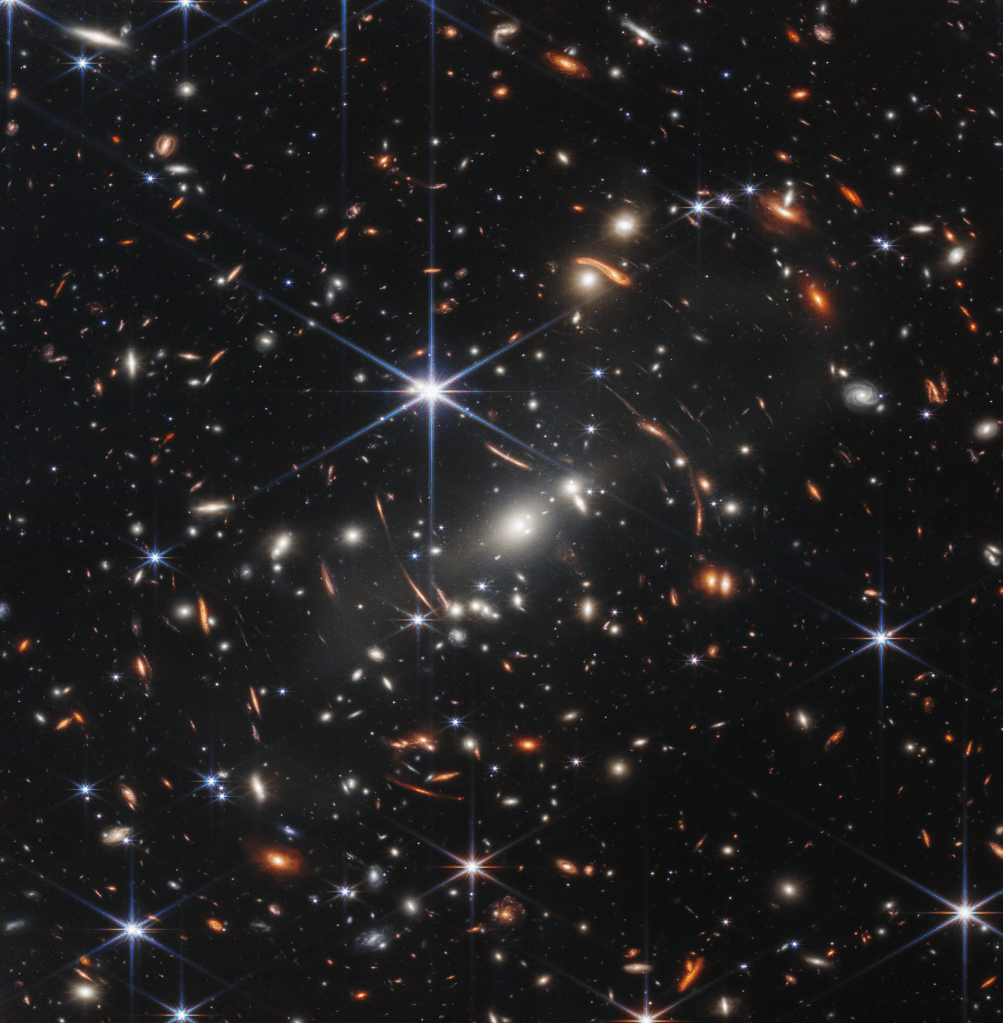
So, this week’s breaking news from NASA Goddard of the reveal of the first five images taken by the James Webb Space Telescope out in orbit of the Earth was a profoundly beautiful moment for me. Webb captured our first images of galaxies as they existed a mere 4.6 billion years ago. Those same galaxies could look very different today, yet their light has only just reached us across the vastness of Space. That image, Webb’s First Deep Field, was released on Monday evening by the White House after NASA offered a preview of the five images to the President and Vice President. Lucky them!

Webb’s First Deep Field, NASA JWST, Public Domain.

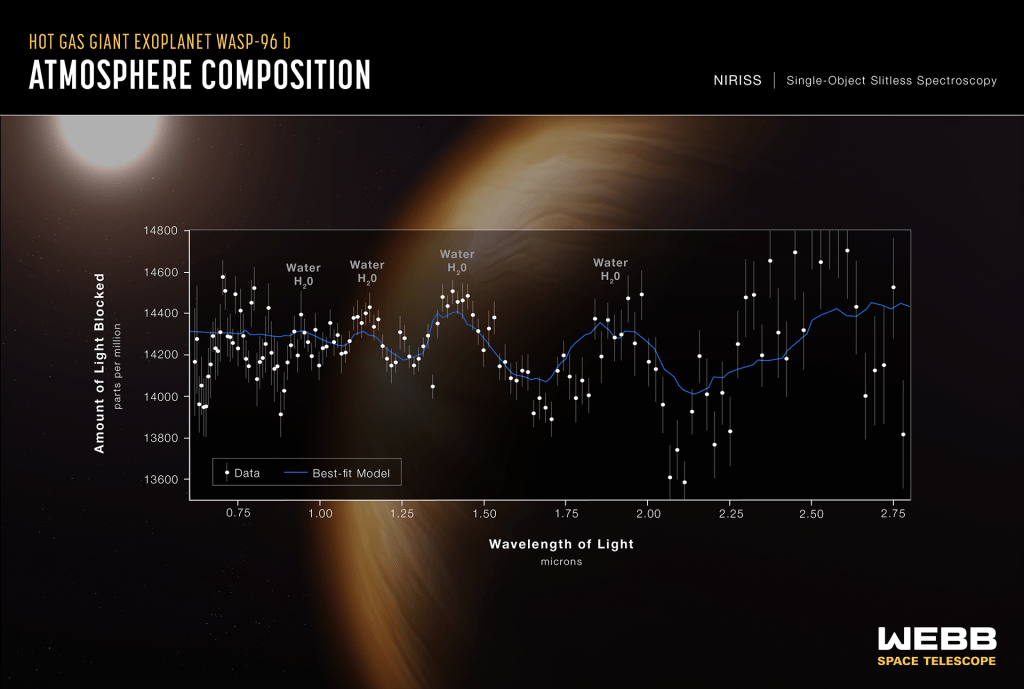
As profound as that deep field is, I was struck more by the potential offered by another one of Webb’s images, the second image released to the public which shows the atmospheric composition of an exoplanet called WASP-96 b, which is about 1,120 light-years from Earth. WASP-96b’s atmosphere confirms the presence of water on that planet’s surface, a sign of potential life on that planet’s surface. This is the part of Webb’s mission I’m the most excited about, its potential to help us in our endeavors to find out whether we’re alone in this vast Universe of ours, or if we’re one planet among many populated and teeming with intelligent, thinking, and innovative people.

I can’t help but mention the picture, which is probably my favorite on an aesthetic level, that being the image of the “Cosmic Cliffs” of the Carina Nebula, a stellar nursery located roughly 7,600 light-years distant from Earth. The vibrant colors of the Carina Nebula even unseated Thomas Wilmer Dewing’s 1904 painting The Lute from the coveted role of my computer’s background, at least for now.  A closer nebula to Earth, the Southern Ring Nebula, was also photographed. This time though instead of a stellar nursery this nebula surrounds a dying star in its cloudy sphere. Even more profound are the quintet of galaxies captured by Webb from some 290 million light-years away, old enough that its light was contemporaneous with the end of the Carboniferous Period and beginning of the Permian Period here on Earth, well before even the evolution of the first dinosaurs.

On a side note: the Carboniferous room in the Evolving Planet exhibit at the Field Museum remains my favorite room in that collection; I’ve always loved those trees.

The images released by the Webb team and broadcast Tuesday from NASA Goddard represent 25 years of combined efforts from a whole host of scientists and engineers at space agencies around the globe working together to achieve a common goal. By expanding our knowledge of the universe around us we are also demonstrating to ourselves and our descendants that it is possible to work across national divides, to achieve common goals. When we do pull ourselves out of our current string of interrelated crises and societal problems it will be because we’ve finally decided to work together as one humanity for the betterment of all of us.

We have an opportunity now to gaze into the past, to see light coming from stars that may well have died long ago. Yet with their light memories of their existence remains. With that light we’re reminded not only of what once was both out there and here on our home planet, but also of what could be in our future, of a time when maybe we will explore further afield, spread out from our home not as conquerors but as explorers. Stay curious.

How Space Exploration Can Unite Us

How Space Exploration Can Unite Us Wednesday Blog by Seán Thomas Kane

In this episode I argue that we should consider Space exploration as a way of uniting humanity around a common cause in what otherwise is a time when we seem far more divided.

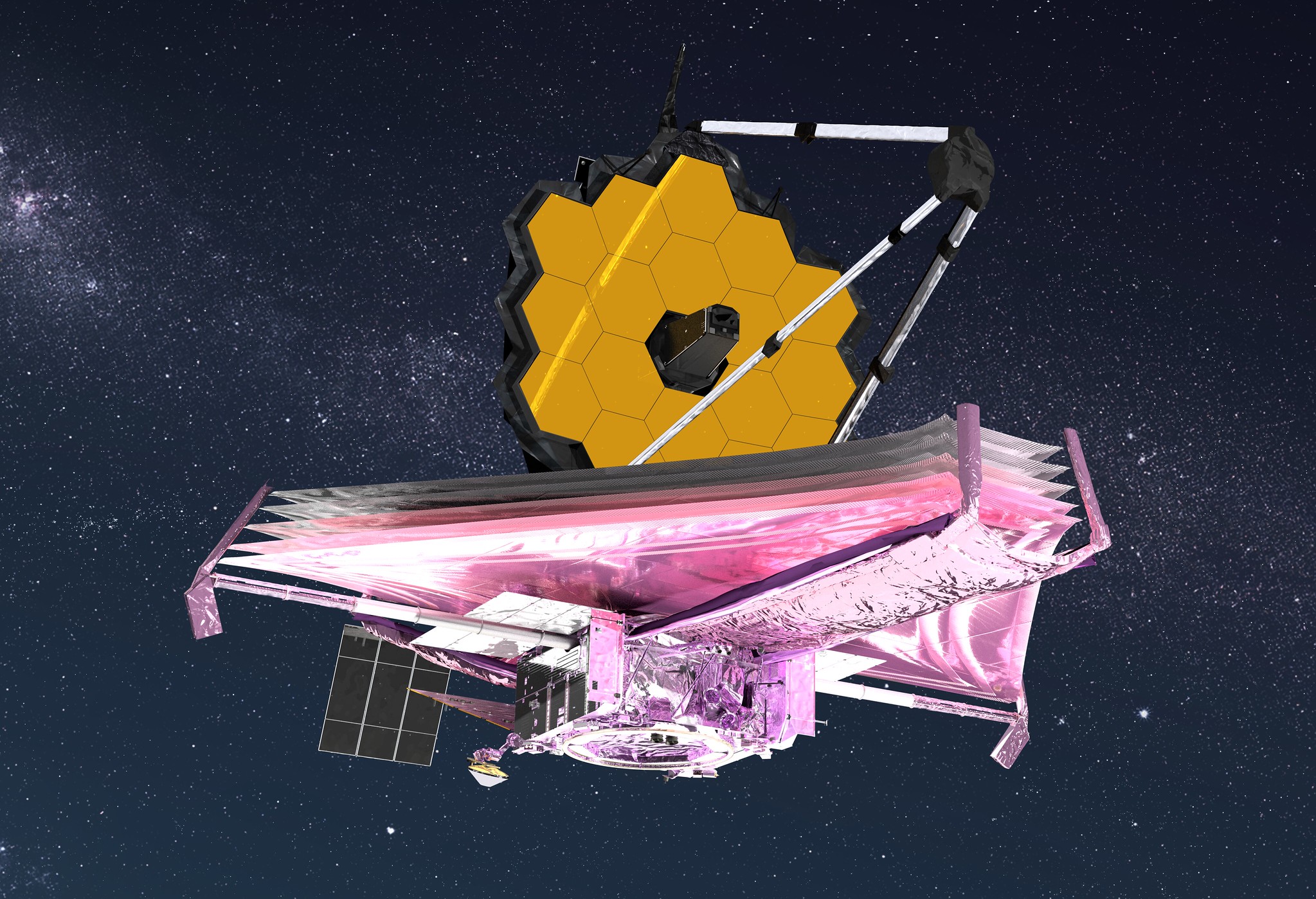
My Dad woke me up just before 6 am on Christmas morning to watch the long-anticipated launch of the James Webb Space Telescope (JWST) from the European Space Agency’s spaceport in French Guiana. Over the past few months, I’d heard and read a great deal about Webb, the engineering behind it, and the mission it has been sent on to travel to the Lagrange 2 point about 1 million miles, or 1.5 million kilometers, from Earth. Once there, Webb will serve as our newest set of eyes on the stars and planets far removed from our own. It will even be able to detect the chemical composition of the atmospheres of distant exoplanets, which could provide us with far better leads than ever before to finding life on distant worlds.

In this last week of 2021, during the Christmas season, a generally happy time of the year, I’ve got to admit there are a lot of problems facing us that are sure to dominate the year to come. The COVID pandemic continues and has recently flooded humanity with a new wave powered by the omicron variant, leaving us scared and worried during the holiday season. The tensions that have boiled over in the last few years in this country, social unrest born out of decades of dissatisfaction, disenchantment, and the pressures of our lives in this Second Gilded Age have brought we Americans closer to the brink than we’ve been in quite some time. Globally, we can’t bring ourselves to do enough to combat climate change, the greatest existential threat humanity has yet faced. Still, the familiar tempo of the drumbeats rises quicker and quicker as the Ukrainians prepare for a potential invasion from Russia, and tensions continue to simmer in the waters between China and Taiwan. Both of these regional wars could well draw my country, the United States, and our allies in, cycling further and further until that simmering pot comes to a boil in the form of another world war.

Meanwhile civil wars, famines, and the other children of fear torment people around the globe in nearly every country, some worse than others. The 2020s have thus far proven to be one of the darkest decades in recent memory, with many of its woes being fruits born from the troubles of the 2010s, 2000s, and the century prior.

Yet alongside all of this, I still have hope that we, humanity, will see ourselves through these threats, that somehow, someway we’ll survive as we have now for so long. It’s interesting to me how the same story, human history, can be told in so many different ways. I was brought up learning the story of human progress, of ingenuity and invention from the Promethean discovery of fire to the digital age in which we now live. It’s a story that has a happy ending, that believes we will eventually overcome our sins and the ghosts that have haunted our waking days as much as our dreams of a better tomorrow. The question I’m left with now, as an adult prone to daydreaming rather than a child without a responsibility to make something of myself, is how do we achieve that future? How do we make tomorrow better than today or all the yesterdays in our collective memory ever have been?

I suggest we look to the potential of what Webb can tell us about the Universe around us. We are after all made of stardust, as Carl Sagan was famous for saying, and at the end of the day it is to that stardust that we will return. The exploration of Space has the potential to be truly revolutionary to our story. If done right, it could be the catalyst that pushes our boulder over the hill, letting us the eternal Sisypheans we are, out of the Hadean turmoil we’ve been in for as long as we can remember. By realizing we are not alone in the Universe, that there are others out there who like us have struggled and fallen time and time again yet still found the strength within them to rise up and build civilizations in their own images, to leave legacies for others to remember them by. We have the potential to overcome our troubles: war, hunger, poverty, ignorance. Let’s set those drums aside and sit down and talk to one another, get to know one another, and learn from each other. Let’s realize that we’re more alike than different, no matter who we are, where we’re from. We may speak different languages, and by extension think in slightly different ways, we may have different incentives for our actions, but at the end of the day we’re all still human.

On the Sunday of Christmas weekend, a date I know as St. Stephen’s Day, I read a thoughtful editorial in the Washington Post by the conservative columnist George Will called “National conservatives and racial identitarians have a common enemy: Individualism”. While I didn’t agree entirely with his argument, and while in general Mr. Will and I only agree on a small number of things (in particular our mutual love of baseball) the main thesis of this column made good sense to me, that here in the United States individuality and the ability of the individual to express their self has fallen by the wayside in many circles in favor of a degree of collective identity on both sides of the political spectrum. The focus has fallen so much on what divides us that we’ve lost sight of how we are really so alike. 

We are all Scrooges as long as we stay in our camps and refuse to venture out into the no man’s land between them. There are past wrongs that need to be delt with, crimes that have yet to be punished, I would be naïve to deny that. At the same time, we need something to bring us together, to break these circles of violence that have been carried out since the time immemorial, embodied in stories like the primordial Fall from Paradise described in the Abrahamic religions. At this point, it’s fair to say we’re in a time when revolutions and counterrevolutions born out of a spirit of vengeance are far more in vogue than any belief in a common humanity. Yet through the fog of war that we allow the dragons of our imagination to breathe out into our world, there are still those among us who send missions beyond Earth with hopes that knowledge will broaden our horizons and increase our knowledge of not only the Universe around us but of ourselves as well. This Second Age of Exploration offers us the chance to unite around a common purpose of bettering ourselves, of elevating humanity above that fog and into a new age in our history when we can achieve all those lofty ideals we continue to set ourselves from each generation to the next.

Why We Need Explorers

I’ve always loved the idea of exploration. I remember on the evening of Sunday, 31 May 2015, I decided to take my dog Noel for a drive down State Line Road here in Kansas City. We kept going south until the Sun started to set, making it as far as about 300th Street. Lately, during my time in Binghamton this Spring, I made a point of doing some sort of weekend drive into the surrounding countryside, just choosing a cardinal direction and driving until I decided to turn around. I suppose it makes sense then that I’d end up training as a historian of Renaissance explorers and travelers in the Americas.

When I decided to write about this topic rather than another post about grammar (you’re welcome), I started wondering why is it that so many of our history’s greatest explorers and most pivotal encounters happened at times of great social unrest at home? Columbus’s world-defining 1492 voyage launched the most recent great Age of Exploration, which I would say lasted from 1492 to around 1800, 1 yet much of that same period is also characterized by a series of disastrous internal conflicts in Europe collectively known as the Wars of Religion and the later eighteenth century dynastic wars of succession, and the first truly global war, the Seven Years’ War (the French and Indian War here in English-speaking North America). Why would a civilization so focused on its own internal divides, the prejudices and hatreds of its own communities, polities, churches, and states, also want to invest so much time, effort, and capital in exploring places in what were ostensibly other worlds across vast hitherto impassable oceans?

I think one main reason was well expressed by a Bonnie Tyler song, originally from the 1984 film Footloose, that my friends and I happened to lovingly use for the theme tune of our YouTube series The Awesome Alliance (2008–2013), they needed a hero, someone ambitious and daring who was wiling to push the boundaries of what was believed possible and achieve something extraordinary. In these cases, the extraordinary is encountering previously unknown worlds.

I wonder what might have become of a Europe wracked by generations of successive wars, after all, it’s important to remember that many of the continent’s major powers were at war with each other before the Reformation and Wars of Religion began. At that point, the European wars were largely dynastic fights between royal families like the Habsburgs, the Valois, and the Tudors. Naturally then, once the Wars of Religion had generally fallen out of fashion after the disastrous Thirty Years’ War, Europe settled down into a familiar pattern of dynastic warfare, only now between the Habsburgs in Austria and Spain, the Bourbons in France and also in Spain, and Hanoverians in Britain.2

All throughout the sixteenth, seventeenth, and eighteenth centuries, with some very real continuations into the nineteenth and twentieth centuries (here lies another historical debate), explorers traveled from their homes to faraway places. Their travels inspired people to keep looking beyond what was known, to keep pushing the boundaries of knowledge and society. The diversity that characterizes our world today wouldn’t have been possible without the explorers of 500 years ago challenging the mould of their day.

Today, we need to continue to celebrate and fund our explorers, to embrace them. We need their efforts to inspire us to remind us that we can to amazing things. When we reach for the stars as our astronomers and astronauts do, we discover new horizons over which we can glimpse. And when we wander into a new city or country where we might not’ve been before, taken that road less traveled, we meet people who enrich our lives with their stories, their experiences, their memories.

Wherever my next trip takes me, off into some place I may not have been before, I hope it’ll be somewhere exciting, somewhere new. Once we’re past the pandemic, and travel is easier and safer again, I hope to use my time in Binghamton to visit more of the Northeast, to see the Green Mountains of Vermont or to visit Boston again for the first time in 20 years. Maybe, if my timing works out right, I can drive down to the Space Coast in Florida and see one of the Artemis mission launches in 2022 and beyond, and see that new class of astronauts begin their long voyage to establish the first human outpost on the Moon.

Eventually, I hope, we’ll have a new name for the Moon as we discover and settle on many other moons and the planets they orbit. The horizon continues eternally, and while chasing after it might seem quixotic, it only means there’s always another adventure to be had, another place to explore out there.

“Holding out for a Hero,” the “Awesome Alliance” theme song

Notes

1 My fellow historians will no doubt recognize the fertile ground for historiographical debate here. For the sake of the sanity of my readers, I’m going to leave that for a later publication.

2 This is a gross over-simplification of 17th and 18th century European political history, especially coming from someone who’s TAing a class called “Europe Since 1500” at the moment.