Tag Archives: St. Louis

On Numbers

This week, how numbers are both a universal language and symbols representing deeper meaning.—Click here to support the Wednesday Blog:https://www.patreon.com/sthosdkane


This week, how numbers are both a universal language and symbols representing deeper meaning.


Consider, if you will, what meaning a number holds if unaffixed to an object for calculation or counting? What does six mean if disassociated from the rest of its sentence? Some numbers are recognizable for their meanings due to the broader cultural connotations held by those definitions. A learned reader who sees 3.14 written on a page will recognize that as the first three digits of the value of π, yet without the decimal a Midwesterner will recognize 314 as the telephone area code for the City of St. Louis. Similarly, while 23 holds significance as Michael Jordan’s jersey number to millions if not billions of us who remember the greatest Bull play around the millennium, to others 23 is just another prime number.

Numbers in themselves can only exist beyond the abstract if they account for something. The life is blown into the Music Man’s best known song by the “76 Trombones”; Professor Harold Hill’s exhortation to the people of River City, Iowa would’ve fallen flat if he called on them to raise the funds and enthusiasm for “76” alone. Perhaps the patriotic connotation of that number, 1776 was the year of this country’s birth, might’ve stirred some hearts, but a number alone cannot bring a parent to tears quite as well as hearing their child blow the life out of a trombone for the first time.

It generally annoys me to hear numbers be used with minimal context. I don’t always know what the speaker is referring to when I hear a given number, and in that instance while mathematics may be the universal language the way we use it requires greater linguistic framing. Language can readily transform numbers that otherwise would be subordinated into defined objects of their own. Consider the penny; on the one hand it is merely 1/100th of a dollar in this country or 1/100th of a pound in the U.K. Yet a penny saved is a penny earned, and if Poor Richard’s maxim is to be believed a penny in itself is something beyond its diminutive status in hard currency. The value of the penny has shrunk a tremendous amount in the last century to the point that for the last quarter-century it’s cost the U.S. Mint more to make an individual penny than the value of the penny itself.

The penny is in a less stable place today because of inflation and our society’s transition toward digital currency. How often do you see products priced at 1¢ in stores anymore? With all electronic payments for things, no coins or banknotes are needed to complete the transaction. The unfortunate incident of coming up a few pennies short when paying for something is no longer a problem unless your card is denied. Yet for the cash-users among us losing the penny means they can no longer aim for exactness when paying for things. If a product is priced at $4.99 and you give the cashier a $5 bill you won’t get that penny back. I’d probably shrug it off, but still, I’d feel a twinge of unfulfillment and a residual sense that that shop now owes me money, even if it’s practically worthless. There lies the one great flaw in this plan: the penny is so ingrained in our culture; it’s been one of our coins since independence and even before then pennies go back to Charlemagne’s denarius (thus why in pre-decimal Britain and Ireland the penny was abbreviated d.) The Carolingian denarius of the 8thcentury CE was in turn borrowed from the Roman denarius which was introduced during the Second Punic War (218-201 BCE). So, the penny has been around far longer than most other coins we use here in the United States, and its name transcends this country where it represents 1 cent. The penny still gets used in Britain as the 1 pence coin, there even that word pence is another plural which is synonymous with our pennies.

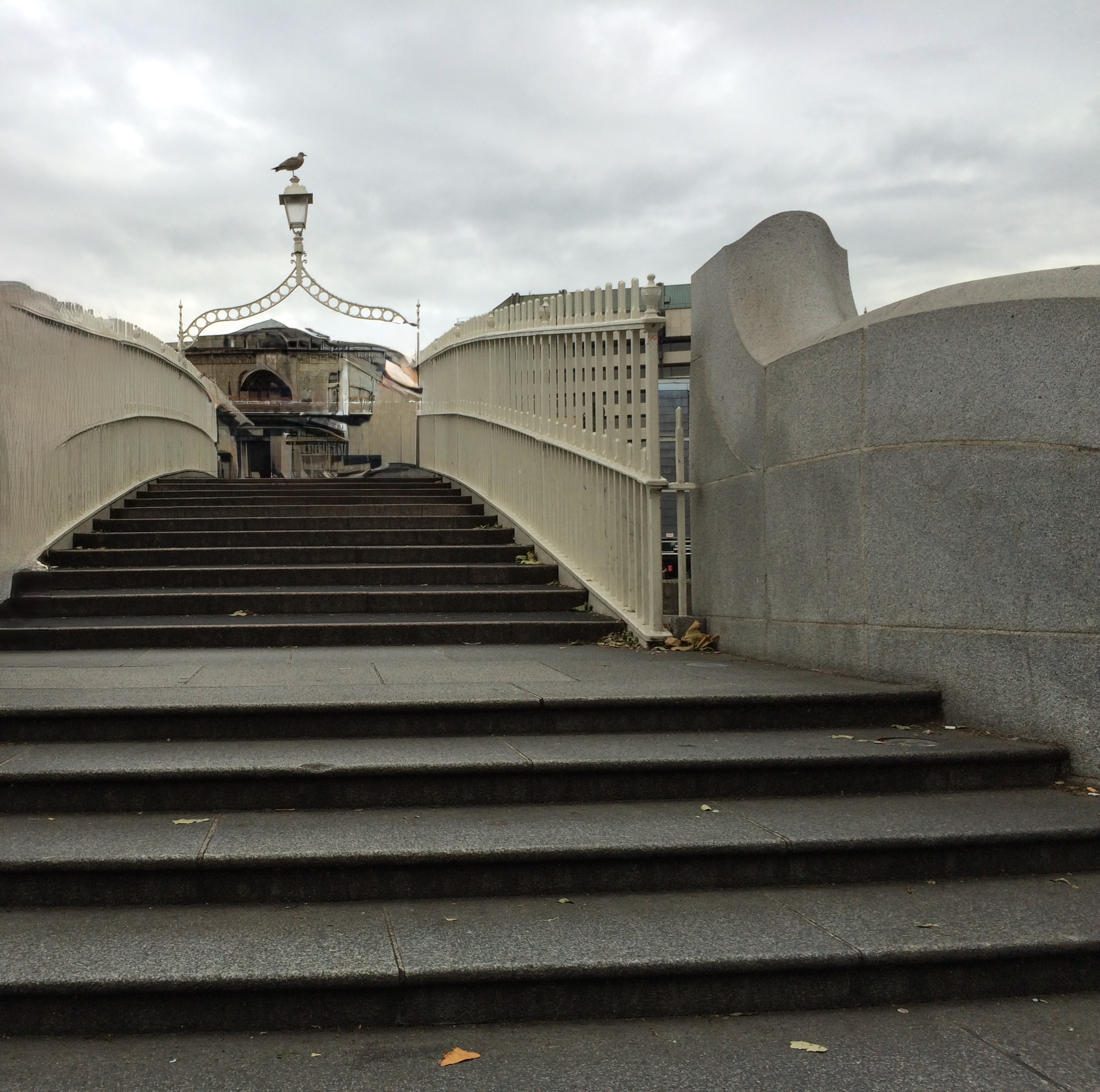
My photo of the Ha’penny Bridge from August 2016.

In older songs and stories, we still remember when the penny was valuable enough to be subdivided into ha’pennies, or half a penny. At that time, the British penny was worth 1/240th of a pound, in a pre-decimal system that was replaced in 1970 with the current pound-pence system. Dublin’s Ha’penny Bridge is named for the tolls that used to be collected to cross it. Even smaller denominations of the pre-decimal pound such as the farthing (1/4d.), and half farthing (1/8d.) were also minted. Clearly then the penny had more value in the past than it does today. I was struck when I moved to London in 2015 how you could still find goods for sale in the groceries priced less than £1, especially bread. That is almost unheard of in my own country anymore. I think this also speaks to a broader transition in the way we think away from older pre-decimal systems toward ones that work better for computers. After all, the primary method by which we interact with numbers anymore is through our computers who tend to do most all of the calculations for us.

One effect of that shift is that fractions now feel less practical. I was taught fractions in school well before being taught about decimal places in what now feels like one of these pre-decimal holdovers. To an extent I still think in fractions, perhaps thanks to our continued use of the quarter (1/4th) among the coins of the US dollar or the weighing of meat in fractions of a pound. Fractions on their own require that they represent a portion of another number, they cannot exist independently. ¾ is three-quarters of something, yet again here context is key. A musician will look at that fraction and read it as ¾ time, or a 3 beat measure where the quarter note gets the beat. Yet again there: this refers to a quarter note. That musical note may be the default note that gets played, with the ascending and descending scales of note length from that point, yet it still is ¼ of the length of a whole note. I love how in English we’ve mixed Latin and Germanic terms together to describe quarters, halfs, wholes, and such. This word quarter is Latin in origin, coming from the ordinal number fourth in that language: quartus. A quarter then is a fourth of an object.

I remember learning my fractions in school, and I still use them a great deal in my daily life. They’re practical when I know the total number of objects I’m dealing with and when I need to subdivide those objects to ensure maximum efficiency or spread. If I have 4 slices of bread left and I know I won’t be able to make it out of the house for a day or so because of snow, I’ll portion those slices out, so I don’t run out until I have the next loaf in hand. For tangible things that exist in the physical world comparing them as fractions (that is dividing the portion by the whole) helps me understand the numbers I’m dealing with.

Yet again, the quotient produced by that division, the result of that fraction is almost always written in decimals. I think of decimals as a product of the development of the metric system in the late eighteenth century. They are fundamentally more rational, and easier to program into a computer. Rather than asking a computer to translate from the more human fraction one can instead speak to the computer in its own language and let it do its computations faster and more efficiently. Today then, I use decimals far more than fractions. What’s more, each decimal number can exist independently of any other figure. 0.25 is simply 0.25, it’s not inherently a quarter of something else. When I see that price tag of $4.99 in the shop, I think of it as just a hair below $5, and am willing to hand over a $5 bill despite that being worth more than the product I’m buying. If I get my penny back or not is less of a concern, after all in this decimal mindset the penny is almost worthless, so what’s the bother if I lose a few cents here or there? Consider that sentence again though: a penny is a cent, or 1 percent of a larger number, namely $1. Even here when contemplating the penny as 1 cent or $0.01 it is still 1/100th of a dollar. Sure, eventually losing those pennies in every transaction will add up, but it’s going to take long enough that it doesn’t register as a problem for me.

Percentages are another sort of number that’ve grown in importance in my thinking in recent years. We mostly encounter percentages in tipping these days. There’s a tender balance here between tipping a percentage digitally or a whole dollar depending on the initial value of the bill of sale. When doing my own mental math, if I get a rough idea of what 20% of something will be I might decide to round up to the nearest whole dollar when writing a tip on a receipt. Yet those tip screens we see at nearly every business changes the dynamic slightly. Instead of leaving room for that rounding up they offer us the exact sum of 20% of the total bill down to the nearest cent. There’s something lifeless yet efficient about this. This is a number to be sure, yet it represents something human and social that ought to be seen in that light rather than just numerically.Mathematics is the purest language, it’s the one most often looked to as a solution for how we might communicate with other intelligent life who surely wouldn’t know how to speak any of our human languages. Yet all numbers are infused with emotion and have a myriad of deeper meanings than the sum of their parts. In balancing budgets, we could just look at the numbers and cut where seems fitting, yet there is always a human side to every budget line. Each cut is something taken away from someone, a potential line of funding removed that otherwise would’ve contributed to someone’s livelihood and helped them make something new and exciting. Numbers can and do reflect people, and they always have. They can exist in both the abstract as just numbers and the real as representations of people and objects. More often than not, we see them in the latter context. The mathematician is warranted to consider the human in their calculations, lest they clip one cent too many and leave too many of us people without the values we need to survive and thrive in this world we’ve built for ourselves.


The Longest Commute, Part 1

Over the last 3 years I have driven between Kansas City and Binghamton, New York twelve times, that adds up to around 15,600 miles of driving in total. It’s a lot of time on the road, and in the last few weeks I’ve begun to think of this period in my life as my Years of Wandering, a period when I have been practically migratory in how I’ve moved across the country so often. Surely at this point the postal workers in Binghamton and Kansas City recognize my name for how frequently I’m asking my mail to be forwarded from one address to another. Still, I am in a far better position professionally today than I was after my first master’s degree in 2016. And looking ahead now, the future really is bright for me. I’ve got a lot of opportunities over the horizon.

With all this in mind, I woke up at the reveille of my 06:45 alarm on Friday, 29 July 2022, as is usual, and ruminated on a strange dream I had been having involving, people singing the Internationale while making strange hand gestures and being overly polite, all as a part of a protest over fish. Must’ve been the wine the evening before. Regardless, I woke up that morning knowing exactly what I needed to do: it was time to strip my bed, start my regular morning routine, and begin packing up the car for the next Long Drive East.

To date this drive is the earliest I’ve ever left to return to Binghamton for the Fall semester. Its predecessor in that record was the original Long Drive East on 1 and 2 August 2019, after which I decided I would never again make that trip so early in August again. I intended to keep that promise, even through the period of 14-day quarantines in 2020, yet here I was, on the 29th of July packing the car for the Long Drive East, a drive that would end in a muggy humid valley in Upstate New York that feels about as far from home as it could be while still being in the Lower 48. So, after a quick breakfast of sourdough French toast, scrambled eggs, and hash browns with some friends, I left home at 10:00, bound for my first refueling stop in St. Louis.

The normal Long Drive East has four refueling stops, one every four hours. Typically, they are St. Louis, Indianapolis, Columbus, and Erie. That is if I take the fastest out of the possible 10 different routes. In this instance, I intended to keep to form and barrel my way across Missouri without stopping between Kansas City and St. Louis, so as to get the trip off to a strong start, and maybe to make better time at my overnight stop. But, as things have happened so often this summer, the first day of the trip didn’t quite go to plan. Rather than making it all the way to St. Louis without stopping I decided midway across the state to make a lunch stop in Columbia, home of Mizzou (the University of Missouri to the rest of humanity not from the Midwest). Already by that point I was beginning to feel pretty tired, and knew I needed at least a few minutes of a break. With that in mind, I made an early stop, and shrugged it off, opening the door for even more unscheduled stops over the rest of the trip to come.

This particular Long Drive East was different from every other one that I’ve done over the past few years. Sometimes, I might include a day or two of sightseeing along the way, as an extra bribe to myself to go through with driving so far for so long. The last time I did that was in January 2020 when I stopped in Pittsburgh for a couple days to see the Carnegie Museums. In the years since I’ve allowed myself half-day stops here and there, like at the Cleveland Museum of Natural History in August 2021. In all of those occasions I rarely detoured from the general Great Lakes region that lies between the Great Plains where Kansas City blooms and the Appalachians where Binghamton is nestled among those low mountains along the banks of the ancient Susquehanna River.

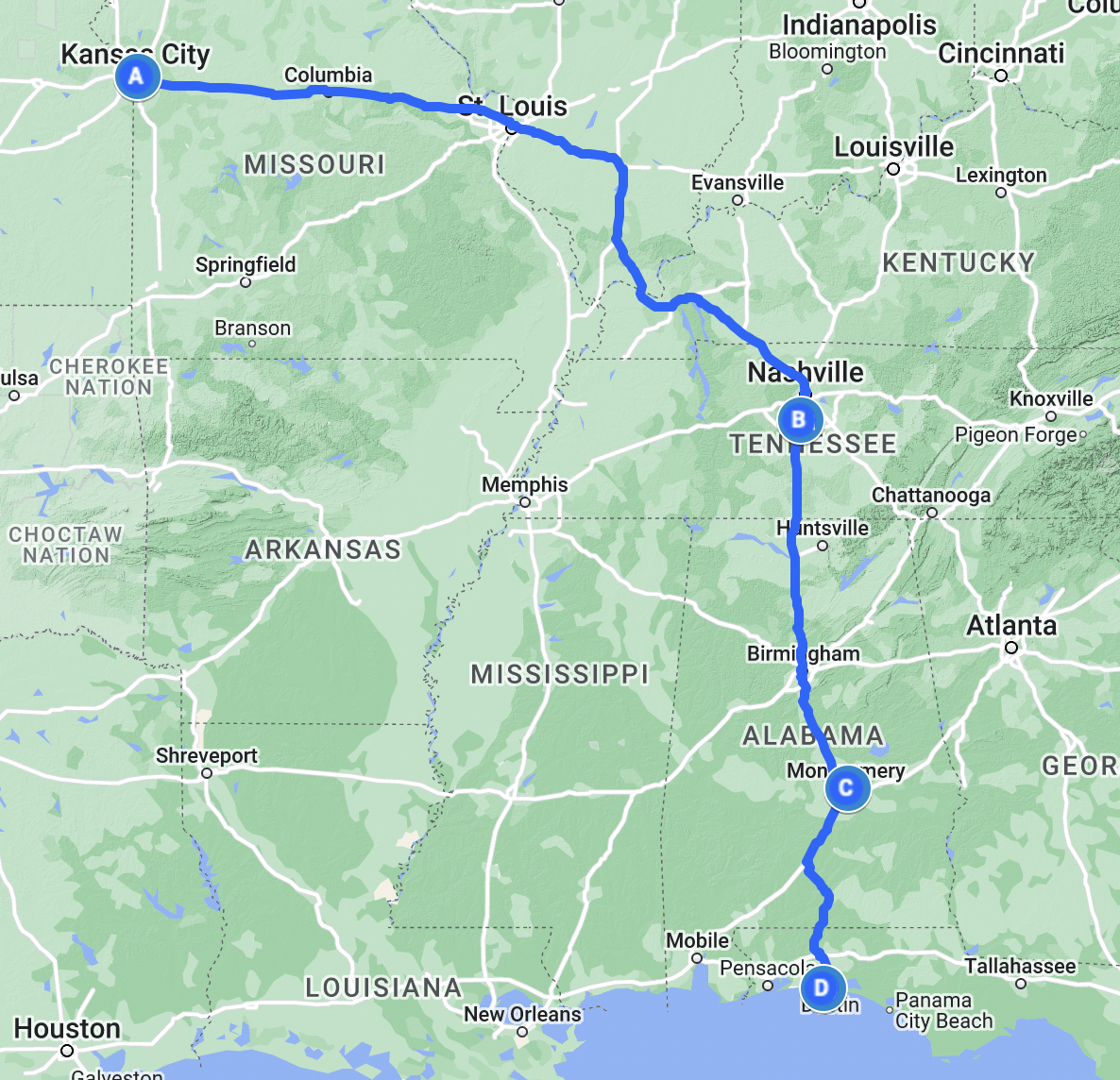
This time I was taking a long way around, not exactly what I’d call “the long way around”––that would be driving to Binghamton via Alaska––instead, I planned to return to Binghamton via the South, the one region of the country (besides Alaska and Hawaii) that I’ve spent the least amount of time in. Why would I add an extra 1,430 miles (2,301.36 km) to my route just to do a bit of sightseeing? Family, that’s why. This year my family decided to hold a reunion in Destin, Florida, a small resort town on the Emerald Coast of the Gulf of Mexico that lies about halfway between the larger Northern Florida cities of Pensacola and Panama City. 

Of the 24 of us who went to Destin this Summer about half made the trip by air along various routes, while the other half of us drove. I decided from the first moment I started planning this trip that I wanted to stick to the interstates as much as possible, seeing as I memorized most of those over years of staring at maps during road trips as a kid between Chicago and Kansas City. Most of the drivers chose to take a slightly faster route on US Highways through the Ozarks stopping overnight in Memphis and Tupelo, Mississippi (Elvis’s two hometowns). In my case, my goal for the first night was Franklin, Tennessee, a suburb south of Nashville along I-65. So, naturally as I drove across Missouri, I was repeating from time to time the general route I was following on that first day: I-70, I-64, I-57, I-24, I-65. As long as I kept those numbers in mind, I knew I’d make it to Franklin eventually.

I arrived in St. Louis around 13:30, about 2 hours later than I usually would on a Long Drive East. Granted, I also left Kansas City 2 hours later than usual, choosing that wonderful breakfast at Eggtc. over the typical simpler breakfast at home or the quick sandwich & doughnuts that I’d normally pick for such a trip. In the days before I left, the St. Louis area had been badly flooded by heavy rains, with some places in St. Charles County even seeing a foot of rain (30 cm) fall in the course of a day. The reports showed homes inundated, metro stations submerged beneath 21st century ponds, and highways deep under water. I was concerned that the aftereffects of the flooding might close some of the highways I needed to take, particularly I-70 in St. Charles County and I-64 across St. Louis County and City, but thankfully it was smooth sailing the entire way to the Arch.

I crossed the mighty Mississippi on the Poplar Street Bridge and left Missouri behind for the second state, the state of my birth, Illinois. Now the thing to say about Illinois from the start is that as much as it is the state of my birth, there is a tremendous difference between Chicago and the rest of Illinois, just as there is between any metropolitan area and the rural countryside in between across the United States. So, as much as I do kind of feel at home even there in Southern Illinois, it’s still not exactly the same as the place that I still call my original home a couple hours’ drive to the north of St. Louis. This trip marked the first time I drove southeast out of St. Louis on I-64, which is the main road between St. Louis and Louisville, continuing on from there eventually to Richmond and Hampton Roads, Virginia. I was only on I-64 for a short time, little more than an hour, when in Mt. Vernon, Illinois I left that east-west route and turned south on I-57, a highway I usually encounter in Effingham, Illinois, to head towards the furthest reaches of that state of my birth, to a place I’d long heard of and wondered about.

When I was 5 or 6 my parents bought a beautiful cloth-bound hardcover photographic atlas of the United States that was probably a special millennium edition. I remember the inside cover had a photo of a mountain climber scaling an ice-covered cliff on one of the mountains either out in the Rockies or up in Alaska. But as I drove through the southernmost reaches of Illinois, what came to mind the most was the photo of the Fall colors in Shawnee National Forest, which covers 280,000 acres (1,100 km2) of woodlands near the confluence of the Ohio and Mississippi Rivers. As a child, I always was amazed that there was a national forest in Illinois, I had only ever encountered national forests out in Colorado, and so to me that meant they must be truly wild places with great mountains and old trees and lots of animals. Shawnee National Forest certainly has some hills, the Ozark and Shawnee Hills to be precise, but the years since has tempered my initial surprise through time spent in the national forests of the Appalachians.

I crossed the Ohio at Paducah, entering the Commonwealth of Kentucky. I last visited Kentucky in September 2018 when I attended the Midwest Conference on British Studies at an Embassy Suites in Lexington. My experience of the state this time was largely the same as that time, only I’m happy to report I-24 is far less potholed than I-75 was the last time I drove it between Cincinnati and Lexington. I crossed Kentucky quickly, I-24 crosses only 93 miles in that state before entering Tennessee. While in Kentucky though I did see the first big dark clouds that marked the latest round of flooding, this time not in St. Louis but in Eastern Kentucky.

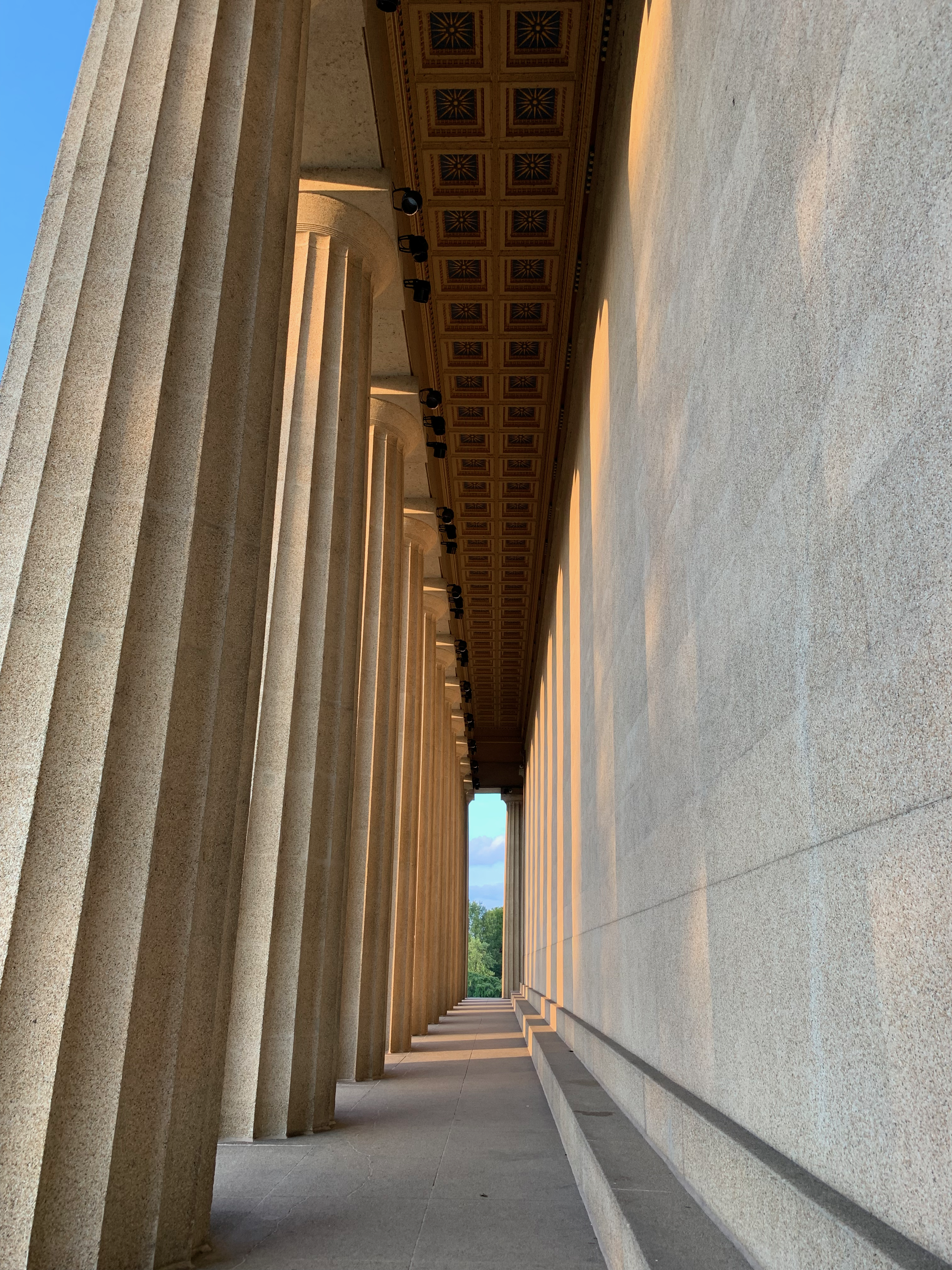
As I left Kentucky for Tennessee, I began to enter a far hillier area that makes up the northern rim of the Nashville Basin, a great bowl surrounding the state capital. Traffic picked up as I descended into the bowl, reaching the I-24/I-65 junction north of Downtown Nashville. Back in Kansas City I had chosen to enter the address of the top site on my tourist list in Nashville into my navigation system, and so I left I-65 early of my hotel for Centennial Park and the Nashville Parthenon. This building is a full-scale replica of the original Parthenon located on the Acropolis in Athens. I arrived at 19:00, sadly a few hours after the interior had closed to visitors, and thus could not enter the building. Nevertheless, I gazed in wonder at the reliefs and ornate ceilings of the porticoes and stoas.

After a quick stop at the Parthenon, I made an even quicker stop at the Tennessee State Capitol, wanting to avoid the ire of the state police for spending too long on their property, and by that point having been on the road for a full 9 hours, I really needed to get to my hotel to sleep. With those two stops in Downtown Nashville done, I returned to I-65 and made quick work of the drive south to Franklin.

The following morning, I woke with my 06:45 alarm and staggered upright after the usual vivid and surreal dreams. There were images of me in quick step striding my way across a white sand beach on the Gulf Coast, dressed in a full business suit beneath the midday Sun. In my left hand my briefcase, my right hand raised aloft trying to catch some phantom bus that was due to roll onto the shore. Riding atop my head was my cat, Kitty, lazily lunging on my scalp as if unconcerned by the precariousness of her position.

I remembered what I had to do and quickly got ready for another day of driving. While the first day had taken me along roads I knew all too well, this day would pass along many roads I’d only ever looked at on the map. I left my hotel in Franklin at 08:00, stopping for a quick breakfast before turning my attention once more to I-65 and the continuing road south. The Tennessee hills glowed in the morning Sun, their green cover of foliage marking the southern end of the great Appalachian Mountains that I knew well in New York. 

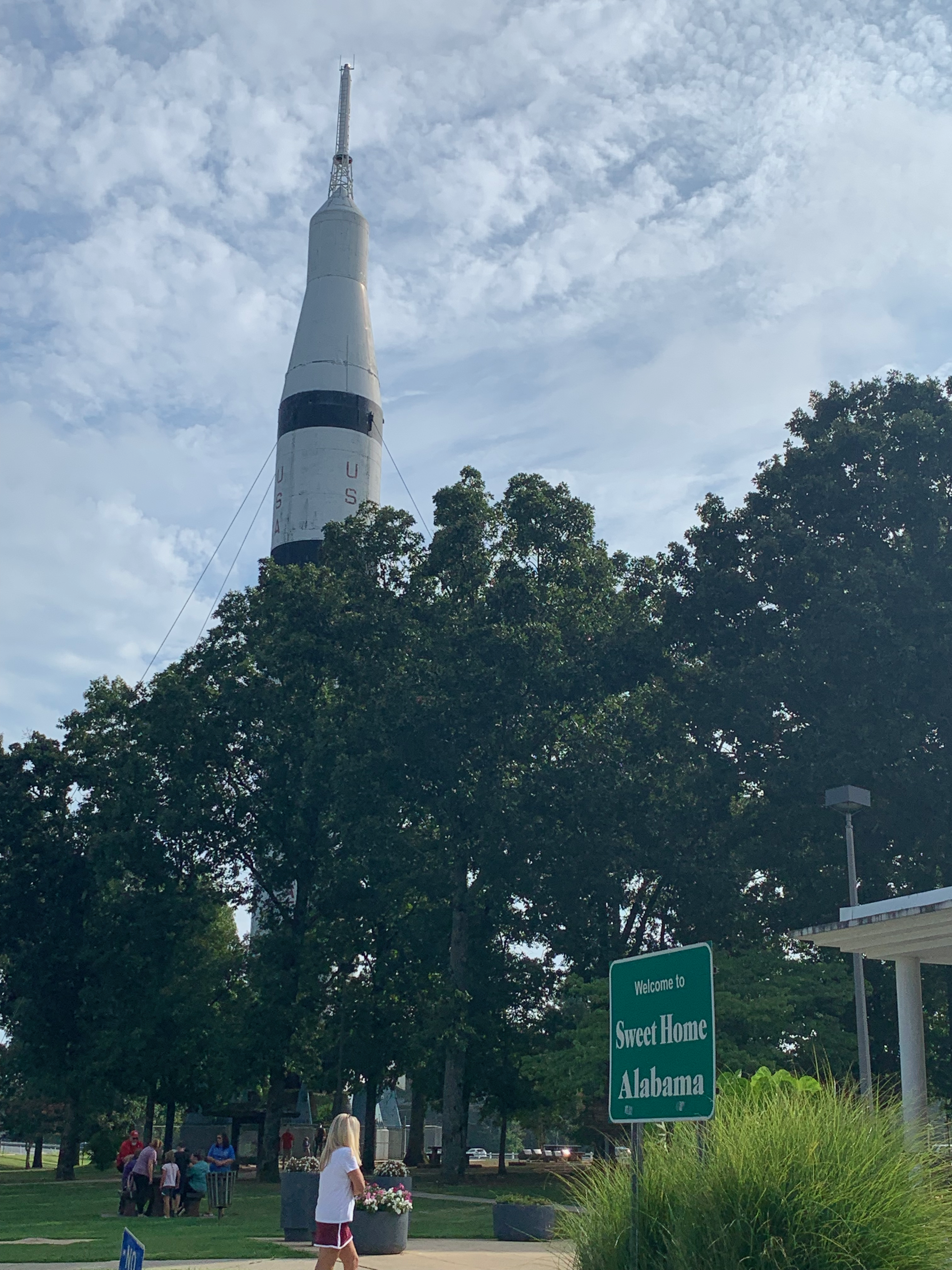
I made quick progress along I-65 to the Alabama border and soon found myself facing a Saturn IB, a NASA rocket built in Huntsville, Alabama. I pulled over into the Alabama Welcome Center parking lot and briskly walked over to the base of the rocket to take some pictures before returning to my own chariot for its continuing voyage rocketing ever southward toward far greener shores.

Alabama struck me as in some ways old fashioned, in other ways brilliant, as in how they included the mile markers on each bridge, a great way of calculating distances as I crossed the Heart of Dixie. After about an hour I entered the great valley where Birmingham was built, the largest city by far in the state. In Birmingham I began to truly notice that I was moving southward as I crossed over Interstate 20.

Here in the US, the Interstate highways are numbered in an ingenious way to help navigation: east-west highways are even numbered with the lower numbered highways in the south and higher numbered in the north, and north-south highways are odd numbered, with the lower numbered in the west and higher numbered in the east. Thus, with Interstates 5 and and 8, San Diego is the 0/0 point of the Interstate system, while Boston with its Interstates 95 and 90 is the exact opposite. There are some exceptions to the rule (I’m looking at you, I-99 in central Pennsylvania and New York), but by and large it’s a rule that’s followed nationwide. So, when I saw the signs for I-20, I knew I was making progress, especially when I started the trip in Kansas City on I-70.

Birmingham seemed like an interesting place, and while I didn’t stop there this time, I wouldn’t be entirely opposed to having a conference there in future years, if that happens. Nevertheless, I passed it on by and continued south toward my first waypoint of the day in the state capitol Montgomery. Yet after leaving Birmingham I was baffled to be stopped by bumper-to-bumper traffic that had occurred for no apparent reason. I sat in the southbound lanes crawling behind semis, RVs, boats on trailers, pickup trucks, and suburban soccer mom tanks (aka minivans) with every state’s license plate imaginable adorning their rear bumpers. The heavy traffic continued for the rest of the day’s drive until I reached the Gulf Coast late that afternoon.

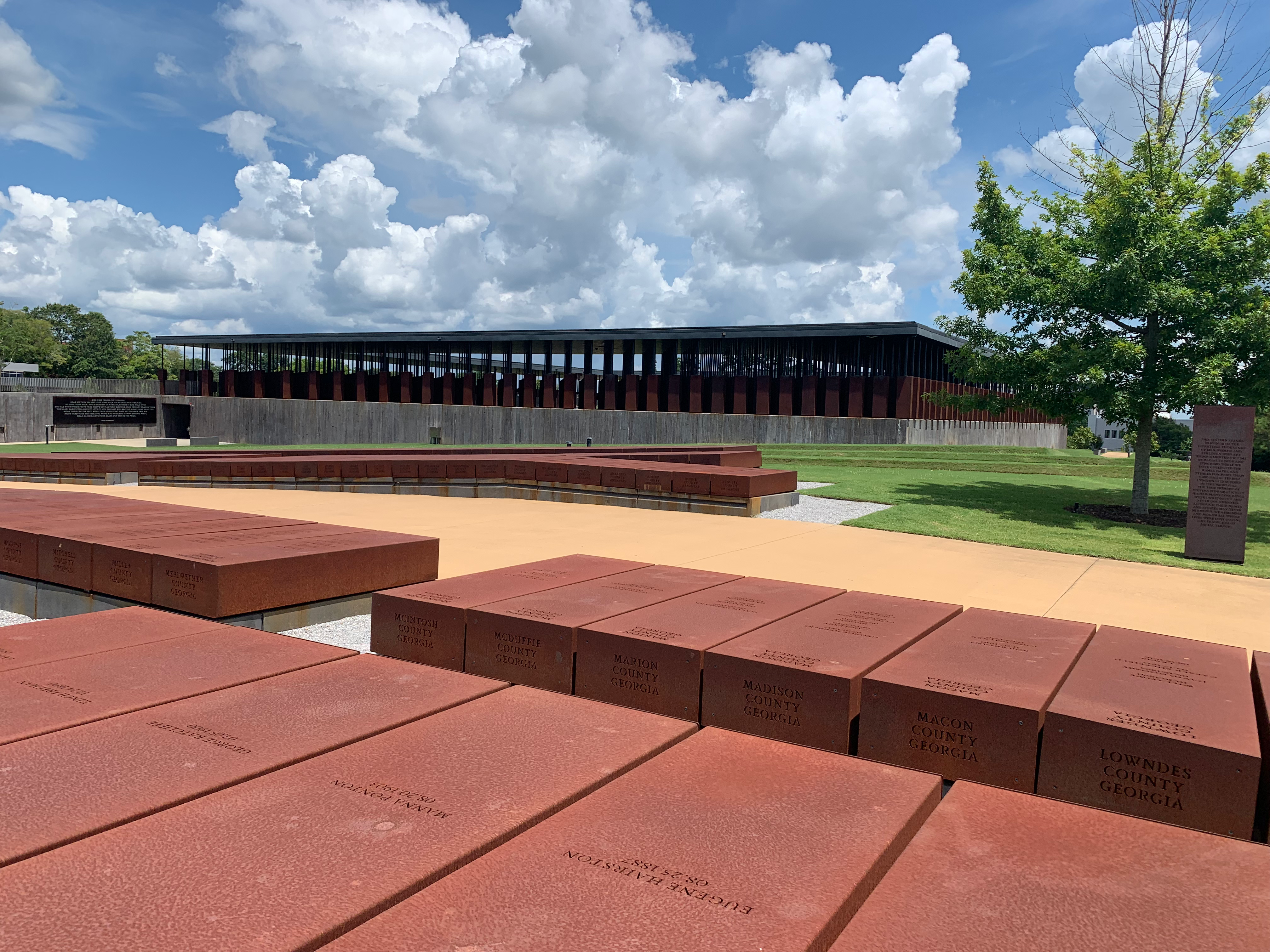
I reached Montgomery just before noon and drove straight to the main site I wanted to visit. The National Memorial for Peace & Justice opened in April 2018 to much press. A review at the time from The Washington Post’s Philip Kennicott called it “one of the most powerful and effective new memorials created in a generation.” I read all about it when it opened, and even looked into how I could travel to Montgomery to visit it. When I did arrive, I wasn’t disappointed. The memorial honors the African American victims of racially motivated lynchings that took place between the end of Reconstruction in 1877 and the beginning of the Civil Rights movement in the 1950s. The memorial is made up of a series of 805 hanging rectangular steel pillars representing each county where an African American was lynched in this country during that 73-year period. I was quiet walking up to the memorial, stunned by the sight of it. I knew what to expect, but I didn’t really grasp the power of that vision until I actually saw it in the flesh. How such racially motivated terror was, and frankly remains so common in this country is sickening. 

My eyes stayed wide as I gazed first at the pillars that hung along the entry to the memorial and then slowly turning upward as I walked down into the heart of the site, a trench that was dug deep into the ground like some vast communal grave into which all these tormented souls were buried. Some of these pillars have been taken down from their original places aloft and placed on the ground in a series of rows like in a cemetery, those that have are the ones that represent counties that have established their own memorials to mourn those who were murdered this way locally. My own home county––Jackson County, Missouri––was included among those that have erected their own memorials, in our case to a man named Levi Harrington who was murdered on 3 April 1882 on a bridge in the West Bottoms. In June 2020 the monument in question was thrown down the cliffs on the western side of Quality Hill soon after its installation by several unnamed individuals. At this moment of writing, I can’t remember if it was replaced and fixed.

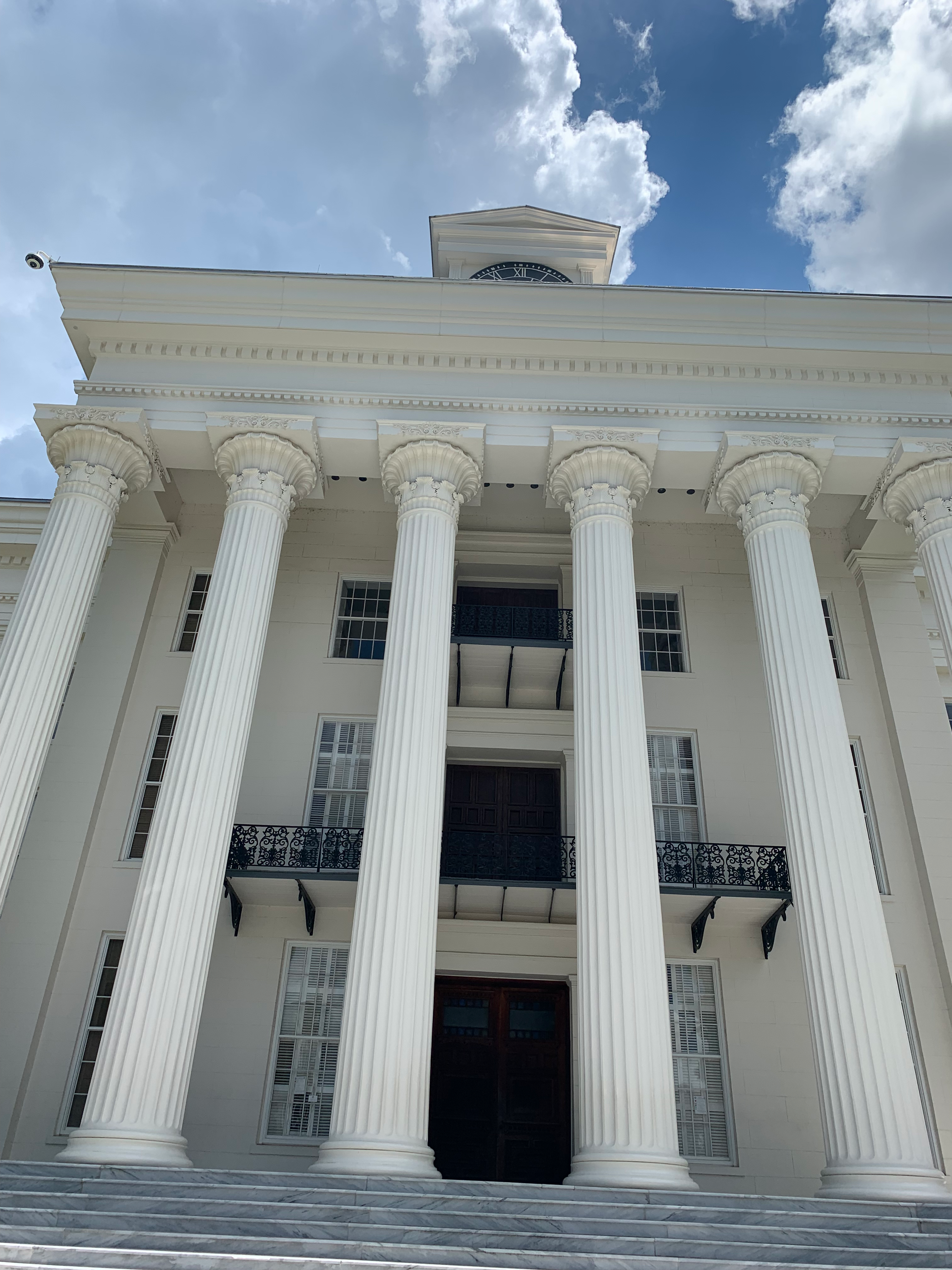
I left the memorial and drove into downtown Montgomery hoping to find lunch and make a stop at the Alabama State Capitol. Yet of all the things that could be confounding the parking situation was what kept me from making more than just the one stop on the capitol grounds. Every parking meter I stopped at had a red “Expired” sign waving like a most unwelcoming of flags before me. So, I decided the best place to risk getting ticketed for illegal parking was the State Capitol itself.

The Alabama State Capitol has a checkered history in my book. On 22 February 1862 it was the scene of the inauguration of Jefferson Davis as President of the Confederate States. While I was taking pictures of the capitol building’s white façade a guard walked over to me and asked, “You should get pictures of the statues as well, like Jefferson Davis over there?” I turned to the guard and quickly replied, admittedly without thought, “I don’t take pictures of traitors.” Alabama to me is the South personified, it was home to the first capital of the Confederacy, and the heart of the old Jim Crow South that perpetuated the evils of the old Southern way of life for generations after they were defeated in battle by the Northerners and Midwesterners. I myself didn’t have any ancestors who fought in the Civil War, they were all either too old or too young for the draft, but I do remember hearing stories of the anger towards the South in the younger generation that lived through that war, whose lives were scarred by the horrors of a war fought over the elites of one half of the country’s inability to consider an entire group of people as anything more than property. This is the reason why I’ve generally avoided the South, especially Alabama, which to me is the beating heart of that infernal system.

I left Montgomery and continued ploughing my way ever southward toward the coast. I followed I-65 for another 90 minutes of steady traffic until turning off and onto a series of smaller country roads at the town of Georgiana, birthplace of Hank Williams (1923–1953) one of the most influential country singer-songwriters of the last century. From there the road took me ever deeper into the hardwood swamp forests and bogs of southern Alabama, typified by the woods of Conecuh National Forest. As I drove through the forest the first sign that I had entered Florida was that the highway name had switched from an Alabama state highway to a Florida one. Naturally at that point I lost my data signal and briefly lost navigation and communication on my car’s computer. 

But after a good 15 minutes it all began to return as I left the thick forests of the far northern reaches of the Florida Panhandle and crossed over I-10, better known in California as the Santa Monica Freeway. After another 20 minutes I was in Fort Walton Beach approaching Destin with seemingly nearly everyone else from the Midwest and Deep South. The streets of Fort Walton Beach were packed to the gills, leading to the last mile of the drive taking a full 20 minutes to complete. Regardless, I was now in sight of the Gulf of Mexico, the second arm of the Atlantic I had driven my car, the Mazda Rua, to. It was surely the beginning of a beautiful relationship.

Rivalries

The idea of a rivalry and all the extra stuff that goes with it seems to be baked into American culture. Rivalries often make for the most exciting games in a league’s calendar not only for the history traditionally associated with that matchup but also for the antics and occasional brawls that break out in the process of playing the game. As a young Cub fan I always expected there’d be a fight during a Cubs vs Cardinals game or a Cubs vs White Sox game, just as any meeting between the Red Sox and the Yankees seemed sure to produce the sort of atmosphere normally reserved in North American professional sports for the hockey rink.

Interestingly, going off of what I wrote about last week in terms of regionalism, I think it’s important to recognize that rivalries often define a region’s local identity more than anything else. The two great cities of Missouri, Kansas City and St. Louis, are defined just as much by the shuttlecocks at the Nelson-Atkins and the Gateway Arch as they are by the rivalry between the Royals and Cardinals, particularly during the 1985 World Series, which ended in Game 7 with a Royals victory over the red birds. I only hope that with the introduction of MLS’s new St. Louisian team, St. Louis City SC, that we’ll see a strong rivalry between “City” as likely they’re going to call themselves, and our own Sporting.

If anything unites most American cities and their surrounding metropolitan suburbs it’s a general dislike for other cities and their metros. Often the greatest of these rivalries seem to be founded in sports: the Chicago/St. Louis rivalry for example, which certainly began as a disagreement among two of the Midwest’s greatest metropolises in the nineteenth century and developed in the last decades of that century and into the early decades of the twentieth through the birth of the Cubs in 1871 and the ancestors of the Cardinals, the original St. Louis Browns, in 1882. In the decades and generations since that rivalry has grown not only with the introduction of the Blackhawks vs. Blues rivalry in hockey but also a general sentiment that I experienced as a Cub fan going to college at a place dominated by St. Louisians; it didn’t help that my freshman year was also a year when the redbirds won their last World Series.

On a larger scale it seems like we could carry this idea of the rivalry to a geopolitical level. Sure, the US has rivals, traditionally they’d be our counterparts in Europe, in particular in the nineteenth century Britain and in the first half of the twentieth century Germany. More recently though, in the last few generations the US’s biggest global rivals have tended to be the likes of Russia and more recently China. I will fully admit to playing off of the eternal bogeyman in the American psyche by playing the sublimely stereotypically Russian theme tune to the fantastic 1990 film The Hunt for Red October every time I find myself in St. Louis when the Cardinals are doing well. In my own silly way it’s playing off of fears of the bogeyman projected on the wall in this country in communism, comparing my own Cubs’ greatest rival to that red scourge.

It’s interesting though that we have come to develop such profound senses of national pride out of how different we are from other countries, or at least how different we see ourselves from other countries. People in positions of authority, both in government and in the media, have taken advantage of this idea of rivalry to profoundly change the political discussion: we hear more banter about the creeping influences of socialism or Islam today than we do from the same people about problems that face our country internally like racism, vast inequality, and the constant threat of violence due to our overly lenient gun laws.

I’ve often thought that if anything is true it’s that a people who define themselves by what they aren’t rather than what they are will surely fall apart in the long run. Equally, a people who cry wolf at the shadow of the wolf on the wall, labelling it something foreign, when its fangs are being used by the same crier to cause chaos in the cave itself is a people doomed to falter. We’ve found ways to use the excitement of sports to infiltrate our politics and our daily lives, forcing us to adopt a mindset that it’s always us vs. them. Eventually, if we’re not careful we’re going to bring about our own defeat on the field of play, and not by anything our opponents do. It’ll be an own goal, a safety, our knives in our own back that will bring the land of rivals to its knees.