
Tag Archives: Star Trek: Voyager

On Universals

This week, I discuss some of the things which are common to all of us, problems we all share, and why I think we ought to look at solving those problems.—Click here to support the Wednesday Blog: https://www.patreon.com/sthosdkane


This week, I discuss some of the things which are common to all of us, problems we all share, and why I think we ought to look at solving those problems.


I don’t rest much these days, there’s so much I have on my mind from my work to my hopes for my life to the state of our world boiling in tumult around us. I sleep, yet I rarely feel rested when I awaken. I suspect it’s worse on those mornings when I’m pulled awake from the middle of a dream, that is from REM sleep into my waking reality. Perhaps this is the same for you if you’ve noticed it. This morning was one such occurrence and I’ve been tired throughout the day, even drifting off to sleep midday while watching the Cubs game and later riding in the backseat of my family’s car to an event. These days, I have a lot on my plate, and as one of my best friends pointed out to me recently, I’m probably due for a vacation of at least a week in length. When I have the time and the money to do so I’ll probably slip away somewhere as suggested.

I’ve always thought that the more technologically advanced our society becomes the better life will be for we humans who crafted these machines and machine intelligences which are the hallmarks of our civilization today. I suspect many, if not all, of you would both agree and disagree on some level with this statement. Life is easier on some counts, yet we still haven’t found a way to relieve the burden of human labor through invention. This is one of many universals we all have in common, one of many things we can look to and nod at as signs of our humanity. We all struggle in our own way, and we all have things we love and fear. I think at the core of our problems today is the desire to divide us into camps armed to the teeth to defend their own circle from the other circles out there in the fog of doubt. How often I’ve worried about nothing when someone doesn’t respond to a message, email, or letter when the person on the other end was simply busy! We all dream, don’t we? In our waking moments as well as in our sleep we dream about the life we want to have in our future. There does lie a difference between those who see those dreams as blueprints for what they can create and those who merely see these dreams as figments of an overactive imagination. Yet that difference can be overcome with enough courage and determination to see a better tomorrow.

I do believe that we all want to be happy, the question lies in what we each believe on our own terms will make us happy. In America, a country with capitalism so deeply baked into our collective consciousness, happiness is often quantifiable in dollars and cents. I went to college with a lot of people who chose their majors out of a conviction that their happiness would come if they became rich. I also know other people who are happy with quiet, unassuming lives. In my case I know I am capable of doing great things, of making an impact on our society, and I want to do all that. Yet as I’ve grown, I’ve found that what makes me happiest is being comfortable in my living, having choice in what I do and who I live my days with, and always seeking new knowledge and even wisdom from time to time. I know I need to earn my keep to do these things, something I’m presently not doing, yet as I often say when I’m feeling especially dour about the current state of my life at 32: I have many long years ahead of me, let’s take one step after another to get to that point of comfort that I seek.

Another universal emotion for humanity is fear; in fact, it’s one of the most powerful emotions we can feel. I know fear well, as Captain Kathryn Janeway of the Starship Voyager said to an embodiment of Fear in one of the finest episodes of Star Trek: Voyager, “I’ve known fear, it’s a very healthy thing most of the time. You warn us of danger, remind us of our limits, protect us from carelessness. I’ve learned to trust fear.” Fear is a seed of knowledge, yet hope is the fertilizer needed for wisdom to flower. We’ve been fed so much fear by one camp of  all others that it is nearly all we hear today. Yet that fear lacks the depth which is needed for true societal growth to occur. The power of the fearmongers will remain brittle and fragile until at long last it crumbles again as it always does.

So, let me ask you this: what would it be like if we let our guard down even for a few moments and talked with one another about the things we have in common? What if we lowered our banners proudly proclaiming our camps and sought out the universal ground upon which we all stand? At the end of this time of change, whenever whatever is coming next is settled, we’re going to have to do just this. We will need to talk with one another and recognize our common humanity. What’s more, we will have to learn not only to talk with one another but listen to one another again. I’ve been in meetings in the last few months where I certainly could’ve contributed my own thoughts about the state of things, yet I’ve found it far better to be attentive to the people there with me and hear what they have to say. Often, we have similar concerns and similar hopes in kind. To do any of this takes a tremendous amount of courage but not anymore than we’ve mustered in the past. I’ve seen it after big storms when people help dig each other out of the damage. You may ask, “Why would we care about our neighbors if we don’t even know them well?” That question is simple: you do it because it’s the right thing to do.

There was a series of television commercials several years ago which purported to show a potentiality where it was normal to prefer pain or trouble over pleasure and comfort. I wonder if we aren’t in fact living in that world where we accept the pain and trouble because we can’t work up the courage to face that pain and trouble and find solutions to remedy it? Take for instance the trouble we go to in the United States to travel between our cities: we put up with uncomfortable day or multiday long road trips or quick yet rickety short-haul regional flights because we’ve dismissed the potential of trains to connect our smaller and larger cities together. Last month, I drove up to Chicago in the backseat of my Dad’s small pickup truck and returned home in a sleeper class roomette on Amtrak’s Southwest Chief. I appreciate the ride back to the city of my birth, yet the benefits of having more legroom, being able to walk about the train, lounge access in Chicago, and complimentary service in the dining car can only be outweighed by the convenience of being able to choose when I want to leave my origin and arrive at my destination by car, especially when as of now there’s only one direct train per day in each direction between Chicago and Kansas City.

We can use particular answers to solve universal problems, if only we have the courage to consider those particularities. I worry today that we may be short on the courage to solve our most universal of problems, the rot at the heart of our civilization that we’ve too long ignored until it’s oozing there right before our eyes. A house with rot in its foundation will eventually fall and crumble into ruin. Can we face our own rotting foundations before we lose what is most universal, what we most love and appreciate about our lives? Or can we do what we know to be right, what we know we must, and begin the process of rebuilding to craft a better version of the old edifice of our civilization, a more equitable edifice indeed, for our posterity to enjoy?I’ll leave you with those questions, because often the best conclusion to any essay ought to be the provocation of more queries rather than definitive answers.
A Trek Among the Stars

I first started watching Star Trek a month before the first waves of the pandemic hit the U.S. early in 2020. I knew a fair bit about the characters of the different series and some of the overarching stories, so when Star Trek: Picard was released in February 2020 I figured I wanted to see what it was all about. Thus began the next two years of my life in terms of TV viewing. Since then, I’ve gone all in and seen the entirety of the first two seasons of Picard, with a third coming in February 2023, as well as all seven seasons of The Next GenerationDeep Space Nine, and Voyager, all four seasons of Enterprise, and what’s so far been released of Lower Decks, and Strange New Worlds. I’m now watching the original series, Star Trek starring William Shatner, Leonard Nimoy, and DeForest Kelly that aired between September 1966 and June 1969 on NBC.

Like with the other Trek series, I’ve found the characters relatable and enjoyable to watch. I’ve also found some of the futuristic settings and technologies depicted on the show inspirational to my own imagination as a storyteller. Yet I’ll freely admit I find this series harder to get excited about compared to the later Trek series released in the ’80s,’90s, and 2000s, perhaps because this original Star Trek sought to depict the future of the late 23rd century as the 1960s dreamed it might be, whereas the later series looked to the late 24th century as the ’80s, ’90s, and 2000s aspired it to be. Being a child of the ’90s and 2000s, that post-Cold War worldview fits my own far more closely than the background surrounding the Original Series during my parents’ childhood in the ’60s.

Still, when I do get into an episode of the first of these shows, I often find I do like the stories. They’re in the same spirit as other mid-century sci-fi shows that I’ve always admired like The Twilight Zone or the older William Hartnell era Doctor Who serials. What’s more, the vibrant colors used to light the sets of Star Trekalways catch my eye in a way that keeps me focused on the action of the story.

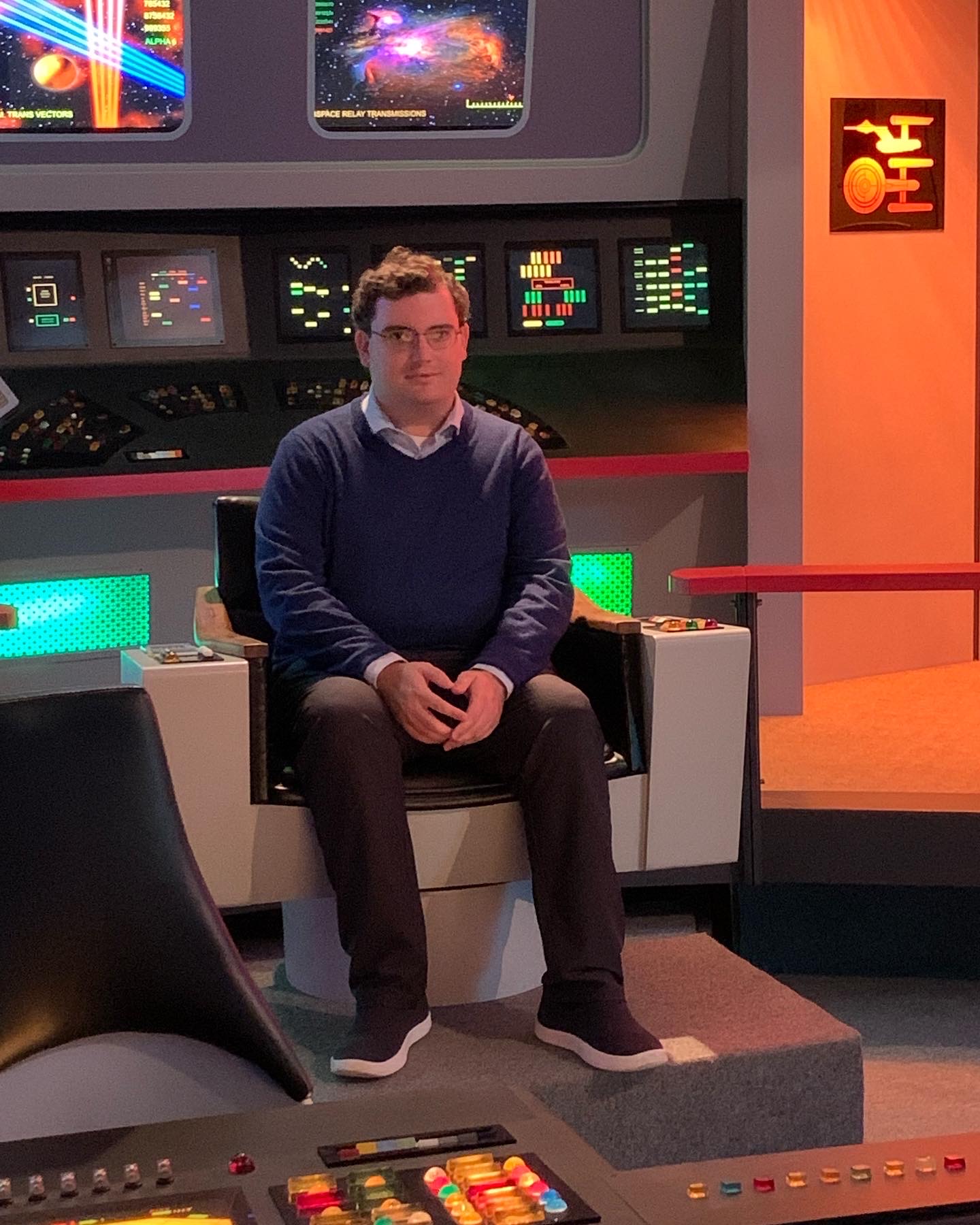
So, a few months ago when I learned there was a recreation of the sets of the Starship Enterprise in a building in Ticonderoga, New York, I knew I had to pay a visit. I arranged things with my good friend Alex Brisson, and we made a weekend trip out of it, visiting the Star Trek: The Original Series Set Tour around noon on Saturday, 17 September. The sets were built by a local guy named James Cawley, who interned on the production of Star Trek: The Next Generation at Paramount. Over the intervening years, the team in Ticonderoga have built with meticulous detail the sets of that original Enterprise as they appeared on the soundstages at Desilu Studios in the late ’60s. In many ways, the tour is both an opportunity for fans to experience walking on board the Enterprise as much as it is for film and TV buffs like myself to see what a TV set from the ’60s would have looked like.

When we walked on the bridge and saw all the stations set out in their circle, the captain’s chair in the center of the room, most of the people in our tour were hushed, a sense of respect among us. I got a chance to sit in the chair, as did everyone there, and I’ll admit the picture of me sitting there looks a fair bit deer-in-headlights as I couldn’t decide what to focus on with so much around me to see. For me, the original Trek isn’t necessarily the show that I prefer the most, that’d have to be Deep Space Nine with Next Generation and Voyager close behind it, but it spoke to a common thread in my life over the past two years as I’ve continued with my own work and studies while in the evenings taking an hour or two to watch another story set a few centuries down the line.

I think the thing that has kept me so interested in Star Trek is how aspirational it is. Unlike so many other futuristic films and shows out there, in the stories told here humanity has figured out how to get out of our cycles of violence and greed and work with the best parts of our nature to achieve the closest we could ever come to returning to Paradise here in our own mortal lives. They are stories that say, “no matter how bad things may be now, no matter how much the pandemic and all the other troubles that came out of it have become, there’s always hope.” 

I’ve always been one to trust in the fundamental goodness of humanity, it’s an idea that really does have some deep roots in my Catholic faith, as well as in my lived experiences. I’ve been fortunate to live the life I’ve led so far, in the places I’ve lived and with the people I’ve known, family and friends who I’ve loved. The seeds of a better future are laid in that fertile soil of hope. Had I grown up in the midst of the wars that my country waged over the last 20 years in Afghanistan and Iraq or in a country with less opportunities for success than my own, my worldview would likely be quite different. Yet if we are going to ever get out of this mire we’ve been in for so long, our adolescence as a species as Carl Sagan put it in his novel Contact, then we’ve got to let our hope for a better tomorrow guide us just as much as our cynicism and bad memories of past wrongs guide us now.

In the future that Star Trek depicts humanity finally begins to overcome our faults in the last half of the current century when first contact between humans and an alien species, in this case Vulcans, occurs. Our technology, and their helping hand (however hesitant it may be) moves humanity up from an age of nation states and superpowers battling each other for supremacy and resources on Earth and into a new age where humanity is one small island in the great ocean of Space, learning to live amid our galactic neighbors, and finally contributing to the creation of a Federation of Planets in the mid 22nd century that brings about a new Golden Age of sorts not just to us on Earth but to many other worlds floating in this cosmic sea.

It’s fiction, I’m well aware of that. It’s a collection of stories dreamed up by writers and showrunners over the past six decades that could very well remain stories in our cultural memory. But maybe there is some room for our future to be more peaceful, more prosperous, and more equitable than our present is or our past ever has been. In the decades since Star Trek first premiered in 1966 so many technologies inspired by the shows have become realities from tablets to personal communicators to now virtual reality taking the place of the holodecks and holosuites of the Next Generation, Deep Space Nine, and Voyager. I’ve been drawn to these stories because they came at just the right time for me. I began watching Voyager in the long dark winter of 2021 when I was preparing for my Comprehensive Exams. That winter, being so far from home and so isolated by the continuing pandemic, I found the story of a lone ship lost 70,000 light years from home to resound with my own situation. These are stories that laud curiosity and teamwork, and while just stories with the odd bizarre plot or weekly new alien with different nose ridges, they offer us a vision of what our world could be like.

Why not give that future a try?

Freedom from Fear

Credit: Wikimedia Commons CC BY-SA 3.0
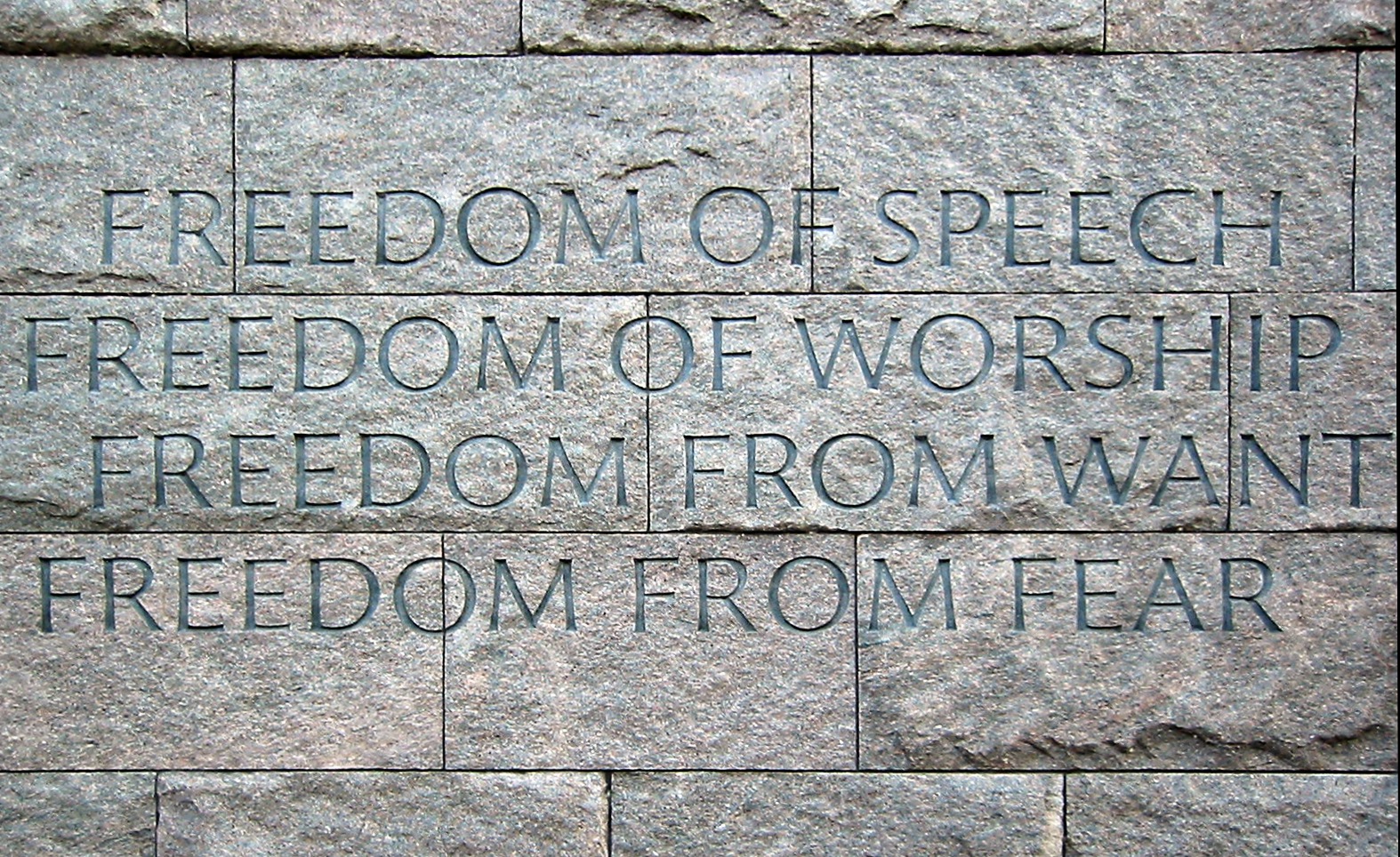
In this episode I talk about how FDR’s Four Freedoms from his 1941 State of the Union is pertinent to today.

When I worked as a Teaching Assistant for the US History II class (1877-present) at the University of Missouri-Kansas City, the week that we’d discuss the Great Depression and the New Deal, I would always highlight President Franklin Delano Roosevelt’s Four Freedoms and spend a good deal of time discussing them, what they meant to Americans in the 1940s, and what they mean to us today. Chief among these for me has always been the most abstract yet primeval of these Four Freedoms: Freedom from Fear.

At the time he announced the Four Freedoms in his 1941 State of the Union Address, 81 years ago this week, FDR saw Freedom from Fear as “a world-wide reduction of armaments to such a point and in such a thorough fashion that no nation will be in a position to commit an act of physical aggression against any neighbor –– anywhere in the world.” 

This spoke as profoundly to a world plunged into the worst war yet known in human history as it does to us today in a world where the instability of war has of late shown its face both in the form of terrorism and paramilitary attacks as well as in more conventional fighting around the globe. Yet now as I write this, headlines in the major papers and other prominent news outlets continue to warn of aggression from the likes of China or Russia against Taiwan and Ukraine, both conflicts that surely, we in the United States would be likely to involve ourselves in.

Yet beyond the terrible yet over-glorified world of weapons and war, I often think of this fourth freedom in other social contexts all the same. It saddens me, yet still doesn’t surprise me to know that now, nearly as distant from FDR’s presidency as Lincoln’s was from the Continental Congress, we still are a country that lives in fear of enemies both foreign and, yes, domestic as well. This cycle of fear has led to so many of our fellow citizens buying guns for self-defense, often in response to the frequent mass shootings and other homicides that are a wrathful shadow over our lives. 

This cycle of fear has kept us indebted to our for-profit health insurance industry, without which we couldn’t afford to pay the medical bills that result from the healthcare that keeps us alive. I thank God that my employer has good quality health insurance, because honestly if I were given the choice of surviving or going into severe debt to pay for an emergency surgery or other procedure, I’d have to really think about that before making a decision. What value is there in life if you can’t really live because all your earnings are going to pay off not only your debt but also the interest on that debt?

Fear can drive us to achieve better things, to overcome our fears, yet it can also inspire us to do terrible things. Fear of the other, fear of difference, is the root cause of so many problems that beset our country and humanity at large. I study this in the context of how the idea of the savage was understood in Renaissance natural history in my professional capacity as a PhD candidate in history.

One of my favorite episodes of Star Trek: Voyager provides a clue as to how we could truly achieve the dream of this fourth freedom. In the second season episode “The Thaw” Captain Janeway and the crew of Voyager take on an AI that was created by the imaginations of a group of interstellar settlers who put themselves into cryogenic stasis for decades. That AI ended up manifesting itself as Fear itself and proceeded to terrorize the settlers and eventually the Starfleet officers from Voyager who enter the stasis chambers to try and deactivate it from the inside. At the end of the day, Captain Janeway herself confronts Fear and proceeds to give the best argument for power that I’ve ever heard; power only lasts if its authority is unchallenged. Fear only lasts if we are afraid. At the end of the day, the answer it seems is coming to terms with our own agency, our own ability to make decisions for ourselves.

We as the United States have become paralyzed by fear; there are reforms and changes we really should make but the people who could make them more often say it’s too dangerous to disrupt the status quo, to shake the foundations if only slightly. To quote another President, this time Mr. Lincoln from his 1862 “Annual Message to Congress”, “As our case is new, so we must think anew and act anew.” Times have changed, and with them the ways we deal with our government and its relationship with the people must change as well. We need universal healthcare; we need electoral reform that will fully protect the right to vote enshrined in the Voting Rights Act. We need to make the changes necessary in our educational system, policing, and in nearly every other facet of our society to tackle bigotry in every venomous form it takes. We need to rethink our immigration laws, unscramble them, welcome in people who want to become our fellow citizens, our friends, our neighbors, who want to contribute to our society by their presence within our borders.

Eventually, I dearly hope, we’ll finally achieve FDR’s fourth freedom. I look forward to a day when I, and everyone around me has nothing to fear. I’m a teacher, admittedly in higher ed rather than in K-12, but a teacher nonetheless, and here in the United States being a teacher means knowing that there’s always a chance someone is going to decide they need to attack the students, faculty, and staff at your school or university. In my classroom, while my first priority is to teach, in that situation my first priority is to ensure my students’ safety. I long for the day when I won’t have to worry about someone attacking my classroom, and frankly I know there’s a decent chance even if I don’t experience a school shooting firsthand that I’m likely to experience a lockdown because of one, and not just the frequent drills we did for school shooters when I was in high school.

We fear each other because we don’t trust each other, and a country comprised of citizens who are too afraid to trust one another is a country in peril. Everything that I said today could well be interpreted as a partisan statement. Think about that: fear itself has been weaponized for partisan purposes to such an extent that the few solutions to that fear are themselves inherently partisan, fundamentally political. What have we done to ourselves to get to this point?

To turn again to President Roosevelt, freedom from fear “is no vision of a distant millennium. It is a definite basis for a kind of world attainable in our own time and generation.” Make this my hope, my prayer even, that if my generation and the generations to follow are remembered for anything it’s at long last overcoming those innate human fears that have driven us since the first Cain of our legendary past cast their stones against their fellow humans.


In the podcast version of this post, the recording of FDR’s 1941 State of the Union Address, his “Four Freedoms Speech” comes from the Archives of the Franklin D. Roosevelt Presidential Library and Museum in Hyde Park, New York which is operated by the National Archives and Records Administration. I’d also like to thank my friend the immensely talented voice actor Michael Ashcraft for his giving life to President Lincoln’s words in this episode.