

Supplementing Human Nature – Wednesday Blog by Seán Thomas Kane
This week, how technology enhances and supplements human nature.
Just before the New Year began, I paid a visit to the new aquarium at the Kansas City Zoo, a new favorite haunt of mine. Because the high holiday week between Christmas and New Year’s Day was in full force, we were joined by a sizable crowd curious at what this new aquatic construction might contain. This was my third visit to the new Sobela Ocean Aquarium, so while some of the wonder had faded, I was still fascinated to see some of these creatures up close and in person.
Amid all the fish though I paused in front of a shark, caught in thought about its method of propulsion. How is it that this animal is able to glide so smoothly through its space with so few motions of its fins when we need to move our legs for each step? Our language for motion itself is biased towards human propulsion, we move forward step-by-step, pace by pace. There is little sensible movement that the human body can make without moving our arms or legs. Other life forms––floral and faunal––have other means of moving about their world, yet for us and most life that we find sensible there’s an inherent reliance on feet, legs, and even arms to move.
As I stood there, I thought about Prometheus, the titan in Greek mythology who formed all mortal life out of clay saving humans for last. Yet when he came to creating humans, he found he had used all the claws, fangs, furs, scales, feathers, and fins that he had, leaving humanity more naked and exposed than any other species. To rectify this the cunning Prometheus guided humanity towards wisdom and stole fire from Zeus “which, unknown to Zeus, he had hidden in a stalk of fennel,” wrote Pseudo-Apollodorus in the Bibliotheca (1.7.1). In the Abrahamic traditions, humanity’s original sin was to eat from the tree of knowledge of good and evil and to question God. Zeus punished Prometheus for his theft by chaining him up onto the side of Mount Elbrus where each day an eagle was sent by Zeus to eat out his liver, which would grow back only to be eaten again the following day.
Plato wrote in his book the Protagoras that humanity supplemented our standing and raised ourselves above other life by adopting the creative power demonstrated by Prometheus, whose name means “forethought” in Greek. Our use of techne (τέχνη), our skill and inventiveness, drove us to create not only with our hands like other animals do but with our minds as well. Mel Brooks’s 2000 Year Old Man joked that as soon as one of his pet cave chickens walked through a fire and cooked itself, he and his companions realized that cooked meat tasted good. So too with most things, we can discover wonders with the things we’ve made for ourselves. Today the human eye extends far beyond that of any other known life.
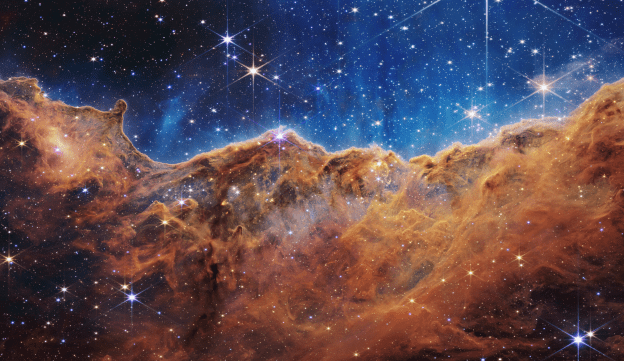
This weekend I went to see an IMAX film called Deep Sky about the James Webb Space Telescope (JWST) which launched from the European Space Agency’s spaceport in French Guiana on Christmas Day 2021 and six months later began transmitting images back to Earth of the earliest moments in the Universe’s long story. There are glimpses of light, whisps of dust, and clouds of matter that were unknown to humanity until just now yet predate our evolution by billions of years. We can now see that, well beyond what our own evolved eyes can see. Yet is our nature evolved only to perceive certain things with our senses, only those things we can immediately touch, smell, taste, hear, and see? Knowledge could be a sense of its own, one which perceives further using supplements from technology and reliance on other people alike. Yet knowledge is what sorts through all the signals coming from our senses and, well, makes sense of them.
Yesterday afternoon on our drive back to Kansas City from seeing that film at the St. Louis Science Center I awoke in the front passenger seat of the family car to see a snowplow in the lane next to us. I watched as it drove past us and was at first startled by what I thought I saw, a man hanging onto the back of the plow moving at 70 mph (112.6 km/h) only to blink again and see that what I thought was a man hanging on for dear life was actually an assortment of things hanging down from over the rim of the back of the plow that holds the road salt, with a large box in the back near the middle that my sleepy brain mistook collectively for a person.
Knowledge could be a sense of its own yet unlike the others I can’t say if it contributes its own information to the assortment that is our understanding of the world around us. Everything enters our mind through our senses, I saw those images captured by the Webb Telescope just as I’ve heard, read, and seen retellings of the ancient myths of Prometheus and stories of Genesis time and again. In some ways then, the reflective pause that I experienced watching that shark two weeks ago was less a reaction to the shark itself and more a realization of my own human nature in contrast to the shark’s. I may be able to dream, and often do, of flying or floating distances without moving my arms or legs yet those visions remain encased in my mind, thoughts to return to in my sleep or in those quiet moments fit for daydreaming.
And yet those same thoughts are what propel us as a species forward. We supplement our human nature with those thoughts, and work through the questions they raise until we have solutions which can make our lives better. I have always lived with this understanding that human history is one of overall general progress, that our finest minds are always finding ways to improve the human experience, to raise humanity’s stars so that we can hold onto that dream, that belief which is fundamental to human nature that we can better ourselves and the lives of future generations.
We offer these thoughts and all their creations as our inheritance to posterity, that they may make of what we left unfinished something even more wondrous than what we and our forbearers aspired to.
 Wednesday Blog by Seán Thomas Kane