
Tag Archives: The Exodus: How it Happened and Why it Matters

On Conversion

This week, I spoke with a friend who converted to Catholicism as an adult about her conversion and how she relates to the Catholic Church as a whole.—Click here to support the Wednesday Blog: https://www.patreon.com/sthosdkane


This week, I spoke with a friend who converted to Catholicism as an adult about her conversion and how she relates to the Catholic Church as a whole.


The Catholic Church in 2025 stands at a crossroads in the shadow of our late Pope Francis when the world at large has fallen into so many new wars, conflicts, and when fearmongers are the loudest voices in so many countries and governments. It was striking then when Pope Leo XIV began his Urbi et Orbi address, his first public address as pontiff, last Thursday with the words “peace be with you.” To achieve that peace, one needs to allow one’s heart and soul to open to the possibility of peace and of dialogue with both our innermost selves and the world around us. Faith gives an avenue for this dialogue which has provided a moral foundation for generations. Biblical scholar Richard Elliott Friedman made the case in his book The Exodus: How It Happened and Why It Matters that the faith of Moses and the Hebrews evoked in Exodus was the first faith recorded which preached love for neighbor and love for oneself. It was the first time in human history that a religion sought to elevate humanity and dignify us as children of God made in the Image of God.

Kim Meyer

I’ve long considered this topic of conversion; in fact, I’ve often noticed how different the perceptions of our shared religion are between cradle Catholics like myself and converts to the Church. My own Catholicism is built on fifteen centuries of believers in my family going back to my distant early medieval Irish ancestors who in the fifth century surely noticed when St. Patrick made his pilgrimages up the holy mountain on the southern shore of Clew Bay, a mountain that towers over the townlands where my ancestors lived for thousands of years that now bears the saint’s name as Croagh Patrick. I asked my friend, Dr. Kim Meyer, if she could tell me more about her perceptions of her faith and our shared religion. A convert to Catholicism who grew up in a secular suburban Kansas City family with Lutheran and Methodist roots, Kim told me about how she found her faith through the most horrific experience of her life as a journalism student at Kansas State University reporting on the activities of a cult in Abeline, Kansas in 1977. Kim described it as “a really dark, dark time and my editors had people in the room with me when I was editing it because I was terrified. It was several months of terror.” After one particularly intense night of terror during her investigations in Abeline when she felt she “was terrified for my soul and I started praying to God, and my Mom had given me a penny of the 23rd Psalm on it, but I was so scared that I couldn’t remember the Lord’s Prayer so I kept rubbing this penny saying, ‘God, if you exist, save me until morning.’ It was really a horrible, horrible, terrifying experience. The next morning, I was still praying and the sun came up, and I realized that the sense of evil was no longer present.” Kim described how she went to several local religious leaders to tell them her story, including the cult leaders, but the only one who listened was the local Catholic priest at St. Andrew’s Parish in Abeline, Monsignor Alfred Wasinger.

This speaks to something that I’ve known, and that has led to little conversions of my own often from one plan or ambition to another. We are drawn to people who appreciate our humanity and who listen to us as this priest listened to Kim at the darkest moment in her life. That’s something that Pope Leo was famous for before his papacy; in all the reports of his life he’s often referred to as a good listener. This draw to a faith that listens to its people is what drew Kim to the Jesuits. More than just thinking of herself as a convert, Kim said she doesn’t “think of myself as a Catholic first. There’s still so much tradition and so much politicking around Catholicism that I find deeply offensive, but the Jesuits’ critical thinking, open spirit, missionary focus, all of that, and it’s the same theology for both, and it’s all about how we practice, and I’m not into the way how some sects of Catholicism practice.” For her, the Jesuits are “really trying to walk the Way of Jesus. It’s literally the Way of Jesus. Some people want to walk the way of Paul or the way of the most recent Pope, but they forget it’s really all about Jesus.” 

Converts like Kim have more of an opportunity to find “the beauty of questioning and the opportunity to discover their faith.” This questioning has marked my faith for most of my life, yet even more so in my adult years as I moved on from my Jesuit undergraduate university and onto graduate and doctoral programs outside of the Church. Whereas my faith is so deeply rooted in millennia old traditions and inheritances embodied in the last century by the various neighborhood parishes that my family called home in Chicago and Kansas City, Kim’s faith seems to fly above that tradition, seeking a closer connection with God through the mysteries of Catholicism and our belief that God opens us to a wider world of possibilities. In Kim’s words, “once I came to believe that God loves me and God is in every person, and I really believed in it that the world wasn’t really the same.” It is notable that of those old neighborhood parish churches, Kim and my parish, St. Francis Xavier in Kansas City is the only one left open. Unlike the others it has adapted with the changing demographics of its home neighborhood, which a few generations ago was largely Irish American, and now caters to Kansas City Catholics seeking Ignatian spirituality. St. Francis was one of the fastest growing parishes in Kansas City during the pandemic, in large part because of its Jesuit affiliation. However, due to a variety of factors the Jesuits left the parish at the end of July 2024 and transferred its leadership to the Diocese of Kansas City-St. Joseph, leading to an uncertain moment for a parish that stands out in this city for its openness and Ignatian spirituality. Kim noted that “Last year we didn’t know what the transition away from being Jesuit would look like, and our community is just as Ignatian as it has ever been.”

Because of this, Kim said she feels more closely connected to the Jesuits than to the Church as a whole. I’ve been struck in the two years since I met Kim how much her outward approach to others reflects this deep well of her faith. I felt in our conversation that we could relate in that depth, though I do not outwardly project my own beliefs in the same way she does, preferring to take a rational approach to life. Yet that rationality has its limits, as I’ve written here in the Wednesday Blog before. Faith and a conversion to accepting the possibility of the improbable is necessary to be open to new and unknown things both in the furthest fringes of our knowledge and at home in our understandings of ourselves. Like anything, there is a blind spot closest to home and that self-reflection and introspection is necessary to live a full and enriching life.

With the election of Pope Leo, the Cardinals embraced this period of self-reflection for the Church in full. They chose a pope who embraced synodality in his Urbi et Orbi address and who said he would continue the efforts of Pope Francis all while seeking to build bridges between the increasingly disparate factions and camps in the Church. The Pope’s humanity shows in his imperfections, in his poor history of dealing with the sex abuse scandals, something familiar to many of us in our own bishops and local leadership. Kim’s approach to life, her mentality born from her Catholic faith has led her to think “’what would Jesus do?’ and that means looking at each person and trying to see God inside of them, and that’s each person.” This stands in contrast to “‘what is the right thing,’ which has less clarity and less consistency in the secular world. Because if you think right vs. not right, where you draw that line is a lot more subjective in the secular world.” The greatest way toward conversion, she said, is prayer. “Pray with others, go find somebody you trust as a spiritual mentor. Stretch yourself and pray. Find ways that you praise that you never imagined.” Both of us pray the Ignatian Examen in our own ways, as Kim said “Prayer changes over time. What I do in my prayer time changes from one season to the next.”Just as May brought us a new Pope and each passing day new things to worry about in politics, the economy, and in ordinary life, so too this conversation told me that the place where one’s spirit is resting will change with time. It may float along in the river of our life, following the currents where they take it, yet it will be there for an opportunity to pray to announce itself. In the wider world we hear messages of people seeking connection with something greater than themselves; it’s a part of our social nature. We do these things to find connection with other people and to grow in those connections as we were born to do. These are all conversions, all transformations of ourselves which can reawaken something dormant that will lead to us living fuller and richer lives. A conversion can reawaken the self to their spirit and spiritual need for connection to something greater than themselves through God as love.

The Divine Essence

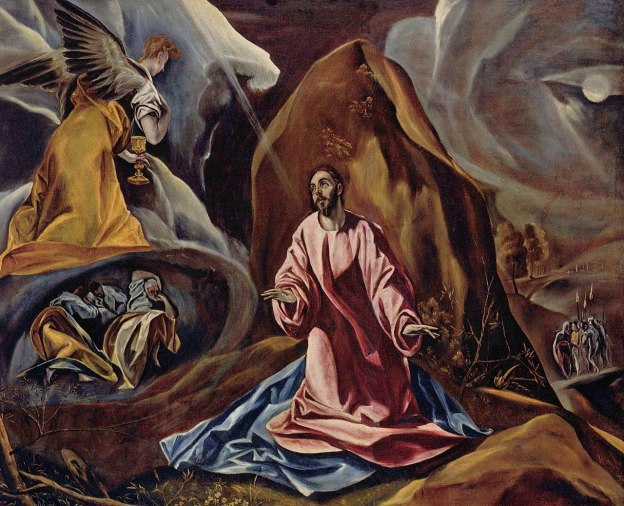
Art: Studio of El Greco, “Agony in the Garden,” (1590) oil on canvas, 102 x 131 cm, Toledo Art Museum, Toledo, Ohio, USA, ⁠National Gallery, London⁠.

This week, a meditation on the Name of God.—Art: Studio of El Greco, "Agony in the Garden," (1590) oil on canvas, 102 x 131 cm, Toledo Art Museum, Toledo, Ohio, USA, National Gallery, London.Click here to support the Wednesday Blog: https://www.patreon.com/sthosdkane


This week, a meditation on the Name of God.


At the start of Advent last November, I picked up a little blue book after Mass as an Advent lectio divina guide for the coming weeks. I’d done this several times before in Advent and Lent, the two holy seasons of preparation in Christianity, yet this time I actually read that little blue book and kept up with it each day through Christmas. By the end of it I was looking forward to being done with this one part of my nightly routine before bed, the time when I was able to sit and read the daily reflection. I wasn’t sure then if I would pick up the little black book when it appeared at my parish the weekend before Ash Wednesday, and yet when it was there, I took a copy home.

This year’s little black book offers reflections on St. John’s Gospel, the most spiritual in focus of the evangelists. Several aspects of the readings have caught my attention, usually out of a curiosity concerning the grammar or translation of the biblical text. On one early day, the reflection was on John’s recounting of the arrest of Jesus in the Garden of Gethsemane. This recounting contradicts the three other Gospels in that Jesus asks the soldiers to let his disciples go, rather than the disciples taking flight in fear of the soldiers. It is more self-sacrificial, following the prophetic undertones of the Gospel overall. Not only does this vital moment of arrest in the Passion narrative take place in a Garden, akin to the Garden of Eden where humanity’s fall into sin occurred, but it is also here where Jesus revealed Himself as God the Son. Quoting here from the New American Bible:

[4] Jesus, knowing everything that was going to happen to him, went out and said to them, “Whom are you looking for?”[5] They said to him, “Jesus the Nazorean.” He said to them, “I AM.” Judas his betrayer was also there with them. [6] When he said to them, “I AM,” they turned away and fell to the ground. [7] So he again asked them, “Whom are you looking for?” They said, “Jesus the Nazorean.” [8] Jesus answered, “I told you that I AM. So if you are looking for me, let these men go.”

(John 18: 4–8)

In this passage the omniscience of God is first revealed, followed by the humility of God the Son as merely one among them, “the Nazorean.” Here though the omnipotence of God as the Divine Essence, existence in its purest form as “I AM,”[1] before showing such mercy toward the soldiers at making it clear he was in their power and would surrender to them yet asking for mercy from them for his friends, his disciples who not being omniscient were very much afraid as any of us would be. It is the third part of this passage, the identification of God that I wish to focus on here.

The Name of God is known as the Tetragrammaton after the four Hebrew letters which comprise that Name. These are the four holiest letter combinations out there. The Name of God is too sacred to write in Judaism, and considering Hebrew is an abjad lacking written vowels it’s not entirely certain how this Name was originally pronounced before that prohibition.[2] This prohibition extends in some traditions to not even writing the word God, as it is capitalized as the common Name of God in regular parlance. I grew up capitalizing this word in reference to the Abrahamic God, who I do believe is the Creator and One True God, I don’t just recite the Nicene Creed every week at Mass to do it; and yes, this capitalization is in line with the tradition of capitalizing proper nouns in all of the languages I speak and write. Yet I’ve never really thought of God as a name, rather it’s a title in the same way that Christ is a title and Jesus the name. I’ve had some students over the years who won’t write God out, instead writing “G-d” out of respect for this title, which I think is fair. For the sake of my readers, I won’t include the Hebrew Tetragrammaton here, you can look it up on your own.

What I’m more interested in is how the Tetragrammaton was translated from Biblical Hebrew into the other languages in which I’ve read the Bible. There are really four such languages: English, Latin, Koine Greek, and Irish. 

I was first introduced to the Bible and to my Catholic faith through English, I was born in the second generation after the vernacular Mass was allowed largely replacing the older Tridentine Mass said in Latin. The New American Bible (NAB) which I read from a few paragraphs back is the translation that I grew up with, and the one which I use in all aspects of my life. It was also developed during Vatican II as the approved English biblical translation for the United States. In Ireland, Australia, and New Zealand the Jerusalem Bible (JB) is the translation used, while in Great Britain the English Standard Version – Catholic Edition (ESV-CE) is used. 

I was introduced to the Latin Vulgate and Greek New Testament and Septuagint in high school and college and today I own a copy of the Greek New Testament published by the German Bible Society (Deutsche Bibelgesellschaft). Both are key sources for the English translations that I grew up with, alongside the Hebrew Tanakh itself. I chose St. James Academy for my high school years largely because they offered Latin, and while the fact that Latin remains the official language of the Roman Catholic Church, I was more interested in reading classical Roman literature. Likewise, the first of the two Ancient Greek classes I’ve taken was at St. James under the direction of our Latin teacher Bob Weinstein. That class was focused on Classical Attic Greek from democratic Athens of the 5th century BCE. In college at Rockhurst I made the 5 century leap forward to the Koine Greek of the 1st century CE when I studied Biblical Greek under Professor Daniel Stramara. I wasn’t the best student, yet I was fascinated by that class and would love someday to study Latin and Greek more fully. It would certainly be a benefit to my research.

Finally, while I’ve known of the Bíobla Naofa, the approved Irish translation of the Bible, for a long while, I only bought one in the last year. Irish is an odd language for me that feels untouched by the embrace of vernacular piety for me as by the time the Vatican II Council occurred between 1962 and 1965 my family largely spoke English, though the last generation of native Irish speakers were still around. For me then the Bíobla Naofa is as much a study tool as it is an aspiration of piety. I keep mine on my desk the easier to reference when I’m curious how a particular word or phrase is translated into Irish. The Bible is a good source if you want to see how common biblical names are translated from one language to another. It’s how I know that the Irish biblical tradition predates the Anglo-Norman invasion of 1169 because St. John is called Naomh Eoin, not Naomh Seán. My name is an Irish rendering of the French name Jean, while Eoin is an older rendering of the Latin and Greek name Ioannes, which is also the parent of the French Jean. The Evangelist is thus known by the same name today as the Celtic monks knew him in the early medieval period when the Irish cultural influence on Europe was at its peak.

Returning then to the Tetragrammaton, when I read this passage from St. John’s Gospel that evening, I was curious to see how it was translated from the original Koine Greek into Latin and Irish. Translation is a funny business, it’s not ever as simple as going word-by-word and replacing the original language’s text with the target language’s equivalent. There’s far more nuance to each language and its dialects to allow for this. I’ve learned this in my efforts to translate André Thevet’s 1557 book Les Singularitez de la France Antarctique from Middle French into Modern English. The last English translation was written in 1568 and is thus in Early Modern English from the generation just before William Shakespeare. Thanks to the bard Early Modern English is still fairly familiar to many of us, myself included, yet it is still different from how this language sounds and is written today. To make the first draft of my translation I brought together a composite of the 1558 Antwerp French edition, the 1568 London translation, the 1878 Paris French edition, and the 1944 and 1978 Brazilian Portuguese translations to create an accurate and modern English translation fitting for the 21stcentury.[3] All this is to say that translation is far more complicated than just taking the original text and interpreting each word on its own. The words work together within the ecosystem of the phrase.

I was curious then to see if the English “I AM THAT AM” was perhaps clunkier than the Greek. This full phrase is familiar to me especially from the Burning Bush story in the Book of Exodus (Ch. 3), in which Moses meets God in a burning bush. This scene is beautifully retold in the 1998 animated film The Prince of Egypt which is a classic from my childhood. The four words we have mirror the four letters of the Tetragrammaton in the original Hebrew, yet these four words are reduced to two in Greek. In John’s telling Jesus’s response “I AM,” is written in the original Koine Greek as “ἐγώ εἰμι,” (John 18:5) with the full phrase in the Septuagint’s retelling of the burning bush story written as “ἐγώ εἰμι ὁ ὤν,” (Exodus 3:14) or I am the Being. I feel this final word ὤν is essential here. It is the present active participle of the Greek copular verb εἰμι. In a sense, it is saying that God is existence itself, the essence behind the Cosmos and all Reality itself. One translation of ὤν in the Liddell, Scott, Jones Ancient Greek Lexicon (LSJ) is the English word fact.

This is adopted into Latin somewhat, as the Vulgate is drawn so much from the Greek Bible, where the Name of God is rendered as “Ego sum qui sum,” whence we received the English “I AM THAT AM.” Yet because Latin doesn’t have a similar present active participle for the copular verb sum, the reuse of the indicative present active form sum is necessary. The English present participle of be is being, yet replacing the second am in the name with being doesn’t work grammatically in this language.

I was pleasantly surprised to see the Irish translation of this phrase for how simple it is. The Greek ἐγώ εἰμιwas translated as “Is mise é,” a phrase which I’d usually translate back into English as “I am he.” On an immediate level this is profound in its everyday character. This is something I’d say when someone asks “An bhfuil tú Seán?” Yet on a deeper level it speaks to Irish’s ability to express emphasis in a manner unfamiliar to English. The first person pronoun in Irish is , this is the translation of both the English I and me. Yet the -seending tacked onto it expresses extra emphasis on the pronoun. The closest we can get in English, or at least in my American English, to this is saying “me too,” or perhaps capitalizing ME and adding an exclamation mark behind it (or several if you’re one of those people who are overly fond of exclamatory sentences). So, God’s existence is expressed in Irish in the emphatic, as something to be shouted from the rooftops in wonder all while reflecting the priority Irish gives to all of us to be worthy of emphasizing no matter how mighty or small we may be. The Irish translation of the full Name from Exodus is “Is mé an te atá ann,” which is closer in meaning to the Greek ἐγώ εἰμι ὁ ὤν, translating into English as “I am the one who is.” Again, this speaks to the ability of Irish to interpret the existence of God as the essence of reality.

In my undergraduate years when I started to think deeply about the Tetragrammaton & the Name of God, I settled on the idea that the best way to describe God without limiting God in human terms was to focus on God as the essence of life. In this way, I began to refer to God in my theological studies as the Divine Essence, in an attempt to better reflect this truth that God is omniscient, omnipotent, and omnipresent. The Divine Essence rises above any limitations of human terminology or senses of gender that weigh down even the word God, which is traditionally masculine in English and its fellow Indo-European languages. I’d rather see God in God’s fullness existing beyond gender, the better “to see the Face of God,” to quote Jean Valjean’s last words in the musical adaptation of Victor Hugo’s Les Misérables.I’ve had trouble with this thinking in the last few years, because how should I begin to approach God in these terms in prayer? How can I seek any sort of personal connection to God when I’ve devoted such effort to seek to understand God in such abstract terms by stretching language as far as it will go without breaking? This Lent that is where I stand, and where I am uncertain. Looking at the story of the Garden of Gethsemane told in John’s Gospel in this year’s little black book, I noticed that while Jesus revealed His true Nature, he also identified himself as mere “Jesus the Nazorean,” a human and God all the same. That human nature is approachable, personable. I remember how in the Ignatian Examen one is called to think of one sitting with Jesus while one reflects on their day. This is a starting point, and a good point of departure for reflection this Lent.


[1] In my Catholic tradition we capitalize this phrase as the name of God.

[2] See Richard Elliott Friedman, The Exodus: How it Happened and Why it Matters, (New York: HarperOne, 2017) for more on this. I really enjoyed reading this book a year ago.

[3] NB: I used a 2018 reprint of the 1944 Brazilian Portuguese translation.